License Plate Recognition Cameras: Why a 4K Camera Still Cannot Read a Plate
Affiliate Disclosure: This article contains affiliate links. If you buy through these links, we may earn a commission at no extra cost to you. Our editorial opinions are our own and are not influenced by affiliate relationships. Read our full disclosure policy →
Contents
Quick Answer
Resolution is the wrong spec. A camera reads a plate when enough pixels land across the plate itself, and Axis Communications — which builds dedicated plate cameras for a living — recommends 2 MP or less when the recognition software runs on the camera, because higher resolution slows the analysis down. What decides the outcome is how tightly the lens is zoomed onto one lane, how short the shutter time is, how shallow the angle is, and how the camera handles infrared bouncing off a retroreflective plate. No single camera can watch your whole driveway and read plates, because those jobs need opposite settings.
The White Smear: What Actually Happened to Your Footage
The moment that sends people shopping for a license plate camera is always the same one. Something happened in the driveway — a clipped mirror, a package taken, a car that circled the block twice — and you scrub back through the footage expecting the plate to be there. The vehicle is there. The color is there. The plate is a pale smear, or at night, a solid white rectangle.
The instinct is to shop for more megapixels, the one number every listing puts in its title. Swann’s own support documentation answers that directly, and answers it “not always”: higher resolution captures more detail, but it is only one part of a readable plate, and shutter speed, exposure, bitrate, distance and angle all decide whether the characters survive.
So this is not a lineup of four plate cameras. It is why the camera you own failed, which specs actually matter, and what a setup that genuinely reads plates looks like at a house. There is a short buying section at the end, with the honest caveats attached.
Pixel Density Is the Spec, Not Megapixels
The spec that replaces resolution is pixel density: not how many pixels the sensor has, but how many land across the width of the plate. Full contrast between black characters and white background needs at least two pixels across the smallest structure being resolved, which works out to roughly 74 pixels across a full European plate as an absolute minimum, and most recognition software wants 100 to 150. Axis’s own plate reading application asks for at least 130 pixels on a single-row plate.
Two things matter for a US reader. Those figures came from European plates, which are wider than ours, and Axis notes smaller plates may need a higher resolution to hit the same count — a standard American passenger plate is 6 inches by 12 inches, a dimension most states write into statute. And Axis recommends 2 MP or less when recognition runs on the camera, because a high-resolution image takes longer to analyze.
The Four Numbers That Decide It
130 px
Minimum plate width Axis’s plate reading app asks for on a single-row plate
2 MP
Resolution Axis recommends when recognition runs on the camera itself
Under 30°
Total angle between camera and the direction the vehicle travels [1, 2]
6 x 12 in
Standard US passenger plate, written into state vehicle code
Not one of these four is the number printed on the front of a camera box.
Run the arithmetic on your own driveway. Take a 4 MP camera, which images 2,688 pixels across the frame, and point it the way most people do: wide, covering perhaps 60 feet of yard and driveway. That frame is 720 inches across, so you get about 3.7 pixels per inch, and a 12-inch plate lands on roughly 45 pixels — a third of what Axis’s application asks for. Digital zoom afterward cannot invent detail that was never recorded.
Zoom that same camera onto a single 10-foot lane and the scene is 120 inches across: about 22 pixels per inch, and a plate on roughly 270 pixels. Same sensor, same megapixels. Only the lens coverage changed. That is why buying a higher-resolution camera does not fix this by itself.
Shutter Speed: The Setting Nobody Puts on the Box
Pixel density gets you a plate big enough to read. Shutter speed keeps it from smearing. A typical security camera defaults to a maximum shutter time around 1/30 of a second, chosen to gather light rather than freeze motion, and Axis is blunt that a vehicle crossing the frame at that setting will blur.
The detail that changes where you mount the camera is that blur depends on the angle, not just the speed. A car approaching head on does not travel sideways in the frame, it just grows, an effect Axis describes as often negligible. Move the camera to one side and the shutter time you can get away with collapses:
| Angle between camera and travel direction | Vehicle at about 19 mph | Vehicle at about 31 mph |
|---|
| 5° (almost head on) | 19.3 ms (about 1/52 s) | 11.6 ms (about 1/86 s) |
| 10° | 9.7 ms (about 1/103 s) | 5.8 ms (about 1/172 s) |
| 15° | 6.5 ms (about 1/154 s) | 3.9 ms (about 1/256 s) |
| 20° | 4.9 ms (about 1/204 s) | 2.9 ms (about 1/345 s) |
| 30° (the outer limit) | 3.4 ms (about 1/294 s) | 2.0 ms (about 1/500 s) |
Axis’s own reading of that table is the payoff: moving a camera from a 20-degree angle to 5 degrees allows roughly four times the shutter time, which doubles the infrared range at night. Mounting position is worth more than any spec upgrade you can pay for.
There is a cost. Short shutter times collect less light, and Axis states that a general-purpose camera used for plate capture loses about half its specified infrared reach at a 1/500 second shutter, because that figure assumes the default 1/30 second setting and a non-reflective subject. Its advertised night range stops applying the moment you configure it for plates.
Why the Plate Glows White at Night
The white rectangle is not a malfunction. It is the plate doing what the law requires. Montana’s plate statute, like most states’, requires plates to be treated with a reflectorized background material so headlights make them readable. Reolink explains the consequence: retroreflective coatings send light back toward its source instead of scattering it, so the plate returns your camera’s own infrared straight down the lens and burns out.
Reolink’s phrasing is worth repeating for anyone who suspects a defective camera: this is normal, and every camera does it under night vision with built-in infrared on. Swann says the same. Buying a different consumer camera does not escape it — see how camera night vision works.
Two Real Fixes, and What Each One Costs You
Turn the infrared off, light the lane instead
- Reolink’s own recommendation: put a supplementary white light near the camera and force the camera to stay in day mode
- Gives you a color image and readable characters at night
- Costs you covertness, and needs power where the light goes
Keep infrared, but tame the exposure
- Axis caps maximum gain so the plate stops blowing out, suggesting between 9 dB and 21 dB with built-in infrared
- Axis also switches wide dynamic range off for plate capture, since it can introduce motion artifacts on moving vehicles
- External infrared must sit close to the camera, since a retroreflective plate returns light to wherever it came from
- The surroundings go darker, so the image is worse for everything except the plate
Both columns share one thing: each degrades the camera at every other job it was doing. Plate reading is not a feature you switch on. It is a separate install.
Angle and Distance Beat Any Sensor You Can Buy
Axis’s headline installation rule is one number: keep the total angle between camera and direction of travel below 30 degrees, so plates are viewed close to head on. Its plate reading application repeats the limit — no more than 30 degrees in any direction, and the plate tilted no more than 5 degrees horizontally in frame. Mount above headlight height, and away from streetlights that confuse auto-exposure.
Distance is the other half. Vehicles must stay in frame long enough for several usable frames, so Axis publishes a minimum capture distance that scales with speed: about 13 feet at roughly 6 mph, 23 feet at 19 mph, and 36 feet at 31 mph, assuming a detection time of two tenths of a second. Its plate verifier documentation gives roughly 6.6 to 23 feet for vehicle access control and 23 to 65 feet for slow free-flowing traffic. A car turning into a driveway sits at the low end of that range, which is good news.
Height follows from distance rather than from where the wiring happens to be: for access control Axis recommends a mounting height of about half the distance between vehicle and camera. Capture a plate at 15 feet and the camera wants to sit near 7 to 8 feet up — a different decision from the one in our room-by-room placement guide, where height is chosen to make faces visible.
| Capture distance | Horizontal field of view Axis recommends for one lane | What that means in practice |
|---|
| About 16 ft | 33° to 44° | A modest zoom, the widest any row here allows |
| About 33 ft | 17° to 23° | Clearly telephoto; a fixed wide lens cannot get close |
| About 66 ft | 9° to 11° | A long lens aimed down a driveway like a rifle sight |
| About 98 ft | 6° to 8° | Commercial territory: long drives, business gates |
That table is the whole argument in one place. A general-purpose outdoor camera ships with a fixed wide-angle lens precisely so it covers as much of a property as possible, the exact opposite of what every row asks for. Optical zoom is not a luxury on a plate camera. It is the mechanism.
Why One Camera Cannot Do Both Jobs
Put those sections together and the conflict is not a matter of degree. Every setting that makes a plate readable makes the rest of the scene worse.
 The overview camera and the plate lane camera are looking at different things on purpose. Distances and the 30-degree angle limit follow Axis’s published guidance [1, 2].
The Same Sensor, Asked for Two Opposite Things
What the overview camera needs
- The widest practical view, so nothing happens off camera
- Wide dynamic range on, to hold shadow and bright sky at once
- A longer shutter, so faces stay visible in low light
- Infrared at full strength across the whole scene
What the plate lane camera needs
- A narrow view zoomed onto one vehicle width
- Wide dynamic range off, since it can smear moving vehicles
- A short shutter locked in, trading brightness for sharp characters
- Gain capped so the retroreflective plate does not blow out
This is also where battery cameras leave the conversation, which matters because they are the cameras most people own. Reolink advises directly against using its battery models for plate reading: fixed lens, and the motion sensor needs roughly 0.8 to 1 second to wake the camera, by which time a moving car has gone past. If your coverage is battery-based, our driveway camera guide is the better place to start.
What a Realistic Two-Camera Setup Looks Like
A home does not need a highway-grade installation. Vehicles entering a driveway are already doing the most helpful thing they can, which is slowing down — and Swann makes the same point, that a camera where vehicles slow is far likelier to capture a readable plate than one watching a wide lot from a distance.
Five Steps, in the Order That Actually Matters
1
Find the choke point
The spot every vehicle must pass, slowly: the gate, the apron, the last feet before the garage. Everything else follows from it.
2
Set distance and height
Aim for the 13 to 23 foot capture band Axis gives for access control, with the camera roughly half that distance in height [1, 2].
3
Get the angle under 30 degrees
As close to head on as the property allows, with the plate level in frame within about 5 degrees [1, 2].
4
Zoom to one lane, not the yard
Fill the frame with one vehicle width. If you can see your landscaping, it is zoomed too far out.
5
Fix the exposure last
Cap the shutter, cap the gain, switch wide dynamic range off, and choose between infrared and a white light [1, 3].
The overview camera is a separate install with separate settings.
For the plate lane, a wired camera is close to mandatory: continuous power for a camera that never sleeps, and a bitrate high enough that fine characters survive compression — Swann lists bitrate among the factors deciding readability. Our guide to Power over Ethernet cameras covers the wiring, and where your footage should live covers the recorder, because a plate you cannot find later is a plate you did not capture. A driveway alarm adds the arrival alert to the same layout.
Recognition Is Not the Same Thing as Capture
Everything so far has been capture: producing an image in which the characters are legible. Recognition is the separate second step, where software turns those characters into text you can search or match against a list. Axis describes the split cleanly — the software runs either on the camera, keeping bandwidth low, or on a remote server with more power but every stream shipped somewhere. Its blunt line is the one to remember: no algorithm reads a plate from an image where the plate is not clearly visible.
Manufacturer accuracy claims here are confident. Anpviz publishes a capture rate above 96 percent and a recognition rate above 96 percent for its 5X zoom plate camera running recognition on the edge, and above 98 percent capture for its longer 8-32mm model. Those are the manufacturer’s own figures under its own conditions, not independent tests, and they assume the installation guidance above has been followed.
Be clear-eyed about what recognition gives you. The Electronic Frontier Foundation’s work on automated plate readers describes systems that capture every plate coming into view, not only the ones you care about, and store them with time and location. Point one at your driveway and you have built a small version of that: a log of your neighbors’ cars and anyone who turns around in your drive. The EFF also documents that these systems misread plates, citing a 2009 case in which a driver was stopped at gunpoint after a plate reader misidentified her vehicle. Treat an automated read as a lead to verify against the image, never as a fact.
So decide your retention window deliberately rather than letting the recorder decide it — our guide to how long cameras keep footage covers the tradeoff — and check what you can legally record before aiming a zoomed camera at a public street.
The Short, Honest Buying Section
Here is the state of this category, stated plainly. No mainstream consumer brand sells a camera to homeowners designed to read plates. The products that genuinely do it on Amazon are commercial bullet cameras from small manufacturers: motorized varifocal lenses, 4 MP sensors, Power over Ethernet, on-camera recognition with allowlists and blocklists [6, 7]. They carry review counts in the single digits, sometimes one, sometimes none. That is not a knock on the hardware — the category sells to installers, not households — but you are buying without the crowd-verification a doorbell camera would give you. The two below sit at opposite ends of the variable that matters most at a house: how far the camera sits from the plate.
Anpviz 4MP LPR PoE Camera (2.7-13.5mm) — for a short driveway or a gate
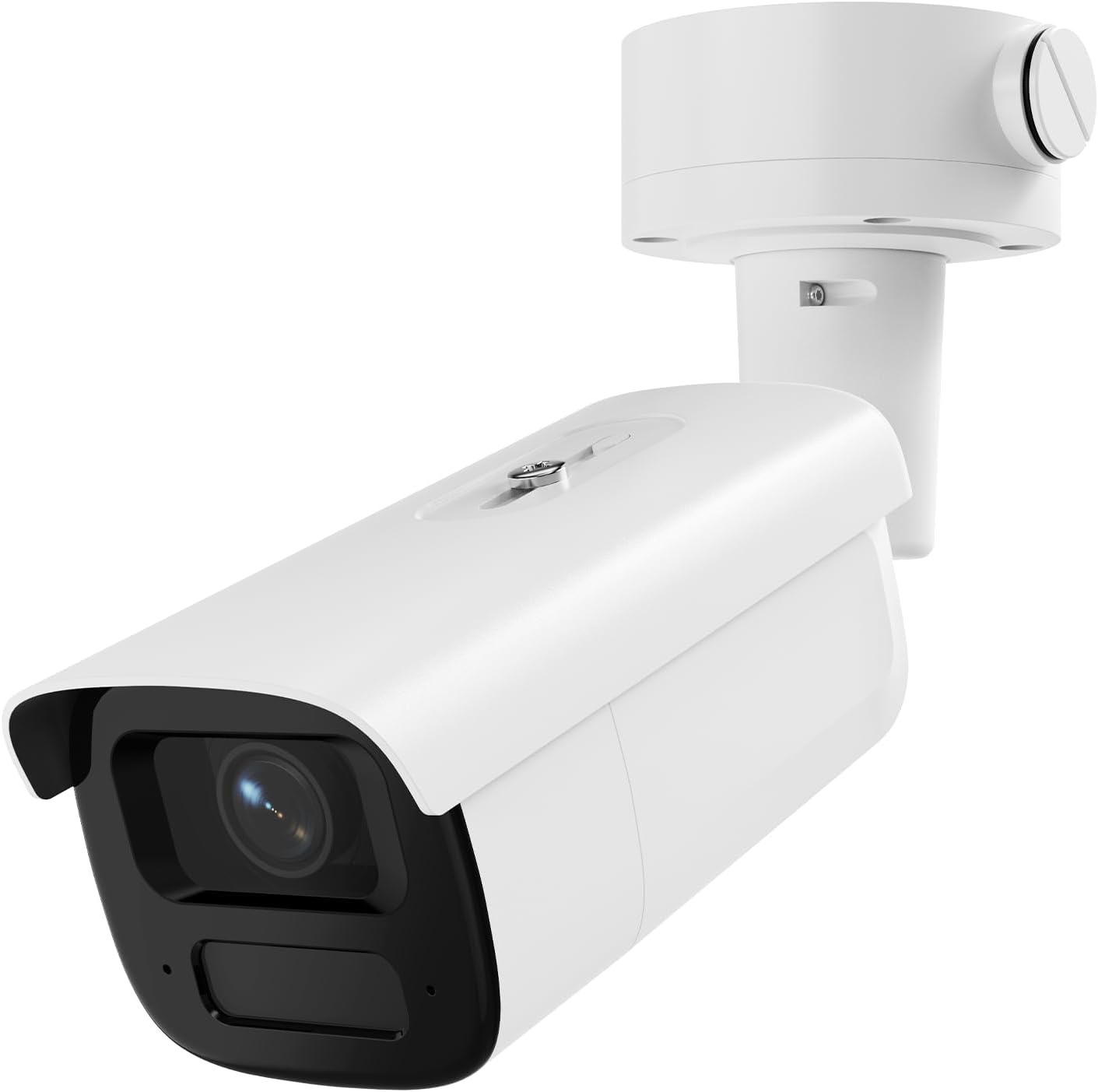
Key specs: 4MP at 30 fps bullet ANPR camera; 5X motorized zoom, 2.7-13.5mm; 1/1.3″ low-light sensor; 132 ft infrared range; 120 dB wide dynamic range; on-camera plate recognition with allowlist and blocklist; Power over Ethernet
This is the one to look at first for a normal residential driveway, gate or parking apron — anywhere the camera mounts within roughly 15 to 30 feet of where a vehicle stops. Anpviz publishes this model as a 4 MP camera at 30 frames per second with a 5X motorized zoom covering 2.7 to 13.5mm, 120 dB wide dynamic range, 132 feet of infrared range, and plate recognition running on the camera itself with allowlist and blocklist support. The short end of that zoom is what makes it a residential fit: at a 16-foot capture distance Axis calls for a 33 to 44 degree field of view on a single lane, which this lens reaches comfortably where a long-throw 8-32mm lens would be over-zoomed. The honest caveat is the evidence base — its Amazon listing currently carries a single customer review, and not a favorable one, so treat the published specs as the manufacturer’s claims.
✅ Pros
- The zoom range genuinely matches residential capture distances rather than commercial ones
- Recognition runs on the camera, so no video has to be shipped elsewhere to read a plate
- Power over Ethernet means continuous power and a stable link, which plate reading needs
❌ Cons
- A single customer review at the time of writing, and a negative one
- Commercial configuration: expect a web interface and manual exposure settings, not an app
- Not a substitute for an overview camera; useless at anything except its one lane
- Shortening the shutter for plates cuts the quoted infrared reach
Amcrest LPR Camera (8-32mm Optical Zoom) — for a long approach
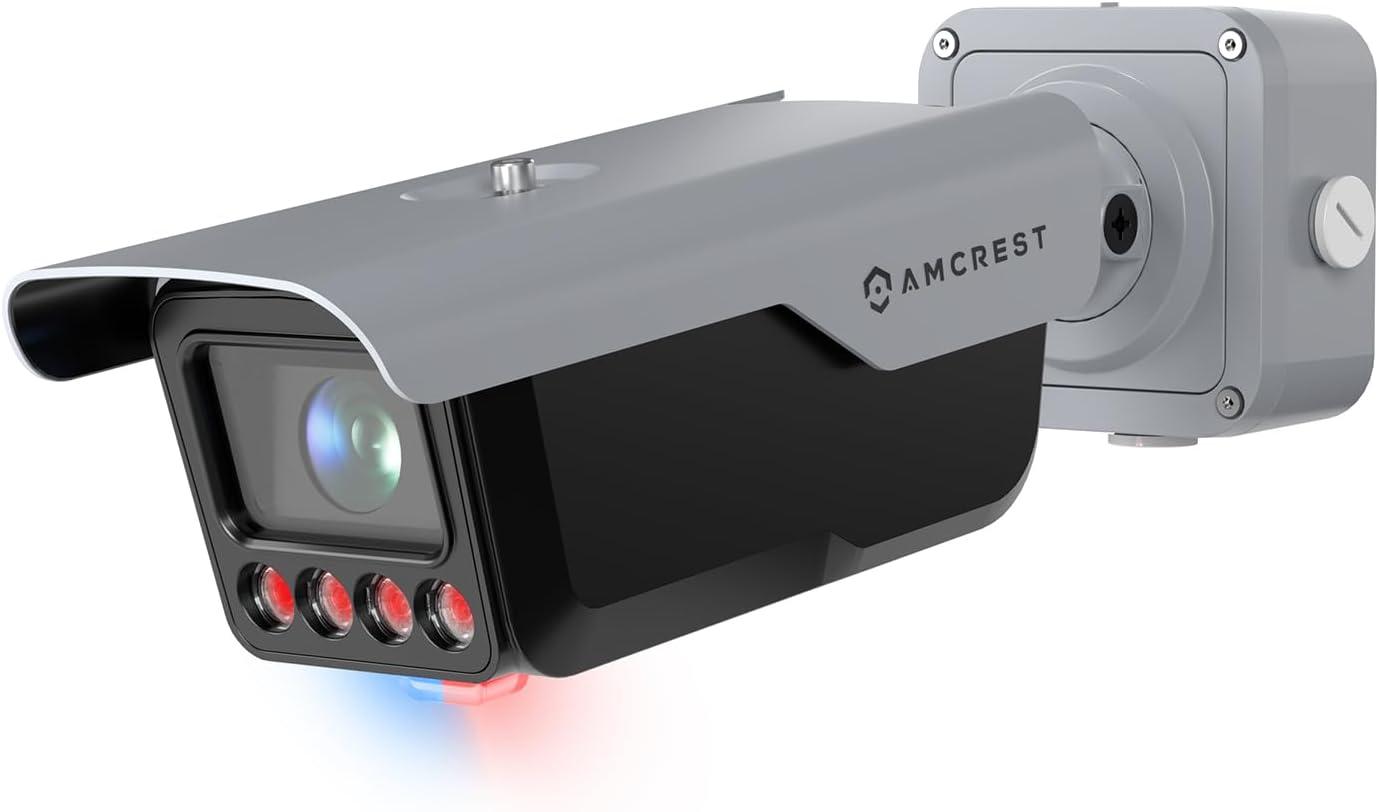
Key specs: 4MP at 30 fps Power over Ethernet bullet camera; 8-32mm optical zoom; 1/1.8″ low-light sensor; 98 ft infrared range; active deterrent siren and light; AI license plate recognition
The case for the longer 8-32mm lens is simple: if the only place you can mount a camera is well back from where vehicles pass — a long private drive, or a camera on the house watching a gate 60 or 80 feet away — the shorter lens cannot put enough pixels on the plate. Axis’s field of view table is the check: at roughly 66 feet a single lane needs 9 to 11 degrees, and at 98 feet, 6 to 8. Amcrest’s listing specifies 4 MP at 30 frames per second through an 8-32mm optical zoom on a 1/1.8-inch low-light sensor, with 98 feet of infrared range plus an active deterrent siren and light. Two honest flags. The review base is again in the single digits, and unlike the Anpviz option the average sits well below what a mainstream consumer camera carries. And that 98-foot infrared figure is in tension with the distances this lens exists for, since Axis warns a general camera’s rated reach drops by roughly half once the shutter is shortened. Plan on lighting the capture point. It also appears in our driveway camera roundup, for a different job.
✅ Pros
- The 8-32mm range is the right tool when the mounting point genuinely cannot move closer
- Larger 1/1.8-inch sensor gathers more light, which matters once the shutter is shortened
- Active deterrent siren and light give it a second function the Anpviz option lacks
- Power over Ethernet, so it fits the same wiring plan as the rest of a wired system
❌ Cons
- Single-digit review count with a below-average score — weak buyer evidence
- Over-zoomed for a short driveway, where it is the wrong choice rather than the premium one
- Rated infrared range will not survive the shutter settings plates require
- Long capture distances need more light, so budget for supplementary lighting [1, 3]
At a business the calculation changes, because whole multi-channel systems with plate recognition built into the recorder are sold for exactly that: see our business camera system guide and warehouse camera guide.
Final Recommendation
Do not buy anything yet. The first action costs nothing: walk the driveway and find the choke point, the spot every vehicle passes slowly. Then answer one question. Can you mount a camera within roughly 15 to 25 feet of it, at around half that distance in height, aimed close enough to head on that the total angle stays under 30 degrees [1, 2]? If not — the only power is at the wrong corner, or the drive curves so every car crosses the frame sideways — then no plate camera at any price fixes it, and the honest move is to spend the money on better overview coverage.
If the answer is yes, build one wide overview camera plus one dedicated plate lane camera, and put the optical zoom, short shutter and capped gain on the plate lane. For a suburban driveway with the camera 15 to 30 feet from the capture point, the short-zoom option is the Anpviz 4MP LPR PoE Camera (2.7-13.5mm), whose 2.7 to 13.5mm range matches those distances rather than commercial ones — bought with clear eyes about how little buyer feedback stands behind it. Choose the longer 8-32mm option only after confirming the camera cannot be mounted closer than about 50 feet, where that lens is over-zoomed rather than better.
There is also a third answer, right more often than this category admits: skip plate recognition. If you only want to know who came up the drive and what they did, a well-placed overview camera delivers that. Plate reading earns a dedicated camera when you have a specific, recurring reason to identify vehicles — a shared drive, a rural gate, a repeat problem you are documenting — not as a general upgrade.
SafeBode does not yet run an in-house product testing program. This guide is built from manufacturer specifications, official support documentation, current retail listings and verified buyer feedback rather than hands-on testing, and we say so plainly rather than implying testing we have not done.
Frequently Asked Questions
Can a 4K camera read a license plate?
Only if it is zoomed onto a narrow lane at a shallow angle with a short shutter time. Pointed wide across a whole driveway, a 4K camera puts far too few pixels across a 12-inch plate for the characters to resolve, and the extra resolution does not compensate.
How far away can a camera read a plate?
There is no fixed distance, because it depends on the lens. What is fixed is the pixel requirement: roughly 100 to 150 pixels across the plate’s width. A long motorized zoom can hit that at 60 or 80 feet; a fixed wide-angle camera may fail at 20.
Why is the plate pure white at night?
Plates are made with retroreflective material by law, so they send light straight back toward its source. Your camera’s infrared LEDs sit right beside the lens, so that light goes into the sensor and blows the plate out. Every camera does this. The fixes are capping the gain, or turning infrared off and lighting the capture point with a white light instead.
Will a battery-powered camera work for plates?
In practice, no. Battery cameras use fixed wide lenses and sleep between events, and the motion sensor needs close to a second to wake up. A vehicle rolling in has usually passed the useful part of the frame before recording starts.
Do I need special software, or does the camera do it?
Both exist. Cameras marketed as LPR or ANPR run recognition on the camera and output plate text directly. The alternative is sending video to a server or recorder that reads it. For a single residential lane, on-camera recognition is much simpler.
Is it legal to record license plates on my own property?
Recording your own driveway is generally straightforward, and plates in public view are not private the way a conversation is. What varies is how far your camera may point beyond your property, whether audio is involved, and what your state says about retaining and sharing the data. Check your own state’s rules first.
Can I use a plate camera as my only outdoor camera?
No, and this is the most common mistake. A camera configured for plate capture is zoomed to a strip a few feet wide, with a short shutter, capped gain and wide dynamic range off. It shows you a readable plate and almost nothing else.
Does weather ruin plate capture?
It shortens the usable range rather than switching it off. Rain, snow and fog cut visibility at longer capture distances, another argument for placing the camera as close to the capture point as the angle limit allows.
Should I change my existing camera’s settings instead of buying another one?
Try it first if your camera lets you set shutter and gain manually and has any optical zoom. Shorten the maximum shutter, cap the gain, switch wide dynamic range off and zoom in as far as the lens goes. If the lens is fixed, nothing you adjust fixes the pixel-density problem.
Sources
Show sources (8)
- [1] Axis Communications — white paper, “License plate capture,” December 2024, whitepapers.axis.com/en-us/license-plate-capture
- [2] Axis Communications — “AXIS License Plate Verifier” user manual, help.axis.com/en-us/axis-license-plate-verifier
- [3] Reolink Support — “Can’t See License Plate at Night,” support.reolink.com
- [4] Swann Support — “Why Is My Camera Not Reading License Plates Clearly,” support.swann.com
- [5] Montana Code Annotated 61-3-332, “Standard license plates,” mca.legmt.gov
- [6] Anpviz — product page, “4MP Automatic License Plate Recognition Camera with 5X Zoom” (IPC-B7340WD-5X-LPR), anpviz.com
- [7] Anpviz — product page, “4MP ANPR 8-32mm Varifocal Lens 4X Zoom Bullet Camera” (IPC-B7842WD-4X-LPR-32), anpviz.com
- [8] Electronic Frontier Foundation — “Automated License Plate Readers (ALPR),” Street-Level Surveillance, eff.org


