Best Driveway Security Cameras 2026: What It Takes to Actually Read a Plate
Affiliate Disclosure: This article contains affiliate links. If you buy through these links, we may earn a commission at no extra cost to you. Our editorial opinions are our own and are not influenced by affiliate relationships. Read our full disclosure policy →
Contents
Quick Answer
Most cameras sold for driveways will show you that a car arrived and will not let you read its plate. The specification that decides it is optical zoom, not megapixels — Reolink puts the practical limit for general cameras with strong zoom at roughly 15 to 50 feet, with dedicated hardware needed beyond that. For most homes the Jennov 4K PoE camera with 20x optical zoom is the right buy if you can run a network cable, and the solar 10x model if you cannot. If you genuinely need plate numbers for police reports, that is a specialist camera and a different budget.
The Plate Problem, Honestly
Driveways are the hardest thing a home camera is asked to do. The subject is far away, it moves, it arrives at night with headlights pointed at your lens, and the thing you most want to read is a small reflective rectangle. Three technical facts explain almost every disappointing driveway camera.
Pixels on the plate, not pixels on the sensor. Plate Recognizer’s guidance for automatic recognition is a design target of about 100 pixels across the width of the plate, with 120 to 150 adding margin. What puts pixels on a plate is how much of the frame the plate occupies — which is a function of distance and lens, not of the camera’s headline resolution. The same guide maps resolution to distance: 2MP is usually enough up to roughly 20 feet, 4MP for about 20 to 40 feet, 4 to 8MP from 40 to 70 feet, and 8MP or higher with optical zoom past that.
Shutter speed, not megapixels, is why plates smear. Reolink names motion blur as the most common reason a moving vehicle’s plate turns into a smear. Plate Recognizer gives working starting points — roughly 1/1000 to 1/2000 second in bright daylight, 1/500 to 1/1000 in overcast conditions, and 1/250 to 1/500 under street lighting with good infrared — and advises locking the shutter speed first to freeze motion, then fixing exposure with gain and lighting.
Night is a different problem entirely. License plates are retroreflective, so a camera’s own infrared bounces straight back and the plate can wash out to a white blur. The fix is not more infrared — Reolink suggests a separate fill light near the capture point instead, and testing the actual mounting spot after dark rather than assuming the daytime setup will translate.
The Numbers That Decide Whether You Get a Plate
~100 px
Plate width in pixels that recognition software needs as a design target
15–50 ft
Realistic plate-reading range for a general camera with strong zoom
1/500 s
Shutter to freeze a moving vehicle in ordinary daylight
4–5MP
Resolution Reolink calls the practical sweet spot for driveways
Optical zoom is what puts pixels on the plate. Digital zoom enlarges what the sensor already captured and adds nothing.
Where You Mount It Decides Everything
A modest camera in the right position beats an expensive one in the wrong one, and driveways punish bad placement more than any other position on a house.
Five Placement Rules for a Driveway Camera
1
Shoot across, not down the drive
A camera facing straight down a driveway sees headlights. One angled across the approach sees the vehicle and its plate.
2
Get closer to the capture point
Distance is the single biggest variable. Mounting on the garage rather than the house can halve it.
3
Add light where you want detail
A separate fill light beats more infrared for plates, which reflect IR straight back.
4
Test after dark, on site
Reolink’s advice exactly: check the real mounting spot at night before assuming daytime results carry over.
5
Keep a second wide camera
A zoomed camera watching the plate line sees nothing else. Pair it with a wide view.
Seattle Police recommend motion sensor lighting directed specifically at entry points and vulnerable areas, with landscaping trimmed so the approach stays visible.
That last point is worth expanding. A camera aimed tightly enough to read a plate has a narrow field of view, which means it is not covering the rest of the property while it does that job. The practical setup is two cameras: a wide one showing what happened, and a zoomed one covering the point vehicles pass. Our camera placement walkthrough covers the rest of the property, and motion sensor lighting covers the fill-light half of the problem.
Jennov 4K PoE PTZ with 20x Optical Zoom — best for a long driveway
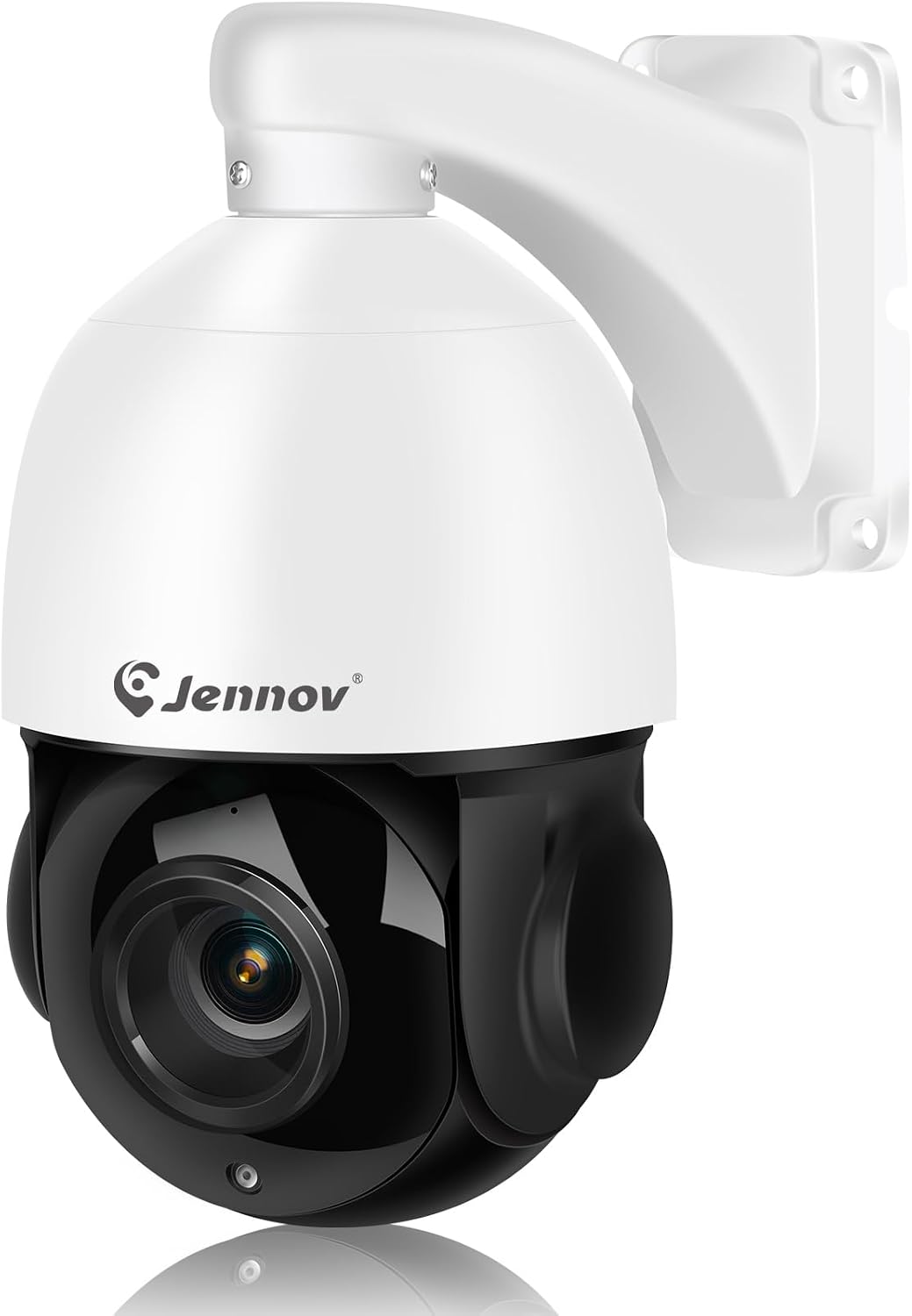
Key specs: 4K 8MP Power over Ethernet pan-tilt-zoom camera; 20x optical zoom; 360-degree pan and 90-degree tilt; 320-foot infrared night vision; auto tracking; continuous recording; works with an ONVIF PoE NVR
This is the sensible answer for a driveway of any real length. Twenty-times optical zoom is the specification that matters — it puts pixels on a distant subject rather than enlarging a blurry one — and it comes with 4K resolution, 360-degree pan, 90-degree tilt, auto tracking and 320 feet of infrared. Power over Ethernet means one cable carries power and video, so nothing depends on Wi-Fi reaching the end of the drive, and it records continuously rather than in clips. Read the compatibility line before ordering, because it is the catch: this camera is listed as working only with an ONVIF PoE NVR, so it is a component of a recorder-based system rather than a standalone app camera. If you do not already own an NVR, budget for one — our recorder-based systems guide covers what to look for.
✅ Pros
- 20x optical zoom — the one specification that decides plate legibility
- PoE means power and video on one cable, with no Wi-Fi dependency
- Continuous recording rather than event clips, so nothing falls in the gaps
- Pan, tilt and auto tracking cover the whole approach from one mount
❌ Cons
- Requires an ONVIF PoE NVR — not a standalone app camera
- Running Ethernet to the end of a driveway is real work
- Zoomed in on the plate line, it is not watching anything else
- Auto tracking can wander off the position you actually care about
SEHMUA 5MP Solar PTZ with 10x Optical Zoom — best without wiring
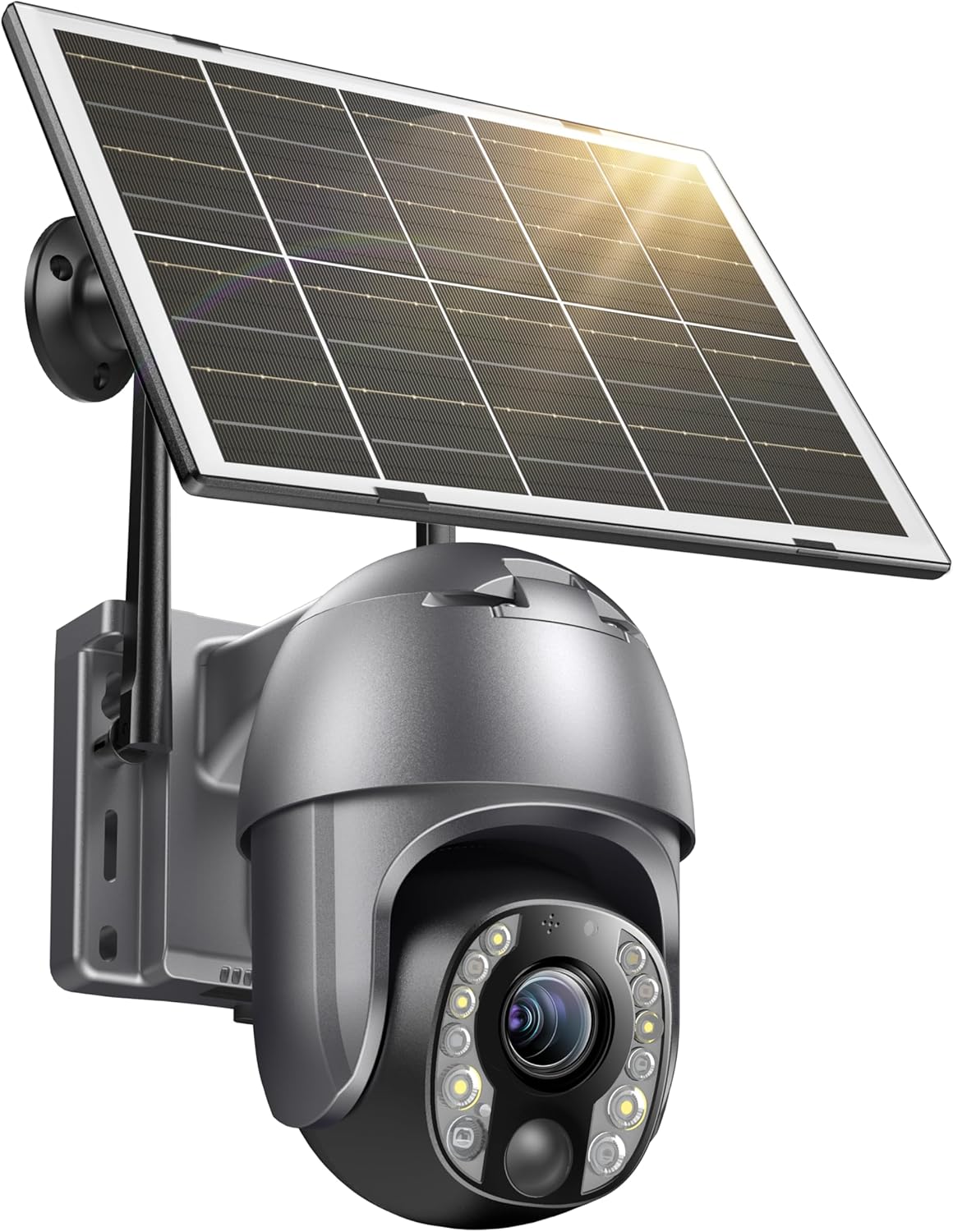
Key specs: 5MP solar-powered wireless camera; 10x optical zoom; 360-degree panoramic pan and tilt; color night vision; PIR detection; IP65 rated
Driveways are exactly where wiring gets difficult — the useful mounting point is often a pole, a gate post or a detached garage with no circuit. This is the wire-free answer: solar power, 5MP, 10x optical zoom, full pan and tilt, color night vision and PIR detection. Ten-times optical is meaningfully less reach than the wired pick, which puts it in Reolink’s stated realistic band for general cameras rather than at the top of it, but 5MP with real optical zoom is squarely in the resolution range both sources call appropriate for driveway distances. It has the largest owner-feedback history of anything here, which for a category full of new listings counts for something. Solar performance through a dark winter is the usual caveat, covered in our solar camera guide.
✅ Pros
- No wiring at all — mounts on a pole, gate post or detached garage
- 10x optical zoom, not the digital zoom most wireless cameras offer
- 5MP sits in the resolution range both sources call right for driveways
- Substantial owner-feedback history compared with most cameras in this category
❌ Cons
- Less optical reach than the wired pick, so mount it closer to the capture point
- Solar output drops through short winter days and long overcast spells
- Wi-Fi has to reach the end of the driveway, which is often the actual problem
- PIR detection at distance is less reliable than at a doorway
Amcrest License Plate Recognition Camera — best if you truly need plate numbers
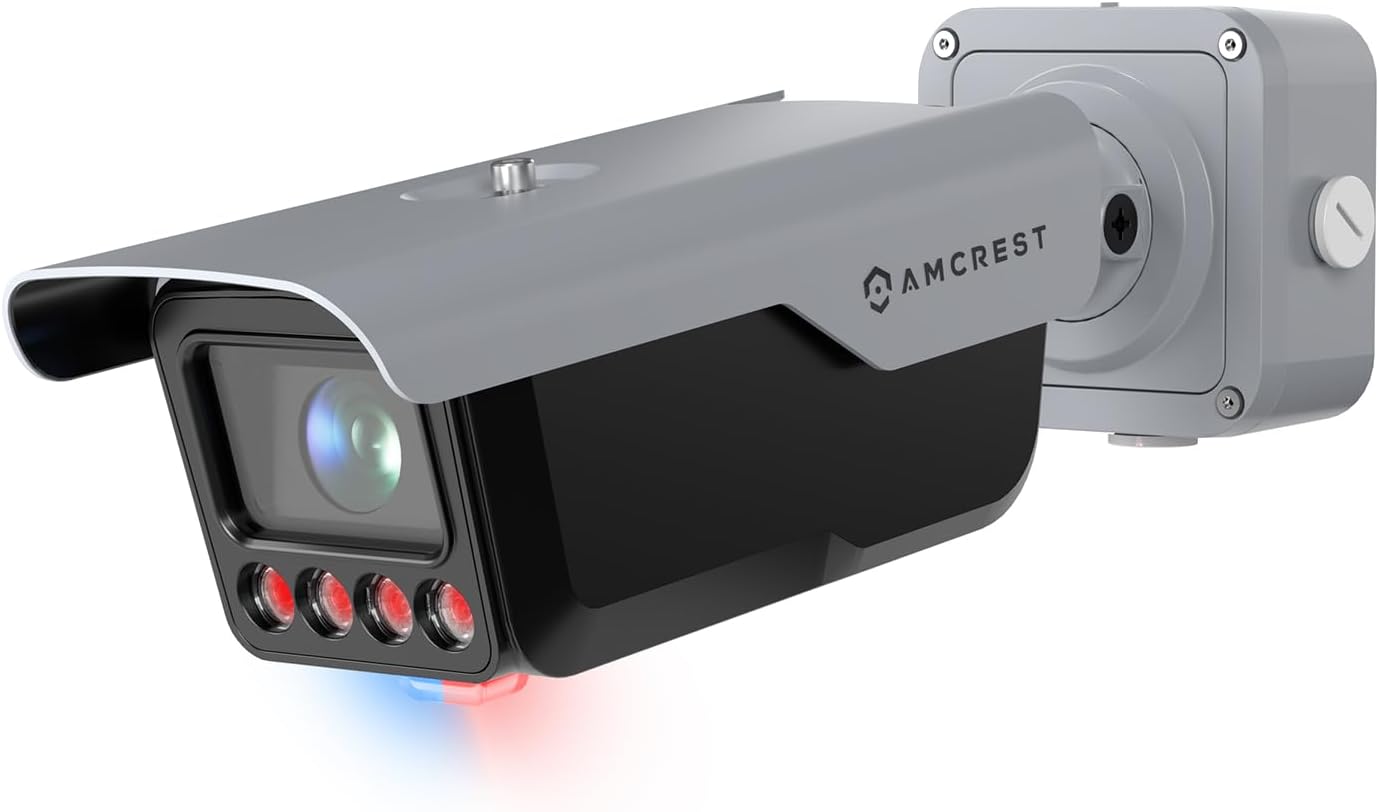
Key specs: Dedicated LPR bullet camera; 8-32mm optical zoom lens; 4MP at 30fps; 1/1.8-inch low-light sensor; active deterrents; 98-foot night vision; Power over Ethernet
Be clear about what this is: a specialist tool, not a better home camera. A dedicated license plate recognition camera pairs an 8-32mm motorized zoom lens with a large 1/1.8-inch low-light sensor and the exposure control that plate capture actually requires — which is the combination Plate Recognizer’s guidance describes when it says to lock shutter speed first and light the scene second. If your reason for buying is a genuine, recurring problem — repeated theft from vehicles, a disputed access route, a business entrance — this is the category that delivers. Two honest caveats. It is Power over Ethernet and expects a recorder, so it is not a plug-and-play purchase. And its owner feedback is thin and mixed rather than reassuring, so buy it on the specification and the return policy rather than on consensus.
✅ Pros
- Motorized 8-32mm zoom and a large low-light sensor — built for the actual job
- Exposure control is what plate capture needs, more than resolution
- Active deterrents built in, so it is not purely passive
- The right tool when a plate number genuinely matters
❌ Cons
- Thin and mixed owner feedback — a specification-led purchase
- PoE and recorder-based, so expect a system rather than an app
- Considerably more expensive than a general outdoor camera
- Narrow field of view by design — it reads plates, it does not survey a property
Vosker VKX Farmers Pack Solar Cellular Camera — best with no power and no internet
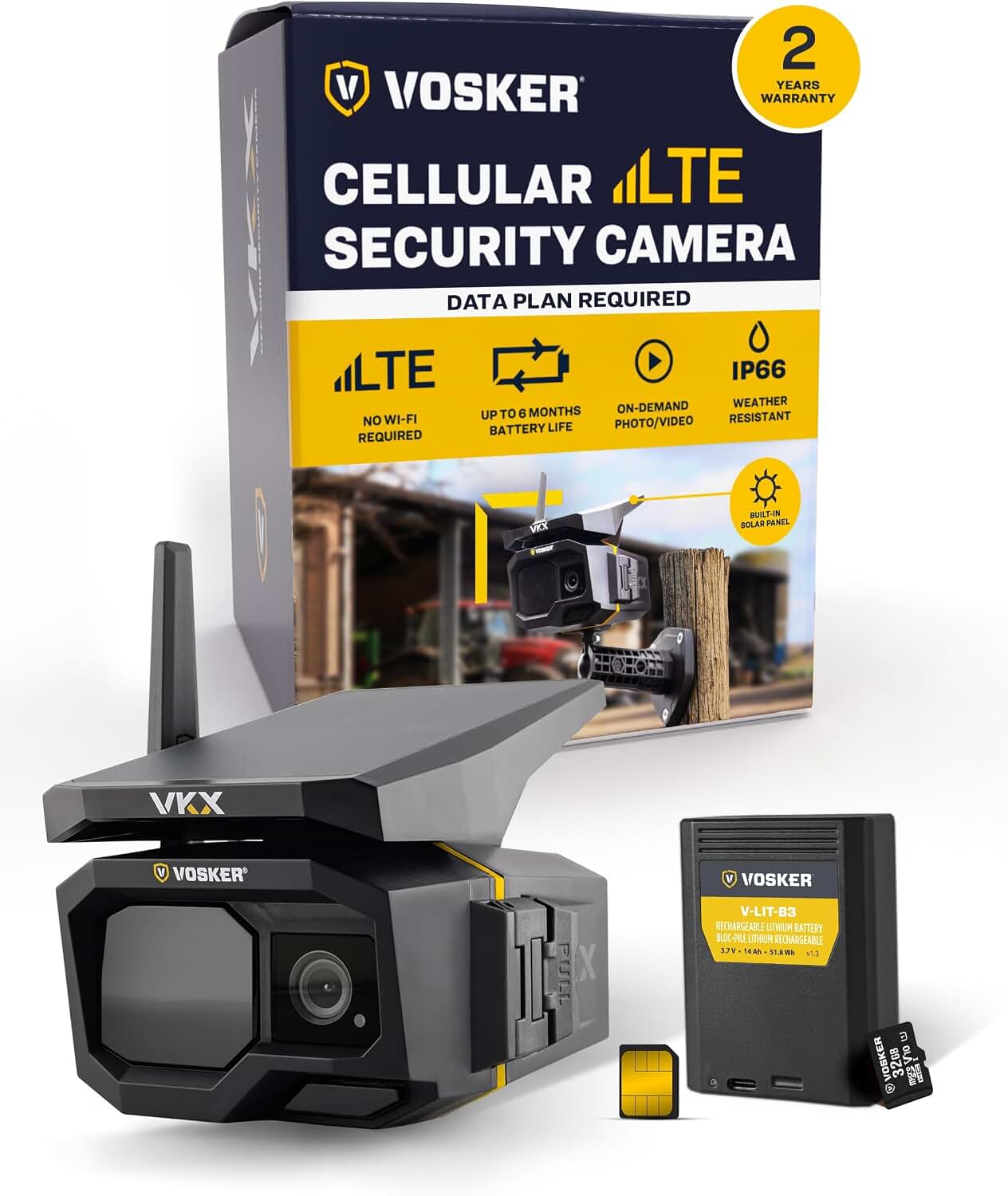
Key specs: Solar 4G LTE camera pack aimed at farms, sheds and rural properties; SIM card included; no Wi-Fi required; night vision; IP65 weather resistant
Rural driveways are their own category: a gate a quarter mile from the house, a farm track, a yard with no circuit and no broadband. This pack is built for exactly that — solar power, a 4G LTE connection with the SIM included, night vision and an IP65 housing, aimed at farms, sheds and rural properties. What you give up is the thing this whole article is about: this is a camera that sends photos and short clips rather than a zoomed video feed, so it will tell you a vehicle came and went and will not read its plate at distance. That is a fair trade when the alternative is no coverage at all. Pair it with a driveway alarm if what you actually need is to know somebody has turned in, rather than to identify them afterwards.
✅ Pros
- Works where there is no power and no broadband — solar and cellular
- SIM included, so it is running rather than a project
- Built and marketed for rural properties rather than adapted to them
- IP65 housing and night vision for exposed positions
❌ Cons
- Needs a cellular data plan, which is a recurring cost
- Not a plate-reading camera — clips and photos rather than zoomed video
- Cell signal at the gate decides whether it works at all
- Solar in a shaded rural position is less reliable than it sounds
Pick by Driveway, Not by Megapixels
The right camera follows from the shape of the driveway and what power reaches it. This is the shortcut.
| Your driveway | What to buy | Why |
|---|
| Short, beside the house, power nearby | Solar or wired camera with modest optical zoom | At close range, resolution alone can carry the plate |
| Long, with a garage or outbuilding to mount on | Wired PoE camera with high optical zoom | Distance is the biggest variable, and zoom is the fix |
| No circuit at the useful mounting point | Solar camera with real optical zoom | Wire-free, at the cost of some reach and winter reliability |
| Rural, no power and no broadband | Solar cellular camera | Clips and alerts over LTE beat no coverage at all |
| You need plate numbers for reports | Dedicated LPR camera plus a fill light | Exposure control and a motorized lens, not a bigger sensor |
One realistic expectation to set. Even a good driveway camera mostly produces evidence rather than intervention — it records what happened and who was there. If the outcome you want is somebody responding while it is happening, that is a different question, and our guide to monitored alarms and verified response covers what actually triggers a dispatch. Recorded video is, usefully, exactly the kind of evidence verified-response policies accept.
Final Recommendation
Buy the Jennov 4K PoE PTZ with 20x Optical Zoom if you can get a network cable to the mounting point. Twenty-times optical zoom, 4K and continuous recording is the combination that gives a driveway camera a real chance at a plate rather than a shape, and PoE removes the Wi-Fi problem that ruins so many end-of-drive installs. Confirm you have or will buy a compatible ONVIF PoE recorder before ordering.
If running cable is not realistic, the solar 10x model is the honest second choice — mount it closer to where vehicles actually pass to make up for the shorter reach. If there is no power and no broadband at all, the cellular pack is the only thing on this list that works, and you should go in expecting alerts and clips rather than plate numbers. And if a plate number is genuinely the point — an ongoing problem, a business, a disputed access — buy the dedicated LPR camera and a separate fill light, because that is what the job takes.
Whatever you choose, do the two free things first: angle the camera across the approach rather than down it, and go outside after dark and look at what it actually captures with headlights in frame. Lighting the approach helps more than another megapixel. If your real goal is simply knowing when a vehicle turns in — not identifying it — a driveway alarm does that better and cheaper than any camera, and the two work well together. For the garage end of the same problem, our garage door sensor guide covers the hardware most people ignore until it fails.
SafeBode does not yet run an in-house product testing program. This guide is built from manufacturer specifications, official support documentation, current retail listings and verified buyer feedback rather than hands-on testing, and we say so plainly rather than implying testing we have not done.
Frequently Asked Questions
Will a normal security camera read a license plate?
Usually not at driveway distances. General cameras with strong optical zoom are reliable within roughly 15 to 50 feet; beyond that you need dedicated hardware. Most disappointment comes from expecting a wide-angle camera to do a telephoto job.
Does more megapixels fix it?
Only partly. What matters is how many pixels land on the plate itself, which depends on distance and lens far more than on sensor resolution. A 4K camera aimed at a wide scene puts fewer pixels on a plate than a 4MP camera zoomed onto the spot vehicles pass.
Why do plates look like white blurs at night?
License plates are retroreflective, so the camera’s own infrared bounces straight back and overexposes them. Adding more infrared makes it worse. A separate fill light near the capture point, plus manual exposure control, is the actual fix.
What shutter speed should I use?
Fast enough to freeze the vehicle: roughly 1/1000 second in bright daylight, 1/500 or so in overcast conditions, and no slower than about 1/250 for moving vehicles at night. Set the shutter first, then sort out exposure with gain and lighting.
Where should a driveway camera be mounted?
Angled across the approach rather than facing straight down it, as close to the point vehicles pass as you can manage, and high enough to avoid headlight glare directly into the lens. Mounting on a garage instead of the house often halves the distance.
Is optical zoom really that different from digital zoom?
Yes. Optical zoom uses the lens to put more pixels on the subject. Digital zoom crops and enlarges what the sensor already captured, which cannot add detail that was never recorded.
Do I need two cameras?
For plate capture, effectively yes. A camera zoomed tightly enough to read a plate is not covering the rest of the property. Most workable setups pair a wide camera for context with a zoomed one on the vehicle line.
What if there is no power at the end of my driveway?
Solar with a real optical zoom is the best compromise, mounted as close to the capture point as the sun allows. If there is no broadband either, a cellular camera is the only option, and you should expect alerts and clips rather than identification.
Sources
Show sources (3)
- [1] Plate Recognizer — “LPR Camera Resolution Guide: Pixels Needed at Every Distance,” platerecognizer.com/lpr-camera-resolution-guide
- [2] Reolink — “License Plate Camera Guide,” reolink.com/blog/best-license-plate-security-cameras
- [3] Seattle Police Department — “Burglary Prevention,” seattle.gov/police/crime-prevention


