How to Rekey a Lock: Doing It Yourself vs. Calling a Locksmith
Affiliate Disclosure: This article contains affiliate links. If you buy through these links, we may earn a commission at no extra cost to you. Our editorial opinions are our own and are not influenced by affiliate relationships. Read our full disclosure policy →
Contents
Quick Answer
Look at the face of your cylinder before you buy anything. A small extra hole beside the keyway means the lock rekeys in under a minute with the key that already works, the maker’s tool and your new key — that is Kwikset’s SmartKey or Schlage’s Advanced Rekey. No second hole means a standard pin-tumbler cylinder, and rekeying means taking the lock apart, sliding the plug out on a follower bar and swapping the bottom pins to match the new key’s cuts. Every documented DIY route starts by inserting the key that currently operates the lock. Without one — or with a worn cylinder, or an upgrade you wanted anyway — this is a locksmith call or a new lock, not a rekey.
The Two Things That Send People Here
Almost nobody searches for this out of curiosity. Two moments produce the question, and they need slightly different answers.
The first is moving in. You have the keys the previous owner handed over and no idea how many others exist — the neighbor who watered the plants, the contractor who never gave one back, the adult child who moved out in 2019. SafeWise’s advice for a new home is blunt: if you are moving into a residence someone else used to call home, change the door locks so you do not have strangers out there with a key to your house. Rekeying is the cheap version of that — keep the hardware, retire every key that currently works.
The second is a key that has gone missing. A roommate leaves badly; a key comes off a keyring in a parking lot with an address label attached. The urgency is higher but the scope is smaller, because you usually still hold a working key — the one thing every DIY method here depends on.
Both point at the same job, worth naming precisely. Rekeying changes which key operates the cylinder. It does not change the cylinder, the bolt, the strike or how hard the door is to kick. If the strength of the lock is what bothers you rather than who holds a key for it, you are shopping, not rekeying, and our guide to high-security deadbolts is the more useful page.
Rekey or Replace? Settle That First
This decision costs nothing and saves a wasted afternoon. Work down the left column until you hit your situation.
| Your situation | Rekey | Replace or call a locksmith |
|---|
| Just moved in, hardware is sound | Yes — the textbook case | Only if you want different hardware |
| A roommate, tenant or contractor kept a key | Yes, if you still hold a working key | Not needed |
| Every exterior door on one key | Yes — both makers document keying a house alike | Not needed if the locks share a keyway |
| No working key at all | No — every DIY method begins by inserting the current key | Locksmith, or replace |
| The key sticks, drags or needs jiggling | It will still stick — rekeying reuses the same plug and shell | Replace, or have the cylinder serviced |
| You want a keypad, a smart lock or no keys | Pointless — you are removing the key, not changing it | Replace the lock |
| You want a stronger lock, not a different key | Changes nothing about strength | Replace and step up a grade |
That last row is the one people talk themselves out of. A certified residential deadbolt is put through seventeen aggressive security tests under the ANSI/BHMA A156.40 standard, including one that loads the door against the bolt with 1,350 lb of force. Rekeying moves none of those numbers — a builder-grade lock stays a builder-grade lock. Our explainer on what ANSI/BHMA lock grades actually mean covers what the ratings do and do not promise.
Which Route Your Lock Is Actually On
Go and look at the cylinder — not the brand on the box, the metal face the key goes into. There are three answers, and one non-answer.
 One glance at the cylinder face decides which of these three jobs you are about to do.
A small hole beside the keyway means a tool-rekeyable cylinder. Kwikset calls the feature SmartKey Security and its instructions have you locate the SmartKey hole before anything else. Schlage’s Advanced Rekey sheet opens the same way — locate the rekey pin hole. Both are patented and brand-specific: SmartKey works exclusively with Kwikset products, and Advanced Rekey is designed for Schlage’s own SC1 keyway locks and is not compatible with non-Schlage hardware.
A plain keyway with nothing beside it means a standard pin-tumbler cylinder. Schlage’s glossary describes the mechanism: small sliding pins working against coil springs, which prevent the plug from rotating unless every one is aligned simultaneously by cuts of the proper depth in the key. Rekeying one means physically changing those pins.
And there is the non-answer. If you cannot produce a key that currently operates the lock, skip the DIY sections entirely — both tool systems require it, and the pin-tumbler sequence needs it to turn the plug out of the housing.
Route 1: Rekeying a Kwikset SmartKey Lock
Three things on the table: the key that works now, the SmartKey tool, and the key you want next. Kwikset states the tool ships in every SmartKey package — worth knowing, because it is also the part nobody can find years later.
The SmartKey Sequence, as Kwikset Documents It
1
Set the door up
Lock installed, door all the way open, bolt or latch in the locked position. Make sure the door cannot swing shut on you.
2
Current key, quarter turn
Insert the key that operates the lock now and rotate it 90 degrees clockwise.
3
Press the tool in, then out
Push the SmartKey tool fully and firmly into the SmartKey hole — you may feel it click. Remove the tool, then the current key.
4
New key, fully seated
Insert the new key. Kwikset is emphatic that it must be fully in, its edge touching the indent in the cylinder face.
5
The rotation, without pushing or pulling
Rotate 180 degrees counter-clockwise, then 180 degrees clockwise. Tug the key to confirm it will not come out in that position.
6
Back to home, and test
Rotate 90 degrees counter-clockwise and remove the new key. Test it, and test that the old key no longer works.
Three details from Kwikset’s FAQ change how people use this. There is no limit on how many times a SmartKey cylinder can be rekeyed. Every SmartKey lock in the house can be rekeyed to one existing Kwikset key, which is how a household ends up carrying one key instead of four. And a new SmartKey lock does not need rekeying — it arrives keyed to the key in the package.
One genuine limitation, stated by Kwikset rather than inferred: a SmartKey cylinder cannot be master-keyed, and only one key cut operates the lock at a time. Kwikset also markets SmartKey as pick resistant and bump proof — the manufacturer’s characterization of its own design, repeated here as such rather than as an independent test result. If an electronic SmartKey lock is the trouble rather than the cylinder, our Kwikset smart lock reset walkthrough covers that half of the hardware.
Route 2: Schlage’s Advanced Rekey, and Why You Probably Do Not Have It
Schlage now has its own answer to SmartKey, and most write-ups have not caught up with it. Advanced Rekey uses a rekey pin instead of a tool, and instruction sheet 48234197 (revised January 2025) lays out a sequence mirroring Kwikset’s while running the opposite way.
| Step | Kwikset SmartKey | Schlage Advanced Rekey |
|---|
| Set-up | Door open, lock in the locked position | Door open, to avoid a lockout |
| Turn the current key | 90 degrees clockwise | 90 degrees left |
| Actuate | Press the SmartKey tool in until it clicks, then remove it | Press the rekey pin in firmly until it stops, then remove it |
| The rotation | 180 counter-clockwise, 180 clockwise, 90 counter-clockwise | 180 right, 180 left, 90 right |
| Finish | Remove the key and test | Remove the new key, confirm the old one fails |
Read that table as a warning, not a convenience: the sequences are mirror images, so muscle memory from one brand will actively mislead you on the other. Schlage adds a caution that is easy to skip and expensive to ignore — do not rotate the key while removing or inserting it.
Now the honest part. Schlage’s own Advanced Rekey page is headed coming soon to select trade pro partners, and its FAQ describes the feature as one that will be added to all Schlage residential keyed locks, reaching builders through dealers and wholesale partners. In plain terms: unless your lock is very new and came through a builder, the Schlage on your door almost certainly does not have this. Check for the rekey pin hole before you shop for a pin — and note the pin is the same part as Schlage’s emergency pin for privacy locks, so replacements are sold online. Like SmartKey, it needs the current key and the pin together, so only someone holding both can rekey your lock. Our guide to the Schlage residential lineup covers which families are current.
Route 3: Rekeying a Standard Pin-Tumbler Cylinder
This is the real job, and the one the phrase “rekey a lock” originally meant. First the vocabulary, from Schlage’s glossary. The plug holds the keyway and turns with the key; the shell surrounds it; the shear line is where the two meet, the height the bottom pins must reach for the plug to turn. Bottom pins are bullet-shaped in lengths matching the key cuts, and top pins are flat-ended under the springs. Rekeying swaps the bottom pins for a set matching a different key; everything else exists to reach them without the springs and top pins escaping.
 The follower bar is the whole trick. It occupies the shell as the plug leaves it, so the springs and top pins stay in their chambers.
What is in the box. A rekeying kit is a parts bin plus tools: Schlage’s trade kit lists bottom pins, top pins, springs, cylinder caps, cap pins, tailpieces, a key gauge, a plug follower, a cylinder cap removal tool and a follower bar. The two followers are what a first-timer underestimates — they keep the springs and top pins in their chambers while the plug is out.
The sequence for a deadbolt, condensed from Schlage’s guide: original key in; cylinder cap off with the cap removal tool; cylinder pin and its spring out; key rotated to the two o’clock position; housing slid away on the follower bar, which stays in the housing with its notch horizontal; old pins tipped out and the original key removed; new key in; then the correctly numbered pin loaded into each hole, reading the cylinder right to left. Verify every pin sits flush with the top of the plug before reassembling.
How you know which pins. If the new key has cut numbers stamped on it, read them off. If not, use the key gauge: slide the key in with the cuts facing up, move to the first notch from the bow, slide left until it stops on a number, and repeat to the tip. That five- or six-digit number is the bitting. Schlage’s rule for an ambiguous reading is specific — if the key lands between two numbers, take the lower one, the shallower cut.
The caution most people miss. Schlage warns against rekeying from a duplicate, aftermarket key: duplicates wear faster and can produce key-cut discrepancies that leave the cylinder sticking after it is repinned. Work to a factory-cut key. And note how the same document introduces the topic — rekeying is a precise process that requires expertise, particularly when several products are involved — in a guide written for hardware-store staff who do this daily.
If the lock has to come off the door first, our deadbolt installation guide covers the figures you will be putting it back into. And a double-cylinder unit means two cylinders to rekey, not one — our single versus double cylinder explainer covers where that configuration is a bad idea.
Kwikset SmartKey Re-Key Kit — for the SmartKey route
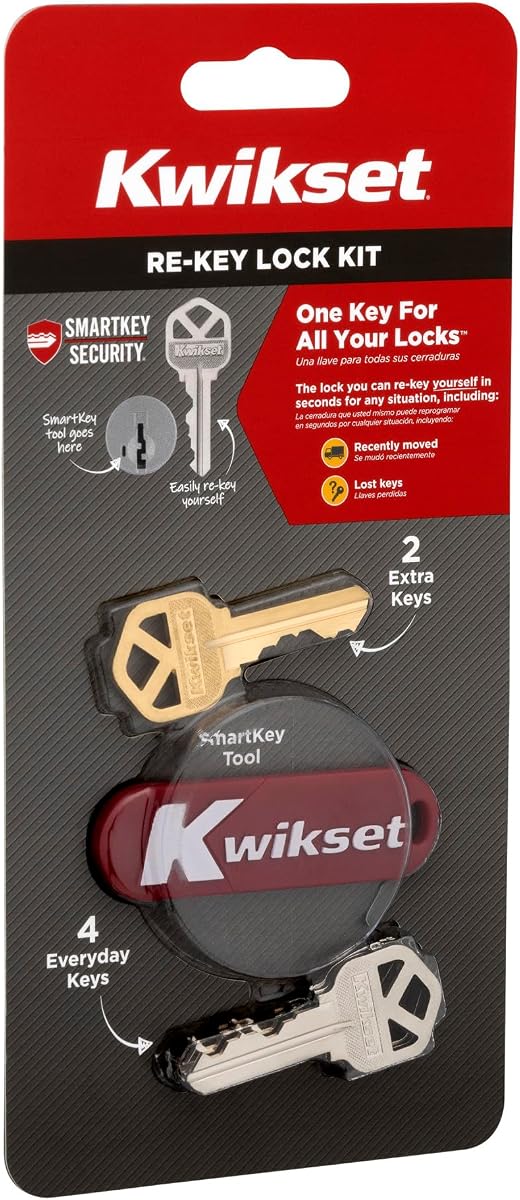
Key specs: SmartKey re-key tool plus four identical everyday keys and two identical alternate keys; works only on Kwikset locks that carry SmartKey Security; the listing states the original working key is required to use it
If your cylinder has the SmartKey hole and the original tool is long gone, this is the replacement — Kwikset’s own kit, with the re-key tool, four identical everyday keys and two identical alternate keys. The two-tier key set is the genuinely useful part: hand a dog walker or a contractor the alternate key, then retire only that key later by rekeying back to the everyday one. Kwikset states there is no cap on how many times a SmartKey cylinder can be rekeyed, so that swap is repeatable indefinitely.
✅ Pros
- The tool is the one part you cannot improvise, and this is the maker’s own
- Two key tiers out of the box supports lend-and-retire access without a smart lock
- Rekeys any Kwikset SmartKey cylinder in the house to a single key
- No cap on how many times the cylinder can be rekeyed
❌ Cons
- Kwikset states SmartKey is a patented design that works exclusively with Kwikset products — it will not touch a Schlage, Yale or Baldwin cylinder
- Useless without the key that currently operates the lock
- Cannot master-key: only one key cut operates a SmartKey cylinder at a time
- Buys you nothing if the lock itself is what needs upgrading
Prime-Line E 2400 Re-Keying Kit — for the pin-tumbler route
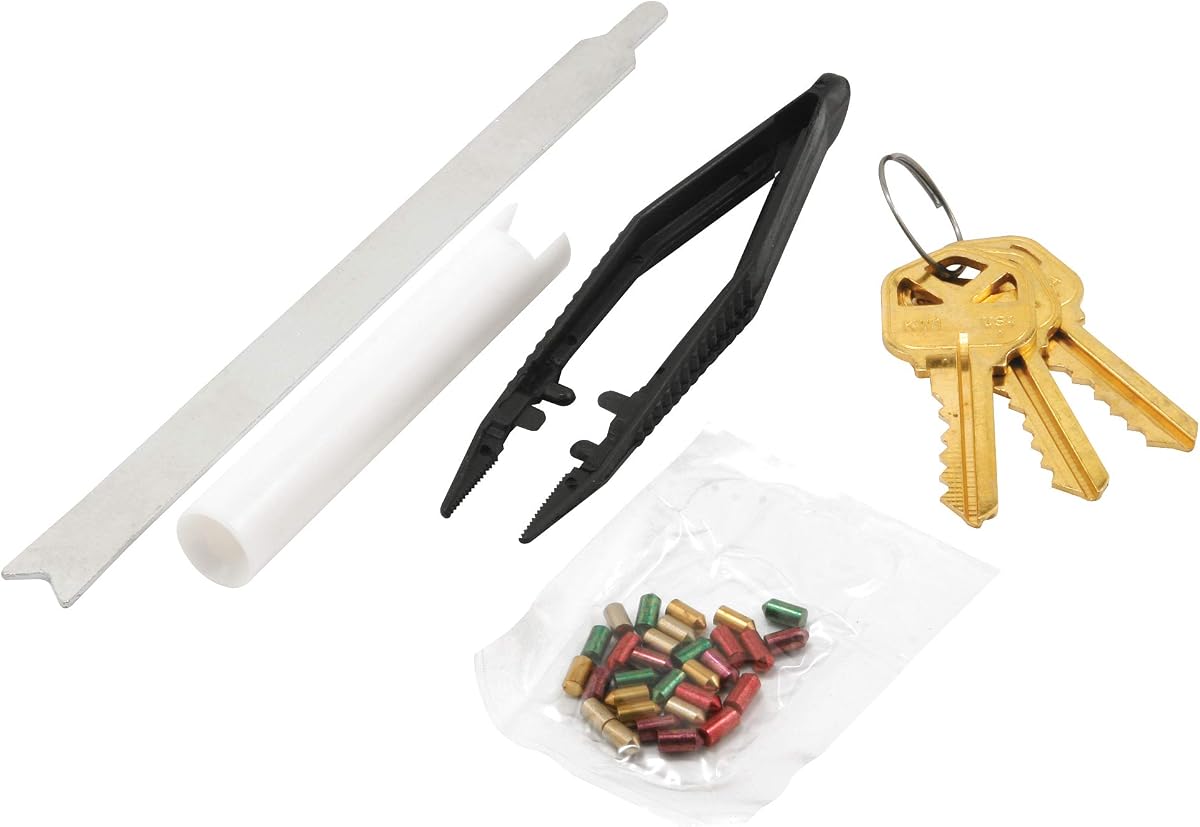
Key specs: Pin-tumbler rekeying kit for Kwikset, Weiser and Weslock five-pin locks; includes three pre-cut keys, replacement pins and the cylinder tools; the original key is required, and locks are rekeyed to the kit’s own pre-cut key rather than to a key you already carry
For a plain cylinder with no tool hole, a consumer rekeying kit is the cheapest way in, and this is the common one for Kwikset, Weiser and Weslock five-pin locks. Read the constraint before you buy, because most listings bury it: this kit rekeys your locks to the pre-cut keys supplied in the box, not to a key you already own. Fine if the goal is one new key for every exterior door; wrong if the goal was matching the front door key already on your ring — that needs pins in specific depths and a key gauge to read the bitting, the trade-kit route Schlage documents. Schlage-keyway owners want the sister kit, the Prime-Line E 2402 for Schlage "C" five-pin locks — the same product cut for a different keyway, not a genuinely different pick.
✅ Pros
- The realistic entry point for a cylinder with no rekey tool hole
- Pre-cut keys, pins and cylinder tools in one box — nothing else needed
- Covers Kwikset, Weiser and Weslock five-pin locks, most builder-installed hardware
- Keying several doors to one key is exactly what it is designed for
❌ Cons
- Rekeys only to the kit’s own pre-cut keys — it cannot match a key you already carry
- Still requires the original working key to get the plug out
- Keyway-specific: the Kwikset version will not serve a Schlage cylinder
- Fiddly — the springs and top pins are unforgiving of a slipped follower
When It Goes Wrong: The Misprogrammed Cylinder
The failure that catches people on the tool-based route is specific enough that Kwikset keeps a support topic for it. The symptom set is small and recognizable:
Four Documented Symptoms, and What Causes Them
🛑 What you will see
- Neither the old key nor the new key operates the lock
- The key used during rekeying will no longer rotate the cylinder
- The new key came out during the test rotation, when it should not have
- The cylinder turns in one direction only after rekeying
📌 What Kwikset says causes it
- The key was not fully inserted during rekeying
- The key was accidentally pulled while rotating back to the home position
- The key was pushed in, up or down while rotating back to home
- All recoverable — Kwikset publishes a reset procedure, not a replacement
Three of the four causes are the same mistake: touching the key with anything other than rotation while it sits in the cylinder. That is why both manufacturers flag it — Kwikset says to rotate without pushing or pulling, Schlage says not to rotate the key while removing or inserting it. Grip the bow, turn, ignore every other instinct.
The second reason a rekey appears to have failed is that it never was the problem. A bolt that binds, a latch catching on the strike, a cylinder stiff before you started — none are key problems, and none change when the pins do. Our guide to common door lock problems separates the mechanical faults from the key ones.
Four Times Rekeying Is the Wrong Answer
Rekeying is cheap, fast and reversible, which makes it tempting in situations it does not fix. Four are common enough to name.
The Four Cases Where a New Lock Beats a New Key
No key
You cannot produce a working key — every DIY route needs one
Worn
The cylinder already drags. New pins in a tired plug and shell change nothing
Unknown
You cannot account for the lock’s history, and rekeying leaves the hardware exactly as strong as you found it
Upgrade
You want a keypad, a smart lock or a higher-graded deadbolt, which is a purchase, not a procedure
Rekeying answers one question — who holds a key that works. It answers no others.
The worn-cylinder case deserves one more sentence. Rekeying reuses the same plug, shell and springs; only the bottom pins change. Pair a marginal cylinder with a worn duplicate key and Schlage’s sticking warning applies twice over — the lock can end up feeling worse afterward than before.
The unknown-history case is the one people rationalize away. Having just bought a house, you do not know whether the front door lock has been picked, drilled or left in the weather since 2011, nor whether it is a certified deadbolt or the cheapest thing that would pass inspection. Rekeying answers neither; replacing answers both, and it is the moment to buy something carrying a rating you can check. To stop dealing with keys altogether, our roundups of keypad door locks and keyless entry locks cover that path — and changing a code later is easier still, as our guide to changing the code on a Schlage lock shows.
Renters have a fifth case. Rekeying a lock you do not own is usually a lease violation, and many buildings require the landlord to hold a working key. Ask first; if the answer is no, our renter security guide covers what works without touching the landlord’s hardware.
What a Locksmith Does That You Cannot
There is a version of this article that tells you a locksmith is a waste of money. The manufacturers’ own documents make that untrue.
No working key. Absolute for the consumer routes. Kwikset directs owners without a working key to a builder, a locksmith or its own support team, Schlage says the same for Advanced Rekey, and the pin-tumbler procedure cannot begin without it. A locksmith can decode or pick the cylinder, get the plug out and re-pin it. That is a skill, not a markup.
Matching a key you already own. Consumer kits rekey locks to the pre-cut keys they ship with. Matching a key already on your ring means reading its bitting and stocking bottom pins in every depth — which is why Schlage’s trade kit carries pins in ten depths plus a key gauge. A locksmith has that inventory in the van.
Mixed brands, mixed keyways, and master keying. One key for the front, back and garage side door is easy when all three share a brand and keyway, and a different problem when they do not — neither SmartKey nor Advanced Rekey crosses brands, so getting there means swapping cylinders. Master keying is further out of reach: a SmartKey cylinder cannot be master-keyed at all, and a real master system needs master pins creating a second shear line, which no consumer kit sets up.
What to Actually Do
Start with the cylinder face, not a shopping cart. Look for a small extra hole beside the keyway. That one free observation tells you whether you are ten minutes from done or an hour into a repinning job.
Hole, and it is a Kwikset: run the SmartKey sequence with the door standing open. If the tool is missing, the Kwikset SmartKey Re-Key Kit replaces it. Hole, and it is a Schlage: follow document 48234197’s sequence rather than a half-remembered Kwikset one — they turn opposite ways.
No hole, and your goal is one new key for every exterior door: a consumer kit such as the Prime-Line E 2400 Re-Keying Kit is the honest starting point, provided you accept you are rekeying to the key it supplies. To match a key you already carry, the trade route needs pins in every depth and a key gauge — pay a locksmith rather than assembling that inventory for one afternoon.
And change the decision entirely if you have no working key, the cylinder already drags, or you have just moved into a house whose hardware history you cannot account for. That money belongs in a new lock with a rating you can look up, not a new key for an old one.
SafeBode does not yet run an in-house product testing program. This guide is built from manufacturer specifications, official support documentation, current retail listings and verified buyer feedback rather than hands-on testing, and we say so plainly rather than implying testing we have not done.
Frequently Asked Questions
Is rekeying the same as changing the locks?
No. Rekeying changes the pins inside the existing cylinder so a different key operates it, and leaves the hardware on the door. Rekeying is right when the lock is sound and only the key needs retiring; replacement is right when the lock itself is the problem.
Can I rekey a lock without the original key?
Not through any consumer route. Both manufacturer tool systems require the key that currently operates the lock, and the pin-tumbler kit procedure needs it to turn the plug into the position where it can leave the housing. Without a working key this becomes a locksmith job or a lock replacement.
How long does rekeying actually take?
A tool-based cylinder takes well under a minute once everything is on the table. A pin-tumbler cylinder is realistically fifteen to thirty minutes for a first attempt on one deadbolt, most of it spent reading pin numbers and checking that every pin sits flush.
Can I rekey a Kwikset lock with a Schlage kit, or the reverse?
No. Both makers state their rekeying systems are patented designs that work only on their own hardware, and pin-tumbler kits are sold per keyway because the pins, keys and tools are cut for one. Buy the kit that names your brand and keyway on the box.
Can I put every door in the house on one key?
Yes, if the locks share a brand and a keyway. Both tool-based systems document rekeying several locks to one existing house key, and pin-tumbler kits exist to bring a set of locks onto a single pre-cut key. Mixed brands or keyways usually mean swapping cylinders.
Why do neither of my keys work now that I have rekeyed it?
That is a misprogrammed cylinder, common enough that Kwikset publishes a recovery procedure for it. The usual causes are the key not being fully inserted, or being pulled or pushed while rotated back to the home position. It is recoverable, so do not buy a new lock.
Does rekeying make my door more secure?
Only in the sense that fewer people can open it. It does nothing to how the lock resists force, picking or drilling, because the plug, shell and bolt are the ones you started with.
Should I rekey a brand-new lock when I install it?
Not usually. A new lock arrives keyed to the keys in its own package, and Kwikset says explicitly that rekeying a new SmartKey lock is unnecessary. The exception is wanting it to match keys you already carry, which is what the feature is for.
Can my landlord stop me from rekeying my apartment door?
In most tenancies, yes, and many leases and local rules require the landlord to hold a working key. Ask first. If the answer is no, add security that does not modify the landlord’s hardware.
Sources
Show sources (8)


