Best High-Security Deadbolts 2026: What to Look for Beyond the Grade Sticker
Affiliate Disclosure: This article contains affiliate links. If you buy through these links, we may earn a commission at no extra cost to you. Our editorial opinions are our own and are not influenced by affiliate relationships. Read our full disclosure policy →
Contents
Quick Answer
If a listing’s only security claim is a grade or a star rating, it is not answering the question that actually matters. Pick, bump and drill resistance come from specific hardware: a re-keyable or patented cylinder that resists picking, hardened anti-drill plates and pins, a bump-resistant mechanism instead of a plain pin-tumbler shear line, and a full 1-inch bolt throw backed by a reinforced strike plate anchored with long screws into the door framing, not just the jamb. No residential deadbolt is truly unpickable – these features raise the time and skill an intruder needs, they do not make forced entry impossible. Our grade guide covers what the A/B/C Secure Home rating actually measures; this one covers what to look for on top of it.
The Grade Sticker Was Never the Whole Answer
We have already made the case, in detail, that the commercial Grade 1/2/3 scale printed on some listings is the wrong scale for a residential deadbolt, and that the real residential system is three separate letter scores for security, durability and finish under the BHMA Certified Secure Home program. Read that article first if you have not, because we are not going to re-argue it here. What that article did not do is tell you which specific hardware features actually produce a high security score, or name products that carry them. That is this article’s whole job.
Here is the short version of why grade alone is not enough. A security rating is earned in a lab, against a defined set of force and cycle tests. It says nothing about whether the cylinder resists a cheap pick set, whether the bolt can be knocked loose with a rubber mallet and a cut key blank, or whether the screws holding the strike plate are long enough to reach the framing behind the door jamb. Two deadbolts can carry the same headline rating and differ enormously on all three. What follows is the hardware-level checklist that actually separates them, then four real products we checked it against.
What Actually Resists Picking, Bumping and Drilling
These four features are the ones that show up, consistently, on the deadbolts manufacturers themselves market specifically as pick-, bump- or drill-resistant, rather than simply as certified. We verified each one directly on Schlage’s and Kwikset’s own product documentation rather than assuming a marketing term meant what it sounds like.
Four Things to Check Before the Grade
1
A cylinder built to resist picking
Either a re-keyable design like SmartKey, which drops the exposed top pins a pick needs to feel, or a patented high-security cylinder with extra shear lines a standard pick set is not shaped for.
2
Hardened anti-drill plates and pins
A hardened steel plate or pin behind the cylinder face stops a drill bit from destroying the pins directly – the fastest brute-force bypass on a cheap deadbolt.
3
A mechanism that is not just pin-and-tumbler
Lock bumping exploits the spring-loaded shear line in an ordinary pin-tumbler cylinder. A bump-resistant design like BumpGuard replaces that shear line with a different mechanism entirely, so a bump key has nothing to strike.
4
A full 1-inch bolt throw plus a reinforced strike plate
The bolt is only as strong as what it is anchored into. A 1-inch throw backed by a strike plate with 3-inch screws into the framing resists a kick-in; a short bolt or short screws into thin jamb wood does not, regardless of the cylinder.
All four sit on top of whatever ANSI/BHMA rating a lock carries – they are what the rating does not tell you.
What We Verified Directly on Schlage and Kwikset’s Own Pages
Marketing copy for “high security” hardware is common enough that it is worth checking what each brand actually documents, rather than what a retail listing implies. We went directly to Schlage’s and Kwikset’s own product and support pages for the two most widely available brands, and the table below shows what each confirms in its own words.
| Feature | Schlage (B60/B62 series) | Kwikset (SmartKey Security) |
|---|
| Anti-drill hardware | Anti-drill plates over the cylinder, stated on the product page | Not stated by name on Kwikset’s SmartKey pages we checked – see the honest note below |
| Anti-pick design | Anti-pick pins behind the cylinder face | SmartKey’s re-keyable design removes the exposed top pins a standard pick set targets |
| Bump resistance | Marketed as resisting bumping alongside kick-ins, prying and drilling | BumpGuard: a patented slide-locking bar mechanism in place of a pin-tumbler shear line |
| Bolt throw | 1-inch deadbolt with a hardened steel spinning pin | Not specified as a throw measurement on the pages we checked |
| Strike plate included | Integrated strike reinforcer with 3-inch screws, in the box | Not included – pair with a separate reinforcement product, covered below |
| Independent grade cited | Grade 1/AAA BHMA certified for security, durability and finish | Grade 1 BHMA certified for security, durability and finish |
The gap in Kwikset’s column is not an accusation – it is what their own pages do and do not say. SmartKey’s press materials describe “improved drill resistance” without the specific “anti-drill plate” wording Schlage uses, and neither of the SmartKey pages we checked lists a bolt throw measurement. That does not mean the feature is absent; it means we could not verify the specific claim on the specific page, so we are not stating it as fact here. An independent check is useful here too: SafeWise’s own door lock reviewers describe the Schlage B60N626 as “pick-and-bump-resistant” and the Kwikset 980 as carrying “BumpGuard technology, and it’s tough to pick, too” – a second source landing on the same two features we found directly on each brand’s own pages.
Schlage B62N Deadbolt — the most documented hardware here
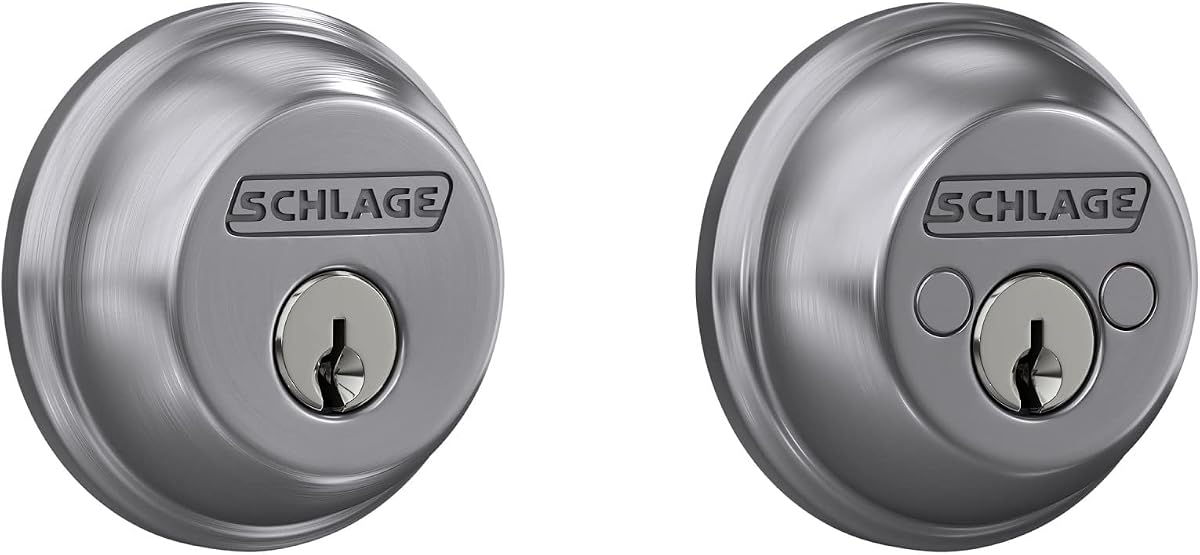
Key specs: 1-inch deadbolt with hardened steel spinning pin, anti-drill plates and anti-pick pins; integrated strike reinforcer with 3-inch screws included; Grade 1/AAA BHMA certified for security, durability and finish; keyed on both sides; fits doors 1-3/8″ to 1-7/8″ thick, 2-3/8″/2-3/4″ backset
This is the pick for a reader who wants every feature from the checklist above confirmed in writing by the manufacturer, in one product. Schlage’s own product page states this deadbolt ships with a 1-inch bolt on a hardened steel spinning pin, anti-drill plates and anti-pick pins, plus an integrated strike reinforcer with 3-inch screws already in the box – the frame problem this article opened with, solved without a separate purchase. It carries Schlage’s highest residential certification, Grade 1/AAA BHMA rated across security, durability and finish. This specific listing is keyed on both sides, which is a real, separate decision worth reading up on before you buy – our single vs. double cylinder guide covers the fire-egress tradeoff a double-cylinder deadbolt introduces. If you would rather see Schlage’s broader current lineup first, our Schlage lineup guide is the place to start.
✅ Pros
- Every feature on our checklist is stated in Schlage’s own product documentation, not implied
- Strike reinforcer with 3-inch screws is included, not a separate purchase
- Grade 1/AAA is the highest rating in Schlage’s own residential certification
- Keyed both sides suits a door with a nearby glass panel, where a single-cylinder thumb-turn could otherwise be reached and turned from outside
❌ Cons
- Keyed on both sides means a key is needed to exit from indoors too – a real fire-egress consideration, not a minor one
- This exact listing is Satin Chrome in a contemporary style only; other finishes are separate listings
- Priced close to the Kwikset pick below despite noticeably more documented hardware, which makes the double-cylinder tradeoff the real deciding factor rather than price
Kwikset 980 SmartKey Security Deadbolt — the easiest upgrade
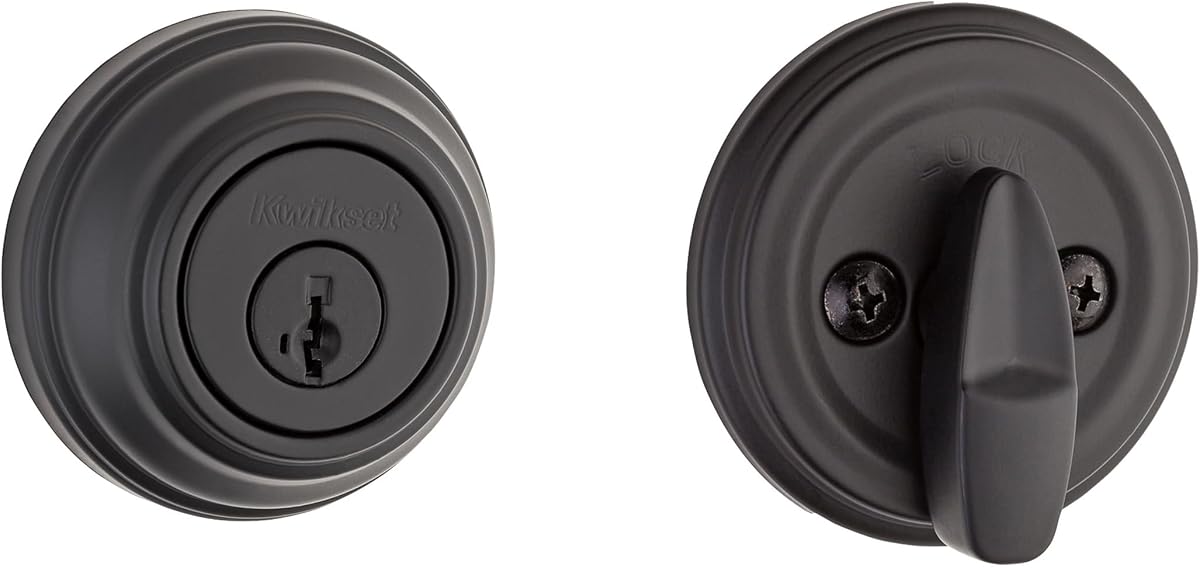
Key specs: SmartKey re-keyable cylinder with BumpGuard bump resistance; Grade 1 BHMA certified for security, durability and finish; single cylinder, keyed one side; fits doors 1-3/8″ to 1-3/4″ thick, 2-3/8″/2-3/4″ adjustable backset
This is the pick if your current deadbolt is a plain, unbranded builder-grade lock and you want a straightforward, well-reviewed upgrade rather than a research project. Kwikset’s own SmartKey Security page states the technology is designed to protect against advanced break-in techniques, and the company’s own 2008 announcement of BumpGuard describes it as a patented slide-locking bar mechanism that eliminates the traditional pin-and-tumbler shear line a bump key needs, making SmartKey deadbolts “virtually impervious to lock-bumping attacks” and confirming they passed UL 437’s picking standard. This specific listing carries Grade 1 BHMA certification for security, durability and finish, and SmartKey’s own re-key feature lets you reset the cylinder to a new key yourself in seconds if you ever need to, without a locksmith.
✅ Pros
- SmartKey re-keying means you can change what key opens the lock yourself, in seconds, if a key is ever lost or a previous occupant might still have one
- BumpGuard’s mechanism does not use the pin-and-tumbler shear line a bump key relies on
- Grade 1 BHMA certified for security, durability and finish
- The least expensive of the three deadbolts in this article
❌ Cons
- This specific finish and ASIN carries a thinner review count than Kwikset’s 980 line as a whole – the mechanism has a long track record, this exact listing does not, yet
- Kwikset’s own pages we checked do not use the specific term “anti-drill plate” the way Schlage’s do, and do not state a bolt throw measurement – see the comparison table above
- Single cylinder only in this listing, so the same nearby-glass-panel caveat from the Schlage section applies in reverse
Mul-T-Lock Cronus High Security Deadbolt — a genuinely different tier
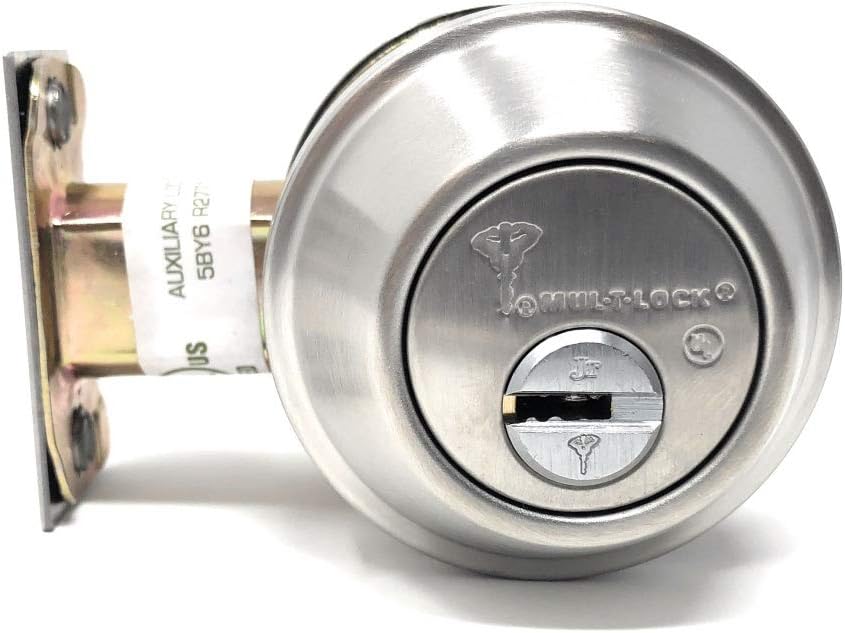
Key specs: Patented high-security cylinder with a hardened steel pin and solid-core steel rosette, marketed by the listing as drill- and pick-resistant; ANSI Grade 2; keyed-alike/master-keyable; fits doors 1-3/8″ to 1-3/4″ thick; ships with 3 keys and a duplication-control card
This is the pick for a reader who has already decided a residential-market deadbolt is not enough security for their situation – a street-level unit, a history of attempted entry, a high-value room. Mul-T-Lock’s Cronus uses a patented cylinder platform built around a hardened steel pin and a solid-core steel rosette, and the listing itself describes it plainly as drill- and pick-proof, UL fire-rated, and carrying an ANSI Grade 2 certification. Grade 2 sitting below the Grade 1 claims on the other two picks here is the exact trap our companion article warns about: ANSI/BHMA grade measures durability and impact force, not pick resistance, so a Grade 2 lock with a genuinely harder cylinder to pick is not a worse security choice than a Grade 1 lock with an easier one – see our grade explainer for the full argument. Key control is the real differentiator: duplicate keys require an authorized dealer and a coded card, not a hardware-store key machine.
✅ Pros
- A patented cylinder platform genuinely different from the mass-market pin-tumbler design the other two picks use, at least at this price point
- Key control means duplicate keys cannot be casually cut at a hardware store – a real deterrent against an ex-tenant, contractor or ex-partner keeping a spare
- UL fire-rated and keyed-alike/master-keyable if you need matching cylinders across multiple doors
- The lowest Grade rating of the three picks here is not the same as the weakest security – see the note above
❌ Cons
- Roughly double the price of the Schlage or Kwikset pick, and the least accessible: you cannot walk into a hardware store for a duplicate key
- ANSI Grade 2 rather than Grade 1, which reads as a downgrade to a shopper who has not read our grade explainer first
- Fewer independent reviews than the two mass-market brands above, though the ones we read were substantive rather than one-line ratings
Every feature above lives in the lock. None of it changes what the deadbolt is anchored into. A kick-in does not usually shear the bolt – it rips the strike plate out of a thin door jamb, which is why Schlage bundles a reinforced strike plate with 3-inch screws into the B62N box and why we are treating a separate frame reinforcement product as the fourth pick in this article rather than an afterthought. If your current deadbolt did not come with one, this is the honest priority order: buy the reinforcement before you buy a second, more expensive lock.
Prime-Line U 11449 Door Reinforcement Lock — the companion product
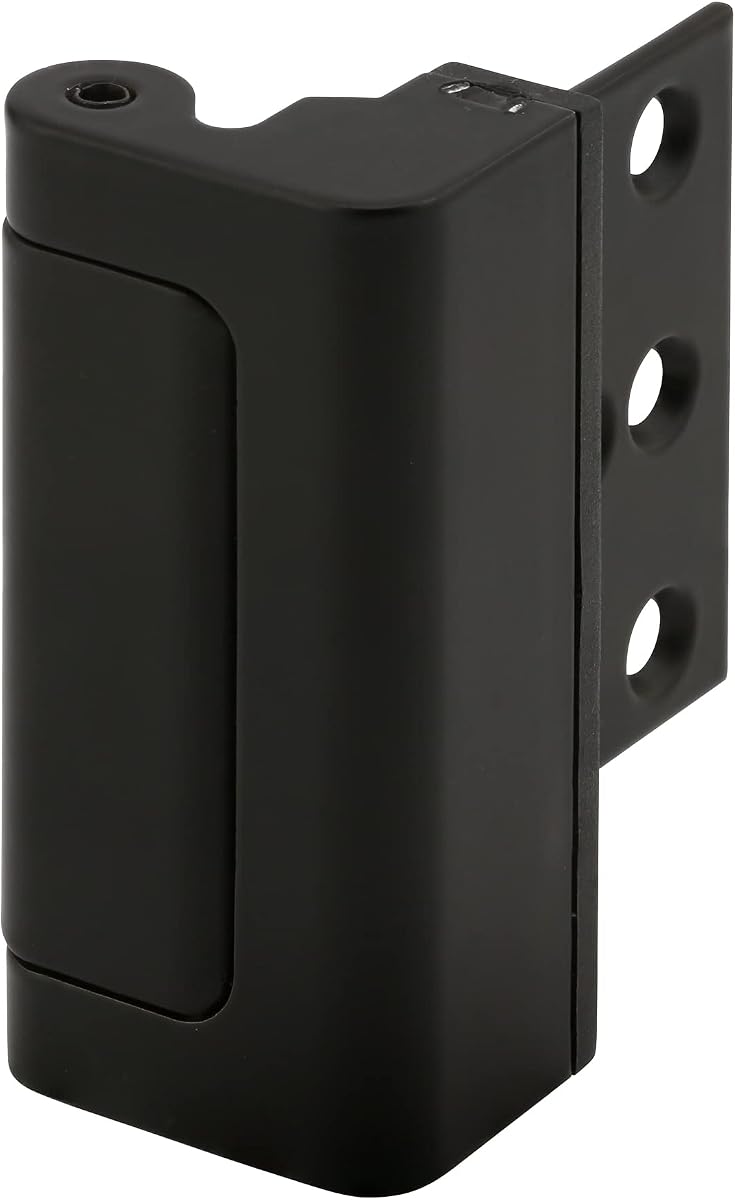
Key specs: Aluminum-body door reinforcement lock rated by the listing to withstand 800 lb of force; ships with 3-inch hardened screws for anchoring into the door frame; described as tamper-resistant against picking and bumping; mounts on the door jamb as a supplement to the deadbolt, not a replacement for it
This is not a deadbolt, and we are not presenting it as a substitute for one – it is the product that addresses the frame side of the problem the three deadbolts above do not touch. The listing describes an aluminum-body door reinforcement lock rated to withstand 800 lb of force, installed on the door jamb with 3-inch hardened screws that reach past a thin jamb into the structural framing behind it, and marketed as tamper-resistant against both picking and bumping in its own right. It engages independently of whatever deadbolt is already on the door, so it works alongside any of the three picks above rather than replacing one of them. If you are installing any of this hardware for the first time, our deadbolt installation guide and our door security bar guide cover the two other low-cost layers worth stacking alongside it.
✅ Pros
- By far the largest review base of anything in this article, and an Amazon’s Choice pick in its category
- 800 lb force rating and 3-inch hardened screws directly address the strike-plate weakness none of the three deadbolts above solve on their own
- Cheap enough to add without replacing an existing, otherwise-adequate deadbolt at all
- Installs in minutes with common tools, according to the listing’s own installation notes
❌ Cons
- It is not a deadbolt and does not replace one – it only functions as an additional interior block, and only when someone engages it from inside
- Some buyers report the included screws can strip under an impact driver; several substitute their own hardware, per the listing’s own reviews
- Only useful on inswing doors, and only while it is engaged – it offers nothing while you are away and the door is simply locked
No Residential Deadbolt Is Actually Unpickable
It would be dishonest to close this article without saying plainly what “pick-resistant” and “drill-resistant” actually mean in testing terms, because it is not what the marketing language implies. UL 437, the certification standard Kwikset cites for its SmartKey line, does not require a lock to resist picking indefinitely – it requires resisting a defined set of tools and techniques for a specified window, ten minutes for door locks and cylinders at the standard’s tested levels. That is a real, meaningful bar against a casual attempt with common tools. It is not a claim that the lock cannot be opened by someone sufficiently skilled, equipped and unhurried.
What These Features Actually Buy You
✅ A real, honest improvement
- Raises the tool set and skill level a casual intruder needs, past what most opportunistic break-ins bring
- Removes the cheapest, fastest bypass methods – an inexpensive bump key or a five-minute drill job on an unprotected cylinder
- Closes the gap between the lock’s rating and the door’s actual weak point, when paired with a reinforced strike plate
❌ Not what it is not
- A guarantee against a determined, skilled or well-equipped intruder given enough uninterrupted time
- A substitute for securing the rest of the opening – a nearby window, a glass panel, or a weak frame the strongest deadbolt is still bolted into
- A reason to skip the strike plate and screws – the lock and the frame are one system, not two independent purchases
None of that is an argument against buying better hardware. It is the reason to buy the hardware and the reinforcement together, and to treat a locked door as one layer in a system rather than the whole system.
Final Recommendation
Start with the frame, not the lock. If your current strike plate is held in with the short screws most builders use, buy the Prime-Line U 11449 Door Reinforcement Lock first – it is the cheapest item here and it fixes the single most common actual failure point in a forced entry.
For the deadbolt itself, the Schlage B62N Deadbolt is the default recommendation: every feature on our checklist is stated in the manufacturer’s own documentation, and the strike reinforcer ships in the box. Choose the Kwikset 980 SmartKey Security Deadbolt instead if a double-cylinder lock is not right for your door, or if the SmartKey re-keying feature matters to you specifically. Reach for the Mul-T-Lock Cronus High Security Deadbolt only if you have a specific reason to want a step above what either mass-market brand offers – a documented attempted entry, a street-level unit, or a need for real key control – because the price and the key-duplication hassle are real costs, not hypothetical ones.
SafeBode does not yet run an in-house product testing program. This guide is built from manufacturer specifications, official support documentation, current retail listings and verified buyer feedback rather than hands-on testing, and we say so plainly rather than implying testing we have not done.
Frequently Asked Questions
Does a higher ANSI/BHMA grade mean a lock is harder to pick or bump?
Not directly. ANSI/BHMA grades and the residential Secure Home A/B/C ratings measure impact force, cycle durability and finish resistance. Pick and bump resistance come from specific cylinder design choices that sit outside those tests entirely, which is why a Grade 2 lock can genuinely be harder to pick than a Grade 1 one.
What does bump resistance actually mean?
Lock bumping exploits the spring-loaded pins in an ordinary pin-tumbler cylinder using a specially cut key and a sharp tap. A bump-resistant design replaces that mechanism with something a bump key has nothing to strike against, such as a sidebar or slide-locking bar system instead of a plain pin stack.
What does anti-drill actually protect against?
Drilling out the pins directly above the cylinder’s shear line is one of the fastest ways to defeat a cheap lock. An anti-drill plate or pin is a piece of hardened steel positioned to blunt or deflect a standard drill bit rather than letting it walk straight through to the pin stack.
Why does bolt throw length matter?
The bolt throw is how far the bolt extends into the strike opening. A longer throw, typically a full inch on a residential Grade 1 deadbolt, gives more material for the door and frame to resist a kick-in force, rather than shearing off closer to the door edge.
Is a reinforced strike plate really as important as the lock itself?
In most forced entries, yes. The strike plate and the screws holding it into the door jamb are frequently the actual failure point, not the bolt. Screws that only reach the thin jamb wood rather than the structural framing behind it can pull free under a kick, regardless of how good the deadbolt is.
Should I buy a single-cylinder or double-cylinder deadbolt?
It depends on whether your door has glass within reach of the interior thumb-turn, and on your local fire code’s stance on keyed interior egress. Our single vs. double cylinder guide covers the tradeoff in full; this article is not a substitute for reading it before you choose the Schlage pick above.
Can any residential deadbolt be made truly pick-proof?
No. Certification standards like UL 437 test resistance for a defined window against a defined tool set, not indefinite resistance against any attacker. High-security features raise the time and skill required; they do not make forced entry impossible.
Do I need to replace my strike plate if I already own a Grade 1 deadbolt?
Check it before assuming you don’t. A Grade 1 or A-rated deadbolt fitted into a strike plate held by short screws is not a Grade 1 door – the bolt will hold and the surrounding wood will not. A reinforcement product or longer screws is a five-minute fix either way.
What is the real difference between ‘Grade 1’ and hardware marketed as ‘high security’?
Grade 1 is a certification level within the ANSI/BHMA testing program. ‘High security’ as used by brands like Mul-T-Lock typically refers to a patented cylinder platform and key control that sit outside the standard grading system entirely, which is why a high-security lock can carry a lower headline grade while still being harder to pick.
Sources
Show sources (9)
- [1] Schlage – “Single Cylinder Deadbolt” B60 series product page, schlage.com/en/home/products/B60FFF.html
- [2] Schlage – “B600 Series Grade 1 Deadbolts,” commercial.schlage.com/en/products/mechanical-locks/b600-series-grade-1-deadbolts.html
- [3] Kwikset – “SmartKey Security,” kwikset.com/smartkey-security
- [4] Kwikset – “Kwikset Reveals Latest Innovation in Residential Locks for Improved Home Security and re-Keying Convenience” (BumpGuard press release), kwikset.com/about-kwikset/news-press/press-releases/2008/02/11/kwikset-reveals-latest-innovation-in-residential-locks-for-improved-home-security-and-re-keying-convenience
- [5] Kwikset – “980 Deadbolt Lock, Keyed One Side, Featuring SmartKey” product page, kwikset.com/products/detail/980-deadbolt-keyed-one-side-featuring-smartkey
- [6] SafeWise – “Top 4 Best Door Locks to Prevent Break-Ins,” safewise.com/resources/best-door-locks/
- [7] Amazon product listing – Mul-T-Lock Cronus High Security Grade 2 Deadbolt, amazon.com/dp/B01N1EVVQV
- [8] Amazon product listing – Prime-Line U 11449 Door Reinforcement Lock, amazon.com/dp/B0BHN3PJPR
- [9] Lockwiki – “UL 437,” lockwiki.com/index.php/UL_437


