Schlage Door Locks: Which One Actually Fits Your Door
Affiliate Disclosure: This article contains affiliate links. If you buy through these links, we may earn a commission at no extra cost to you. Our editorial opinions are our own and are not influenced by affiliate relationships. Read our full disclosure policy →
Contents
Quick Answer
Buy the Schlage Encode if you want remote access, the Camelot BE365 if you want a keypad with no app or account, the Touch BE375 if you want no keyhole at all, and the B60N deadbolt if you want the strongest bolt with no electronics in it whatsoever. The question is not which is best — it is how much technology you actually want on your door.
How the Schlage range is organized
Schlage is a lock manufacturer that added electronics, rather than an electronics company that added a lock. That shows in the hardware: the deadbolt itself is the same well-regarded mechanism across the range, and the model number mostly tells you what sits on top of it.
The two halves of the range
Keypad-only models
- No app, no account, no network
- Codes entered at the door
- Noticeably longer battery life
- Nothing to update or breach
Which Schlage to buy
Schlage’s residential range really comes down to one question: how much electronics do you actually want on your front door? If you have not settled on Schlage specifically, our broader keyless entry lock guide compares them against Kwikset and the budget brands first. These four answer that question differently, and the most expensive is not automatically the right one. If you are weighing a lock against the other upgrade people consider first, we compare them directly in video doorbell vs. smart lock.
Schlage Encode Smart WiFi Deadbolt — Best if you want remote access
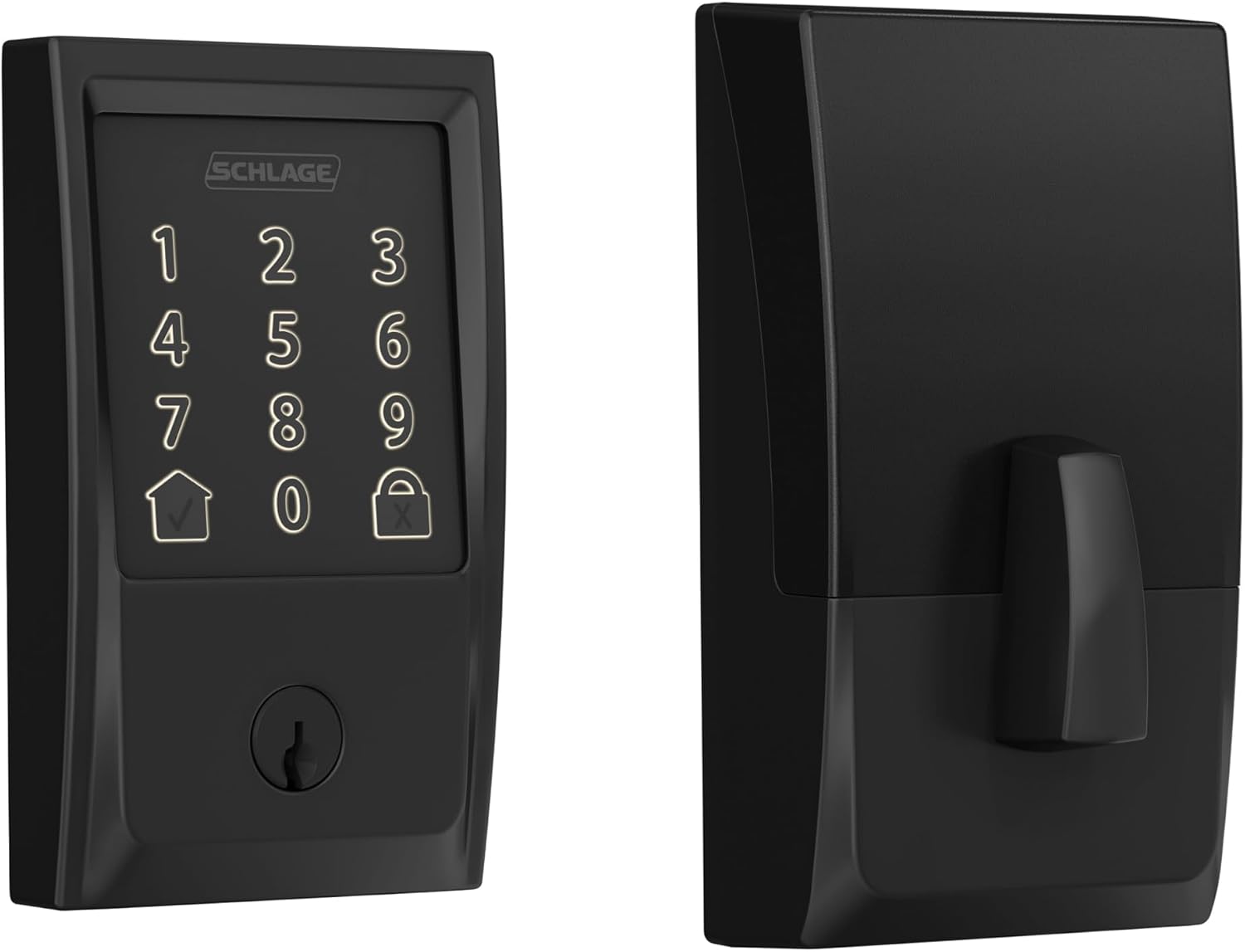
Key specs: built-in WiFi, no hub needed · app and keypad · Greenwich trim · battery powered
This is Schlage’s flagship and the only one here with WiFi built in, which matters more than it sounds: most connected locks need a separate bridge or hub to reach the internet, and the Encode does not — Schlage states its built-in WiFi needs no additional accessories. You get remote lock and unlock, access codes you can issue and revoke from anywhere, and a record of who came and went. It is also the most-reviewed lock in Schlage’s range by a wide margin, so you are buying into well-understood hardware rather than a first generation.
✅ Pros
- WiFi built in — no hub or bridge to buy
- Remote access and code management from anywhere
- Keypad still works if your internet is down
- By far the largest review base in the Schlage line
❌ Cons
- The most expensive lock here
- WiFi draws more battery than a keypad-only lock
- Needs an account and an app to use the connected features
- Overkill if you never actually need remote access
Schlage Camelot Keypad Deadbolt (BE365) — Best keypad without an app
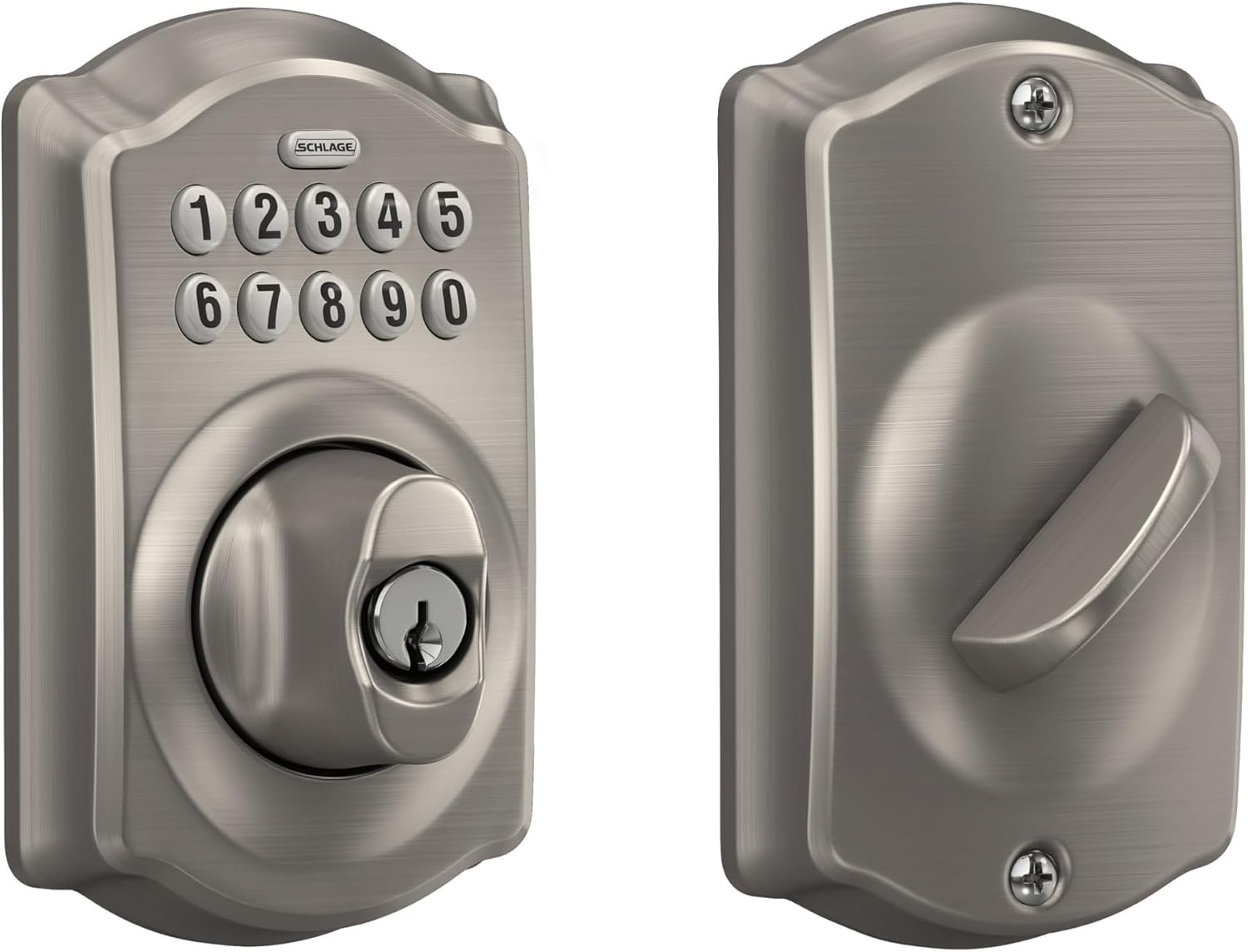
Key specs: physical keypad · no app, no WiFi, no account · Camelot trim · keyed override
The BE365 is the lock to buy if the appeal of keyless entry is not having to carry a key — not managing your door from a phone. There is no app, no account, no firmware and no radio. You program codes on the keypad itself. That also means nothing to update, nothing to be breached, and batteries that last dramatically longer than any connected lock, because the lock is asleep until someone touches it. For a back door, a garage door or a rental you manage, this is often the smarter buy.
✅ Pros
- No app, no account, no firmware to maintain
- Battery life far longer than any connected lock
- Nothing to hack remotely — there is no radio
- Keyed override still fits a normal Schlage key
❌ Cons
- No remote access at all
- Codes must be changed at the door, not from a phone
- No record of who came and went
- Physical buttons wear visibly over years, hinting at your code
Schlage Touch Deadbolt (BE375) — Best for no keyhole at all
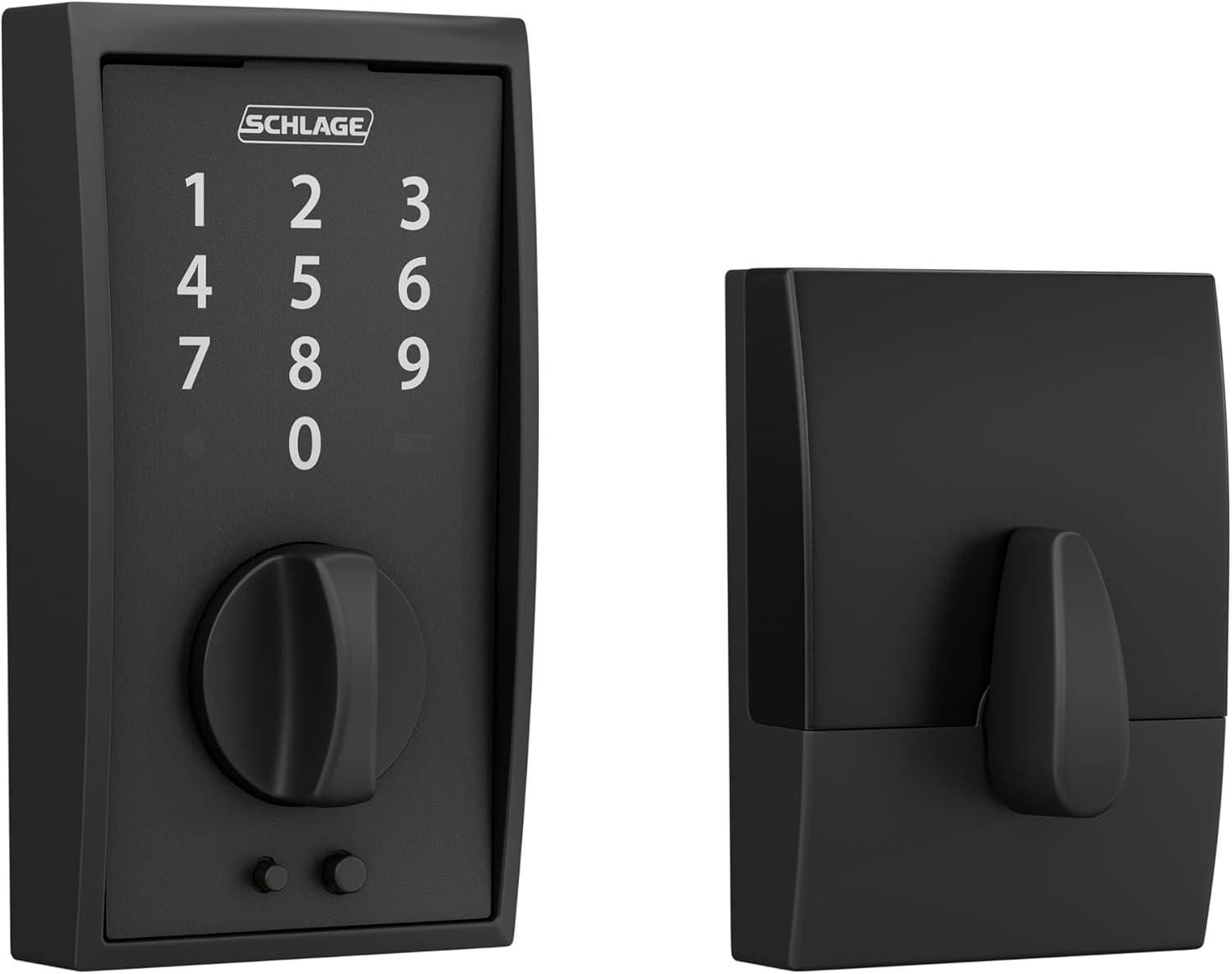
Key specs: capacitive touchscreen · genuinely keyless — no keyhole at all · Century trim
The Touch removes the keyway entirely. That is the point: a lock with no keyhole cannot be picked, bumped or drilled through the cylinder, because there is no cylinder — Schlage describes it as a cylinder-free design with no keyway to bump or pick. There is no physical key backup, but a dead internal battery does not remove every way to unlock it. The BE375 has external contacts for a fresh 9-volt alkaline battery; keep that battery against the contacts while entering a valid user code and turning the thumbturn. Replace the depleted internal battery after opening the door. Schlage warns that the lock stays unlocked until you replace that battery or manually relock from inside. The smooth touchscreen also avoids the worn-button problem that eventually gives away a keypad code.
✅ Pros
- No keyhole means no picking, bumping or cylinder drilling
- Touchscreen shows no wear pattern to reveal your code
- No app or account needed
- Clean look with no visible keyway
❌ Cons
- No physical key override; emergency access needs a fresh 9-volt alkaline battery and a valid user code
- Replace the internal battery when warned; the jump-start contacts are an emergency option
- No remote access or usage history
- Touchscreens can be awkward with wet or gloved hands
Schlage B60N Single Cylinder Deadbolt — Best pure security, no electronics
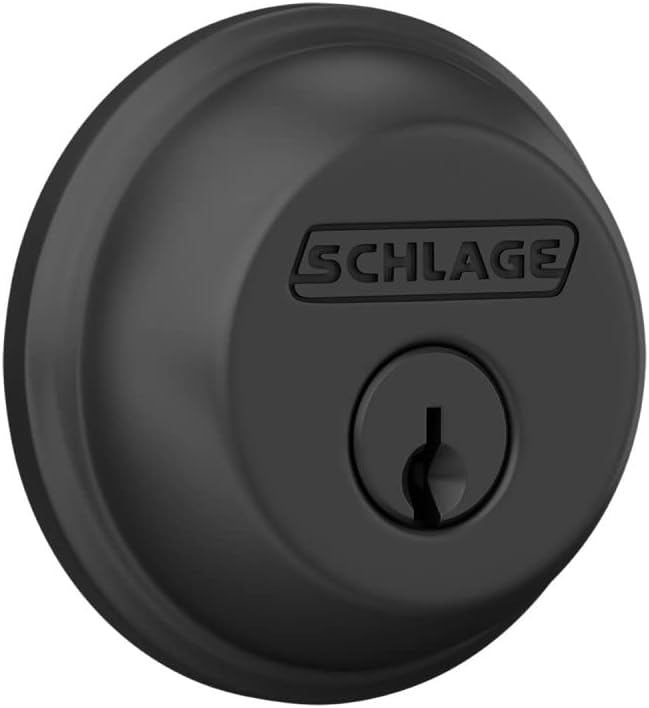
Key specs: mechanical deadbolt · no electronics · no batteries · keyed one side
Worth saying plainly in a guide full of keypads: the highest-security option Schlage sells for a residential door has no electronics in it whatsoever, and it still carries Schlage’s highest residential security rating. No batteries to die in a cold snap, no firmware, no radio, no app, and nothing that stops working when a company changes its cloud service. If what you actually want is the strongest possible bolt on a front door and you are happy carrying a key, this is the honest answer — and it costs a fraction of any lock above.
✅ Pros
- No batteries, ever — nothing to die at the wrong moment
- Nothing to update, breach or discontinue
- Cheapest lock in this guide by a wide margin
- Very large review base over many years
❌ Cons
- You have to carry a key
- No codes to share with a cleaner, guest or contractor
- No remote access or history
- Rekeying needs a locksmith or a rekey kit
The four side by side
| Lock | Connectivity | Key backup | Batteries | Best for |
|---|
| Encode Smart WiFi | WiFi built in, no hub | Yes, keyed | Yes | Remote access and shared codes |
| Camelot BE365 | None | Yes, keyed | Yes | Keyless entry with no app or account |
| Touch BE375 | None | No physical key; external 9V battery jump-start with a valid code | Yes | Removing the keyway as an attack surface |
| B60N Deadbolt | None | Key only | None | Maximum security with zero electronics |
The part nobody mentions: your door frame
Choosing between Schlage and Kwikset occupies most of the discussion, and it is close to the least important decision you will make. Both meet mainstream residential security grades. What actually decides whether a locked door holds is the frame it sits in.
- Strike plate screws. Most doors ship with short screws that bite only into the door jamb. Three-inch screws that reach the wall stud behind it are the single cheapest security upgrade available, and they cost less than a coffee.
- Bolt throw. A deadbolt that does not fully extend into the frame is doing a fraction of its job. If you have to lift the door to turn the key, the alignment is off.
- Frame material. A superb lock in a soft or rotten frame fails at the frame. Check the wood around the strike before spending on the lock.
Fit the good lock, by all means. Then spend ten minutes and a few dollars on the frame — it is the half of the job that the brand comparison never covers. The same reasoning applies to the other opening most homes leave weak: our guide to securing a sliding glass door covers the frame and track fixes that matter more than the lock hanging on them.
What the grade on the box actually tells you
Schlage locks carry an ANSI/BHMA grade, and it is the one genuinely comparable rating across brands — provided you read the right scale. Grades 1, 2 and 3 apply to commercial hardware. Residential deadbolts and locksets are certified under ANSI/BHMA A156.40 and A156.39 and graded A, B or C — Best, Better and Good — under BHMA’s Secure Home program.
Two things follow that most brand comparisons skip. First, on a residential lock you are looking for an A or B rating rather than a grade number, and the rating is awarded per category — security, durability and finish are scored separately, so one lock can be Best for security and only Good for finish. Second, and more usefully: the grade measures the lock mechanism, not the electronics. It says nothing about the keypad, the app, the radio or the firmware.
So when a Schlage and a newer competitor both show the same grade, that number is telling you they are comparable as locks. Everything that differs — app quality, update support, how long the company will still be around — sits outside what the grade covers.
Before you buy: check the door
Schlage or otherwise, a deadbolt swap only works if the door is standard. Worth five minutes before ordering.
- Backset — door edge to bore-hole center, usually 2⅜ or 2¾ inches. Most locks ship adjustable for both, but a non-standard door will need checking against the specific model before you order.
- Door thickness — standard is 1⅜ to 1¾ inches; thicker needs an extension kit.
- Bore diameter — 2⅛ inches is standard. Smaller means drilling.
- Strike plate — if the frame is soft or split, fix that first.
For the wider comparison beyond Schlage, see our keyless entry lock guide and the no-subscription roundup.
One last practical note. Schlage sells the same lock in several finishes and trims, and the model name often changes with the trim rather than the mechanism — Camelot, Century, Greenwich and so on describe the visible plate, not the lock inside it. If you are comparing two Schlage listings that look different but carry the same core model number, the difference is usually cosmetic. Match the finish to the handle set already on the door and treat the trim name as a styling choice, not a security one.
Final Recommendation
Start with the Camelot BE365 unless you have a specific reason not to. It delivers the thing most people actually want from a keyless lock — no key to carry, codes you can hand to a cleaner or a guest — without an app, an account, a radio or the shorter battery life that comes with one. For most front doors it is the right amount of technology, and the money saved is better spent on the frame.
Move up to the Schlage Encode only if you will genuinely use remote access: letting someone in while you are out, issuing and revoking codes from your phone, or seeing who came and went. If you would never use those, you are paying for a radio that mostly drains batteries. Choose the Touch BE375 instead when removing the keyway is the point, and plan for its keyless backup: a fresh 9-volt alkaline battery at the external contacts plus a valid user code can provide emergency access if the internal battery is depleted. And if you are happy carrying a key, the B60N deadbolt is the honest answer: the strongest bolt here, nothing to update or discontinue, and the cheapest lock in the guide.
Whichever you pick, do the frame work the same afternoon. Three-inch strike plate screws that reach the stud behind the jamb cost almost nothing and do more for the door than the difference between any two locks on this page.
Frequently Asked Questions
Does the Schlage Encode need a hub?
No. WiFi is built into the lock, which is the main practical advantage over rivals that still require a separate bridge.
Is Schlage more secure than Kwikset?
Both make deadbolts that meet mainstream residential security grades. In practice the bigger security variable is your door frame and strike plate, not the brand on the lock.
Can I rekey a Schlage myself?
Some models support DIY rekeying and some do not — check the specific model. Kwikset’s SmartKey system is generally the easier of the two.
How do I reset one?
Procedure varies by model. We have a full walkthrough for the equivalent Kwikset range in our reset guide.
What ANSI grade are Schlage residential deadbolts?
Schlage’s residential deadbolts are generally graded for home use. Check the specific model, since the grade varies across the range.
Does the grade cover the electronics?
No. It measures the lock mechanism. Keypad, app, radio and firmware all sit outside what the grade tests.
Will a Schlage fit my door?
If the door is standard, yes. Check backset, thickness and bore diameter first.
Is Schlage or Kwikset easier to rekey?
Kwikset’s SmartKey system is generally the easier of the two for DIY rekeying. Schlage support varies by model.
Sources
Show sources (5)
SafeBode does not yet run an in-house product testing program. This guide is built from manufacturer specifications, current retail listings and verified buyer feedback rather than hands-on testing, and we say so plainly rather than implying testing we have not done.


