Best PTZ Security Cameras 2026: Pan, Tilt, Zoom, and What Auto-Tracking Really Does
Affiliate Disclosure: This article contains affiliate links. If you buy through these links, we may earn a commission at no extra cost to you. Our editorial opinions are our own and are not influenced by affiliate relationships. Read our full disclosure policy →
Contents
Quick Answer
One motorized camera can watch an area that would take three fixed ones, but only one slice of it at a time. Two specs decide which PTZ to buy. First, whether the zoom is optical or digital: optical zoom changes the lens’s focal length without compromising image quality, while digital zoom enlarges pixels you already captured. Second, how the motor is powered, because panning on demand is a real electrical load. Our default pick is the Reolink RLC-823S1, a PoE camera with a genuine 5X optical zoom. Take the TrackMix PoE if tracking matters more than reach, the Argus PT Ultra if no cable can get there, and the Jennov 20X if you must identify someone at the far end of a property.
What a PTZ Camera Actually Does
Pan, tilt and zoom describes three motors, not a picture-quality tier. The body rotates horizontally, the head angles up and down, and on the better models the lens itself moves. Reolink rates the RLC-823S1 for a full 360 degrees of pan and 90 of tilt, covering that entire range in about four seconds. It holds one guard position plus up to 64 presets, and can run a patrol route through as many as 16 of them — a genuinely different class of coverage from a fixed camera bolted under a soffit.
The catch is the thing no product page leads with: at any instant, a PTZ points in exactly one direction. A 16-point patrol does not watch 16 places at once; it visits them in turn, and the other 15 are unmonitored while it does. Good camera layouts are built on overlap — Security.org is explicit about using overlapping coverage zones, where one camera’s field of view begins where another’s ends. A camera that swings 90 degrees to follow a delivery van has removed itself from that overlap for as long as the van holds its attention.
So the useful mental model is not “a PTZ replaces four cameras” but “a PTZ is the one camera that can go and look at something.” If you have not settled which spots need permanent coverage first, our room-by-room camera placement walkthrough covers the fixed layer this one sits on top of.
Optical Zoom vs. Digital Zoom: The Most Oversold Spec Here
Every listing here shouts a zoom number, and the number alone tells you almost nothing. Optical zoom means the camera physically changes its focal length while holding focus, so you see more detail without giving up image quality. Digital zoom means software is enlarging a crop of a frame the sensor already captured. The pixels do not multiply — it is the same picture, closer up and coarser.
Same “10X” Sticker, Two Different Products
🔍 Optical zoom — real glass moves
- The lens changes focal length and holds focus as it does
- Detail improves as you zoom; a face or a plate can become readable
- Needs a motorized varifocal lens, which is why these models cost more
- The RLC-823S1 runs 2.7-13.5mm, narrowing its field from 100 to 31 degrees
🖥️ Digital zoom — software crops
- The lens is fixed; the image is cropped and enlarged after capture
- Detail never improves — it gets larger and softer
- Free to implement, which is why every battery camera advertises it
- The Argus PT Ultra’s spec sheet lists a fixed 90 degree lens
A third label is worth decoding, because one of our picks uses it. “Hybrid zoom” means the camera reaches part of the way with optics and the rest with a crop. Reolink’s TrackMix PoE carries two fixed lenses, a 2.8mm wide-angle and an 8mm telephoto, and markets the pair as 6X hybrid zoom. The step from 2.8mm to 8mm is real optical gain, but it is a jump between two fixed lenses rather than a continuous range like the RLC-823S1’s motorized lens. Both are useful; they are not the same thing, and the marketing does not distinguish them.
| Camera | Lens | What the zoom actually is | Narrowest horizontal field |
|---|
| Reolink RLC-823S1 | 2.7-13.5mm motorized | 5X optical, continuous | 31 degrees |
| Reolink TrackMix PoE | 2.8mm wide + 8mm telephoto | 6X hybrid — two fixed lenses plus crop | 38 degrees |
| Reolink Argus PT Ultra | Fixed lens | Digital crop only, no optical zoom | 90 degrees, fixed |
| Jennov 4K PoE PTZ | 4.7-94mm motorized | 20X optical, continuous | Not published by the seller |
One nuance in digital zoom’s favor, because the honest version is not “digital zoom is useless.” A 4K sensor captures roughly four times the pixels of a 1080p one, so cropping a 4K frame leaves far more usable detail. That is why the wire-free pick here is 4K: resolution is doing the work the lens cannot. Our guide to 4K security cameras covers where the extra pixels stop helping.
What Auto-Tracking Really Does, and What It Stops Doing
Auto-tracking is the feature that sells PTZ cameras and the one most likely to surprise you after installation. The camera detects a moving person, vehicle or animal and physically follows it across the scene. That part works about as advertised. What buyers do not anticipate is what the camera stops doing while it happens.
What Happens During a Tracking Event
1
Detection fires
Motion is classified as a person, vehicle or animal, and tracking engages.
2
One subject is chosen
If several objects move at once, Reolink cameras follow the highest-priority type first and only pick up the others once the earlier ones disappear.
3
The camera leaves its post
It pans and tilts to keep that subject framed, so whatever it watched before is now out of view.
4
It waits, then returns
When the subject stops or leaves, the camera holds the last tracked position for a user-set 10 to 60 seconds before returning to its monitor point.
Steps 2 and 4 are the ones to plan around: a PTZ follows one thing at a time, and does not snap back the instant an event ends.
Reolink documents both behaviors plainly. Its tracking-priority setting exists precisely because the camera cannot follow two subjects: you rank person, vehicle and animal, and it tracks the top-ranked one, moving to the next only once the previous object disappears.
Put those together and you get the failure mode this article is built around. A car pulls into the driveway, the camera swings to follow it, someone walks up to the front door from the other side, and for the next half minute the camera is still pointed at the car. It is not broken — it is doing the only thing one motorized camera can do. Anyone who has watched a camera chase a bird across a yard has seen the harmless version.
Three mitigations are worth setting up on day one rather than after an incident. Define a monitor point — the position the camera returns to — so its default view is the entrance that matters, not wherever the last squirrel went. Use the horizontal tracking range limits to stop it following anything into the street or a neighbor’s yard. And on a dual-lens model, pick the tracking method deliberately: in Reolink’s Digital Tracking mode the camera crops a close-up of the subject inside the wide lens’s field of view and does not pan or tilt at all, even if the subject leaves the frame — you trade following for the guarantee that it never abandons its post.
PoE, Solar or Battery: A Motor Changes the Power Math
A fixed camera draws a small, steady load. A PTZ adds motors that spin up on demand, a motorized lens on the optical-zoom models, and infrared LEDs at night. That changes what you have to supply, and it is the most common reason a PTZ install disappoints.
On the wired side, the number that matters is which Power over Ethernet standard the camera expects. TP-Link’s breakdown is a clean reference: 802.3af delivers up to 15.4W at the switch and about 12.95W at the device, while 802.3at — sold as PoE+ — delivers up to 30W at the switch and 25.5W at the device. TP-Link puts IP cameras with infrared night vision, motorized lenses or onboard analytics in the 10 to 25W band, which is PoE+ territory rather than plain PoE.
The Numbers That Decide Your Install
15.4W
802.3af PoE, maximum at the switch port
30W
802.3at PoE+, maximum at the switch port
21.6Wh
Battery in the Argus PT Ultra
33 ft
Maximum PIR detection range on that battery model
Sources and. Our two wired picks differ too: Reolink specifies 802.3at for the RLC-823S1 and 802.3af for the TrackMix PoE [1, 2].
The difference between our own two wired picks is not a detail. The RLC-823S1’s specification table lists IEEE 802.3at; the TrackMix PoE’s lists IEEE 802.3af. On an inexpensive af-only switch, one of those cameras is a straightforward plug-in and the other is not. Check the per-port rating and the total budget across all ports before you buy — our PoE camera guide covers how to read a switch’s power budget. Jennov’s listing for the 20X model does not state which PoE standard it needs, which is reason enough to give it a PoE+ port with headroom rather than assume.
On the wireless side the trade is different. Reolink pairs the Argus PT Ultra with a 21.6Wh battery and a detachable 3W solar panel, and states that roughly 20 minutes of daily sunlight keeps it powered year-round — the manufacturer’s figure for good conditions, and short winter days with snow on the panel are not good conditions. Two specs show how the design copes: it records on motion triggers rather than continuously, and its PIR sensor reaches only about 33 ft. A battery PTZ is not panning all day; it sleeps, wakes on a nearby trigger and moves. The constraint we covered in our look at the Argus PT Solar applies to its 4K sibling, and the broader solar camera roundup covers why panel placement matters more than panel wattage.
| Power route | Install cost | Capability cost | Best suited to |
|---|
| PoE, 802.3at | Ethernet run plus a PoE+ switch with headroom | None — full-time recording, motors always available | A permanent overview camera you will keep for years |
| PoE, 802.3af | Ethernet run; works on cheaper switches [2, 7] | Usually a lighter motor and lens | Adding a PTZ to an af-only switch |
| Solar plus battery | No wiring, but the panel needs real sun | Motion-triggered recording, short PIR range, no optical zoom | Sheds, gates and anywhere trenching is not happening |
Reolink RLC-823S1 — best overall
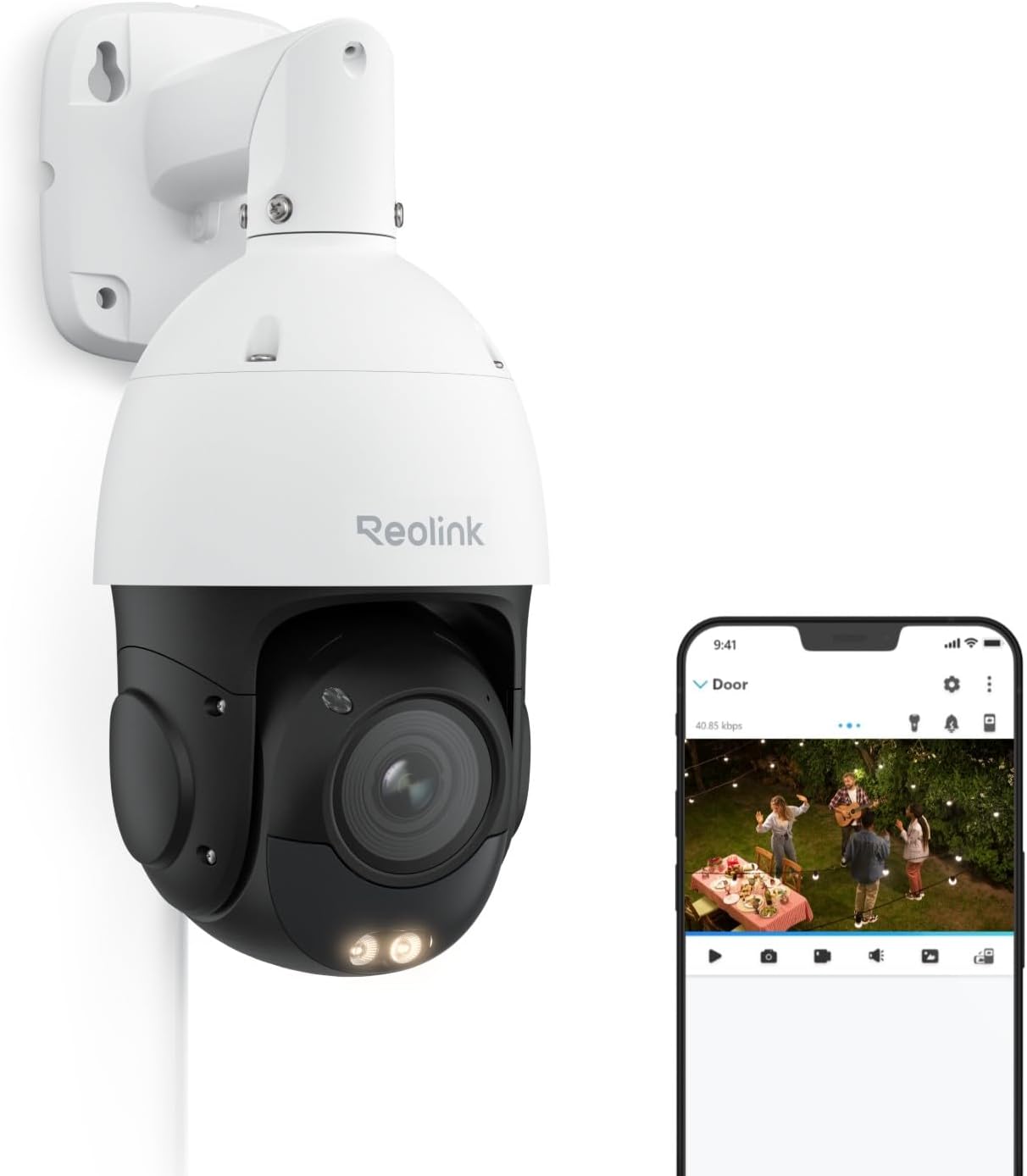
Key specs: 4K PoE PTZ camera; 5X optical zoom on a 2.7-13.5mm motorized lens; 360 degree pan, 90 degree tilt; auto tracking; 64 presets and a 16-point patrol; IEEE 802.3at PoE; microSD up to 512GB; IP66
This is the pick if you want what a PTZ is genuinely good at, without the compromises the other three make. It is the only camera here with a continuous motorized optical zoom in a sensible range for a house: 2.7 to 13.5mm, rated 5X optical, narrowing the horizontal field from 100 degrees to 31. It pans a full 360 degrees, tilts 90 and covers its whole range in about four seconds. Storage is local, on microSD or a Reolink NVR, with no subscription. Confirm your switch first: the specification table calls for IEEE 802.3at, not plain 802.3af. Our wired camera system guide lays out the fixed-camera alternative.
✅ Pros
- The only pick with a true continuous optical zoom, so detail improves as you zoom [1, 6]
- One guard position, up to 64 presets and a 16-point patrol route
- Local storage on microSD or an NVR, no subscription to record
- IP66 housing and a bracket for wall or ceiling mounting
❌ Cons
- Needs an 802.3at PoE+ port — an af-only switch is not enough [1, 7]
- Single lens, so while it is zoomed in the wide view is genuinely gone
- Wired install: you are pulling Ethernet to wherever it goes
- Same one-subject-at-a-time tracking limit as every camera here
Reolink TrackMix PoE — tracking without losing the scene
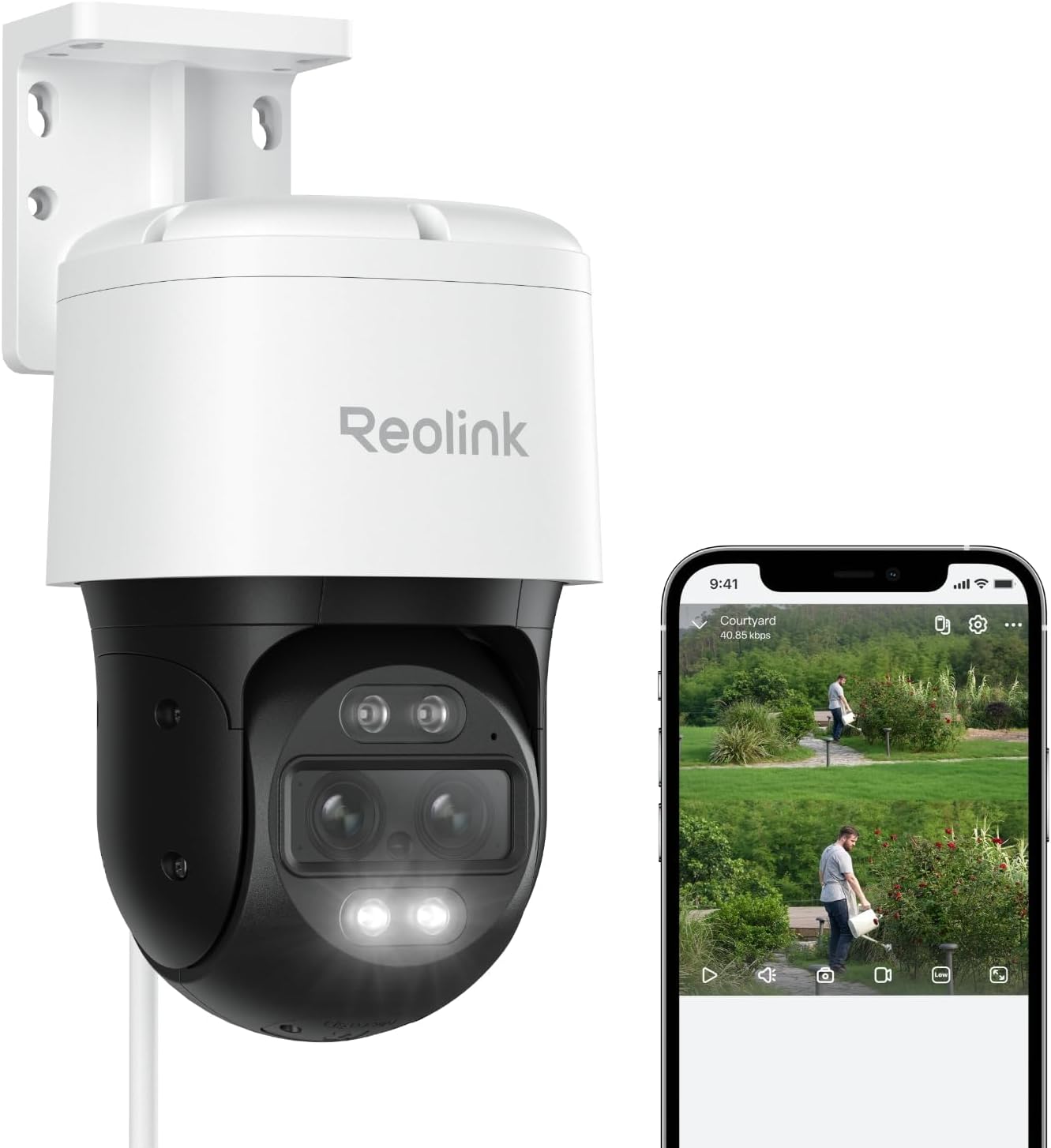
Key specs: 4K dual-lens PoE PTZ camera; 2.8mm wide-angle plus 8mm telephoto lens; 6X hybrid zoom; 355 degree pan, 90 degree tilt; three tracking methods; IEEE 802.3af PoE; microSD up to 512GB; IP65
The TrackMix PoE solves the exact problem the auto-tracking section describes, which is why it earns a slot rather than being a cheaper version of the pick above. It carries a 2.8mm wide-angle and an 8mm telephoto lens, and tracks a subject in both views at once, so you get the close-up and the context on one screen. Better still, its Digital Tracking method crops that close-up inside the wide lens’s field of view without panning or tilting at all — tracking on a camera that never leaves its assigned view. It runs on ordinary 802.3af PoE. Be clear-eyed about the zoom, though: 6X hybrid is a step between two fixed lenses plus a crop, not a continuous optical range.
✅ Pros
- Dual lenses give the close-up and the wide scene at once, which no single-lens PTZ can
- Digital Tracking follows without moving the camera, so it never abandons its post
- Runs on standard 802.3af PoE, so an inexpensive switch is fine [2, 7]
- Three tracking methods let you tune how aggressively it follows
❌ Cons
- 6X hybrid is not 6X optical — it is a jump from 2.8mm to 8mm plus crop
- Pans 355 degrees rather than 360, leaving a small dead sector behind it
- IP65 rather than the IP66 on the other two wired picks [1, 2]
- The telephoto lens is fixed, so no intermediate framing
Reolink Argus PT Ultra — where no cable can reach
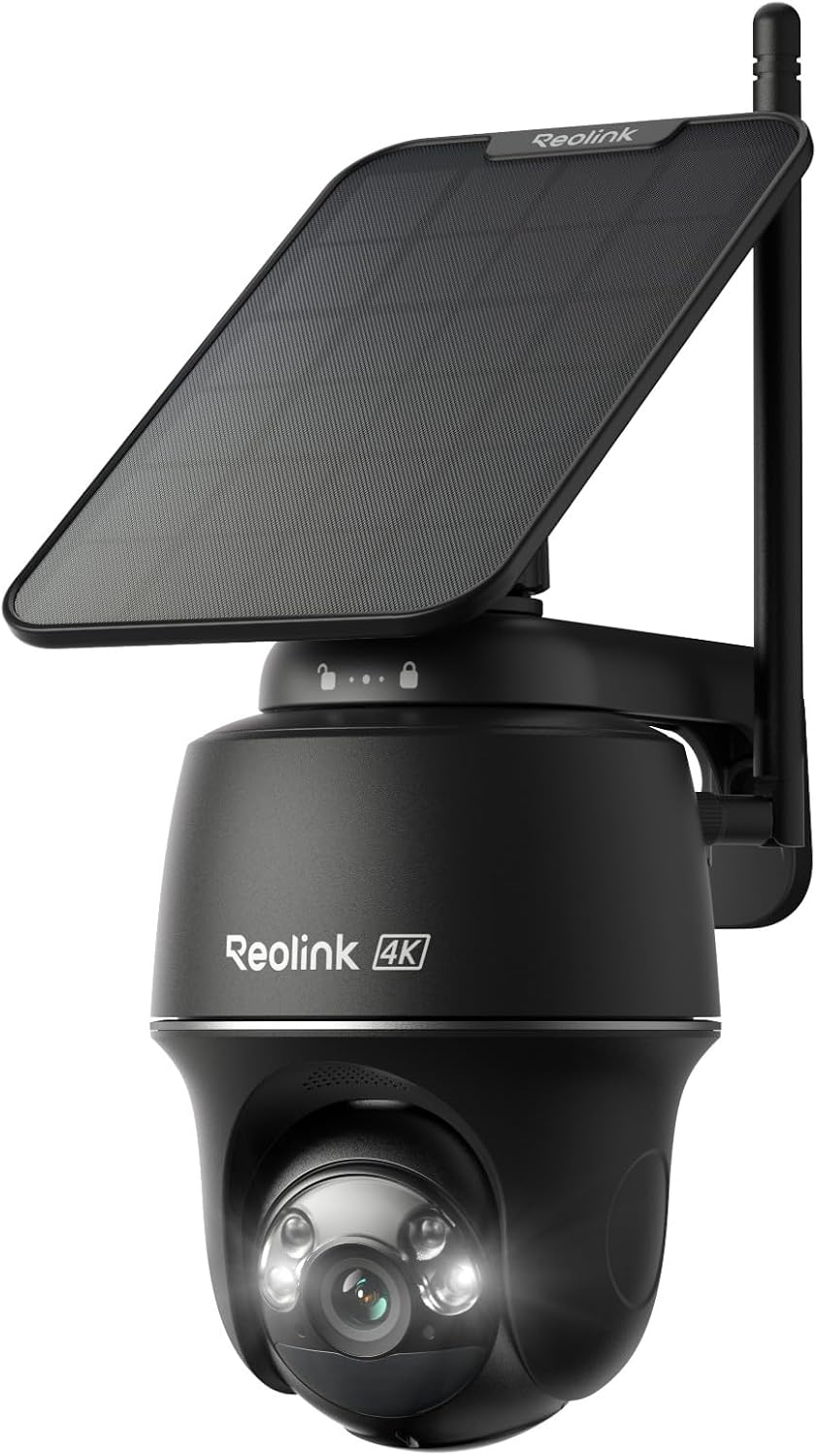
Key specs: 4K wire-free pan and tilt camera; fixed 90 degree lens, no optical zoom; 355 degree pan, 140 degree tilt; 21.6Wh battery with a detachable 3W solar panel; PIR range up to 33 ft; dual-band wifi; microSD up to 512GB; IP65
Pick this one when the honest constraint is wiring, not optics. It runs on a 21.6Wh battery with a detachable 3W solar panel that can be mounted away from the camera or strapped to a pole without drilling. Pan is 355 degrees and tilt a generous 140, useful on a shed or gatepost where a fixed camera would need perfect aiming. Now the part the listing does not lead with: the specification table lists a fixed lens with a 90 degree horizontal field. There is no optical zoom here at all, so every zoom is a crop. It records on motion triggers rather than continuously, and its PIR sensor reaches only about 33 ft — fine over a gate, not enough for a long driveway. Footage lands on microSD with no subscription; our guide to choosing a card covers which ones survive outdoors.
✅ Pros
- Genuinely wire-free: no Ethernet run, no outlet, no trenching
- The panel detaches and can be aimed at the sun independently of the camera
- 140 degrees of tilt, more than either wired pick offers [1, 2, 3]
- Local microSD storage up to 512GB, no cloud subscription
❌ Cons
- No optical zoom at all — the lens is fixed and every zoom is a crop [3, 6]
- PIR reaches only about 33 ft, so distant approaches may not wake it
- Motion-triggered recording, not the 24/7 the PoE picks support [1, 3]
- Reolink’s 20-minutes-of-sun figure assumes good conditions
Jennov 4K PoE PTZ with 20X Optical Zoom — best for reach
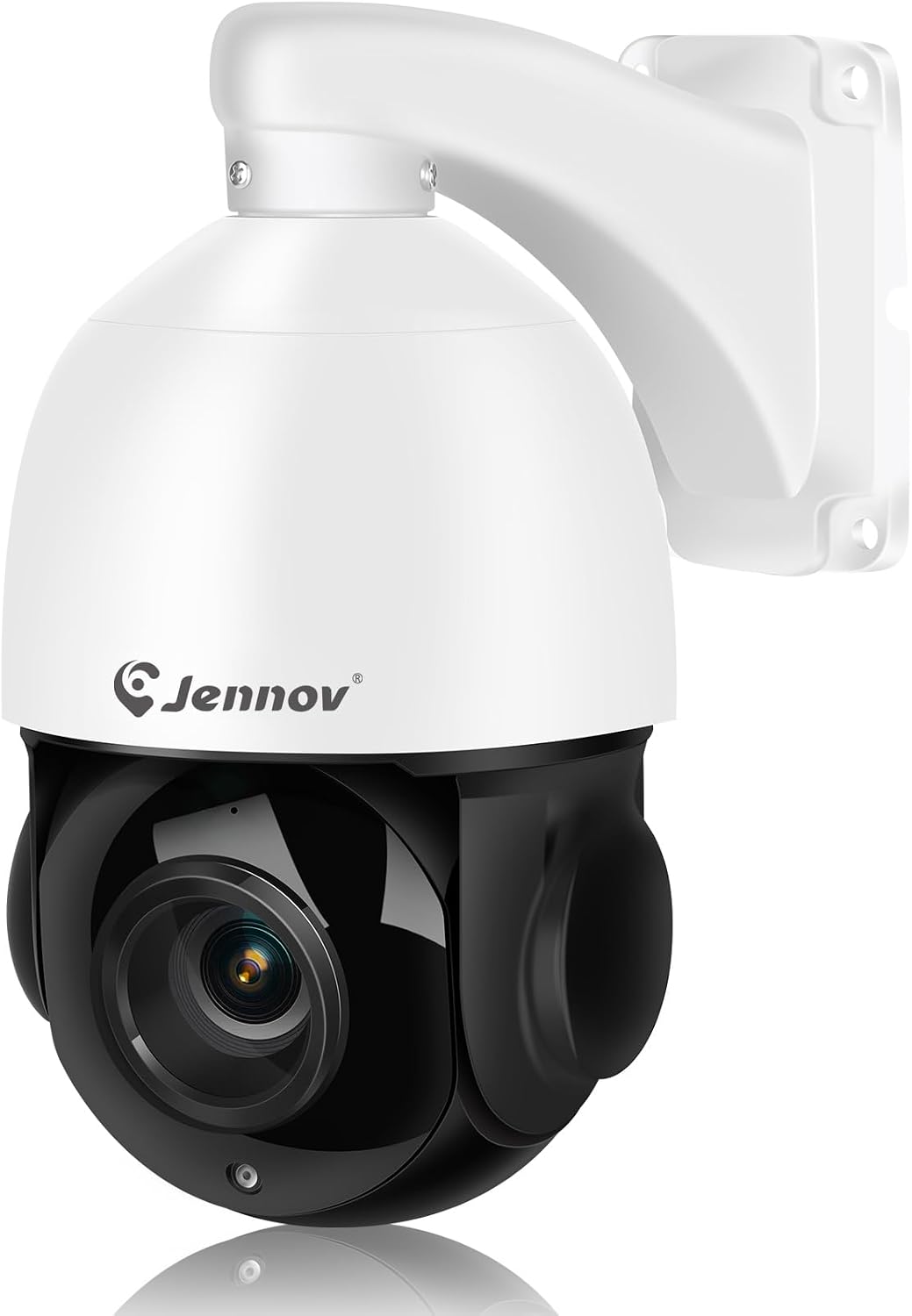
Key specs: 4K 8MP PoE PTZ camera; 20X optical zoom on a 4.7-94mm motorized lens; 360 degree pan, 90 degree tilt; human detection with auto tracking; six infrared LEDs rated to 320 ft; H.265+; ONVIF; two-way audio; IP66
This is the specialist, with a caveat stated up front: Jennov is a small brand and this listing carries a thin review base compared with the Reolink models above, so there is far less independent buyer feedback to weigh. What it offers is something none of the others do. The lens runs 4.7 to 94mm, a genuine 20X optical range and four times the reach of our top pick — the difference between seeing someone at the end of a long driveway and being able to describe them. The listing also specifies six infrared LEDs rated to 320 ft, H.265+ encoding, ONVIF support and 24/7 recording. Our driveway camera guide covers the same problem from the other direction, and how night vision distance ratings work is worth reading before taking any 320 ft figure at face value.
✅ Pros
- A true 20X optical range on a 4.7-94mm lens, by far the most reach here
- ONVIF support, so it works with third-party NVRs, not just one brand’s app
- H.265+ encoding keeps 24/7 recording from filling a drive as fast
- IP66 housing and two-way audio, matching the wired picks above
❌ Cons
- Thin review base and a much smaller brand — the least-proven pick here
- The listing never states which PoE standard it needs, so allow PoE+ headroom [7, 8]
- At 94mm the view is extremely narrow: at full zoom it sees a keyhole, not a yard
- Long-range infrared ratings are best-case figures, not a moonless night
Why Three of These Four Are Reolink
Three picks from one brand deserves an explanation rather than a shrug. We went looking for a spread of brands and did not find one that held up. In the consumer PTZ category — unlike fixed bullet and dome cameras, where the field is crowded — much of what sells is either a Reolink model or an unbranded unit whose specification sheet is a bullet list with nothing behind it. Reolink publishes full specification tables, names the PoE standard each camera expects, and documents its tracking behavior in support articles you can read before buying [1, 2, 3, 4, 5]. That is the difference between a claim we can verify and one we would be repeating. The one new entrant worth watching is SwitchBot, which shipped its first outdoor pan/tilt model — the Outdoor Pan/Tilt Cam 3K — in fall 2026. It comes from an established smart-home maker rather than an unbranded storefront, but it is too new to have the published documentation and track record these picks are chosen on, so it is not ranked here.
The three Reolink picks also do genuinely different jobs, which is the test that matters: a continuous optical zoom on PoE, a dual-lens tracker that watches without moving, and a wire-free unit with no optical zoom at all. The Jennov earns its place because no Reolink consumer model reaches 20X. Our Reolink camera roundup covers the brand’s fixed models, and the dome camera guide covers the form factor most often cross-shopped against a PTZ.
Where a PTZ Belongs in a Camera Layout
Security.org recommends four to six cameras on an average 1,500 to 2,500 square-foot home: two on the front entrance and driveway, one on the backyard, one on the garage, one or two indoors. A PTZ does not delete four of those. It replaces the one whose job is overview rather than identification.
In practice that means the open area a fixed lens covers badly: a driveway, a side yard, a backyard that runs long. Mount it high, at the eight to 10 feet Security.org recommends for coverage and tamper resistance, set its monitor point to the approach that matters most, and leave the doors to fixed cameras that never move.
Which Camera Does Which Job
🎯 Give the PTZ
- Long driveways and large yards one fixed lens cannot reach the far end of
- The overview shot during an incident — the wide picture of what happened
- Approaches you may want to zoom into later, given real optical zoom
- Anywhere you would otherwise install two fixed cameras for the angles
🚪 Leave to fixed cameras
- The front door, back door and any ground-floor entry
- Package drop zones, where a missed 30 seconds is the whole event
- Narrow spaces a fixed wide lens already covers completely
- Any frame you need guaranteed while the PTZ is off chasing something else
One practical note for the wireless option: a pan-and-tilt camera streaming 4K is a heavier wifi load than a doorbell, and a marginal signal shows up as stalled live view exactly when you are trying to steer the camera. It is worth testing the signal at the mounting spot before committing to a wire-free model, rather than discovering the problem from a ladder.
Final Recommendation
Start with the Reolink RLC-823S1. It is the only pick with a continuous motorized optical zoom, it stores locally with no subscription, and Reolink documents every claim we made about it. Check one thing before ordering: that your switch or injector supplies 802.3at rather than plain 802.3af [1, 7].
Choose differently in three cases. If you want tracking that never leaves the yard unwatched, buy the Reolink TrackMix PoE and set it to Digital Tracking, which follows a subject by cropping rather than by turning the camera. If there is no way to get a cable there, the Reolink Argus PT Ultra is the honest answer, as long as you accept a fixed lens and motion-triggered recording. And if the job is identifying a person or a plate hundreds of feet out, the Jennov 4K PoE PTZ with 20X Optical Zoom is the only pick with the reach, with the honest caveat that it is the least-proven product on this page.
What should change your mind about buying a PTZ at all: if every area you care about is already covered by a fixed camera you trust, a motorized one buys flexibility you may never use and can be pointed away from the thing you needed to see. In that case another fixed camera, or a system without a subscription, is the better use of the money.
SafeBode does not yet run an in-house product testing program. This guide is built from manufacturer specifications, official support documentation, current retail listings and verified buyer feedback rather than hands-on testing, and we say so plainly rather than implying testing we have not done.
Frequently Asked Questions
Is a PTZ camera enough on its own?
For a small, enclosed area it can be. For a house it should not be your only camera: a PTZ points one direction at a time, so anything it is not aimed at is uncovered. Use fixed cameras on the entries and a PTZ for the open area they cannot cover.
Does auto-tracking work at night?
It works wherever detection works, which at night means within range of the camera’s infrared or spotlight illumination. A subject beyond usable night-vision range is not tracked, because it is not reliably detected in the first place.
How much optical zoom do I actually need?
For a typical suburban lot, very little — 5X is enough to pull detail from a driveway or the far side of a backyard. Reach becomes worth paying for on acreage or a parking area where the subject may be several hundred feet away.
Will a PTZ camera work on my existing PoE switch?
Only if the switch supplies the standard the camera asks for and has the total power budget for it. Motorized cameras sit higher up the power scale than fixed ones, so a cheap switch running four fixed cameras may not run one PTZ.
Do PTZ motors wear out?
They are mechanical, so they are a wear item in a way a fixed camera is not, and a patrol route exercises them constantly. If service life matters most, set a monitor point and skip the all-day patrol.
Can I turn auto-tracking off?
Yes, and it can be limited rather than switched off. You can restrict which object types trigger it, narrow the horizontal range it follows within, and set how long it waits before returning to its default position.
Does a PTZ camera need a subscription?
None of the picks here require one to record. All write to a local microSD card, and the wired models can also use a network video recorder. Cloud plans are optional, not a condition of recording.
Is a dome camera or a PTZ better for a driveway?
A fixed dome gives a guaranteed frame of the same area at all times, which is what evidence needs. A PTZ gives reach and the ability to look around, which is what a large property needs. On a short suburban driveway, the dome is usually the better buy.
Sources
Show sources (9)
- [1] Reolink – “RLC-823S1: 4K 360 Degree Auto-Tracking PoE Camera with 5X Optical Zoom,” product page and specification table, reolink.com/us/product/rlc-823s1
- [2] Reolink – “Reolink TrackMix PoE: 4K Dual-Lens PoE PTZ Camera with Auto Tracking,” product page and specification table, reolink.com/us/product/reolink-trackmix-poe
- [3] Reolink – “Reolink Argus PT Ultra,” product page and specification table, reolink.com/us/product/argus-pt-ultra
- [4] Reolink Support – “How to Set up Auto Tracking for Reolink Cameras,” support.reolink.com/articles/14042664166169
- [5] Reolink Support – “Introduction to Tracking Methods for TrackMix Series Cameras,” support.reolink.com/articles/8119848769177
- [6] Reolink Blog – “Security Cameras Optical Zoom vs. Digital Zoom: Which One Is Better,” reolink.com/blog/security-cameras-optical-zoom-vs-digital-zoom
- [7] TP-Link – “PoE vs. PoE+ vs. PoE++: Power over Ethernet Standards,” tp-link.com/us/blog/2595
- [8] Amazon product listing for ASIN B0GQ9LTNTB, “Jennov 4K 8MP POE PTZ Camera Outdoor, 20X Optical Zoom,” manufacturer specification bullets
- [9] Security.org – “Where to Place Your Home Security Camera,” security.org/security-cameras/placement-guide


