Best Dome Security Cameras 2026: Where a Dome Beats a Bullet, and How Much Resolution to Buy
Affiliate Disclosure: This article contains affiliate links. If you buy through these links, we may earn a commission at no extra cost to you. Our editorial opinions are our own and are not influenced by affiliate relationships. Read our full disclosure policy →
Contents
Quick Answer
A dome is a housing decision before it is a camera decision: it sits close to the wall or soffit, reads as part of the building rather than as surveillance, and gives a hand nothing obvious to grab. For most positions the Reolink RLC-520A is the right amount of camera — 5MP at 2560×1920, IP67, and 18 infrared LEDs quoted to 100 feet, over a single PoE cable. Step up to the RLC-1224A only if you genuinely need to enlarge footage afterwards, because 12MP with a spotlight for color night video is a storage commitment as well as a detail one. The Anpviz 4MP dome is the pick when you want audio captured at the camera and are watching the budget.
What a Dome Actually Buys You
The shape is doing three jobs, and only one of them is about the picture. A dome sits low against its surface, so it does not announce itself the way a bullet on an arm does — which matters on a porch where visitors would find an obvious camera hostile, and in shared or rented buildings where a conspicuous camera invites objections.
The second job is physical. There is no protruding arm to grab, twist or knock out of alignment, and the cover protects the lens assembly from being nudged. The third is weather: the same cover keeps driving rain off the lens face, which on an exposed wall is the difference between a usable picture and a smeared one. Reolink rates the RLC-520A’s casing IP67 and describes it as working perfectly both inside and outside the house, which is the ordinary expectation for this housing rather than a premium feature.
What the Housing Changes
Low profile
sits against the wall rather than on an arm
No arm
nothing obvious to grab or knock askew
IP67
weatherproof casing on the RLC-520A
100 ft
infrared night range quoted on the same camera
Housing figures taken from Reolink’s own product page for the RLC-520A.
Where a Dome Loses to a Bullet
Be Honest About the Trade
A dome is the better choice when
- The camera is on a porch, soffit or entryway
- You would rather it were not noticed
- It is within reach of somebody who might interfere with it
- Rain lands directly on that wall
A bullet is the better choice when
- Visible deterrence is part of the point
- You need to aim precisely at a distant gate or driveway
- Infrared glare inside a dome cover is a known problem in that spot
- You may want to re-aim the camera later without re-mounting it
The aiming point is the one that catches people out. A bullet is adjusted by loosening an arm; a dome is aimed by moving the ball inside the housing and then committing to that angle when the cover goes on. Get it wrong and the fix is taking the cover off again, on a ladder. Our camera placement walkthrough is worth reading before you drill, and the PoE camera guide covers the wiring side of the same installation.
How Much Resolution a Dome Actually Needs
Domes usually watch close range: a doorway, a porch, a hallway, a shop counter. That changes the resolution answer compared with a camera pointed down a driveway, because the detail you need is already large in frame. 5MP at 2560×1920 is comfortably enough to identify a person at porch distance, and the extra pixels of a 12MP sensor mostly buy you the ability to crop hard afterwards.
That is a real benefit in exactly one situation: a wide view where you expect to enlarge one corner of the frame later. It is a real cost in every situation, because higher resolution means larger files and a shorter history on the same drive. If detail at distance is genuinely the goal, our 4K camera guide covers the storage and bandwidth arithmetic in more depth.
Reolink RLC-520A — best value dome
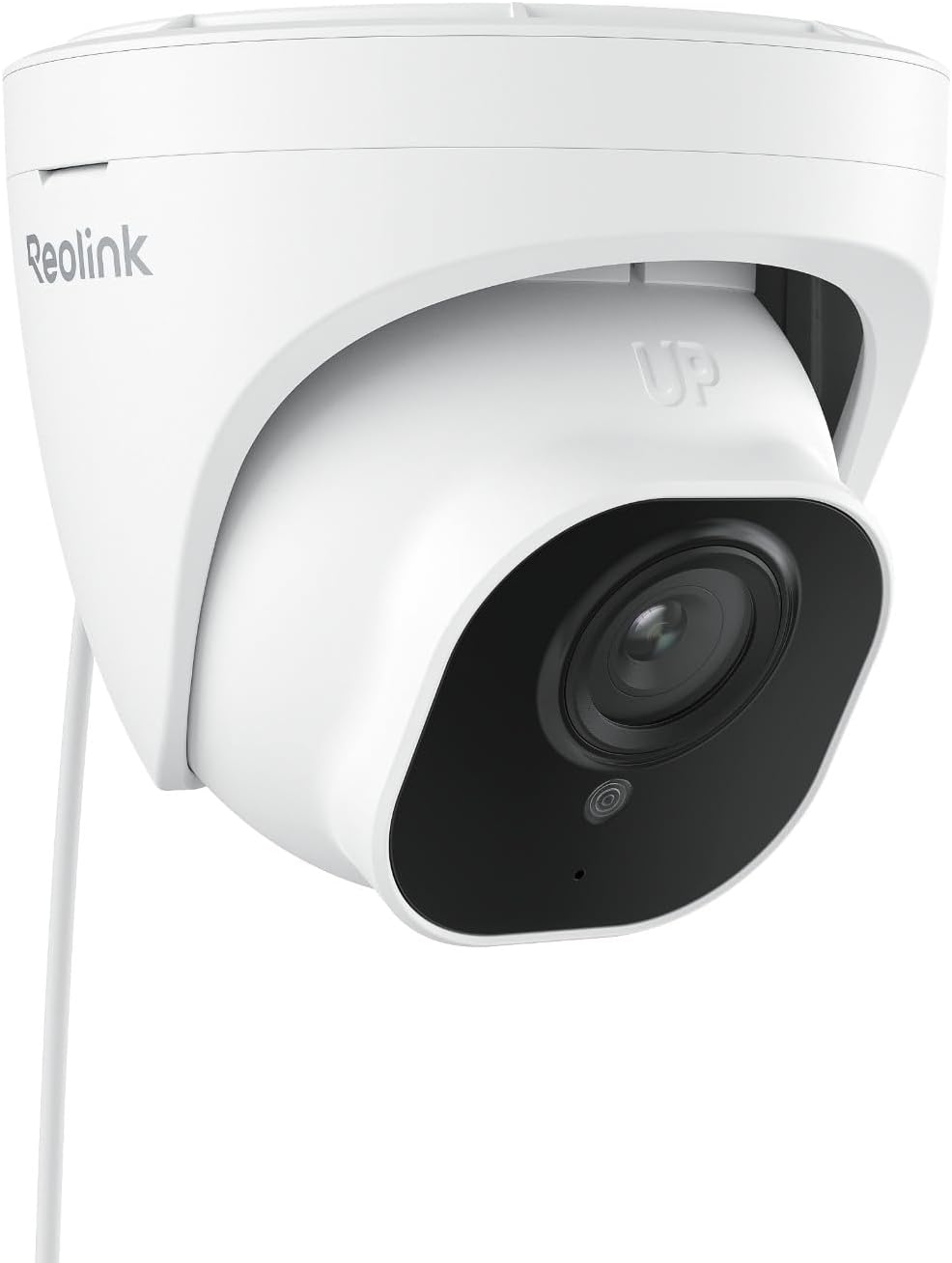
Key specs: 5MP outdoor dome at 2560×1920, with 18 infrared LEDs quoted to 100 ft of night vision; IP67 weatherproof casing rated for indoor or outdoor use; person, vehicle and animal detection; PoE installation over a single cable
This is the sensible default. Reolink quotes 2560×1920 across a 5MP sensor with 18 infrared LEDs reaching up to 100 feet at night, which is far more range than a porch or entryway needs and useful headroom for a wider view. The IP67 casing is rated to work inside or outside, so the same camera suits a soffit, a garage or a hallway. Person, vehicle and animal detection keeps alerts meaningful, and PoE means one cable does power and data. The honest limitation is that it is a fixed camera with no spotlight: night footage is infrared black and white rather than color.
✅ Pros
- 5MP at 2560×1920, ample for close and mid range
- IP67 casing rated for indoor or outdoor use
- 18 infrared LEDs quoted to 100 ft
- Person, vehicle and animal detection
- Single PoE cable for power and data
❌ Cons
- Infrared night vision only — no color after dark
- Fixed view; aiming is committed once the cover is on
- Needs a PoE switch, injector or NVR at the other end
Reolink RLC-1224A — best for maximum detail
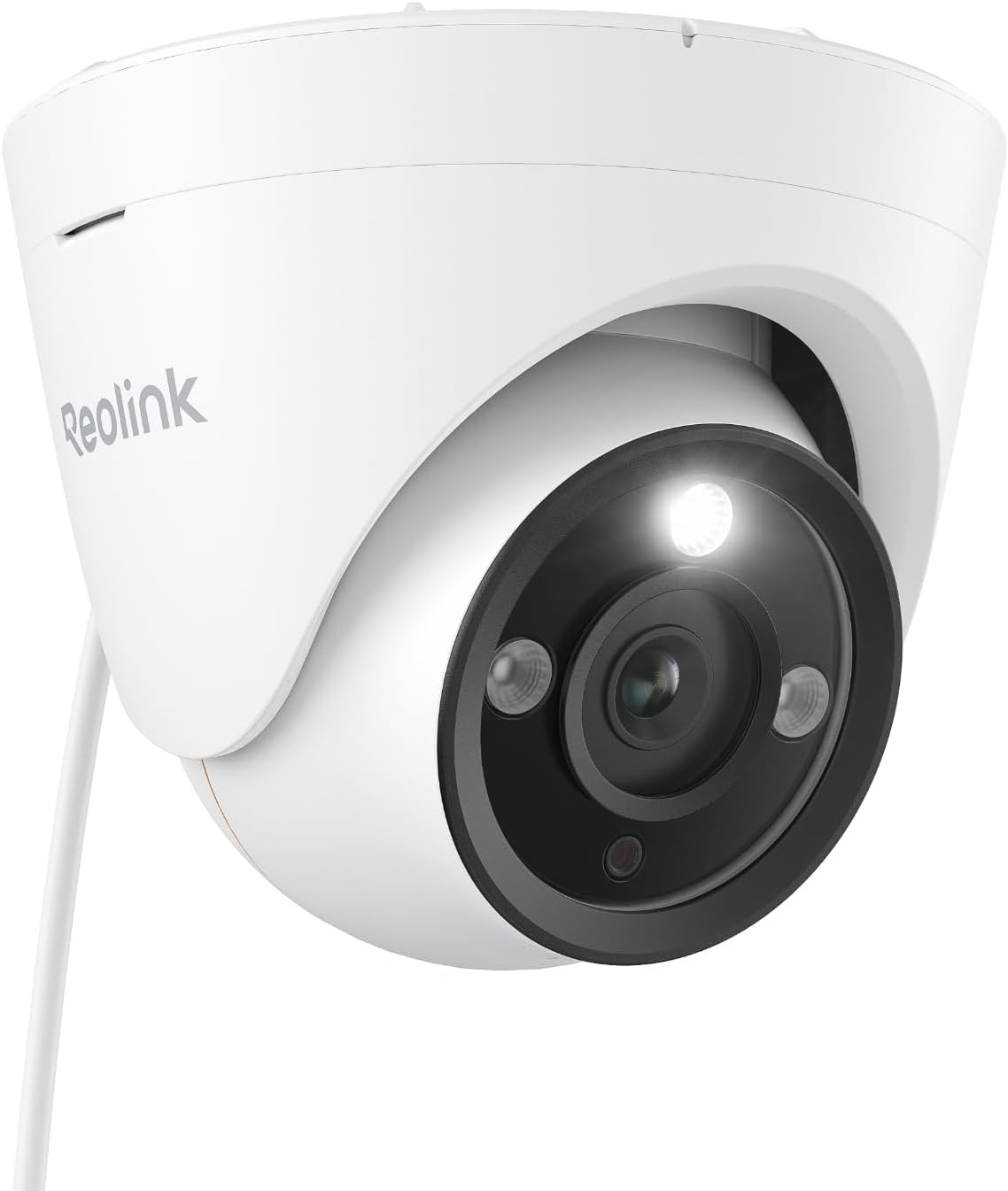
Key specs: 12MP ultra HD PoE dome with a built-in spotlight and flexible night vision modes for color footage after dark; person, vehicle and pet detection; the highest resolution in this comparison by a wide margin
Buy this one only if you have a specific reason to. Reolink specifies 12MP ultra HD with a built-in spotlight and flexible night vision modes, so it can produce color footage after dark rather than falling back to infrared. On a wide entrance, a forecourt or a shop floor, that combination genuinely lets you crop into a face or a plate that a 5MP camera would only suggest. What comes with it is storage: a sensor of this resolution fills a drive considerably faster, and that shortens how far back your history goes on the same hardware.
✅ Pros
- 12MP, the highest resolution in this comparison
- Built-in spotlight for color night video
- Flexible night vision modes rather than infrared only
- Person, vehicle and pet detection
- PoE, so it fits the same wiring as the others
❌ Cons
- Consumes storage far faster than a 5MP camera
- Spotlight draws attention, which undercuts the discreet dome argument
- More resolution than a porch or hallway can use
Anpviz 4MP PoE Dome — best with audio on a budget
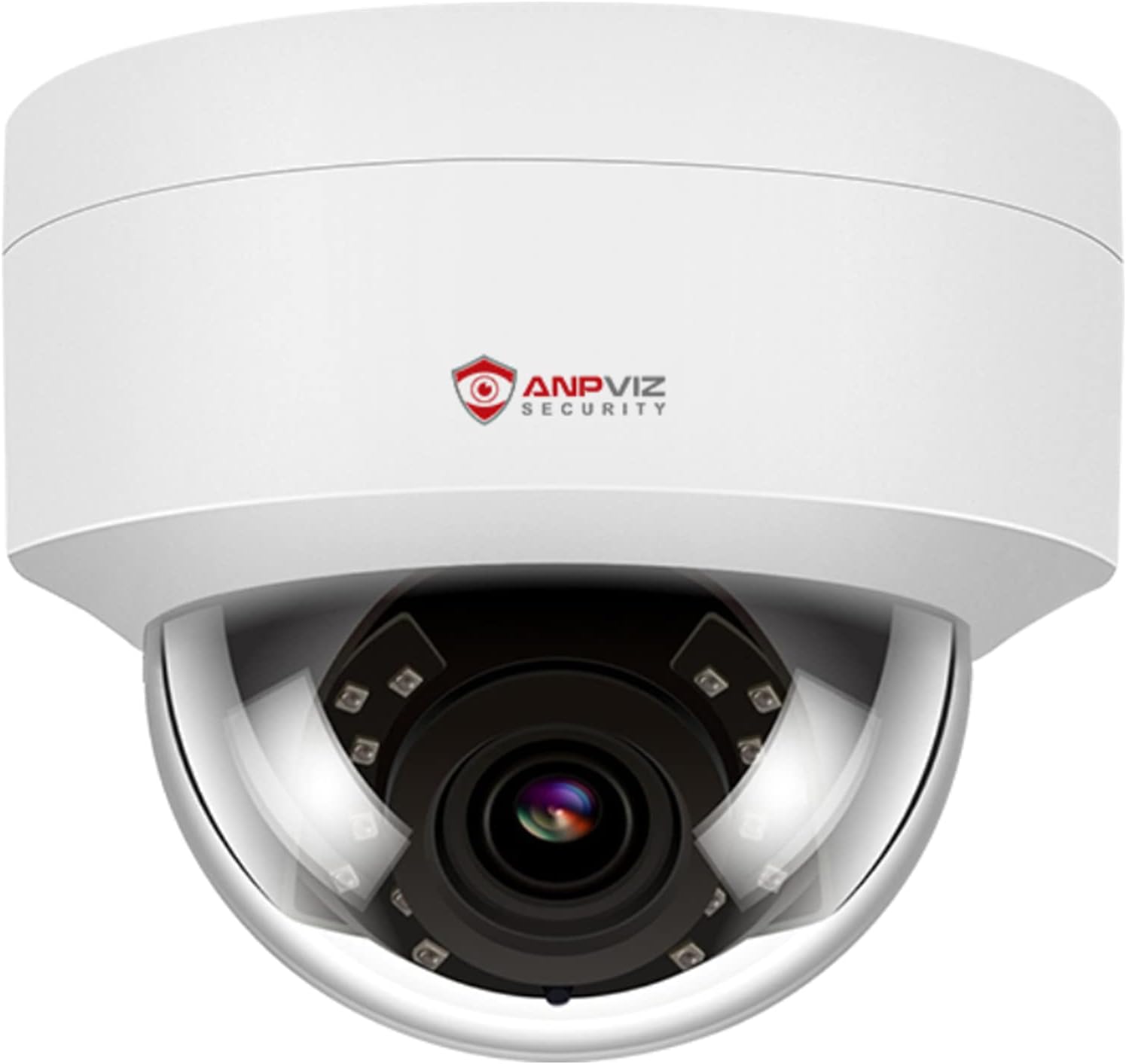
Key specs: 4MP PoE dome with a built-in microphone for audio, quoted at 98 ft of infrared night vision, from a manufacturer that builds PoE cameras and switches for home and business installations
The reason to consider this one is the microphone. Most budget domes are video only, and audio changes what a recording is worth — a delivery conversation, a raised voice, a car door. Anpviz builds PoE cameras and switches for home and business installations, and this model pairs 4MP with a built-in microphone and a quoted 98 feet of infrared night vision. Two honest caveats: 4MP is a step below the Reolink picks, and the brand publishes less model-by-model documentation than Reolink does, so more of what you know comes from the retail listing than from a specification page.
✅ Pros
- Built-in microphone, unusual at this price
- 4MP is comfortably enough for porch and hallway distance
- Quoted 98 ft infrared night vision
- PoE, so it drops into the same wiring as the others
- From a manufacturer that specializes in PoE hardware
❌ Cons
- Lower resolution than either Reolink pick
- Less published per-model documentation to check specs against
- Check local law before recording audio — consent rules differ by state
The Three Side by Side
| Camera | Resolution | Night approach | Audio | Best for |
|---|
| Reolink RLC-520A | 5MP | Infrared to 100 ft | No | The default porch or entryway dome |
| Reolink RLC-1224A | 12MP | Spotlight, color modes | No | Wide views you expect to crop into |
| Anpviz 4MP PoE Dome | 4MP | Infrared to 98 ft | Yes, built-in microphone | Capturing what was said as well as seen |
Two Mounting Mistakes That Ruin a Dome
Avoid Both and the Camera Will Outlast the Warranty
1
Aiming through the cover, not before it
Set the angle with the app open and the cover off, confirm the frame, then fit the cover. Re-aiming later means going back up the ladder.
2
Mounting where the infrared reflects
A dome under a low soffit or against a wall can bounce its own infrared off the cover and wash out the picture. Move it a few inches out or angle it away from the surface.
3
Forgetting the drip line
Water running down a wall crosses the cover and dries as spots that scatter infrared at night. Mount under an overhang where you can.
The infrared reflection problem is specific to this housing and it is the reason some installers prefer turrets, which have no cover in front of the LEDs at all. If you are covering several positions rather than one, our wired camera system guide covers multi-camera kits, and the business systems guide is the better starting point for a shopfront or an office.
Final Recommendation
Buy the Reolink RLC-520A. At the distances a dome actually watches, 5MP is enough detail, IP67 covers the weather, and 100 feet of infrared is more range than a porch will ever ask for. It is the pick that leaves you with the fewest regrets and the smallest storage bill.
Two things change that. If the camera watches something wide — a forecourt, a shop floor, a double driveway — and you expect to crop into the footage afterwards, buy the RLC-1224A and size your drive for it, because 12MP is a storage decision as much as a detail one. If capturing audio matters and the budget is tight, buy the Anpviz 4MP dome, and check your state’s recording-consent rules before you enable the microphone. What should push you out of domes entirely is wanting visible deterrence or the ability to re-aim easily later — both are arguments for a bullet, and no dome specification compensates for them.
SafeBode does not yet run an in-house product testing program. This guide is built from manufacturer specifications, official support documentation, current retail listings and verified buyer feedback rather than hands-on testing, and we say so plainly rather than implying testing we have not done.
Frequently Asked Questions
Is a dome camera better than a bullet camera?
Neither is better in general. A dome is discreet, harder to interfere with and sheds rain off the lens; a bullet is visible deterrence and much easier to aim precisely. Choose by position rather than by specification.
Do dome cameras have worse night vision?
Not inherently, but the cover can cause problems. Infrared light bouncing off the inside of the dome, or off a nearby wall, washes out the image. Mounting the camera clear of surfaces solves it in most cases.
How much resolution do I need on a dome camera?
For porches, entryways and hallways, 4MP to 5MP is plenty because the subject is already close. Higher resolution earns its place on wide views where you expect to enlarge one part of the frame afterwards.
Can dome cameras be used indoors?
Yes, and they suit indoor use well because the low profile is less intrusive than a bullet on a wall. Weather-rated models work in both places, so one camera type can cover the whole property.
Do these cameras need an NVR?
Not necessarily. PoE cameras can record to a card, to a network recorder or to a server, so the recorder is a choice about how much history you want rather than a requirement to get the camera working.
Are dome cameras vandal proof?
Some are, but the shape alone does not guarantee it. Impact resistance is described by an IK rating, which is separate from the IP weather rating, and only cameras that publish one have been tested for it.
Should I buy a dome camera with a microphone?
Only if you have thought about the law where you live. Audio recording is treated differently from video in many states, and consent rules can apply even on your own property, so the feature is worth checking before it is worth buying.
Will a dome camera fog up?
It can, if warm moist air is trapped inside the housing or the seal is damaged. Mounting under an overhang, keeping the cover clean and not opening the housing in wet weather all help avoid it.
Sources
Show sources (3)


