Best Fire Escape Ladders 2026: Second-Story Escape Ladders That Deploy Reliably
Affiliate Disclosure: This article contains affiliate links. If you buy through these links, we may earn a commission at no extra cost to you. Our editorial opinions are our own and are not influenced by affiliate relationships. Read our full disclosure policy →
Contents
Quick Answer
Buy by the drop, not the floor count: 13 to 14 feet covers a normal second-story window, 25 feet covers a third. Measure the sill first — Kidde fits sills 5.5 to 11 inches deep and at least 16 inches wide, First Alert’s two-story model wants 6 to 10 inches. The part almost nobody mentions: Kidde’s ladders are single use, to be discarded once unfolded, so the one in your closet is a ladder nobody will have opened before the night it matters. First Alert’s folds back up after opening, which is why it is our pick despite a lower published load figure.
Two Minutes and One Staircase
Most upstairs bedrooms have exactly one way out, and it is the way out that fire takes first. Central Kitsap Fire & Rescue puts the geometry plainly: most homes have a single staircase serving the upper stories, and when it is blocked the rooms above it have no route to the door. That is the entire reason this product category exists.
The clock is the other half. The U.S. Fire Administration’s guidance is that residents could have less than two minutes to escape once the smoke alarm sounds, and its planning advice is to find two ways out of every room and practice the drill with everyone in the household. Upstairs, the second way out is a window — and a second-floor window is only an exit if something bridges the gap to the ground.
What the Safety Guidance Actually Says
Under 2 min
The time USFA says you may have once the smoke alarm sounds
2 ways out
Exits USFA tells you to plan from every room in the house
1 per room
Ladders NFPA recommends for occupied rooms above the main level, per Kidde
3rd floor
The highest story ESFI says an escape ladder should be used from
Sources: U.S. Fire Administration, Kidde, Electrical Safety Foundation International.
None of it works if nobody wakes up. The ladder is the last item in the chain, not the first — it only matters during the minutes a working alarm bought you, which is why alarm coverage on every level and in every sleeping room is the purchase that comes before this one.
Step One: How Far Is the Drop, Really?
The category is sold by story count, and story count is a proxy that fails on a lot of real houses. Kidde’s two-story ladder extends 13 feet and its three-story ladder extends 25 feet [2, 3]; First Alert’s equivalents are 14 feet and 24 feet [5, 6]. Those lengths assume a conventional lot where the ground under the window sits level with the front door.
Go and look at the window. A walk-out basement or a hillside lot can turn a nominal second-floor bedroom into a genuine three-story drop at the back of the house, and a 13-foot ladder ending six feet above a concrete patio is not an escape route. Measure from the sill straight down to whatever the person will land on, and buy for that number.
There is a ceiling as well as a floor. ESFI is explicit that escape ladders should not be used from floors higher than the third story, and that a window and a ladder are a backup for when other exits are blocked — never the primary plan. Weight matters too, because somebody has to lift the thing onto a sill under stress: First Alert publishes 12.8 lb for its 14-foot ladder and 30 lb for the 24-foot version [5, 6]. That gap is real if the likely user is a child.
Step Two: The Window Decides More Than the Ladder
Every ladder here works the same way: hook it over the window sill and climb down the outside of the house. The sill and frame carry the entire load, which is why manufacturers publish sill dimensions at all instead of treating windows as interchangeable.
The published limits do not line up, and this is the most common way people buy the wrong ladder. Kidde states a maximum window frame capacity of 11 inches and a minimum width of 16 inches, with sill compatibility from 5.5 to 11 inches deep, on both models [2, 3]. First Alert’s two-story ladder is designed for sills between 6 and 10 inches wide, and its three-story ladder wants a sill at least 20 inches wide, 32 inches high and 6 to 13 inches deep. A sill that suits one can fall outside another’s range entirely. Two more details from Kidde’s own product content: the ladder needs no lip on the window and works on casement windows, but Kidde states it is not recommended for narrow railings or areas without a wall or house exterior to support it. A balcony rail is not a substitute for a sill.
Before You Buy: Two Measurements and Four Tests
📏 Measure at the window itself
- Sill depth and width — the numbers that rule ladders in or out [2, 5]
- The clear opening once the sash is fully raised
- The drop from sill to whatever is directly below
- Whether the landing spot is clear of a deck rail, condenser or shrubs
🧪 Test before you file it away
- Can the smallest person who sleeps there open the window unaided
- Do the screen and storm pane come out without tools
- If the window has bars, do they have inside emergency release devices
- Does the hooked ladder seat on your sill, not just in the photo
That third test deserves more attention than it gets. ESFI says security bars need emergency release devices on the inside so they open quickly — worth weighing against the trade-offs in window bars and security film generally, because a bar set that defeats a burglar and also defeats a nine-year-old at 2 a.m. is a bad trade.
Rope-and-Rung vs. Standoff Rungs
Two structural approaches are on sale, and they produce different descents. Kidde’s is strap-and-rung: zinc-plated anti-slip metal rungs a foot wide on red nylon strap rails, folded tangle-free so it drops cleanly when the release strap is pulled. It hangs flat against the wall. First Alert adds steel stabilizers to each rung to hold the ladder away from the wall — its stated reason is that this makes each rung easier to grasp and keeps the ladder from swaying. It matters more the further you climb.
The load figures need reading carefully, because the brands publish different kinds of number. Kidde says its ladders are load tested to 1,000 lb [2, 3] — a test figure. First Alert states a weight capacity of 375 lb at one time — a working limit. A bigger test number is not automatically a stronger ladder. What First Alert’s figure does say plainly is that it is rated for one person at a time, which matters if you pictured a parent carrying a child.
One honest gap: ESFI advises buying ladders that bear the label of a nationally recognized testing laboratory. In the material we read, First Alert states ASTM testing [5, 6] and Kidde and Hausse publish load-test figures [2, 10] — none advertises a testing-laboratory listing mark. If a lab listing matters to you, check the box, because no product page here answers it.
The Four, Side by Side
Two of these are the same product in two lengths, deliberately — story height is the first branch in this decision. The other two are the genuine design alternatives.
| Kidde 2-Story | First Alert Two-Story | Kidde 3-Story | Hausse Retractable |
|---|
| Deployed length | 13 ft | 14 ft | 25 ft | 13 ft |
| Published load figure | Load tested to 1,000 lb | 375 lb weight capacity | Load tested to 1,000 lb | Tested for up to 1,000 lb |
| Sill requirement | 5.5–11 in deep, 16 in wide and up | 6–10 in wide | Up to 11 in deep, 16 in wide and up | Retractable hooks, extended fully at both ends |
| Rungs held off the wall | No | Yes, steel stabilizers on each rung | No | Not stated |
| Reusable | No — single-use design | Yes — folds back up after opening | No — single-use design | Yes, but the maker advises replacing it every three years |
| Rung material | Zinc-plated | Steel | Metal on heavy-duty straps | Aluminum |
| Published warranty | Five-year limited | One-year limited | Not stated | Not stated |
The row that decides most purchases is not the load figure. It is the reusable row, because it settles whether the ladder you own is one anybody in the house has ever opened.
Kidde 2-Story Escape Ladder (13 Feet) — the default second-floor pick
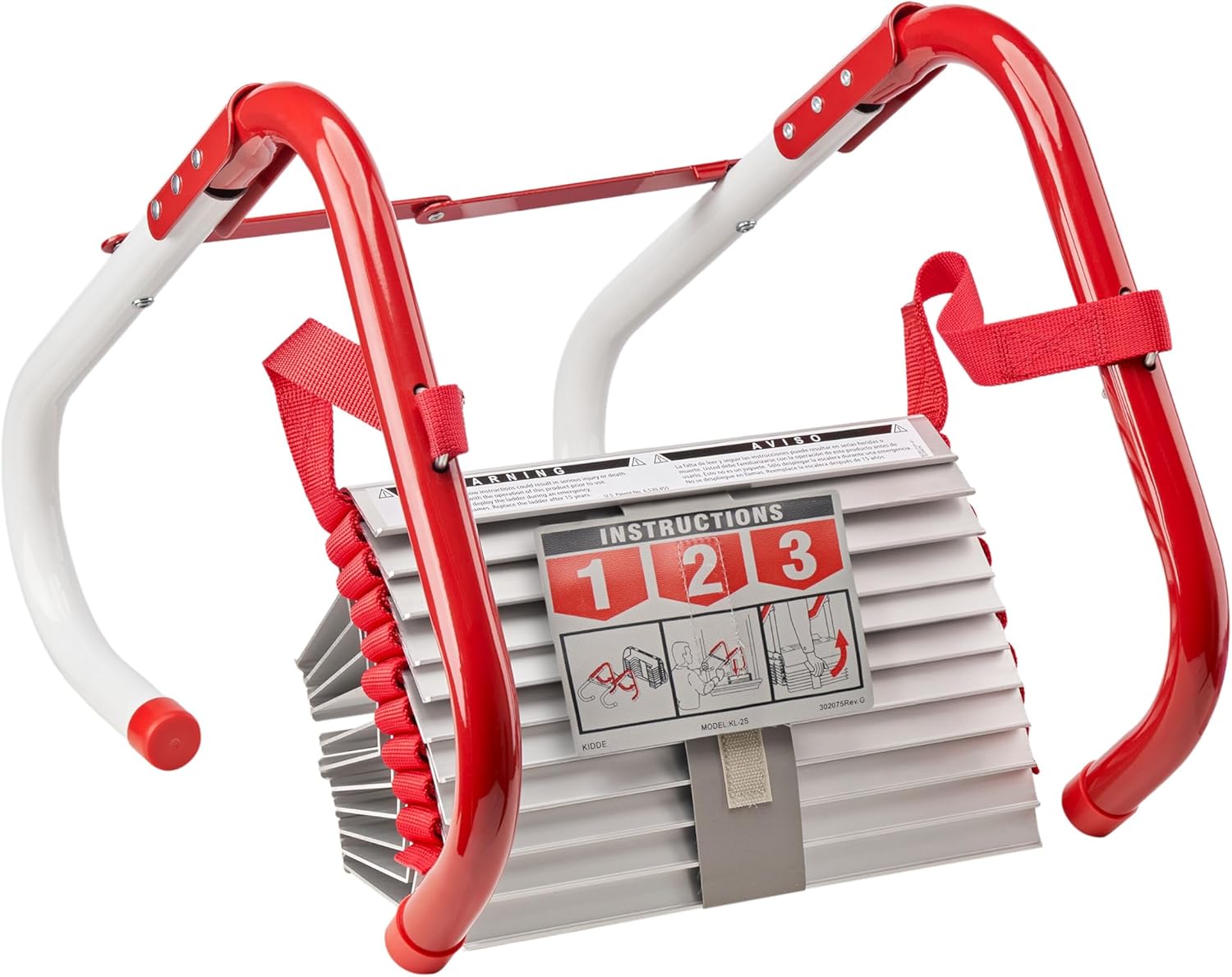
Key specs: Extends 13 feet; load tested to 1,000 lb; zinc-plated anti-slip metal rungs on red nylon strap rails; fits sills 5.5 to 11 inches deep, 16 inches wide and up; no tools; tangle-free single-use design; five-year limited warranty
The safe default for a conventional second-story bedroom. Kidde publishes the widest sill range here — 5.5 to 11 inches deep, 16 inches wide and up — so it fits more real windows than the alternatives. Deployment is four steps and no tools: hook it on the window, pull the release strap, it extends 13 feet, climb down. The catch is printed on the listing itself and shapes the rest of this guide: single use only, discard once unfolded.
✅ Pros
- The widest published sill compatibility of the four, the spec that most often rules a ladder out
- Works on casement windows and needs no sill lip, per Kidde’s own detail content
- Tangle-free folded design meant to drop cleanly rather than be untangled in the dark
- Load tested to 1,000 lb, and the longest published warranty here at five years [2, 9]
❌ Cons
- Single use only — discard once unfolded, so nobody will ever have opened the one they own
- Nothing holds the rungs off the wall; the standoff approach is First Alert’s
- Kidde says it is not recommended for narrow railings or anywhere without a wall behind it, so it is not a balcony answer
- At 13 feet it is the shortest option here, a real constraint on a tall second story
First Alert Two-Story Escape Ladder (14 Feet) — the one you can rehearse with
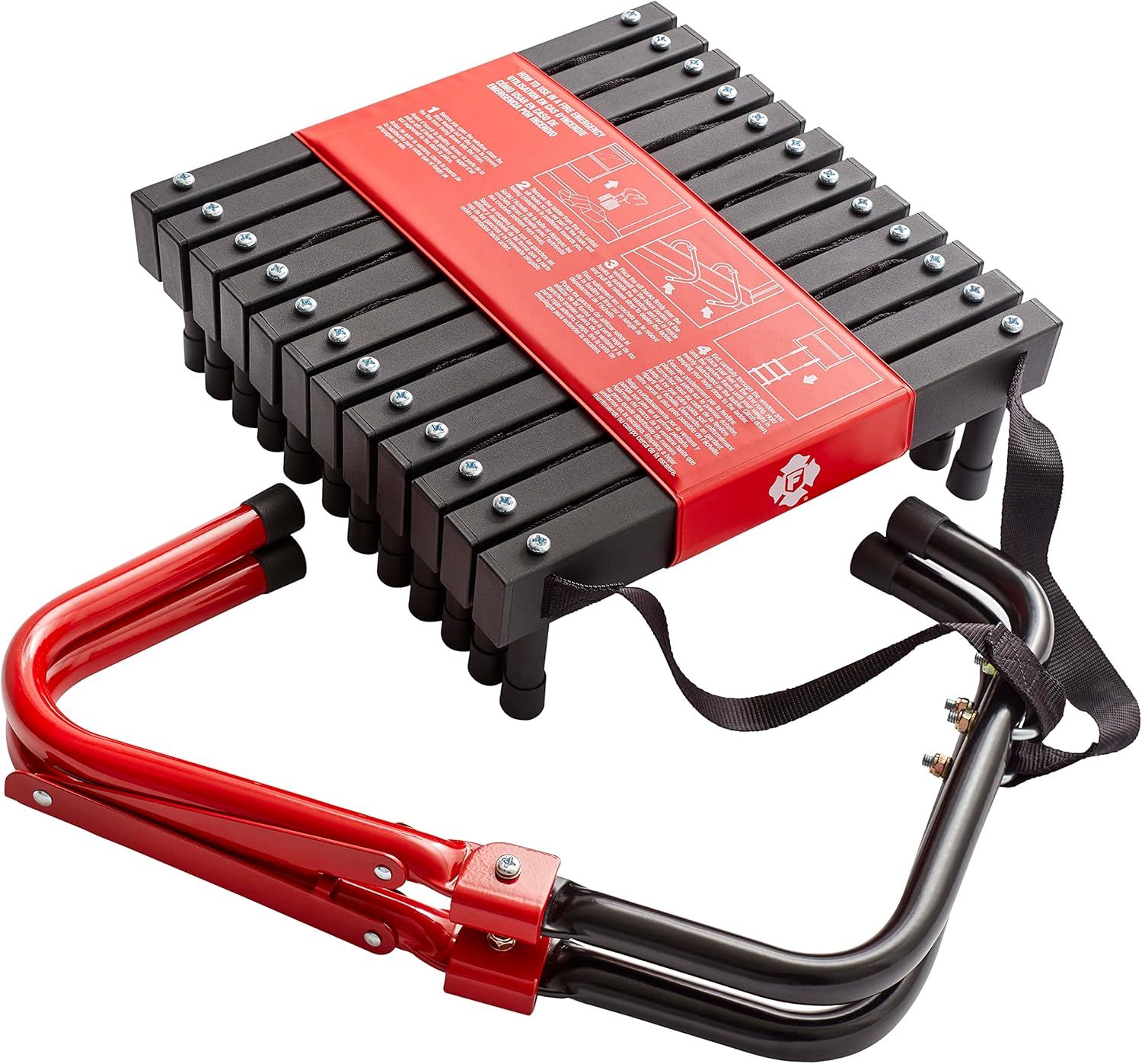
Key specs: Model 1047153; 14 feet; 375 lb weight capacity; steel anti-slip rungs with steel stabilizers that hold the ladder off the wall; nylon strapping; for sills 6 to 10 inches wide; folds back up after opening; 12.8 lb; ASTM tested; one-year warranty
Our pick for most households, on the strength of one line in First Alert’s own specification: it arrives fully assembled and folds back up after opening. That single property turns an escape ladder from an object you hope works into one you can take out, hook over a ground-floor sill, look at and put away — the difference between owning equipment and having a plan. The steel stabilizers are the other real advantage: their stated purpose is to hold the ladder off the wall so each rung is easier to grasp, and to stop it swaying.
✅ Pros
- Folds back up after opening, so one ladder covers the rehearsal and the emergency
- Steel stabilizers hold the rungs off the wall, which First Alert says eases grip and reduces sway
- The only ladder here whose maker names an external test standard, stating ASTM testing
- At 12.8 lb, light enough for a smaller adult or an older child to lift onto a sill
❌ Cons
- Published capacity is 375 lb at one time — a working limit rated for one person, not two
- The sill range is narrower than Kidde’s at 6 to 10 inches wide, so measure before ordering
- One-year limited warranty, against Kidde’s five
- Heavier than a strap-only ladder, because the stabilizers are steel
Kidde 3-Story Escape Ladder (25 Feet) — for a third-floor window
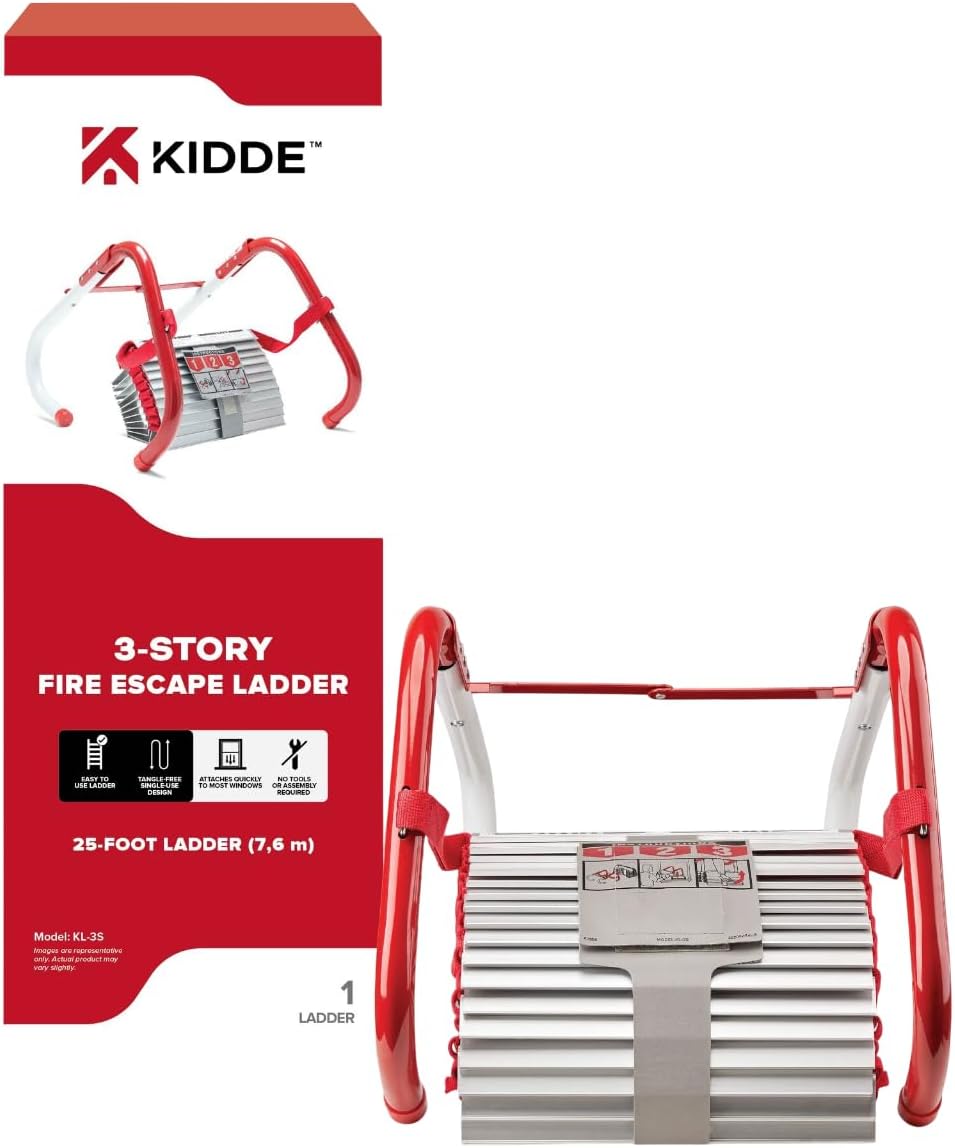
Key specs: Extends 25 feet; load tested to 1,000 lb; anti-slip metal rungs on heavy-duty straps; fits window sills up to 11 inches deep and 16 inches wide and up; no tools or assembly; tangle-free single-use design; flame-resistant construction
If the window is on the third floor, or the drop at the back of the house is longer than one story, this is the same Kidde design at 25 feet. Everything true of the two-story version holds: the same tools-free deployment, sill range, load-test figure and single-use construction. One honest note on the feedback — Amazon shows the same rating and the same review total for the two-story and three-story listings, which is what a shared parent listing looks like, so read it as evidence about the Kidde ladder family rather than this length specifically. And note ESFI’s ceiling: this is the top of the range, because escape ladders should not be used from floors above the third story.
✅ Pros
- The right length when the two-story ladder genuinely does not reach, the only reason to buy it
- Identical deployment sequence and sill range to the two-story model, so one procedure covers the house [2, 3]
- Same 1,000 lb load-test figure and flame-resistant construction as the shorter model
❌ Cons
- Single-use design, same as the two-story model, so practicing costs you the ladder
- Twenty-five feet is a long, tiring descent on a ladder that hangs flat with no standoffs
- The Amazon rating and review total appear shared with the two-story listing, so they are not independent evidence about this length
- Not a way to reach a fourth floor — ESFI’s guidance stops at the third story
Hausse Retractable 2-Story Escape Ladder (13 Feet) — the reusable alternative
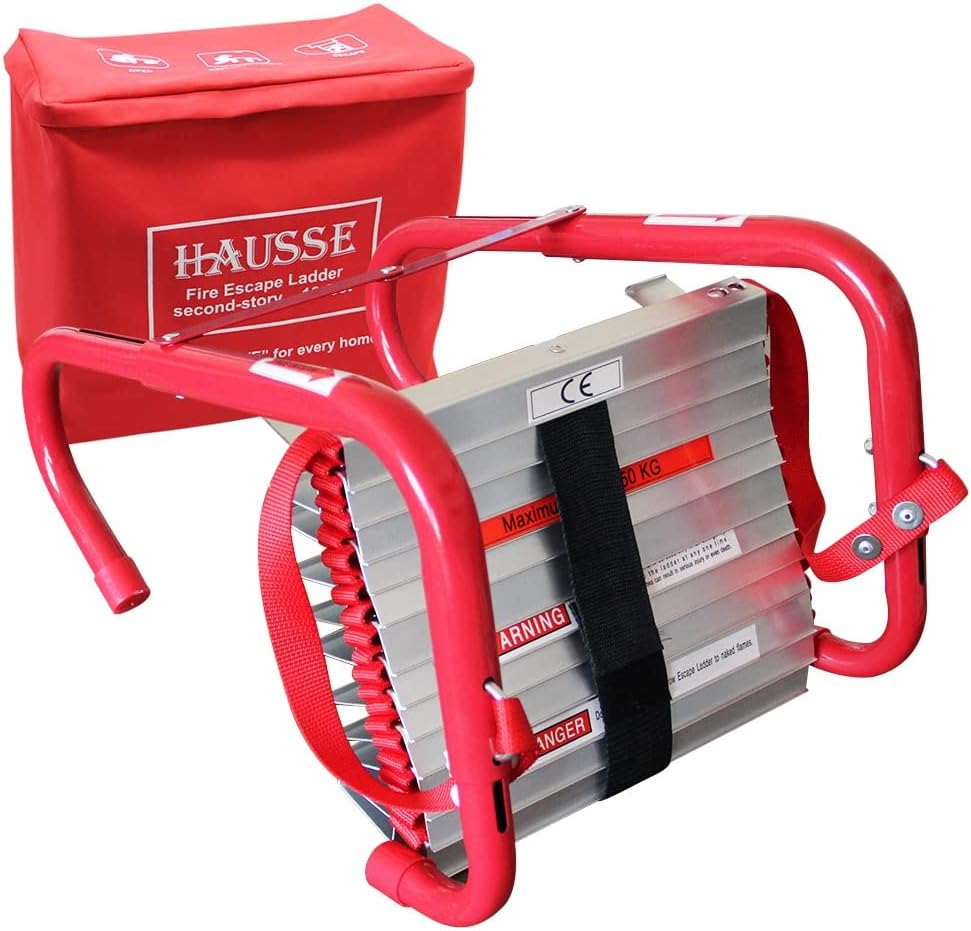
Key specs: Extends to 13 feet (listed maximum height 156 inches); aluminum; retractable hooks that secure to the frame or sill and must be extended fully at both ends before use; slip-resistant rungs; tested for up to 1,000 lb; red canvas storage bag; the maker advises replacing it every three years
The reusable option for people who want to keep the ladder after a practice run. The retractable hooks are the distinguishing feature: they adjust to the frame or sill rather than being one fixed width, and the listing instructs you to extend them fully at both ends before use. What we are not going to smooth over: unlike Kidde and First Alert, Hausse publishes no manufacturer product page we could check these figures against, so every specification here rests on the Amazon listing’s own manufacturer content. That is a weaker evidence base than we want on life-safety equipment.
✅ Pros
- Reusable, so a practice deployment does not consume the ladder
- Retractable hooks adjust to the window frame instead of assuming one sill width
- Aluminum build and a supplied bag make it the easiest of the four to stow and re-stow
- Its listing states a tested figure of up to 1,000 lb at 13 feet
❌ Cons
- No manufacturer product page we could verify against — every spec rests on the listing alone
- The maker advises replacing it every three years, a recurring cost the branded ladders do not ask for
- The hooks must be extended fully at both ends before use — one more step in the dark
- No published standoff, ASTM reference or warranty term, all of which the branded options state [2, 5]
Permanent-Mount Ladders: What We Could Not Recommend
There is a fourth format we deliberately have not given you a pick for: the permanently mounted ladder that lives in a wall box under the window, already anchored to the structure, so nobody has to lift a folded ladder onto a sill under stress. The appeal is obvious, especially with small children or an older adult upstairs.
The problem is what is on the shelf. In the Amazon US catalog results we pulled for this guide, the wall-mounted cabinet-style ladders had review bases in the single digits and no manufacturer product page we could check their claimed specifications against. We are not going to hand you an affiliate link to an unverifiable life-safety product to fill a structural gap in an article. If a permanently mounted ladder is what you want, treat it as a building product: get pricing from a company that installs them, and ask for the anchoring specification in writing. That costs us the sale on the most expensive format here, and it is still right.
The Practice Problem Nobody Resolves
Here is a real disagreement between two credible safety sources. We would rather show it to you than pick a side and pretend it does not exist.
Central Kitsap Fire & Rescue says an escape ladder is a great start but not enough, and that family members who sleep in upper stories should have used the ladder in a non-emergency practice situation. ESFI says the opposite about the ladder itself: do not practice with it during family fire drills, use it only in a real emergency — while also telling you to practice setting it up from a first-floor window.
Kidde resolves it commercially, in a product FAQ rather than any buying guide: because of the tangle-free design the ladder is single use only, and if you are practicing fire drills, Kidde recommends buying extra ladders. That is the honest cost of a single-use ladder and almost nobody budgets for it. Read together, though, the guidance is more consistent than it looks: everyone agrees on rehearsing the deployment — window open, screen out, hooks seated, in order and without reading instructions — and nobody endorses practice descents from upstairs.
A Practice Run That Does Not Waste the Ladder
1
Open the window
Time the smallest person who sleeps there raising the sash and clearing the screen. Every family member must be able to open it.
2
Seat the hooks
Hook the practice ladder over a ground-floor sill and confirm it sits correctly.
3
Climb low, or not at all
Any climbing happens at a first-floor window with an adult present, never the bedroom the ladder is for.
4
Stow it within reach
Refold and store it near its own window, and make sure everyone knows where.
Run this alongside the escape plan itself, which Central Kitsap Fire & Rescue recommends practicing at least twice each year.
One Ladder Per Room, and Where It Lives
One ladder for the house is a common and dangerous economy. Kidde cites the National Fire Protection Association’s recommendation of one ladder in every occupied room on floors above the main level, and ESFI says the same in different words: in each occupied room on the second or third story, near the window, reachable quickly. A ladder in the hallway is a ladder on the wrong side of a closed bedroom door. The folded format exists so it fits in that room’s closet or under the bed — not the garage, not the attic, not inside a sealed box. Everyone who sleeps there should know where it is without being told.
Keep the sequence straight, too. The ladder is the last resort in a chain that starts with detection, and the equipment ahead of it deserves the same attention: a connected alarm layer you can hear from the far end of the house, alarms retired on schedule rather than when they start chirping at 3 a.m., carbon monoxide coverage on every sleeping level, and strobe or bed-shaker alerting wherever somebody will not wake to a standard sounder. If your units are Kidde, the date codes on the back are the check most households skip.
Final Recommendation
Start with the First Alert Two-Story Escape Ladder (14 Feet) for a standard second-story bedroom whose sill measures 6 to 10 inches wide. It is not the strongest number on paper and we are recommending it anyway, because it folds back up after opening and a ladder your household has deployed once beats a stronger ladder nobody has ever unfolded. The steel stabilizers are the second reason — the feature you will care about most while hanging off it.
Choose differently in three cases. If your sill falls outside 6 to 10 inches, the Kidde 2-Story Escape Ladder (13 Feet) covers a wider range and is the one that will fit — budget for two, since Kidde’s own advice for households that practice is to buy extra ladders. If the drop is longer than one story, step up to the Kidde 3-Story Escape Ladder (25 Feet). And if you want a reusable ladder at the lowest outlay, and accept that its specs rest on a marketplace listing rather than a published manufacturer page, the Hausse is a defensible third choice.
Whichever you buy, do the two things that cost nothing: measure the sill before you order, and twice a year open the window, seat a ladder on a ground-floor sill and put it back [7, 8]. And if that window is barred, sort the inside release before the ladder arrives — an escape route with a lock on it is not an escape route.
SafeBode does not yet run an in-house product testing program. This guide is built from manufacturer specifications, official support documentation, current retail listings and verified buyer feedback rather than hands-on testing, and we say so plainly rather than implying testing we have not done.
Frequently Asked Questions
How long should a fire escape ladder be for a second-story window?
Thirteen to fourteen feet is the standard length, and it is right for a conventional lot. Measure from the sill straight down at that specific window first — a walk-out basement or a sloped yard can make the drop on one side of the house much longer than the floor count suggests.
Can I practice climbing down my escape ladder?
Practice the deployment, not the descent. Safety guidance is consistent that setting the ladder up should be rehearsed, and that any actual climbing happens from a first-floor window with an adult present, never the upstairs bedroom the ladder is meant for.
Are single-use escape ladders really single use?
Yes, when the manufacturer says so. Kidde states its escape ladders are single use only and should be discarded once unfolded, and that households running fire drills should buy extra ladders for the purpose. Treat that as an instruction, not a liability disclaimer.
Will an escape ladder work on a casement window?
Kidde states its two-story and three-story ladders work on casement windows and need no lip on the window to hang securely. Other makers do not all address casement windows, so check your model and confirm the crank opens the sash wide enough for an adult.
Can I use a fire escape ladder from a balcony?
Kidde advises against it, stating the ladder is not recommended for narrow railings or areas without a wall or house exterior to support it. These ladders hang against the outside wall, and a railing with open air behind it gives them nothing to rest on.
Do escape ladders work above the third floor?
They are not intended to. Safety guidance is explicit that they should not be used from floors higher than the third story. Above that, the plan should be built around the building’s protected stairwells and fire protection systems.
How many escape ladders do I need?
One in every occupied room on a floor above the main level — the recommendation Kidde cites from the National Fire Protection Association. A single shared ladder assumes the hallway is passable, and an impassable hallway is the scenario you bought it for.
Do fire escape ladders expire?
The branded ladders here publish no expiry date, though warranties run from one to five years. One marketplace ladder we looked at advises replacement every three years. Check straps, hooks and rungs for corrosion at each twice-yearly drill and replace anything you would hesitate to hang from.
Are these ladders safe for children to use?
Manufacturers describe them as usable by children as well as adults, but that assumes a child who has seen the ladder before. The failure mode is not strength — it is a child who has never opened that window and has never seen the ladder leave its bag.
Sources
Show sources (10)
- [1] U.S. Fire Administration (FEMA) — “Home Fire Escape Plans,” usfa.fema.gov
- [2] Kidde — “2-Story Fire Escape Ladder KL-2S” product page, kidde.com
- [3] Kidde — “3-Story Fire Escape Ladder KL-3S” product page, kidde.com
- [4] Kidde Safety Hub — “What if I’m Upstairs When a Fire Happens?”, kidde.com
- [5] First Alert — “Two-Story Portable Fire Escape Ladder, 14 Feet” (model 1047153), firstalert.com
- [6] First Alert — “Three-Story Portable Fire Escape Ladder, 24 Feet” (model 1047154), firstalert.com
- [7] Electrical Safety Foundation International — “Escape Ladder Safety Tips,” esfi.org
- [8] Central Kitsap Fire & Rescue — “Emergency Escape Ladders,” ckfr.org
- [9] Amazon US listing, Kidde Fire Escape Ladder 2-Story (ASIN B00005OU7B) — manufacturer detail content, retrieved August 2026
- [10] Amazon US listing, Hausse Retractable 2 Story Fire Escape Ladder 13 Feet (ASIN B07B923D27) — manufacturer detail content, retrieved August 2026


