When to Replace a Smoke Alarm: The Ten-Year Rule and the Date Stamped on the Back
Affiliate Disclosure: This article contains affiliate links. If you buy through these links, we may earn a commission at no extra cost to you. Our editorial opinions are our own and are not influenced by affiliate relationships. Read our full disclosure policy →
Contents
Quick Answer
Replace smoke and heat alarms every ten years, and carbon monoxide or combination alarms every seven to ten years depending on the model — that is Kidde’s own guidance, which it attributes to the National Fire Protection Association. The clock runs from the manufacture date stamped on the label on the back of the alarm, not from the day you bought or fitted it. If an alarm is chirping and a fresh battery does not stop it, that is the end-of-life signal rather than a power problem: Kidde states the beep will only stop when the alarm is out of power, and that replacing the battery will not stop it. An alarm in that state cannot detect carbon monoxide at all.
The Rule, and Where It Comes From
Kidde’s support page is unambiguous: according to the National Fire Protection Association, it recommends replacing smoke and heat alarms every ten years, and for carbon monoxide and combination alarms the replacement period is every seven to ten years depending on the model. That is the whole rule, and the variation in the second half is the part people miss — a combination alarm is not automatically on the same ten-year clock as a plain smoke alarm.
The reason is the sensor rather than the electronics. Smoke sensing degrades slowly with dust, humidity and time, and an electrochemical carbon monoxide sensor has a shorter working life again. Nothing about that degradation is visible, audible or obvious from the outside, which is why the interval is expressed as a date rather than as a condition to inspect for.
The Intervals, From the Manufacturer
10 years
smoke and heat alarms
7-10 years
carbon monoxide and combination alarms, by model
Back label
where the manufacture date is stamped
From manufacture
not from purchase or installation
Kidde support guidance, which it attributes to National Fire Protection Association recommendations.
How to Find the Date on the Back
Take the alarm off its mounting plate and look at the label on the back. Kidde states the manufacture date code is stamped on that label, alongside the model number. It takes about fifteen seconds per alarm and it is the only reliable way to know where you are in the ten-year window.
Do this for every alarm in the house on the same afternoon, because they were rarely all fitted at once and they will not all expire together. Write the replacement year on the back of each one in marker while you have it in your hand — a future occupant, including future you, will otherwise be doing this same exercise with a torch and a ladder. Kidde’s own advice where there is any doubt about an alarm’s age is to replace it rather than guess. If the date is recent and the alarm is misbehaving, our guide to resetting a smoke alarm is the step to try before replacing it.
Two Dates People Confuse
Manufacture date — the one that matters
- Stamped on the label on the back of the alarm
- The ten-year clock starts here
- Unaffected by how long the alarm sat in a warehouse or a drawer
- Present on every alarm, including sealed-battery models
Install date — the one people use
- Often written on the alarm by an installer
- Can be years after manufacture
- Useless for calculating end of life on its own
- Worth recording anyway, alongside the manufacture date
The Chirp That a New Battery Will Not Fix
This is the single most useful thing to know about an aging alarm, and it is documented rather than folklore. Kidde describes persistent beeping as a replacement signal, and is specific about the distinguishing test: the beep will only stop when the alarm is out of power, and replacing the battery will not stop it.
So the diagnosis is simple. Put a fresh battery in. If the chirping stops, it was a low battery. If it continues, the alarm has reached the end of its service life and needs replacing, not repairing. Kidde also documents the timing on its carbon monoxide alarms: seven years after initial power up, a Kidde CO alarm begins chirping every 30 seconds, and it will not stop until the unit is powered off — and critically, an alarm in end-of-life mode can no longer detect carbon monoxide at all.
First Alert publishes the same distinction in the pattern itself: four beeps and a pause is an emergency, one beep every minute is a low battery, and five beeps every minute means end of life. If you are trying to identify a pattern right now rather than plan a replacement, our guide to what each carbon monoxide alarm pattern means goes through them one by one, and our piece on alarms that chirp with no battery in them covers the case that confuses people most.
Pressing the test button confirms that the horn sounds and the electronics have power. It does not test the smoke sensor’s sensitivity, which is the part that degrades. An alarm can pass its test every month for a decade and still respond more slowly to real smoke than it did when new.
That is why the replacement rule is expressed as an interval rather than as a condition. The test button is a useful weekly or monthly habit for catching dead batteries and failed horns; it is not evidence that a twelve-year-old alarm is still fit for purpose. Treat the two as separate activities: test regularly, and replace on the date.
The same logic applies to the rest of a home safety setup, where devices quietly age out rather than announcing a failure. Our DIY alarm system guide covers the sensors that sit alongside these alarms, and if a security system keeps triggering for no obvious reason, our piece on false alarms works through the causes in the same order: cheapest and most likely first. If you are replacing alarms for someone who is hard of hearing, our guide to smoke alarms for deaf and hard of hearing households covers the strobe and shaker options.
Kidde 20SD10 10-Year Smoke Detector — the straightforward replacement
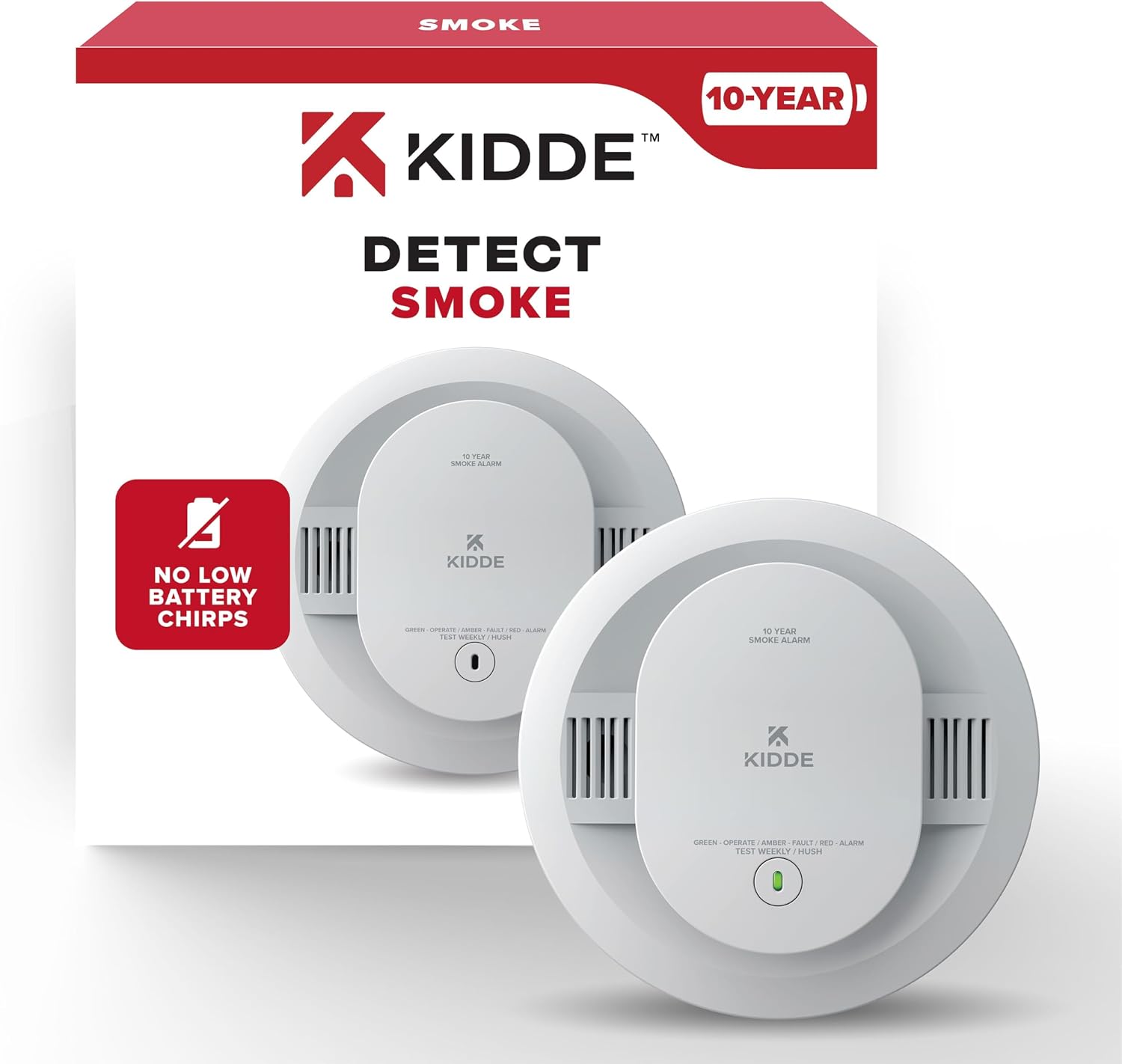
Key specs: Sealed 10-year battery smoke alarm with LED status lights and an 85 dB alarm; no battery changes and no low-battery chirps over its service life
If you are replacing an alarm that has reached ten years, this is the least complicated way to do it. The battery is sealed and rated for the life of the alarm, so the unit and its power supply expire together — which removes both the annual battery change and the 3am low-battery chirp that causes people to disable alarms entirely. LED status lights and an 85 dB alarm are the standard package. The trade-off is that when the battery does reach the end, the whole alarm is replaced rather than the cell, which is the intended design rather than a flaw. If the alarm on your ceiling is already a Kidde, our Kidde replacement guide matches the power type so the new one actually fits the system.
✅ Pros
- Sealed battery lasts the alarm’s rated service life
- No annual battery changes and no low-battery chirps
- LED status lights for at-a-glance checking
- 85 dB alarm, the standard for household units
- Unit and battery reach end of life together, which simplifies planning
❌ Cons
- The battery cannot be replaced separately by design
- Smoke sensing only — it does not detect carbon monoxide
- Single-sensor design rather than dual
First Alert SM310 Dual-Sensor Smoke Alarm — if you want both sensing types
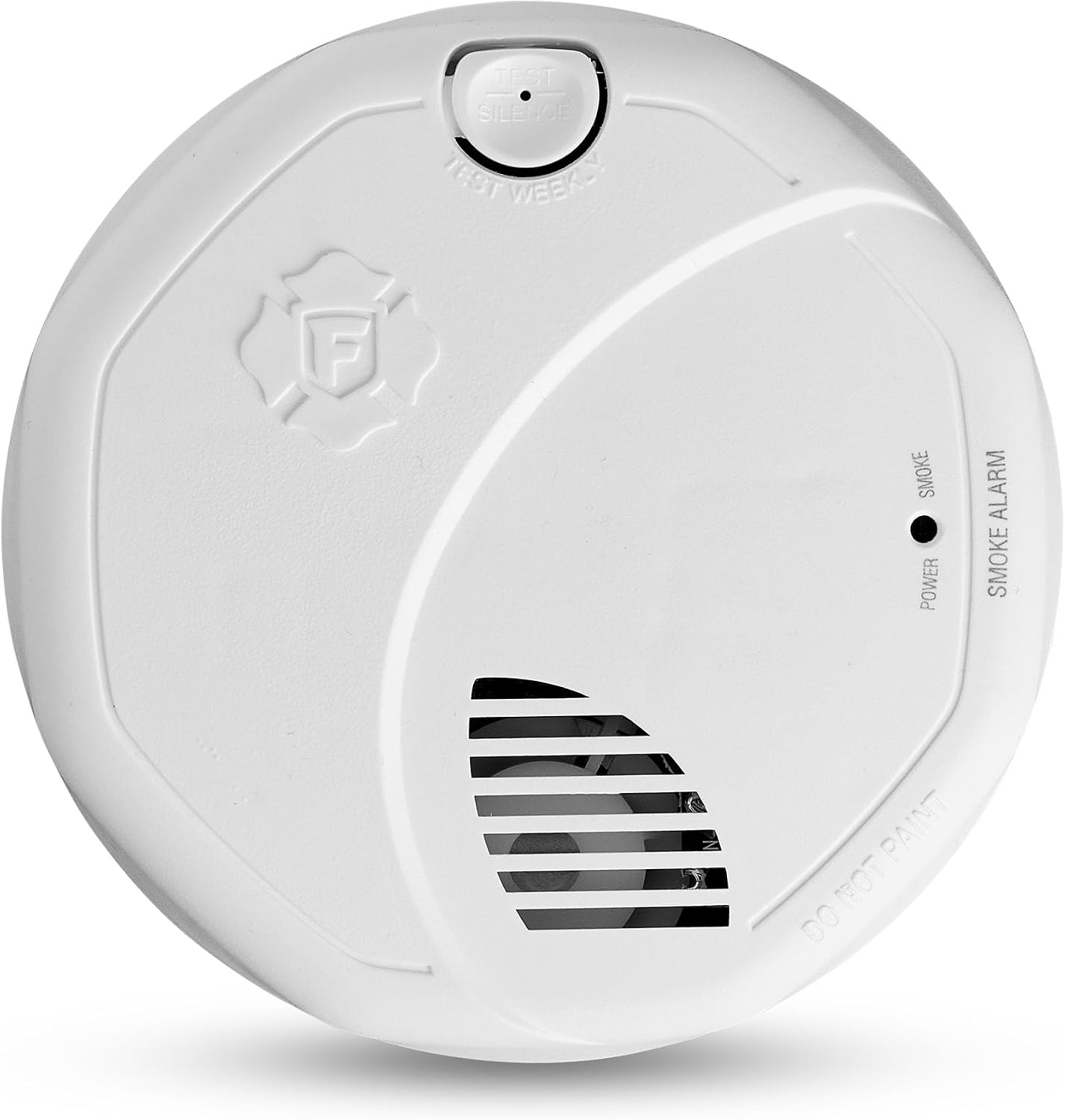
Key specs: 10-year battery smoke alarm using both photoelectric and ionization sensing, so it responds to smoldering and fast-flaming fires rather than favoring one
Smoke alarms sense in two different ways, and each is better at a different kind of fire: photoelectric sensing responds sooner to slow, smoldering fires, while ionization responds sooner to fast-flaming ones. This alarm carries both, which removes the choice rather than asking you to guess which fire you will have. It runs on the same 10-year battery arrangement. Dual-sensor alarms can be marginally more prone to nuisance alarms near kitchens and bathrooms, which is a placement question rather than a reason to avoid them.
✅ Pros
- Photoelectric and ionization sensing in one unit
- Responds to both smoldering and fast-flaming fires
- 10-year battery, so no annual changes
- Removes the sensor-type decision entirely
- Same fit and mounting as a single-sensor alarm
❌ Cons
- Slightly more prone to nuisance alarms in the wrong position
- Smoke only — no carbon monoxide detection
- Costs more than a single-sensor unit
First Alert 10-Year Combination Smoke and CO Alarm — if you are replacing two alarms
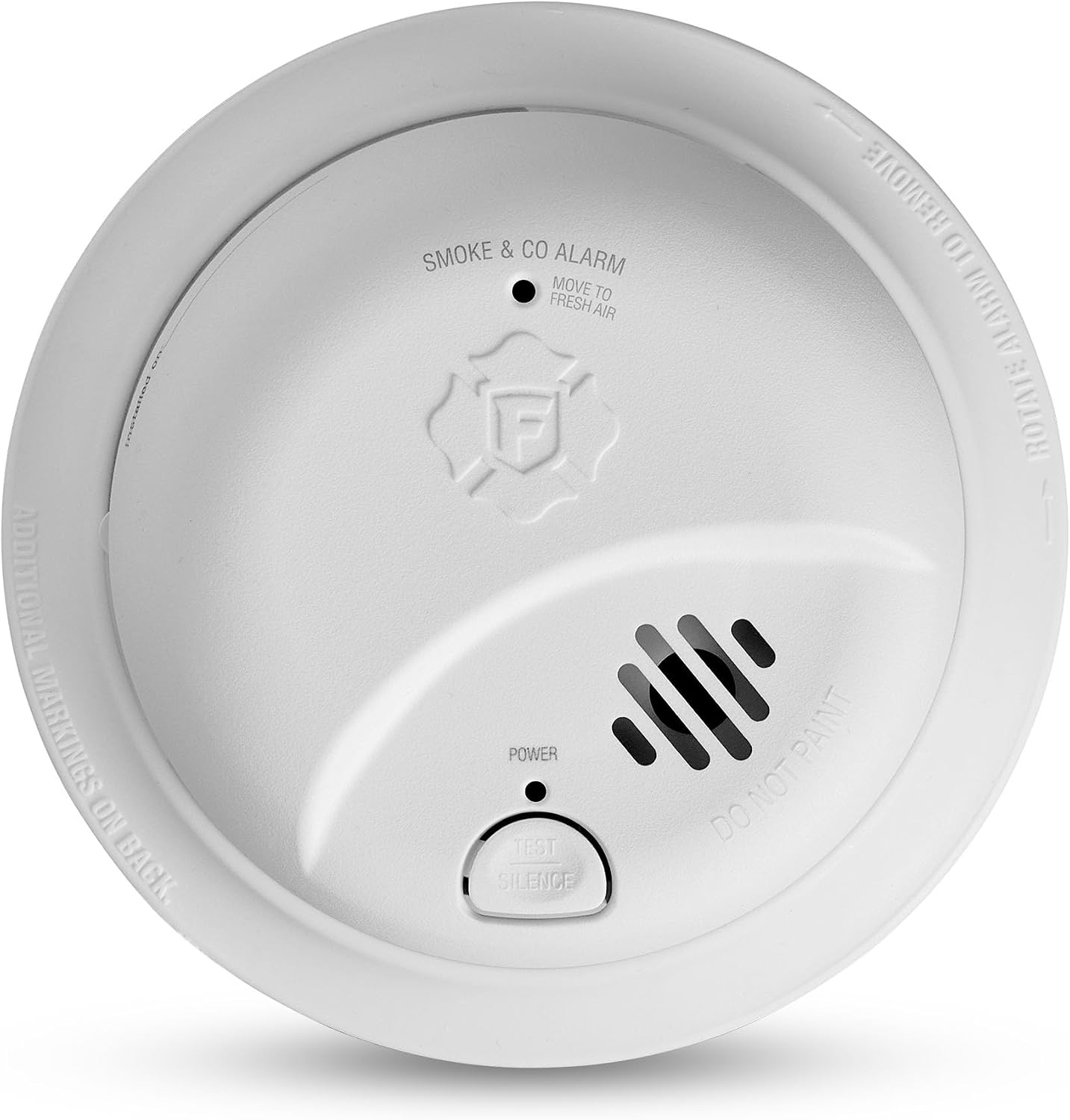
Key specs: Combination smoke and carbon monoxide alarm on a 10-year battery, covering both hazards from one ceiling position
If a hallway currently has both a smoke alarm and a carbon monoxide alarm, and both are due, a combination unit replaces two devices with one and halves the ceiling clutter. The important caveat is the interval: Kidde’s guidance puts combination alarms on a seven to ten year replacement period depending on model, rather than the flat ten years that applies to smoke alarms. So a combination alarm may need replacing sooner than the smoke alarm beside it would have, and that is worth writing on the back when you fit it.
✅ Pros
- Covers smoke and carbon monoxide from one position
- Replaces two devices with one
- 10-year battery, no annual changes
- Fewer units to test and track
- Sensible where a hallway already has both alarm types
❌ Cons
- Shorter replacement window than a plain smoke alarm
- One failure takes out both protections at that position
- Carbon monoxide alarms should also sit at sleeping-area height, not only on ceilings
The Three Side by Side
| Alarm | Detects | Sensing | Replacement window | Best for |
|---|
| Kidde 20SD10 | Smoke | Single sensor | Ten years | A straight like-for-like replacement |
| First Alert SM310 | Smoke | Photoelectric and ionization | Ten years | Covering both fire types without choosing |
| First Alert Combination | Smoke and carbon monoxide | Combination unit | Seven to ten years by model | Replacing two alarms with one |
Final Recommendation
Do the audit before you buy anything. Take every alarm down, read the manufacture date on the back label, and replace anything ten years old or older — seven or more for carbon monoxide and combination units. If any alarm is chirping and a fresh battery does not silence it, that one is finished regardless of its date.
For the replacements themselves, buy the Kidde 20SD10 as the default: a sealed ten-year battery means the alarm and its power supply expire together, and the low-battery chirp that makes people disable alarms simply never happens. Choose the First Alert SM310 instead if you would rather not pick a sensing technology, since it carries both. Choose the combination alarm only where you are genuinely replacing both a smoke and a carbon monoxide alarm at the same spot, and write its shorter replacement window on the back when you fit it. If you want app alerts and connected features as part of this refresh, our smart smoke detector guide covers that category, and the carbon monoxide detector roundup covers CO specifically. What would change this advice is a rented home, where replacing alarms is usually the landlord’s obligation — report the dates rather than buying.
SafeBode does not yet run an in-house product testing program. This guide is built from manufacturer specifications, official support documentation, current retail listings and verified buyer feedback rather than hands-on testing, and we say so plainly rather than implying testing we have not done.
Frequently Asked Questions
How often should I replace a smoke alarm?
Every ten years for smoke and heat alarms, according to Kidde’s guidance citing the National Fire Protection Association. Carbon monoxide and combination alarms are on a shorter window of seven to ten years depending on the model.
Where do I find the manufacture date?
On the label on the back of the alarm, stamped alongside the model number. You have to take the alarm off its mounting plate to see it, which is why so few people know how old their alarms actually are.
Does the ten years start when I installed it?
No, it runs from the manufacture date. An alarm that sat in a warehouse or a drawer for two years before being fitted has already used two years of its service life.
My alarm chirps even with a new battery. What is wrong?
That is the end-of-life signal rather than a power problem. Kidde states the beep will only stop when the alarm is out of power and that replacing the battery will not stop it, which makes the fresh-battery test a reliable way to tell the two apart.
Can an expired alarm still detect a fire?
It may respond more slowly or less reliably, and you cannot tell from the outside. On carbon monoxide alarms the position is starker: once in end-of-life mode the alarm cannot detect carbon monoxide at all.
Does pressing the test button prove my alarm works?
It proves the horn sounds and the electronics have power. It does not test the sensor’s sensitivity, which is the part that degrades with age, so a passing test on a twelve-year-old alarm is not reassurance.
What is the difference between photoelectric and ionization sensing?
Photoelectric sensing responds sooner to slow, smoldering fires and ionization responds sooner to fast-flaming ones. Dual-sensor alarms carry both, which removes the need to predict which kind of fire you might have.
Should I buy sealed-battery alarms or replaceable ones?
Sealed ten-year units remove the annual battery change and the low-battery chirp that causes people to disconnect alarms, which is a real safety benefit. The trade is that the whole unit is replaced at end of life rather than just the cell.
Sources
Show sources (4)


