Best Fire Extinguishers for Home 2026: Reading the A-B-C Rating Before You Buy
Affiliate Disclosure: This article contains affiliate links. If you buy through these links, we may earn a commission at no extra cost to you. Our editorial opinions are our own and are not influenced by affiliate relationships. Read our full disclosure policy →
Contents
Quick Answer
Ignore the front of the box and read the rating stamped on the label. In 1-A:10-B:C, the letters are fuel types and the numbers are capacity: the number before the A is a multiple of 1.25 gallons of water, and the number before the B is the square footage of a flammable-liquid fire the unit is rated to handle. So a 2-A unit has genuinely double the Class A capacity of a 1-A — and 2-A:10-B:C on every level, no more than 40 ft apart, is the published minimum Kidde cites from NFPA, even though 1-A:10-B:C units dominate the shelf. Start with the First Alert HOME2PRO per level, add a lighter 1-A unit where someone needs to lift it, and step up to 3-A:40-B:C in a garage.
How to Read 1-A:10-B:C
The rating stamped on a home extinguisher looks like a license plate. It is not decoration and not a model number — it is the result of a standardized fire test. The standard is UL 711 (published jointly as ULC-S508), the Standard for the Rating and Fire Testing of Fire Extinguishers, which UL Standards & Engagement describes as specifying rating requirements and fire-test performance so the different classes of extinguisher are suitable for specific types of fire, across Class A, B, C, D and K. The letters are not a marketing claim — they are the classes the unit passed a test for.
The Letters: What Each One Is Burning
🔥 Classes you want at home
- A — ordinary combustibles: wood, cloth, paper, rubber, plastics
- B — flammable liquids and gases: gasoline, oils, petroleum greases, tars, oil-based paints, solvents
- C — energized electrical equipment, where the agent not conducting electricity is the whole point
🚫 Classes a home unit will not carry
- D — combustible metals: magnesium, titanium, sodium, lithium
- K — cooking appliances with flammable oils and fats, which USFA places in commercial kitchens
- An ABC unit is not rated K — which matters more in a home kitchen than most guides admit
Now the numbers. The U.S. Fire Administration spells out the arithmetic: the number before the A represents a multiple of 1.25 gallons of water, and the number before the B represents a multiple of the area, in square feet, of fire to be extinguished. So 1-A:10-B:C means the equivalent of 1.25 gallons of water on a Class A fire, plus a Class B fire up to 10 square feet, plus clearance for Class C. The C never carries a number because there is nothing to measure — it is a pass or fail on whether the discharged agent is electrically nonconductive.
The Same Label, Decoded Piece by Piece
2
the A numeral: 2 × 1.25 = 2.5 gallons of water equivalent
A
ordinary combustibles — wood, paper, cloth, plastics
10
the B numeral: a flammable-liquid fire up to 10 sq ft
B:C
flammable liquids, plus clearance for live electrical gear
Reading 2-A:10-B:C: two capacity figures and one safety clearance, not three scores.
One more line matters as much as the rating: USFA tells buyers to always look for the “UL Listed” or “ULC Listed” mark. A can with a bold A-B-C graphic and no listing mark tells you nothing verifiable — the same logic we apply in our smart smoke detector guide, where the certification mark is the checkable claim.
1-A vs. 2-A Is a Real Capacity Gap
Kidde’s own placement guidance cites NFPA’s minimum recommendation for a house: install a 2-A:10-B:C rated extinguisher on every level, no more than 40 ft apart, and include all locations where a fire may start. Now look at what sells: the units dominating the home category are rated 1-A:10-B:C — half the Class A capacity of the figure the guidance names.
That is not a scandal, and a 1-A unit is not a fake product. It is UL rated, it works, and it will handle a wastebasket. But if you buy one, hang it in the hallway and consider the floor covered, you have bought half of what the recommendation describes without anyone telling you. Nobody at the shelf explains that the numeral is a capacity multiple, so the two units read as interchangeable. The B numeral scales the same way: a 10-B unit covers a flammable-liquid fire up to 10 square feet, a 40-B unit four times that area. Kidde makes the Class A side explicit on its Pro 340 — it markets three times more firefighting power and footnotes the comparison precisely, against the Class A capability of a UL 1-A:10-B:C rated extinguisher. The manufacturer is telling you, in a footnote, that the numeral is the product.
| Rating | Class A capacity | Class B capacity | Where it fits |
|---|
| 1-A:10-B:C | 1.25 gallons water equivalent | Up to 10 sq ft | Supplemental, at a specific hazard |
| 2-A:10-B:C | 2.5 gallons water equivalent | Up to 10 sq ft | The per-level baseline Kidde cites from NFPA |
| 3-A:40-B:C | 3.75 gallons water equivalent | Up to 40 sq ft | Garage or workshop, where flammable liquids are stored |
| 10-B:C (no A) | None — not rated for ordinary combustibles | Up to 10 sq ft | Vehicle and marine units. Not a house extinguisher |
That last row is a genuine trap. A unit rated 10-B:C with no A is not a weaker home extinguisher — it is a different product, with no rating for the wood, paper and fabric that make up most of what burns in a house.
Where Each Unit Should Go
Rating and placement are one decision, because the right rating depends on what is stored in the room. Kidde’s guidance: keep extinguishers within reach on every level, install close to exits and in the kitchen and garage, and check the gauge monthly. “Close to exits” is the part people invert — a unit mounted past the stove means walking toward the fire. Same reasoning as where smoke alarms go and why they should be interconnected: position is set by the escape route.
| Location | Rating to look for | Why | Mounting note |
|---|
| Every level (hallway or landing) | 2-A:10-B:C | The NFPA minimum Kidde cites, no more than 40 ft apart | Near the stairs and an exit |
| Kitchen | 2-A:10-B:C multipurpose | Cooking is by far the leading cause of home fires — but an ABC unit is not rated K | Between the cooking area and the way out |
| Garage or workshop | 3-A:40-B:C or higher | Kidde recommends a higher rating for the volume of flammable liquids present | By the door into the house, at liftable height |
| Utility, furnace or laundry room | 2-A:10-B:C | Appliance and electrical ignition, where the C clearance matters | At the doorway, clear of the appliance |
| Car, boat or RV | 10-B:C or a small A:B:C unit | Liquid-fuel risk dominates; some marine units meet a 5-B requirement | Strap bracket, secured |
The garage is where the rating gap matters most and the room people equip last: gasoline cans, paint, solvents, a car and a workbench put a real Class B load in one space, and a fire there can burn a while before anyone notices — which is also why an attached garage is a standard location for a carbon monoxide detector too.
The honest kitchen caveat. Every guide says put one in the kitchen, and you should. But the classic kitchen fire — a pan of cooking oil alight on the stove — is a Class K scenario, and a residential ABC extinguisher is not rated K. USFA’s advice for a pan fire does not involve an extinguisher at all: keep a lid or baking sheet nearby and use it to cover the pan. Lid on, burner off. The kitchen extinguisher is for the towel, the trash can and the outlet — fires that spread past the pan.
Rechargeable or Single-Use
The second decision hiding on the label is whether the unit can be serviced. It changes what happens after any discharge, however brief.
Two Different Ownership Models
♻️ Rechargeable — metal head, serviceable
- Rechargeable after use, but First Alert specifies this is done by certified professionals, not by you
- Durable metal head, metal pull pin with safety seal, corrosion-resistant metal gauge
- Kidde ships its rechargeable Pro line with a location sign and inspection tag so service is documented in line with NFPA 10
🗑️ Single-use — sealed, replace after any discharge
- Cannot be recharged. Any discharge, even a short one, ends the unit’s life
- Kidde’s Basic 110 is single-use, rated for 12 years with no internal examination required
- Per NFPA 10, single-use units skip the 6-year internal examination, though annual external examinations still apply
Anyone who says rechargeable always wins is skipping the handling question. USFA’s guidance is to select the largest extinguisher a user can safely and comfortably operate. First Alert lists its 2-A:10-B:C HOME2PRO at 17 in tall and 9 lb; Kidde’s 1-A:10-B:C Basic 110 averages 3.9 lb at 14.2 in. That gap decides more purchases than it should by accident.
How We Picked
We started from the rating, not the brand. Every unit below is UL rated and carries an A numeral, because a home extinguisher without a Class A rating is not one. We chose one unit per real placement case rather than four versions of the same thing, and checked every specification against the manufacturer’s own product page or data sheet rather than retail listing copy. Small aerosol “fire extinguishing spray” cans were left out on purpose: they surfaced with thin review histories and no A:B:C rating stated at all, and USFA tells buyers to look for the classification and the listing mark.
First Alert HOME2PRO Rechargeable Fire Extinguisher — the per-level baseline
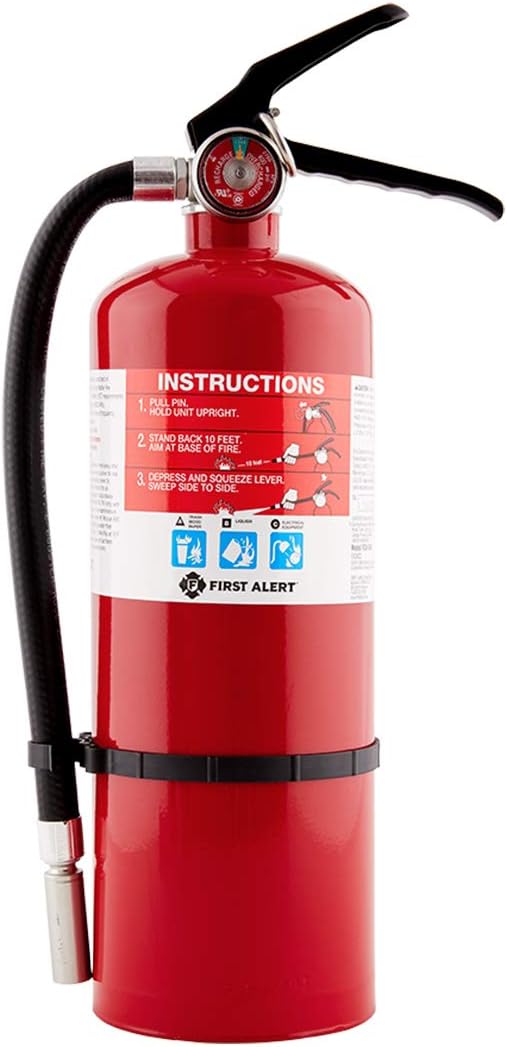
Key specs: UL rated 2-A:10-B:C; rechargeable by certified professionals; metal head, metal pull pin with safety seal, corrosion-resistant metal gauge; wall mounting hook included; First Alert lists model FE2A10GR at 17 in tall, 9 lb, 12-year limited warranty
This is the pick that matches the published guidance rather than the shelf. Its 2-A:10-B:C rating is exactly what Kidde cites from NFPA as the minimum for main home protection on every level, and the 2-A numeral means 2.5 gallons of water equivalent instead of the 1.25 a 1-A unit delivers. First Alert describes it as ideal for meeting minimum fire extinguisher codes and builds it that way: a durable metal head, a metal pull pin with a safety seal, a corrosion-resistant color-coded gauge, and a code-compliant wall mounting hook in the box. One honest supply note: at the time of writing, First Alert’s own store listed this model as backordered while the Amazon listing remained active — a stock observation, not a discontinuation.
✅ Pros
- Matches the per-level minimum Kidde cites from NFPA
- Double the Class A capacity of the 1-A units that dominate the category
- Metal head, metal pull pin with safety seal, corrosion-resistant gauge
❌ Cons
- At 9 lb and 17 in, a heavy object to aim one-handed — check who will use it
- Recharging means a certified service, not a home job
- Still a 10-B unit, so under-rated for a garage of flammable liquids
Kidde Basic 110 (FA110G) — the light one you will lift
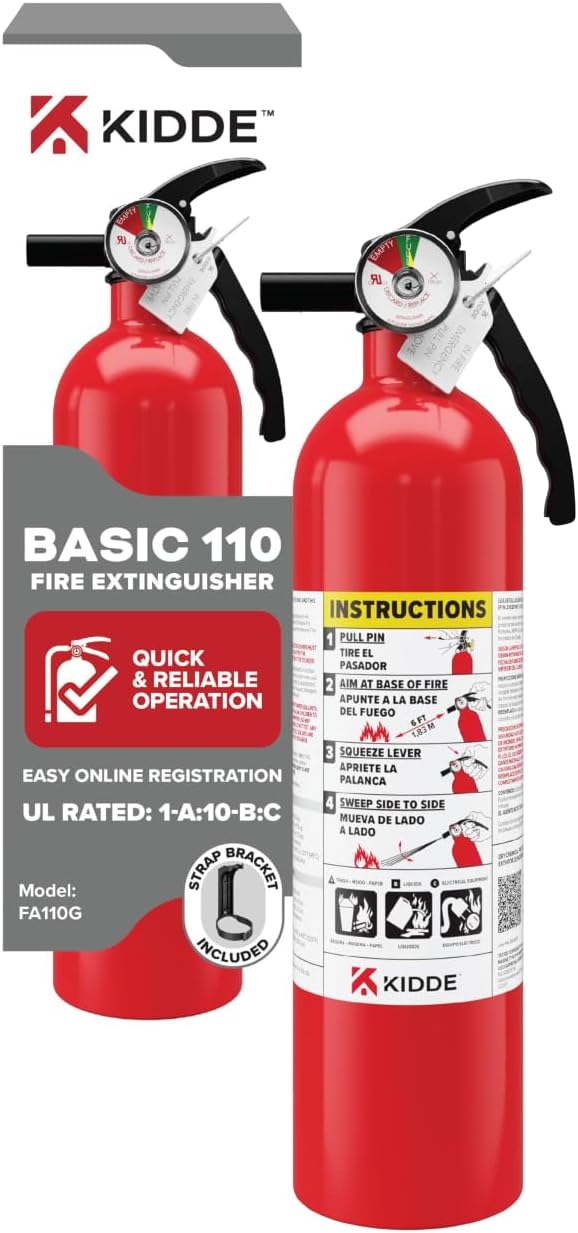
Key specs: UL rated 1-A:10-B:C; single-use, not rechargeable; 2.5 lb net agent charge in a seamless aluminum cylinder, 3.9 lb average unit weight, 14.2 in tall; 8-12 second discharge, 6-8 ft range; 12-year service-free design; U.S. Coast Guard approved with the included strap bracket
This is the unit almost everyone ends up buying, and it deserves a fair hearing. Kidde publishes real numbers: a 2.5 lb agent charge in a seamless aluminum cylinder, 3.9 lb average unit weight, 14.2 in tall, an 8-12 second discharge time and a 6-8 ft range. It is UL rated 1-A:10-B:C, single-use with a 12-year service-free life, and Coast Guard approved with the included strap bracket. Buy it with clear eyes: as a second unit at a specific hazard, or for a household where 9 lb held at arm’s length is not realistic — not believing one of these covers a floor to the standard the guidance describes.
✅ Pros
- Under 4 lb — USFA’s rule is the largest unit the user can safely operate
- Kidde publishes full specifications, down to discharge time and range
- 12 years of service-free life, no internal examination required
❌ Cons
- 1-A is half the Class A capacity of the per-level minimum Kidde cites
- Single-use: any discharge, even a two-second test, means buying a new one
- 8-12 seconds of discharge is a short window to get it right
Kidde Home Fire Extinguisher 4-Pack — coverage in one order
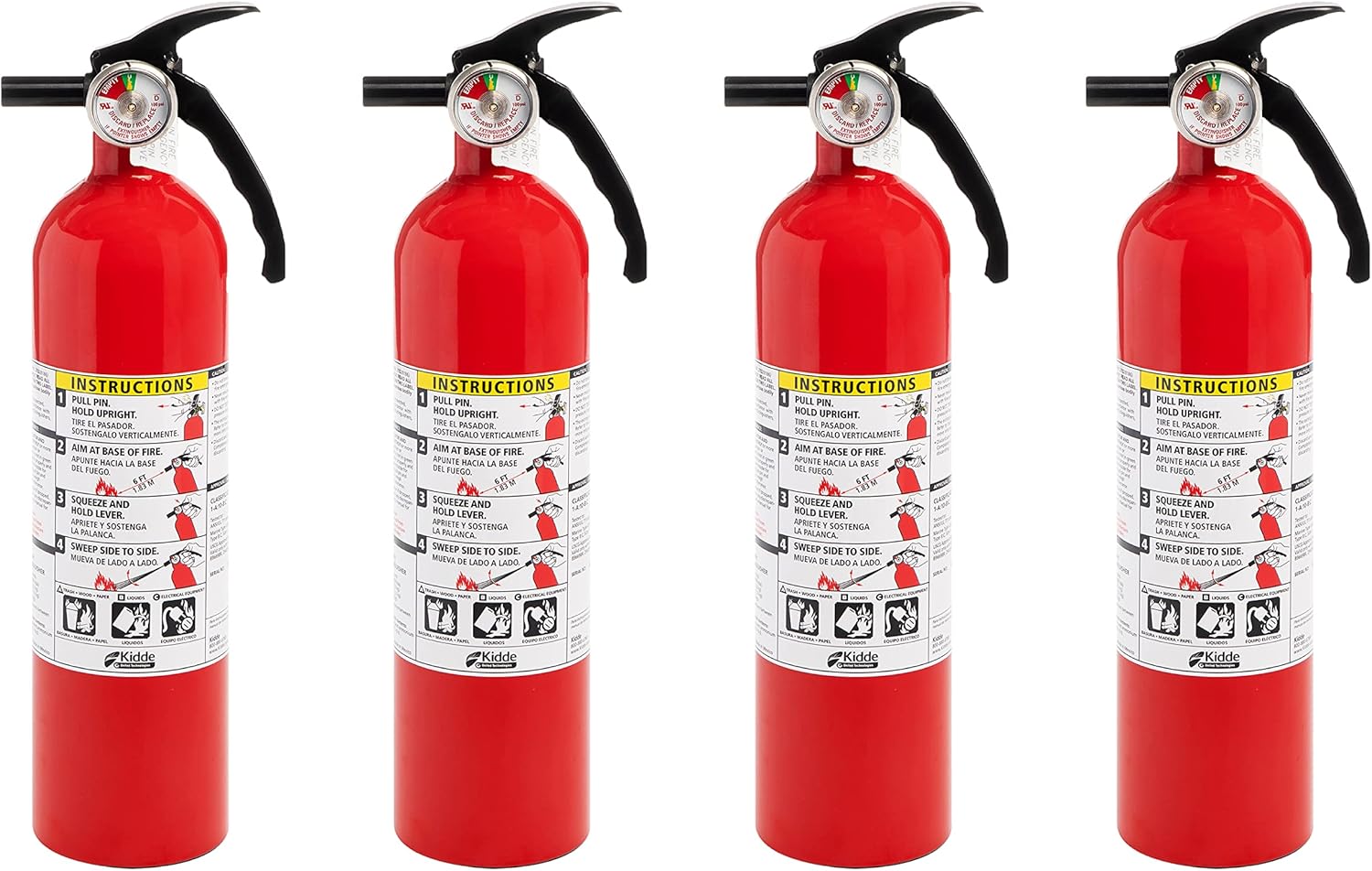
Key specs: Four multipurpose dry chemical units, each UL rated 1-A:10-B:C, with mounting brackets included; sold as a single four-unit order
The most common failure in home fire preparation is not owning the wrong extinguisher — it is owning one, in the kitchen, and nothing anywhere else. Kidde’s guidance is to place units within reach on every level and include all locations where a fire may start, and a two-story house with a basement and a garage needs four positions. This is four 1-A:10-B:C multipurpose dry chemical units with brackets in one order — a quantity answer, not a capacity one, since the per-level recommendation Kidde cites is written for a 2-A. The strongest version of this plan is a 2-A on each main level with these filling the secondary positions.
✅ Pros
- Solves the real problem — most homes are under-equipped, not mis-equipped
- Mounting brackets included, so every unit goes on a wall not in a cupboard
- Same UL 1-A:10-B:C multipurpose rating as the standalone Basic units
❌ Cons
- Quantity, not capacity — the per-level minimum Kidde cites is a 2-A
- Four single-use units means four replacements after any discharge
- None of the four is rated for the flammable-liquid volume of a garage
Kidde Pro 340 (PRO-5MP-1) — the garage unit
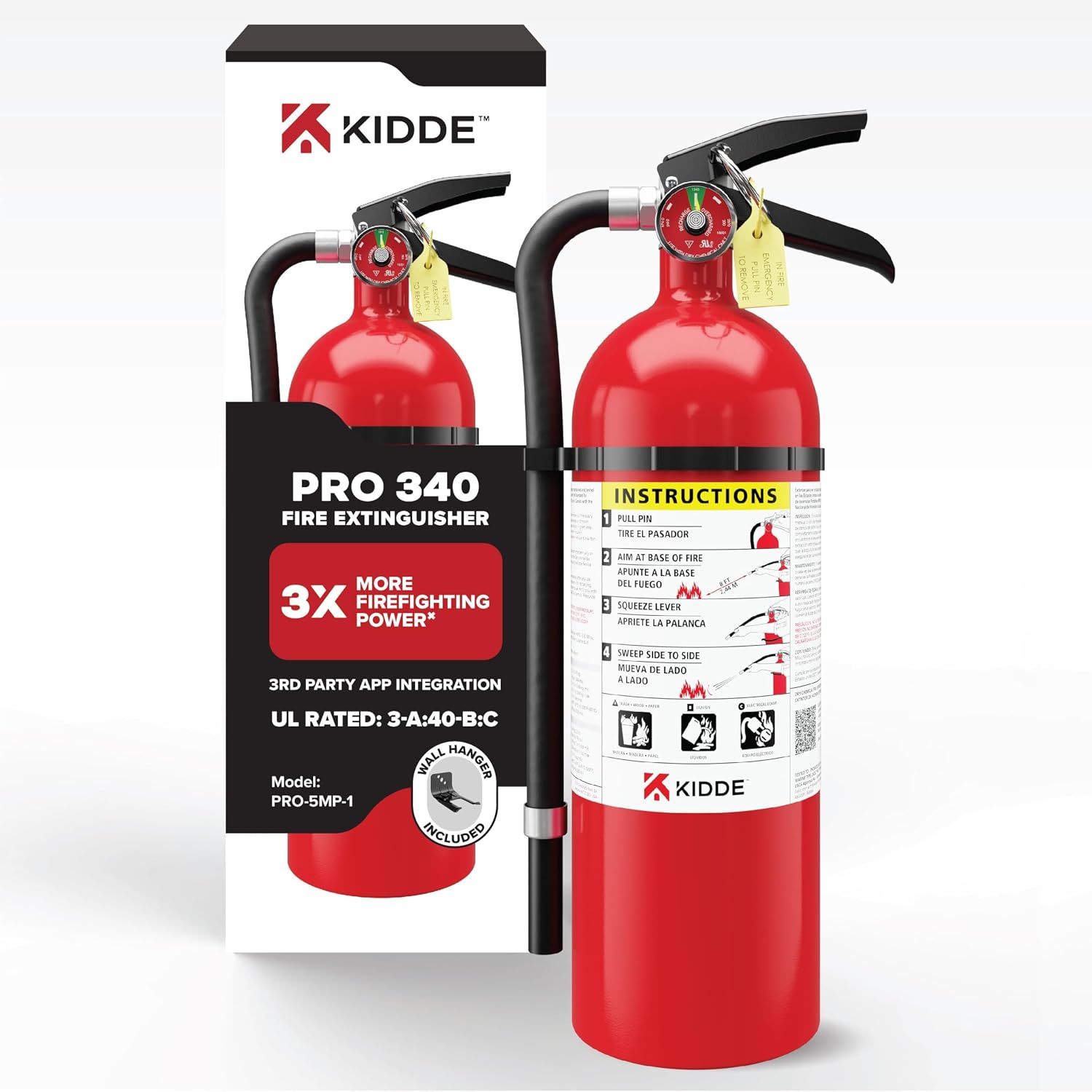
Key specs: UL rated 3-A:40-B:C; rechargeable; built for commercial code compliance over larger areas; Kidde rates its Class A power at three times a 1-A:10-B:C unit; ships with a location sign and inspection tag for NFPA 10 service documentation
Kidde is explicit that garages and workshops need a higher-rated extinguisher, because of the volume of flammable liquids normally present and because the unit there has to handle paint, wood, gasoline and energized electrical equipment. Its 3-A:40-B:C rating means 3.75 gallons of water equivalent on Class A and a flammable-liquid rating of 40 square feet rather than 10 — Kidde markets it as three times the firefighting power of a 1-A:10-B:C unit, footnoting the comparison to Class A capability specifically. It is rechargeable and ships with a location sign and inspection tag so service is documented in line with NFPA 10, the detail that gives it away as a commercial unit. If your workshop faces any kind of inspection, that documentation trail is the reason to buy this over a consumer unit — the same logic behind fire alarm requirements for a small business.
✅ Pros
- Four times the Class B area rating of a 10-B unit, in the room where that risk lives
- Kidde rates it at three times the Class A power of a 1-A:10-B:C unit
- Rechargeable, with a location sign and inspection tag for NFPA 10 documentation
❌ Cons
- A commercial unit — heavier than anything else here. Re-read USFA’s “can safely and comfortably operate” line before mounting it
- Overkill in a hallway; this is a garage or shop-floor purchase
- Rechargeable means a service relationship, and the inspection tag implies upkeep
What Ten Seconds of Discharge Buys You
Kidde’s data sheet for the Basic 110 lists a discharge time of 8-12 seconds and a range of 6-8 ft. Read those together and the honest framing of this category falls out: roughly ten seconds of agent from about two paces away — enough for a trash can, a countertop or one appliance, not enough for a fire that has reached a wall or a second object. UL Standards & Engagement puts this before any discussion of ratings: in any fire event the first priority is to escape safely, and an extinguisher may be appropriate only if the fire is small and confined.
PASS: The Four Moves, In Order
1
Pull the pin
Hold the extinguisher with the nozzle pointing away from you and release the locking mechanism.
2
Aim low
Point at the base of the fire, not the flames. The base is where the fuel is.
3
Squeeze the lever
Slowly and evenly. Squeezing harder does not deliver more agent, only faster.
4
Sweep side to side
Sweep the nozzle across the base until the fire is out and stays out.
The PASS sequence as published by the U.S. Fire Administration. Practicing it out loud once, while the extinguisher is still full and on the wall, is free.
One note the acronym leaves out: aiming low is the instruction most often ignored under stress, and spraying at flame tips wastes most of a ten-second charge on air.
When Not to Pick It Up at All
This is the section a product roundup is least motivated to write, so here it is in the middle rather than the end. Kidde’s own placement guidance leads with it: the number one priority in any house fire is to escape safely, and extinguishers should only be used to extinguish or contain a small fire, and only after the fire department has been notified.
USFA publishes a go/no-go checklist for this exact moment, and every item has to be a yes before you reach for the handle: others alerted, fire department called, physically able to use an extinguisher, fire small and contained to a single object or surface, safe from the smoke, and a clear escape route. USFA also states directly that young children and older adults should not use fire extinguishers. If you are unsure: alert others, leave, call 911.
Why “Small and Contained” Is Not Fussiness
170,000
home cooking fires U.S. fire departments responded to in 2021
37%
of nonconfined cooking fires had unattended equipment as the leading factor
3,000
injuries from home cooking fires that same year
8-12 sec
of discharge in a 1-A:10-B:C home unit
Cooking is by far the leading cause of home fires and home fire injuries. Ten seconds of agent is a real tool against a contained fire and nothing against a spreading one.
The other half of leaving safely is knowing about the fire early enough to have a choice. An extinguisher is a response device; the alarm is the reason you are awake to use it. Interlinked alarms, and the smoke and heat sensors bundled with most modern DIY home alarm systems, are what turn a fire you would have found too late into one you have ten seconds’ worth of options against.
Keeping It Ready
An extinguisher is the only safety device in the house that can look completely fine and be completely useless, because everything that matters is sealed inside a cylinder. USFA’s maintenance list is short: check nothing is blocking access, check the gauge sits in the correct pressure range, check the can, hoses and nozzles are not damaged, dented or rusted, and keep the outside free of dust, oil and grease. Kidde’s home version is simpler — check the gauge monthly. Requirements vary: USFA notes some units need shaking monthly, others pressure testing every few years, and while some can be recharged, others must be replaced.
Tie the check to something you already do — whoever tests the smoke alarms is under a ceiling with a checklist once a month anyway. Our guide on when a smoke alarm has to be replaced covers the alarm half of that routine, and if your alarms are Kidde units, the Kidde replacement walkthrough covers model-specific timing.
Final Recommendation
Buy the First Alert HOME2PRO Rechargeable Fire Extinguisher first, one for each main level, mounted near an exit. It is the only unit here whose rating matches the 2-A:10-B:C per-level minimum Kidde cites from NFPA, and 2-A means double the Class A capacity of the 1-A units that fill the category. If your garage stores gasoline, paint or solvents in any quantity, add the Kidde Pro 340 (PRO-5MP-1) out there for the 40-B rating rather than the brand.
Choose differently in two situations. If 9 lb held at arm’s length is not realistic for the people most often home — USFA’s standard is the largest unit a person can safely operate — then the Kidde Basic 110 (FA110G) at 3.9 lb is the better extinguisher, because the best-rated unit nobody can lift is rated zero. If you own one extinguisher for the whole house, the coverage gap beats the capacity gap: the Kidde Home Fire Extinguisher 4-Pack fills four wall positions today, and the main levels can move to 2-A units later.
Whatever you buy, mount it rather than shelving it, and read the gauge once a month. Keep the order of operations straight: everyone out, fire department called, and only then the extinguisher — and only if the fire is small and confined. If protecting documents and valuables from fire is part of what brought you here, a fire-rated safe is the right tool for that and an extinguisher is not.
SafeBode does not yet run an in-house product testing program. This guide is built from manufacturer specifications, official support documentation, current retail listings and verified buyer feedback rather than hands-on testing, and we say so plainly rather than implying testing we have not done.
Frequently Asked Questions
What does 1-A:10-B:C actually mean?
The letters are the fuel classes the unit passed a fire test for: A is ordinary combustibles, B is flammable liquids, C means the agent is electrically nonconductive. The numbers are capacity — the figure before the A is a multiple of 1.25 gallons of water equivalent, and the figure before the B is the square footage of a flammable-liquid fire it is rated for.
Is a 1-A:10-B:C extinguisher enough for a house?
It is a real UL rated extinguisher and will handle a small contained fire. But the minimum Kidde cites from NFPA for main home protection is a 2-A:10-B:C unit on every level, double the Class A capacity. Treat a 1-A unit as supplemental rather than full coverage for a floor.
How many fire extinguishers do I need at home?
One on every level, no more than 40 ft apart, close to exits, plus the kitchen and the garage. For a two-story house with a basement and an attached garage that is four or five positions, not one.
Can I use a standard ABC extinguisher on a grease fire in a pan?
A burning pan of cooking oil is a Class K scenario, and residential ABC extinguishers are not rated Class K. The published advice is to slide a lid or baking sheet over the pan and turn the burner off.
Do fire extinguishers expire?
They have a service life rather than a hard expiration date, and it depends on type. Kidde’s single-use Basic 110 is designed for 12 years with no internal examination needed, though annual external checks still apply; rechargeable units are serviced on a schedule instead. A gauge outside the correct range, or visible damage, means it needs attention regardless of age.
Where should I not put a fire extinguisher?
Anywhere you would have to move toward the fire to reach it. The classic mistake is mounting the kitchen unit on the far side of the range, so the stove sits between you and the extinguisher. Mount it between the hazard and the exit.
What is the difference between an extinguisher and a fire extinguishing spray?
A rated extinguisher carries a UL classification you can read on the label and a testing laboratory listing mark. Many small aerosol sprays are sold alongside them without stating any A:B:C classification, which leaves you nothing verifiable about what the can will put out.
If I put the fire out myself, do I still call the fire department?
Yes, and you call before using the extinguisher, not after. The published sequence is alert everyone in the building, have someone call the fire department, then consider an extinguisher on a small contained fire. Fires that look out can smolder inside a wall cavity or an appliance.
Sources
Show sources (7)
- [1] U.S. Fire Administration (FEMA) – “Choosing and Using Fire Extinguishers,” usfa.fema.gov/prevention/home-fires/prepare-for-fire/fire-extinguishers/
- [2] UL Standards & Engagement – “Fire Extinguisher Standards: Helping to Contain and Put Out Small Fires” (UL 711 / ULC-S508, the Standard for the Rating and Fire Testing of Fire Extinguishers), ulse.org
- [3] Kidde Safety Hub – “Where to Place a Fire Extinguisher in Your Home,” kidde.com
- [4] Kidde – Basic 110 Fire Extinguisher (FA110G) product page and Product Data Sheet (PDS_FA110G_BASIC110), kidde.com
- [5] First Alert – “Compliance Fire Extinguisher UL Rated 2-A:10-B:C | HOME2PRO” product page (model FE2A10GR), firstalert.com
- [6] Kidde – Pro 340 Fire Extinguisher (PRO-5MP-1) product page, kidde.com
- [7] U.S. Fire Administration (FEMA) – “Cooking Fire Safety,” usfa.fema.gov/prevention/home-fires/prevent-fires/cooking/


