Window Security Film and Security Bars: Do They Stop a Break-In?
Affiliate Disclosure: This article contains affiliate links. If you buy through these links, we may earn a commission at no extra cost to you. Our editorial opinions are our own and are not influenced by affiliate relationships. Read our full disclosure policy →
Contents
Quick Answer
Security film and security bars solve two different problems, and the single most misunderstood fact about film is this: it does not stop glass from breaking. It holds the shattered glass together so an intruder cannot punch straight through in one hit. Bars physically block the opening instead, which works, but a bar with no quick-release mechanism on a bedroom window is a serious, documented fire-escape hazard. Ground-floor and basement windows are the ones worth hardening first — they are a well-established entry point, and Security.org names them specifically as the case for installing bars.
Two Different Jobs, Not Two Versions of the Same Thing
Search results for window security tend to lump film and bars together as though they are simply a cheap option and an expensive option for the same problem. They are not. Film is a delay tactic applied to the glass itself. Bars are a physical barrier applied to the opening. A determined intruder eventually defeats either one given enough time and noise tolerance — the honest goal of both is to make a break-in take long enough, and sound loud enough, that the person gives up or gets noticed.
For a sliding window, also check the opening hardware: our sliding window lock guide covers track stops and lock fit alongside the need to preserve emergency escape.
Here is the fact that gets garbled most often: security window film does not prevent glass from breaking. A rock, a pry bar or a swift kick will still crack the pane. What the film does is hold the shattered pieces together in one sheet instead of letting them fall away, so the intruder is left punching and clawing at a sagging but still-attached sheet of glass rather than an open hole. That single distinction is why film is marketed as delaying entry, never preventing it, and it is the reason we are not going to describe any film product below as unbreakable.
Bars work on a completely different principle. Installed correctly, a bar grille physically will not open regardless of what happens to the glass behind it, which is a stronger claim than film can make. That strength is exactly what creates the fire-safety problem covered later in this guide — a barrier that will not open for an intruder will not open for you either, unless it is built to.
Which Problem Do You Actually Have?
💠 A break-in-delay problem — film helps
- The window itself is sound, you just want a smashed pane to stop being an instant opening
- You want something invisible from the street once installed
- The window needs to stay usable as a normal window and, if applicable, as a fire exit
- You are hardening several windows on a budget and want one material that scales
🔐 A physical-barrier problem — bars help
- The window is rarely if ever opened, so losing that convenience costs nothing
- The opening itself is the weak point, not just the glass in it
- It is a basement or utility window with no other use
- You want a visible deterrent, not just a delay someone might not notice
Why Ground-Floor and Basement Windows Are the Real Target
Both products in this guide are worth the most money on the windows a person can actually reach without a ladder. Our own room-by-room walkthrough on camera placement covers entry-point data in more depth, and SafeWise’s own research lands on a consistent figure: roughly 23% of burglars gain entry through a first-floor window. Security.org goes further and names the two specific window types worth hardening first — “If you have basement windows or ground-floor windows in a higher-crime area, window bars are worth installing”.
Basement windows deserve their own line of thinking, separate from ground-floor windows on the main level. They are usually smaller, closer to grade, screened from street view by shrubs or a window well, and in a lot of houses they are the window nobody upstairs would hear being forced. That combination of low visibility and low audibility is exactly why basement windows show up specifically in the search behind this guide, separate from the ground-floor windows people already think to secure.
It also matters whether a given basement window sits behind a bedroom. A basement used only for mechanical equipment, storage or a laundry room is a different legal case than a basement with a bed in it, and the difference changes which product on this page is even allowed on that specific window. That distinction is the subject of the fire-egress section below, and it is worth reading before ordering bars for a basement, not after.
Security Film vs. Security Bars, Side by Side
| Security film | Security bars |
|---|
| Stops glass from breaking | No — holds it together after it breaks | Not applicable, glass is not the barrier |
| Physically blocks the opening | No | Yes, when properly mounted |
| Visible from outside | No, once installed correctly | Yes, and often deliberately so as a deterrent |
| Fire-egress restriction | None — the window still opens normally | Real restriction on any required exit unless quick-release |
| Typical install | DIY, cut to size and applied with the included tools | DIY with a drill for most adjustable models |
| Best fit in this guide | Any ground-floor or basement window you still want to open | Basement or utility windows, or any window paired with a quick-release model |
The row that should decide most purchases is fire-egress restriction. If a window is legally required to serve as an emergency exit — almost every bedroom, and most habitable basements — that row is not a minor caveat, it is the deciding factor, and it is covered in full below.
BDF S8MC Window Film Security and Safety, 8 Mil Clear — the heavy-duty pick
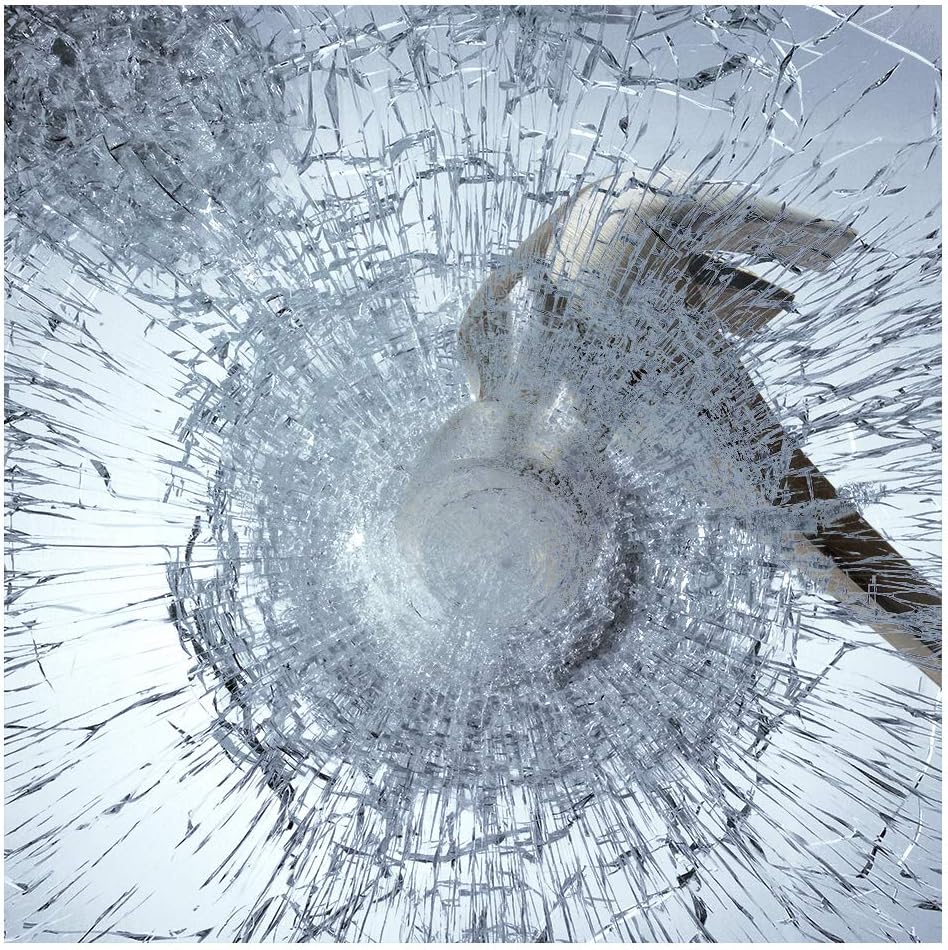
Key specs: 8-mil clear polyester security and safety film, 36in x 12ft roll; UV blocking; self-adhesive, cut-to-size installation; Amazon’s Choice for window security film
This is SafeWise’s own top pick for security film going into 2026, and the reasoning holds up: an 8-mil clear polyester film is thick enough to meaningfully slow a break-in attempt while staying inexpensive per square foot, and it ships with the tools needed for a cut-to-size DIY install. Applied to a ground-floor or basement pane, it turns a single well-placed hit into a sagging, still-attached sheet the intruder has to keep working at rather than an open hole they can climb straight through. It changes nothing about how the window opens or closes, so it carries none of the fire-egress restriction covered later in this guide — a real advantage over bars on any window that must remain a usable exit.
✅ Pros
- Ships with the application tools needed for a full DIY install
- 8-mil thickness sits at the upper end of what is sold for home use, not the thin end
- Leaves the window fully operable, so it never becomes a fire-egress question
- Amazon’s Choice listing for this search, so stock and delivery are reliably available
❌ Cons
- Does not stop glass from breaking, only holds it together afterward
- Does nothing for the frame, lock or hinge — a pried frame defeats it entirely
- Cut-to-size application takes real care to avoid bubbles; a rushed job looks obviously amateur
- One roll size covers a fixed run of window area, so a whole-house job means ordering enough footage up front
Qualsen Window Security Film and Safety, Premium 4 Mil Clear — the budget pick

Key specs: 4-mil clear security and safety film, 35.4in x 78.7in sheet; anti-shatter, strong adhesive, marketed for home, office and storefront glass
At 4 mil instead of 8, this sheet is roughly half the thickness of the pick above, and that difference is real: a thinner film holds together a smaller, more determined impact less well than a thicker one. What it is genuinely good for is a reader hardening several smaller panes on a tighter budget — a basement window, a garage window, a mudroom window — where 8-mil coverage on every pane is not worth the cost. Buy this one with eyes open about the tradeoff rather than assuming thinner film performs the same as thicker film with a lower price tag.
✅ Pros
- Meaningfully cheaper per pane than the 8-mil pick above
- Pre-cut sheet size fits a standard-height residential window without a large leftover offcut
- Same basic mechanism as the heavier film — holds shattered glass together rather than letting it scatter
- A reasonable choice for lower-priority panes where 8-mil coverage is not worth the cost
❌ Cons
- Thinner film means less resistance before an intruder works through it than the 8-mil option
- Best treated as a budget-tier pick for secondary windows, not the primary defense on a known weak point like a basement bedroom window
- Still does nothing for the frame or lock, same as any film product
The Fire-Egress Problem With Bars
This is the section to read before ordering any bars, not after. Most residential fire codes require an emergency escape and rescue opening from sleeping rooms, and from a basement that contains habitable space — the exact language, drawn from the 2025 California Residential Code by a municipal building department, states that “every sleeping room, habitable attics, and basements shall have at least one operable egress window or door approved for emergency escape and rescue,” with narrow exceptions for mechanical-only basements under 200 square feet, or basements in fire-sprinklered buildings that already have two separate means of escape.
That same document is direct about what a security bar is allowed to do on one of those windows: “Where security bars (burglar bars) are installed on egress windows or doors, such devices shall be releasable or removable from inside without the use of a key, tool, or special knowledge and must be approved by Fire Department”. A fixed, bolted grille with no release mechanism does not meet that standard, full stop, regardless of how well it is built or how good it looks.
This is not a theoretical rule. Tennessee’s State Fire Marshal’s Office has published a direct public warning that “bars without a quick-release device can block crucial exits and trap residents inside a burning home,” and the office tied that warning to at least 12 Tennessee residents who died between 2012 and 2016 in fires where security bars hindered their escape. That is one state’s own count, over one five-year window — not a national estimate, and not an exaggeration for effect. The recommendation from that same office is equally direct: only install security bars with a quick-release device that allows them to be opened quickly and easily from the inside.
Does This Window Need a Quick-Release Bar?
1
Is it a sleeping room window?
Bedrooms almost always require an operable emergency escape opening. Assume yes unless you have confirmed otherwise with your local code.
2
Is it a habitable basement?
A finished basement used for living space, not just mechanical equipment or storage, generally needs its own egress window too.
3
Does an exception apply?
A basement under 200 sq ft used only for mechanical equipment, or a sprinklered home with two separate means of escape, can be genuine exceptions — verify locally, do not assume.
4
Choose the bar accordingly
Any egress window: quick-release only. A confirmed non-egress window, like a small basement utility pane: a fixed grille is a legitimate option.
When in doubt, treat the window as an egress window and buy the quick-release model — the downside of an unnecessary release lever is minor; the downside of a blocked exit is not.
Grisham PP SPAG Window Security Bars with Quick-Release Egress — for any window that must stay an exit
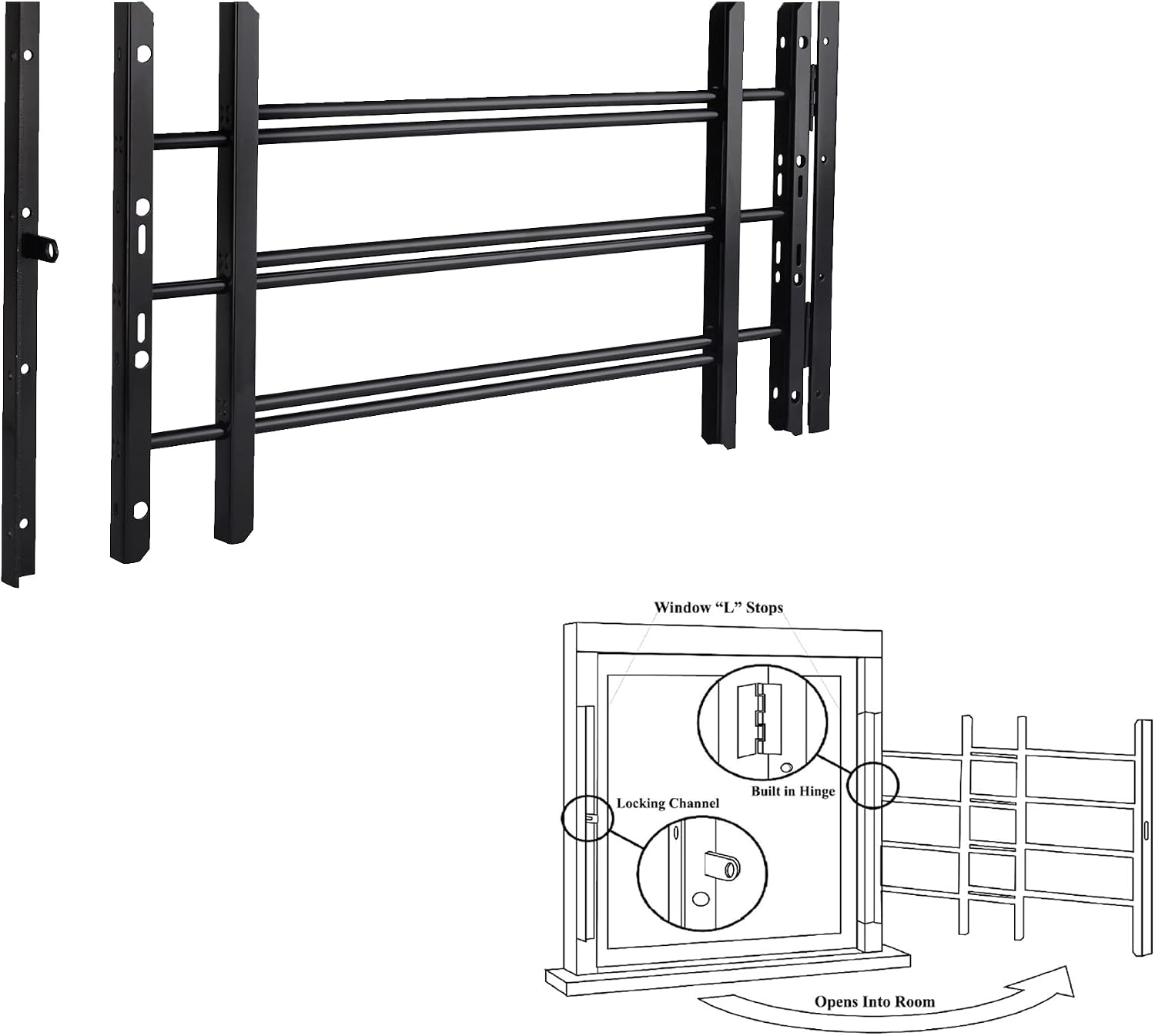
Key specs: 3-bar tubular steel window security bars, black, rust-resistant; adjustable 22in to 42in width at 14in height; built-in quick-release egress mechanism
This is the model to buy for a bedroom window, a habitable basement window, or any opening you have not personally confirmed is exempt from egress requirements — which, per the step-by-step check above, should be the default assumption. The listed mechanism is a quick-release built into the mount itself, matching the standard both cited fire authorities describe: operable from the inside, without a key, tool or special knowledge. It adjusts across a 22in to 42in width range at a 14in bar height, which covers most standard residential window widths without custom fabrication. Test the release mechanism the same day you install it, in the dark if you can manage it safely — a release you have never actually operated is not a release you can rely on during an actual fire.
✅ Pros
- Built-in quick-release mechanism, matching what fire code requires on an egress window
- Rust-resistant tubular steel construction, rated for the outdoor exposure a window bar sits in
- Adjustable width covers most standard residential windows without custom cutting
- The one bar product on this page that is appropriate for a bedroom window
❌ Cons
- Costs more than the fixed, non-release version below for the same physical coverage
- A release mechanism is one more moving part that needs occasional testing and lubrication
- Still a visible security measure from outside, which some buyers prefer to avoid on a front-facing bedroom window
- Not a substitute for testing your household’s actual fire escape plan, bars or no bars
Grisham AWG Fixed Window Security Bars — for basement windows that are not an exit
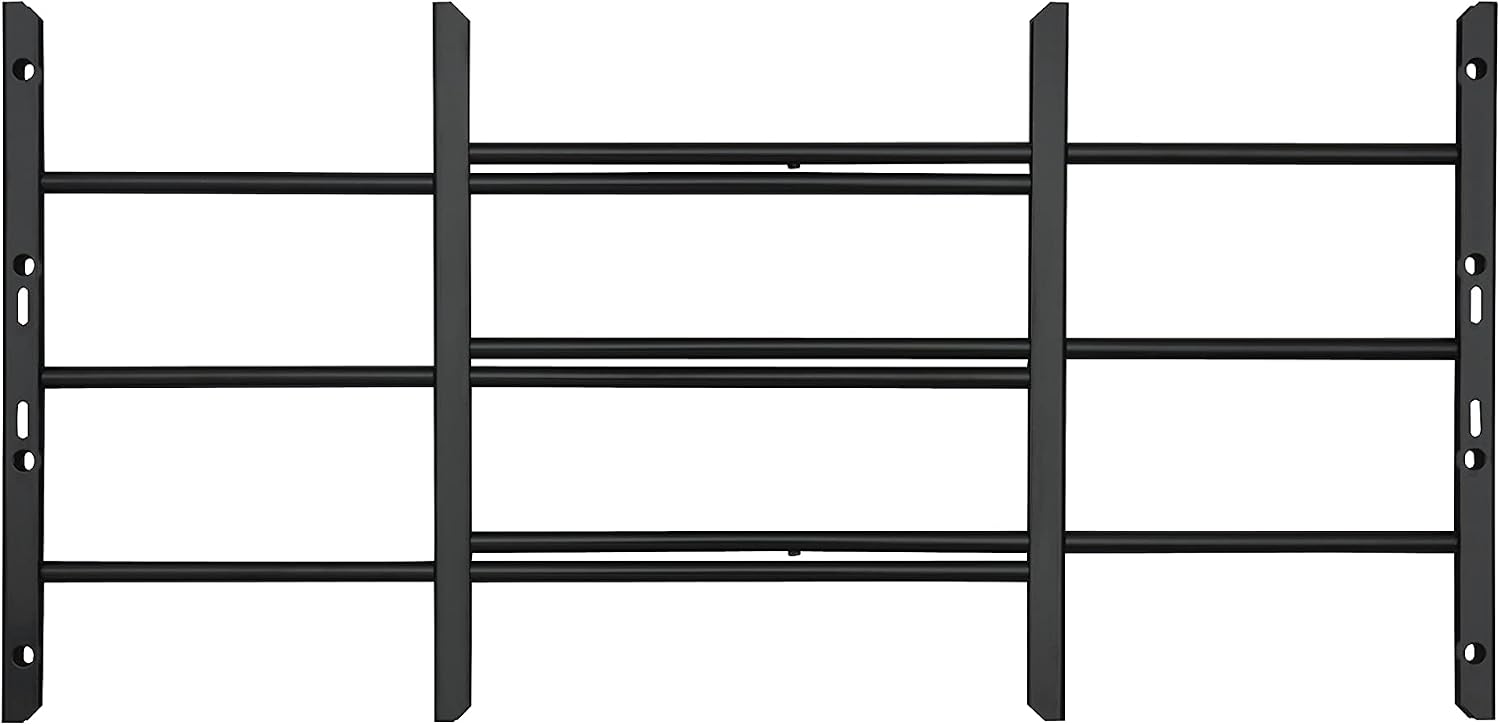
Key specs: 3-bar tubular steel window security bars, black, rust-resistant; adjustable 22-3/4in to 38-1/2in width at 14-3/4in to 15-3/4in height; fixed mount, no release mechanism
Read the fire-egress section above before buying this one. This is a fixed, bolted grille with no release mechanism at all, and that makes it the wrong product for any bedroom window or any basement that serves as habitable space under the code language quoted above. Where it is a legitimate, honest option is a genuinely non-egress basement opening — a small mechanical-room window, a laundry or utility pane, the kind of basement window nobody sleeps behind. On that specific class of window, the fixed mount is simpler, has one less part to maintain, and is typically less expensive than the quick-release version for comparable coverage.
✅ Pros
- Simpler mechanically than a release-equipped bar, with nothing to test or lubricate
- Rust-resistant tubular steel, same general build quality tier as the quick-release version
- Adjustable width fits a range of small basement and utility window openings
- A reasonable cost-saver when the window genuinely has no egress requirement to meet
❌ Cons
- Not releasable from inside — do not install this on a bedroom or habitable-basement window under any circumstance
- Verifying “non-egress” is the buyer’s job, not the product’s — check local code before ordering, not after
- Marketed partly as a child-safety window guard, a different use case than forced-entry resistance, so do not expect door-grade steel gauge
Can You Use Both on the Same Window?
Yes, and on a genuinely high-value target — a basement window behind a home office or a ground-floor window that is otherwise hard to see from the street — layering both is not overkill. Film on the glass plus bars on the opening means an intruder who manages to crack the pane still has to work through a sheet that will not fall away, then still has to get past a barrier that physically will not open. Install the film first, let the adhesive fully cure, and only then mount the bar hardware, since drilling through freshly applied film risks lifting an edge before it has bonded.
If the goal is knowing the moment either layer is tested, not just slowing the attempt, pair either one with a real sensor rather than relying on noise alone to alert you. Our glass break sensor guide and our door and window sensor guide both cover detection hardware that works alongside film or bars rather than in place of them — a delay tactic is far more useful when something is also telling you it is being tested.
Final Recommendation
Start with the window, not the product. If it is a ground-floor or basement pane you want to keep opening normally, or that sits behind a bedroom, apply the BDF S8MC Window Film Security and Safety, 8 Mil Clear and, if you also want a physical barrier there, add the Grisham PP SPAG Window Security Bars with Quick-Release Egress rather than a fixed grille — the quick-release mechanism is not optional on any window that has to double as an exit.
Reserve the fixed bars for a basement window you have personally confirmed is not an egress opening — a mechanical room, a laundry pane, storage space with no bed anywhere near it. And if the budget only stretches to one product this season, put it on the window that is both least visible from the street and least likely to be heard if forced: for most houses, that is the basement, not the front room facing the sidewalk.
For the door side of the same house, our door security bars guide covers what stops a kicked-in door, which is a different failure point than anything on this page, and our sliding glass door guide covers the other common ground-floor opening this guide does not.
SafeBode does not yet run an in-house product testing program. This guide is built from manufacturer specifications, official support documentation, current retail listings and verified buyer feedback rather than hands-on testing, and we say so plainly rather than implying testing we have not done.
Frequently Asked Questions
Does window security film make glass bulletproof or unbreakable?
No. Nothing sold as residential security film is rated to stop a bullet or prevent breakage entirely. It holds shattered glass together instead of letting it fall away, which slows a break-in attempt but does not prevent the glass from cracking in the first place.
Can I install security bars on a bedroom window at all?
Yes, but only a model with a working quick-release mechanism operable from inside without a key, tool or special knowledge. A fixed, bolted grille on a bedroom window is a real fire-escape hazard and is not what fire code allows on that type of opening.
Do all basement windows legally need to be an emergency exit?
No. A basement used only for mechanical equipment under a small size threshold, or a basement in a fire-sprinklered home with two separate means of escape, can be genuine exceptions. Confirm the exact threshold with your local building or fire department rather than assuming your basement qualifies.
How thick should security window film be?
Thicker film generally holds together under a harder or more sustained impact, so an 8-mil film gives more resistance than a 4-mil film on the same size pane. Thinner film is a reasonable budget choice for lower-priority windows, not a like-for-like substitute on a window you have identified as a real weak point.
Will security film stop someone from prying the window frame open instead?
No. Film only reinforces the glass itself. A pried frame, a forced lock or a lifted sash bypasses film completely, so it works best as one layer alongside a solid frame and lock, not as a standalone fix for a window with a weak latch.
Do security bars need a permit to install?
Sometimes, depending on your city and whether the bars go on a required egress opening. Since bars on an egress window must be fire-department approved in many jurisdictions, it is worth checking with your local building department before installing rather than after.
Can renters install either of these products?
Security film is generally renter-friendly since it applies directly to the glass and can be removed. Bars typically require drilling into the frame or wall, so renters should get written landlord permission before installing them, the same way they would for any permanent hardware change.
Is security film a substitute for a window or door alarm?
No. Film and bars are both physical delay measures — they do nothing to notify anyone that a window is being tested. Pairing either with a glass break sensor or a door/window contact sensor is what actually gets you or a monitoring service alerted in real time.
Sources
Show sources (4)


