Best Water Leak Detectors 2026: Alert, Alarm, or Shut the Water Off
Affiliate Disclosure: This article contains affiliate links. If you buy through these links, we may earn a commission at no extra cost to you. Our editorial opinions are our own and are not influenced by affiliate relationships. Read our full disclosure policy →
Contents
Quick Answer
Water is the second most common homeowners insurance claim in the United States — the Insurance Information Institute puts water damage and freezing at 27.6 percent of claims in 2022, behind only wind and hail. A pack of Wi-Fi sensors under the sinks, the water heater and the washing machine is the cheapest insurance you can buy, and the GoveeLife three-pack is the sensible starting point. If the property is large, or the basement is far from the router, the YoLink kit uses a long-range radio and can trigger a siren even with the internet down. If you want the water actually turned off rather than a notification, that is a different product: a shutoff valve on the main.
Leak Detectors Do Three Different Jobs
Everything sold as a water leak detector falls into one of three groups, and they are not tiers of the same thing. Knowing which one you are buying is the whole decision.
| Alert-only sensor | Sensor with local siren | Shutoff valve |
|---|
| What happens on a leak | Your phone gets a notification | The unit sounds where it sits, and your phone gets a notification | The water supply closes automatically |
| Useful when | You are reachable and can act | Somebody is home, including people without the app | Nobody is home, or nobody can reach the stopcock |
| Installation | Drop it on the floor | Drop it on the floor | Plumbed into the main supply — a real job |
| What it cannot do | Stop anything, or wake anyone | Stop anything | Tell you which appliance failed, on its own |
| Typical placement | Under sinks, behind the toilet | Basement, laundry room, near the water heater | At the main, where water enters |
Most households want the first or second type in several places, and the third only if the house sits empty regularly or a previous leak has already cost them. The three combine well: sensors tell you where, a valve stops how much. What none of them do is fix a pipe, so treat the alert as the beginning of the job.
One practical note before you buy: leak sensors and the door and window sensors on a security system are different devices with different jobs, even though they look alike and both push a notification. A contact sensor tells you something opened; a leak sensor tells you something is wet. Several alarm systems accept both, which is worth checking if you would rather not run two apps. Some insurers reward water and alarm sensors on a policy, and our guide to security system insurance discounts covers how much that discount is really worth.
Why This Is Worth Bothering With
Water damage is unglamorous and extremely common. The Insurance Information Institute’s claims data puts water damage and freezing at 27.6 percent of homeowners claims in 2022 — the second largest category after wind and hail — with a frequency of 1.61 claims per 100 policies, against 2.82 for wind and hail. Fire is far more expensive per incident, but it is also far rarer. Water is the loss most households will actually meet.
The reason a sensor helps so much is timing rather than detection. Nobody needs a gadget to notice a burst pipe when they are standing in the room. The damage that ruins a floor is the slow supply-line drip behind a washing machine, or the water heater that lets go on a Tuesday while everyone is at work. A sensor turns days into minutes.
Where to Put the First Four Sensors
Water heater
The classic catastrophic failure, usually in a place nobody looks
Washing machine
Supply hoses fail, and the machine sits against a wall
Under sinks
Slow drips that rot the cabinet base long before you see them
Sump or basement
The lowest point, where any water in the house ends up
Water damage and freezing accounted for 27.6 percent of homeowners claims in 2022, second only to wind and hail.
One more placement worth a sensor: the pan under an upstairs air handler. A blocked condensate line puts water directly into a ceiling, and it is the leak people discover from the stain downstairs. If you are already running a DIY alarm system, check whether it takes leak sensors as accessories — several do, which puts the alert in the same app as everything else.
GoveeLife Water Leak Detector 1s 3-Pack — best overall
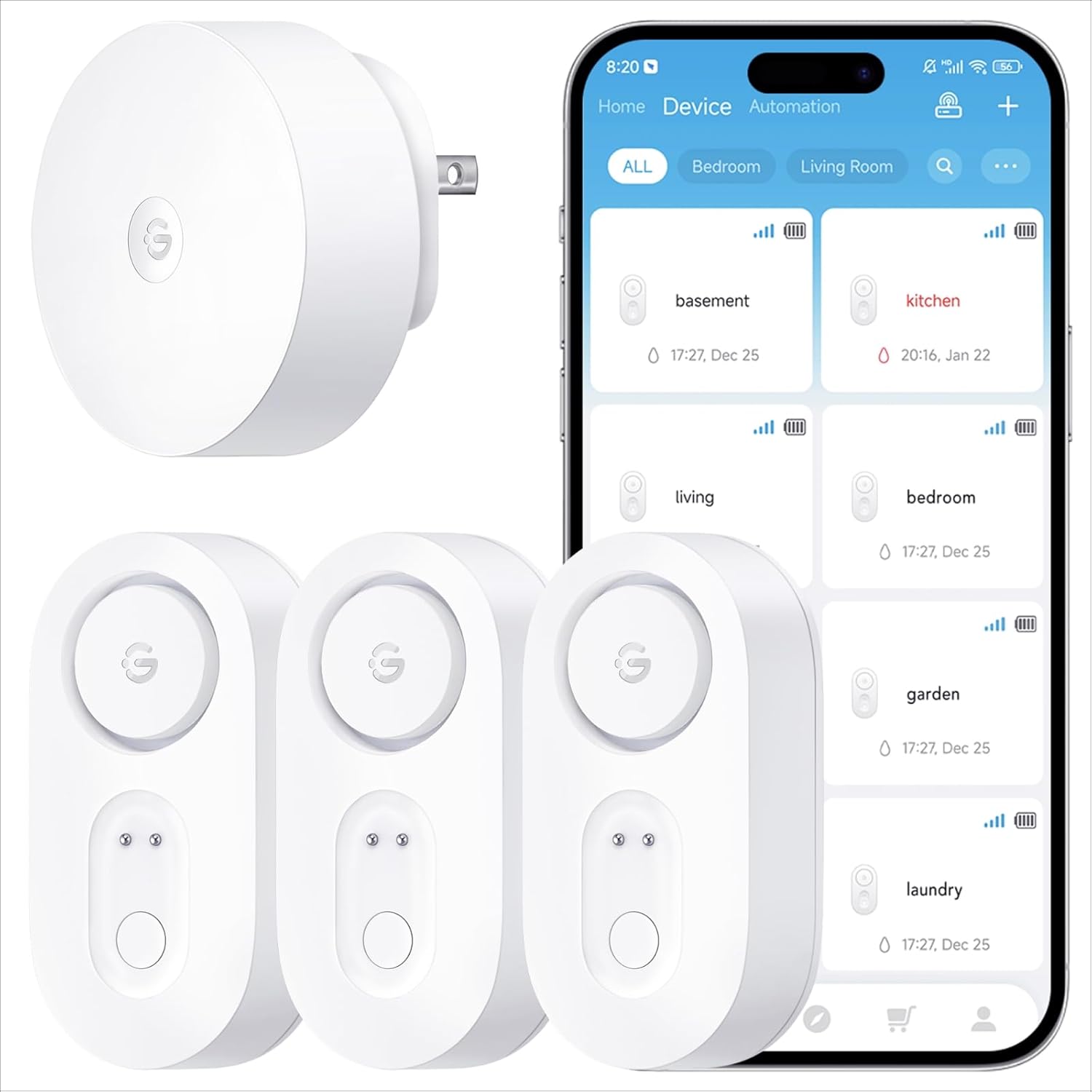
Key specs: Three Wi-Fi leak sensors with a base; manufacturer-rated range of 1,804 feet; app, SMS and email alerts; five-year battery life; IP67 rated
For most homes the right answer is three sensors, not one clever device. This pack covers the water heater, the washing machine and a sink cabinet on day one, sends app, SMS and email alerts, and is rated IP67 so a sensor sitting in an inch of water keeps working rather than drowning. The published range figure — 1,804 feet from the base — matters more than it sounds: it is what lets a sensor in a far basement corner still report to a base plugged in upstairs, which is exactly where cheap Wi-Fi-only sensors fail. Battery life is rated at five years, so these are genuinely fit-and-forget. The tradeoff is that they alert rather than act: nobody home means nobody responding.
✅ Pros
- Three sensors covers the three positions that matter most, out of one box
- App, SMS and email alerts, so a silenced phone is not the only channel
- IP67 rating means the sensor survives the flood it is reporting
- Five-year battery life, so it is not another thing to maintain
❌ Cons
- Alert-only — it notifies, it does not stop the water
- Needs the base plugged in and on your network to reach the internet
- Range figures are open-air best cases, as always
- Adding more sensors later means staying in one brand’s app
One same-category alternative worth knowing about if your home already runs SwitchBot gear: the SwitchBot Water Leak Detector takes the same no-hub approach — it connects straight to Wi-Fi for phone alerts, carries an IP67 rating, and runs up to two years on a single battery, per SwitchBot’s own spec sheet. We haven’t compared it head-to-head with the four picks in this guide.
YoLink Water Leak Starter Kit with Six Sensors — best for a big or awkward property
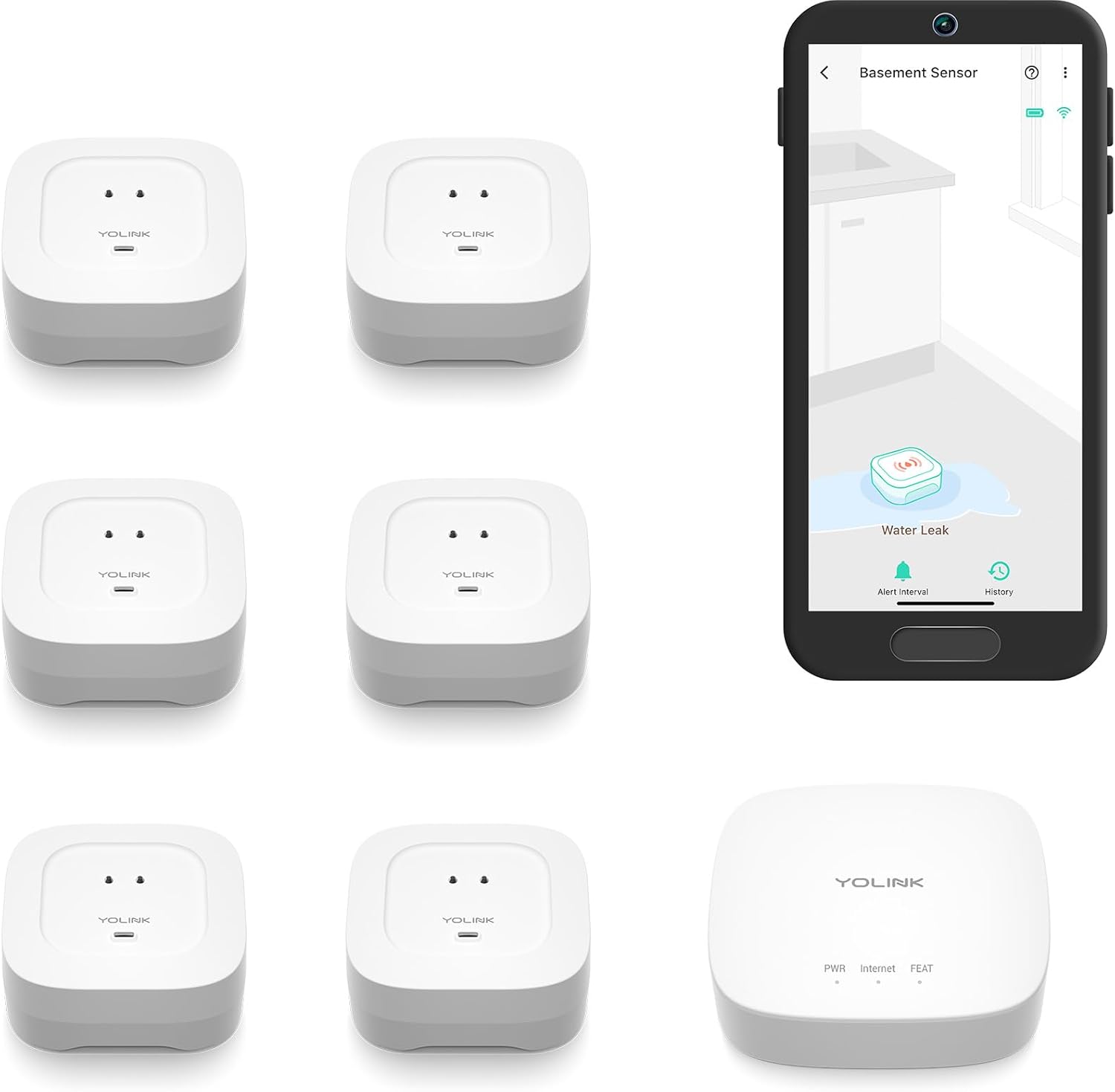
Key specs: Hub plus six Leak Sensor 4 units with 105 dB sirens; LoRa radio rated to a quarter mile in open air; Control-D2D device-to-device triggering; two AAA cells rated beyond five years
This is the kit for the house where Wi-Fi does not reach the far corner — a detached garage, a crawl space, a barn, a basement under a concrete slab. YoLink uses a LoRa radio rated at up to a quarter mile in open air, which is a different order of range from Wi-Fi sensors. Each Leak Sensor 4 has a 105 dB siren built in, so it wakes the house rather than only pinging a phone, and runs on two AAA cells rated beyond five years. The genuinely distinctive feature is Control-D2D: sensors can be paired directly to sirens and smart valves so they work without an internet connection, and without power. That is the failure mode most smart sensors ignore. Be straight about the caveat YoLink itself states — a hub with an internet connection is required for full functionality, with D2D acting as backup rather than a replacement. If you are choosing radios for a wider smart home, our Z-Wave versus Zigbee explainer covers why protocol choice matters for security hardware.
✅ Pros
- LoRa range rated up to a quarter mile in open air — reaches outbuildings
- 105 dB siren on each sensor, so it wakes people rather than only phones
- Control-D2D keeps sensor-to-siren triggering working with no internet
- Six sensors covers a whole house and then some
❌ Cons
- Needs a hub, and YoLink says full functionality requires internet
- More expensive per sensor than plain Wi-Fi packs
- Another app and ecosystem to maintain
- D2D is deliberately a backup path, not the main one
Moen Flo Smart Water Shutoff — best for stopping the leak
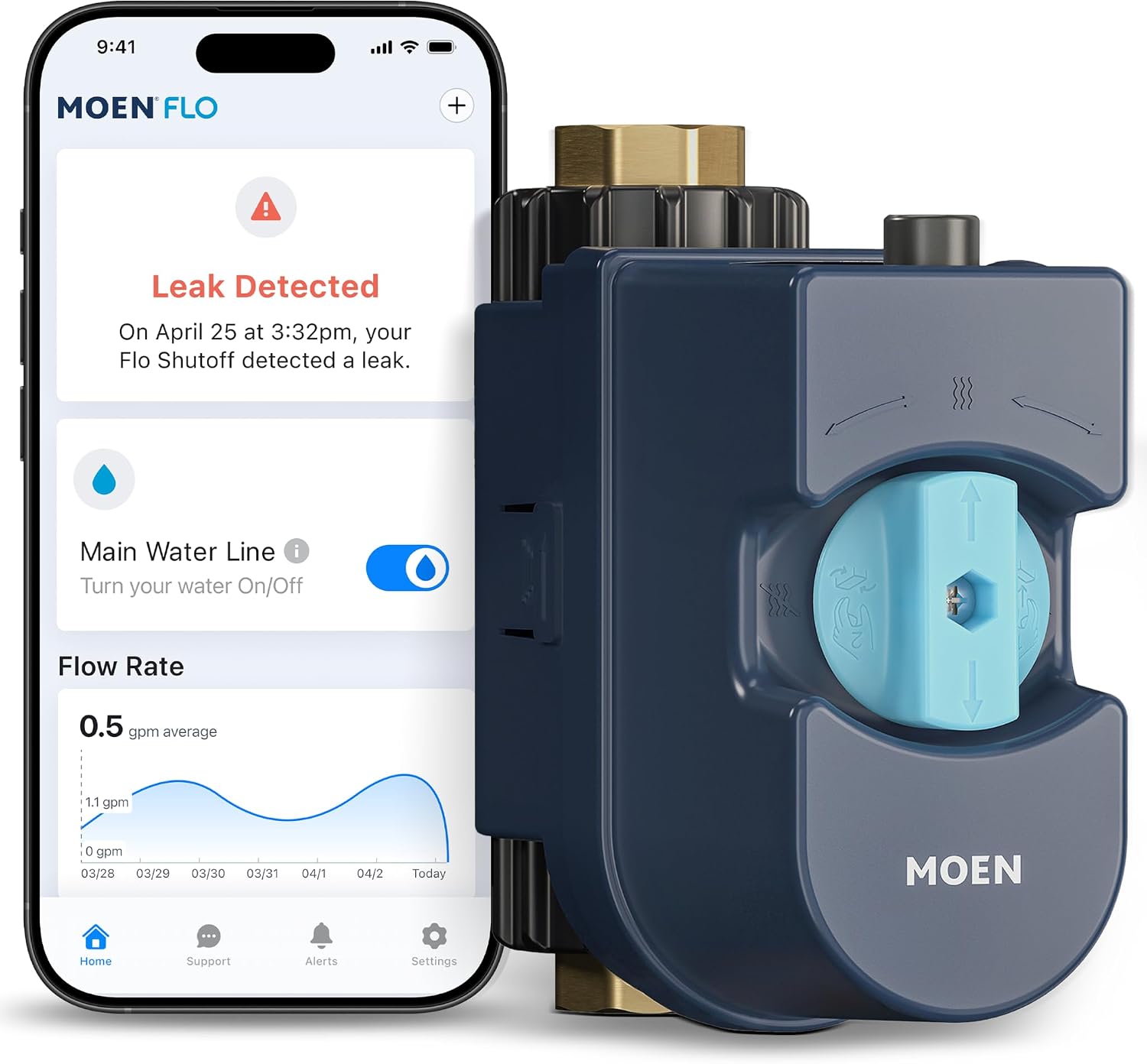
Key specs: Three-quarter-inch automatic shutoff valve fitted to the main supply; monitors flow, pressure, moisture and temperature; runs automatic MicroLeak tests; Wi-Fi app control
This is the one that changes outcomes rather than response times. It plumbs into the main supply and can close the valve automatically when it sees something wrong, which is the only thing on this page that helps when the house is empty for a week. Its most interesting trick is preventative: Moen’s MicroLeak test runs automatically — usually once a day, up to three times if needed — closing the valve and watching the stability of pressure in the pipes, and it can pick up a drip as slow as one drop per minute. That finds the leak inside a wall before there is anything on the floor for a sensor to detect. The cost is installation: this is a plumbing job on your main, not a device you place on the floor, and for most people that means hiring someone.
✅ Pros
- Closes the water off automatically — the only pick here that stops damage rather than reporting it
- MicroLeak testing detects a drip as slow as one drop per minute
- Monitors flow, pressure and temperature continuously, not just wet floors
- Protects the whole house from one device rather than one puddle at a time
❌ Cons
- Plumbed into the main supply — expect to pay a plumber
- Will not tell you which appliance failed, only that water is going somewhere
- A valve that closes on a false positive leaves you without water until you intervene
- Most expensive option here by a wide margin
Kidde Water Leak and Freeze Detector — best for freeze risk
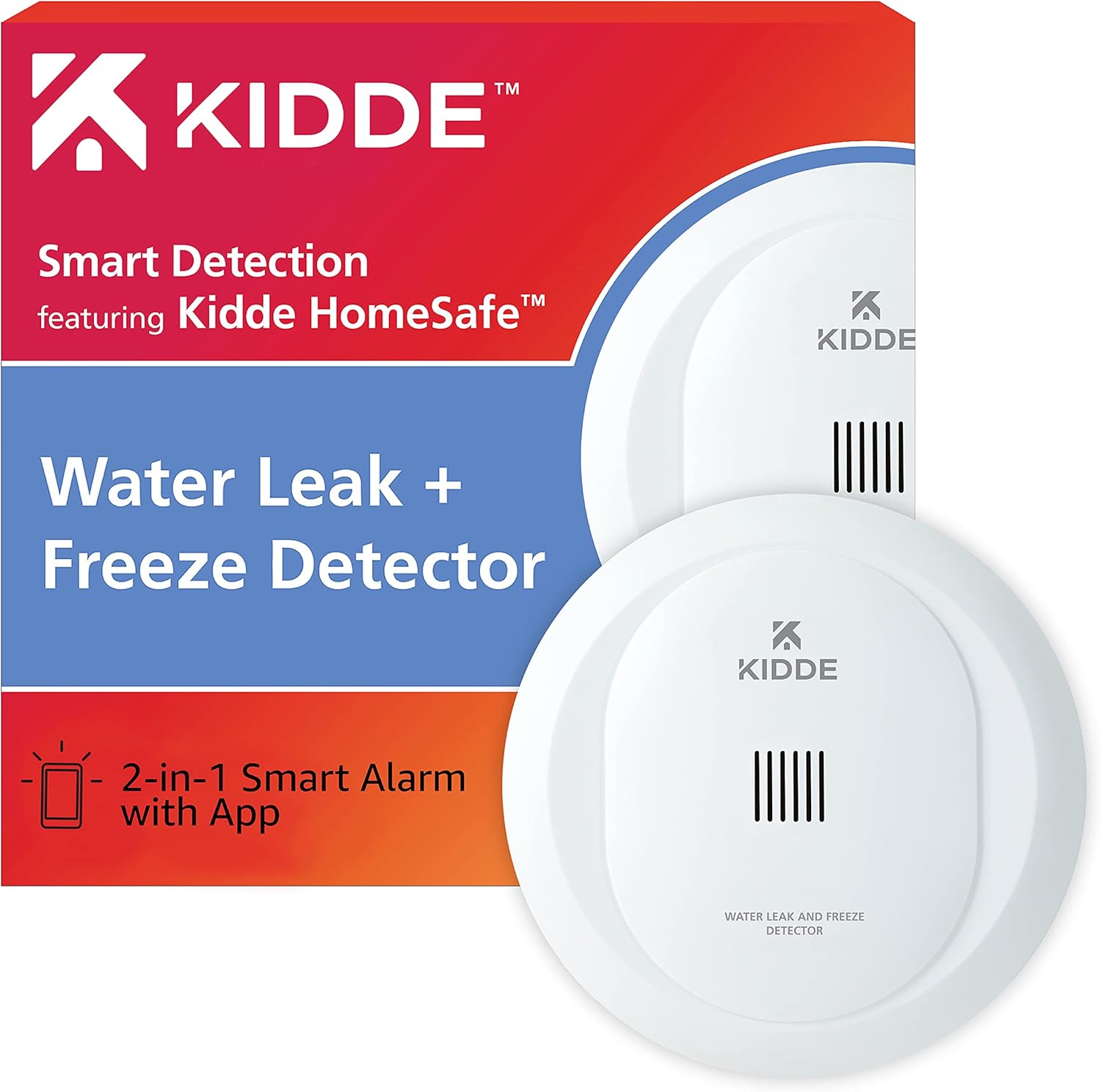
Key specs: Wi-Fi water leak detector with freeze alarm; app alerts; works with Alexa; designed for sinks, water heaters, washing machines and unheated spaces
Leaks and freezing are the same insurance category for a reason: a pipe that freezes is a pipe that bursts, and the burst happens on the thaw when nobody is expecting it. This detector covers both, alerting when it detects water and when the temperature in its location falls toward freezing — which is the alert that lets you act before there is any water at all. Kidde is also a name with a long track record in home safety devices rather than a brand that appeared last year, and it works with Alexa if you want the alert spoken aloud. Put it where the risk actually is: an unheated garage, a crawl space, a vacation property, the laundry room on an outside wall. It is a single unit rather than a pack, so budget accordingly if you need several.
✅ Pros
- Freeze alerting catches the problem before the pipe bursts, not after
- Established safety brand rather than a newcomer
- Works with Alexa for spoken alerts in the house
- Right choice for garages, crawl spaces and seasonal properties
❌ Cons
- Single unit — covering a house means buying several
- Alert-only, like most of this category
- Needs Wi-Fi where it sits, which unheated spaces often lack
- Freeze alerting is only useful if somebody can act on it quickly
The Failure Nobody Plans For: You Are Not Home
Every alert-only sensor shares one weakness, and it is the same weakness that runs through self-monitored security generally: the notification is only as good as the person receiving it.
A leak at 2 a.m. with a silenced phone, a leak during a flight, a leak while the house is empty for two weeks — in each case a notification changes nothing. This is why the two features worth paying extra for are the ones that do not need you: a local siren loud enough that a neighbor or a house-sitter hears it, and a valve that closes on its own.
Two Very Different Setups
🏠 Someone is usually home
- Alert-only sensors in three or four spots are enough
- A local siren adds real value for sleeping households
- Keep a second alert channel — SMS or email — not just push
- Know where your stopcock is, and that it actually turns
✈️ The house is often empty
- An automatic shutoff valve is the only thing that helps
- Sensors that trigger a siren without internet cover an outage
- Give a neighbor a key and tell them what the siren means
- Turn the supply off at the main before long trips regardless
That last line is free and beats every device on this page for a long absence. Shutting the water off at the main before a two-week trip removes the failure mode entirely. Leak sensors are for the other fifty weeks. The same logic applies to detection generally — our guides to smart smoke detectors and carbon monoxide detectors cover the two other alerts you want reaching your phone from an empty house.
Final Recommendation
Start with the GoveeLife Water Leak Detector 1s 3-Pack. Three sensors under the water heater, behind the washing machine and in a sink cabinet covers the three failures that produce most claims, for less than the cost of drying out one cabinet. Set up SMS or email alerts alongside push notifications, so a silenced phone is not the single point of failure.
Change that answer in two situations. If your property is large, or the spot you need to cover is a detached garage or a crawl space where Wi-Fi does not reach, the YoLink kit’s LoRa range and its ability to trigger a siren without internet or power are worth the extra. If the house is regularly empty — a second home, frequent travel, a rental you manage — no alert-only sensor helps, and the Moen shutoff is the only product here that acts on its own, with the bonus that its daily MicroLeak test can find a hidden drip before it becomes a flood.
Add the Kidde freeze detector if any part of your plumbing runs through an unheated space. Freezing and water damage sit in the same claims category for a reason, and a temperature warning is the rare alert that arrives while the problem is still preventable. Whatever you buy, find your main shutoff valve this weekend and check it turns — that is the step that makes every other device on this page useful.
SafeBode does not yet run an in-house product testing program. This guide is built from manufacturer specifications, official support documentation, current retail listings and verified buyer feedback rather than hands-on testing, and we say so plainly rather than implying testing we have not done.
Frequently Asked Questions
Where should I put water leak sensors first?
Water heater, washing machine, under the kitchen and bathroom sinks, and the lowest point of the basement. If you have an air handler upstairs, put one in its drain pan too — a blocked condensate line puts water straight into a ceiling.
Do leak detectors need WiFi?
The alerting side does. The sensor itself detects water regardless, and models with a built-in siren will still sound locally. If the spot you need to cover has poor signal, a long-range system with its own radio and hub is more reliable than a plain WiFi sensor.
Will a leak sensor turn the water off?
No. Sensors detect and alert; shutting the water off requires a motorized valve on the main supply, which is a separate and more expensive product. Some systems let a sensor trigger a compatible valve, which is the best of both if you own both.
How long do the batteries last?
Several years on the better models, because the sensor sleeps until it gets wet. Replace them on a schedule rather than waiting for a low-battery warning you might miss, and test each sensor when you do.
Can I test a leak detector safely?
Yes — touch a wet finger or a damp cloth across the contacts. It should alarm within seconds. Do this when you install it and once a year after, because a sensor nobody has ever tested is an assumption rather than a safeguard.
Do these help with my insurance?
Some insurers offer a discount for leak detection, particularly for automatic shutoff systems, and some will ask about them after a water claim. Ask your own insurer rather than assuming, since the credits vary widely.
What about freeze detection — is it worth it?
If any plumbing runs through an unheated garage, crawl space or exterior wall, yes. A freeze alert arrives while the problem can still be prevented, which is not true of a leak alert.
Are the cheap multi-packs any good?
For the alert-only job, generally yes — detecting water is not a hard engineering problem. What varies is range, app quality and how long the company supports the product. Prefer models with a real IP rating and more than one alert channel.
Sources
Show sources (3)
- [1] Insurance Information Institute — “Facts + Statistics: Homeowners and renters insurance,” iii.org/fact-statistic/facts-statistics-homeowners-and-renters-insurance
- [2] Moen — “Get to Know Your Device: MicroLeak Test,” solutions.moen.com help center
- [3] YoLink — “Water Leak Sensor 4” product specifications, shop.yosmart.com/products/ys7906


