Best Carbon Monoxide Detectors 2026: Plug-In, Sealed, or Portable
Affiliate Disclosure: This article contains affiliate links. If you buy through these links, we may earn a commission at no extra cost to you. Our editorial opinions are our own and are not influenced by affiliate relationships. Read our full disclosure policy →
Contents
Quick Answer
For most homes, a plug-in alarm with battery backup is the right buy — it never needs a wiring change and keeps working in a power cut. Get the First Alert CO605 if you just want reliable protection, the Kidde plug-in with a digital display if you want to see the actual parts-per-million reading, the First Alert CO710 if you never want to touch a battery again, and the Kidde portable for hotels and rentals. You need one on every level of the home, not just one in total.
Why a CO Alarm Is Not Optional
Carbon monoxide is the one household hazard your body cannot detect on its own. It is colorless, odorless and tasteless, and the early symptoms — headache, dizziness, nausea, weakness — are close enough to flu that people routinely go to bed instead of going outside. That is the whole problem: the failure mode is falling asleep.
The scale is not small. According to the Centers for Disease Control and Prevention, more than 400 Americans die each year from unintentional carbon monoxide poisoning unrelated to fires, more than 100,000 visit an emergency department, and more than 14,000 are hospitalised.
Carbon Monoxide in the U.S., Each Year
400+
deaths from unintentional, non-fire CO poisoning
100,000+
emergency department visits
0
human senses that can detect CO
Figures: Centers for Disease Control and Prevention. CO is colorless, odorless and tasteless — an alarm is the only warning you get.
A smoke alarm will not help you here. Smoke alarms detect particles; CO alarms use an electrochemical sensor that reacts to the gas itself. They are genuinely different devices, which is why we treat them as a separate purchase from our guide to smart smoke detectors. If you own a combination smoke-and-CO unit you are covered for both, but a smoke-only alarm gives you no CO protection whatsoever.
The Only Three Choices That Matter
Strip away the marketing and buying a CO alarm comes down to three decisions. Everything else is detail.
What Actually Separates One CO Alarm From Another
Decisions that change the product
- Power source — plug-in with battery backup, sealed 10-year battery, or replaceable AA/9V. This determines your maintenance for the next decade.
- Display or no display — a digital readout shows the current CO level in parts per million and, on some units, the peak level recorded while you were out.
- Placement need — a portable unit solves hotels, rentals and caravans; a plug-in solves the house.
Decisions that don’t
- Brand loyalty — First Alert and Kidde dominate this category and both build to the same safety standard.
- Extra gas sensing — explosive-gas combo units exist, but only matter if you have gas appliances and want that second function.
- Smart features — a phone alert is genuinely useful, but a CO alarm’s core job is a 85-decibel noise in the hallway at 3am.
The one rule that overrides all three: every CO alarm has a finite sensor life and then must be replaced entirely, not just re-batteried. This is where CO differs from smoke — the CPSC advises replacing CO alarms every five years, or as the manufacturer specifies, rather than the ten years people associate with smoke alarms. Newer units carry an end-of-life indicator that beeps when the alarm is finished. Check the manufacture date printed on the back before you install it, and again every year — the clock starts at manufacture, not at purchase.
The Four Picks Compared
| Pick | Best for | Power | Digital display | Battery changes |
|---|
| First Alert CO605 | Most homes | Plug-in + battery backup | No | Backup battery only |
| Kidde Plug-In Digital | Seeing the real number | Plug-in + 9V backup | Yes, with peak memory | Backup battery only |
| First Alert CO710 | Zero maintenance | Sealed 10-year lithium | Yes | None, ever |
| Kidde Portable | Hotels and rentals | AA batteries | No | Replaceable AA |
First Alert CO605 Plug-In CO Alarm — Best Overall
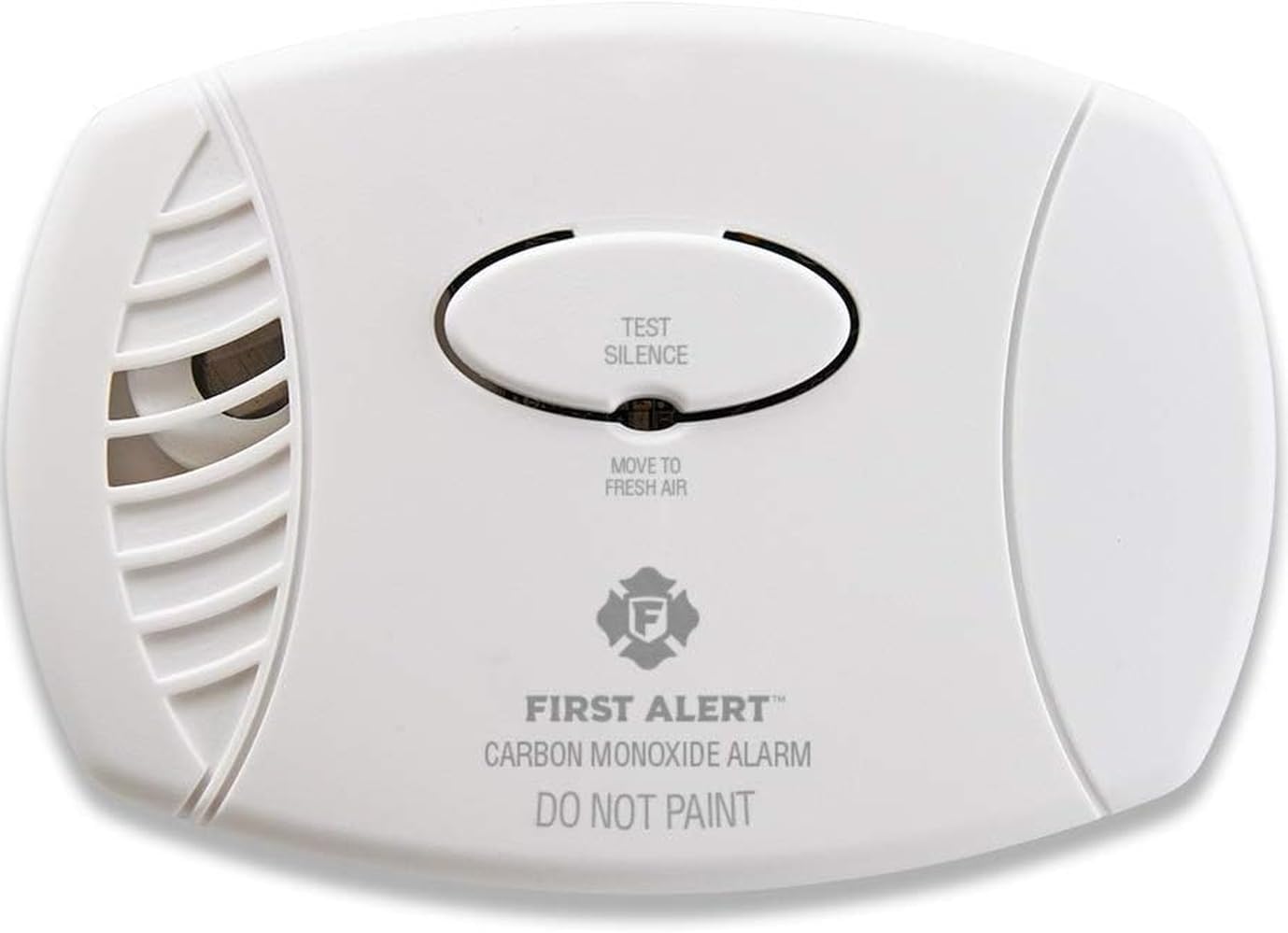
Key specs: plug-in with battery backup · electrochemical CO sensor · end-of-life warning · no display
This is the default answer for a reason. It plugs straight into a wall socket, so there is no wiring and no ladder, and the battery backup means a power cut does not silently disable it — which matters because power cuts and generator use are exactly when CO incidents spike. It has no display, and for most households that is fine: you do not need a number, you need a loud noise when something is wrong. It is also one of the most-reviewed CO alarms on the market, which gives you a large real-world reliability sample rather than a handful of early reviews.
✅ Pros
- No wiring, no drilling — plug in and it works
- Battery backup keeps it alive through a power cut
- Very large review base compared with newer entrants
- End-of-life warning tells you when the unit itself expires
❌ Cons
- No digital display — you get an alarm, not a reading
- Occupies a wall socket
- Backup battery still needs periodic replacement
- Plug-in position means it sits low on the wall
Kidde Plug-In CO Detector with Digital Display — Best Digital Display
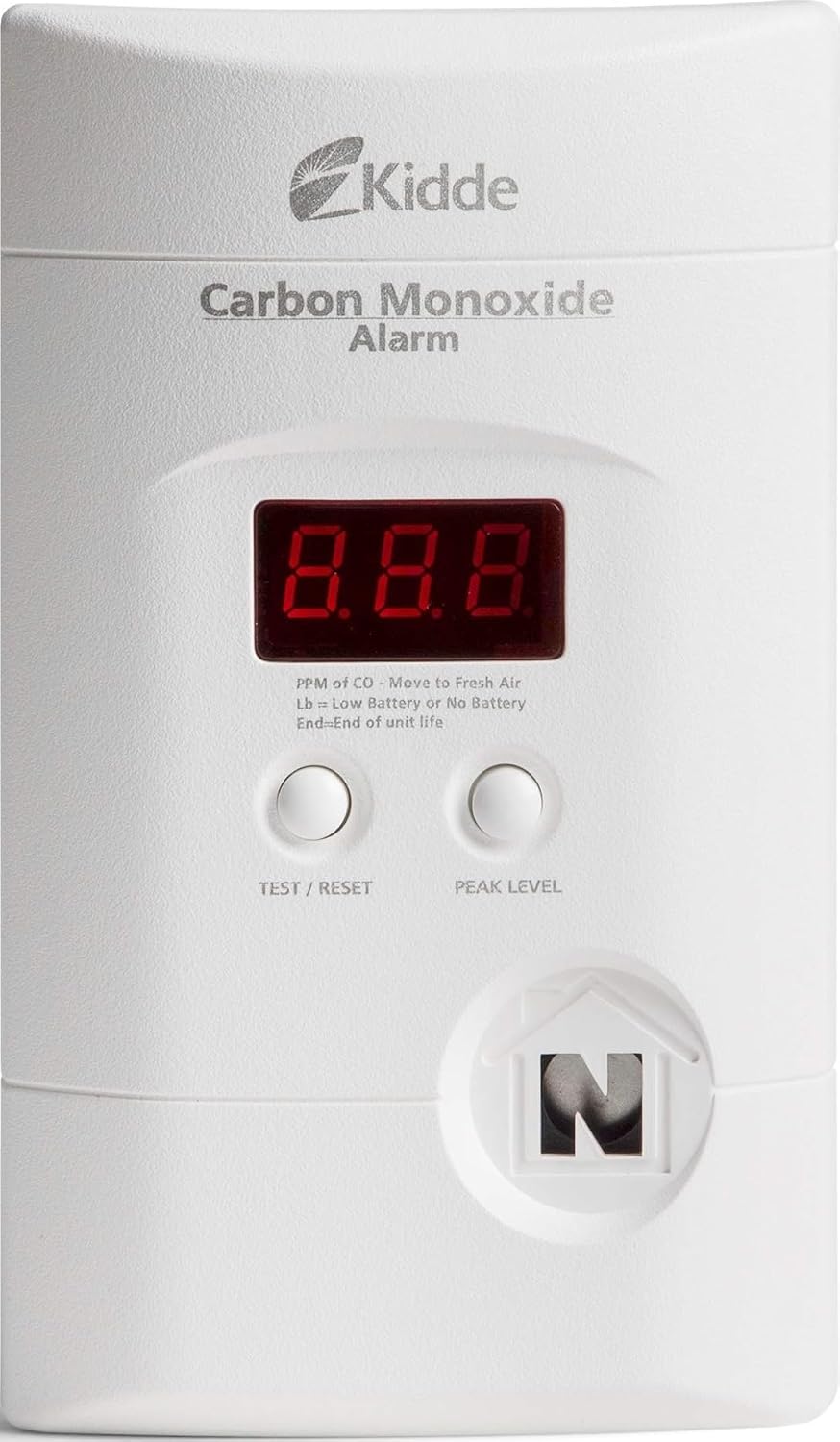
Key specs: plug-in · 9V battery backup · digital PPM display · peak-level memory
The argument for a display is not vanity. A digital readout tells you whether you are looking at a brief, low-level reading from a fireplace backdraft or a genuine, climbing concentration — and the peak-level memory shows the highest reading recorded while you were out of the house, which is information a simple alarm can never give you. If you have gas appliances, an attached garage or a wood burner, that context is worth having. This unit also has the largest review base of any CO alarm we found, which is a meaningful signal in a safety category.
✅ Pros
- Shows the live CO level in parts per million
- Peak-level memory reveals what happened while you were out
- Battery backup for power cuts
- The most-reviewed CO alarm in this comparison
❌ Cons
- 9V backup battery is a genuine maintenance item
- Costs more than a display-free alarm
- Display is only readable up close, so hallway placement limits its usefulness
- Still expires and needs full replacement on schedule
First Alert CO710 10-Year Sealed CO Alarm — Best No-Maintenance Option
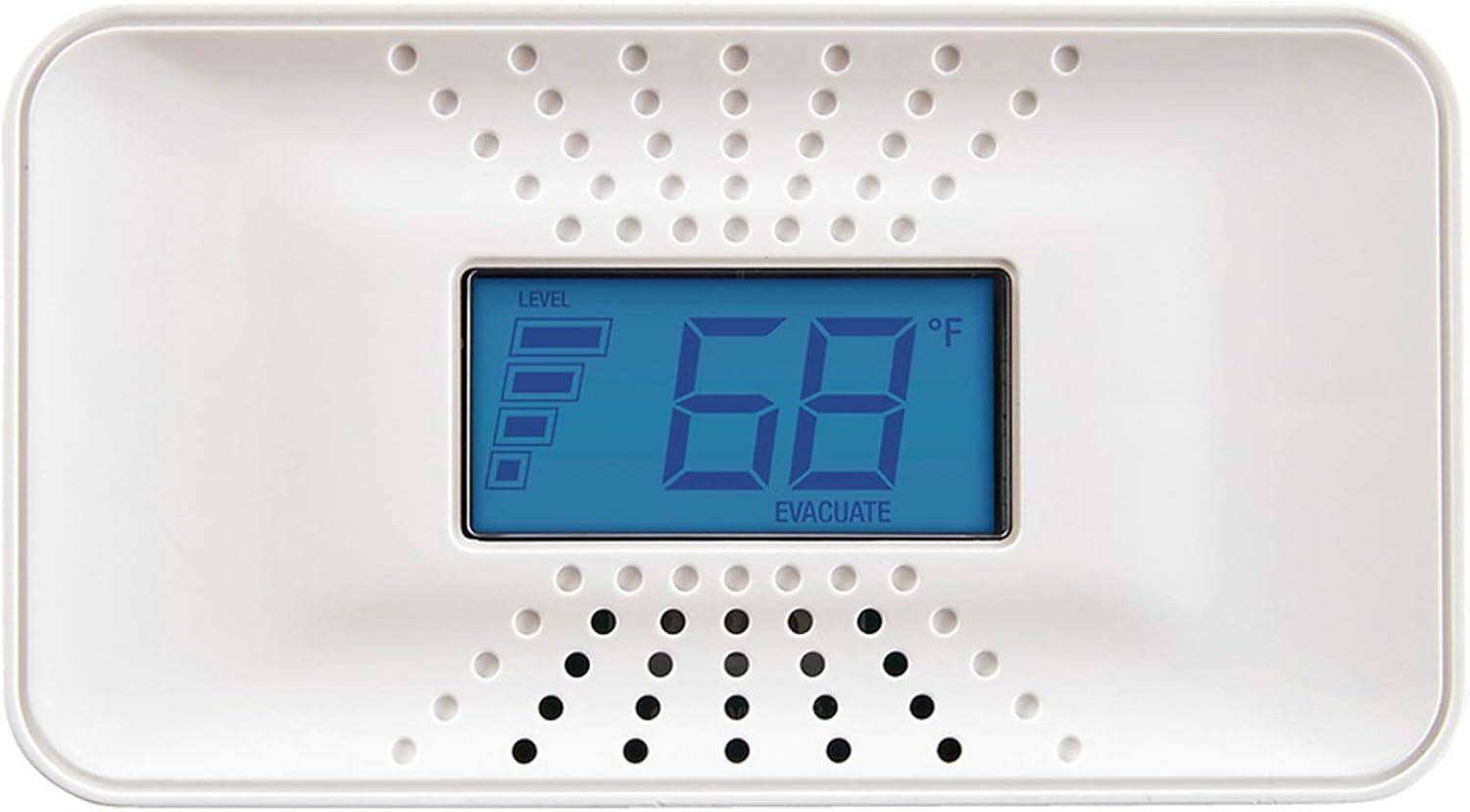
Key specs: sealed 10-year lithium battery · digital display · no wiring · no battery changes
The sealed ten-year battery is the whole point. There is no backup battery to replace, no chirp at 2am because a 9V finally died, and no socket occupied. You install it once and replace the entire unit at end of life — which, as the CPSC and USFA both note, is what you have to do with every alarm anyway. For a rental you manage, a holiday home, or any ceiling or wall position nowhere near a socket, this removes the single most common reason household alarms end up disabled: someone pulled the battery to stop the chirping and never put it back.
✅ Pros
- No battery changes for the life of the unit
- Digital display included
- Mounts anywhere — not tied to a wall socket
- Removes the ‘pulled the battery to stop the chirp’ failure mode
❌ Cons
- Higher upfront cost than a basic plug-in
- When the battery dies the whole unit is discarded
- No mains power means no power-cut advantage over a plug-in with backup
- Ten-year clock starts at manufacture, not at purchase — check the date
Kidde Portable CO Detector (AA Battery) — Best for Travel and Rentals
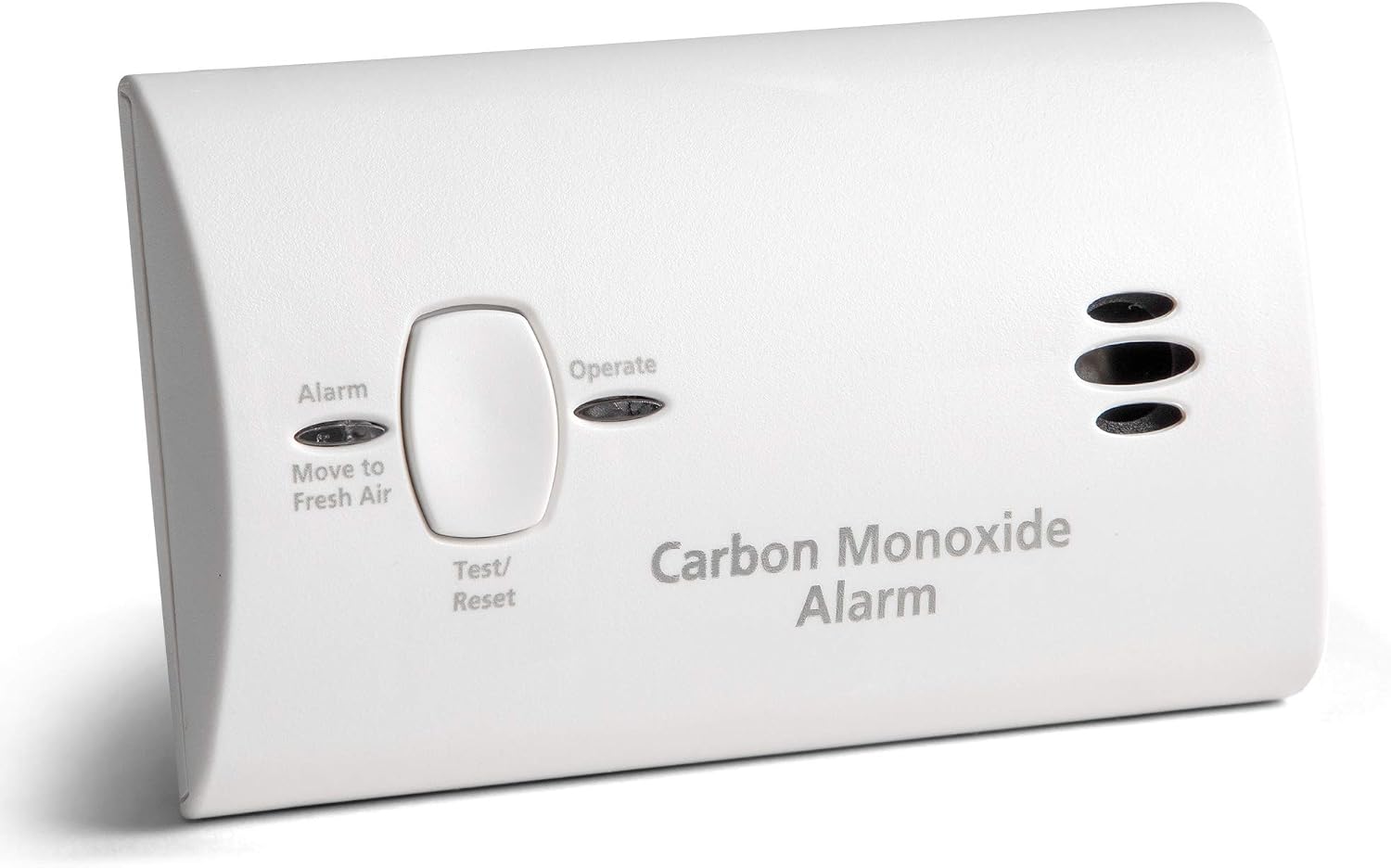
Key specs: AA battery powered · compact · designed for travel, hotels and rentals
This is a different job, not a cheaper version of the same one. Hotels, holiday rentals, cabins and caravans frequently have no CO alarm at all, or one whose condition you cannot verify. A compact AA-powered unit that goes in a bag solves that, and it is the only pick here you can put on a bedside table in a room you do not own. It carries Amazon’s Choice status in the portable CO category. It is not a substitute for fixed alarms at home — think of it as the one you take with you, not the one you rely on.
✅ Pros
- Genuinely portable — bag, bedside table, caravan
- AA batteries are available anywhere in the world
- Covers rentals and hotels that have no working alarm
- Amazon’s Choice in its category
❌ Cons
- Not a replacement for fixed household alarms
- No display
- Small size means it is easy to leave behind
- AA batteries need checking before every trip
Where to Actually Put It
Placement is where most people get CO wrong, usually by treating it like a smoke alarm. Smoke rises, so smoke alarms go high. Carbon monoxide has almost the same density as air and mixes through the room rather than collecting at the ceiling, so height is far less critical — what matters is coverage and audibility from where people sleep.
The Placement Rules That Matter
Every level
including the basement
Outside each
separate sleeping area
15+ ft
away from fuel-burning appliances
Not in
bathrooms, garages or draughts
Placing an alarm directly beside a boiler or cooker causes nuisance alarms from normal brief start-up emissions; placing it in a bathroom kills the sensor with humidity.
One alarm for a whole house is the most common real-world mistake. If the only CO alarm is in the hallway downstairs and the source is a bedroom-level gas heater, the people asleep upstairs may not hear it in time. Alarms on every level, positioned so they are audible through a closed bedroom door, is the standard worth meeting. This is the same logic we apply to camera placement — coverage beats a single well-chosen device.
Four Mistakes People Make
Get These Wrong and the Alarm Does Not Help
Common mistakes
- Buying one alarm for a multi-storey house
- Mounting it right next to the boiler or gas cooker
- Assuming a smoke alarm covers CO as well
- Ignoring the end-of-life chirp and pulling the battery
What to do instead
- One per level, plus outside each sleeping area
- At least 15 feet from any fuel-burning appliance
- Buy a CO alarm or an explicit combination unit
- Check the manufacture date and replace the whole unit on schedule
The last one deserves emphasis. A CO alarm that chirps at end of life is doing exactly what it was designed to do, and the correct response is replacement, not silencing. If you are dealing with a chirping alarm right now and are not sure why, our guide to an alarm that keeps going off walks through the difference between a low battery, an end-of-life warning and a genuine fault.
Detection is only one layer. If you are adding cameras alongside alarms, our Arlo camera guide and Blink camera guide compare the two most common DIY choices.
Final Recommendation
Buy the First Alert CO605 for the main living level and add a second alarm upstairs. If you want to see real numbers rather than just hear an alarm, spend a little more on the Kidde plug-in with the digital display. If the thought of another device needing a battery in three years is what has stopped you buying one at all, the First Alert CO710 removes that objection entirely — and an alarm you actually install beats a better alarm you don’t. Add the Kidde portable to your luggage if you travel or stay in rentals.
Whichever you choose, the decision that matters most is not which model — it is how many. One alarm per level, audible from the bedrooms, replaced on schedule. That is the part that saves lives, and it costs less than most people assume. If you are building out wider home protection, our DIY home alarm systems guide covers where alarms fit alongside sensors and monitoring.
Frequently Asked Questions
Do I need a carbon monoxide detector if I have no gas appliances?
Usually yes. CO comes from anything that burns fuel — an attached garage, a wood burner, a charcoal grill used too close to the house, a portable generator, or a neighboring apartment’s appliances in a shared building. All-electric homes with no attached garage are the genuine exception, but they are rarer than people think.
Where should a CO alarm be placed — ceiling or low on the wall?
Height matters far less than it does for smoke. Carbon monoxide is close to the same density as air and mixes through the room rather than pooling at the top or bottom, so manufacturers generally allow ceiling, wall or plug-in socket height. What matters more is one on every level, outside each sleeping area, and away from appliances and draughts.
How long does a carbon monoxide detector last?
The sensor has a finite life and the whole unit is replaced at end of life rather than repaired. The CPSC advises replacing CO alarms every five years, or as the manufacturer specifies — notably shorter than the ten-year rule for smoke alarms. Check the manufacture date printed on the back; the clock starts there, not when you bought it. Replace on schedule regardless of whether the unit still passes a test-button check.
Does a smoke alarm detect carbon monoxide?
No. Smoke alarms detect airborne particles from combustion; CO alarms use an electrochemical sensor that reacts to the gas itself. They are different sensors solving different problems. Only a unit explicitly sold as a combination smoke and CO alarm does both.
What does it mean if my CO alarm chirps but does not sound the full alarm?
A chirp is almost always a low backup battery or an end-of-life warning, not a CO event. A real CO alarm is a loud, repeating, unmistakable pattern rather than an intermittent single chirp. Check the manufacture date first — if the unit is at end of life, replace it rather than silencing it.
Is a digital display worth paying extra for?
It is worth it if you have gas appliances, a wood burner or an attached garage, because it lets you distinguish a brief low-level reading from a climbing concentration, and the peak-level memory shows what happened while you were out. If your home is all-electric and low risk, a display-free alarm does the essential job.
How many carbon monoxide detectors does one house need?
One on every level, including the basement, plus one outside each separate sleeping area. A single alarm for a multi-storey house is the most common real-world mistake — if the alarm is downstairs and the source is upstairs, sleeping occupants may not hear it in time.
Should I buy a combination smoke and carbon monoxide alarm instead?
Combination units are a reasonable choice and reduce the number of devices on your ceiling. The trade-off is that the two sensors can have different lifespans and ideal placements, so when one expires you replace both. If you want the flexibility to place each where it works best, separate units give you more control.
Sources
Show sources (3)
SafeBode does not yet run an in-house product testing program. This guide is built from manufacturer specifications, official support documentation, current retail listings and verified buyer feedback rather than hands-on testing, and we say so plainly rather than implying testing we have not done.


