Radon Mitigation Explained: What a System Does
Affiliate Disclosure: This article contains affiliate links. If you buy through these links, we may earn a commission at no extra cost to you. Our editorial opinions are our own and are not influenced by affiliate relationships. Read our full disclosure policy →
Contents
Quick Answer
A radon mitigation system is a pipe and a fan. It draws soil gas from beneath your foundation slab and discharges it above the roofline, before it can enter the house. You need one if a test puts you at or above 4 pCi/L, which is the level the EPA tells homeowners to fix. This is professional work in most states — Minnesota, for one, requires mitigation installers to be licensed — and the single most useful thing you can do as a homeowner is refuse to pay in full until a post-installation test shows the level has actually dropped.
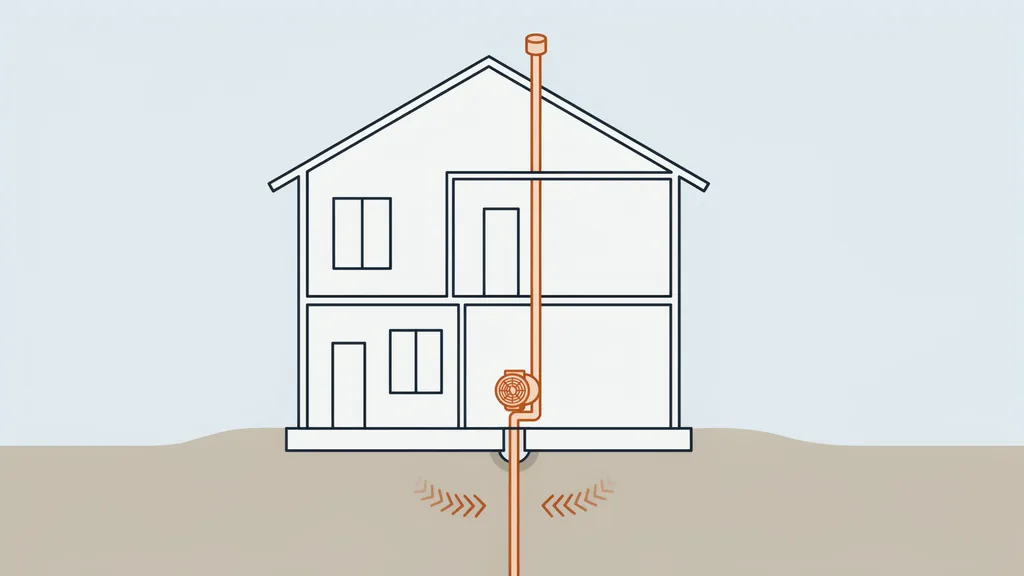
What a Mitigation System Physically Is
For something that carries a four-figure quote, a radon mitigation system is underwhelming to look at. A length of PVC pipe enters the concrete floor of the lowest level of the house. It runs up — through the interior, or up an exterior wall — and terminates above the roofline. Somewhere along that run sits a continuously operating fan. That is the whole machine.
What makes it work is not the fan’s power but where the intake sits: in the gravel or soil directly beneath the concrete slab, rather than in the room. The system is not filtering your indoor air. It is intercepting soil gas before it becomes indoor air, which is a fundamentally different and much easier job. This is why the EPA’s own consumer guidance frames radon reduction around venting from beneath the foundation rather than around air purification.
The distinction matters commercially, because it is the thing that separates a real mitigation system from the products that get marketed alongside it. An air purifier does not mitigate radon. Nor does opening windows, beyond a temporary and unreliable dilution. If a proposal does not involve drawing gas from under the slab and discharging it outside and above the house, it is not the thing the EPA is describing.
Why Pulling Air From Under the Slab Works
Radon is produced by decaying uranium in soil and rock. It moves through the ground as a gas and finds its way into buildings through whatever paths exist — slab cracks, the gap where the floor meets the wall, sump pits, service penetrations, crawlspace floors. Houses help it along: warm air rising inside creates a slight negative pressure at the bottom of the building, which actively draws soil gas upward through those paths.
A mitigation system reverses that pressure relationship in the one place it matters. By running a fan on a pipe that opens beneath the slab, it makes the space under the floor lower in pressure than the room above it. Gas that was being pulled into the basement is instead pulled into the pipe. This is why the technique is usually called sub-slab depressurization, and why the diagnostics matter more than the hardware — the installer’s job is to find a suction point that can actually influence the whole slab, and to size the pipe and fan to suit it.
Two Things People Assume, and What Is Actually True
❌ Common assumption
- A stronger fan means better results
- Sealing every crack in the basement will fix it
- The system cleans the air inside the house
- Once it is installed, the job is finished
✅ What actually matters
- Suction point placement, and whether it reaches the whole slab
- Sealing helps the system work, but rarely fixes a problem on its own
- It intercepts soil gas before it enters, and does nothing to room air
- It runs continuously and needs its performance re-tested
When You Actually Need One
The threshold is not a judgment call. The EPA’s guidance to homeowners is to fix the home at 4 pCi/L or above, and to consider fixing between 2 and 4 pCi/L. Below 2 pCi/L, no action is required. If you have not tested, that is the prerequisite — radon is invisible and odorless, and the EPA’s position is that testing is the only way to know your level.
The Three Bands That Decide It
2–4
pCi/L — consider fixing
Under 2
pCi/L — no action required
1.3
pCi/L — the U.S. indoor average, for comparison
These are action levels, not safety lines — the EPA does not declare any radon level free of risk.
The awkward band is 2 to 4. “Consider fixing” is genuinely ambiguous advice, and it is where a single short-term test result leaves you worst off. Radon moves with the seasons — levels are typically highest in fall and winter when a house is sealed up and ventilation drops — so a 3.1 pCi/L result in July and a 3.1 pCi/L result in January mean quite different things about your annual exposure. If you land in that band, a longer measurement before committing to a system is a reasonable thing to buy first. Our guide to radon detectors covers which device suits that specific job.
The Approaches, and Which House Each Suits
“Radon mitigation” is one label over several installations, and which one you get is decided by how your house sits on the ground rather than by preference.
| Foundation type | Typical approach | What drives the cost |
|---|
| Basement or slab-on-grade | Sub-slab depressurization — pipe through the slab into the aggregate below | Whether one suction point can influence the whole slab, or several are needed |
| Crawlspace | Sub-membrane depressurization — a sealed plastic membrane over the crawlspace floor, with the pipe drawing from beneath it | Crawlspace area and access; the membrane is labor, not hardware |
| Mixed foundation | Often more than one system, or a combined manifold | Effectively paying for two installations that have to be balanced |
| Sump pit present | The pit is frequently used as the suction point, sealed with an airtight lid | Usually reduces cost, since the opening already exists |
| New construction | Radon-resistant features built in before the slab is poured | Far cheaper at build time than retrofitting later |
The last row is worth flagging to anyone building or buying new. The EPA maintains guidance specifically on radon-resistant new construction, because roughing in the pipe before a slab is poured costs a fraction of cutting into it afterwards. If you are commissioning a build, this is a decision you get to make once and cheaply, or make later and expensively.
The sump-pit row deserves one practical note. Sealing a sump pit with an airtight lid is good for radon and mildly awkward for everything else you might want that pit to tell you — you lose the ability to simply look in. If your basement relies on that pit, it is worth pairing the seal with a water sensor that alerts you rather than trusting to periodic inspection you can no longer easily do.
Hiring Someone Without Getting Burned
This is where a radon article earns its keep, because the hardware is commodity and the outcome depends almost entirely on who installs it. Several states regulate this trade directly: Minnesota requires anyone performing radon mitigation to be licensed by the state health department, and Pennsylvania runs a certification program covering radon testing, mitigation and laboratory analysis for both individuals and firms. Check your own state’s program before you check reviews.
How a Legitimate Job Is Supposed to Run
1
A site visit, not a phone quote
Minnesota’s guidance is explicit that bids should not be made over the phone or by email — the installer should visit before proposing anything.
2
Diagnostics before design
The contractor determines the suction point location and the correct pipe and fan sizes for your slab, rather than fitting a standard kit.
3
A written contract, firm price
Get a firm price and confirm there are no hidden fees for follow-up work later.
4
Payment on a proven result
Do not pay in full before the work is complete, and require a valid radon test showing reduced levels before final payment.
Adapted from the Minnesota Department of Health’s homeowner guidance.
One more warning worth repeating because it runs against instinct: an unusually cheap quote is a red flag rather than a bargain. Minnesota’s guidance says plainly that very low installation rates are often too good to be true and leave the homeowner with sub-standard workmanship and a system that may not be working. A radon system that runs, hums, and does not reduce radon looks identical from the outside to one that works.
The Questions That Separate a Real Bid From a Bad One
Minnesota publishes a homeowner question list for exactly this conversation. These are the ones that most reliably reveal whether you are talking to a professional:
Ask These Before You Sign
🔧 About the work itself
- What is your state license or certification number?
- Will you perform diagnostics to determine the suction point and pipe and fan sizing?
- Will electrical work be needed to power the fan, and is that cost in the proposal?
- Who is responsible for obtaining permits, if any are required?
📋 About the outcome
- Will you guarantee levels below the EPA action level of 4.0 pCi/L?
- What happens if the level is still above it after mitigation?
- Is there a warranty on materials, on workmanship, and on performance?
- Will you show me how the system works and how to spot a fault?
The two performance questions are the important ones, and they are the two most likely to produce an evasive answer. A contractor who will commit in writing to a post-mitigation result, and who has a stated plan for what happens if the first attempt does not reach it, is offering something meaningfully different from one who will only guarantee that a pipe and fan get installed.
How to Know It Is Working, Months Later
Most systems include a simple pressure gauge on the pipe — a U-shaped tube of colored liquid, sitting at different heights on each side while the fan runs. It is not a radon reading. It tells you one thing only: that the fan is still moving air. If the two columns of liquid ever sit level, the fan has stopped, and the system is doing nothing.
That gauge is necessary and not sufficient, which is the part homeowners most often miss. A fan can run perfectly while the system underperforms, and the only way to know your actual exposure is to measure radon again. This is the clearest case on the whole site for owning a continuous monitor rather than another mail-in kit: you want to confirm the level dropped, and then that it is still down a year later, across a winter. That is a trend, not a single number.
Re-test after anything that changes how the house breathes, too — new windows, a new HVAC system, a finished basement, foundation work. It is the same maintenance instinct that applies to aging smoke alarms and to carbon monoxide detectors: the device was correct when it was installed, and the house has changed since.
Can You Do This Yourself?
In some states, legally, no. Minnesota requires a state license for anyone conducting radon mitigation, and Pennsylvania certifies mitigation firms and individuals. Where it is permitted, it is still the wrong first DIY project. The part that decides whether the system works is the diagnostic step — establishing whether a given suction point can influence the entire slab, and sizing the fan accordingly. That requires equipment and interpretation, not just a hole saw.
There is also a failure mode specific to getting this wrong. A poorly designed system can depressurize the wrong volume and pull combustion gases back down a flue — a backdrafting risk around furnaces and water heaters. If you take nothing else from this section: a botched radon system is not merely an ineffective one. That is a good reason to have working CO detection in the house regardless of who does the installation.
What is genuinely worth doing yourself: sealing obvious slab cracks and the floor-wall joint, and fitting an airtight sump lid. None of that reliably fixes a radon problem alone, but it makes a professional system work better and cheaper, because there are fewer competing paths for the fan to fight.
What to Actually Do
If you have a test result at or above 4 pCi/L, get quotes from state-licensed or certified mitigation contractors and require a post-installation test before final payment. That single contractual condition — payment released on a proven reduction, not on a completed installation — does more to protect you than any amount of research into fan brands. Budget it as a home-infrastructure expense rather than a gadget purchase — it sits closer to the installed-system end of the cost scale than to anything you buy in a box.
If you are between 2 and 4 pCi/L, measure for longer before you spend. Buy a continuous monitor and watch the level through a winter. You may find you are consistently near 2 and can leave it, or that your July reading badly understated a January problem. Either answer is worth knowing before committing to a system.
If you have never tested, do not read further into mitigation. Test first. Most homes do not need a system, and the U.S. indoor average sits at 1.3 pCi/L — comfortably in the no-action band.
What would change this advice: if you are building or substantially renovating, do it now regardless of your current number. Radon-resistant construction is dramatically cheaper before a slab is poured than after, and it is one of the few home-safety decisions where acting early is straightforwardly cheaper rather than merely wiser.
SafeBode does not yet run an in-house product testing program. This guide is built from manufacturer specifications, official support documentation, current retail listings and verified buyer feedback rather than hands-on testing, and we say so plainly rather than implying testing we have not done.
Frequently Asked Questions
How much does a radon mitigation system cost?
It varies with foundation type, how many suction points the slab needs, and whether electrical work is included. What is more useful than a number: Minnesota’s health department warns that unusually low installation quotes are often too good to be true and leave homeowners with sub-standard work. Get a firm written price after a site visit.
Does a radon mitigation system run all the time?
Yes. The fan operates continuously, which is what maintains the pressure difference under the slab. Switching it off seasonally defeats the mechanism, and radon is typically highest in the colder months when houses are closed up.
Will an air purifier reduce radon?
No. A mitigation system intercepts soil gas beneath the foundation before it enters the house. An air purifier works on air already inside the room, which is a different problem and not one that addresses radon entry.
Can sealing cracks fix a radon problem on its own?
Rarely. Sealing helps a mitigation system work better by removing competing entry paths, and it is worth doing, but as a standalone fix it seldom brings a home below the action level.
How do I know my system is still working?
The pressure gauge on the pipe tells you the fan is still moving air — if the liquid sits level on both sides, the fan has stopped. It does not tell you your radon level, so you also need to re-measure radon periodically.
Do I need to re-test after mitigation?
Yes, and you should make it a condition of final payment. Minnesota’s guidance is to obtain a valid radon test showing reduced levels before paying in full.
Is radon mitigation regulated?
In several states, yes. Minnesota licenses radon mitigation professionals and Pennsylvania certifies both individuals and firms for testing, mitigation and lab analysis. Check your own state’s program rather than assuming the trade is unregulated.
Can a radon system cause other problems?
A poorly designed one can. Depressurizing the wrong volume can affect combustion appliances, which is one reason the diagnostic step and a qualified installer matter, and why working carbon monoxide detection belongs in any house with fuel-burning appliances.
Should I mitigate before selling a house?
It depends on your market and your reading, but the practical point is that a buyer’s inspection will often test anyway. Having a documented result — and a system with a post-installation test behind it, if you needed one — is a stronger position than discovering the number during a negotiation.
Sources
Show sources (6)


