Best Radon Detectors 2026: Lab Test Kit or Continuous Monitor?
Affiliate Disclosure: This article contains affiliate links. If you buy through these links, we may earn a commission at no extra cost to you. Our editorial opinions are our own and are not influenced by affiliate relationships. Read our full disclosure policy →
Contents
Quick Answer
Buy a lab-analyzed test kit first, not an electronic monitor. Radon is invisible and odorless, testing is the only way to know your level, and the EPA says every home should be tested. A mail-in kit like the First Alert RD1 gives you one number a third-party lab stands behind, which is what you need to decide whether to spend money on mitigation. Add a continuous monitor — the Airthings Corentium Home 2 is the safe default — once you want to watch the number over seasons, or confirm that a mitigation system is actually working. Most households do not need both on day one, and buying the monitor first is the common mistake.
A Test Kit and a Monitor Answer Different Questions
Almost every radon buying guide sorts these devices into good, better and best, as though a paper mail-in kit is simply the cheap version of a digital monitor. That framing is wrong, and it is why people end up buying the wrong one. The two product types are not competing on quality. They answer different questions.
A lab test kit answers: what is the radon level in this house, measured by someone independent? You expose a charcoal canister for a set window, mail it to a laboratory, and get a result back. The number carries weight precisely because you did not produce it. That matters when the reading is going to be attached to a decision with money on the other side of it — a real estate transaction, a mitigation quote, a landlord conversation.
A continuous electronic monitor answers a different question: what is radon doing in this house over time? Radon is not a fixed property of a building. It moves with weather, with how sealed the house is, with whether the basement door is open. Airthings’ own guidance notes that concentrations are typically highest in fall and winter, when homes are shut up and ventilation drops. A single 3-day snapshot cannot show you that. A monitor sitting on a shelf for a year can.
The practical consequence: if you have never tested, start with the kit. If you have tested, or you have already mitigated and want to know the system is still doing its job, the monitor is the better buy. If radon is genuinely high in your area and you are about to spend real money fixing it, owning both is reasonable — but in that order.
What the Numbers Actually Say
Radon is a radioactive gas that seeps from soil into buildings. You cannot see it or smell it, and there is no short-term symptom that tells you it is there. The reason it is worth a detector at all is what the exposure does over years.
Radon, by the EPA’s Own Figures
21,000
U.S. lung cancer deaths a year attributed to radon
#1
cause of lung cancer among people who have never smoked
2,900
of those annual deaths occur in never-smokers
1.3
pCi/L: the average indoor radon level in the U.S.
Radon is the second leading cause of lung cancer overall, behind smoking.
Two things in that grid are worth sitting with. The first is that radon is the leading cause of lung cancer in non-smokers — this is not a risk that only compounds an existing one. The second is the average: 1.3 pCi/L indoors against 0.4 pCi/L outdoors. Most homes are fine. The problem is that the ones that are not fine look exactly the same from the street, and radon levels vary house to house rather than neighborhood to neighborhood. Your neighbor’s clean test result says very little about your own house.
This is the same argument that applies to every invisible household hazard, and it is why the site treats carbon monoxide detection as non-negotiable rather than optional. The difference is timing: carbon monoxide can kill in an afternoon, so it needs an alarm that screams. Radon harms over decades, so it needs a measurement you act on deliberately.
The EPA’s Thresholds, and What They Mean for You
The EPA publishes a risk table that maps radon concentration to recommended action. It is the single most useful thing to have in mind before you look at a reading, because it turns an abstract number into an instruction.
| Your reading | What the EPA says to do | For context |
|---|
| 4 pCi/L or above | Fix your home | About 5 times the risk of dying in a car crash, for a lifetime of exposure |
| Between 2 and 4 pCi/L | Consider fixing | Above the 1.3 pCi/L national indoor average |
| Below 2 pCi/L | No action required | Approaching the 0.4 pCi/L outdoor background level |
| 8 pCi/L | Fix your home | About 30 times the risk of dying in a fall |
| 20 pCi/L | Fix your home | About 250 times the risk of drowning |
Note what the table does not say. There is no threshold below which radon is declared safe — the EPA’s own framing is that any radon exposure carries some risk, and the numbers above are action levels rather than safety lines. That is why the guidance at 2 to 4 pCi/L is “consider fixing” rather than “you are fine.”
Lab Kit vs Electronic Monitor, Side by Side
Which One Fits What You Are Trying to Do
📮 A mail-in lab kit is right when
- You have never tested this house and want a first, defensible number
- The result is going into a transaction — buying, selling, or a landlord dispute
- You want a third party, not a device you own, to produce the figure
- You only intend to test once and act on the answer
📈 A continuous monitor is right when
- You have already tested and want to watch the number across seasons
- You have installed mitigation and need to confirm it is working
- You want to see how basement use, weather or ventilation move the level
- You would rather pay once than pay a lab fee every time you want a reading
One more practical distinction that rarely makes it into comparisons: a lab kit has a deadline. The canister has to be exposed for its specified window and then mailed promptly, because the measurement depends on the timing. A monitor has no deadline at all, which is genuinely the better experience — but it is also why a monitor is easy to buy, place badly, and never really read.
First Alert RD1 Radon Gas Test Kit — the defensible number
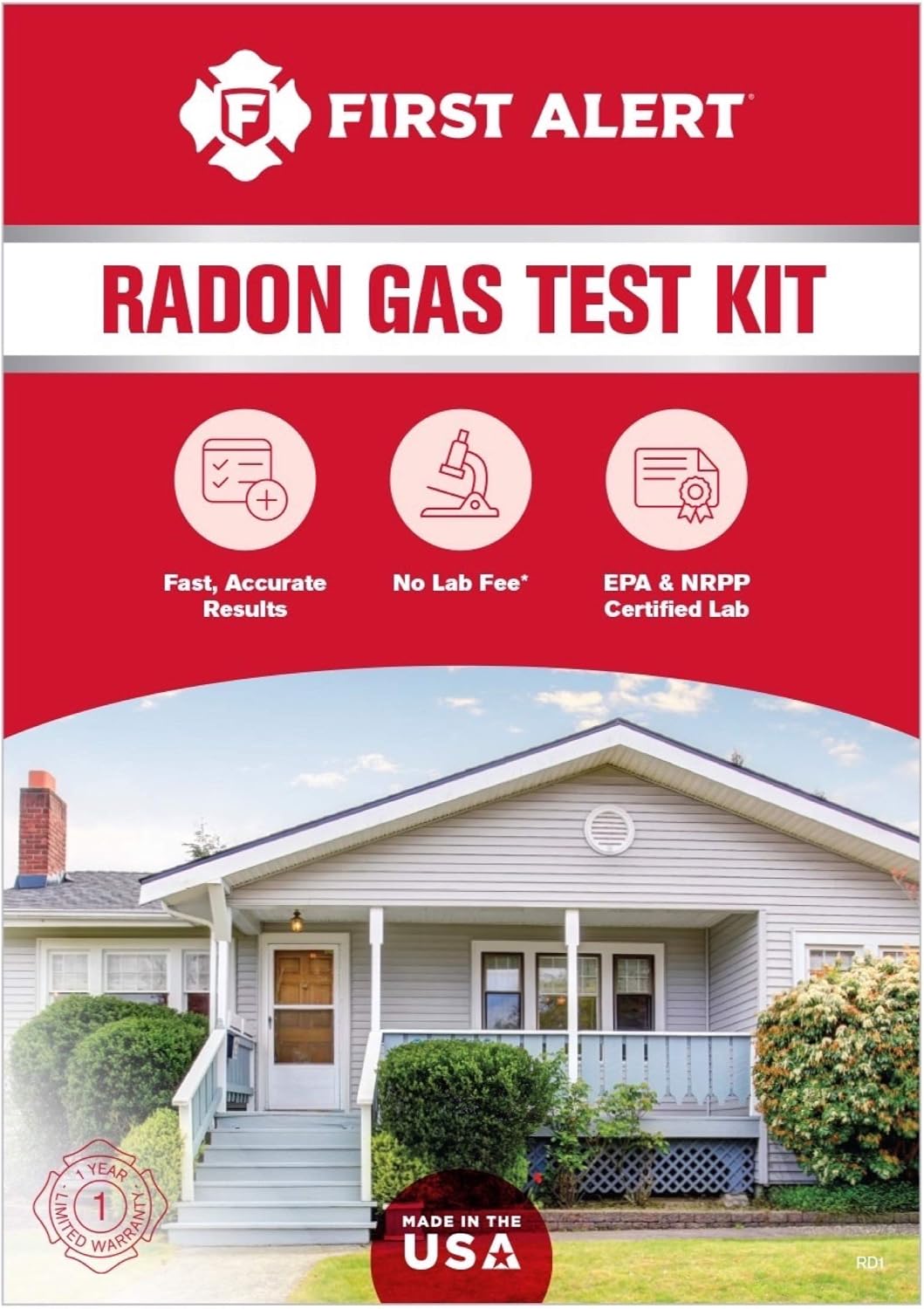
Key specs: Short-term charcoal test kit analyzed by a third-party lab; listed under the EPA radon gas measurement proficiency program; test materials and lab fees included (New Jersey state fees excluded); results emailed within 72 hours of lab receipt
This is the one to buy first, and the reason is the boring line in its specification rather than anything about the hardware: it is listed under the EPA’s radon measurement proficiency program, and the price includes the laboratory fee. You expose the canister, mail it, and a lab that is not you produces the number. Results come back by email within 72 hours of the lab receiving it. Nothing here is clever, and that is the point — when a radon reading has to convince somebody else, an independent lab result does that and a screen on your shelf does not.
✅ Pros
- Third-party lab analysis, not a reading you generated yourself
- Listed under the EPA radon measurement proficiency program
- Lab fee included rather than charged separately
- By far the most-reviewed radon product in the U.S. Amazon catalog
- Nothing to charge, pair, update or maintain
❌ Cons
- One measurement, then it is used up — no trend, no seasons
- You wait on mail and lab turnaround instead of seeing a number now
- New Jersey state fees are excluded and billed separately
- Timing matters: the canister has to be mailed promptly to stay valid
Airthings 325 Corentium Home 2 — the one to live with
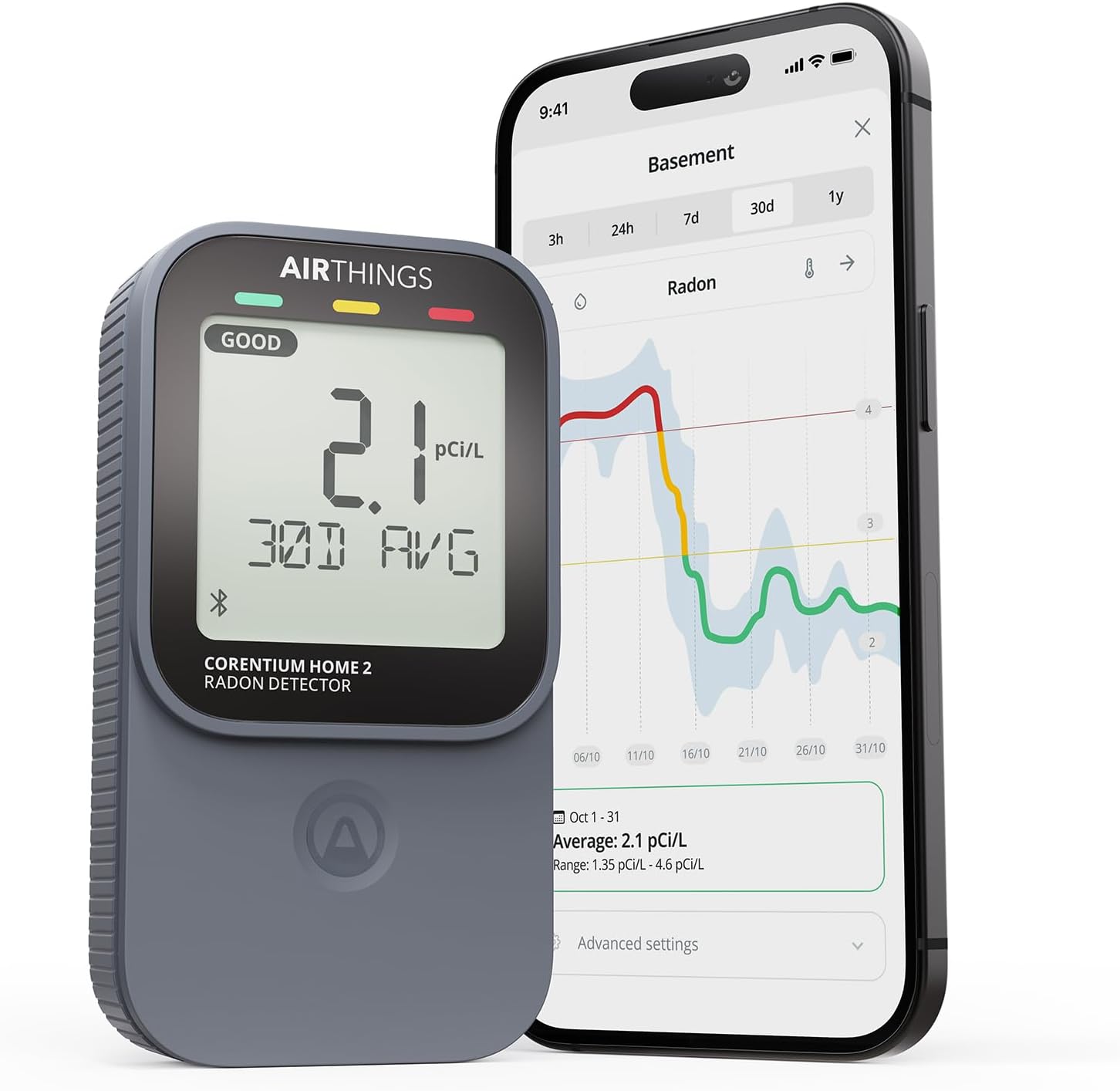
Key specs: Continuous digital monitor using alpha spectrometry; 0-250 pCi/L range; LCD shows 24-hour, 7-day, 30-day and long-term rolling averages plus temperature and humidity; runs on 2 AA batteries rated up to 3 years; Bluetooth and app optional, works fully standalone
If you are buying a monitor rather than a kit, this is the default, and it earns that on track record more than on any single spec. Airthings has been building alpha-spectrometry radon sensors since 2011, and this generation reports 24-hour, 7-day, 30-day and long-term rolling averages directly on the LCD. Those four windows matter more than they sound: radon swings day to day, so a single instantaneous reading is close to meaningless, and the long-term average is the figure that actually maps onto the EPA’s action levels. It runs on two AA batteries rated up to three years and works fully standalone — the app adds graphs and history, but you are not locked out of your own readings without it.
✅ Pros
- Rolling averages over four time windows, shown on the device itself
- Works standalone; no Wi-Fi, hub or account needed to read it
- Up to 3-year battery life on 2 AA cells
- Adds temperature and humidity sensors
- Longest track record of any brand in this category
❌ Cons
- Costs more than a lab kit, and produces a number you generated yourself
- First useful average takes a full 24 hours; a meaningful one takes weeks
- Bluetooth only — no remote alerts when you are away from the house
- Measurement range tops out at 250 pCi/L
Aranet Radon Plus — the fastest feedback
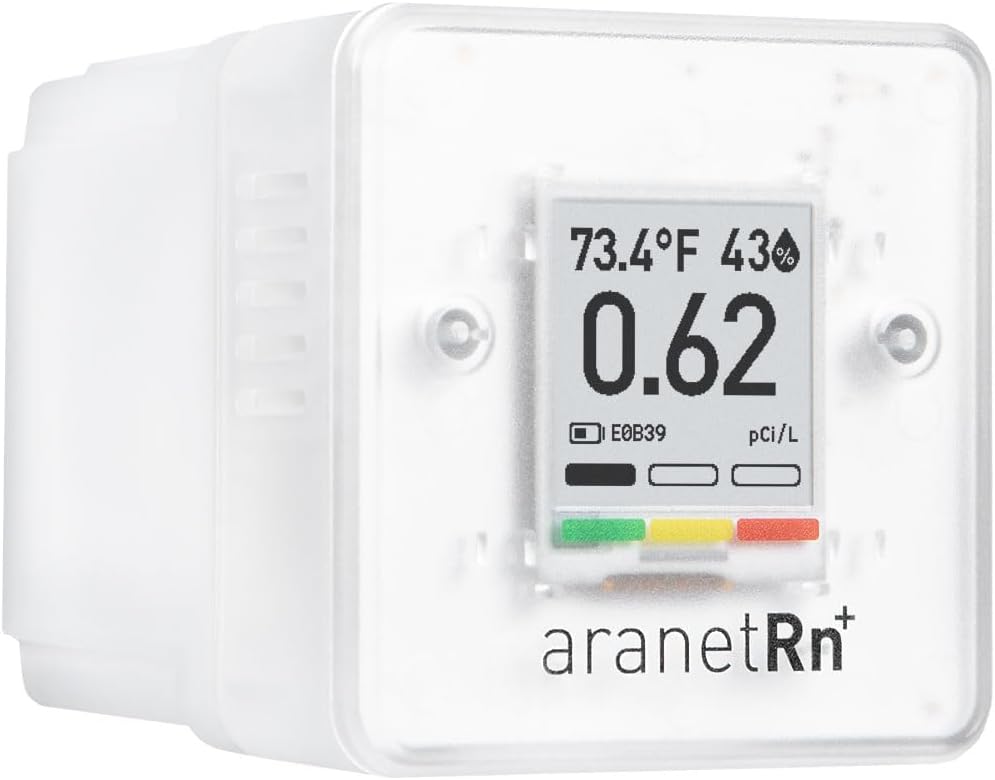
Key specs: Continuous monitor updating every 10 minutes; color-coded E-Ink display; also measures temperature, relative humidity and atmospheric pressure; 2 AA batteries rated up to a 7-year lifetime
Buy this one if you are actively doing something about radon rather than just checking on it. Its distinguishing feature is a 10-minute update interval, which turns the device into a diagnostic rather than a passive logger. If you are sealing a sump cover, testing whether a basement fan changes anything, or commissioning a mitigation system, a monitor that responds within the hour tells you whether the change did something. One that reports a 24-hour average does not. It also logs temperature, humidity and atmospheric pressure, which is genuinely relevant here — pressure differences are part of what drives soil gas into a building.
✅ Pros
- 10-minute measurement interval, the fastest feedback loop of the four
- Color-coded E-Ink display, readable at a glance without backlight drain
- Battery rated up to a 7-year lifetime on 2 AA cells
- Logs pressure and humidity alongside radon
❌ Cons
- Overkill if you only want to know whether your house is above 4 pCi/L
- Smaller review base than Airthings or the First Alert kit
- Short-interval readings tempt you to react to noise rather than trend
- Still a self-generated number, not an independent lab result
AEGTEST HOUND-1011 — the budget monitor, honestly
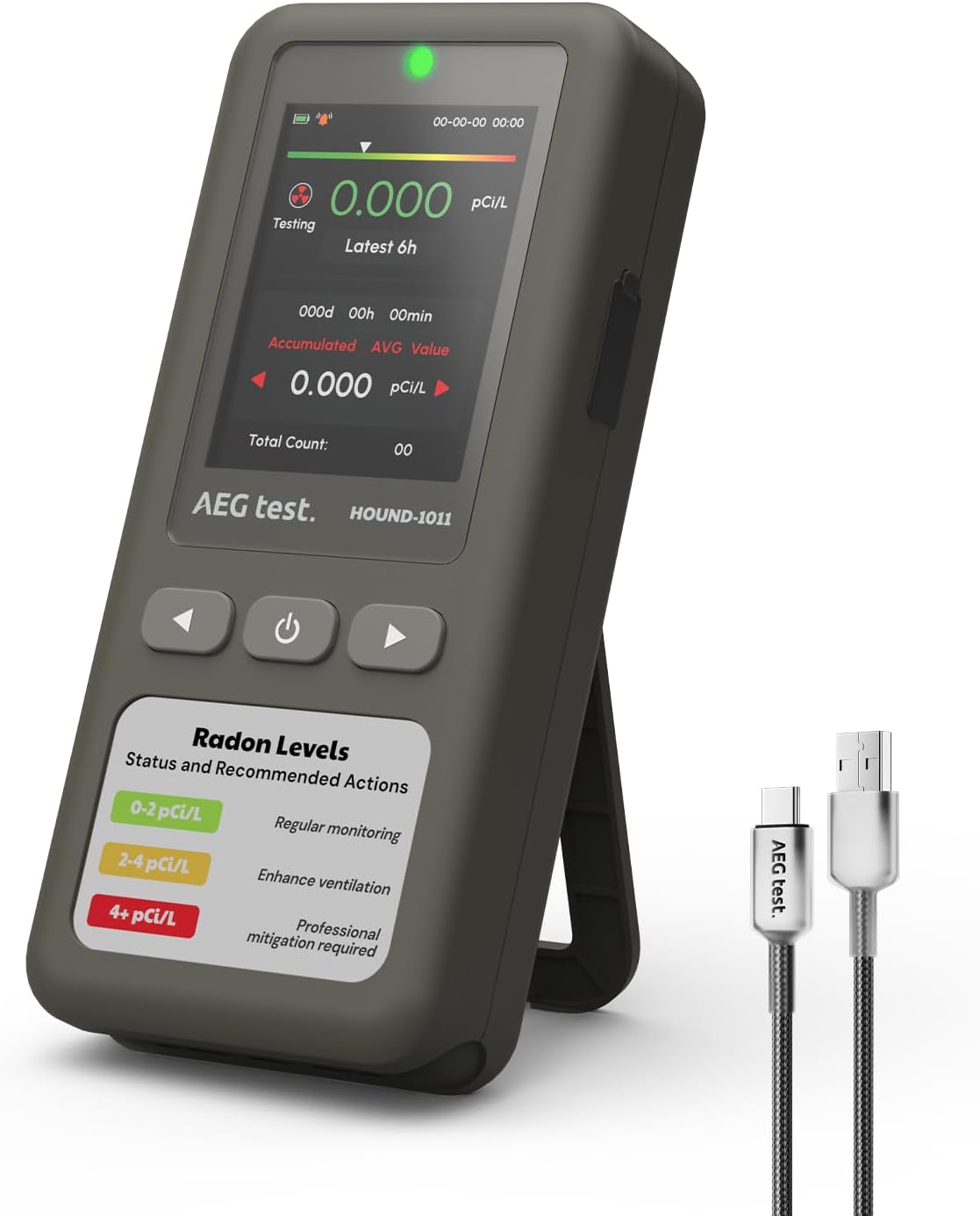
Key specs: Continuous portable monitor with a semiconductor sensor; 0.09-1000 pCi/L range; switchable pCi/L and Bq/m3 units; first reading at 6 hours then hourly updates; short-term and long-term timeframes up to 45 days
This is the cheapest continuous monitor here that reports a genuinely useful set of timeframes — first reading at 6 hours, hourly updates after that, and short and long-term windows out to 45 days. The stated range, 0.09 to 1000 pCi/L, is far wider than Airthings’ 250 pCi/L ceiling, though in practice a reading anywhere near the top of either range means you stop measuring and start mitigating. The honest caveat is brand track record: AEGTEST is not an established instrument maker the way Airthings or Aranet are, and a radon monitor is a device whose accuracy you cannot check by looking at it. We are listing it as the budget option, not as an equal-confidence alternative.
✅ Pros
- Cheapest route into continuous monitoring of the four picks
- First reading at 6 hours, faster than a multi-day lab turnaround
- Very wide stated measurement range
- Switches between pCi/L and Bq/m3 units
❌ Cons
- Least-established brand here, on a device you cannot self-verify
- Semiconductor sensor rather than the alpha spectrometry Airthings uses
- Thinner review base than the other three picks
- If the number will be shown to anyone else, a lab kit is the stronger evidence
Where to Put It, and When to Test
Placement changes the reading more than most people expect, and a badly placed detector produces a confidently wrong number rather than an obviously broken one.
Getting a Reading You Can Trust
1
Test the lowest lived-in level
Radon enters from the soil, so it is highest at the bottom of the house. Measure the lowest level you actually occupy — a finished basement counts, a crawlspace you never enter does not.
2
Keep it away from drafts
Exterior doors, windows, vents and fans all dilute the local air. A reading taken next to a drafty window tells you about the draft, not the house.
3
Give it time
Radon fluctuates with weather and ventilation. Airthings’ guidance is to measure over several weeks for a reliable long-term average.
4
Prefer the colder months
Levels are typically highest in fall and winter, when the house is sealed and ventilation drops. A summer test can read low and still miss a winter problem.
These apply to both product types — a lab canister placed badly is just as wrong as a monitor placed badly.
One habit worth borrowing from smoke and CO detection: decide the location once, deliberately, and leave it. The same discipline that makes smoke alarm placement worth thinking through applies here, with one difference — a smoke alarm in a poor spot still usually alarms eventually, whereas a radon detector in a poor spot quietly reports a number that is simply not about your house.
You Got a Number. Now What?
At or above 4 pCi/L, the EPA’s instruction is unambiguous: fix your home. Fixing here does not mean buying a better detector. It means radon reduction — most commonly a vent pipe and fan system that draws soil gas from beneath the foundation and discharges it above the roofline, which is the approach the EPA’s own consumer guide covers. That is contractor work with a real price attached, and it is worth budgeting the same way you would any other whole-home safety spend rather than treating it as an impulse purchase.
Between 2 and 4 pCi/L, you are in genuine judgment territory, and this is where a monitor earns its keep. “Consider fixing” is much easier to act on when you can see whether the house sits at 2.1 pCi/L all year or spends every January at 3.8. A single short-term kit result in that band tells you almost nothing about which of those you have.
Below 2 pCi/L, no action is required. It is still worth retesting after anything that changes how the house breathes — a new HVAC system, sealed windows, a finished basement, foundation work. Sealing a house up for efficiency is exactly the kind of change that can move radon in the wrong direction, which is a genuine trade-off worth knowing about before you weatherize. Put it on the same mental schedule as replacing aging smoke alarms — a periodic check you do not think about again until it comes round.
And a caution that applies to the whole category: a radon detector is a measurement device, not a protective one. It does nothing to your air. That distinguishes it from most of the hardware on this site — a water leak detector that alarms at 2am can genuinely save a basement, whereas a radon monitor only ever hands you information you then have to act on.
Final Recommendation
Start with the First Alert RD1 lab kit. If you have never tested this house, that is the first purchase, and for most households it is also the last one. It produces an independent number, the lab fee is already in the price, and it is the result that will actually carry weight if you end up quoting mitigation or negotiating a sale.
Buy the Airthings Corentium Home 2 instead if you have already tested and landed somewhere in the 2 to 4 pCi/L band, or if you have mitigation installed and want ongoing confirmation it is working. That is the case where the seasonal picture is the thing you need and a one-shot canister genuinely cannot give it to you.
Choose the Aranet Radon Plus over the Airthings only if you are actively changing something and need to see the effect — sealing, venting, commissioning a fan. Its 10-minute interval is a real advantage in that narrow situation and close to irrelevant outside it. Choose the AEGTEST HOUND-1011 only if budget is the binding constraint and you accept the weaker brand track record on a device you cannot independently check.
What would change our answer: if radon is known to be high where you live and you are confident you will mitigate regardless, skip straight to a monitor and put the kit money toward the mitigation quote. The kit exists to make the decision; if the decision is already made, it is a step you can skip.
SafeBode does not yet run an in-house product testing program. This guide is built from manufacturer specifications, official support documentation, current retail listings and verified buyer feedback rather than hands-on testing, and we say so plainly rather than implying testing we have not done.
Frequently Asked Questions
Is a cheap radon test kit as accurate as a digital monitor?
They are not really measuring the same thing. A charcoal kit gives a single integrated result for its exposure window, analyzed by a laboratory; a monitor gives you repeated readings you average yourself. For a one-time yes-or-no answer, the lab kit is the stronger evidence precisely because it is independent.
What radon level is considered dangerous?
The EPA tells homeowners to fix the home at 4 pCi/L or above, and to consider fixing between 2 and 4 pCi/L. There is no level the agency declares safe — those are action thresholds, not a safety line.
How long does a radon test take?
A short-term charcoal kit runs for a set window of a few days and then goes to a lab. A continuous monitor shows a first daily average after 24 hours, but the number that matters is the long-term average, which takes weeks to settle.
Do I need to test if my neighbor’s house tested low?
Yes. Radon levels vary house to house rather than by neighborhood, because they depend on the soil directly beneath the building and on how that particular structure is built and sealed. A neighbor’s result tells you almost nothing about yours.
Where should I place a radon detector?
The lowest level of the house that people actually use, away from exterior doors, windows, vents and fans. Drafts dilute the local air and pull the reading down, so a detector next to a leaky window can report a comfortable number for a house that has a problem.
Does a radon detector remove radon from the air?
No. Every product in this guide only measures. Reducing radon is a separate job, usually a vent pipe and fan system that draws soil gas from under the foundation and discharges it above the roof.
Should I test in summer or winter?
Winter, if you have the choice. Radon concentrations are typically highest in fall and winter when the house is closed up and ventilation is lower, so a summer reading can look reassuring and still understate the annual picture.
Do I need to retest after mitigation?
Yes, and this is the single best argument for owning a monitor rather than another kit. You want to confirm the system dropped the level, and then that it is still holding months later, which is a trend rather than a one-off measurement.
Can radon detectors give false readings?
They can give misleading ones, most often through placement or too short a measurement window rather than a broken sensor. A reading taken over a few hours, or next to a draft, is not wrong so much as it is answering a narrower question than you think.
Sources
Show sources (7)


