Best Window Alarms 2026: Standalone Sirens With No Hub Required
Affiliate Disclosure: This article contains affiliate links. If you buy through these links, we may earn a commission at no extra cost to you. Our editorial opinions are our own and are not influenced by affiliate relationships. Read our full disclosure policy →
Contents
Quick Answer
Buy the UltraPro six-pack and put one on every ground-floor window, not just the obvious ones — coverage is what makes these work, and at this price coverage is affordable. Each unit is a self-contained 120 dB magnetic alarm with a three-position switch: off, chime, or alarm. That chime setting is the half most buyers ignore and end up using most. There is no hub, no app, no subscription and no notification — if nobody is home to hear it, nothing happens.
This Is Not the Same Product as a Contact Sensor
The confusion is understandable because the hardware looks identical: two small plastic pieces, one on the frame and one on the moving part, held in alignment by a magnet. What differs is what happens when they separate.
A contact sensor belonging to an alarm system reports the opening to a hub. The hub decides what to do — sound a siren, send a phone notification, notify a monitoring center. The sensor itself is silent, and it is useless without the system it belongs to. Those are covered in our guide to wireless door and window sensors.
A standalone window alarm makes the noise itself. There is no hub, nothing is transmitted, and nothing is recorded. It is a siren strapped to a magnet, and its entire theory of operation is that noise at the point of entry is unwelcome.
Which One You Actually Want
🔔 Standalone window alarm
- Works out of the box with no hub, app or account
- Costs a few dollars per opening rather than per system
- Nothing to configure, and nothing to subscribe to
- Renter-friendly — adhesive mounting, removable
📡 Contact sensor on a system
- Sends a notification when you are not home
- Can trigger a whole-house siren and a monitoring response
- Logs what opened and when
- Requires a hub, and usually a subscription for the useful part
The honest framing: a standalone alarm is a deterrent and a household notifier. A monitored sensor is part of a response system. If your reason for shopping is “I want to know if somebody opens this while I am away,” you want the second thing and this article is the wrong product category.
The Chime Setting Is the Underrated Half
Three of the four picks here have a three-position switch: off, chime, alarm. People buy these for the alarm position and, in practice, spend most of the year using the chime one.
In chime mode the unit produces a short pleasant tone when the door or window opens or closes, instead of a siren. That turns the product into something quite different: an awareness device. It tells you a toddler has opened the back door, that an elderly relative has gone out, that the gate to the pool has moved, that somebody came in through the garage while you were upstairs.
Three Positions, Three Different Products
Alarm
120–125 dB siren for deterrence
Chime
a short tone for awareness, not deterrence
Off
for the windows you actually open daily
Per unit
the switch is on each alarm individually
The switch being per-unit is what makes a mixed setup possible across one house.
Because the switch is on each individual unit, you can run a mixed house: chime on the doors people use, alarm on the windows nobody should be opening, off on the kitchen window you crack every evening. That flexibility is the real argument for buying a multipack rather than one device, and it is why these outsell tidier-looking alternatives.
Coverage Beats Loudness, and It Is Cheaper
The specification race in this category is decibels — 120 dB here, 125 dB there. That difference is close to irrelevant compared with how many openings you actually cover.
Consider what a window alarm is for. It does not detect an approach, it detects an entry, and it detects it only at the specific window it is attached to. An unalarmed window is not partially covered; it is entirely uncovered. A house with one very loud alarm on the front window and nothing on the other seven ground-floor openings has, functionally, one protected window.
For context on what these decibel figures mean, personal alarm makers publish audible ranges alongside them — SABRE lists ranges from 750 up to 1,300 feet across its 120 dB and 130 dB models. At those levels every unit here is loud enough to be heard through a house. Beyond that point, adding decibels adds nothing you can use; adding units adds coverage you can.
One structural caveat worth stating: a contact alarm detects the window opening. It does nothing if the glass is broken and someone climbs through the frame without moving the sash. Covering that requires a different sensor entirely, which is what glass break sensors are for. On a ground-floor window, the two are complementary rather than alternatives.
The Four Picks Side by Side
UltraPro Window and Door Alarm (6 Pack) — the one to buy
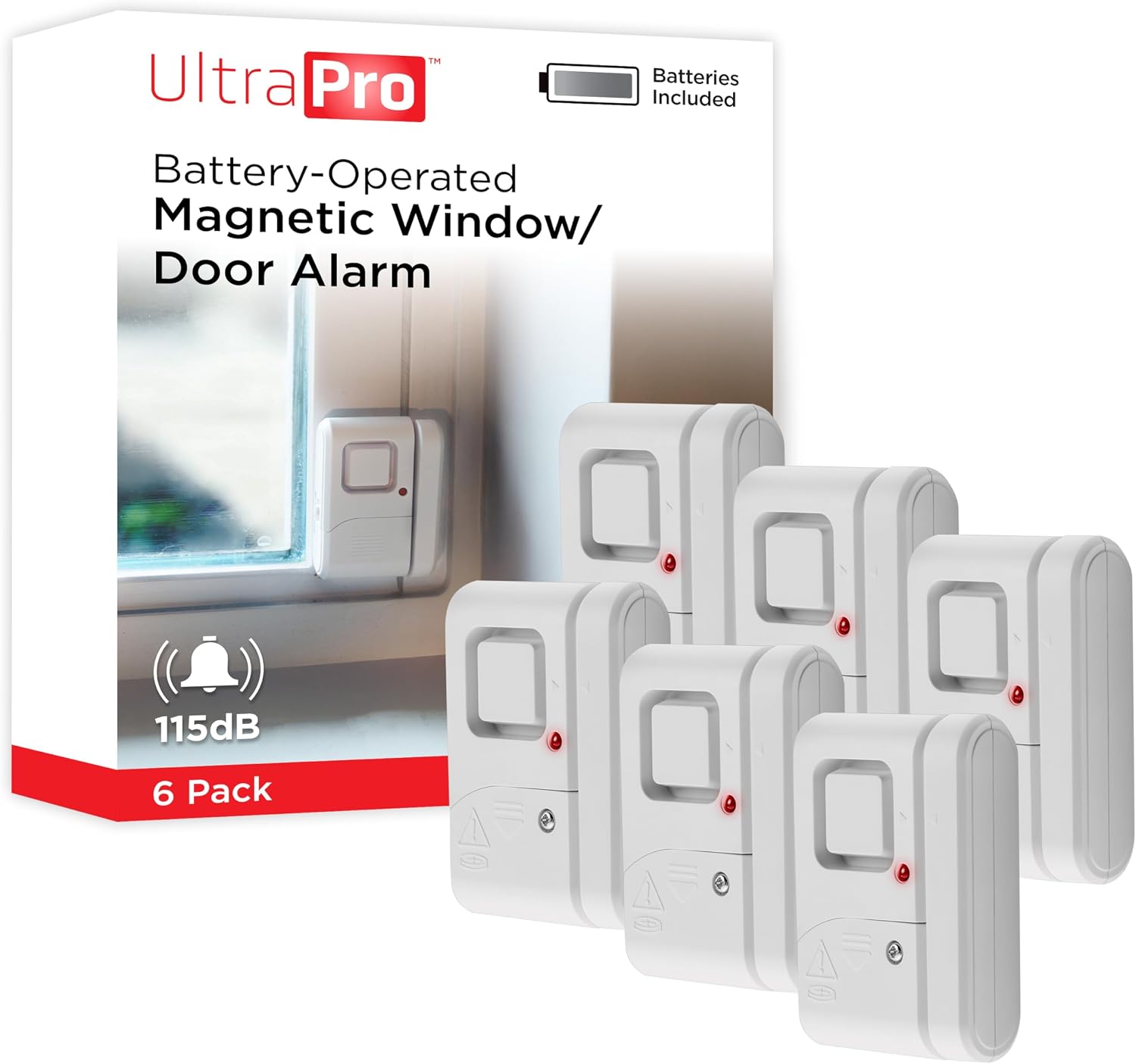
Key specs: 120 dB magnetic-sensor alarm with a side OFF/chime/alarm switch, so each unit can sound a siren or a chime when a door or window opens or closes; adhesive mounting; six units per pack
Six units is the right quantity, and quantity is the thing that matters in this category. A typical house has more ground-floor openings than people count — front and back doors, four or five windows, a garage side door, a patio slider — and a four-pack leaves some of them bare. Each unit carries the three-position side switch for off, chime or alarm, which is what lets you run different behavior on different openings rather than committing the whole house to one mode. Adhesive mounting means nothing is screwed into a frame, so this works in a rental and comes off cleanly.
✅ Pros
- Six units, enough to genuinely cover a floor
- Per-unit off/chime/alarm switch
- 120 dB, loud enough to carry through a house
- Adhesive mounting, renter-friendly and reversible
- Large review base in a category full of unknown names
❌ Cons
- No notification — nobody hears it if nobody is home
- Adhesive can fail in heat or on textured frames
- Detects opening only, not broken glass
- Batteries in six separate units to keep track of
Sanjie Door Window Alarm Sensors (5 Pack) — louder, with volume control
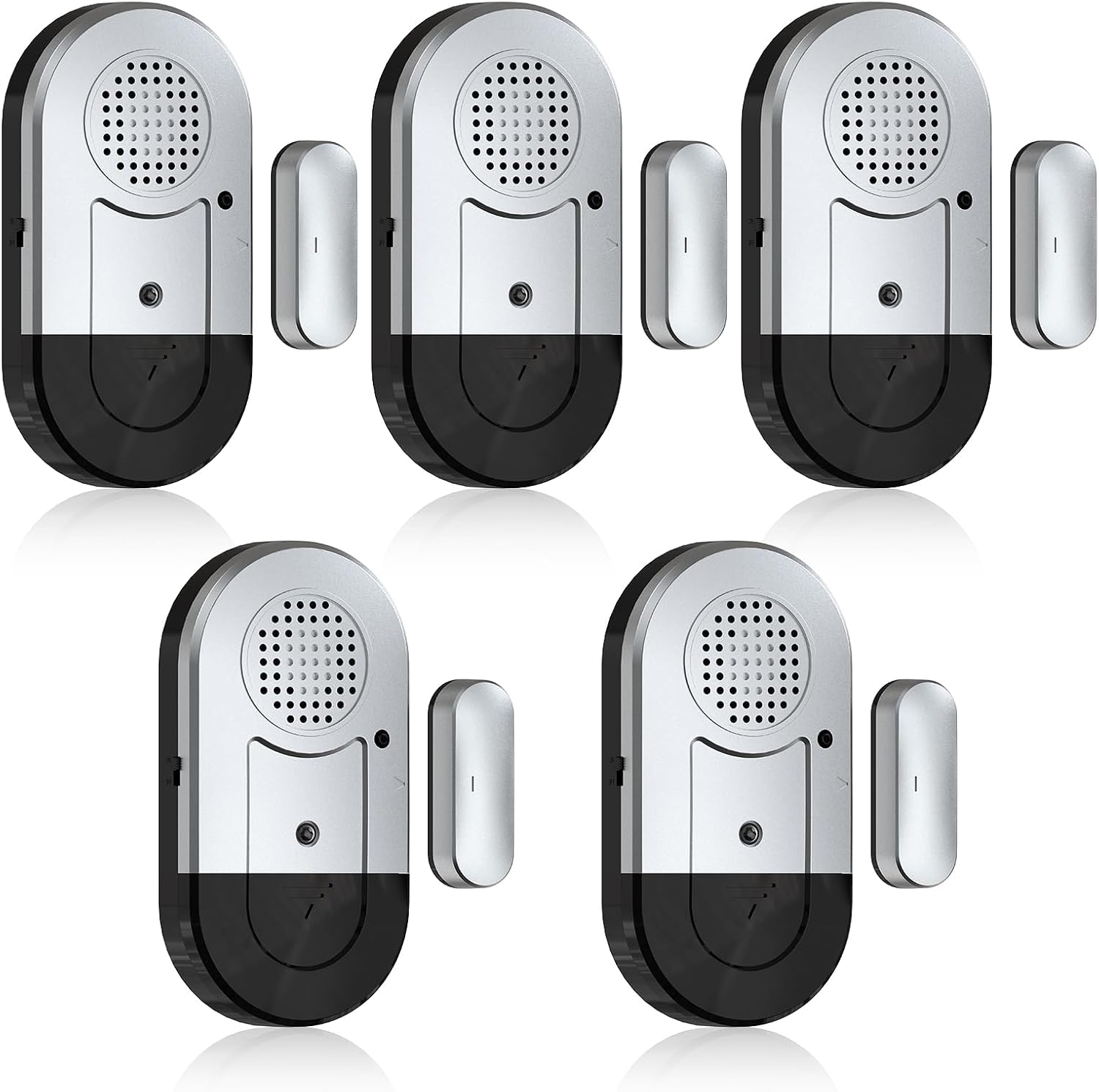
Key specs: 125 dB magnetic-sensor alarm with adjustable volume control; sounds an alarm or a chime when the two halves separate; marketed for homes, apartments, garages, RVs, stores and offices; five units per pack
The pick if the alarm is going somewhere its volume needs adjusting. At 125 dB it is nominally the loudest here, but the more useful feature is that the volume is adjustable — which sounds like a downgrade and is not. A full-volume siren in a small apartment hallway is genuinely painful and gets switched off; the same unit at a lower setting stays armed. It sounds an alarm or a chime when the two halves separate, and the manufacturer positions it across homes, apartments, garages, RVs, stores and offices, which reflects a device that is simply a magnet and a buzzer.
✅ Pros
- 125 dB, nominally the loudest of the four
- Adjustable volume, so it stays armed rather than annoying
- Five units per pack
- Works on anything with two surfaces that separate
❌ Cons
- Less recognizable brand than Philips or UltraPro
- One fewer unit than the UltraPro pack
- Same no-notification limitation as the rest
- Volume control is one more thing that can be left set wrong
Philips Window and Door Alarm (4 Pack) — the smaller pack
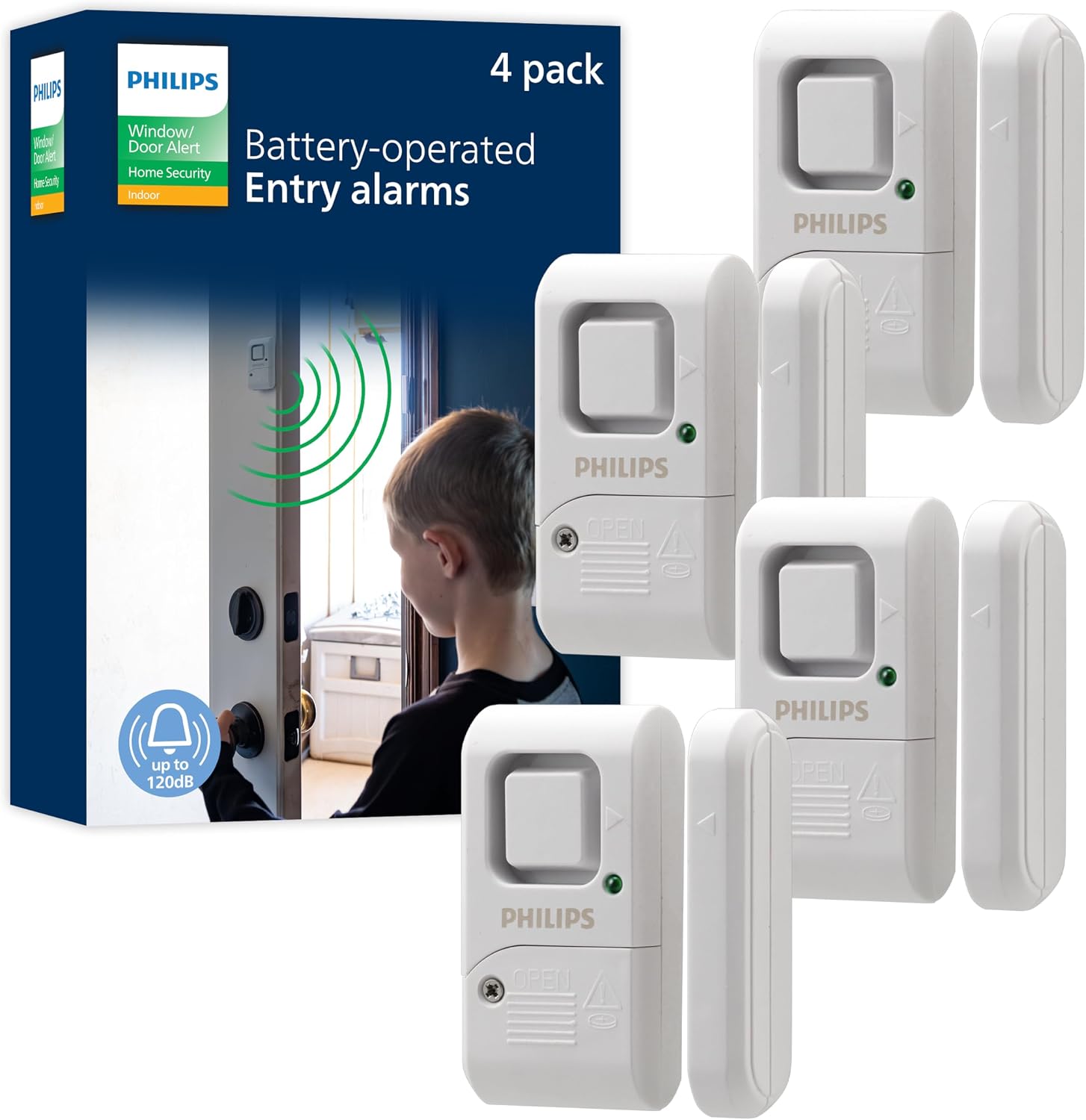
Key specs: 120 dB alarm triggered by a magnetic sensor, with an OFF/chime/alarm switch on the side of the unit; chime mode signals openings and closings without a siren; four units per pack
Functionally very close to the UltraPro: a 120 dB magnetic-sensor alarm with the same off/chime/alarm switch on the side of the unit. The differences are the pack size — four rather than six — and the brand on the front. Worth choosing if four openings genuinely is your whole requirement, or if brand familiarity matters to you in a category where most names are unfamiliar. If you are covering a whole floor, the six-pack is better value per opening and the hardware is comparable.
✅ Pros
- Same three-mode switch as the UltraPro
- Recognizable brand name in a category short of them
- 120 dB, comparable to the UltraPro
- Chime mode signals both opening and closing
❌ Cons
- Four units where most homes need more
- No meaningful specification advantage over the UltraPro
- Smaller review base than the six-pack
- Same detect-opening-only limitation
Hendun Door Alarms With Remote — the one with a remote
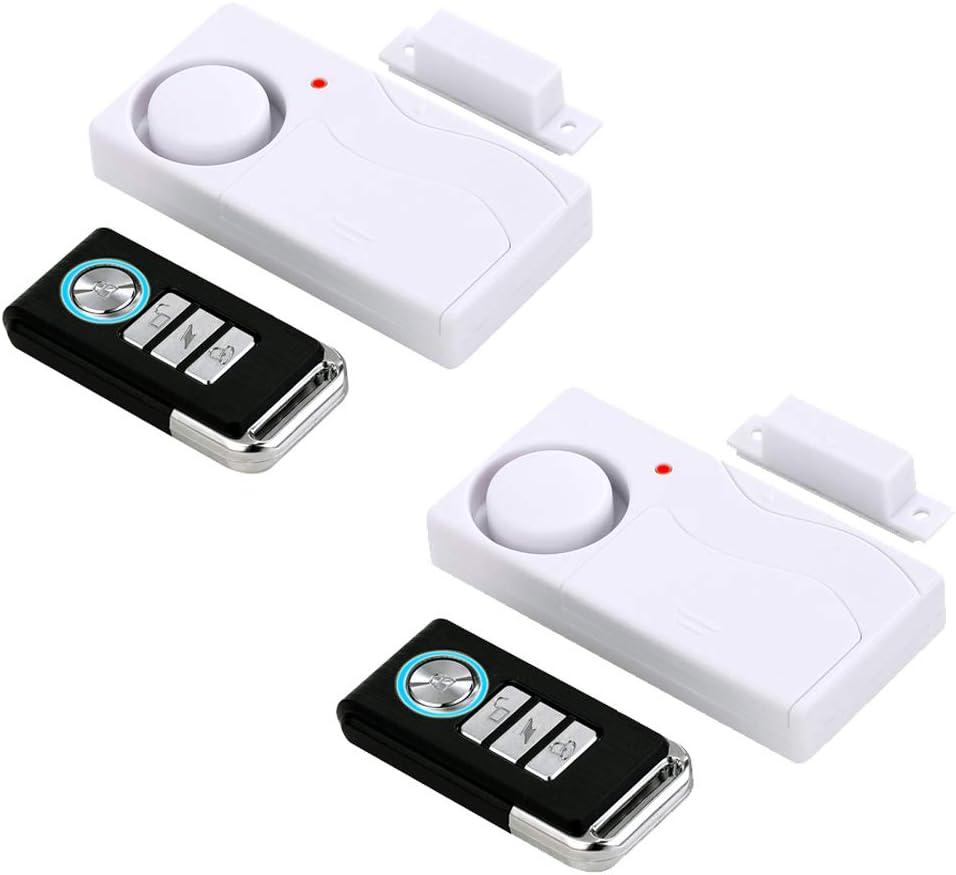
Key specs: Magnetic contact alarm supplied with a remote so it can be disarmed from outside; four adjustable volume levels and chime customization; marketed for pool and gate doors, sliding doors and refrigerators as well as entry doors
This is the different one, and it solves a specific irritation: it comes with a remote so you can disarm it from outside before you open the door. Anyone who has set a door alarm and then triggered it themselves coming home with shopping will see the point. It offers four adjustable volume levels and chime customization, and the manufacturer positions it for pool and gate doors, sliding doors and even refrigerators — the pool gate use is a genuine one, though a certified pool alarm is the right product where child safety is the concern.
✅ Pros
- Remote disarm from outside, unique among these picks
- Four volume levels plus chime customization
- Suits gates and outbuildings as well as windows
- Large review base
❌ Cons
- Two units rather than five or six
- A remote is one more thing to lose or leave inside
- Not a certified pool alarm, despite the marketing
- No stated decibel figure to compare directly
What These Will Not Do
Worth being blunt, because the price makes it tempting to treat these as a security system rather than as one layer of one.
They do not notify you. Nothing is transmitted, so an alarm sounding in an empty house is a noise a neighbor may or may not investigate. They do not record. They do not detect broken glass, only an opening. They do not resist entry at all — the window still opens, loudly. And a determined person who expects an alarm can silence a small adhesive-mounted unit within seconds of getting inside.
Where they genuinely shine is exactly where a system does not fit: rentals, dorms, temporary accommodation, outbuildings without power or network, and households that want awareness rather than monitoring. That overlaps closely with the situations covered in our renter-focused security guide, and for a whole entry door specifically, dedicated door alarms cover more ground than a window unit does.
One use that deserves its own mention: child awareness. A chime on a door a small child might open is a genuinely valuable thing, and it pairs with child safety door locks — the lock delays, the chime tells you. If there is water on the other side of that door, though, a certified pool door alarm is the correct product rather than a generic window alarm. And when you need the device to resist the door as well as announce it — a hotel room, a rental, a bedroom door — a wedge alarm does both jobs at once; our roundup of door stop alarms covers that hybrid.
Final Recommendation
Buy the UltraPro six-pack and fit every ground-floor opening. Six units is the quantity that actually covers a floor, the per-unit off/chime/alarm switch lets you run different behavior on different windows, and the adhesive mounting keeps it viable in a rental.
Choose the Sanjie five-pack instead if any of the units is going somewhere full volume would be intolerable. Adjustable volume is the difference between an alarm that stays armed and one that gets switched off in week two.
Add the Hendun for the one door you keep triggering yourself. Remote disarm is a small feature that solves the single most common reason people abandon door alarms.
What would change our answer: if what you want is to know about an opening while you are out, none of these delivers it, and no amount of loudness changes that. That is a hub-based sensor and a system, and buying six standalone sirens instead will leave you with a house that makes noise at nobody.
SafeBode does not yet run an in-house product testing program. This guide is built from manufacturer specifications, official support documentation, current retail listings and verified buyer feedback rather than hands-on testing, and we say so plainly rather than implying testing we have not done.
Frequently Asked Questions
Do window alarms actually deter burglars?
A sudden 120 dB siren at the point of entry is genuinely unwelcome to someone relying on being quiet, so as a deterrent they have real value. What they cannot do is notify you, record anything, or physically resist entry.
What is the difference between a window alarm and a door sensor?
A standalone window alarm makes the noise itself and needs no hub. A contact sensor reports to an alarm system, which decides what to do — siren, phone notification, monitoring response. The hardware looks the same; the behavior is completely different.
Will a window alarm work if the glass is broken?
No. These detect the window opening, which means the two magnetic halves separating. Someone breaking the glass and climbing through the frame does not trigger one, and glass break sensors exist specifically to cover that.
Can I use these in a rental?
Yes — they mount with adhesive rather than screws, which is the main reason renters buy them. Check the adhesive comes off cleanly on your specific frames before covering the whole apartment.
What is the chime setting for?
It sounds a short tone rather than a siren when something opens or closes, turning the device into an awareness tool instead of a deterrent. In practice most households end up using chime mode on the doors they actually use and alarm mode on the windows they do not.
How many do I need?
Count your ground-floor openings honestly — doors, windows, patio sliders, garage side doors — and cover all of them. An unalarmed window is not partially protected, it is uncovered, so coverage matters far more than the decibel rating.
Do they need WiFi or a subscription?
Neither. They are entirely self-contained: a magnet, a battery and a buzzer. That is the appeal and also the limitation, because nothing is sent anywhere.
How loud is 120 dB?
Loud enough to be heard clearly throughout a house and outside it — personal alarm makers publish audible ranges of several hundred feet for devices at this level. Between 120 and 125 dB the practical difference is small.
Can a burglar just switch it off?
Once inside, yes — these are small adhesive-mounted units with a switch on the side. Their value is in the noise at the moment of entry, not in resisting someone who is already in the room.
Sources
Show sources (5)
- [1] SABRE — Personal alarms and stated audible ranges, www.sabrered.com/personal-alarms
- [2] UltraPro — Personal Security Window and Door Alarm, current retail listing specifications (ASIN B08PCDZTVD)
- [3] Philips — Personal Security Window and Door Alarm, current retail listing specifications (ASIN B08FXX18WZ)
- [4] Sanjie — Door Window Alarm Sensors, current retail listing specifications (ASIN B07GY9YXL2)
- [5] Hendun — Door Alarms with Remote, current retail listing specifications (ASIN B078B7LBSG)


