Best Child Safety Door Locks (2026): Match the Lock to the Door and the Real Risk
Affiliate Disclosure: This article contains affiliate links. If you buy through these links, we may earn a commission at no extra cost to you. Our editorial opinions are our own and are not influenced by affiliate relationships. Read our full disclosure policy →
Contents
Quick Answer
Buy for the door, not the child. A door leading outside – to a pool, a driveway or a garage – needs a latch mounted high and out of reach, which is what the WINONLY top-of-door latch does. Interior doors need something matched to your handle: a lever lock for lever handles, a knob cover for round knobs, or the HugLock if you rent and cannot drill or use adhesive. The American Academy of Pediatrics recommends door locks and doorknob covers specifically to stop a toddler getting outside or into the garage unnoticed.
Start With Which Door, Not Which Lock
The mistake that wastes money here is shopping by product type. Parents buy a multipack of knob covers, fit them to every door in the house, and discover that the one door that actually mattered has a lever handle, or leads to the garage, or is the one a determined three-year-old learns to defeat first.
Doors fall into three groups by consequence, and the third one is not really about childproofing at all – it is about supervision. Sort your doors before you buy anything.
One door type deserves separate mention because none of these products fit it. A sliding patio door – very often the one between a family room and a pool deck – has no knob, no lever and no frame edge to clamp, so every device in this guide is the wrong shape for it. Our guide to securing a sliding glass door covers what actually works there, including the track blocks that are also the cheapest child barrier available for that opening.
Sort your doors first
1
Doors to water or the street
Pool, hot tub, back yard, driveway, garage. Highest consequence. These need a high latch plus an alert, not a knob cover.
2
Doors to hazards inside
Bathrooms, laundry rooms, the room with the cleaning cupboard, stairs. A handle-matched device is the right answer here.
3
Doors you just want closed
Home office, a bedroom during nap time. Lowest consequence – the cheapest device that matches the handle is fine.
The AAP’s guidance is explicit that safety gates, door locks and doorknob covers are for stopping a toddler getting outside or into the garage without you knowing.
Why Height Beats Cleverness
Every childproofing device relies on one of two things: a mechanism a small child cannot operate, or a position a small child cannot reach. Mechanisms get defeated. Height does not get defeated until the child grows, and by then you have had years of warning.
The pediatric guidance on pool fencing makes the same point with a number. The AAP recommends a self-closing, self-latching gate that opens away from the pool, with the latch at least 54 inches from the ground. That figure is not about the strength of the latch – it is about where a child’s hands can reach. The same logic applies to a door: a latch at the top of the frame is beyond a toddler regardless of how simple its mechanism is.
The numbers behind the recommendation
1-4
Age range in which drowning is the leading cause of death
69%%
Share of drownings in children 4 and under during non-swim times
54 in
Minimum latch height the AAP recommends on a pool gate
4 sides
Fencing the AAP recommends around a pool, including temporary ones
The 69%% figure is the important one for door locks specifically: most of these incidents happen when nobody is swimming and nobody expects the child to be near the water.
That 69%% is the whole case for locking the door rather than watching the pool. The risk is not the swim session – it is the ordinary Tuesday afternoon when a door was unlocked for two minutes.
Match the Device to Your Door Hardware
Once you know which doors matter, the choice is mostly mechanical. Lever handles and round knobs need genuinely different devices, and adhesive-mounted products have surface requirements that are easy to miss until the package arrives.
Check these before ordering
Will fit
- Round knobs – use a dual-lock knob cover
- Lever handles – use a lever-specific cover
- Flat, smooth door faces for anything adhesive
- Standard 1-3/8 in interior doors for over-the-top devices
- Frames you are allowed to drill, for a high latch
Will not fit
- Textured or panelled doors, for adhesive products
- Doors with less than 4.5 in of flat surface beside the lever
- Exterior and garage doors, for the snap-on type
- Jambs wider than 1.5 in, for over-the-top devices
- Rentals where you cannot make holes, for screw-mounted latches
The Four Picks Side by Side
| Device | Fits | Mounting | Defeats a child by | Best door |
|---|
| WINONLY Top-of-Door Latch | Any hinged door with a drillable frame | 8 screws, about 5 minutes | Height – it is out of reach | Doors leading outside, to a pool or garage |
| Door Lever Lock, 2 pack | Lever handles with 4.5 in of flat surface | Adhesive | Covering the lever so it cannot be pushed | Interior doors with levers |
| Wappa Baby Knob Cover, 4 pack | Standard round doorknobs | Clips over the knob | A dual release small hands cannot squeeze | Interior doors with round knobs |
| HugLock Snap-On | Interior doors 1-3/8 in thick, jamb under 1.5 in | Slides over the door, no tools or adhesive | Height – fit it as high as you like | Rentals, and doors you cannot modify |
WINONLY Top-of-Door Reinforcement Latch — best for a door to outside
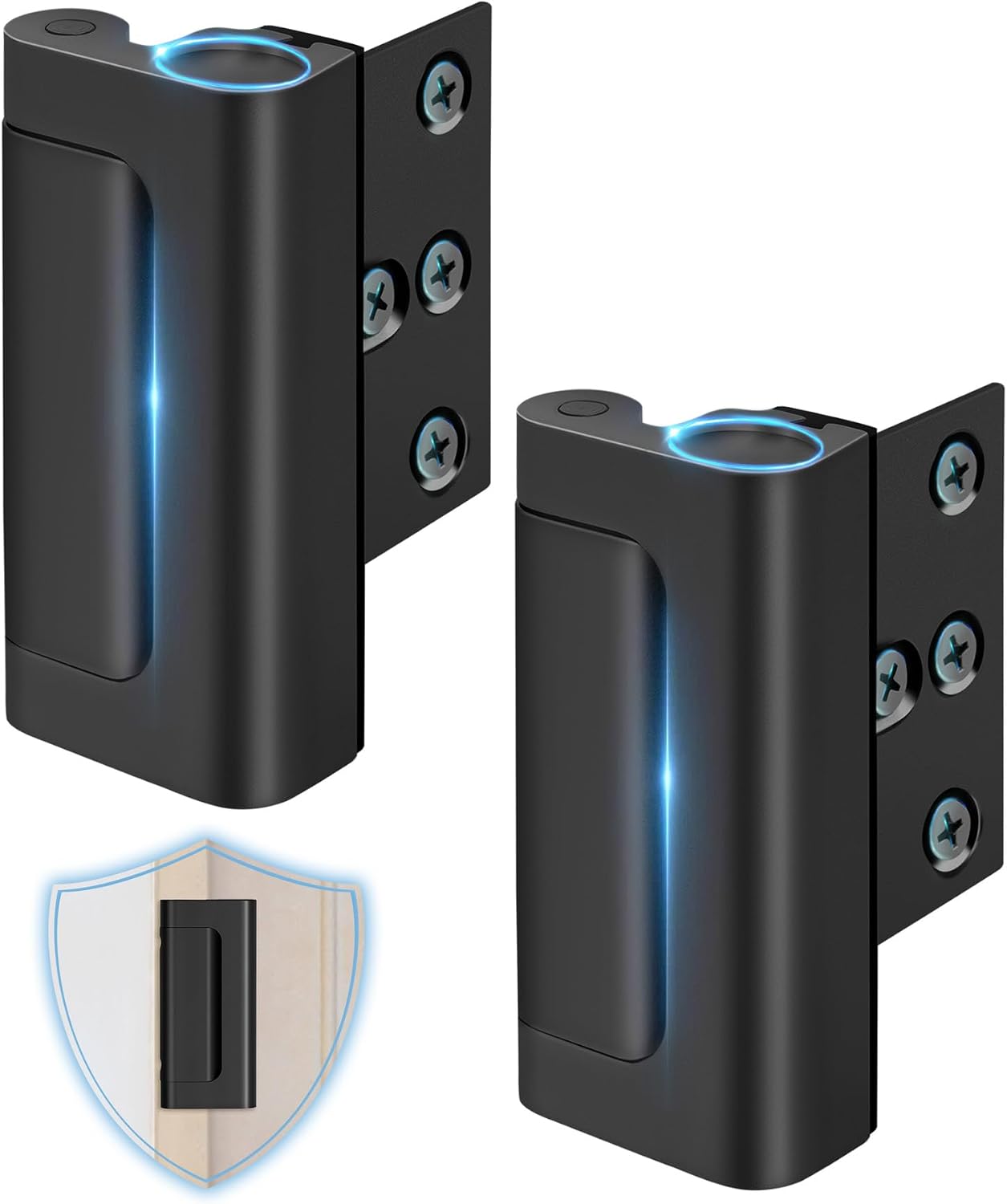
Key specs: 3 in metal reinforcement latch that screws to the door frame, mounted high and out of a child’s reach; ships with 8 screws in two lengths; the manufacturer states it withstands 800 lb of force; installs in about 5 minutes with a drill and screwdriver
This is the one to fit on the door that actually worries you. It is a metal reinforcement latch that screws to the frame, and because you choose the mounting height you can put it well above a child’s reach – the same principle behind the AAP’s 54-inch pool-gate latch recommendation. It ships with eight screws in two lengths so you can bite into the frame properly rather than just the trim, and the manufacturer states it withstands 800 lb of force, which is a security claim rather than a childproofing one but does mean the hardware is not flimsy. Fitting takes about five minutes with a drill. The honest limitation: it makes holes, so it is a poor choice for a rental, and it does nothing to tell you the door was tried.
✅ Pros
- You choose the height, so it is genuinely out of reach
- Metal construction with a stated 800 lb force rating
- Doubles as a real security latch for adults
- Fast to fit with ordinary tools
- Nothing to unstick, unlike adhesive devices
❌ Cons
- Requires drilling – not renter-friendly
- Silent: it blocks the door but does not alert you
- An adult has to remember to set it every time
- Wrong choice for a door you pass through constantly
Door Lever Lock, 2 Pack — best for lever handles
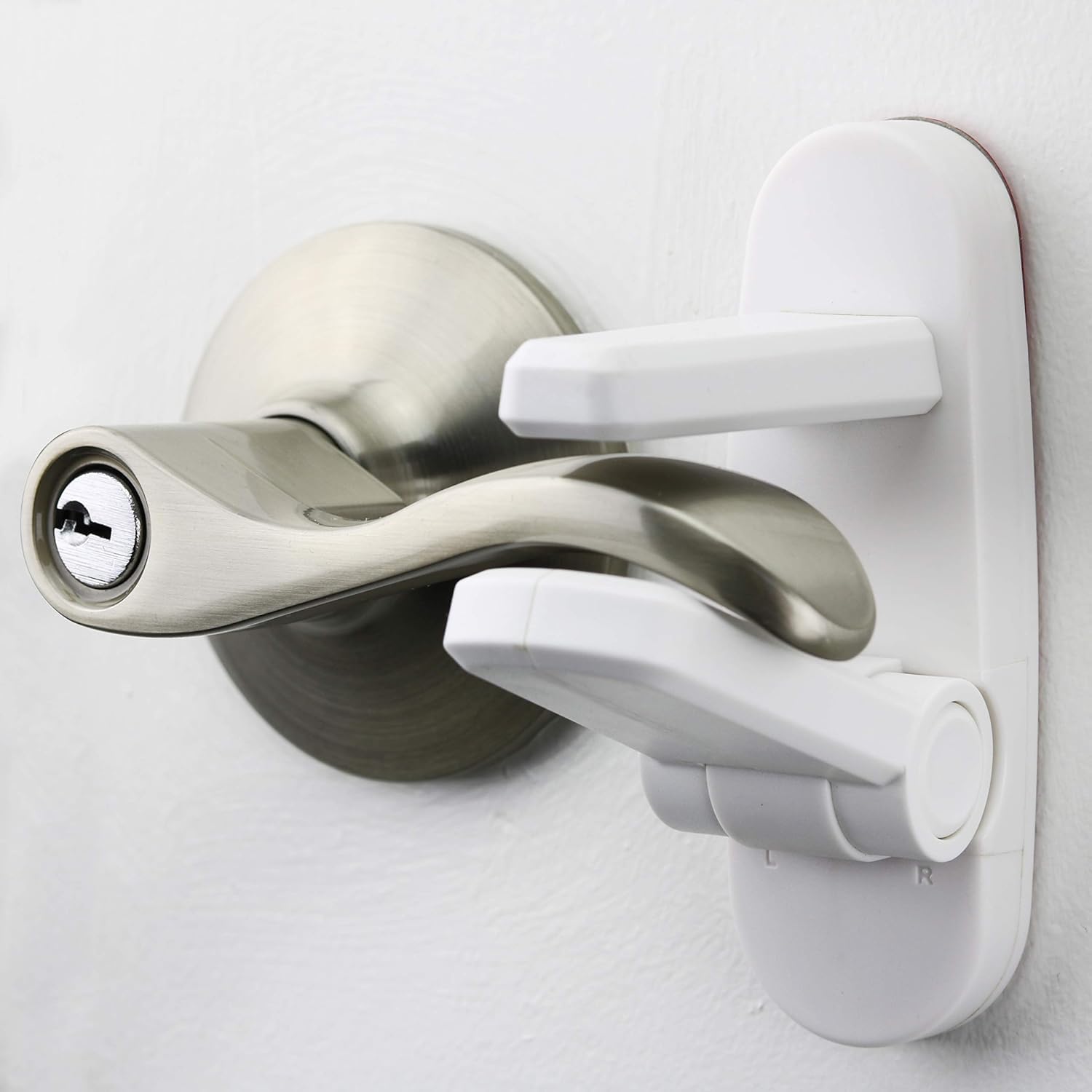
Key specs: Adhesive cover for lever-style handles, 3.25 x 1.5 x 4.5 in; needs at least 4.5 in by 1.5 in of flat surface next to the lever and will not stick to textured doors; once activated it locks the door from both sides, so a caregiver needs access to release it
Lever handles are the hardest common hardware to childproof, because a toddler can open one by leaning on it – no grip strength or twisting required. This cover sits over the lever and removes that option. Read the fit requirements before ordering, because they are specific and the maker states them plainly: you need at least 4.5 inches of height and 1.5 inches of width of flat surface next to the lever, and it will not stick to textured doors, where uneven surfaces stop the adhesive making full contact. One behavior worth knowing in advance: once activated it locks the door from both sides, so an adult needs access to release it – which is a real consideration for a bathroom or any room someone might be inside.
✅ Pros
- Solves the lever problem, which knob covers cannot
- Two per pack, so a pair of doors is covered
- No drilling – suits most rentals
- Clear published dimensions and surface requirements
❌ Cons
- Will not adhere to textured or panelled doors
- Needs 4.5 in by 1.5 in of flat surface next to the lever
- Locks from both sides once activated – think about bathrooms
- Adhesive can lift in humid rooms over time
Wappa Baby Child Safety Door Knob Cover, 4 Pack — best for round knobs
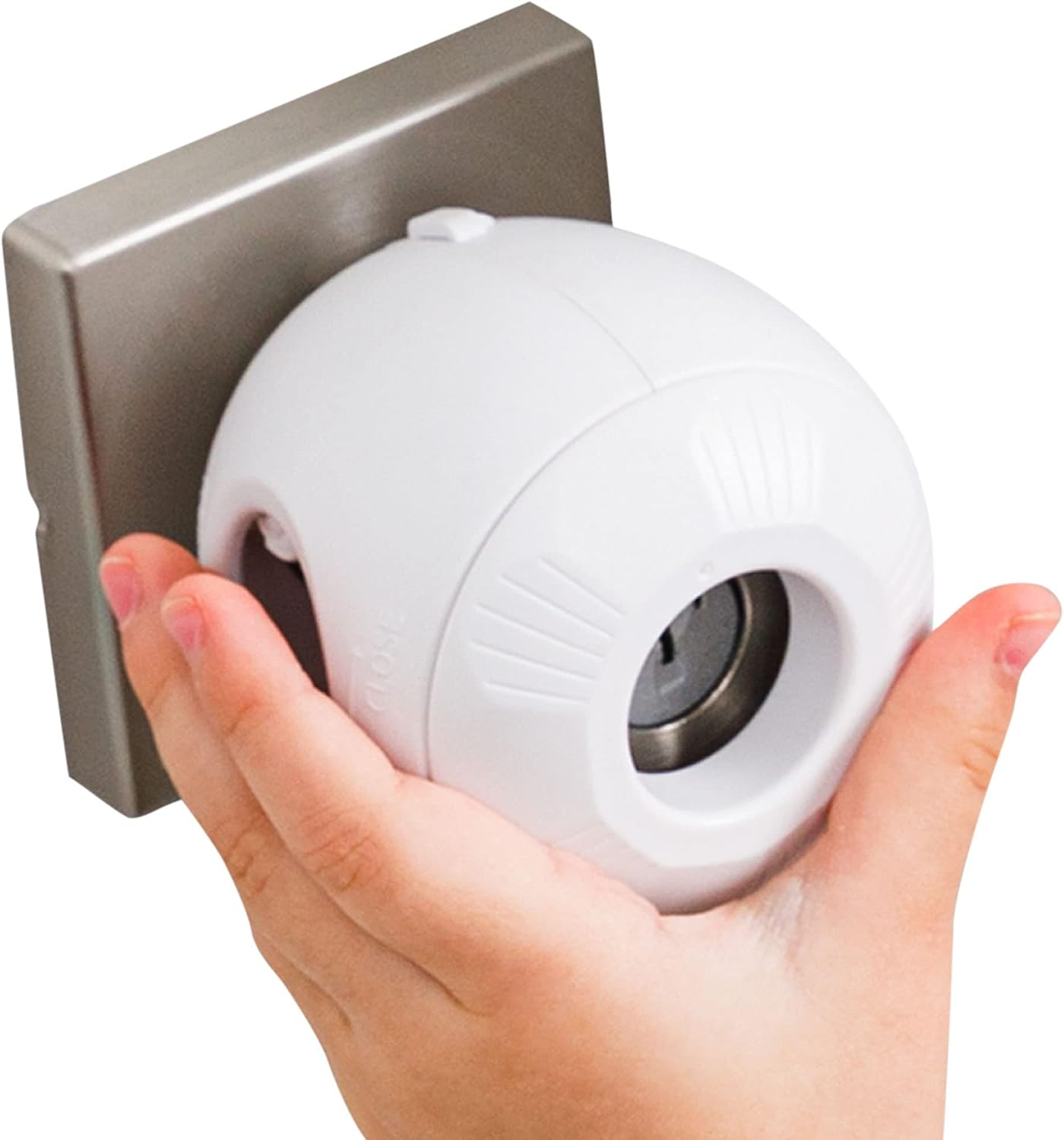
Key specs: Dual-lock knob cover for standard round doorknobs, four per pack; BPA-free plastic; the cover spins freely unless both release points are squeezed at once, which is what puts it beyond small hands
The classic childproofing device, and still the right answer for a house with round doorknobs. The cover clips over the knob and spins freely unless both release points are squeezed at once – the dual-lock design is what separates the ones that work from the ones a determined four-year-old opens in a week. Four per pack means you can do the bathroom, the laundry, the cleaning cupboard and one spare in a single purchase, which lines up with the AAP’s advice to keep harmful items behind a cabinet with a lock or safety latch and to keep bathrooms closed when not in use. The honest weakness is universal to this category: adults with arthritis or reduced hand strength find them genuinely difficult, and that is the same population that may need to get through the door quickly.
✅ Pros
- Dual-lock release is harder to defeat than single-catch designs
- Four per pack covers most of a small home
- No tools, no adhesive, no marks
- BPA-free plastic
- Fits standard round knobs without measuring
❌ Cons
- Useless on lever handles – check your hardware first
- Hard for adults with limited hand strength or arthritis
- Older children work them out eventually
- Plastic can crack if forced repeatedly
HugLock Snap-On Door Lock — best for renters and no tools
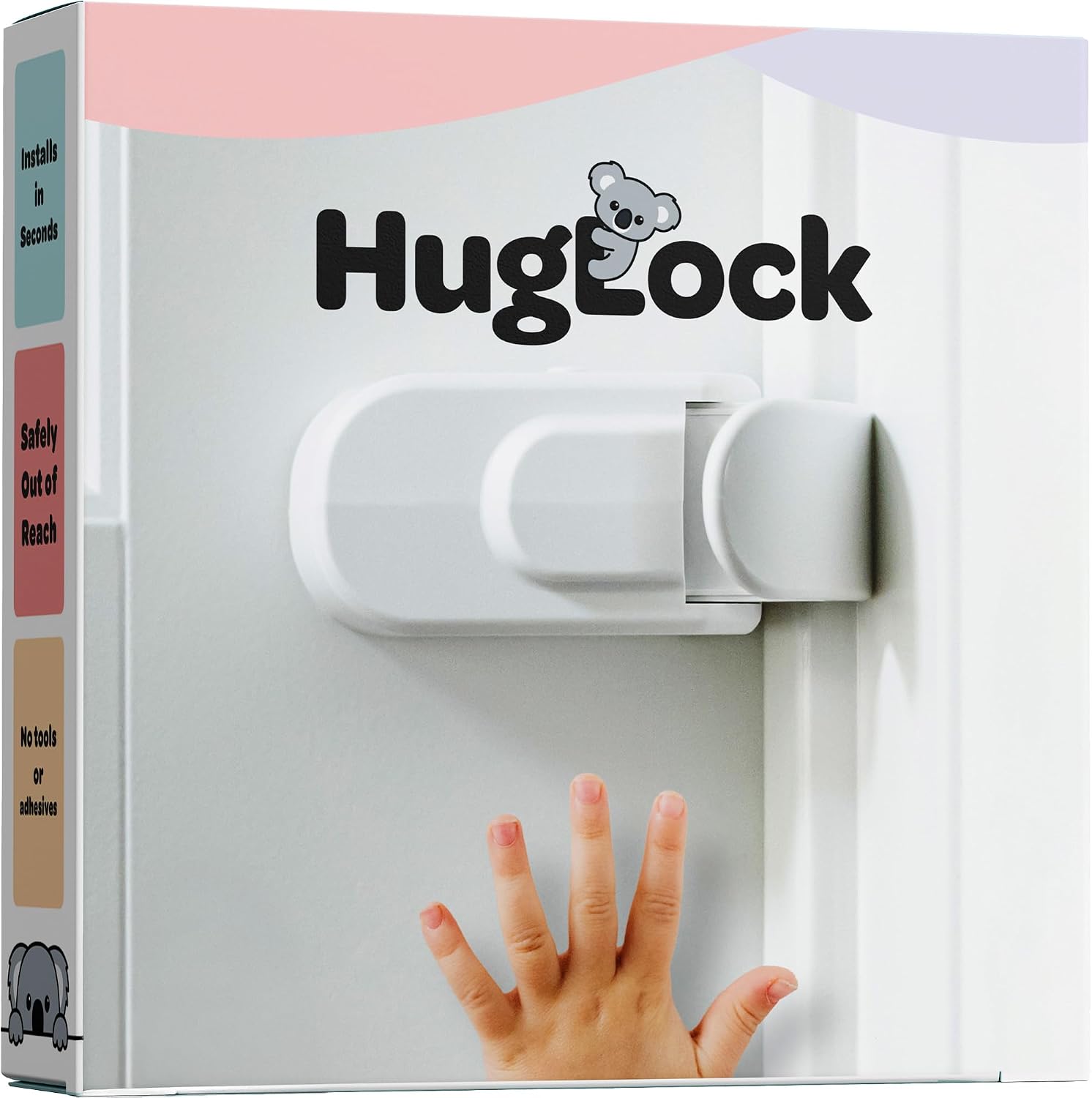
Key specs: Slides over the top edge of an interior door at any height with no tools and no adhesive; fits standard 1-3/8 in interior doors with a jamb under 1.5 in wide; works with round knobs, oval knobs and lever handles; explicitly not for exterior or garage doors
The HugLock takes the height approach without the drill. It slides over the top edge of an interior door at whatever height you choose, using no tools and no adhesive, so there is nothing to damage the door, the frame or the paint – which is the entire argument for it if you rent. It works with round knobs, oval knobs and lever handles alike, because it is not interacting with the handle at all. The compatibility requirements are strict and the maker publishes them: interior doors only, standard 1-3/8 in thickness, and a door jamb narrower than 1.5 in. It is explicitly not for exterior or garage doors – which unfortunately rules it out for the highest-consequence doors in the house.
✅ Pros
- No tools, no adhesive, no damage – built for rentals
- Works with knobs and levers alike
- You choose the height, so it can be out of reach
- Moves between doors in seconds
- Also stops pets opening doors
❌ Cons
- Interior doors only – not exterior or garage
- Needs a 1-3/8 in door and a jamb under 1.5 in
- Easy to remove, so easy to lose
- Does not help on the doors that matter most for drowning risk
One Lock Is Not a Plan
The AAP frames water safety as layers of protection, because no single method prevents all drowning, and notes that barriers exist to cover the brief lapses in supervision that are a normal part of every day. That framing is worth borrowing for the whole house. A door lock is one layer. It is a good one. It is not the plan.
The layer most often missing is knowing the door was opened at all. The AAP’s own list includes door alarms alongside locks, and suggests turning on the audible door alert feature if you already have a home security system. A lock that fails silently leaves you no worse informed than no lock; a chime tells you the moment something changed. We compare the options in our door alarm guide, and our door and window sensor roundup covers the sensor version that reports to a hub.
The AAP’s poison guidance points the same way for interior hazards: keep harmful items out of reach and out of sight, ideally in a cabinet with a lock or safety latch, and store devices containing button-cell batteries where children cannot get them. A door lock on the laundry room is a layer; moving the detergent pods is the other one, and it costs nothing. For the items that genuinely have to stay in the house and out of reach – medication, documents, a firearm – a locked container rather than a locked room is the right answer, and our home safe decision tree walks through the options.
The Fire-Escape Problem You Have to Solve Deliberately
Anything that makes a door harder for a child to open makes it harder for everyone, and that includes during an evacuation. The U.S. Fire Administration warns that residents may have less than two minutes to escape a home fire once the smoke alarm sounds, and its escape-planning guidance says to draw a map including all doors and windows and to make sure doors and windows are not blocked.
Two practical rules follow. Do not fit a childproofing device to the door you would evacuate through, unless every adult in the household can release it in the dark without thinking. And practise it – the USFA’s advice is to run the drill with everyone in the home. A device an adult has to puzzle over is a device that will not be released in the two minutes that matter. If you are also thinking about smoke alarm coverage, our smoke alarm placement guide covers where they belong.
The Same Devices, a Different Household
These products get bought for a second reason that rarely appears in the marketing. The Alzheimer’s Association states that six in ten people living with dementia will wander, that it can happen at any stage, and that everyone living with Alzheimer’s or another dementia is at risk. Adult hands defeat knob covers easily, so the devices that transfer to this use are the height-based ones – the top-of-door latch and the snap-on lock, fitted above eye level.
The association is careful to say that risk-reduction steps cannot guarantee a person living with dementia will not wander, and the same honesty applies here: a latch buys time and makes noise, it does not remove the need for a plan. Pairing one with a door chime rather than a siren is usually the right combination, for the reasons we set out in our door alarm comparison.
What to Actually Do
Fit the WINONLY top-of-door latch on every door leading outside, and match the interior doors to their handles afterwards. That order matters more than the products. The doors to a pool, a driveway or a garage carry the consequences the pediatric guidance is actually written about, and a latch mounted out of reach is the approach that keeps working while a child gets cleverer.
For the rest of the house, buy by hardware: the lever lock if your handles are levers and your doors are smooth enough for the adhesive to hold, the Wappa Baby knob covers if they are round knobs, and the HugLock if you rent or simply refuse to put holes in a door. Then add the layer everybody skips: something that tells you the door opened, which the AAP lists alongside locks rather than as an alternative to them.
What would change this: if you cannot drill – a rental, a lease clause, a landlord – the HugLock becomes the primary pick rather than the fallback, and you should compensate with an alarm on the exterior door it cannot cover. And if the person you are protecting is an adult living with dementia rather than a toddler, skip the knob covers entirely and go straight to a height-mounted latch plus a chime.
SafeBode does not yet run an in-house product testing program. This guide is built from manufacturer specifications, official support documentation, current retail listings and verified buyer feedback rather than hands-on testing, and we say so plainly rather than implying testing we have not done.
Frequently Asked Questions
Which door should I childproof first?
The one that leads outside, to a pool, or into the garage. Pediatric guidance singles out exactly those doors, and most drownings involving young children happen during non-swim times when nobody expected the child to be near water at all.
Do knob covers work on lever handles?
No. A lever can be opened by leaning on it, with no grip or twist needed, so it needs a lever-specific cover. Check your handles before buying anything – this is the single most common wasted purchase in this category.
Will adhesive locks damage or stick to my doors?
They need a genuinely flat, smooth surface. Textured or panelled doors leave gaps that stop the adhesive making full contact, and the lever lock in this guide needs at least 4.5 by 1.5 inches of flat area beside the handle.
How high should I mount a door latch?
High enough to be out of reach, and use the pool-gate benchmark as your guide – pediatric guidance puts a self-latching pool gate’s latch at least 54 inches from the ground. On a door, near the top of the frame is simplest.
Are these safe if there is a fire?
Only if every adult can release them instantly in the dark. Fire safety guidance is that residents may have under two minutes to escape and that doors must not be blocked, so do not fit one to your main escape route unless you have practised releasing it.
At what age do children defeat these?
It varies, but mechanism-based devices – knob covers, lever covers – are defeated years before height-based ones. If a child is getting past a cover, move to a latch mounted above their reach rather than buying a cleverer mechanism.
Can I use these for a relative with dementia?
The height-based ones, yes. Knob and lever covers are trivial for an adult to remove. Bear in mind that the Alzheimer’s Association is clear no measure guarantees someone will not wander, so treat a latch as one part of a plan rather than the whole of it.
Do I need a door alarm as well as a lock?
It is the layer most people skip and the one that changes the outcome most. A lock that gets left unset fails silently; a chime tells you the door opened either way. Pediatric guidance lists door alarms alongside locks rather than as an alternative.
Sources
Show sources (4)


