Best Door Alarms 2026: Chime, Siren or Wedge, and Which Problem You Are Solving
Affiliate Disclosure: This article contains affiliate links. If you buy through these links, we may earn a commission at no extra cost to you. Our editorial opinions are our own and are not influenced by affiliate relationships. Read our full disclosure policy →
Contents
Quick Answer
“Door alarm” covers three unrelated devices. A chime tells you a door opened. A siren tries to scare whoever opened it. A wedge does both while physically resisting the door. Decide which of those you want before you shop, because the wrong one is useless rather than merely worse. For most households the honest answer is a chime – the Daytech Wireless Door Chime – because knowing is what you actually needed. Buy the Sanjie contact alarms if you want every door and window covered rather than one.
Three Different Devices Sold Under One Name
Search for a door alarm and you get results that share a category label and nothing else. It is worth separating them before comparing anything, because they answer different questions and the reviews are not transferable.
The three shapes this product takes
1
Contact chime
A magnet on the door, a sensor on the frame, and a receiver elsewhere in the house. Separating them plays a tone. Its job is information, not deterrence.
2
Contact alarm
The same magnetic trigger wired to a loud siren instead of a pleasant tone. Its job is to startle whoever opened the door and alert everyone nearby.
3
Wedge alarm
A door stop with a siren inside. The door pushing against it sets it off, and the wedge itself resists the door opening further.
Some products switch between chime and alarm modes, which is the most flexible shape and worth preferring where the price is similar.
The distinction that actually matters is chime versus siren. A chime is a monitoring tool you will leave on permanently, because a pleasant tone twelve times a day is livable. A 125 dB siren is an event – you arm it at night or when you leave, and if it goes off while you are cooking you will disable it and never turn it back on. Devices that offer both modes exist precisely because most households need one of each at different times.
Which Problem Are You Actually Solving?
Match the device to the actual worry
You want to know
- A child is opening the back door
- A relative with dementia may leave at night
- Customers are walking into the shop
- Somebody came home while you were upstairs
- The garage door to the house was opened
You want to deter or wake
- You are alone in an unfamiliar room and want to be woken
- A door is out of earshot and you need the alert to carry
- You want an intruder to leave rather than continue
- You want a layer on a door that has no other protection
- You are covering a vacant property or a storage room
Most people shopping for a door alarm are in the left column and buy from the right one. That mismatch is why so many of these end up in a drawer. If your actual requirement is “tell me when this door opens,” a chime with adjustable volume is the product, and its loudness rating is close to irrelevant.
About Those 125 dB Claims
Every listing in this category leads with a decibel figure, and the numbers involved are genuinely high. This is worth a sentence of context that no product page provides. The National Institute on Deafness and Other Communication Disorders notes that sounds at or below 70 A-weighted decibels are unlikely to cause hearing loss even after long exposure, while long or repeated exposure at or above 85 dBA can cause it – and the louder the sound, the shorter the time it takes.
Where these alarms sit on the scale
70 dBA
Below this, prolonged exposure is unlikely to damage hearing
85 dBA
At or above this, long or repeated exposure can cause hearing loss
110 dB
Top volume on the chime picks in this guide
125 dB
Top mode on the contact alarm pick
NIDCD also notes that distance from the source and length of exposure both matter. A siren at arm’s length is a different exposure from the same siren down a hallway.
The practical implication is not that these products are dangerous – a brief alarm is not an occupational exposure. It is that mounting a 125 dB siren at head height next to where someone sleeps, or where a small child will be standing when it triggers, is a decision worth making deliberately rather than by accident. Mount loud alarms high and away from where people stand, and use the chime modes for doors that trigger routinely.
The Four Picks Side by Side
| Device | Type | Loudness | Power | Best at |
|---|
| Daytech Wireless Door Chime | Contact chime with receiver | Mute to 110 dB, 5 levels | Battery sensor, plug-in receiver | Knowing, without annoying the household |
| EMDMAK Door Stop Alarm | Wedge with siren | 120 dB, 3 sensitivities | One 9V, about a year | A room you are currently in |
| Sanjie Contact Alarms, 5 pack | Magnetic contact alarm | 125 dB / 100 dB alarm, or 100 dB chime | Batteries, per unit | Covering every door and window at once |
| SanJie Door Chime Alarm | Contact chime with receiver | Mute to 110 dB, 26 tones | Battery sensor, plug-in receiver | Toddlers and dementia-related wandering |
Daytech Wireless Door Chime — best for knowing a door opened
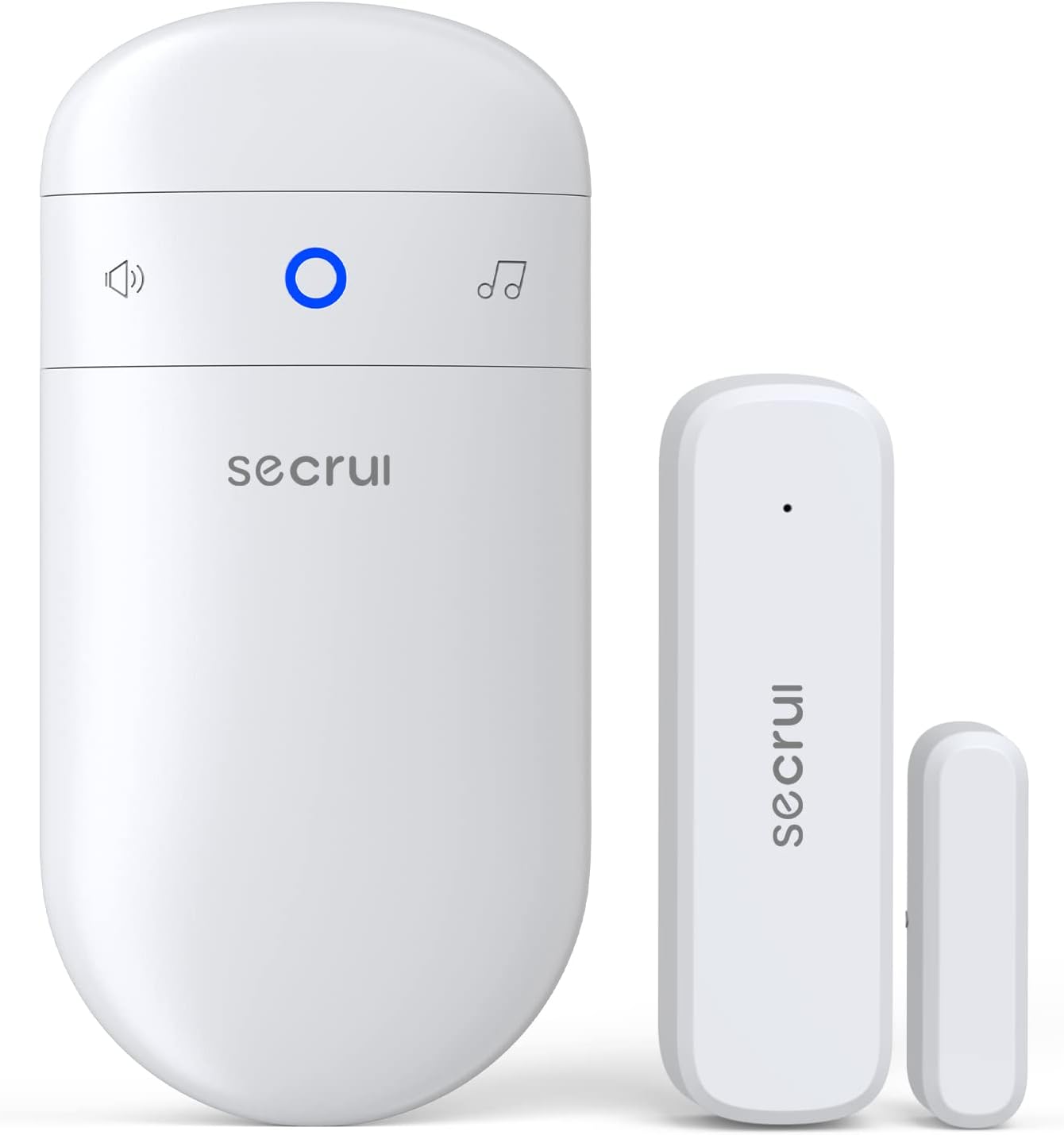
Key specs: Sensor-and-receiver door chime; 58 melodies and 5 volume levels from mute to 110 dB; colored LED indicator that still signals at 0 dB so it works silently; pre-paired out of the box; mounts with 3M tape or screws
This is the one most people should buy, and the reason is the LED. The sensor mounts on the door with tape or screws, the receiver plugs in anywhere within range, and the pairing is done out of the box. It offers 58 melodies and five volume levels running from mute to 110 dB – and critically, the colored LED indicator still signals at 0 dB. That means you can run it silently overnight and still see, from across a room, that the back door opened. For a family monitoring a door that opens ten times a day, a device you can mute without turning off is the difference between a tool you keep and one you unplug in week two.
✅ Pros
- Works silently via LED at 0 dB volume
- Five volume levels up to 110 dB when you want sound
- Pre-paired, so setup is genuinely minutes
- Tape or screw mounting suits renters
- Very large review base for the category
❌ Cons
- A chime, not a deterrent – it will not scare anyone off
- Receiver needs a mains outlet within range
- 58 melodies is 55 more than anyone needs
- Range depends on your walls, as with any 433 MHz device
EMDMAK Door Stop Alarm — best for a room you are in
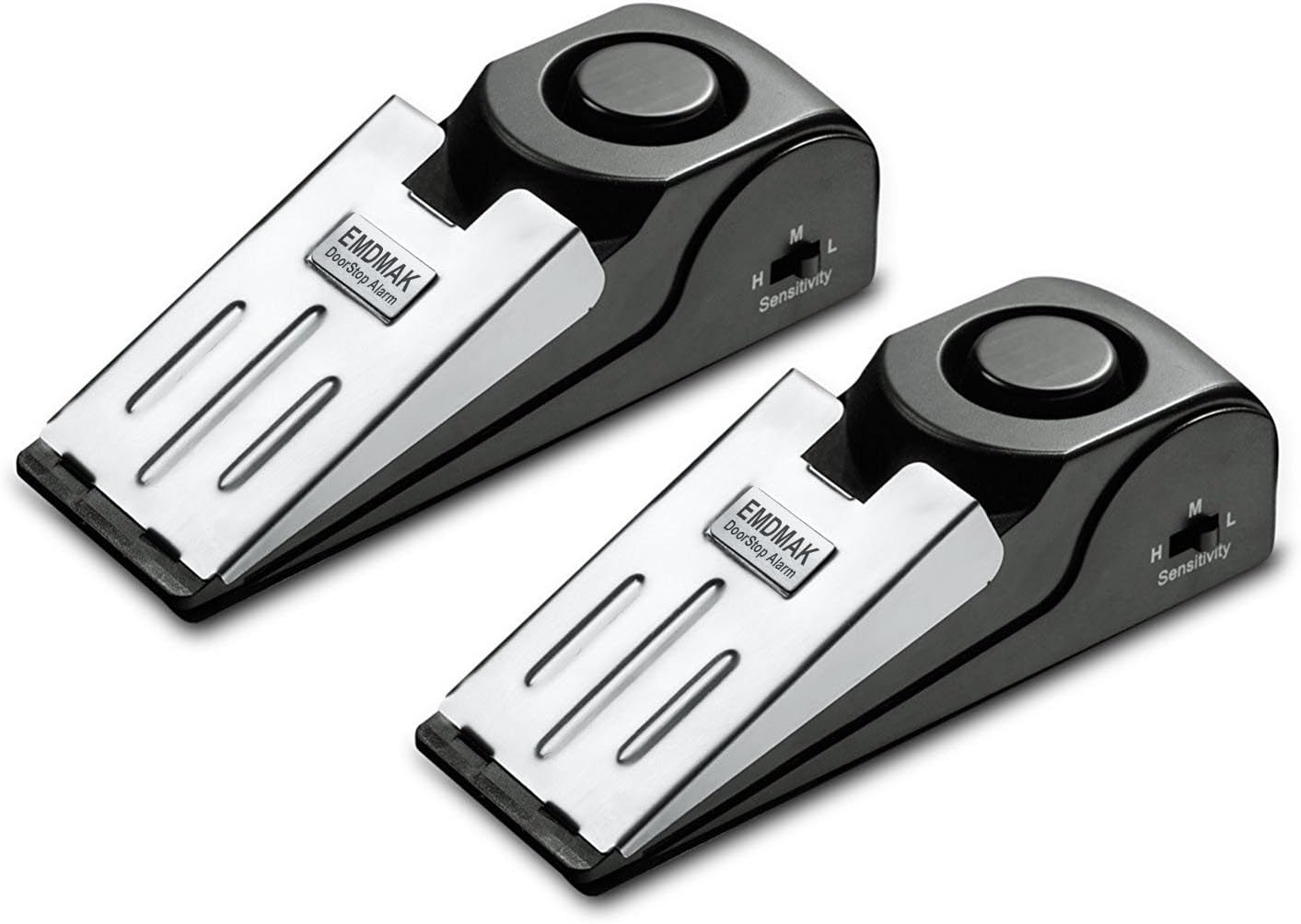
Key specs: Wedge-style door stop with a 120 dB alarm triggered by the door moving against it; three sensitivity levels; rubberized base doubles as a physical door stop; fits floor clearances of 0.6 in and 1.2 in; runs about a year on one 9V battery, not included; 4.5 oz
The wedge is the right shape for exactly one situation: you are inside a room, you want to know immediately if the door moves, and you want the door itself resisted while that happens. It sits under an inward-opening door on a rubberized base, and the door pushing against it fires a 120 dB alarm with three selectable sensitivities. There is nothing to install and nothing to pair, and one 9V runs it for around a year. It is genuinely useful for hotel rooms, dorms, and anyone sleeping alone in an unfamiliar place – the same use case as a portable door lock, with noise instead of steel. It is a poor choice for unattended monitoring, because it only helps if you are there to hear it.
✅ Pros
- No installation, no pairing, works anywhere with a hard floor
- Doubles as a physical door stop resisting the door
- Three sensitivity levels to cut false triggers
- One 9V lasts roughly a year
- Light enough to pack at 4.5 oz
❌ Cons
- Only works on inward-opening doors with the right floor clearance
- Useless if nobody is home to hear it
- Battery not included
- Needs a hard floor – deep carpet undermines the wedge
Sanjie Door and Window Alarm Sensors, 5 Pack — best for covering a whole house
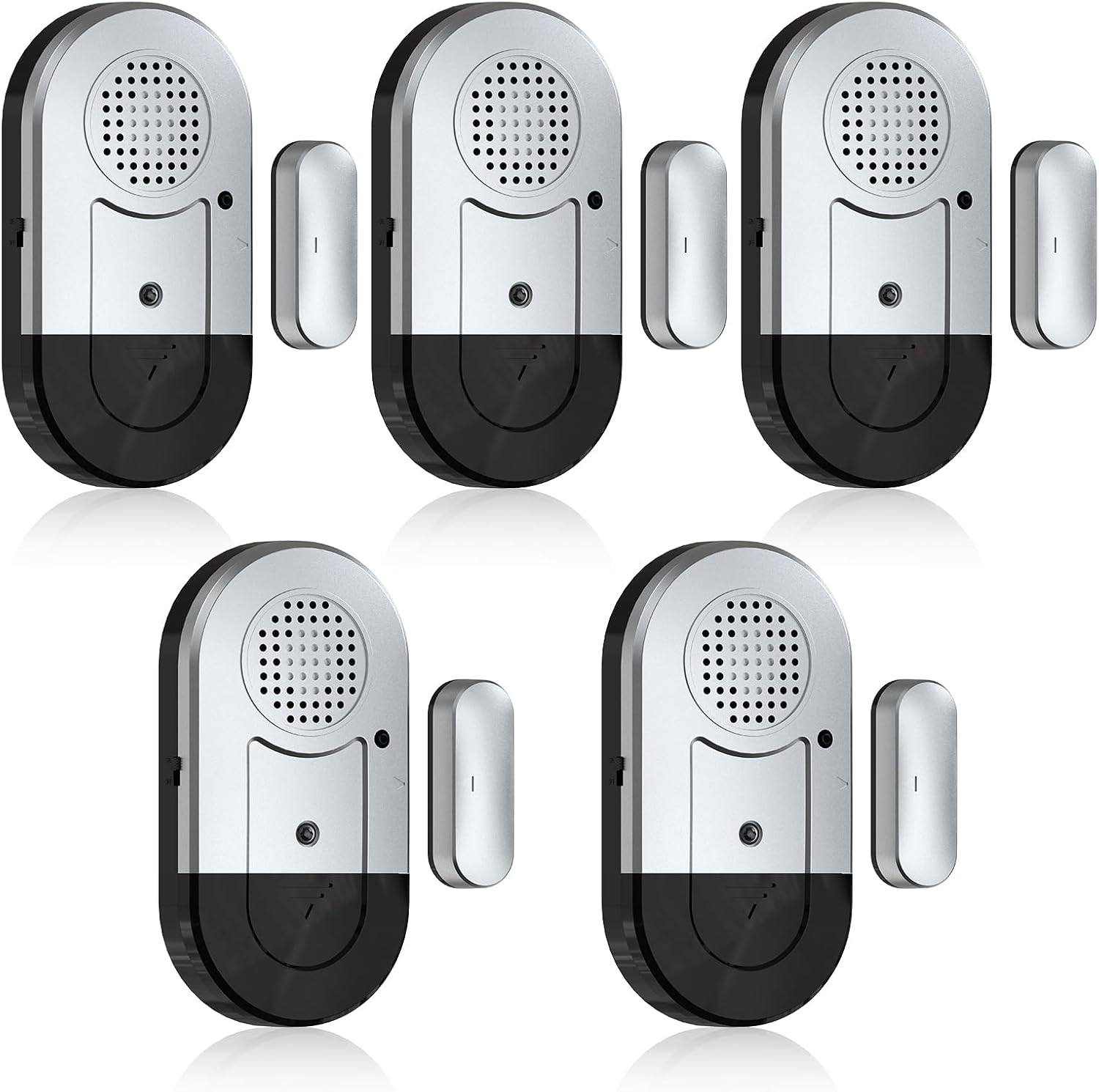
Key specs: Magnetic contact alarms that sound when the two halves separate; three modes – 125 dB alarm, 100 dB alarm and a 100 dB two-tone chime; sounds continuously for 31 seconds and does not stop until the door or window is closed; 3M tape mounting; five units per pack
Five sensors in a pack changes what you can do. Instead of protecting one door, you cover the back door, the patio slider, the garage entry and two ground-floor windows for the cost of one smarter device. Each unit is a self-contained magnetic pair with three modes – 125 dB alarm, 100 dB alarm, or a 100 dB two-tone chime – so you can run chimes on doors that open all day and full alarms on the ones that never should. The detail worth knowing is the behavior: it sounds continuously for 31 seconds and will not stop until the door or window is actually closed, which is what makes it a deterrent rather than a beep. The tradeoff is that each unit is standalone – there is no panel, no app, and no way to know which one went off except by walking to it.
✅ Pros
- Five units cover a whole ground floor
- Switchable between 125 dB alarm, 100 dB alarm and chime
- Runs for 31 seconds and will not stop until the door is shut
- Adhesive mounting, no wiring, renter-friendly
- Works on windows, cabinets and drawers too
❌ Cons
- No panel or app – you cannot tell which unit triggered remotely
- 125 dB at close range is genuinely loud, so mount thoughtfully
- Batteries in five separate devices to keep track of
- Adhesive can fail on textured or cold surfaces
SanJie Door Chime Alarm for Kids Safety — best for wandering and elopement
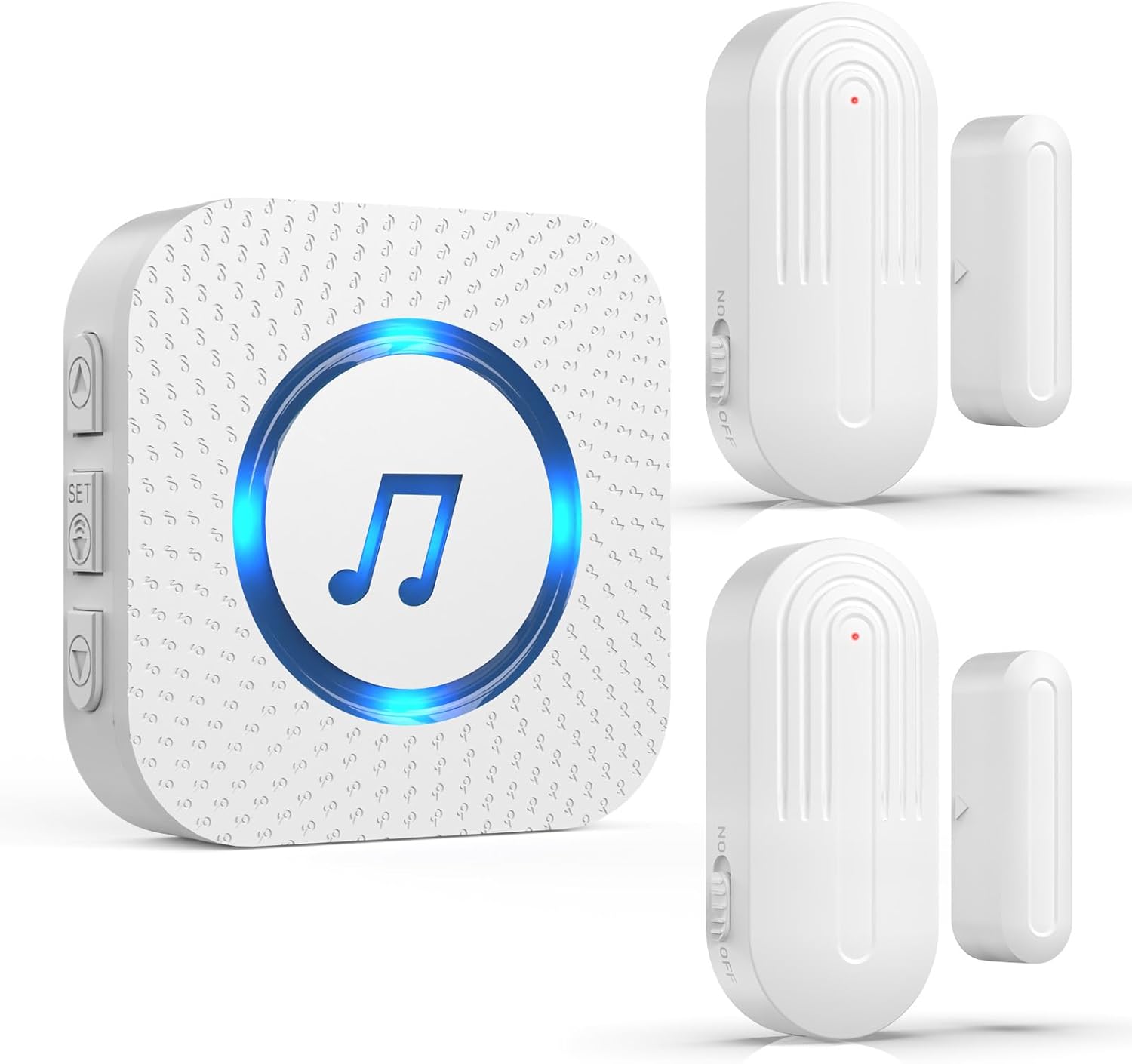
Key specs: Wireless chime marketed specifically for households with a toddler or a relative living with dementia; 26 tones with 5 volume levels from mute to 110 dB; LED indicators and a memory function that keeps your tone after the receiver is unplugged; plug-in receiver, adhesive sensor
This is the same category of device as the first pick, marketed honestly at the use case that most needs it: the listing leads with toddlers sneaking out of a bedroom and relatives living with dementia trying to leave the house. It offers 26 tones across five volume levels from mute to 110 dB, LED indicators, and a memory function that keeps your chosen tone when the receiver is unplugged and plugged back in – a small thing that matters when the receiver moves between rooms. Choose a distinctive tone you use nowhere else, so the sound means one thing.
✅ Pros
- Explicitly designed around the wandering use case
- Memory function survives unplugging the receiver
- Mute-to-110 dB range with LED indication
- 26 tones make it easy to pick a distinct sound
- Adhesive sensor, plug-in receiver, no wiring
❌ Cons
- Alerts, but does nothing to slow the door
- Not a substitute for a supervised care plan
- Receiver must stay within radio range of the sensor
- A determined person can remove the adhesive sensor
The Use Case That Matters Most and Gets Written About Least
Most coverage of door alarms is about burglars. The larger real-world use is people leaving who should not, and the numbers are not small: the Alzheimer’s Association states that six in ten people living with dementia will wander, that it can happen at any stage, and that everyone living with Alzheimer’s or another dementia is at risk.
A door chime is a genuinely good fit for that problem, and a loud siren usually is not. A 125 dB alarm aimed at someone who is confused and frightened makes the situation worse; a distinctive tone that alerts a caregiver in another room does the job without escalating. The Alzheimer’s Association is also clear about the limits, noting that risk-reduction steps cannot guarantee a person living with dementia will not wander. Treat a door chime as one layer of a plan rather than the plan.
The same logic applies to households with a small child and a door to a pool, a road or a garage. The device you want is the one you will leave switched on for years, which means the one whose alert you can live with. If you want the same alert to reach your phone rather than a plug-in receiver, our guide to wireless door and window sensors covers the hub-connected version of this idea.
What a Door Alarm Does Not Do
None of these devices resists entry. A contact alarm sounds after the door is already open, and a wedge slows a door rather than locking it. The barrier layer is the lock and the frame, and BHMA is explicit that residential hardware without its Secure Home certification has not been assured of third-party testing for security, durability and finish. If the door itself is the weak point, an alarm is the wrong purchase – start with a proper deadbolt.
They also do nothing for a door that is not the problem. If the entry you are worried about is a slider or a patio door, the failure mode is the latch rather than the alert, and our sliding glass door guide covers what actually helps there.
None of them notify you when you are out, either. There is no app, no cellular backup and no monitoring center. If somebody opens the door while you are at work, a 125 dB siren sounds in an empty house. Whether that matters depends entirely on which problem you were solving, and it is why a monitored system is a different product rather than a more expensive one – we cover that distinction in our piece on what monitoring actually gets you.
For scale on the underlying risk, the Bureau of Justice Statistics recorded household burglary rates falling 56% between 1994 and 2011, from 63.4 to 27.6 victimizations per 1,000 households. That figure is over a decade old now, so treat it as direction rather than a current rate. If you want a system that actually reports to you rather than shouting into an empty room, our DIY alarm system roundup is the more useful starting point.
Final Recommendation
Buy the Daytech Wireless Door Chime. Most people shopping for a door alarm want to know a door opened, not to frighten someone, and this is the device that does that well enough to stay switched on. The LED that still signals at zero volume is the specific reason it beats the alternatives: you can run it silently and still get the alert, which is what keeps it plugged in after the novelty wears off.
Choose the Sanjie five-pack instead if the goal is coverage rather than one door – five switchable chime-or-alarm units across a ground floor is more security per dollar than any single device here, as long as you accept there is no panel telling you which one fired. Take the EMDMAK wedge for travel and for any room where you are sleeping and want both a noise and a physical obstruction. Buy the SanJie chime when the person you are monitoring is a toddler or a relative living with dementia, where a distinctive tone is the right alert and a siren is the wrong one.
What would change this recommendation: if you need to be told while you are out of the house, none of these do that, and no combination of them adds up to it. That is a connected sensor on a hub, not a door alarm, and buying three of these first is the most common way people spend more to get less.
SafeBode does not yet run an in-house product testing program. This guide is built from manufacturer specifications, official support documentation, current retail listings and verified buyer feedback rather than hands-on testing, and we say so plainly rather than implying testing we have not done.
Frequently Asked Questions
What is the difference between a door alarm and a door chime?
A chime plays a tone so you know a door opened; an alarm sounds a siren intended to startle and deter. Some devices switch between the two modes. Chimes get left switched on because they are livable; sirens tend to get disabled after a few false triggers.
Will a door alarm notify my phone?
None of the devices in this guide do. They are self-contained radio pairs with a local receiver, with no app, no internet connection and no monitoring service. If a phone alert is the requirement, you need a hub-based sensor rather than a standalone door alarm.
Are 125 decibel alarms safe to use at home?
A brief alarm is not an occupational noise exposure, but the level is high enough to be worth placing thoughtfully. NIH guidance is that long or repeated exposure at or above 85 dBA can cause hearing loss, and that both distance and duration matter, so mount loud alarms away from where people stand or sleep.
Do these work on windows as well as doors?
The magnetic contact type does – it triggers when the two halves separate, which works on windows, cabinets, drawers and sliding doors. Wedge alarms need a door and a hard floor, so they are door-only.
Will a door alarm stop a burglar getting in?
No. Every device here reacts after the door has already opened, or slows it at best. The part that resists entry is the lock and the door frame. An alarm is a detection layer sitting on top of that, not a replacement for it.
Can I use one for a relative with dementia?
Yes, and it is one of the strongest uses for a chime specifically. The Alzheimer’s Association reports that six in ten people living with dementia will wander. Use a distinctive tone rather than a siren, and treat it as one layer of a plan – the association is explicit that no step guarantees someone will not wander.
How long do the batteries last?
The wedge alarm’s maker states about a year on one 9V under normal use. Contact sensors vary with how often the door opens, since each trigger costs power. The practical advice is to test each unit on a fixed schedule, because a silent alarm and a working one look identical.
Do adhesive-mounted sensors stay put?
Usually, on clean, smooth, room-temperature surfaces. They fail on textured paint, dusty frames and in cold garages. Clean the surface first, and on an exterior-facing door use screws if the product allows it.
Sources
Show sources (4)


