Best Door Stop Alarms 2026: The Cheapest Real Security Upgrade
Affiliate Disclosure: This article contains affiliate links. If you buy through these links, we may earn a commission at no extra cost to you. Our editorial opinions are our own and are not influenced by affiliate relationships. Read our full disclosure policy →
Contents
Quick Answer
Buy the SABRE wedge alarm. It is the one with a real brand behind it, a 120 dB siren the manufacturer states carries up to 1,500 feet, and a non-skid pad that resists the door opening rather than just announcing that it did. Before you order anything, though, measure the gap between the bottom of your door and the floor — every product in this category has a clearance range it needs, and buying one that does not fit your door is the most common way this purchase gets wasted.
It Resists and It Screams — That Combination Is the Point
A door stop alarm is a plastic wedge you kick under a closed door. When the door is pushed, two things happen at once: the wedge jams against the floor and physically resists the door opening, and a pressure switch fires a siren.
That pairing is what makes the category worth writing about, because the two halves cover each other’s weakness. A wedge alone can be forced past with enough shoving and gives you no warning. An alarm alone tells you someone is coming through a door that is still opening normally. Together they buy the one thing that actually matters when someone is trying to get into a room you are in: seconds, plus noise.
The Two Halves, and What Each Buys
🔒 The wedge
- Physically resists the door opening
- Non-skid pad is the part that does the work
- Needs no installation, no screws, no landlord permission
- Works on any door that opens inward over a floor it can bite into
🔊 The alarm
- 120 dB triggered by pressure on the door
- Manufacturer states audibility up to 1,500 feet
- Wakes you, and may alert neighbors
- Turns a quiet forced entry into a public one
Compare that with a conventional door alarm, which reports an opening and does nothing to slow it, or a door security bar, which resists strongly and makes no noise. The wedge alarm is the cheap middle: less resistance than a bar, less coverage than a monitored sensor, but the only one of the three that does both jobs at once for the price of a takeaway meal.
Measure the Gap Before You Buy Anything
This is the single most useful thing in this article and it is almost never mentioned in reviews. A wedge alarm only works if it fits into the gap under your door — too much clearance and it sits loose without engaging, too little and it will not slide under at all.
The manufacturers state their ranges, and they differ. SABRE specifies a 7/8 inch gap between the floor and the bottom of the door. EMDMAK’s is stated from around 0.6 inches. The HNHMT set’s alarm requires a gap between 0.2 and 1.38 inches, and its documentation says plainly that outside that range the alarm may not work properly.
The Numbers That Decide Whether It Works
7/8 in
gap the SABRE is designed for
0.6 in+
clearance stated for the EMDMAK
0.2–1.38
inch range for the HNHMT alarm
Inward
the only door swing any wedge works on
Take one measurement with a ruler before ordering — it decides everything.
Two further constraints are worth checking at the same time. Door swing: a wedge only works on a door that opens inward, toward you. On an outward-opening door it does nothing at all, which is a common disappointment on some apartment and hotel doors. Floor surface: the non-skid pad needs something to grip. Hard flooring is ideal; deep pile carpet lets the whole wedge slide, and a polished floor with a rug edge can be worse than either.
The Three Picks Side by Side
Three picks rather than four, deliberately. This category is largely white-labeled — search it and you will find many near-identical 120 dB wedges under unfamiliar names. Adding a fourth interchangeable one would pad the article without giving you a real choice.
SABRE Wedge Door Stop Security Alarm — the one to buy
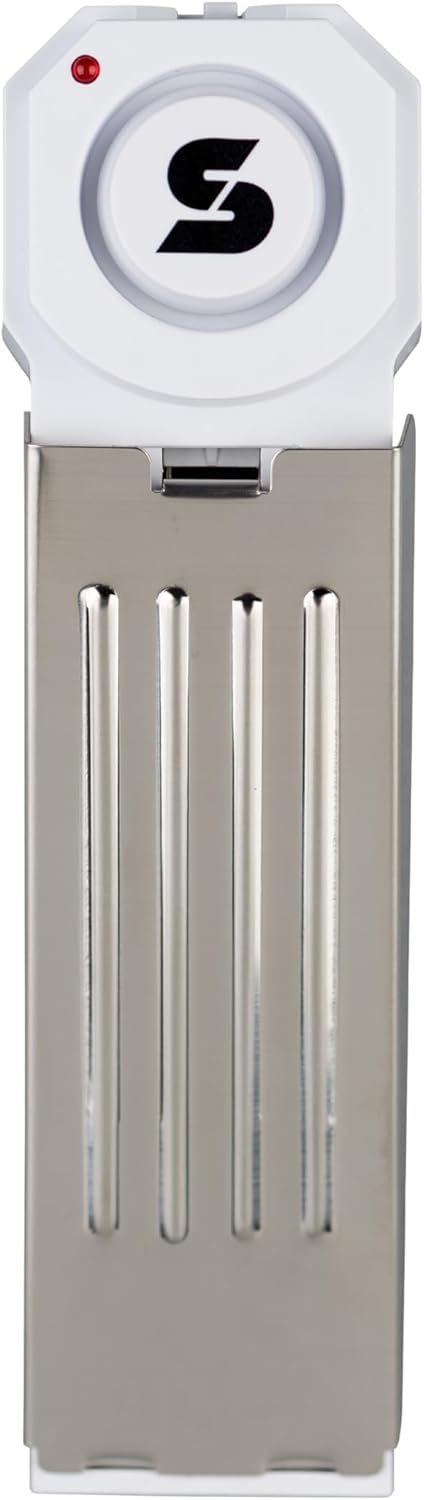
Key specs: 120 dB alarm triggered when pressure is applied to the door; manufacturer states it is audible up to 1,500 feet away; non-skid pad resists the door opening while the alarm sounds; designed for a 7/8 inch gap between the floor and the bottom of the door
SABRE is a genuine personal-security brand rather than a marketplace label, and in a category this commoditized that is most of the argument. The specification that matters beyond the siren is the non-skid pad, which is explicitly described as preventing the door from opening while the alarm sounds — the resistance half of the product, and the half cheap versions skimp on. The stated audible range of up to 1,500 feet is consistent with the ranges SABRE publishes across its wider alarm range, and it matters because the point is not only to wake you but to make the situation public. It is designed around a 7/8 inch floor gap, so measure first.
✅ Pros
- Established security brand rather than an anonymous label
- Non-skid pad genuinely resists the door opening
- 120 dB stated audible up to 1,500 feet
- No installation, so it works for renters and travelers
- Large review base for this category
❌ Cons
- Needs a 7/8 inch floor gap — measure before ordering
- Inward-opening doors only, like every wedge
- Loses grip on deep carpet
- Protects one door; a second door needs a second unit
EMDMAK Door Stop Alarm (2 Pack) — two doors, cheaper
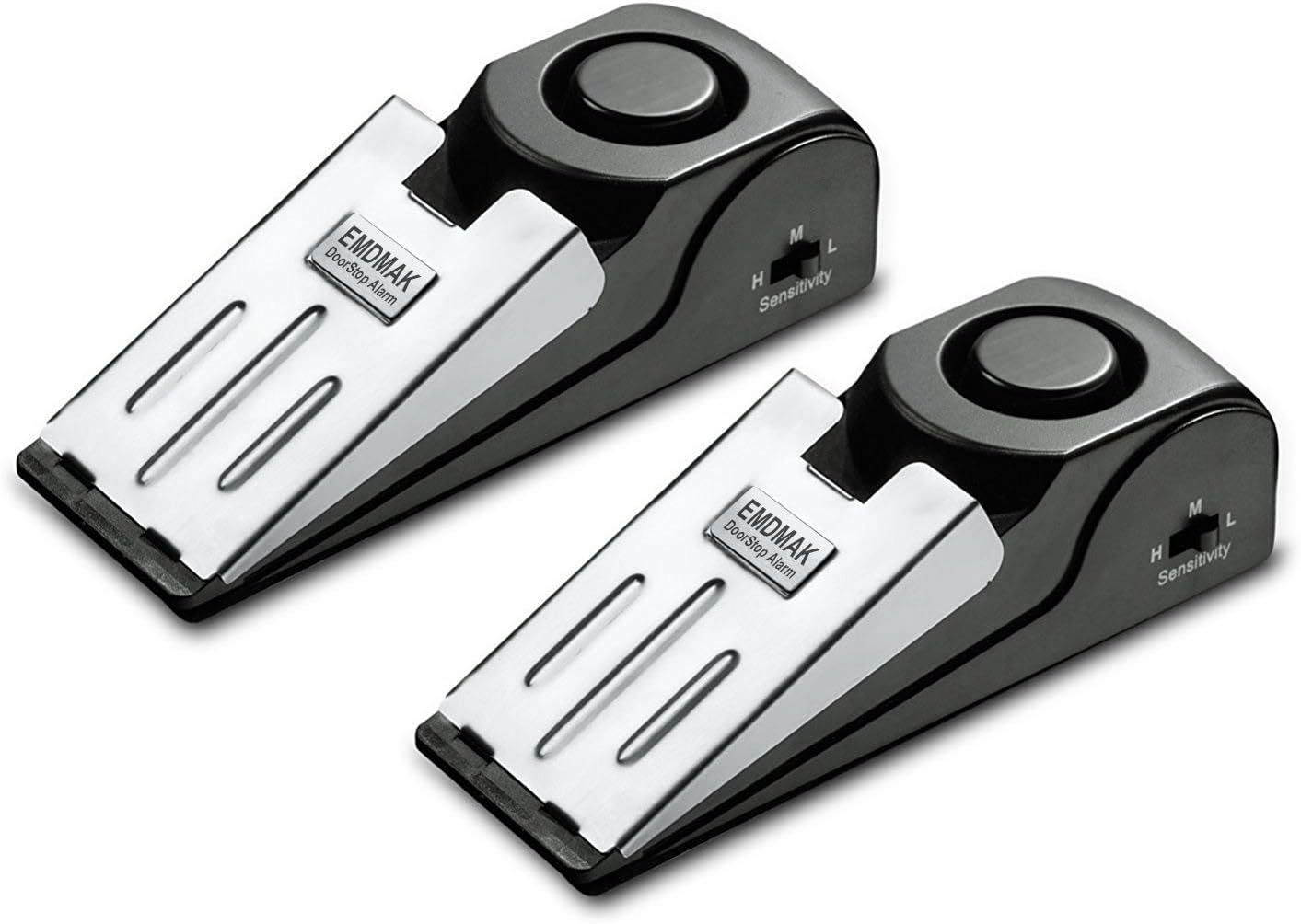
Key specs: 120 dB siren with a rubberized non-slip base that works as a conventional door stop as well as an alarm; powered by a 9V battery the manufacturer states lasts about a year in normal use, not included; suits floor clearances from around 0.6 inches
The practical choice when one door is not the whole problem — a bedroom and a front door, or two bedrooms in a shared house. It is a conventional 120 dB wedge with a rubberized non-slip base that also works as an ordinary door stop when the alarm is off, which is a genuinely nice dual use rather than marketing. Its floor clearance requirement starts lower than the SABRE’s, so it is the better fit for doors with a tight gap. Note that the 9V battery is not included and the manufacturer states roughly a year of normal use per battery, so buy one with it.
✅ Pros
- Two units, covering two doors
- Works as a plain door stop with the alarm switched off
- Lower minimum floor gap than the SABRE
- Stated battery life of about a year per 9V
❌ Cons
- 9V battery not included
- Marketplace brand without SABRE’s track record
- No stated audible range to compare against
- Same inward-opening and floor-surface limits as any wedge
HNHMT Portable Door Lock and Door Stop Alarm Set — the travel kit
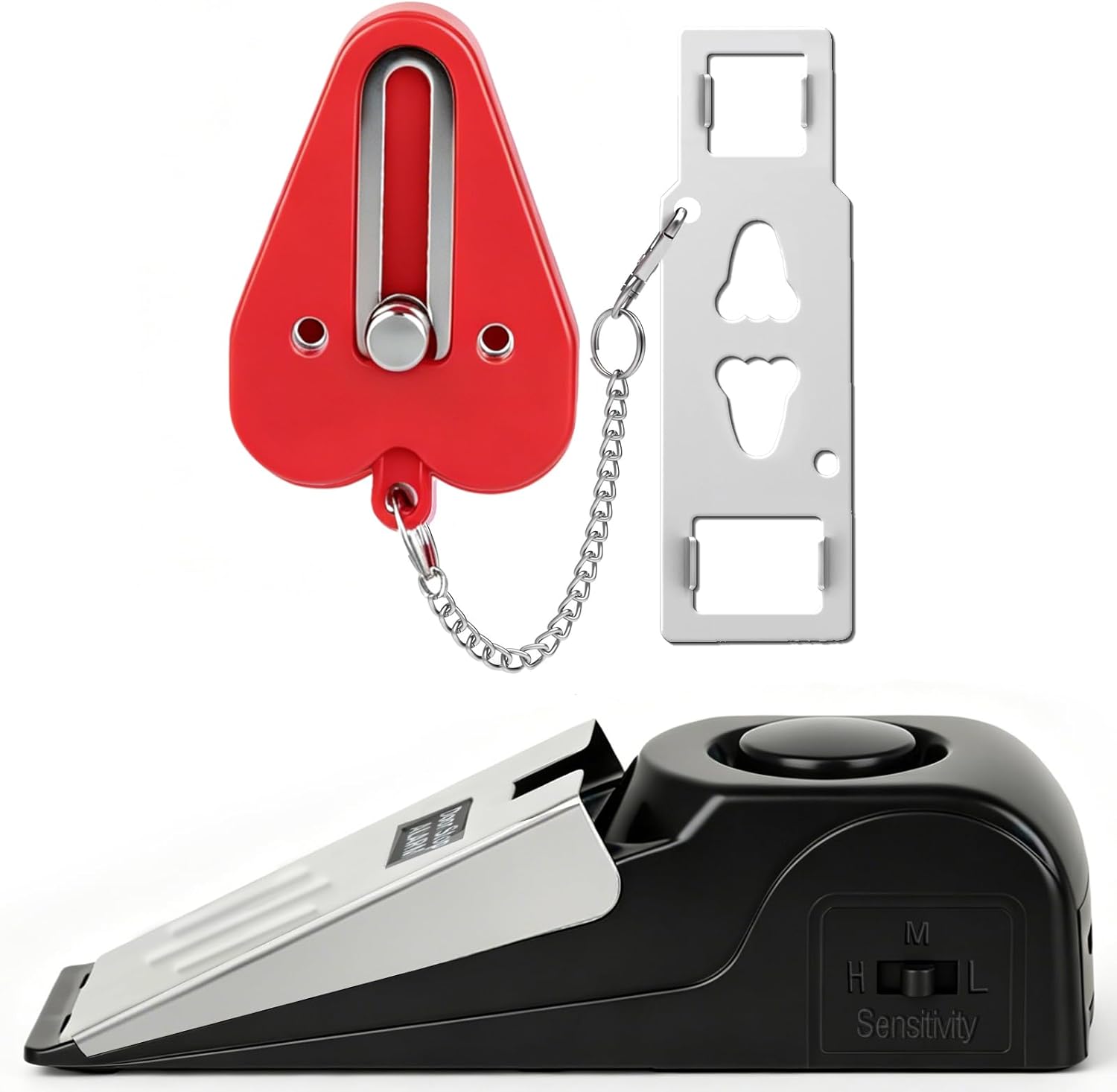
Key specs: Two devices in one set: a stainless steel portable door lock for inward-opening doors only, plus a door stop alarm requiring a floor gap between 0.2 and 1.38 inches; not suitable for outward-opening, double, folding or sliding doors
This is the one to put in a suitcase, because it solves the two different problems a hotel or short-term rental creates. The portable door lock braces the door against a strike plate so it cannot be opened from outside even with a key, and the wedge alarm covers the case where the door is forced. The manufacturer is unusually explicit about compatibility, which is worth respecting rather than skimming: the lock works only on inward-opening doors and is not suitable for outward-opening, double, folding or sliding doors, and the alarm needs a floor gap between 0.2 and 1.38 inches.
✅ Pros
- Two complementary devices in one small kit
- The lock defeats a key from outside, which an alarm cannot
- Widest stated floor-gap range of the three
- Packs small enough to live permanently in a bag
❌ Cons
- Lock does not work on outward-opening, double, folding or sliding doors
- Two devices to remember to deploy rather than one
- Less established brand than SABRE
- A hotel door with an unusual frame may defeat the lock half entirely
Where a Door Stop Alarm Genuinely Helps
The value is highest in exactly the situations where fitting anything permanent is off the table, which is why this product persists despite being unglamorous.
| Situation | Why the wedge alarm fits | What it pairs with |
|---|
| Hotel or short-term rental | No installation, no permission, packs small | A portable door lock |
| Renting an apartment | Nothing screwed into the door or frame | A no-drill door alarm on other entry points |
| A bedroom inside a shared house | The concern is an internal door, where sensors rarely reach | A personal alarm within reach of the bed |
| Ground-floor apartment door | Resistance plus noise on the single most likely entry point | A security bar for stronger physical resistance |
| A door you cannot alarm electrically | No wiring, no hub, no network | Whatever system covers the rest of the property |
The travel case deserves the most emphasis, because it is where the alternatives are worst. You cannot install a camera, you cannot fit a bar, and you have no idea how many keys to that room exist. A wedge alarm plus a portable travel door lock is close to the only meaningful control you have, and both fit in a wash bag. The third item in that same wash bag argument is a keychain alarm for the hours you are not behind the door — our roundup of personal safety alarms covers those.
Where It Does Nothing At All
Being clear about this matters, because a device that feels protective while covering nothing is worse than no device.
A wedge alarm protects one door, while you are behind it. It does nothing for the house while you are out, because somebody has to place it. It does nothing for windows, which is a real gap in a ground-floor apartment — that is what door and window contact sensors are for. It does nothing on an outward-opening door, and it does very little on thick carpet.
It also does not summon anyone. The alarm is local noise; nothing is transmitted, nobody is notified, and no monitoring center hears it. If what you actually want is a response rather than a deterrent, that is a different category of purchase entirely, and a wedge is a supplement to it rather than a substitute.
Final Recommendation
Measure your floor gap, then buy the SABRE wedge alarm if it is close to 7/8 of an inch. It is the pick because the non-skid pad actually delivers the resistance half of the product, and because a real security brand in a white-label category is worth the small premium.
Choose the EMDMAK two-pack if you need to cover two doors, or if your floor gap is tighter than the SABRE wants. Buy a 9V battery at the same time, because it does not come with one.
Choose the HNHMT set if this is going in a suitcase. The portable lock covers the scenario a wedge cannot — someone with a key — provided your door opens inward and is not double, folding or sliding.
What would change our answer: if the door in question is your permanent front door and you own the property, spend the money on a security bar or reinforced strike plate instead. A wedge is the right answer specifically when you cannot modify the door; when you can, permanent hardware resists far more force and does not need to be remembered every night.
SafeBode does not yet run an in-house product testing program. This guide is built from manufacturer specifications, official support documentation, current retail listings and verified buyer feedback rather than hands-on testing, and we say so plainly rather than implying testing we have not done.
Frequently Asked Questions
Do door stop alarms actually work?
For their narrow job, yes — they resist an inward-opening door and make a loud noise when pressure is applied. They are not a substitute for a lock or an alarm system, and they only protect a door you are currently behind.
What floor gap does a door stop alarm need?
It varies by product and it decides whether the thing works at all. SABRE specifies about 7/8 of an inch, EMDMAK states from around 0.6 inches, and the HNHMT alarm wants between 0.2 and 1.38 inches. Measure before ordering.
Do they work on outward-opening doors?
No. A wedge relies on the door pressing into it as it opens toward you. On an outward-opening door there is nothing for it to brace against, which catches out a lot of apartment and hotel buyers.
Will one work on carpet?
On low-pile carpet usually, on deep pile often not. The non-skid pad needs a surface it can grip; if the whole wedge slides, you have an alarm but no resistance.
Are door stop alarms good for hotels?
This is arguably their best use. Nothing is installed, nothing needs permission, and they cover a door you have no control over the keys to. Pairing one with a portable door lock covers both forced entry and someone opening the door with a key.
How loud is 120 dB, really?
Loud enough to wake a sleeping household and to be heard well outside the room. SABRE states its wedge is audible up to 1,500 feet away, which is the point — the noise is meant to make the situation public, not just to alert you.
Do they need batteries?
Yes, and the EMDMAK’s 9V is not included, so buy one alongside it. Because these sit unused for long stretches, a battery check when the clocks change is a sensible habit.
Can a door stop alarm replace a security bar?
No. A bar resists considerably more force, and a wedge trades some of that resistance for the alarm and for needing no installation. On a door you own and can modify, a bar is the stronger physical answer.
Will it protect the house while I am out?
No — someone has to place it, from the inside. It is a device for while you are behind the door. Protecting an empty house is a job for locks, sensors and an alarm system.
Sources
Show sources (4)
- [1] SABRE — Personal alarms and stated audible ranges, www.sabrered.com/personal-alarms
- [2] SABRE — Wedge Door Stop Security Alarm, current retail listing specifications (ASIN B00M30SQGA)
- [3] EMDMAK — Door Stop Alarm, current retail listing specifications (ASIN B01M0X4QM4)
- [4] HNHMT — Portable Door Lock and Door Stop Alarm Set, current retail listing specifications (ASIN B098XLXV3V)


