Best Fireproof Safes 2026: What the UL Fire Ratings Mean
Affiliate Disclosure: This article contains affiliate links. If you buy through these links, we may earn a commission at no extra cost to you. Our editorial opinions are our own and are not influenced by affiliate relationships. Read our full disclosure policy →
Contents
Quick Answer
Most “fireproof safe” buying guides never explain what the rating number on the box actually promises. A UL 72 classification is two things stapled together: a temperature class (how cool the interior stays) and a time (how long it stays that cool against a specific exterior fire). Class 350 protects paper. Class 125 protects digital media, and it is a genuinely different, tighter standard — not just a stricter version of the same test. A safe that is perfectly rated for your passport can still ruin the backup drive sitting next to it. Below: what the numbers mean, four real safes that protect different things, and which one actually matches what you are trying to save.
What a UL Fire Rating Number Actually Means
UL 72 is the actual standard — formally “Standard for Tests for Fire Resistance of Record Protection Equipment,” published by UL Standards & Engagement, the nonprofit standards body behind the UL mark. It does not produce one pass/fail result. It produces two separate numbers that a manufacturer combines into a label like “Class 350, 1 Hour”: a temperature class that says what kind of contents the safe is built to protect, and a time rating that says how long it held that temperature during the test.
The temperature classes are not interchangeable tiers of the same protection. Each one targets a different physical failure point: paper chars, film and tape degrade, and digital storage media corrupts at three very different temperatures. UL 72 defines three classes around exactly that split — Class 350 for paper records, Class 150 for paper plus non-paper media like photographic film and magnetic tape, and Class 125 for flexible computer disks and other digital storage. The number in each class name is the maximum interior temperature, in Fahrenheit, the safe is allowed to reach during the test — not the exterior fire temperature, which runs far higher in every class.
UL 72’s Three Temperature Classes, at a Glance
350°F
Class 350 — the ceiling for paper documents
150°F
Class 150 — paper plus photographic film and tape
125°F
Class 125 — digital media, drives and disks, humidity held under 80% too
Time is rated separately from temperature — 30 minutes, 1 hour, 2 hours, 3 hours or 4 hours, tested against an exterior fire that climbs to roughly 2,000°F.
The test itself is more demanding than “put it in an oven.” The safe goes into a furnace where external temperatures exceed 1,700°F, sensors track interior temperature and humidity the entire time, and — the part most buying guides skip — after the burners shut off, the safe stays sealed inside the cooling furnace for a soak-out period that can run up to 68 hours. Heat already stored in the safe’s walls keeps migrating inward long after the fire itself is out, and that soak-out window is where a lot of safes that looked fine during the burn actually fail. Some models add an explosion test (confirming the safe will not rupture during a sudden temperature spike) and, for safes marketed as impact-rated, a fire-and-impact test that drops the unit roughly 30 feet before re-checking fire performance.
Inside a UL 72 Test, in Order
1
Fire endurance
The furnace holds the safe at rising heat past 1,700°F while sensors log interior temperature and humidity against the class limit.
2
Soak-out cooldown
Burners shut off, but the safe stays sealed inside the cooling furnace for up to 68 hours — most real failures happen here, not during the burn.
3
Explosion check
A separate sample confirms sudden heat won’t cause the safe to rupture and expose its contents.
4
Impact test (select models)
Impact-rated safes are dropped roughly 30 feet onto rubble, then re-tested for fire performance before earning that label.
None of these steps test what happens after a human opens the safe post-fire — see the placement section below for the backup gap that leaves open.
Here is the gap that actually costs people their backups. Paper does not ignite until roughly 451°F, so a Class 350 rating gives it real margin. USB drives, external hard drives, SD cards and optical media start suffering physical damage well below that — which is exactly why UL 72 carved out a separate, far tighter Class 125 in the first place, with its own 80% humidity ceiling on top of the temperature limit. A Class 350 safe is not a weaker version of a Class 125 safe. It is tested to a completely different, higher temperature that digital media does not survive.
The trap is that a lot of popular home fire safes market “digital media protection” as a feature without ever stating a Class 125 rating to back it up. SentrySafe’s own product page for the 1170 document box, for example, lists “protect tablets, phones, external hard drives, memory cards, USB drives, CDs, DVDs and other electronic storage devices” as a feature — on a safe whose actual UL classification is 30 minutes at up to 1,550°F, the same class used for paper. That is not a claim we are calling false; SentrySafe is not alone in phrasing it this way, and a Class 350 safe genuinely does slow heat far more than no safe at all. But “can hold electronics” and “is rated to protect electronics the way it’s rated to protect paper” are two different promises, and the label on the box will not tell you which one you’re getting unless you go looking for the class number specifically.
If what you are actually protecting is a camera’s microSD card or a drive holding footage — and our own guide to where security camera footage should live covers why that question matters even before a fire is involved — the honest fix is a safe that states Class 125 specifically, not a document box that mentions electronics in its marketing copy. That is a narrower, pricier product category, and it is worth knowing it exists before you assume the safe on your desk already covers it.
How Long a Rating Actually Needs to Be
Time ratings matter because house fires move faster than most people plan for. Modern furniture and construction materials burn roughly eight times faster than they did 40 years ago, and fire safety guidance now gives residents as little as two minutes to get out of a burning home. That speed is exactly why the soak-out period described above matters as much as the burn itself — a fire department responding quickly does not mean the heat stored in your walls, floor joists or a safe’s own steel stops climbing the moment the flames are knocked down.
For most homes, a 30-minute to 1-hour rating is the realistic target, which is why it is the class you will see on the majority of consumer document safes, including three of the four picks below. Rural properties with longer fire department response times, or homes built with materials that burn hotter for longer, are the case for stepping up to a 2-hour-class safe if the option exists in the size and price range you need. None of this is a reason to skip a fireproof safe over an unrated lockbox — even a Class 350 rating buys real, tested margin that an ordinary steel box with no UL classification at all does not.
SentrySafe 1170 Fireproof Document Box — the paper documents pick
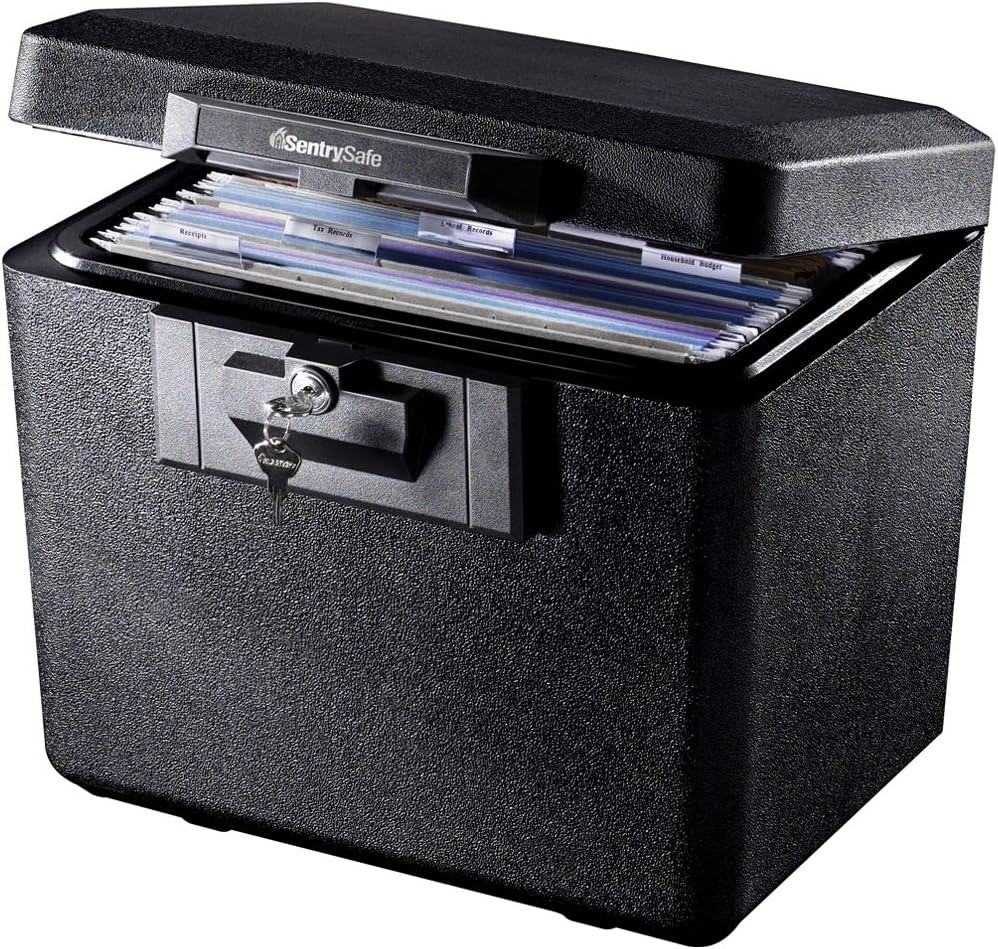
Key specs: 0.61 cu ft interior, exterior 13.6 x 15.3 x 12.1 in, privacy key lock with two keys, sized for hanging file folders, UL Classified fire protection rated for 30 minutes at up to 1,550°F
This is the safe most people picture when they say “fireproof safe,” and it is a genuinely solid one for what it is built to do. SentrySafe states a UL Classified rating of 30 minutes at up to 1,550°F, sized around hanging file folders rather than a jumble of loose paper. As covered above, SentrySafe’s own listing also markets it for electronic storage devices, and we are not going to smooth that over: the classification itself does not specify the tighter Class 125 media limit, so treat any digital media stored inside as a bonus, not the primary use case. It uses a physical key lock rather than a keypad, which means no batteries to die and no PIN to forget — read our SentrySafe lost key replacement guide before you buy if losing a physical key worries you more than forgetting a code.
✅ Pros
- UL Classified fire rating backed by a named class and time, not a vague ‘fireproof’ claim
- Interior sized specifically for hanging file folders — passports, deeds, wills, insurance papers
- Simple key lock, no batteries or firmware to maintain
- Compact enough for a closet shelf rather than needing floor space
❌ Cons
- Marketed for electronic storage devices without a Class 125 rating behind that specific claim
- 30-minute rating is on the shorter end of what’s available in this size
- No stated water resistance
- A lost key with no spare means a locksmith, not a quick fix
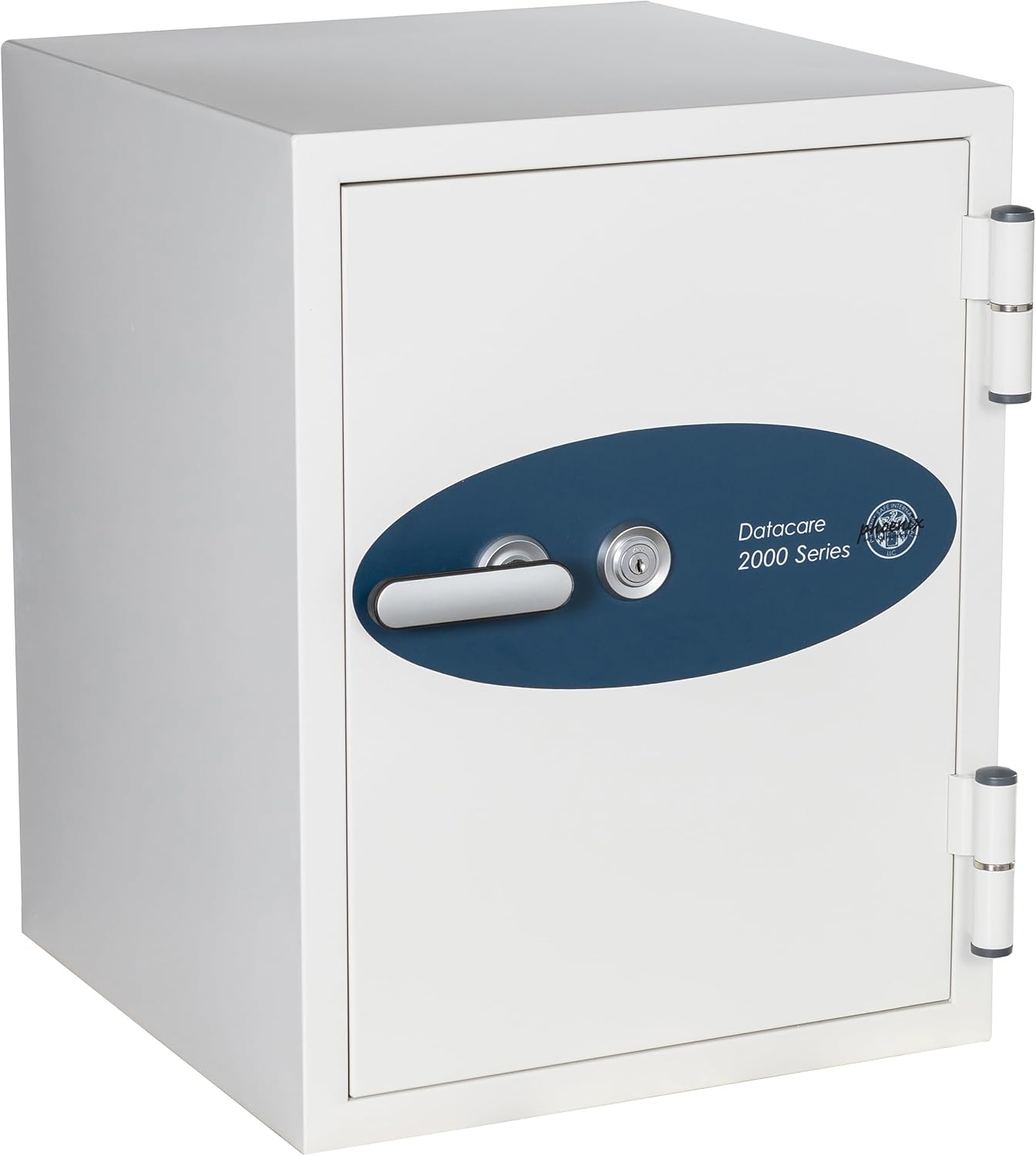
Key specs: 0.58 cu ft, key lock, UL Classified Class 125 fire rating (2-hour), purpose-built for DLT and LTO backup tape, external hard drives, CDs and other magnetic or digital media
This is the honest answer to the trap described above, and it looks nothing like a typical home safe because it is not built like one. Phoenix Safe’s Datacare line carries an explicit UL Classified Class 125 rating, the standard specifically built around the temperature and humidity ceilings that backup tape, hard drives and other digital media actually need. The listing states protection for DLT and LTO backup tape, external hard drives, CDs and other magnetic media specifically — this is a purpose-built data safe, not a document box that happens to mention electronics. We are surfacing the real tradeoffs rather than glossing over them: it is a niche product with a small review base on Amazon, its 0.58 cu ft interior is shaped for tape cartridges and drives rather than file folders, and achieving Class 125’s tighter limits takes meaningfully more insulation than a Class 350 box, which shows up in both size and price for the protection level. If your actual priority is a mix of paper and a handful of USB drives rather than a real backup-media archive, weigh whether a Class 350 safe plus a cloud backup (see the placement section below) gets you there for less.
✅ Pros
- Explicit Class 125 UL classification — the rating actually built for digital media, not paper
- Purpose-designed for tape, drives and disks rather than a document box pressed into service
- 2-hour time rating on this model, longer than most home document safes
- Key lock, same no-battery reliability as the document-box pick
❌ Cons
- Thin review base on Amazon relative to the mainstream document safes on this list
- Small interior shaped for media, not for bulky paper files
- Costs meaningfully more than a Class 350 safe of similar external size
- No stated water resistance in the listing
SentrySafe SFW123GDC Fireproof and Waterproof Safe — the dual fire and water pick
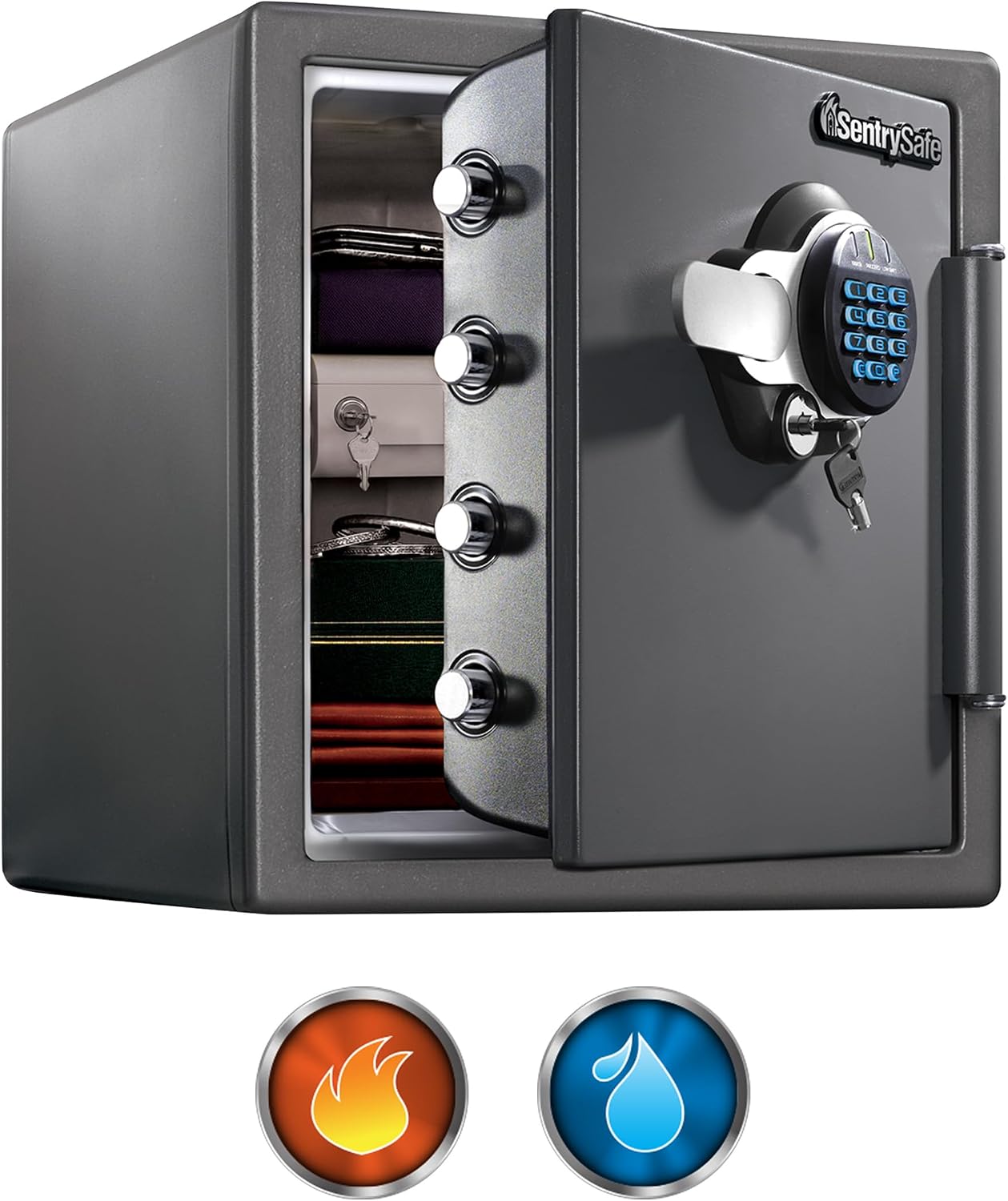
Key specs: 1.23 cu ft interior, exterior 17.8 x 16.3 x 19.3 in, digital keypad with key override, UL Classified fire protection rated for 1 hour at up to 1,700°F, ETL Verified water resistance to 8 inches deep for 24 hours
Fire is not the only disaster that ruins a safe’s contents, and this is the pick built around that reality rather than treating water as an afterthought. SentrySafe states a UL Classified fire rating of 1 hour at up to 1,700°F alongside a separate ETL Verified water rating — 8 inches deep for 24 hours — with independent testing behind each claim rather than one figure standing in for both. SafeWise’s own buying guide singles this exact model out for surviving falls up to 15 feet and close to a foot of standing water, which lines up with SentrySafe’s own published numbers rather than contradicting them. A digital keypad handles day-to-day access, with a physical key kept as a backup if the electronics ever fail.
✅ Pros
- Independently rated for both fire (UL) and water (ETL) rather than one vague ‘protected’ claim
- 1-hour fire rating is longer than the 30-minute document-box pick above
- Digital keypad with a physical key override if the battery dies
- Meaningfully larger interior (1.23 cu ft) than a typical document box
❌ Cons
- Heaviest and largest of the four picks here, which matters for where you can realistically put it
- Class rating still tops out at 350°F equivalent — same media caveat as the document-box pick applies
- Keypad adds a battery to maintain that a pure key-lock safe doesn’t need
- Costs more than either the document box or the budget pick
Amazon Basics Fireproof and Waterproof Safe Box — the budget pick
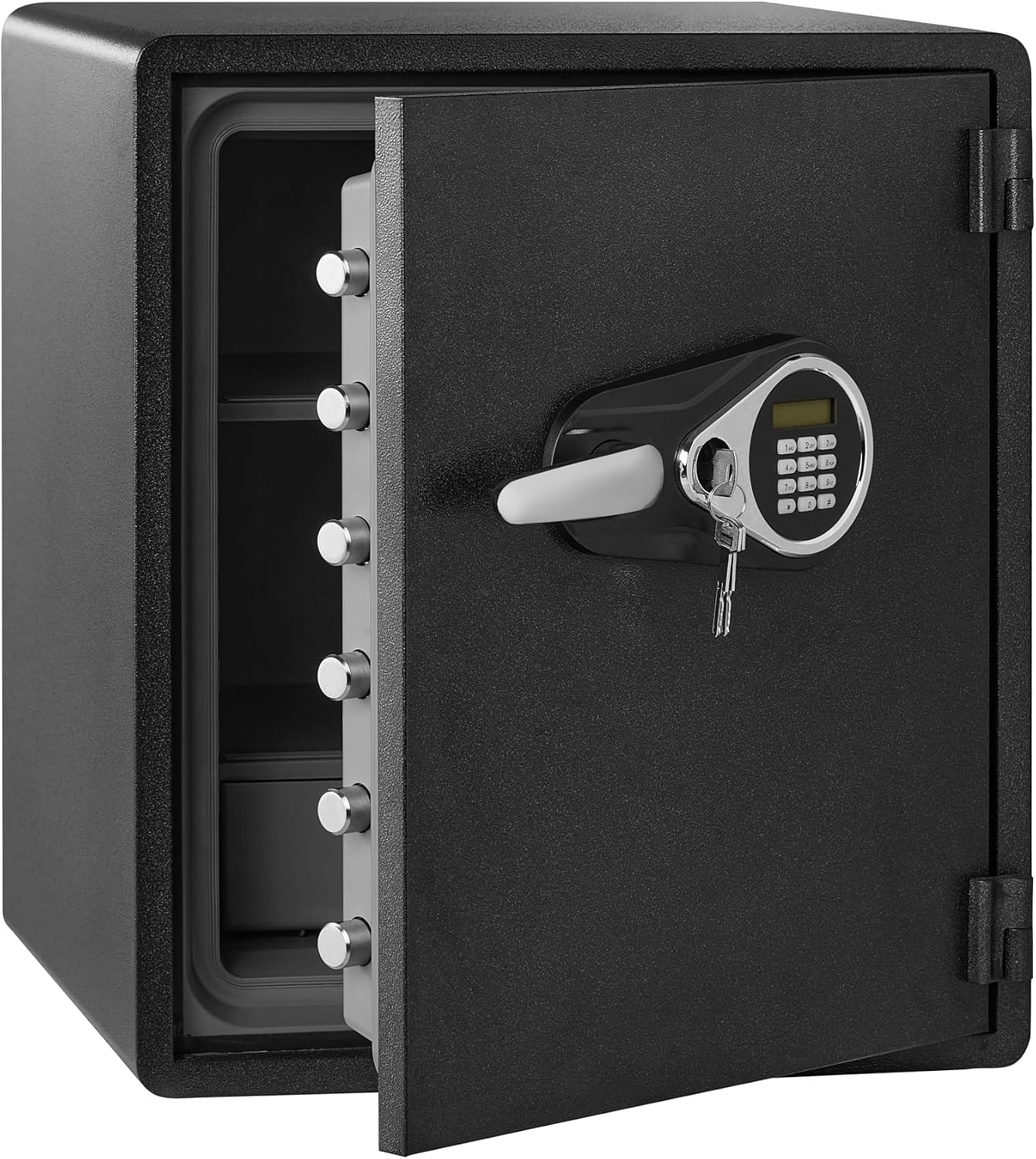
Key specs: 2.13 cu ft, exterior 24 x 20.87 x 19 in, digital keypad with key override, Intertek (ETL)-tested fire protection for 1 hour at up to 1,700°F, tested to withstand 8 inches of water for 24 hours, interior light, removable shelf, bolt-down hardware
This is the pick for readers who want real, independently tested fire and water protection without stepping up to SentrySafe’s flagship pricing — with one honest distinction worth flagging up front. Its listing states fire testing by Intertek to 1 hour at up to 1,700°F, plus 24 hours of protection against 8 inches of standing water. Intertek is a legitimate, independent testing lab — its ETL mark is a recognized alternative to UL, not a lesser one — but this specific model’s listing states Intertek testing rather than a UL Classification specifically, which is a real difference from the other three picks here even though the tested numbers land in a similar range. If having the UL mark itself matters to you (for insurance documentation purposes, for example), confirm that before buying; if what matters is a real, published independent test behind the number, this clears that bar. It is also the roomiest safe on this list at 2.13 cu ft, with an interior light and a removable shelf.
✅ Pros
- Independently tested (Intertek/ETL) fire and water protection at a lower price point than the SentrySafe dual pick
- Largest interior of the four picks, with a removable shelf and interior light
- Digital keypad with a physical key override
- Bolt-down hardware included for anchoring to a floor or closet base
❌ Cons
- Tested by Intertek rather than carrying a UL Classification specifically — confirm which matters to you
- Newer to the market with less of a track record than the SentrySafe lineup
- Larger footprint needs real floor or closet space, unlike the compact document box
- Same paper-class temperature ceiling as the document box and dual pick — not a media-rated safe
Side by Side: Class, Time and What Each One Actually Protects
Reading the four listings next to each other makes the class-versus-marketing gap easier to spot than reading any one of them alone.
| SentrySafe 1170 Fireproof Document Box | Phoenix Safe Datacare 2002 Data Media Safe | SentrySafe SFW123GDC Fireproof and Waterproof Safe | Amazon Basics Fireproof and Waterproof Safe Box |
|---|
| Testing body | UL Classified | UL Classified | UL Classified | Intertek (ETL) tested |
| Temperature class | Paper-class (350°F equivalent) | Class 125 — digital media | Paper-class (350°F equivalent) | Not stated as a named UL class |
| Time rating | 30 minutes at 1,550°F | 2 hours | 1 hour at 1,700°F | 1 hour at 1,700°F |
| Water protection | Not stated | Not stated | ETL Verified, 8 in. / 24 hrs | Tested, 8 in. / 24 hrs |
| Lock type | Physical key | Physical key | Digital keypad + key override | Digital keypad + key override |
| Best for | Paper documents, passports, files | Backup tape, drives, digital media | Documents plus real flood risk | Budget-conscious buyers, largest interior |
Where to Put It, and What Still Needs a Backup Somewhere Else
A fire rating changes almost nothing about where burglars look first, so placement is still a security question as much as a fire one — a bolted-down safe inside a closet beats one sitting in plain sight in a home office regardless of its class. Basements add a second consideration: they are often the coolest spot in a fire, but they are also the spot most exposed to flooding, which is the real argument for the dual-rated pick above over a fire-only safe if that’s where yours will live. Our guide to water leak detectors covers the flood side of that risk in more depth if a basement is genuinely your only option.
Even a perfect rating only covers what happens up to the moment the fire is out — none of the UL 72 tests above say anything about what happens after that, when someone actually has to open the safe and use what’s inside. The Insurance Information Institute’s own home-inventory guidance recommends keeping a copy of your documentation somewhere outside the home entirely — with a trusted contact, in a safe deposit box, or backed up electronically — specifically so a single point of failure at your address, fire-rated or not, is never the only copy that exists. That is not a knock on any of the four safes above; it is the same logic that applies to any single storage card holding footage you actually care about, and it costs nothing to apply it to paper too. Layering a fireproof safe into a wider plan — alongside the rest of what our home security cost breakdown covers — is the realistic goal, not treating one box as a complete answer on its own.
One more placement note specific to the document-box and dual-rated picks above: SentrySafe itself does not differentiate fire performance for digital media on either product page, so if you do store a spare drive in one of those two as a convenience, keep the primary copy of anything irreplaceable in the Class 125 pick or off-site instead.
Final Recommendation
Start with what you’re actually protecting, not the biggest or cheapest box available. If it’s paper — deeds, passports, wills, insurance policies — the SentrySafe 1170 Fireproof Document Box is the right-sized, correctly-classed pick, and its 30-minute rating is genuine tested protection even though it is the shortest time window on this list.
If digital backups — drive images, tape, camera footage archives — are the actual priority, don’t default to a document safe that merely mentions electronics in its marketing copy. Step up to the Phoenix Safe Datacare 2002 Data Media Safe, the only pick here with an explicit Class 125 rating behind it. If your basement or home office carries real flood risk alongside fire risk, the SentrySafe SFW123GDC Fireproof and Waterproof Safe is the one built and independently tested for both. And if budget is the deciding factor over any single threat, the Amazon Basics Fireproof and Waterproof Safe Box still gives you a real, independently tested fire and water number rather than an unrated box — just confirm the Intertek-versus-UL distinction doesn’t matter for your situation before you decide budget outweighs it.
Whichever you choose, treat the class number as a promise about specific contents, not a general seal of approval — and pair it with an off-site or cloud copy of anything you genuinely cannot afford to lose. If you want a single ranked list spanning more use cases than fire rating alone — firearms, cash, jewelry — our home safes decision-tree guide covers that broader comparison separately.
SafeBode does not yet run an in-house product testing program. This guide is built from manufacturer specifications, official support documentation, current retail listings and verified buyer feedback rather than hands-on testing, and we say so plainly rather than implying testing we have not done.
Frequently Asked Questions
Is ‘fireproof’ the same thing as a UL fire rating?
No. ‘Fireproof’ is marketing language with no fixed meaning. A UL Classification is a specific, independently tested claim with a named temperature class and a time rating behind it. Look for the class and time, not just the word fireproof on the box.
Will a Class 350 safe protect a USB drive or laptop?
Not reliably. Class 350 keeps the interior below 350°F, which is fine for paper but well above what digital storage media can survive. A safe rated Class 125 is the one built for that job.
How long should a home fire safe be rated for?
A 30-minute to 1-hour rating covers most homes. Rural properties with longer fire department response times are the realistic case for stepping up to a 2-hour class if it fits your budget and space.
Is Intertek/ETL testing as credible as a UL Classification?
Both are recognized independent testing labs, and neither is inherently ‘lesser.’ The practical difference is which mark shows up on the safe and in any documentation an insurer might ask for — confirm which one matters for your situation rather than assuming they’re identical.
Do fireproof safes also protect against theft?
Some do, some don’t — fire rating and burglary rating are two separate tests, and a safe can pass one without the other. A light document box with a simple key lock is not built to resist prying the way a heavier security safe is.
Should a fireproof safe be bolted down?
For anything with real value inside, yes. A fire rating does nothing to stop someone from simply carrying an unsecured safe out the door, and several of the safes covered here ship with or support bolt-down hardware for exactly that reason.
Can a rated safe still get too hot inside during a long fire?
Yes, if the fire and cooldown period exceed what the safe’s time rating covers. That’s why the time number matters as much as the temperature class — a Class 350 safe rated for only 30 minutes can still exceed 350°F inside if conditions outlast that window.
What should never go in a fireproof safe regardless of rating?
Anything that needs to be accessed instantly in an emergency, like a firearm for home defense in a slow-access safe, and anything you have no backup copy of at all — a fireproof safe reduces risk, it doesn’t eliminate the value of a second copy stored somewhere else entirely.
Do I still need a cloud or off-site backup if I own a fireproof safe?
Yes, for anything genuinely irreplaceable. A safe protects against one specific disaster type at one specific address. A second copy stored elsewhere protects against everything else, including a fire that exceeds the safe’s own rating.
Sources
Show sources (8)
- [1] UL Standards & Engagement — “UL 72, Standard for Tests for Fire Resistance of Record Protection Equipment,” shopulstandards.com/ProductDetail.aspx?UniqueKey=29344
- [2] SafeWise — “Best Home Safes Buyer’s Guide,” safewise.com/resources/home-safe-buyers-guide/
- [3] Phoenix Safe USA — “Media Safes,” phoenixsafeusa.com/media-safes
- [4] SentrySafe — “1170 Small Black Fireproof File Cabinet,” sentrysafe.com/product/1170
- [5] SentrySafe — “SFW123GDC Large Steel Fireproof Waterproof Safe,” sentrysafe.com/product/SFW123GDC
- [6] Security.org — “Fire Safety & Prevention Tips,” security.org/home-security-systems/fire-safety-tips/
- [7] Insurance Information Institute — “Brochure: Home Inventory,” iii.org/article/brochure-home-inventory
- [8] Amazon product listing — “Amazon Basics Fireproof and Waterproof Safe Box with Digital Keypad Electronic Lock,” amazon.com/dp/B0CR5W5VKF


