Best Door Reinforcement Kits 2026: The Jamb Fails Before the Lock Does
Affiliate Disclosure: This article contains affiliate links. If you buy through these links, we may earn a commission at no extra cost to you. Our editorial opinions are our own and are not influenced by affiliate relationships. Read our full disclosure policy →
Contents
Quick Answer
Almost nobody defeats a residential deadbolt. They defeat the pine board it throws into. Seattle Police put it plainly: the most common way to force a door with a wooden jamb is to kick it, the frame splinters and gives way, and the weakest point is almost always the strike plate – which on an average door is fastened only to the lightweight doorframe molding. So the most valuable purchase here is also the cheapest by a wide margin: pull the 3/4-inch screws out of your strike plates and hinges and put 3-inch screws in their place, anchored to framing instead of trim. Add a full steel kit if the door has already been hit or sits out of sight. Hinge studs only if it swings outward. A wrap-around plate only if the door edge itself is already chewed up.
What Actually Breaks When a Door Gets Kicked
Stand in a doorway and look at the strike plate – the metal rectangle the latch and deadbolt drop into. Back one of its screws out. On most American houses built in the last half-century that screw is about three-quarters of an inch long, and the only thing it has ever gripped is the jamb board and the trim behind it.
Seattle Police describe the consequence in one paragraph of their crime prevention bulletin: the most common way used to force entry through a door with a wooden jamb is to kick it open, the frame usually splinters and gives way, and the weakest point is almost always the strike plate that holds the latch or lock bolt in place. The average door strike plate, they write, is secured only to the doorframe molding – lightweight material often tacked on to the doorframe and able to be torn away with a firm kick. Nothing in that sequence involves the lock. The bolt is still extended, still intact, still attached to a door that is now swinging open with a chunk of jamb hanging off it.
The City of Brevard police department names the same fastener problem on the hinge side: hinges are often installed with the same 3/4-inch screws as the common strike plates, and it recommends 2-inch to 3-inch fully threaded screws so they anchor to the sub frame instead. Both halves of the door hang on the same short screws in the same soft wood.
The Four Numbers That Decide a Kick-In
3/4 in
Screw length commonly shipped with strike plates and hinges
3 in
Minimum screw length both police sources here call for [1, 2]
4
Screws a high-security strike plate should have
1 in
Minimum deadbolt throw into the jamb
Every number above is a hardware-store fix, not a security-system purchase.
Seattle’s bulletin also flags a shift away from pure kicking, noting a trend of burglars increasingly using pry tools at doors – and its answer to prying starts with the same 3-inch to 4-inch screws in the strike plates. Screws help against both attacks, which is unusual. Most security spending buys you exactly one thing.
Why Your Deadbolt Is Almost Never the Part That Fails
The asymmetry is not an accident. A residential deadbolt is a standardized, laboratory-tested component; the jamb is a piece of lumber a framer shimmed into a rough opening.
The Builders Hardware Manufacturers Association’s standard for residential deadbolts, ANSI/BHMA A156.40, sets durability, security and finish requirements. BHMA describes seventeen aggressive security tests, including one that loads the door against the deadbolt with 1,350 lb of force; on durability, a Grade A residential deadlatch has to survive 400,000 cycles. Our guide to ANSI/BHMA lock grades unpacks what those letters mean on a package. The point here is narrower: the bolt is a tested part with a published floor. Nobody tests the jamb it lands in, nobody grades it, and nobody certifies the screws the installer happened to have in the pouch.
This is why upgrading the lock alone so often disappoints. A better deadbolt does matter – if yours is a knob lock with no deadbolt at all, that is the first purchase, ahead of everything on this page, and our high-security deadbolt roundup covers it. Past a competent bolt, though, spending more on the cylinder buys resistance to attacks far rarer than a boot. Seattle’s own deadbolt guidance is mostly about throw length and about the single-cylinder versus double-cylinder question near glass, not about picking resistance.
The honest counterweight belongs here rather than buried at the end: most burglaries are not forced at all. The Bureau of Justice Statistics, analyzing National Crime Victimization Survey data from 1994 through 2011, found the largest proportion of burglaries involved completed unlawful entries – someone with no legal right to be there entering without use of force. Brevard puts it in one line: as many as half of all burglaries take place without forced entry. This hardware is insurance against one failure mode. Locking the door is still the higher-value habit, and it is free.
The Four Zones, Ranked by What They Cost to Fix
A door assembly fails in four distinct places, and the products sold as “door reinforcement kits” are less competitors than answers to different questions. Find the row that matches your door, then read that section.
| Zone | What actually fails | The fix | Effort |
|---|
| Strike plate, latch and deadbolt | Screws reach only the jamb board and trim, so the plate tears out | 3-inch screws; a four-screw heavy-duty strike plate if yours is a thin two-screw stamping | Screwdriver, minutes |
| The jamb, along the lock side | The jamb splits along the grain above and below the strike | A steel jamb shield spanning the lock region, screwed back to framing | Drill, about half an hour |
| The hinge side | Hinge screws are the same short screws; on outswing doors the pins face outward | Long screws in every hinge; security studs that interlock the leaves if it swings out | Screwdriver or drill |
| The door itself, at the lock | The stile splits through the lock bore, or the latch prep is chewed out | A wrap-around plate sized to your bore, backset and door thickness | Screwdriver, measure first |
Notice what is not in that table: the lock. Every row is wood, steel and fasteners. If you are swapping the deadbolt at the same time – the sensible moment, since the hardware is already off – our deadbolt installation walkthrough covers the boring parts that go wrong.
Reinforced Door Screw Kit (3-Inch Screws) — the fix that costs almost nothing
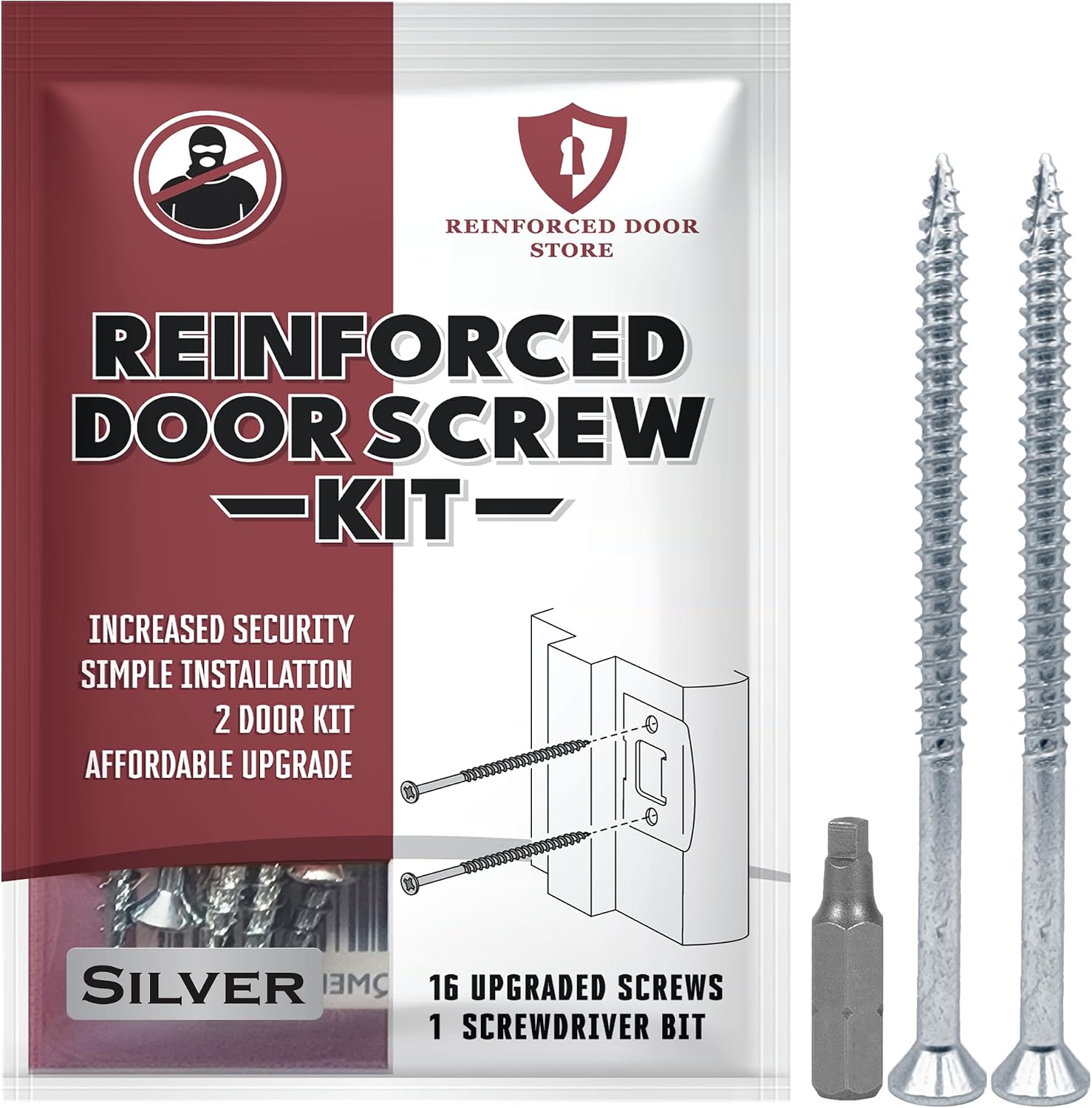
Key specs: 17-piece kit: sixteen 3-inch hardened-steel, zinc-coated screws (#9 thread, Type 17 point, listed as partially threaded) plus a square drive bit. The listing states it covers two doors and is meant for the jamb and frame side only, not the door hardware
This is the recommendation this article exists to make, and it is uncomfortable to write on a page that earns more when you buy something expensive: the cheapest item in the lineup has the highest return, and nothing else here comes close. Seattle Police say it without hedging – install longer screws in the strike plates and at least one long screw in each door hinge, and this one step alone will deter or prevent most through-the-door forced entries. Even without a heavy duty strike plate, they add, the longer 3-inch to 4-inch screws on your existing plates will vastly improve the security of your door. Brevard lands in the same place from a different department. The kit is unglamorous: sixteen hardened, zinc-coated 3-inch screws and a square drive bit, enough for two doors, and the listing is explicit that they go into the jamb and frame side rather than into the door hardware. You reuse the existing holes, so there is nothing to drill and nothing to patch if you move out.
✅ Pros
- Attacks the exact failure both police sources name – screws that never reach framing [1, 2]
- Hardened 3-inch steel with a square drive bit, so heads are less likely to cam out
- Listed as enough for two doors – the front, and the one nobody watches
- No new holes, no patching, minutes per door
❌ Cons
- Adds no steel; a thin two-screw strike plate stays a thin two-screw strike plate
- Listed as partially threaded, while Brevard’s hinge guidance calls for fully threaded [2, 5]
- On a jamb shimmed away from the stud, 3-inch screws can pull it out of alignment – check the gap first
- Does nothing for a jamb or door edge that has already split
Door Armor MAX 5-Piece Reinforcement Kit — the whole jamb, in steel
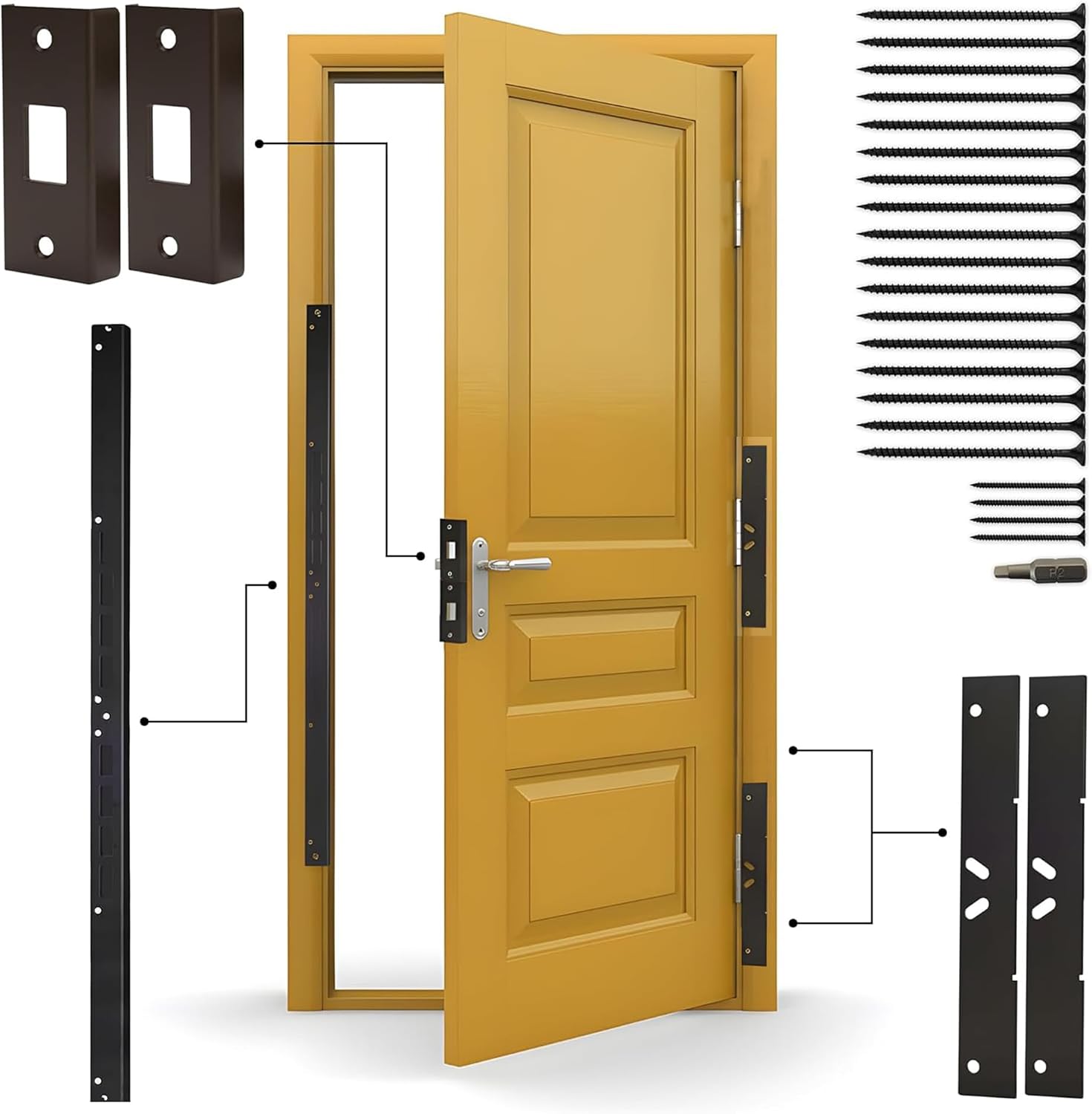
Key specs: Five pieces: one 46-inch jamb shield, two door shields for the lock area and two hinge shields, with a Torx bit and hardened self-tapping screws (seventeen at 3.5 inches, four at 2.5 inches). 16-gauge galvanized steel with a powder-coated finish
This is the pick when you want the problem closed rather than improved: a door already kicked once, a ground-floor unit, a rental you own, or an entry the street cannot see. Armor Concepts describes Door Armor as a patented system – US Patent 7,946,635 – reinforcing the weak points of an existing door with galvanized steel devices that attach to both door and frame, installed with only a drill in under thirty minutes and without taking the door off its hinges. The MAX kit is the five-piece version: a 46-inch jamb shield, two door shields for the lock area, two hinge shields, a Torx bit and hardened self-tapping screws, in 16-gauge galvanized steel. Two things to be straight about. A 46-inch shield is not the full height of an 80-inch door – it covers the lock region, where a kick lands, so treat “full jamb” as shorthand rather than literal. And the design has been copied widely enough that near-identical five-piece kits appear on Amazon under unrelated brand names; check the listing you open is the Armor Concepts one.
✅ Pros
- Covers three of the four failure zones in one box – jamb, lock area, hinge side
- 16-gauge galvanized steel with hardened self-tapping screws long enough to reach framing
- Manufacturer states a drill-only install in under thirty minutes, door still hung
- Visible steel is its own deterrent – it says the cheap attack will not work here
❌ Cons
- Permanent: you are drilling the door and the frame, so a renter needs written permission
- The jamb shield spans 46 inches, not the full door height
- Built for a wood jamb; a steel frame in a condo corridor is a different problem
- Look-alike five-piece kits make it easy to buy the copy by accident
HINGEMATE Door Hinge Security Studs (3-Pack) — the side nobody checks
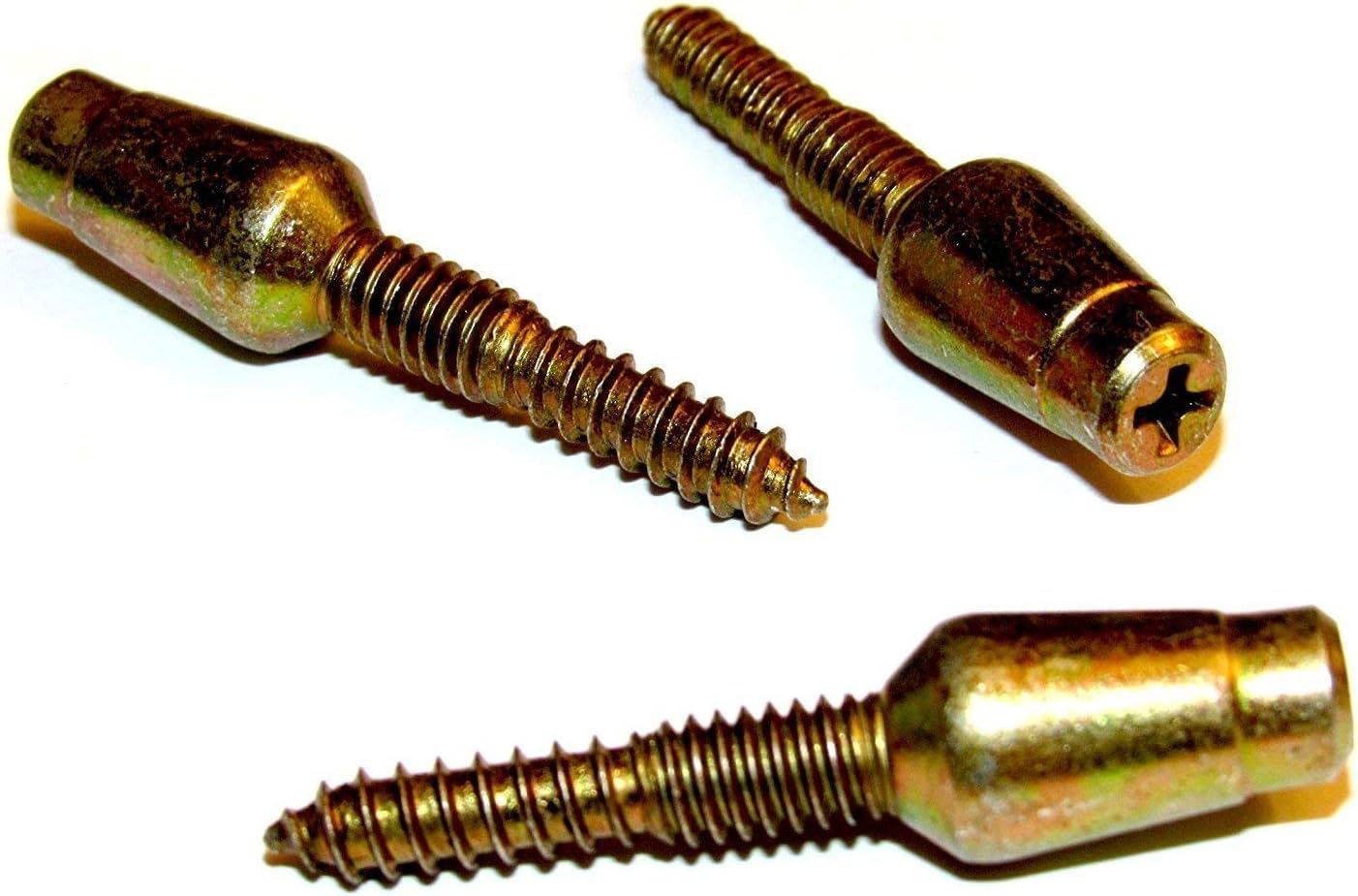
Key specs: Three steel security studs, listed under the HINGEMATE brand as model HM-01, roughly 1-3/4 inches long; the listing names Hinge Outlet, Inc. as the company behind it. They install into hinges you already have rather than replacing them
Most guides in this category talk about the lock side and stop. On an inswing door the hinge leaves are indoors and long screws are the whole answer. On an outswing door – common on back entries and garage-to-house doors – the hinge barrels and pins face the street. Hinge Outlet’s own explainer covers exactly this: security hinges are typically used on outswing doors because exposed pins let someone remove the hinges and take the door off entirely, and a security tab or stud locks the two leaves together when the door is closed, so they stay interlocked whether or not the pin is still there. Hinge Outlet’s own three-pack of security hinge pins is the retrofit version: the pins install directly into existing door hinges and interlock the leaves so the door cannot be lifted or removed while closed. The HINGEMATE three-pack listed on Amazon is that same idea, and its listing names Hinge Outlet as the company behind it. Brevard describes the identical trick done by hand with a headless screw and a drilled hole, a fair sanity check that the mechanism is real rather than a marketing invention.
✅ Pros
- Solves an attack that costs nothing to attempt and no amount of lock spending prevents
- Installs into existing hinges instead of replacing them
- Three studs, matching the three hinges on a standard exterior door
- The same method is independently described by a police crime prevention page
❌ Cons
- Genuinely single-purpose – it does nothing against a kick or a pry bar
- Pointless on an inswing door, which is most American front doors
- The Amazon listing is thin; the clearest how-it-works description is the maker’s own security hinge pin page rather than the listing itself
- You can improvise the same thing with a headless screw if you are happy drilling
Don-Jo 12-CW-S Wrap-Around Plate — for a door that already split
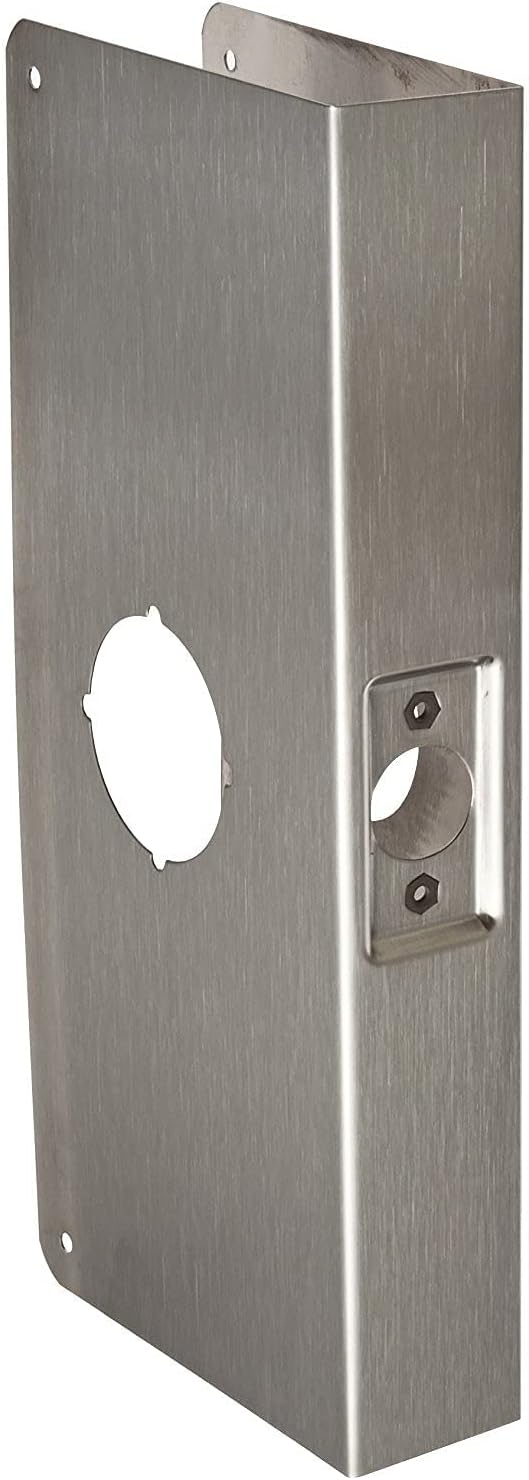
Key specs: 22-gauge (.032 inch) stainless steel wrap-around plate, 5-1/8 inches wide by 12 inches tall, drilled for a 2-1/8 inch cylinder bore at a 2-3/4 inch backset, specified for 1-3/4 inch thick doors, satin stainless finish
This one is a repair part first and a security part second, and it would be dishonest to sell it as armor. Its job is a door that has already lost: a stile split through the lock bore, a latch prep chewed out by a previous lock swap, or a kick the frame survived and the door did not. A wrap-around plate folds over the lock edge and clamps the two faces of the stile together, hiding the damage and stopping the split from spreading. Don-Jo’s specification sheet is precise about what this part is: 22 gauge at .032 inch, 5-1/8 inches wide by 12 inches tall, bored for a 2-1/8 inch cylinder at a 2-3/4 inch backset, for a 1-3/4 inch door. Read those numbers before ordering – if your lock sits at a 2-3/8 inch backset, the other standard residential dimension, this part will not line up and you want a different number from the same family. And if what you have is a latch that no longer meets the strike cleanly rather than split wood, our guide to common door lock problems is the cheaper place to start.
✅ Pros
- Covers visible damage and structural weakness in one part, on a door you would rather keep
- Stainless steel, satin finish, so it reads as hardware rather than as a patch
- Exact width, height, bore, backset and door thickness are published, so fitment is checkable before you buy
- Also useful when a lock change left an oversized or ragged bore
❌ Cons
- 22 gauge at .032 inch is thin next to the 16-gauge Door Armor pieces [7, 10]. It stiffens and covers; it is not an anti-kick component
- Unforgiving fitment: wrong backset, wrong bore or a 1-3/8 inch door and it will not fit
- Does nothing for the jamb, which is where the failure usually is
- Cosmetically obvious on a painted residential door – it looks like commercial hardware, because it is
What Not to Buy Twice
These four are not tiers of the same product, but they overlap in one direction, and it is worth saying so rather than letting four “Check Price” buttons imply you need all of them. The Door Armor kit already includes hinge shields and lock-area door shields, so buying it settles the jamb question outright.
What it does not replace: the hinge studs, which defeat a different attack – pin removal on an outswing door – rather than bracing the hinge-side jamb against a kick. Nor the wrap-around plate, which clamps an already-split door edge instead of resisting force. And not the screw kit, because those screws are for every other exterior door in the house.
Which Half of This Page Is Actually Yours?
🔩 Start with screws and stop there
- The door has never been forced and sits in view of a street or a neighbor
- You rent, and drilling the door or frame is not on the table
- Several exterior doors, one afternoon – screws cover all of them
- Your strike plate already has four holes and just needs longer fasteners
🛡️ Go straight to the full steel kit
- The door has already been kicked, or a neighbor’s has
- The entry is out of sight – a rear door, a side door, an alley-facing unit
- You own the property and want the fix to outlast tenants
- You want visible deterrence, not only structural improvement
The Order to Do This In
Sequencing matters more than it sounds like it should: doing the cheap steps first often removes the reason to do the expensive one, and tells you something real about your own door before you spend anything.
Four Steps, Cheapest First
1
Back out one screw
Remove a single strike plate screw. Its length, and what it gripped, tells you whether you have a problem at all.
2
Replace every short screw
Strike plates first, then at least one screw per hinge, 3 inches minimum [1, 2]. Check for a shim gap before driving them home.
3
Upgrade the plate if it is thin
A high-security strike plate should carry at least four screws of 3 inches or more. Swap a two-screw stamping while the door is open.
4
Only then add steel
A full jamb kit is right for an exposed or previously forced door – and a poor use of money on one that only needed screws.
If step two changes how the door feels when you shove it, you have bought most of the security available in this category.
Where Door Reinforcement Stops Working
Reinforcing a door redirects an attack; it does not delete one. Four places this hardware stops helping.
Glass beside the lock. A steel jamb shield is irrelevant if a sidelight sits within arm’s reach of the thumbturn. Seattle recommends a double-cylinder deadbolt where locks and knobs can be reached through adjacent glass – while noting its own building code does not permit double-cylinder deadbolts in apartment or condominium settings, a live fire-egress concern rather than a technicality. Check local code before keying both sides. Where the glass is the weak point, window film and bars address it more directly than anything on this page.
Doors that fail a different way. A sliding patio door is never defeated at a strike plate – it is lifted, pried at the interlock, or opened at a worn latch, which is why securing a sliding glass door is a separate job with separate hardware. French doors concentrate the weakness at the inactive leaf and its flush bolts, covered in our French door guide. And the door skipped most often is the one between the garage and the house, part of why the garage is a genuine weak point.
An unlocked door. BJS found unlawful entry without force to be the largest share of burglaries across the years it studied, and Brevard puts it at as many as half. Steel on a door left unlatched while you carry groceries in buys nothing at all.
Time, not immunity. Reinforcement converts a two-second kick into a noisy, conspicuous attempt – worth a great deal, but only if that time gets used by a neighbor, a camera, or an alarm, which is why a door alarm is the natural next layer. And if you are weighing all of this against a no-drill option because you rent, door security bars brace a closed door from the inside – a different trade entirely, since a bar only protects the door while you are home to set it.
Final Recommendation
Buy the Reinforced Door Screw Kit (3-Inch Screws) first and install it this week on every exterior door. It is the least profitable recommendation on this page and the one both police sources back, one of them saying outright that longer screws alone will deter or prevent most through-the-door forced entries [1, 2]. Fifteen minutes a door, no drilling, nothing to patch.
Then let the door decide whether you need more. If it has been kicked before, faces away from any street, or protects a property you rent out, add the Door Armor MAX 5-Piece Reinforcement Kit and consider the lock side finished. If it swings outward, add hinge studs – that attack does not care how good the rest of your hardware is. If the edge is already split, the Don-Jo plate is worth fitting before the split spreads, once you have measured the bore, backset and door thickness.
Three things would change this advice. A steel frame puts you outside everything here – these are wood-jamb fixes. A rental where you cannot drill points to bracing hardware instead of permanent steel. And a door whose real weakness is the glass beside it needs glass treatment and a lock decision first, because the strongest jamb on the street does not matter if the thumbturn can be reached through a broken pane.
SafeBode does not yet run an in-house product testing program. This guide is built from manufacturer specifications, official support documentation, current retail listings and verified buyer feedback rather than hands-on testing, and we say so plainly rather than implying testing we have not done.
Frequently Asked Questions
Will 3-inch screws split my door frame?
They can if you drive them carelessly. Pilot the hole where the wood is old or dry and stop when the head seats. The bigger risk is pulling rather than splitting: if the jamb is shimmed away from the stud, a long screw cranked down draws the jamb toward the framing and throws the door out of square. Check that gap first and pack it with a shim.
Do I need to take the door off to install any of this?
No for the screw kit, the hinge studs or the strike plate, and Armor Concepts states its own kit installs with only a drill and the door still hung. The wrap-around plate is the one job that gets easier with the door down, though it is not strictly required.
Does a door reinforcement kit work on a metal door or a metal frame?
These kits are designed around a wood jamb, which is what fails by splitting. A steel frame filled with mortar or grout does not fail that way and will not accept 3-inch wood screws. With a metal frame, look at latch protectors and commercial strike hardware instead.
Will this stop a pry bar as well as a kick?
Partly. Longer screws help against both, since prying also relies on the strike tearing out of soft material. Seattle’s guidance against pry attacks pairs those screws with a deadbolt and a latch guard covering the gap above and below where the knob and deadbolt engage – a separate part from anything in this lineup.
Is a door reinforcement kit the same thing as a door security bar?
No, and they are not substitutes. A bar braces a closed door from the inside and only works while someone is home to set it. Reinforcement hardware is permanent and works whether the house is occupied or empty, which is what you want against a daytime break-in.
Can a renter install any of this?
The screw kit, realistically yes – you are reusing existing holes and swapping fasteners, which most landlords treat as maintenance rather than modification. Ask anyway, in writing. The steel kits drill new holes into the door and frame, so those need explicit permission.
Do I still need a better deadbolt if I reinforce the jamb?
If you already have a competent deadbolt with a full-length throw, reinforcing the jamb is the better next dollar. If your exterior door has only a knob lock, buy the deadbolt first – reinforcing the frame around a latch a card can slip is solving the wrong problem.
How do I tell whether my door swings in or out?
Stand outside and look at the hinges. If you can see the barrels and pins from out there, the door swings outward and the hinge-side advice here applies to you. If the hinges are invisible from outside, it swings inward: skip the studs, still do the long screws.
How long does the whole job take?
Screws on one door run about a quarter of an hour, most of it finding the right bit. A full steel kit is the longer job – the manufacturer quotes under half an hour per door, and a first-time install on an out-of-square door realistically runs longer. Four doors’ worth of screws is still a shorter afternoon than one full kit.
Sources
Show sources (10)
- [1] Seattle Police Department Crime Prevention Bulletin – “Home Security: Door Security,” seattle.gov/documents/Departments/Police/Prevention/Home_Security_Door_Security.pdf
- [2] City of Brevard, North Carolina, Police Department Crime Prevention – “Locks, Strike Plates & Hinges,” cityofbrevard.com/428/Locks-Strike-Plates-Hinges
- [3] U.S. Department of Justice, Bureau of Justice Statistics – “Household Burglary, 1994-2011,” NCJ 241754, June 2013, bjs.ojp.gov/content/pub/pdf/hb9411.pdf
- [4] Builders Hardware Manufacturers Association – “A156.40 – 2025 Residential Deadbolts,” buildershardware.com/ANSI-BHMA-Standards/Hardware-Highlights/A15640-2025-Residential-Deadbolts
- [5] Amazon US product listing for ASIN B0CHXCRMLS – Reinforced Door Screw Kit, kit contents and fastener specifications
- [6] Armor Concepts – Door Armor product description and US Patent 7,946,635, doorarmor.com
- [7] Amazon US product listing for ASIN B00E9ZGWH2 – Door Armor MAX 5 Piece Door Reinforcement Kit, kit contents, steel gauge and included fasteners
- [8] Hinge Outlet, Inc. – “Advantages of Security Door Hinges,” hingeoutlet.com/blogs/news/96054977-advantages-of-security-door-hinges
- [9] Hinge Outlet, Inc. – “Security Hinge Pins – Make any hinge a security hinge,” product page and how-it-works description, hingeoutlet.com
- [10] Don-Jo Manufacturing – “12 CW” wrap-around plate product specifications, don-jo.com/products/12-cw/


