How to Secure a Garage Door: The Seven Fixes, in Priority Order
Affiliate Disclosure: This article contains affiliate links. If you buy through these links, we may earn a commission at no extra cost to you. Our editorial opinions are our own and are not influenced by affiliate relationships. Read our full disclosure policy →
Contents
Quick Answer
Do three things this weekend and the garage stops being the easy way in. Secure the emergency release so it cannot be fished through the top of the door — the Granatan release lock kit moves it to a keyed cylinder without giving up manual entry in a power cut. Fit an inside deadlock into the vertical track for nights and vacations. And put an exterior-grade door with a real deadbolt between the garage and the house, because that is the door most people have never thought about at all.
The Coat Hanger Attack, and the Part Nobody Reports
The technique is simple enough to describe in one sentence, and it is described the same way by a police department and by the garage door industry’s own trade association. An intruder slides a hooked length of straightened coat hanger between the header and the top section of the door, catches the emergency release lever or the cord attached to it, and pulls. The door disconnects from the opener and can then be lifted by hand. San Francisco’s Taraval police station describes the same method and notes it can be done without garage door windows, on feel alone, if you know where the release sits.
The demonstrations are genuinely fast. DASMA’s account records a manufacturer representative grabbing the cord and opening a door with no windows in three seconds, and a break-in contest at a 2002 security conference won in five seconds using nothing but a coat hanger. A 32-year police veteran and crime prevention specialist quoted in the same piece described thieves leaning against overhead doors with coat hangers as a routine method. The article also notes, drily, that cord-grabbing is a favorite way for locksmiths to enter homes where the owner is locked out.
Here is the half that almost never gets repeated, and it is why this article is not a scare piece. Manufacturers quoted in the same DASMA article push back on how universally it applies. Hormann’s US general manager notes the scenario presumes an attached garage, a clear line of sight, enough light to see the mechanism, and room to maneuver the hanger. Another manufacturer points out that the release must be pulled downward, and that since the top of the top section sits at about the same height as the cord, a wire hanger struggles to generate that pull. A third notes that mounting the trolley arm at 45 degrees rather than 90 moves the carriage and release 16 to 20 inches further from the door, making it much harder to reach.
What the Evidence Actually Supports
The attack is real
- Demonstrated at three and five seconds on real doors
- Described independently by a police department
- Works without windows, on feel, if the release position is known
- A known locksmith entry method, not a theoretical one
- Requires no tools beyond a coat hanger
And the panic is overdone
- Presumes an attached garage and a clear line of sight
- Needs light to see the mechanism and room to work
- The release needs a downward pull a hanger delivers poorly
- A 45-degree trolley arm moves the release well out of reach
- Some openers have no dangling center cord at all
The sensible reading is that this is a real vulnerability that costs almost nothing to close, so close it — and then move on to the fixes that matter more often, which are further down this list and much less interesting.
The Seven Fixes, in Priority Order
Ordered by how much security each one buys for the effort, not by how alarming the problem sounds. Most households will do the first four and stop, and that is a reasonable place to stop.
| # | Fix | Effort | What it stops |
|---|
| 1 | Secure the emergency release | 30 minutes | The coat hanger attack, entirely |
| 2 | Fit an inside deadlock or slide latch | 20 minutes | The door being lifted at all, while you are away |
| 3 | Upgrade the garage-to-house door | An afternoon | A garage break-in becoming a house break-in |
| 4 | Get the remote out of the car | Free | A car break-in handing over your house |
| 5 | Cover or frost the windows | An hour | Anyone confirming the garage is worth entering |
| 6 | Add a light and a camera | An hour | The unhurried, unobserved working conditions |
| 7 | Know when it is open | 30 minutes | The most common failure of all — leaving it up |
Notice that only one of the seven is about the mechanism everyone worries about. Security.org makes the same point from a different angle in its home-security walkthrough: the first garage question is whether the door can be lifted when closed, and the second is whether the connecting door into the house is locked.
Fix One: Deal With the Release Cord
There are three ways to close this and they differ in what they cost you in an emergency, which is the trade to think about rather than the security.
Three Ways to Secure the Release
1
Shorten or remove the cord
Free. Take the cord off and leave only the lever, which sits higher and is far harder to hook. The SFPD note observes this alone makes entry more time-consuming.
2
Zip-tie the lever
Nearly free, and the option to be careful with. It works, and it also means you cannot release the door by hand in a hurry unless you can cut the tie.
3
Fit a keyed release lock
The proper fix. Moves the release to an exterior keyed cylinder so you keep manual entry during a power cut and an intruder gains nothing from the cord.
4
Re-angle the trolley arm
Free if you are comfortable adjusting the opener: mounting at 45 degrees rather than 90 moves the carriage 16 to 20 inches further from the door.
Pick by how you would get in if the power failed and the side door were locked.
The zip-tie deserves a warning rather than a recommendation. It is genuinely effective and it is genuinely a trade: the emergency release exists so a door can be opened manually when the opener has no power, and a tie that a person under stress cannot break defeats that on purpose. If you use one, use a light tie you can snap by hand, keep cutters in the garage, and make sure everyone in the house knows it is there. If your garage has no side door at all, do not use a tie — use the keyed release lock, which is exactly the case its manufacturer describes it for.
Fixes Two and Three: Actually Lock the Door
An automatic opener holds the door closed; it does not lock it. Those are different things, and the difference shows up the moment the door is disconnected from the opener by any means. A mechanical lock that engages the track means the door cannot be lifted even after a successful release-cord attack, which is why this pairs with fix one rather than replacing it.
The classic version is an inside deadlock: a galvanized steel slide bolt mounted horizontally on the door so the bolt drops into the vertical track. It is cheap, it is mechanical, and it has one property you have to design around — it works only from the inside. That makes it a nights-and-vacations lock, engaged when you are home or when you leave through another door, rather than something you use daily. If your door has internal grooves rather than a track the deadlock suits, a slide latch with a colored handle cover is the alternative, and the visible red handle is a genuinely useful detail: you can see from across the garage whether it is engaged.
One important caution that applies to both. If the door is mechanically locked and somebody presses the opener remote, the opener will try to lift a locked door. On many openers that means a strained belt, a stripped gear or a bent panel. Some systems have a lock mode that disables the remote; if yours does not, the discipline has to be human, which is another argument for treating these as away-from-home locks rather than everyday ones.
Fix Four: The Door Into the House Is Probably the Weakest Thing You Own
This is the fix with the worst ratio of importance to attention, and it is the one we would argue matters most in practice. Walk into your garage and look at the door leading into the house. In a very large number of homes it is a hollow-core interior door with a passage knob and no deadbolt, hung in a frame with short screws — because at some point somebody treated it as an internal door rather than as an exterior one.
It is an exterior door. Once someone is inside the garage they are working out of sight, out of the weather and with the door closed behind them, which is the most comfortable working environment a burglar could ask for. Security.org’s guidance is blunt on the principle: if the garage connects to the home, that connecting door needs to be locked, and locked means a deadbolt rather than a knob.
Three concrete steps, in order. Replace a hollow-core slab with a solid-core or exterior-rated door if that is what you have. Fit a deadbolt with a full throw, and use screws long enough to reach the framing behind the jamb — our guide to installing a deadbolt properly covers exactly that, and the strike-plate screws matter more than the lock does. Then, if you want the belt and braces version, add a contact sensor to that door so a garage entry raises an alarm inside the house; our roundup of wireless door and window sensors covers the options, and standalone door alarms is the version that needs no system behind it.
Fixes Five to Seven: The Remote, the Windows and Knowing It Is Shut
The remaining three are quick, and one of them is free and prevents a specific, common disaster.
Do not leave the opener remote clipped to a visor. A car broken into on a driveway or in a parking lot hands over the garage, and if the registration or insurance documents are in the glovebox it hands over the address as well. Security.org states the rule directly: never leave a garage door opener in your vehicle. Use a keypad on the door frame, or the phone app, or a keychain remote that stays with your house keys. This costs nothing and closes a whole category of attack.
Cover the windows. A garage window is a shopping catalog — it tells someone whether there are tools, bikes, a second car or nothing worth the trouble, and Security.org specifically suggests frosting or covering them and mentions privacy film for garages and sheds holding valuable equipment. Our roundup of privacy window film covers the options, and the same logic applies to any shed or outbuilding on the property.
Finally, know when it is open, because the single most common way a garage gets entered is that it was left up. A smart controller adds app control and, more usefully, a scheduled auto-close so the door cannot stay open overnight by accident. Pair that with a motion light and a camera covering the driveway approach — our driveway camera roundup and our guide to outdoor motion sensor lights both cover that approach, and light plus observation removes exactly the unhurried working conditions the DASMA manufacturers said the release-cord attack depends on. And if the opener itself predates rolling-code remotes, replacing it beats accessorizing it — our roundup of smart garage door openers covers the models that report state and close themselves on a schedule.
Granatan Emergency Release Lock Kit — for the release cord
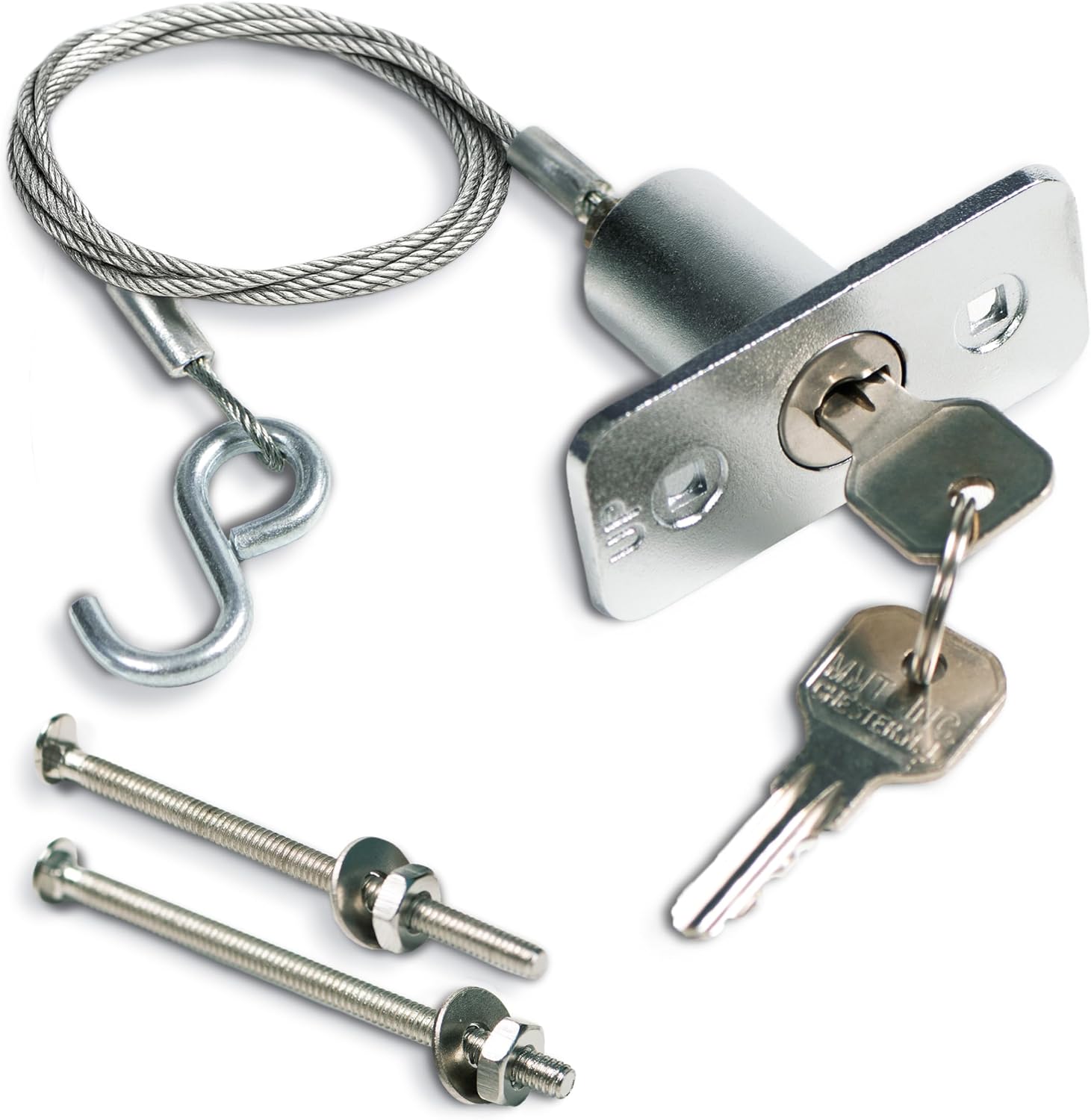
Key specs: Keyed disconnect that moves the emergency release to an exterior lock cylinder instead of a dangling cord; brushed chrome tamper-resistant cylinder with two keys, a lock housing and a 2.95 ft steel cable; universal fit stated for LiftMaster, Chamberlain, Genie and many other overhead openers; intended for garages with no side door, so manual entry is still possible in a power cut
This is the version of fix one that does not cost you anything in an emergency. Instead of removing or tying the release, it relocates it: a keyed cylinder on the outside of the door operates the disconnect through a 2.95 ft steel cable, so you keep the ability to open the door manually in a power cut while an intruder gets nothing from fishing at the top section. The kit includes the housing, the cylinder, two keys and the cable, and the manufacturer states universal compatibility with LiftMaster, Chamberlain, Genie and many other overhead openers. The listing is explicit that this is aimed at garages with no side door, which is exactly the situation where a zip tie is a bad idea. Check your own opener’s carriage before ordering; universal means most, not all.
✅ Pros
- Keeps manual emergency access, which a zip tie removes
- Keyed cylinder rather than an exposed cord or lever
- Stated compatibility across the major opener brands
- The right answer for a garage with no side door
- Complete kit — housing, cylinder, keys and cable
❌ Cons
- Universal fit is a claim, not a guarantee — check your carriage
- Adds a lock cylinder on the exterior of the door to maintain
- More work than simply removing the cord
- Modest review base compared with the mechanical locks
- Does nothing about the door being lifted by other means
Prime-Line GD 52118 Inside Deadlock — for locking the track
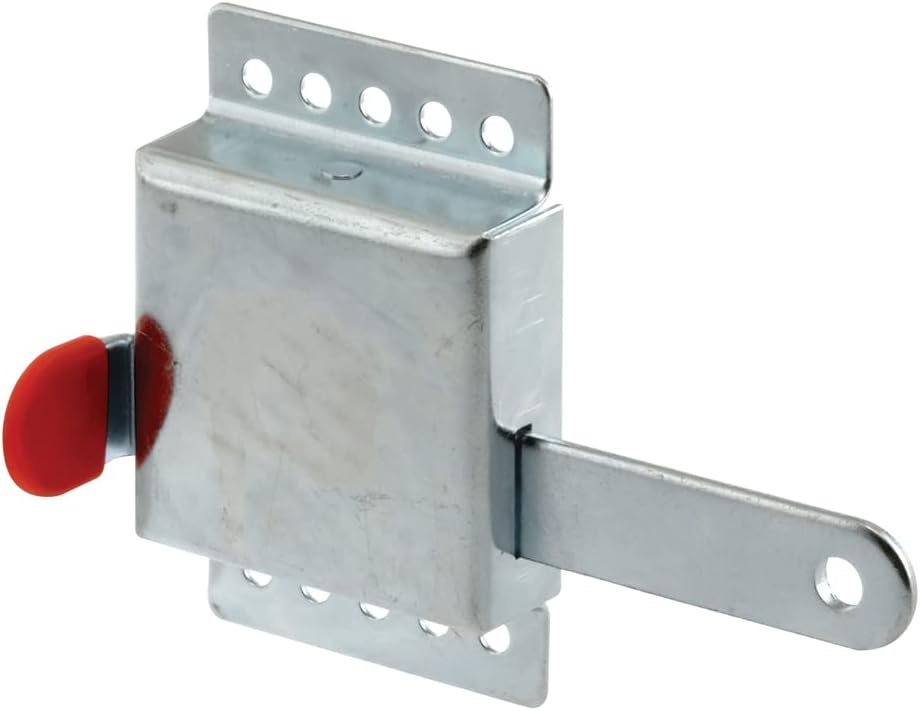
Key specs: Heavy-duty galvanized steel slide bolt, 7/8 in wide and 1/8 in thick in a galvanized housing, fitted horizontally on the door so the bolt engages the vertical track; works only from inside, which makes it a nights-and-vacations lock rather than an everyday one; fits most sectional garage doors
The oldest fix in the category and still the most convincing, because it is mechanical and there is nothing to defeat electronically. A galvanized steel slide bolt in a galvanized housing mounts horizontally on the door and drops into the vertical track, so the door physically cannot travel. It is 7/8 in wide and 1/8 in thick, and the listing tells you to check those dimensions against your existing lock position or the space you intend to use, which is the one measurement people skip. Understand the design constraint clearly: it engages only from inside, so this is the lock you use overnight or before a vacation when you are leaving by another door, not a daily convenience.
✅ Pros
- Purely mechanical — nothing to hack or power
- Stops the door moving even after a successful release attack
- Heavy galvanized steel that will outlast the opener
- Fits most sectional doors with a vertical track
- Cheap enough to fit on both doors of a double garage
❌ Cons
- Inside only, so it cannot be your everyday lock
- If someone hits the remote while locked, the opener strains
- Needs the stated clearance in the track to fit at all
- You have to remember to engage it, every time
- Not usable at all if the garage is your only way in and out
YCAIGKG Heavy Duty Garage Door Slide Latch — for doors the deadlock will not fit
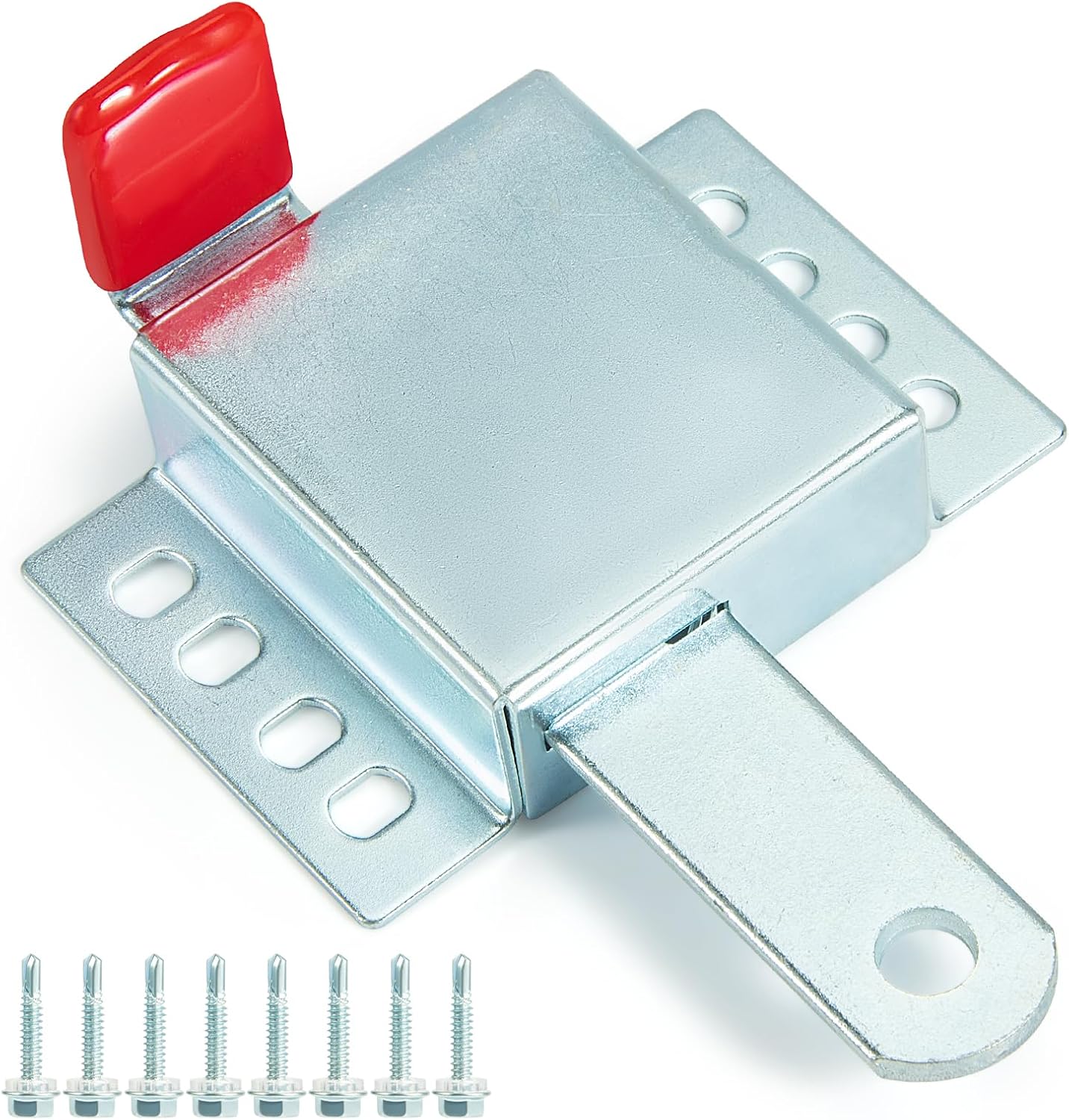
Key specs: Galvanized high-strength steel slide latch for garage doors with internal grooves, supplied with eight self-tapping screws and installed by removing a knock-out on each side; red PVC handle cover so locked and unlocked are visible at a glance and fingers are protected; corrosion-resistant galvanized finish
Same principle, different geometry, and worth knowing about because garage doors are not standardized in the way people assume. This is a galvanized high-strength steel slide latch for doors with internal grooves, installed by removing a knock-out on each side and fixing with the eight supplied self-tapping screws. The detail that makes it better than it looks is the red PVC handle cover: it protects your fingers on the steel edge, and it makes locked-versus-unlocked visible at a glance from across the garage. That sounds trivial and it is not, because the failure mode of every lock in this section is somebody forgetting whether they engaged it. Same inside-only limitation as the deadlock, and the same caution about the opener straining against a locked door.
✅ Pros
- Fits doors with internal grooves where a track deadlock will not
- Colored handle makes the lock state visible across the garage
- Galvanized against corrosion in an unheated space
- Self-tapping screws included, so no extra hardware
- Straightforward install with a knock-out on each side
❌ Cons
- Inside only, like every mechanical garage lock
- Requires the right internal groove profile to fit
- Smaller review base than the Prime-Line equivalent
- Seller brand rather than an established hardware name
- Same opener-strain risk if the remote is pressed while locked
Chamberlain myQ Smart Garage Control — for knowing it is closed
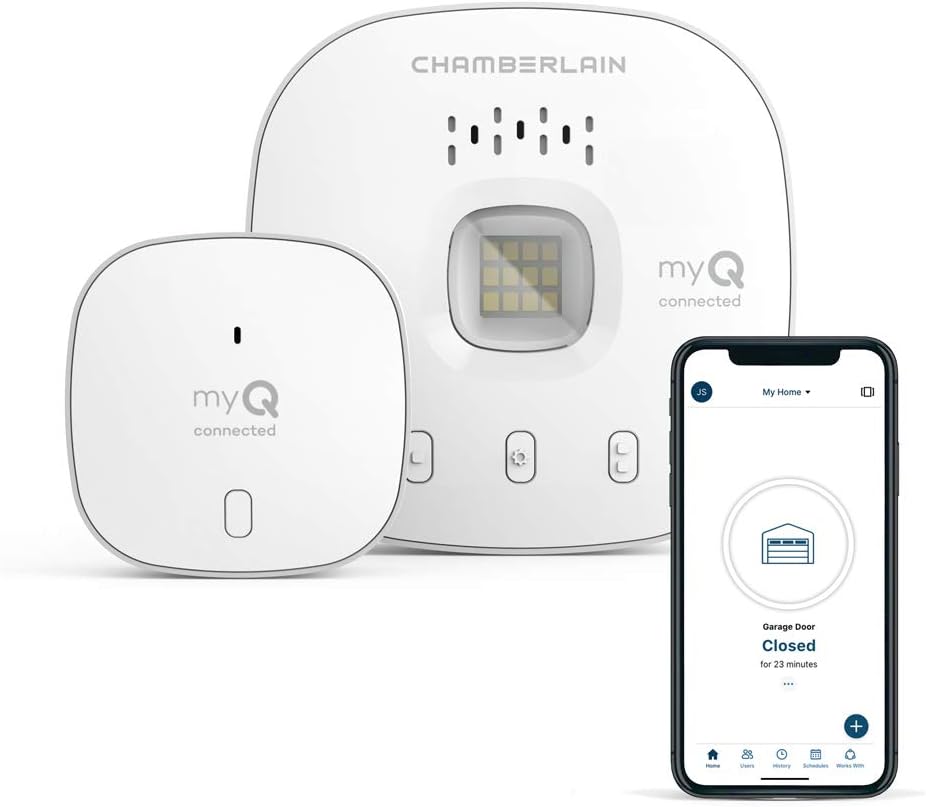
Key specs: Wireless hub and door sensor that add app control to an existing opener over Wi-Fi and Bluetooth; open and close from anywhere, share access, and set a scheduled auto-close so the door is never left up overnight; works with most openers made after 1993 that use photoelectric sensors which stay powered, with stated exceptions including Linear openers and Chamberlain Group units with a yellow learn button made between 2010 and 2021
This addresses the failure that actually happens most: the door left open. A wireless hub and door sensor add app control to an existing opener over Wi-Fi and Bluetooth, so you can check and close from anywhere, share access with family, and — the feature worth buying it for — set a schedule so the door closes automatically rather than staying up overnight. It is worth reading the compatibility note carefully before ordering, because it is specific: most openers made after 1993 that use photoelectric sensors which stay powered, with stated exceptions including Linear openers and Chamberlain Group units with a yellow learn button made between 2010 and 2021. Understand what this is not: it is convenience and awareness, not a lock. It does nothing about the release cord and nothing about the door being lifted.
✅ Pros
- Fixes the most common real failure — leaving it open
- Scheduled auto-close removes the human error entirely
- Works with an existing opener rather than replacing it
- Shared access without handing out physical remotes
- Enormous installed base, so compatibility is well documented
❌ Cons
- Not a lock — adds awareness, not resistance
- Compatibility exclusions are real and worth checking first
- Puts the garage door on your Wi-Fi and on an account
- Depends on internet and power to be useful
- Does nothing about the release cord or a manual lift
What to Actually Do
Start with the release. If your garage has a side door or another way in, take the cord off the lever this afternoon; it costs nothing and the SFPD’s own note says removing it makes entry meaningfully more time-consuming. If the garage is your only way in, fit the Granatan release lock kit instead, because that preserves manual entry in a power cut while closing the same hole.
Then fit the Prime-Line inside deadlock and use it whenever you are away overnight — or the YCAIGKG slide latch if your door’s groove profile suits it better. Then spend an afternoon on the door between the garage and the house: solid-core, a real deadbolt, long screws into framing. That door is where a garage entry either stops or becomes a house entry, and in most homes it is currently the weakest door in the building.
Add the myQ controller if you have ever driven away wondering, because a scheduled auto-close eliminates the most common way a garage is actually entered. What would change this order entirely: a detached garage with no connecting door. In that case fix four disappears, the release-cord attack matters less because there is no house on the other side, and the priority becomes lighting, a camera and a genuinely good lock on the side door — a different problem, closer to securing an outbuilding than to securing a house. One more garage-specific item belongs on the list either way: fire safety authorities recommend a heat alarm rather than a smoke alarm in a garage, and our roundup of heat detectors explains why and which ones fit.
SafeBode does not yet run an in-house product testing program. This guide is built from manufacturer specifications, official support documentation, current retail listings and verified buyer feedback rather than hands-on testing, and we say so plainly rather than implying testing we have not done.
Frequently Asked Questions
Can a burglar really open my garage with a coat hanger?
On many attached garages with a trolley opener and a dangling release cord, yes — demonstrations have opened doors in three to five seconds, and a police department describes the same method. Manufacturers correctly point out that it presumes an attached garage, a line of sight, enough light and room to work, and that the release needs a downward pull that a wire hanger delivers poorly. Treat it as a real hole that costs almost nothing to close.
Should I zip-tie my garage door emergency release?
Only if you have another way into the garage and everyone in the house knows the tie is there. The release exists so the door can be opened manually when the opener has no power, and a tie that cannot be broken by hand defeats that deliberately. If the garage is your only entrance, use a keyed release lock instead.
Do garage door side locks actually work?
Yes, and they are the most convincing fix in this article because they are mechanical. A slide bolt engaging the vertical track means the door cannot travel even if someone has disconnected it from the opener. The limitation is that they engage from inside, so they are a nights-and-vacations lock rather than an everyday one.
What happens if I press the remote while the garage door is locked?
The opener will try to lift a door that cannot move, which risks a strained belt, a stripped gear or a bent panel depending on the opener. Some systems have a lock mode that disables the remote while engaged; if yours does not, everyone in the household needs to know the lock is on.
Is the door between my garage and house really a security problem?
In a great many homes, yes, because it was fitted as an interior door: hollow core, a passage knob, no deadbolt, short screws. Treat it as an exterior door. Once someone is in the garage they are working unseen with the door closed behind them, which is why that connecting door is the one that decides whether a garage entry becomes a house entry.
Are smart garage controllers a security upgrade?
They are an awareness upgrade rather than a resistance one. The genuine value is a scheduled auto-close, which eliminates the most common way garages are actually entered — being left open. They do nothing about the release cord or a manual lift, so pair one with a mechanical lock rather than treating it as a substitute.
Should I cover my garage windows?
Yes, and it is one of the cheapest fixes here. A garage window tells a passer-by whether there is anything worth entering for. Frosting film or a simple covering removes that information without removing the daylight, and the same argument applies to a shed or workshop window.
Where should I keep the garage remote if not in the car?
On your house keys, or replace it with a keypad on the door frame or a phone app. A remote clipped to a visor turns any car break-in into a house break-in, and if vehicle documents are in the glovebox the thief also has the address. This fix is free and closes an entire category of attack.
Does an older garage door opener need replacing for security?
If it predates rolling-code technology, its fixed code can in principle be captured or guessed, and that is a genuine reason to upgrade. For most people, though, the release cord and the unlocked connecting door are far more likely routes than a code attack, so fix those first and treat the opener as a longer-term project.
Sources
Show sources (7)
- [1] DASMA — GDO: The Weakest Link in Home Security, carrying both the release-cord demonstrations and the manufacturers’ rebuttals, www.dasma.com/gdo-the-weakest-link-in-home-security
- [2] San Francisco Police Department, Taraval Station — Thieves can Break Into Locked Garages with Just a Coat Hanger, www.taraval.org/?p=17711
- [3] Security.org — How to Secure Your Home, including its garage section, www.security.org/home-security-systems/how-to-secure-home
- [4] Granatan — Garage Door Emergency Release Lock Kit, current retail listing specifications (ASIN B0CM3RCYHF)
- [5] Prime-Line — GD 52118 Inside Deadlock, current retail listing specifications (ASIN B0002YXMBS)
- [6] YCAIGKG — Heavy Duty Garage Door Locking Slide Latch, current retail listing specifications (ASIN B0F7XF2M16)
- [7] CHAMBERLAIN — Smart Garage Control, myQ, current retail listing specifications (ASIN B08GD3D9YJ)


