Best Patio and Sliding Door Security Locks and Bars 2026
Affiliate Disclosure: This article contains affiliate links. If you buy through these links, we may earn a commission at no extra cost to you. Our editorial opinions are our own and are not influenced by affiliate relationships. Read our full disclosure policy →
Contents
Quick Answer
A sliding or patio door has two separate weaknesses, and no single product fixes both. The factory latch is weak against being forced or jimmied, and on many doors the whole panel can be lifted up and off its track hard enough to bypass that latch entirely. If you rent or just want the fast fix, start with a pressure-mounted security bar in the track — no drilling. If you own the home and the factory latch itself is loose or flexes, replace it with a keyed handle set instead of layering more hardware on top of a bad latch. A pin lock is the cheapest add-on and doubles as a vent stop; a foot lock adds a second, hands-free point of resistance and is easier for small children to leave alone than a latch they can reach and see. For a step-by-step walkthrough of installing each type, see our full how-to guide.
Two Different Failures, Not One
Most patio door buying guides talk about “upgrading the lock” as one project. It is actually two, and confusing them is how people spend money on a bar or a pin and still have an unsecured door. A municipal home-burglary-prevention program lays out the split plainly: sliding-glass doors are “secured by latches not locks,” and those latches are “inherently defective,” leaving the door “vulnerable to being forced open from the outside”. That is failure one — the latch itself is weak. Failure two is separate and just as common: on many sliding doors, especially older installs with worn rollers, the entire panel can be lifted up and out of its track by a half inch to three-quarters of an inch, which disengages the latch mechanism without breaking or even touching it.
A test cited by SafeWise found that a sliding glass door with no upgrades can be forced open in under 10 seconds using nothing more than lifting the door, jiggling the latch, or breaking the glass outright. None of those three techniques requires tools a burglar would need to carry openly, which is part of why patio and sliding doors get picked over a front door with a real deadbolt.
The reason this matters for shopping is that a track-mounted bar only solves the horizontal half of the problem. It stops the door from sliding open. It does nothing about a door that lifts up and out of the same track, which is exactly the failure mode that defeats a bar on its own on older installs. You need something that addresses lift separately, whether that is an anti-lift pin, a foot lock mounted low in the track, or simply replacing rollers that have worn enough to let the panel wander in the first place.
The Numbers Behind the Vulnerability
<10 sec
to force open an unmodified sliding door by lifting, jiggling or breaking the glass
56%
of burglars who enter a home come through a door, not a window
81%
of burglars enter through some first-floor opening, door or window
½–¾ in.
how far most sliding panels can lift before the latch disengages
Figures as reported by the cited sources; the lift measurement describes typical clearance on an unmodified door, not a guarantee for every model.
Four Layers, Four Different Jobs
Once you separate the two failures above, the shopping list stops looking like four competing options and starts looking like four jobs that can overlap or stack depending on your door and your budget. This is also why we are recommending four different product types instead of ranking one “best” pick — they are not interchangeable.
What Each Layer Actually Stops
1
Block sliding
A security bar or dowel in the track stops the panel from being pushed open horizontally, whether the latch holds or fails.
2
Block lifting
A pin lock or an anti-lift screw stops the panel from being lifted up and out of the track, which a bar alone does not address.
3
Fix the latch
A keyed handle-and-mortise-lock replacement solves the actual defect — a weak factory latch — instead of working around it.
4
Add a second point
A foot lock or a hands-free secondary lock gives you resistance even if someone defeats the primary latch, and it is awkward for a small child to operate accidentally.
Most homes only need one or two of these, not all four — see the Final Recommendation for how to pick.
Bar, Pin, Keyed Lock and Foot Lock Side by Side
The table below compares what each product type actually does, not just what it costs. “Addresses lift” is the column that decides whether you need a second product alongside your first pick.
| Security Bar | Pin Lock | Keyed Handle Set | Foot Lock |
|---|
| Stops sliding open | Yes | Yes, while pin is inserted | Yes, via the latch itself | Yes |
| Addresses vertical lift | No, on its own | Partially, if installed as an anti-lift point | No, unless paired with a lift fix | Yes, mounted low in the track |
| Installation | Pressure-mounted, no drilling | Small drilled hole through the frame | Full handle swap, several screws | Screwed to the floor track |
| Renter-friendly | Yes | Usually needs landlord sign-off for the hole | No, replaces existing hardware | Usually needs landlord sign-off |
| Replaces the factory latch | No | No | Yes | No |
| Typical role | Primary, fast fix | Secondary add-on / vent stop | Primary, permanent fix | Secondary, hands-free |
AceMining Sliding Door Security Bar — the no-drill starting point
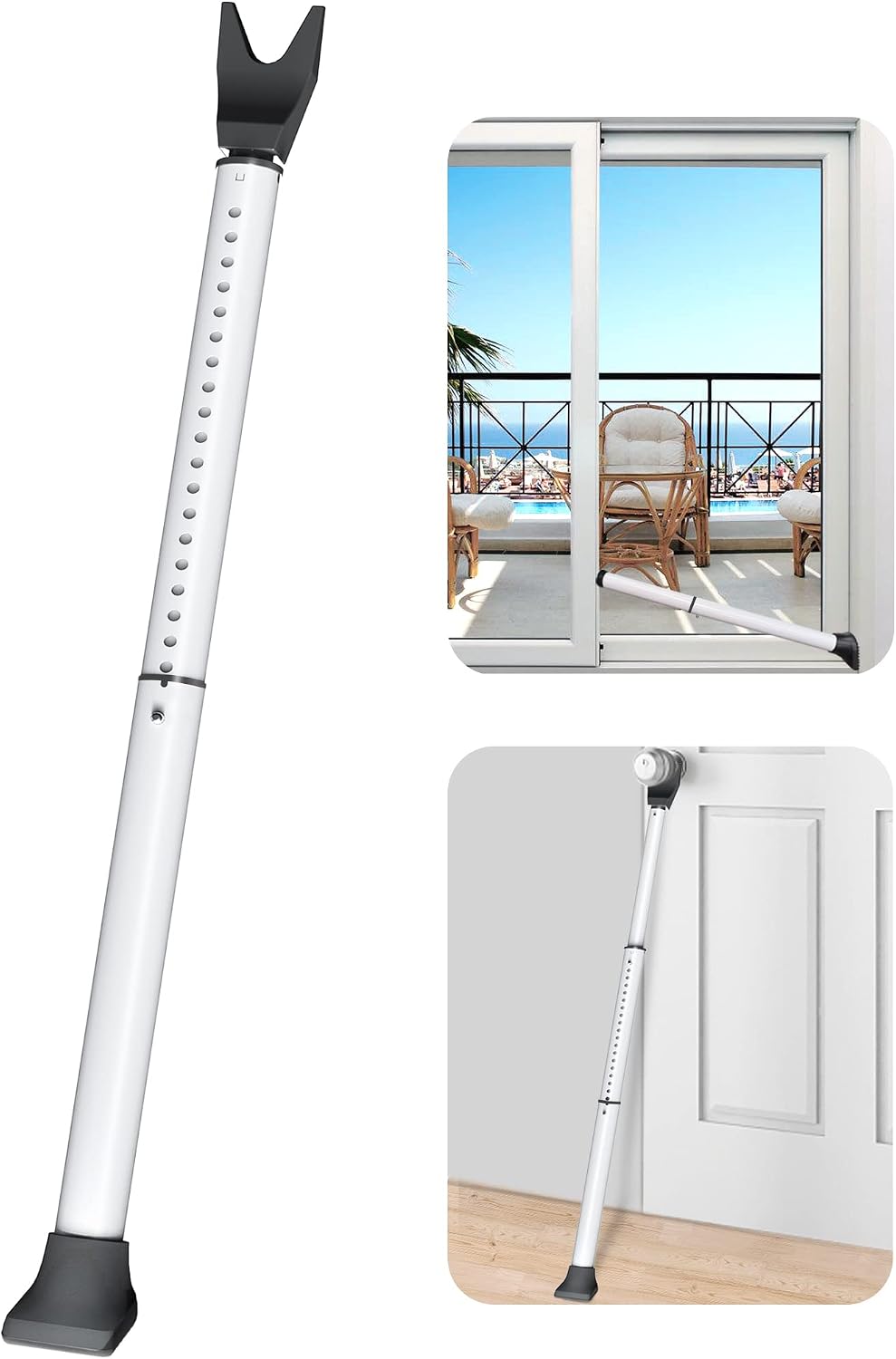
Key specs: Adjustable 20-50 in. telescoping steel bar; pressure-mounts inside the door track, no drilling; padded end caps; white finish; also fits sliding windows
This is where almost everyone should start, and it is the pick that both cited sources describe in nearly identical terms: a bar or dowel set into the track that physically blocks the panel from sliding, no tools or drilling required. It telescopes to fit door openings from 20 to 50 inches, mounts with a pressure system rather than screws, and comes off in seconds if you need to open the door — which also means it comes off in seconds for anyone already inside, so it is a burglary deterrent, not a child lock. Renters in particular should read our no-drill renter security guide before buying anything that needs a drilled hole instead.
✅ Pros
- No drilling, fully reversible, deposit-safe for renters
- Adjustable range covers most standard sliding and patio door widths
- Padded end caps protect the door frame and glass track
- Doubles as a security bar on a sliding window, not just a door
❌ Cons
- Solves the horizontal slide only — does nothing for a door that lifts out of its track
- A determined attempt to jiggle a track-mounted bar can work it loose over time, per SafeWise’s own testing notes on similar bars
- Anyone already inside the home can remove it as quickly as you can
- Needs to be re-seated correctly every time the door is used, which some households find annoying
Prime-Line Sliding Patio Door Pin Lock — the cheapest real upgrade
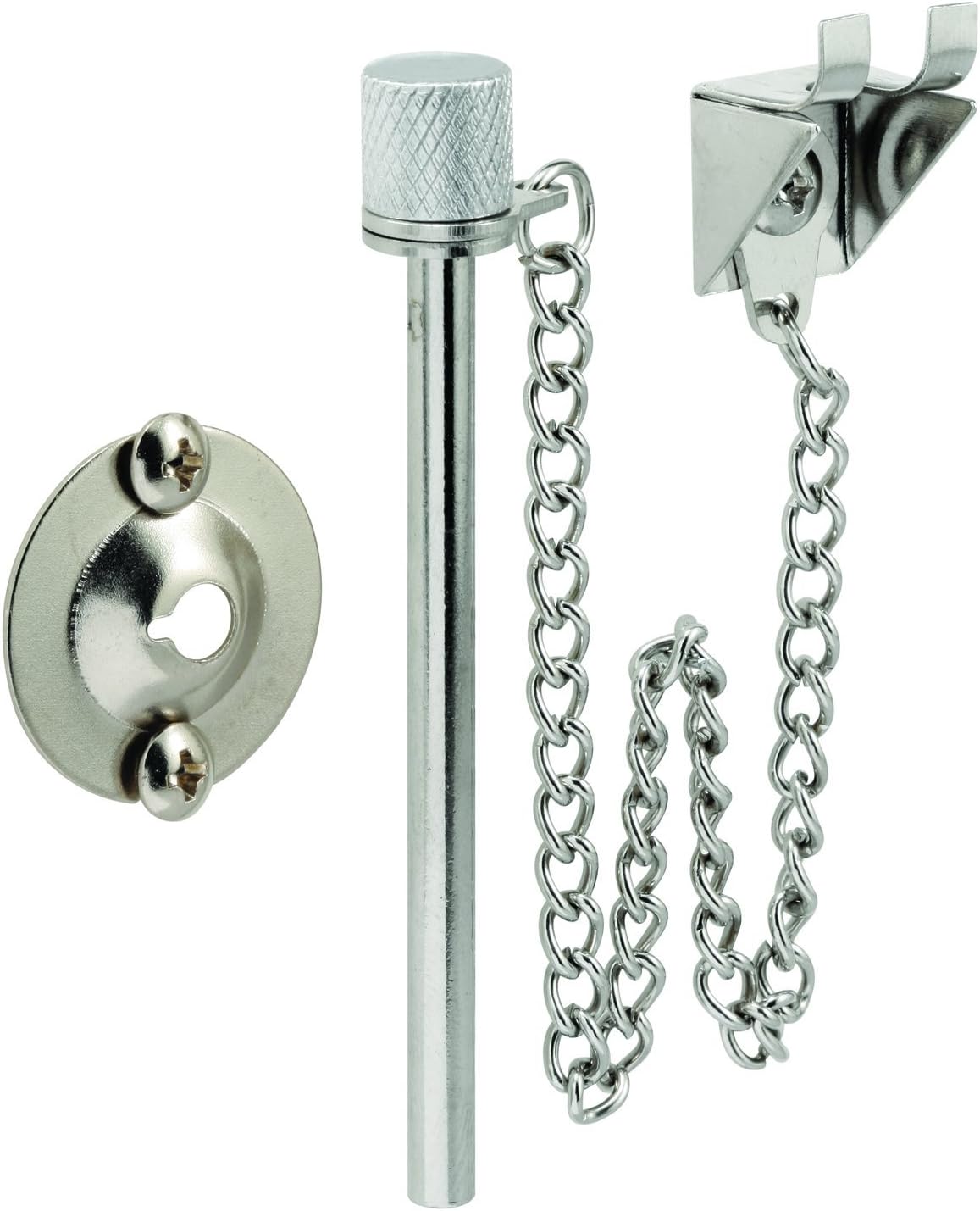
Key specs: Steel pin with retaining ring, 3/16 in. x 2-5/8 in., chrome-plated finish; drills through the sliding panel into the fixed frame; single pack
Prime-Line is a long-standing door and window hardware brand, and this steel pin is the classic, inexpensive way to add a second lock point beyond the factory latch. It drills through the sliding panel into the fixed frame — a small hole, not a structural modification — and physically prevents the door from sliding even if the latch itself is defeated. Positioned at the top of the track rather than partway down, the same style of pin is also the anti-lift fix the earlier sections describe: it passes through both the sliding and fixed portions of the frame, which stops the panel from being lifted rather than just slid.
✅ Pros
- Recognized hardware brand rather than an unbranded import
- Doubles as a vent-position lock — drill a second hole partway open to lock the door cracked for airflow without leaving it fully accessible
- Cheap enough to install one at the top (anti-lift) and one at the base (anti-slide) for a few dollars total
- Steel construction with a chrome finish, not the softer alloy some off-brand pins use
❌ Cons
- Requires drilling, so this is not the pick for a lease that forbids modifications
- Sold as a single pin — covering both the lift and slide vulnerabilities means buying and installing two
- A pin alone does not resist a determined pry attempt the way a full mortise lock does
- Easy to lose track of which of several drilled holes is the “locked” position on an unfamiliar door
Keyed Sliding Patio Door Handle Set with Mortise Lock — fixing the latch itself
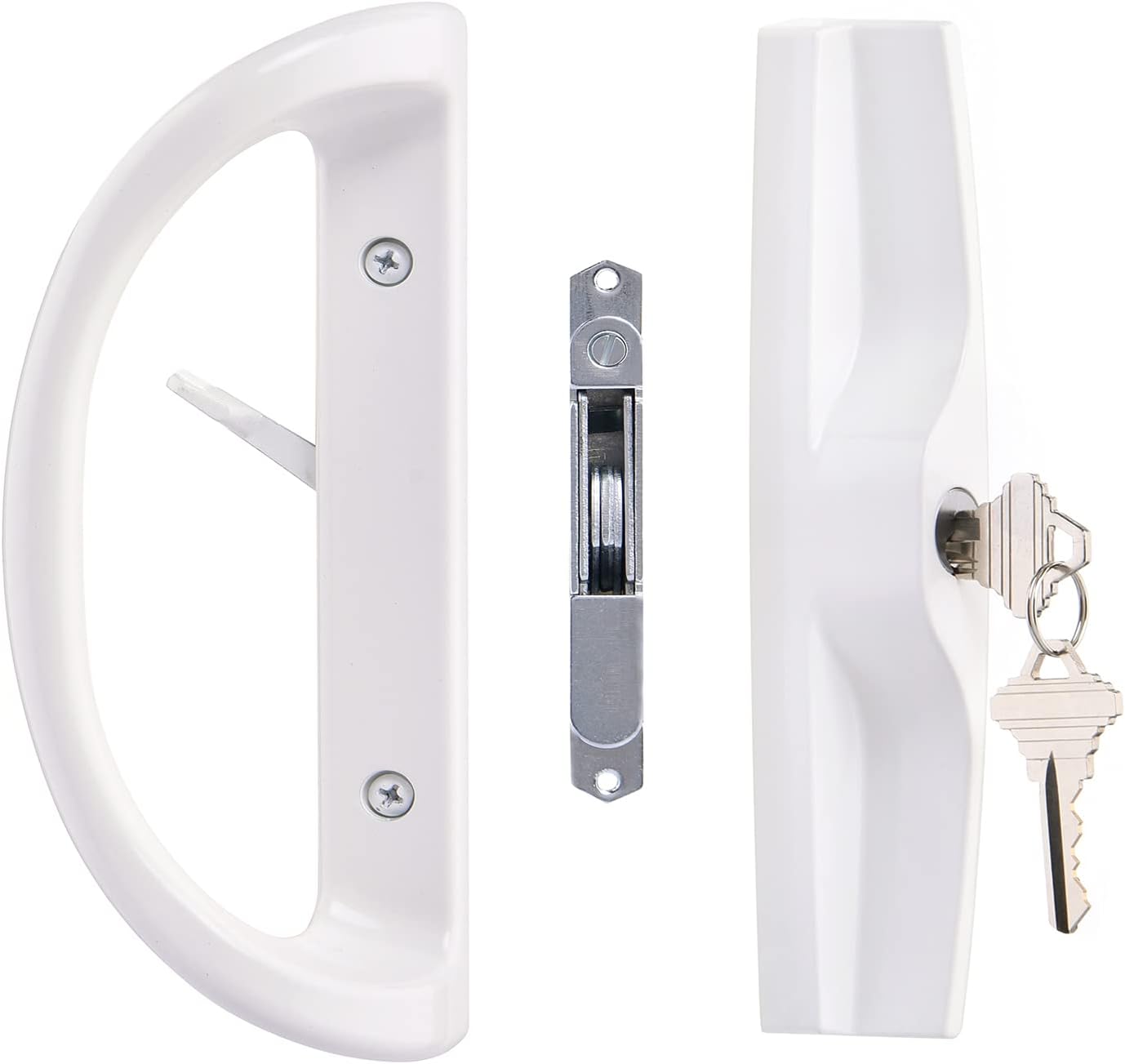
Key specs: Full replacement handle set with key cylinder and mortise lock; fits door thickness 1-1/2 in. to 1-3/4 in.; 3-15/16 in. screw-hole spacing; reversible, non-handed design
Everything above works around a weak factory latch. This replaces it. The kit swaps the entire handle assembly for one built around a real mortise lock and a key cylinder, which is the difference between a hook-style latch that flexes under pressure and a bolt that actually engages a strike plate. It is the pick for an owned home where the original latch is loose, does not click firmly closed, or already shows the wear the earlier sections describe. Because these kits are sold by thickness and screw-hole spacing rather than by door brand, measure your existing hardware before ordering — this one fits doors 1-1/2 to 1-3/4 inches thick with 3-15/16-inch screw-hole spacing, and a mismatch is the most common reason this category gets returned. For how lock hardware is actually graded for durability, see our guide to ANSI/BHMA lock grades.
✅ Pros
- Replaces the actual point of failure instead of adding a workaround
- Reversible, non-handed design fits either a left- or right-opening door
- A real key cylinder means the door can be locked from outside the home, not just from inside
- One-time installation rather than an extra piece of hardware to operate every time you use the door
❌ Cons
- No manufacturer name appears on the retail listing, unlike the branded pin lock above — this is an unbranded import, not a recognized door-hardware maker
- Its buyer rating sits lower than the other three picks in this lineup, so read recent reviews for your specific door thickness before ordering
- A full handle swap is a bigger project than any other pick here — expect 30-60 minutes with a screwdriver, not a five-minute install
- Not a fit for renters; this permanently replaces existing hardware
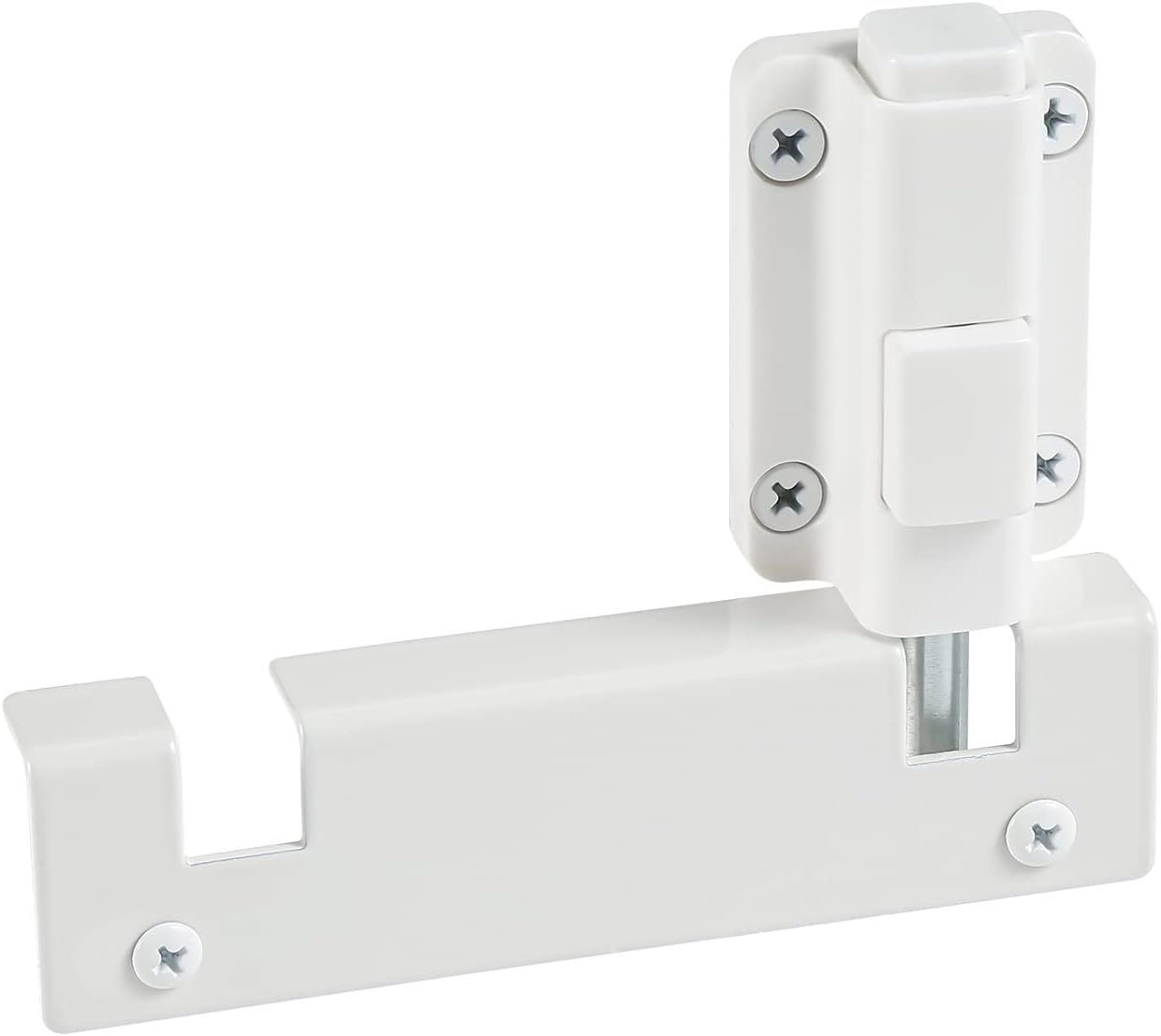
Key specs: Keyless, foot-operated secondary lock with 2-position vent control; white finish; mounts to the floor track at the base of the sliding panel
A foot lock sits low, at the base of the track, and locks or unlocks with a press of a foot rather than a hand at door-handle height. That single design choice does two things: it adds a second lock point below the one a burglar is checking, and it is genuinely more awkward for a toddler to find and operate than a latch or lever sitting right at eye level. This particular lock has a 2-position vent setting, so it can hold the door locked shut or locked open a few inches for airflow, similar in concept to the vent-position trick described above for the pin lock. For households where a small child’s ability to reach and defeat a lock is the bigger concern than a burglar, our child safety door lock guide covers that angle in more depth.
✅ Pros
- Keyless and foot-operated, so it does not add another key to track
- Mounted low, out of the sightline of anyone checking the primary latch from outside
- 2-position design allows a locked-but-vented setting for airflow
- Genuinely more resistant to a young child than a handle-height latch
❌ Cons
- Its review base is thinner than the bar and pin picks above, so treat it as a smaller sample
- A secondary lock only — it does not replace or reinforce the primary latch on its own
- Foot-height mounting means checking it requires bending down, which some households find inconvenient for daily use
- Older children can and do learn to operate a foot lock once they have watched an adult do it a few times — treat this as a delay, not a guarantee
What Renters Can Install vs. What Owners Should Replace
Whether a hole gets drilled is the real dividing line for most readers, more than price or brand.
Which Column Are You In?
🏠 Renting — stick to reversible fixes
- A pressure-mounted security bar, removed and taken with you at move-out
- A wooden dowel or track-blocker cut to fit, which costs almost nothing and needs zero hardware
- A foot lock if your lease allows small screw holes in the track (check first — this is not always covered by a no-drilling clause the way a wall anchor is)
- Save receipts and photos of the original hardware in case a landlord asks what changed
🔑 Owning — fix the latch permanently
- A keyed handle-set replacement if the factory latch is loose, worn, or was never a real lock to begin with
- A dedicated anti-lift pin at the top of the track if your door is older and the rollers show wear
- Pair the bar and the keyed replacement rather than choosing one — they solve different failures
- Consider replacing worn rollers directly if the panel visibly sags or lifts more than the half-inch to three-quarter-inch range described above
If your patio has French doors instead of a single sliding panel, the hardware differs enough that it deserves its own treatment — see our French door security guide. And if the exterior opening in question is a swinging door rather than a slider, our door security bar guide covers that separately, since a slider-track bar and a swing-door brace are not interchangeable hardware.
Should You Add a Sensor Too?
Every product above is a physical barrier. None of them tells you the door was opened, or that the glass was broken instead of the latch defeated — and the SafeWise-cited test above found smashing the glass outright was one of the three ways testers got a sliding door open in under 10 seconds. A physical lock and a detection layer solve different problems, and pairing them is standard practice rather than overkill for a door this frequently targeted.
A door/window contact sensor tells you the moment the panel itself moves, regardless of which lock defeated. Our wireless door and window sensor guide compares the current options. A glass-break sensor covers the other failure mode specifically — someone breaking the glass instead of forcing the latch — and our glass break sensor guide walks through which detection technology actually fits a large patio door pane versus a small window. Neither replaces the hardware in this article; both extend it.
For the exterior side of the equation, a motion-triggered light aimed at the patio adds a deterrent that has nothing to do with the lock itself — someone deciding whether to approach a dark patio door behaves differently than someone approaching a lit one. Our outdoor motion sensor light guide covers options for that layer.
Does Any of This Affect Your Insurance?
Possibly, modestly. The Insurance Information Institute notes that “most insurers provide discounts for security devices such as smoke detectors, burglar and fire alarm systems or dead-bolt locks,” while also cautioning that not every device qualifies and terms vary by company. A pressure-mounted bar or a five-dollar pin is unlikely to move the needle on its own — the discount language is aimed at real lock hardware and monitored systems, not accessory add-ons. The keyed handle-set replacement is the pick most likely to actually count as a “dead-bolt lock”-equivalent upgrade in an insurer’s eyes, but the only way to know for certain is to ask your provider directly before you buy, rather than assuming a discount that may not apply. If cost is the deciding factor across your whole home rather than just this door, our home security cost breakdown lays out where the money actually goes on a fuller system.
Final Recommendation
Start with the AceMining Sliding Door Security Bar if you have not secured this door at all yet — it is the fastest, cheapest, most reversible fix, and it is the right first purchase for a renter or anyone who wants results tonight. Add a Prime-Line Sliding Patio Door Pin Lock at the top of the track if your door is older or the panel has any play when you lift it, since the bar alone will not stop that failure mode. If you own the home and the factory latch itself feels loose, skip the add-ons and go straight to the Keyed Sliding Patio Door Handle Set with Mortise Lock — it is the only pick here that actually replaces the defective part instead of working around it. Reach for the House Guard Sliding Glass Door Foot Lock specifically when a small child’s reach is the concern that matters most to your household, not as a general-purpose first buy.
What would change this: if your door has already been forced or shows pry marks, do not rely on any of these alone — replace the door or have a locksmith assess the frame first, since hardware cannot fix a compromised frame. And if detection matters as much as prevention to you, pair whichever lock you choose with the sensor guides linked above rather than treating this as an either-or decision.
SafeBode does not yet run an in-house product testing program. This guide is built from manufacturer specifications, official support documentation, current retail listings and verified buyer feedback rather than hands-on testing, and we say so plainly rather than implying testing we have not done.
Frequently Asked Questions
Do I need a security bar if I already have a pin lock installed?
They solve different problems, so having one does not make the other redundant. A pin lock resists lifting when placed at the top of the track; a bar resists sliding. Many households run both, especially on a door that is the main entry point to a backyard or ground-floor patio.
Will a security bar damage my door frame or track?
A pressure-mounted bar with padded end caps should not, if it is seated correctly and sized to the actual opening. Oversizing it or forcing a bar that is slightly too long into a track is what causes scuffing, not the bar itself.
Can I install a keyed replacement handle set myself?
Most kits are designed for it — a screwdriver and correct measurements are usually all that is needed. Measure your door’s thickness and existing screw-hole spacing before ordering, since a mismatch is the most common reason this category of product gets returned.
Is a foot lock actually childproof?
No lock marketed for a home should be called childproof outright. A foot lock is genuinely harder for a young child to notice and operate than a handle-height latch, which buys real time and reduces accidental openings, but an older child who has watched it used will eventually figure it out.
My sliding door lifts out of the track even though it’s locked. Is that normal?
It is common on older doors with worn rollers, and it is a real security gap, not just an annoyance — a door that lifts can bypass its latch entirely without anything breaking. An anti-lift pin addresses the symptom; replacing worn rollers addresses the underlying cause.
Do apartment leases usually allow a sliding door security bar?
A pressure-mounted bar with no drilling is one of the safer additions for a lease, since it leaves no holes and comes off in seconds. Anything that requires drilling, including most pin locks and foot locks, is worth confirming with your landlord first.
Does a glass-break sensor make a physical lock unnecessary?
No — a sensor tells you a break happened; it does not stop it from happening. Treat detection and physical hardware as two separate layers that work together, not substitutes for each other.
How much of a factory latch’s weakness is really about the material versus the design?
Both matter, but the design is the bigger issue. A hook-style latch that only needs to be lifted or jiggled to disengage is a weak design even in hardened steel; a real mortise lock with a bolt that seats into a strike plate is a stronger design even in a lower-cost metal.
Sources
Show sources (3)
- [1] Village of Shorewood, WI Police Department — “Sliding-Glass Patio Doors & Windows,” villageofshorewood.org/263/Sliding-Glass-Patio-Doors-Windows
- [2] SafeWise — “How to Secure Your Sliding Glass Door,” safewise.com/home-security-systems/learn/secure-sliding-glass-door/
- [3] Insurance Information Institute (III) — “How to Save Money on Your Homeowners Insurance,” iii.org/article/how-to-save-money-on-your-homeowners-insurance


