Schlage Exterior Door Knobs vs Deadbolts: Which Matters More for Security
Affiliate Disclosure: This article contains affiliate links. If you buy through these links, we may earn a commission at no extra cost to you. Our editorial opinions are our own and are not influenced by affiliate relationships. Read our full disclosure policy →
Contents
Quick Answer
A knob lockset and a deadbolt are not two grades of the same thing. A knob uses a spring-loaded latch with a beveled edge that is designed to retract under angled pressure so the door can close on its own – which is exactly the mechanism that lets it be forced or slipped open. A deadbolt throws a solid, square-cut bolt that does not retract under pressure at all. That difference exists at every grade, which is why a high-rated exterior knob is still a knob. Schlage’s own product page for keyed entry knobs says so directly: it recommends installing a deadbolt for added protection because “door knobs with keyed entries can be easier to pick”. The fix for a front door with only a knob is not a better knob. It is a deadbolt, in addition to the knob, not instead of it.
The Question Nobody Asks Before Buying a Knob
Most searches for a Schlage exterior door knob are really searches for a front-door lock, and that is where the shopping goes wrong before it even starts. A knob and a deadbolt solve different problems, and a listing full of ANSI grade numbers and “certified security” language does not tell you which problem you are about to leave unsolved.
This site has already corrected one version of this confusion. Our guide to ANSI/BHMA lock grades explains why a commercial Grade 1 rating quoted on a residential deadbolt is a rating from the wrong program entirely. This article is about a related but separate mistake: even inside the correct residential rating system, a knob and a deadbolt are tested to two different standards, for two different jobs, and no amount of grade shopping turns a knob into a deadbolt. If your exterior door currently has a knob and nothing else, that is the actual gap – not the finish, not the brand, and not the grade printed on the box.
The Testing Gap, By the Numbers
11
aggressive security tests specified for residential knobs and latches
17
aggressive security tests specified for residential deadbolts
800 lb
force applied to a Grade A knob latch in testing
1,350 lb
force loaded against a Grade A deadbolt in testing
Figures published by BHMA for ANSI/BHMA A156.39 (Residential Locksets and Latches) and A156.40 (Residential Deadbolts). Both tracks share a 400,000-cycle durability requirement at the top grade – the gap is in what happens when force is applied, not in how long the hardware lasts.
How a Knob Lock Actually Differs From a Deadbolt
The mechanical difference is simple, and it is the entire reason this article exists. A keyed entry knob operates a spring-loaded latch bolt with a beveled, angled face. That bevel is not a manufacturing shortcut – it is required for the knob to do its everyday job, which is to let the door swing shut and lock itself automatically without anyone turning a key. The same bevel that makes a knob convenient is what lets the latch be pushed back past the strike plate by anything thin and stiff enough to reach it.
A deadbolt has no bevel and no spring. The bolt is a solid, square-cut bar that only moves when a key or thumbturn tells it to, and it does not retract under sideways pressure at all. That is the whole difference, and it is why SafeHome.org’s own security guidance puts it plainly: “regular door knob locks are nice, but they’re barely going to slow down an experienced lockpicker,” and the fix it gives is to “have – and use – deadbolt locks”.
None of this means a knob is poorly made. Schlage’s own knob line is tested under the same residential certification program as its deadbolts, and the three knobs in this guide all carry that testing. It means a knob is built to solve a different problem than a deadbolt solves, and buying a better-reviewed or better-finished knob does not close that gap, because the gap is in the mechanism, not the manufacturing quality.
Why a Higher Grade Doesn’t Fix This
It is tempting to assume the fix is simply to buy the highest-graded knob available. It is not, and the testing standards themselves explain why. ANSI/BHMA A156.39 – the standard that covers residential locksets and latches, knobs included – puts a Grade A knob through eleven aggressive security tests, including 800 lb of force against the latch and a locked lever test at 500 in.-lbf. That is a genuinely demanding standard, and a certified knob has earned the rating.
But look at what the standard is testing: force and torque applied to the latch and the operating hardware. It is not testing – and cannot test – resistance to the specific technique that defeats a spring latch, which does not use force at all. A thin, stiff card or shim slipped between the door and the frame pushes the bevel back exactly the way the latch is designed to retract when the door closes. That is not a failure of the knob’s certification. It is the certification correctly measuring a mechanism that was never designed to resist that kind of manipulation in the first place, at any grade.
This is the direct, narrower version of a point our lock grades guide makes about deadbolts and door frames: a rating describes the hardware, not the whole opening. Here, the rating describes the knob’s resistance to force – and a knob’s vulnerability was never a force problem to begin with.
Is This Actually Your Situation?
✅ The gap applies to you if
- Your front or back door has a keyed knob and no deadbolt at all
- The knob is the only lock standing between that door and the outside
- You are comparing knobs by grade or finish, not asking whether a knob is the right part
- The door is a primary, regularly used exterior entrance
❌ It does not apply if
- The knob is already paired with a deadbolt on the same door
- The door in question is interior – a bedroom, bathroom, closet or hallway
- The knob is on a screen or storm door in front of a separately locked main door
- The opening is a secondary, rarely used entrance already covered by other layers
Knob vs Deadbolt, Side by Side
| Keyed entry knob | Deadbolt |
|---|
| Bolt type | Spring-loaded latch, beveled edge | Solid, square-cut bolt, no spring |
| Retracts under sideways pressure | Yes, by design – that is how it self-latches | No, not at any grade |
| Residential standard | ANSI/BHMA A156.39 | ANSI/BHMA A156.40 |
| Security tests at the top grade | 11 tests, up to 800 lb latch force | 17 tests, up to 1,350 lb bolt force |
| Durability at the top grade | 400,000 open/close cycles | 400,000 open/close cycles |
| Schlage’s own stated purpose | Convenience and light security, paired with a deadbolt for “added protection” | Not addressed on the knob page – deadbolts are the recommended addition |
| Right on its own for a primary exterior door | No | Yes, and it is the minimum most locksmiths and security guides treat as standard |
Three Real Schlage Exterior Knobs, and What Each Is Actually For
All three of the knobs below are genuinely different products, not interchangeable options – different design lines, different finishes, and in Bowery’s case, a noticeably larger review base than the other two. What none of them are is a substitute for a deadbolt on a primary exterior door. Each pairing note below says plainly what that knob is and is not the right tool for.
Schlage Plymouth Keyed Entry Door Knob, Satin Nickel — the classic pick for a secondary exterior door
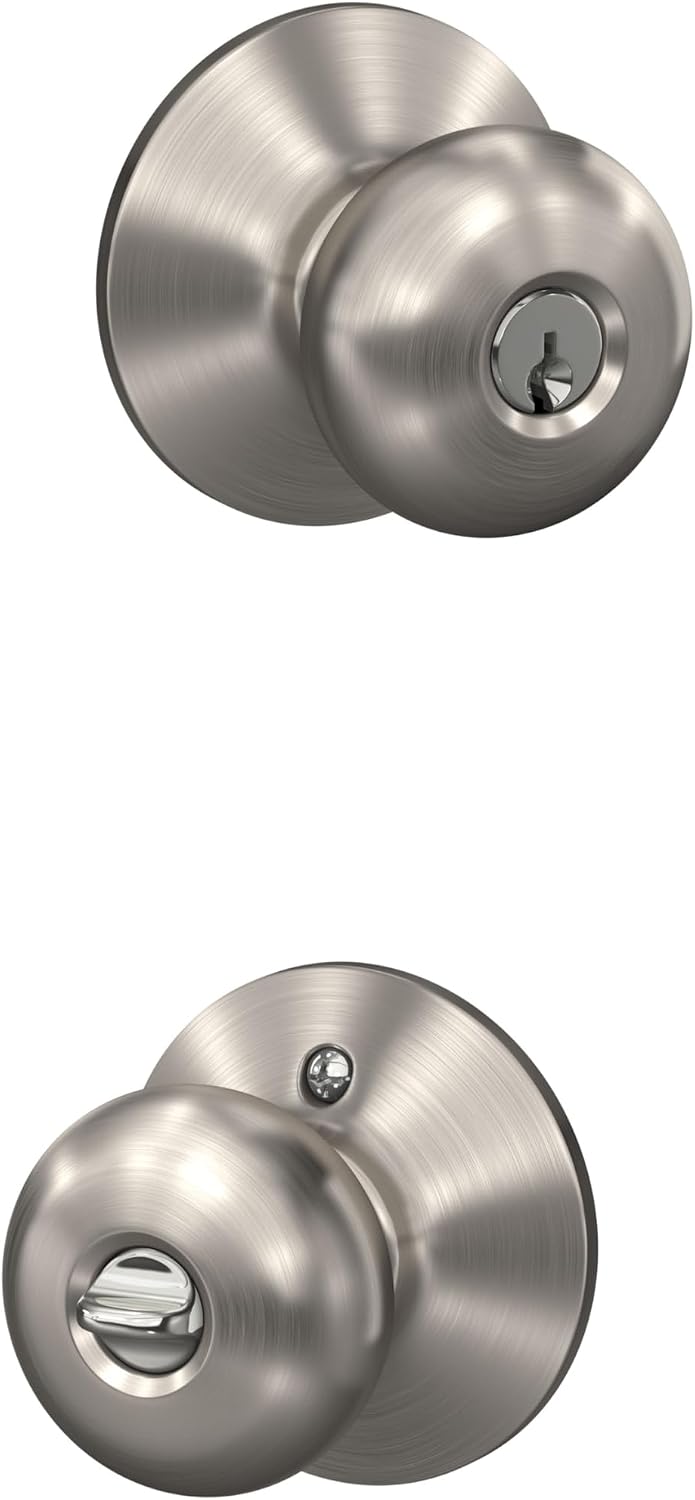
Key specs: Keyed entry knob, interior/exterior use, turn-button interior lock, universal door-prep fit, 2 keys included, current Amazon’s Choice listing for this search
Plymouth is Schlage’s traditional round-knob profile, and it is the current Amazon’s Choice listing for this exact search. It is a solid pick if the door you are fitting it to is a secondary exterior entrance – a side door, a garage entry, a back door – that already has its own deadbolt or sits behind another locked layer. On a primary front door with nothing else on it, it carries the same limitation every knob in this article carries: it is a latch, not a bolt. Our Schlage lineup guide covers where Plymouth sits alongside Schlage’s other knob and lever profiles.
✅ Pros
- Currently the Amazon’s Choice listing for a Schlage exterior door knob
- Universal door-prep fit, so it drops into a standard 2-1/8 in. bore without extra work
- Certified under the same residential standard as Schlage’s deadbolt line
- A sensible, low-friction pick for a secondary door that already has a deadbolt elsewhere
❌ Cons
- Still a spring latch – buying it does not add deadbolt-level security on its own
- Wrong pick if this is meant to be the only lock on a primary front or back door
- Satin nickel only in this specific listing – other finishes are separate ASINs
- No built-in deadlatch feature is stated on the listing, so treat the latch as bypassable
Schlage Georgian Keyed Entry Door Knob, Matte Black — the matte black option for a modern remodel
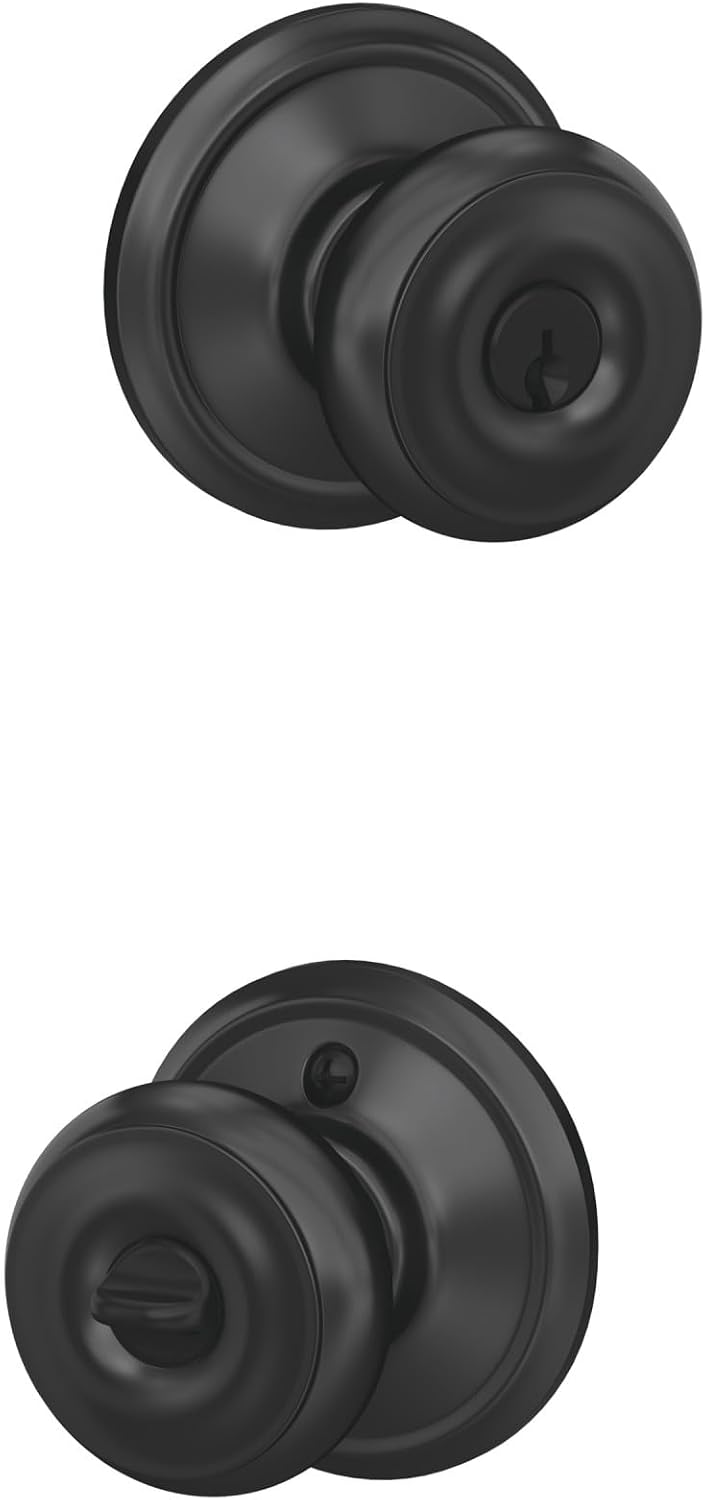
Key specs: Keyed entry knob, interior/exterior use, turn-button interior lock, universal door-prep fit, 2 keys included, matte black finish
Georgian is a step up in styling detail from Plymouth – a more decorative rosette – and this listing is finished in matte black, which is the finish most current exterior-door remodels are actually asking for. Mechanically it is the same story as every knob here: a keyed spring latch, certified under the residential lockset standard, built for convenience rather than as a standalone security device. If your front door hardware shopping started because you wanted matte black finishes to match a new deadbolt or handleset, this is a reasonable knob to pair with one – not to replace one.
✅ Pros
- Matte black finish matches current exterior hardware trends without a special order
- Same universal door-prep fit as the rest of Schlage’s knob line
- Certified under ANSI/BHMA A156.39 alongside Schlage’s deadbolts under A156.40
- Reasonable choice for a interior door being upgraded to a keyed function, like a home office
❌ Cons
- Same spring-latch limitation as every knob on this page – it is not a deadbolt substitute
- No stated deadlatch or anti-shim feature on this listing
- Buying it to match a black deadbolt is fine; buying it as your only front-door lock is not
- Finish coordination matters more here than on Plymouth, so check it against your existing hardware
Schlage Bowery Keyed Entry Door Knob, Matte Black — the highest-review-count knob-only listing in the line
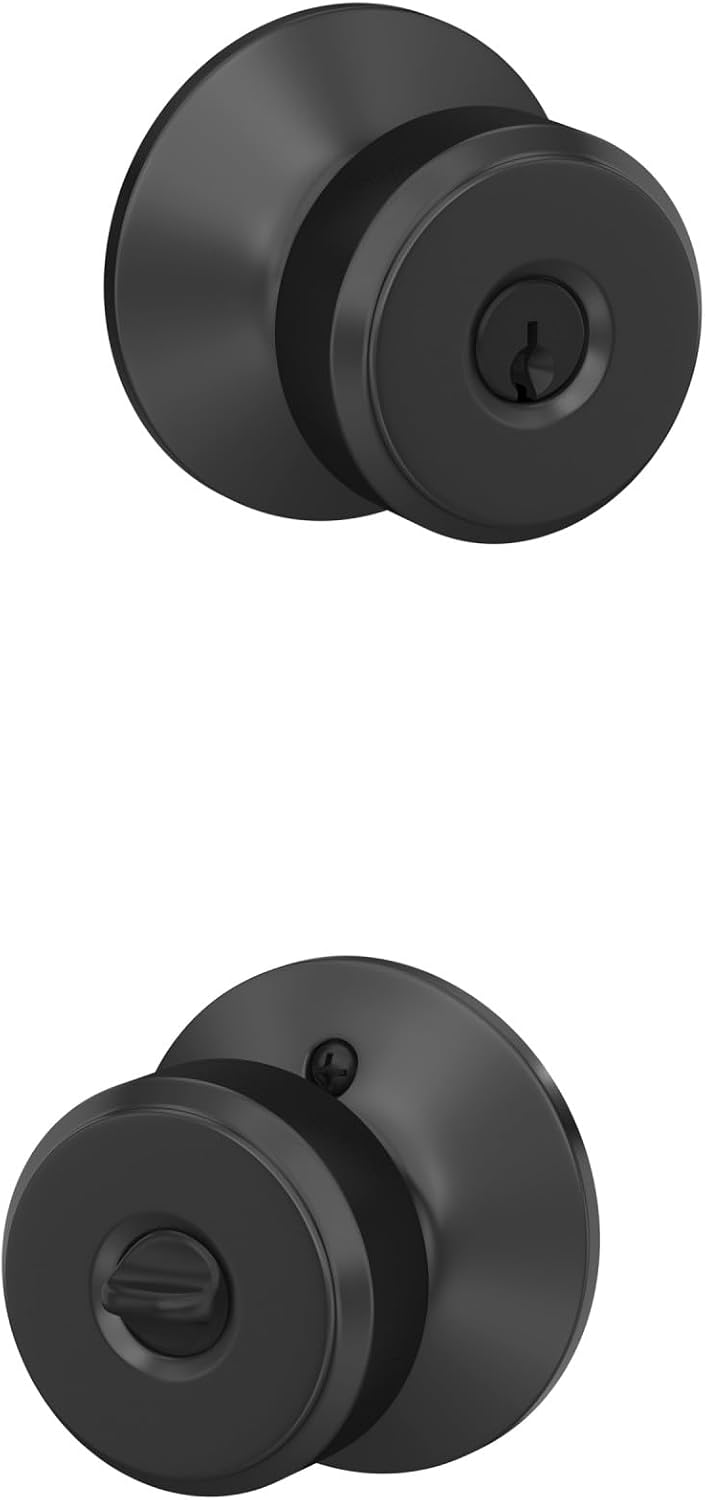
Key specs: Keyed entry knob, interior/exterior use, turn-button interior lock, universal door-prep fit, 2 keys included, matte black finish, the highest-review-count knob-only listing in this product line
Bowery is Schlage’s more contemporary, slightly squared silhouette, and this matte black listing has the largest review base of the standalone knobs covered here by a wide margin. That review volume says the hardware itself performs as advertised for its intended job – smooth turn-button privacy locking, reliable keyed entry, durable finish. It says nothing about deadbolt-level resistance to force or bypass, because Bowery was never tested to that standard. Treat a large review count as evidence the knob does what a knob is supposed to do, not as evidence it can do a deadbolt’s job.
✅ Pros
- Largest review base of the three standalone knobs in this guide
- Contemporary squared profile if Plymouth’s traditional round shape is not the look you want
- Same certified residential lockset testing as Plymouth and Georgian
- A solid, well-proven choice specifically for the use cases where a knob alone is appropriate
❌ Cons
- Review volume reflects satisfaction with knob performance, not resistance to forced entry
- Still a spring latch mechanically identical in principle to the other two knobs here
- Matte black only in this listing, same as the Georgian above
- Do not let a strong review count talk you out of also fitting a deadbolt on a primary door
The Actual Fix: a Knob and a Deadbolt Together
If your front or back door currently has only a knob, this is the section that actually answers the question in this article’s title. The fix is not choosing among the three knobs above by grade or finish – it is adding a deadbolt, and the simplest way to do that correctly is a set built to go on together from the start.
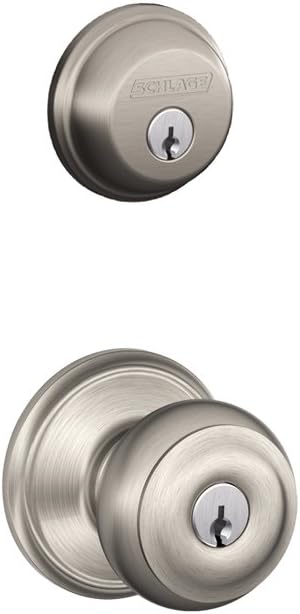
Key specs: Single cylinder deadbolt plus a keyed entry knob, keyed alike so one key operates both, universal door-prep fit, 2 keys included, satin nickel finish
This is a Georgian-profile keyed entry knob and a single-cylinder deadbolt, keyed alike so one key operates both. Keyed-alike matters more than it sounds like it should: it is the detail that keeps a two-lock door from turning into two sets of keys to carry and two chances to get locked out. Schlage’s own knob page frames the deadbolt as the “added protection” step beyond the knob, and a set like this is the version of that advice you can actually order in one box rather than shopping two listings and hoping the finishes and keying match. If you would rather add a deadbolt to a knob you already own, our deadbolt installation guide and the step-by-step section below cover that path instead.
✅ Pros
- Solves the actual problem in this article – a knob paired with a genuine deadbolt bolt
- Keyed alike, so one key covers both the knob and the deadbolt
- Deadbolt half is certified under ANSI/BHMA A156.40, separate from the knob’s A156.39 rating
- One listing, one order, matching finish and keying handled for you
❌ Cons
- Georgian profile only in this specific set – Plymouth or Bowery buyers need a separately purchased deadbolt instead
- Still requires correctly installing two bores rather than one if your door is not already prepped
- A thin, split, or damaged door frame limits what any deadbolt can actually resist
- Satin nickel only in this listing – other finish combinations are separate ASINs
When a Knob Alone Is Actually the Right Choice
None of this is an argument that knobs are bad hardware or that every door needs a deadbolt. Schlage’s own product description for this category is explicit that keyed entry knobs are “commonly used in residential settings, particularly on front doors, garage doors, and any other exterior entry points” – a knob is standard, appropriate hardware for a lot of doors. The question is never “is a knob good enough,” it is “is this door relying on the knob alone.”
Where a Knob Alone Genuinely Belongs
1
Interior doors
Bedrooms, bathrooms, offices and closets. A privacy or passage function is the correct choice here, and a deadbolt would be a strange, over-built fit for a door nobody outside the house can reach.
2
Screen and storm doors
A screen or storm door’s knob is not your primary defense at all – the main door behind it, with its own lock, is doing that job. The screen door knob’s real function is keeping the door itself closed.
3
Secondary exterior entries with other layers
A garage entry or side door that already has a deadbolt, or that opens into a garage secured by its own overhead door, is not resting on the knob alone even though the knob is the only thing on that specific door.
4
Any door already backed by a deadbolt
Once a deadbolt is doing the actual security job, the knob on the same door is exactly what it should be: the everyday convenience layer, not the last line of defense.
The common thread is not the room – it is whether something else is already doing the security job the knob was never built to do.
Adding a Deadbolt Above or Below an Existing Knob
If your front door has a knob and nothing else, adding a deadbolt is a genuinely manageable project, and it does not require replacing the knob you already have. Our full deadbolt installation walkthrough covers the complete process; the outline below is specific to a door that already has a knob in place.
Four Things to Get Right
1
Measure the backset first
Match the deadbolt’s backset – the distance from the door edge to the center of the bore – to your knob’s, or the two locks will not line up on the same vertical centerline.
2
Space it correctly from the knob
A deadbolt is typically installed several inches above the existing knob, high enough that one hand cannot easily reach both at once from outside through a broken pane, if the door has one nearby.
3
Use a long strike-plate screw
The strike plate’s screws should reach into the framing stud, not just the door trim – a deadbolt anchored only in thin trim gives up most of its advantage over a knob.
4
Decide single or double cylinder
Almost every occupied home should use a single cylinder deadbolt with an inside thumbturn. Our
single vs double cylinder guide covers the narrow cases where a double cylinder is actually the right call.
Get these four right and a deadbolt added to an existing knob-only door closes the exact gap this article is about.
If the door in question already has glass panels or a sidelight near the lock, pairing a deadbolt with better glazing is worth doing at the same time rather than as an afterthought – our guide to securing a sliding glass door covers the same reach-through logic that applies to any glazed opening near a lock. And if what you are actually upgrading is a smart lock built around a keypad or app rather than a traditional knob and key, our keypad lock comparison and the Schlage code-change walkthrough cover that different but related decision.
Final Recommendation
One honest caveat before the recommendation itself: hardware is only part of the picture. SafeHome.org’s own research into burglary patterns found that roughly a third of burglaries happen with no forced entry at all – the door was simply unlocked. A deadbolt fixes a mechanical weakness. It does nothing if the household does not actually use it, so the cheapest security upgrade available is still locking whatever hardware you already have.
Do not shop for a Schlage exterior knob by grade thinking a higher number buys you deadbolt-level security. It will not, because the knob and the deadbolt are tested to different standards for different jobs, and that gap exists at every grade.
If your front or back door currently has only a knob, the practical starting point is the Schlage Deadbolt & Door Knob Set covered above – a keyed-alike pairing that closes the actual gap in one order rather than three separate purchases. If you already have a deadbolt on that door and simply need a knob to match it or to fit a secondary or interior opening, any of the three standalone knobs in this guide is a reasonable pick: Plymouth for a traditional profile and the current Amazon’s Choice listing, Georgian for a matte black finish match, or Bowery for the largest review base among the three.
What would change this recommendation: if the door itself has a soft frame, a stripped strike-plate hole, or a large glazed panel within reach of the lock, spend the next hour on the frame and the glass before the hardware – a deadbolt anchored in a split jamb, or sitting next to unprotected glass, gives up much of what it is rated to resist. Our lock grades guide covers that broader point about certification describing the hardware and not the opening around it.
SafeBode does not yet run an in-house product testing program. This guide is built from manufacturer specifications, official support documentation, current retail listings and verified buyer feedback rather than hands-on testing, and we say so plainly rather than implying testing we have not done.
Frequently Asked Questions
Is a Schlage knob with a high ANSI grade as secure as a deadbolt?
No. Grade describes how much force or how many cycles the hardware survived in testing, not what kind of bolt it uses. A high-graded knob is still a spring latch, and a spring latch retracts under the kind of pressure a deadbolt’s solid bolt does not.
Can a knob lock really be opened with a credit card?
A spring latch with a beveled edge can be pushed back by a thin, stiff object slipped between the door and the frame, which is the mechanical basis of the classic “credit card trick.” A deadbolt’s solid, square-cut bolt does not retract under that kind of pressure at all.
Do I need to replace my existing knob to add a deadbolt?
No. A deadbolt installs as a separate lock, typically several inches above or below the existing knob, and both continue operating independently. You are adding a second lock, not replacing the first one.
Is it fine to have only a knob lock on an interior bedroom or bathroom door?
Yes. A knob’s privacy or passage function is the correct, standard hardware for interior doors. The security gap this article covers applies specifically to primary exterior doors relying on a knob as the only lock.
What does ‘keyed alike’ mean on a knob-and-deadbolt set?
It means the knob and the deadbolt share the same key, so one key operates both locks on the door instead of two separate keys. It is a convenience feature, not a security feature, but it is worth checking for before you buy the pieces separately.
Does a screen or storm door need a deadbolt too?
Generally no. The main door behind a screen or storm door is doing the actual security job; the screen door’s own knob mainly keeps that outer door closed rather than acting as a standalone barrier.
How far above the knob should a deadbolt go?
There is no single universal measurement, and it varies by door and by local convention, but the deadbolt is typically placed high enough above the knob that both cannot easily be reached by one hand at once. Our deadbolt installation guide covers backset and spacing in more detail.
Does Schlage make a knob with built-in deadbolt-level security?
No single knob replaces a deadbolt, because the mechanisms solve different problems by design. Schlage’s own recommendation for added protection on a knob-equipped door is to add a deadbolt, not to upgrade to a different knob.
Sources
Show sources (5)
- [1] Schlage – “Keyed Entry Door Knobs,” schlage.com/en/home/products/knobs/keyed-entry-knobs.html
- [2] BHMA – “ANSI/BHMA A156.39 – 2025 Residential Locksets and Latches,” buildershardware.com/ANSI-BHMA-Standards/Hardware-Highlights/A15639-2025-Residential-Locksets-and-Latches
- [3] BHMA – “ANSI/BHMA A156.40 – 2025 Residential Deadbolts,” buildershardware.com/ANSI-BHMA-Standards/Hardware-Highlights/A15640-2025-Residential-Deadbolts
- [4] SafeHome.org – “Home Security Quiz,” safehome.org/quiz/
- [5] SafeHome.org – “A Look Into the Mind of a Burglar,” safehome.org/home-safety/mind-of-burglar/


