Pool Safety Barriers: Why an Alarm Is the Third Layer, Not the First
Affiliate Disclosure: This article contains affiliate links. If you buy through these links, we may earn a commission at no extra cost to you. Our editorial opinions are our own and are not influenced by affiliate relationships. Read our full disclosure policy →
Contents
Quick Answer
Barriers prevent; alarms only notify. The order that actually reduces risk is a four-sided fence with self-latching gates first, then alarms on the doors between the house and the water, then an in-water alarm as the last catch. Drowning is the leading cause of death for children ages 1–4, and it typically happens when several barriers fail at once — a supervision lapse, limited swimming ability and an absent barrier together. Buying an alarm while skipping the fence inverts the sequence and buys reassurance rather than safety.
What “Layers of Protection” Actually Means
The phrase shows up in every pool safety leaflet and it is usually left vague. It has a specific meaning worth understanding, because it explains why spending on the wrong layer feels productive and is not.
The premise is that no single measure is reliable on its own. Stop Drowning Now’s framing is that drowning generally occurs when multiple safety barriers fail together — a lapse in supervision, limited swimming ability, and an absent or ineffective pool barrier in combination. The Red Cross states the same principle as guidance: employ layers of protection including barriers to prevent access to water, life jackets, and close supervision of children.
Read that carefully and the practical instruction falls out. If incidents require several simultaneous failures, then adding a layer is worth far more than improving a layer you already have. A household with a good fence and no alarm gains more from an alarm than from a better fence. A household with an alarm and no fence gains vastly more from a fence.
The Numbers Behind the Sequencing
#1
cause of death for children ages 1–4
4,000+
unintentional drowning deaths a year in the U.S.
Silently
how quickly and quietly children can drown
Multiple
barriers usually fail together in an incident
Layers work because they are independent — each one covers a different failure.
Layer One: The Fence, and Why Four Sides Matters
The barrier layer is specified more precisely than most people realize. Stop Drowning Now’s layers list calls for pool barriers including four-sided fencing with self-latching gates. Both halves of that phrase carry weight.
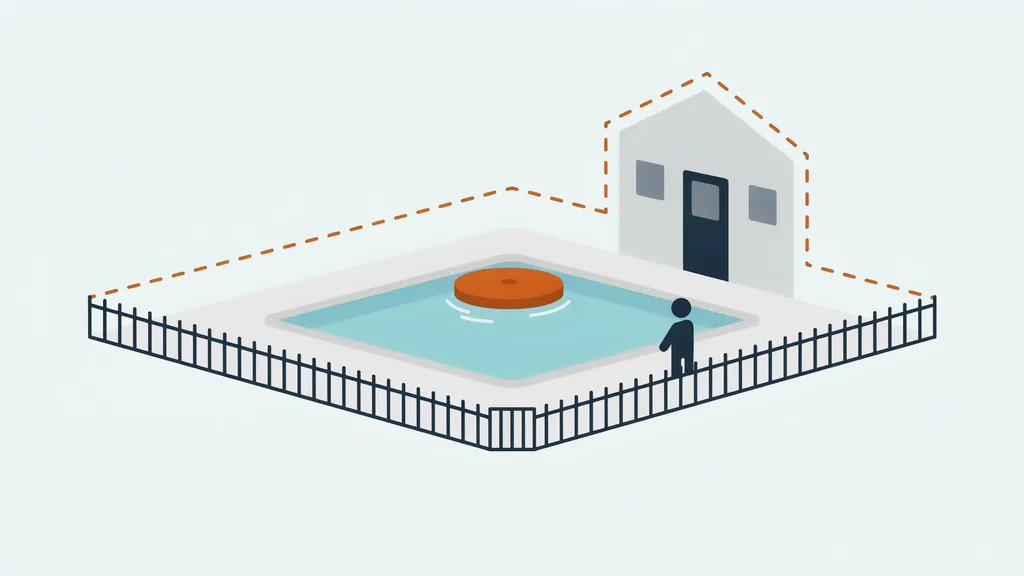
There is a number attached to this, and it is the most persuasive figure in the whole topic: a four-sided isolation fence separating the pool area from the house and yard reduces a child’s risk of drowning by 83% compared with three-sided property-line fencing. That is not a marginal improvement from a nicer fence — it is the difference between two fence layouts that cost roughly the same.
Four-sided means the fence isolates the pool from the house, not just from the street. The common arrangement — a perimeter fence around the whole yard, with the house forming one side of the pool enclosure — leaves the pool directly accessible from inside the home. That is precisely the route a young child takes, because it is the route they are already standing on.
Self-latching matters because the failure mode of a gate is not the gate; it is a person. A gate that has to be consciously latched will eventually be left swinging by a guest carrying towels. A gate that closes and latches itself removes the human step. Same logic, opposite direction: a latch positioned where a small child can reach it is a latch that will be operated by a small child.
A Barrier That Works vs One That Looks Like It Does
✅ Functioning barrier
- Isolates the pool on all four sides, including from the house
- Gate closes and latches with no human action
- Latch high enough to be out of a young child’s reach
- Nothing climbable within reach of the outside face
❌ Barrier in name only
- Perimeter fence only, with the pool open to the back door
- Self-closing hinge fitted but the gate propped open in summer
- Furniture, planters or a cooler left against the fence
- A gap under the fence a child can roll beneath
The right-hand column is where most real backyards sit, and none of those failures is exotic. Two of them — the propped gate and the climbable object — are seasonal behaviors rather than construction faults, which is why a barrier is something to re-check each summer rather than to install once.
Layer Two: The House Is a Wall of the Enclosure
If the house forms one side of the pool area — and in most American backyards it does — then every door and window on that side is part of the barrier. This is the layer that gets skipped most often, because it does not look like pool equipment.
The devices that cover it are ordinary: door alarms on the doors between the living space and the pool, and locks or latches out of a child’s reach. A sliding patio door is the typical weak point, both because it is the natural route outside and because it is easy for a small child to operate. Our guide to securing a sliding glass door covers the hardware side; for this purpose you are adding a secondary latch high on the frame rather than defending against forced entry.
For the alarm side, note that a general-purpose household door alarm and a water-hazard door alarm are not the same product. The latter is built to a specific standard, sounds even when the door is closed behind a child, and includes a pass-through so adults do not disable it out of irritation. Our pool alarm guide covers the certified options for both this layer and the water itself.
The Red Cross puts this in the same terms: install a secondary barrier such as door alarms and locks that are out of a child’s reach, on all doors and windows with direct access to the pool or spa area. Note “all” — a single alarmed patio door beside three unalarmed windows is a layer with a hole in it.
Above-ground pools invert the problem, and the guidance is specific: secure, lock or remove steps, ladders and anything usable for access — including outdoor furniture and toys — whenever the pool is not being actively supervised. The barrier there is the absence of a way up, and it has to be re-established every single time.
Indoors, child safety door locks serve the same function as the gate latch: they put the exit out of reach rather than reporting that it was used. Where a door leads to water, that distinction is the whole point.
Layer Three: Where an Alarm Fits
An in-water alarm is the last barrier, and understanding it that way changes how you value it. It cannot prevent anything. By the time it triggers, a child is in the water and the remaining task is a rescue on a very short clock — children can drown quickly and silently.
That is not an argument against buying one. It is an argument for buying it in addition to, and for insisting the alert actually reaches a person. An 85 dB horn at the pool edge is worthless if the household is indoors with a television on, which is why remote in-house receivers and app notifications matter more in this category than in most.
| Layer | What it does | Fails when | Buy it when |
|---|
| Four-sided fence | Prevents access entirely | A gate is propped, or something climbable is left against it | Always — this is the first purchase |
| Self-latching gate | Removes the human step from closing | The latch is within a child’s reach, or the hinge is disabled | With the fence, never after it |
| House door alarms | Reports the exit toward the water | Fitted to some doors but not all | Once the enclosure is genuinely four-sided |
| In-water alarm | Reports entry into the water | Nobody is in earshot, or it was switched off after nuisance triggers | As the last layer, with a remote receiver |
| Supervision | Prevents and rescues | Attention drifts — the Red Cross names phones specifically | Every time anyone is in or near the water |
The Layer No Product Can Sell You
Every affiliate article has an incentive to skip this section, so here it is with the sources attached. The Red Cross’s water safety guidance asks you to be a “water watcher” — to provide close and constant attention to the children you are supervising, and to avoid distractions including cell phones. Its home pool guidance adds the distance: designate a water watcher and stay within arm’s reach of young children. Stop Drowning Now’s layers list opens with active adult supervision whenever children are near water.
The reason it is named as a formal role rather than a general instruction is that diffused responsibility is the actual failure. At a gathering with six adults present, everyone assumes someone is watching and nobody is. Naming one person, for a defined stretch of time, who is not doing anything else, is the intervention — and handing that role over explicitly when it changes.
The rest of the layers list is worth knowing too: swim lessons and water competency training, life jackets for boating and open water, and learning CPR and emergency response skills. None of those is a purchase for your backyard, and all of them do more than another gadget would.
It Is Not Only Pools
One statistic reframes the whole topic for households without a pool. Over 75% of bathtub and shower-related drowning fatalities involve children under five, and 90% occur when the child is not being supervised by a responsible adult.
That means the layers idea applies indoors, in homes that never had a pool to fence. The practical version is unglamorous: bathroom doors kept closed and latched out of reach, buckets emptied rather than left standing, and the same water-watcher discipline during bath time that you would apply at a pool. Water access that is unexpected is explicitly part of the risk picture.
Outdoors, the same applies to anything holding water that nobody thinks of as a pool: a hot tub, a garden pond, a rain barrel, a kiddie pool left full overnight. The last of those is worth singling out because it is the one that gets emptied “tomorrow.”
Auditing Your Own Setup in Ten Minutes
Walk It Like a Two-Year-Old Would
1
Start at the back door, not the pool
That is where a child starts. Can they open it? Is there a latch out of reach, or an alarm on it?
2
Walk the fence line, looking down
Gaps beneath, worn ground, a dip where a child could roll under. Then look up for anything climbable pushed against it.
3
Test every gate, once, hands off
Open it and let go. It should close and latch by itself. If it needs a push, that is a failure.
4
Stand indoors and have someone trigger the alarm
In the room you actually occupy, with the television on. If you cannot hear it, the alert is not reaching you.
Every failure this finds is a behavior or a small repair, not a new purchase.
If a camera covers the pool area, this is also the moment to check what it can actually see — the same framing questions covered in our camera placement guide. A camera is not a safety barrier and should never be counted as one, but a view of the gate is genuinely useful for confirming after the fact whether it was left open.
What to Actually Do
If you do not have four-sided fencing with a self-latching gate, that is the next thing you buy — before any alarm. It is the layer named first in the guidance, it is the only one that prevents access rather than reporting it, and it is the one a household with an alarm and a perimeter fence is most likely to be missing without realizing.
If the fence is sound, add alarms to the house doors next, not to the water. Catching a child at the doorway leaves time to walk outside; catching them in the pool leaves time to run. Our pool alarm guide covers which certified products cover which layer.
Then do the ten-minute walk above, this week, and again at the start of every summer. The failures that actually occur are seasonal — a propped gate, a cooler against the fence, an alarm switched off in June after one nuisance trigger — and none of them shows up in a purchase decision.
What would change this advice: if there is no pool but there are young children and a bath, the same reasoning still applies indoors, where over 75% of bathtub and shower drowning fatalities involve children under five. The layer to add there is a latch and a routine, and it costs almost nothing.
SafeBode does not yet run an in-house product testing program. This guide is built from manufacturer specifications, official support documentation, current retail listings and verified buyer feedback rather than hands-on testing, and we say so plainly rather than implying testing we have not done.
Frequently Asked Questions
What is a four-sided pool fence?
A fence that isolates the pool on all four sides, including from the house, rather than just enclosing the yard. The common arrangement where the house forms one wall of the pool area leaves the pool directly reachable from inside, which is the route a young child actually takes.
Is a pool alarm enough on its own?
No. An alarm reports that something has entered the water; it cannot prevent access. Guidance consistently places barriers first and treats alarms as an additional layer, because incidents typically involve several failed barriers at once.
What does a self-latching gate do?
It removes the human step. A gate that must be latched deliberately will eventually be left open by someone carrying something. A self-closing, self-latching gate does not depend on anyone remembering.
Where should a pool gate latch be positioned?
High enough to be out of a young child’s reach. A latch a small child can operate turns the gate into a door, and that undoes the point of the barrier.
Do I need to fence a hot tub or garden pond?
Consider it, and check your local rules, which vary. The risk logic is the same as a pool: any standing water a small child can reach unsupervised deserves a barrier, and unexpected water access is explicitly part of the drowning risk picture.
What is a water watcher?
A named adult whose only job, for a defined stretch of time, is watching the children in and around the water — no phone, no other tasks. The role exists because at a gathering everyone assumes someone else is watching.
Are swim lessons a substitute for a fence?
No. Swim lessons are one of the layers and formal lessons can significantly reduce risk, but they sit alongside barriers rather than replacing them. A child who can swim can still reach water unsupervised.
How often should I check the pool barrier?
At the start of every swimming season, and after anything that changes the yard. The common failures are seasonal behaviors — a propped gate, furniture moved against the fence — rather than construction faults.
Can drowning really be silent?
Yes. Drowning does not usually look like the thrashing and shouting people expect; children can drown quickly and quietly. That is exactly why supervision has to be active attention rather than presence in the same yard.
Sources
Show sources (3)


