Best Gas Leak Detectors 2026: Plug-In Monitors vs Handheld Sniffers
Affiliate Disclosure: This article contains affiliate links. If you buy through these links, we may earn a commission at no extra cost to you. Our editorial opinions are our own and are not influenced by affiliate relationships. Read our full disclosure policy →
Contents
Quick Answer
Buy a plug-in monitor first. The Kidde Explosive Gas & Carbon Monoxide Alarm is the default because it covers natural gas, propane and CO in one device and keeps working through a power cut on its battery backup. A handheld sniffer like the TopTes PT199 is a different tool for a different job — it finds where a leak is once you already know you have one. Most households want the monitor. Anyone who owns gas appliances and does their own maintenance wants both. And the placement rule matters more than the brand: natural gas rises and propane sinks, so mount the alarm near where your fuel actually collects.
You Are Supposed to Smell It. So Why Buy a Detector?
Natural gas is colorless, odorless and tasteless as it comes out of the ground. The smell you associate with a gas leak is not the gas — utilities deliberately add mercaptan, a harmless chemical that smells like rotten eggs, specifically so that people can detect leaks. It is a safety system, and it is a good one.
It is also a safety system with a single point of failure: your nose, at the moment the leak happens. That assumption breaks in more situations than people expect. You are asleep. You have a cold, or a chronic condition that has dulled your sense of smell. The leak is small enough to sit below your threshold but large enough to accumulate in a closed basement over days. Or you have been in the room long enough that olfactory fatigue has set in and you have stopped registering a smell that is still there.
A detector does not replace the odorant. It covers the specific gap where the odorant is present and nobody is available to notice it. That framing is worth holding onto, because it also tells you where to put the device — near the appliances and near where people sleep, rather than wherever there happens to be a free outlet.
Monitors Watch. Sniffers Hunt.
The gas detection aisle mixes two genuinely different product classes under one search term, and buying the wrong one is the most common mistake in this category.
Two Products, Two Completely Different Jobs
🔌 A plug-in monitor
- Stays in one place, powered continuously, watching for accumulation
- Alarms loudly enough to wake a household
- Answers: is there gas in this room right now?
- Useless for tracing a leak to its source — it does not move
🔦 A handheld sniffer
- Battery-powered and portable, used deliberately for minutes at a time
- Alarm intensity rises as you get closer to the source
- Answers: which fitting is the gas coming from?
- Does nothing at 3am, because it is in a drawer and switched off
The practical read: if you own gas appliances and have nothing at all, buy the monitor. It is the one that protects you while you are not thinking about it. Add a sniffer if you maintain your own appliances, have recently had gas work done, or find yourself chasing a faint smell you cannot locate — which is exactly the situation where waving a detector along a pipe run beats guessing.
The Placement Rule Nobody Tells You
This is the single most useful thing in this guide, and it is routinely left out of product listings. Kidde states it plainly on its own alarm documentation: natural gas rises and propane sinks, so you place an alarm near where each gas collects. Methane, the main component of natural gas, is lighter than air and pools at ceiling level. Propane and LPG are heavier and pool at floor level.
Where to Mount It, by Fuel
1
Natural gas: mount high
Natural gas rises, so a detector near the floor may never see a leak that is filling the ceiling space above it.
2
Propane or LPG: mount low
Propane sinks. In a propane home, a high-mounted alarm is the mirror image of the same mistake.
3
Both fuels in the house?
Cover both levels. A single alarm cannot be in two places, and the physics does not compromise.
4
Every floor, near sleeping areas
Kidde’s guidance is a detector on every floor including the basement, and in or near each sleeping area.
Placement is decided by your fuel, not by where the outlets are.
One caveat that follows from this and catches people out with combination units: the CO half of a combination alarm has different placement logic again, because carbon monoxide mixes fairly evenly with air rather than collecting high or low. That is part of why dedicated carbon monoxide detectors are still worth having in addition to a combination unit, rather than instead of one.
The Four Picks Side by Side
| Product | Type | Detects | Power | Best for |
|---|
| Kidde Explosive Gas & Carbon Monoxide Alarm | Plug-in monitor | Natural gas, propane, methane, CO | 120V + 9V battery backup | Most households, as the first purchase |
| First Alert GCO1CN Combination Alarm | Plug-in monitor | Propane, natural gas, methane, CO | AC outlet + battery backup | Anyone who wants remote-control muting |
| TopTes PT199 Gas Leak Detector | Handheld sniffer | Natural gas, methane, propane, butane, LPG | 2x AAA | Tracing a leak you already suspect |
| TopTes PT520A Gooseneck Gas Detector | Handheld sniffer | Methane, propane, natural gas, LPG, butane | Battery | Tight spaces, pipe joints, behind appliances |
Kidde Explosive Gas & Carbon Monoxide Alarm — the one to leave plugged in
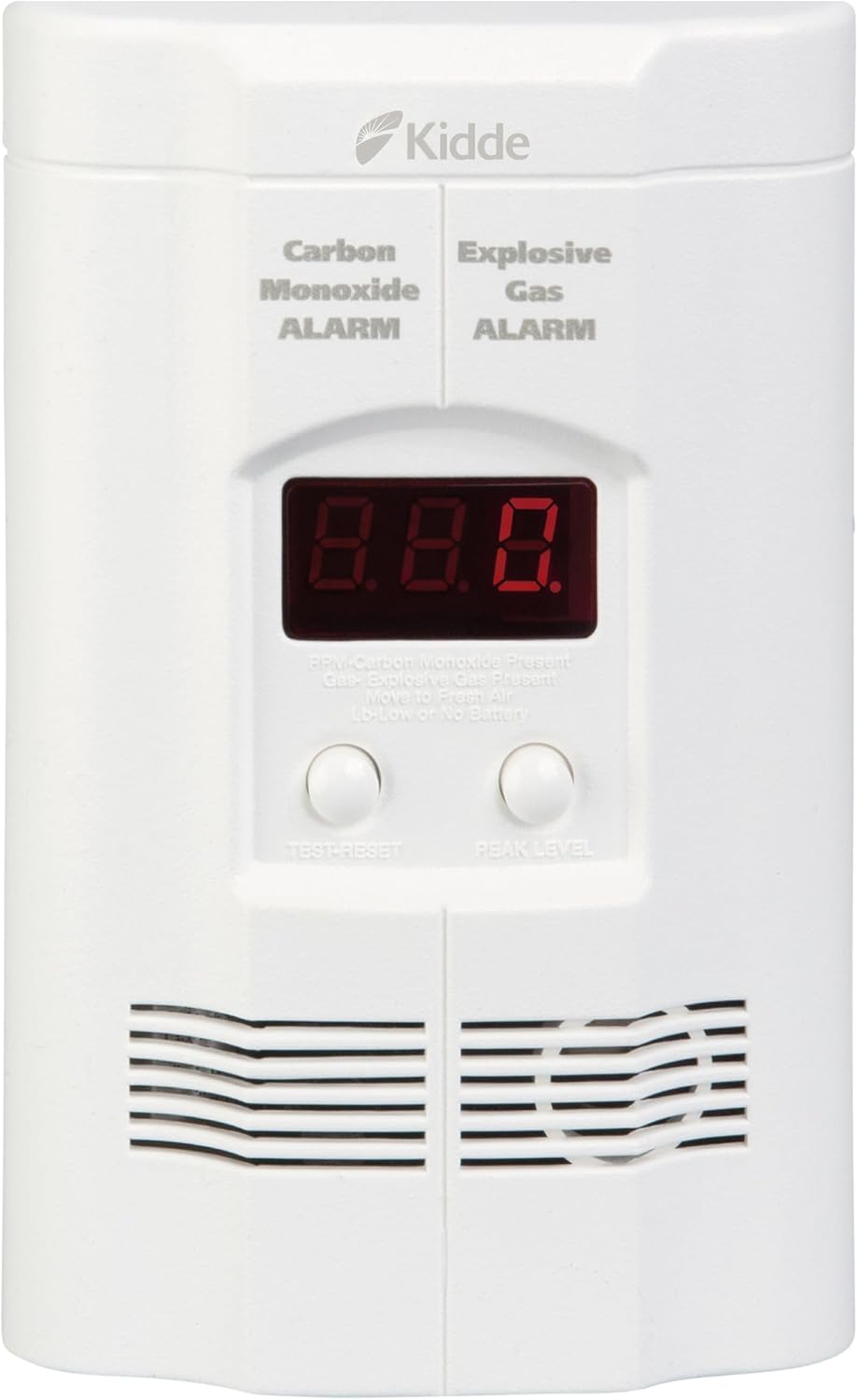
Key specs: Plug-in 120V alarm with 9-volt battery backup; detects natural gas, propane, methane and carbon monoxide; digital LED display shows CO level or reads GAS when explosive gas is present; 85-decibel alarm; peak level memory
This is the default first purchase, and the reason is coverage rather than any single feature: one plug-in device alarms on natural gas, propane, methane and carbon monoxide. Its display does something genuinely useful too — it shows the CO level numerically, and switches to reading GAS when it detects explosive gas instead, so an alarm at 2am tells you which of two quite different emergencies you are in. The 9-volt battery backup matters more than it sounds, because a gas leak and a power cut are not independent events; both can follow the same storm or the same contractor error.
✅ Pros
- One device covers explosive gas and CO
- Display distinguishes a CO reading from a gas alarm
- 9V battery backup keeps it alive through an outage
- Peak level memory records the last CO detection or test
- By far the largest review base in this category
❌ Cons
- Plug-in form factor ties you to outlet locations, which fight the placement rule
- 85 dB is loud but not exceptional for a whole-house alert
- No app, no remote alert — it is audible-only
- A combination unit is a compromise; a dedicated CO alarm is still worth having
First Alert GCO1CN Combination Alarm — the alternative monitor

Key specs: Plug-in combination explosive gas and CO alarm with battery backup; senses propane, natural and methane gas plus carbon monoxide; backlit digital display shows current and peak levels; 85-decibel alarm; can be muted with most household remote controls
Functionally very close to the Kidde, and worth choosing for one specific reason: it can be muted using almost any household remote control. That sounds trivial until you have a detector mounted low in a basement for propane coverage and a nuisance alarm going off while you are holding something. It shows current and peak levels on a backlit display, and covers the same three-way protection against natural, methane and propane gas plus CO. If you already run First Alert smoke alarms, keeping one brand across the house has a mild practical benefit at replacement time.
✅ Pros
- Remote-control muting, genuinely useful for awkward mounting spots
- Backlit display shows both current and peak levels
- Three-way gas coverage plus CO in one unit
- Battery backup through a power outage
❌ Cons
- Smaller review base than the Kidde equivalent
- Same outlet-dependency problem as any plug-in unit
- Remote muting is a convenience, not a safety feature — do not use it to live with a recurring alarm
- No app or remote notification
TopTes PT199 Gas Leak Detector — the one to go looking with
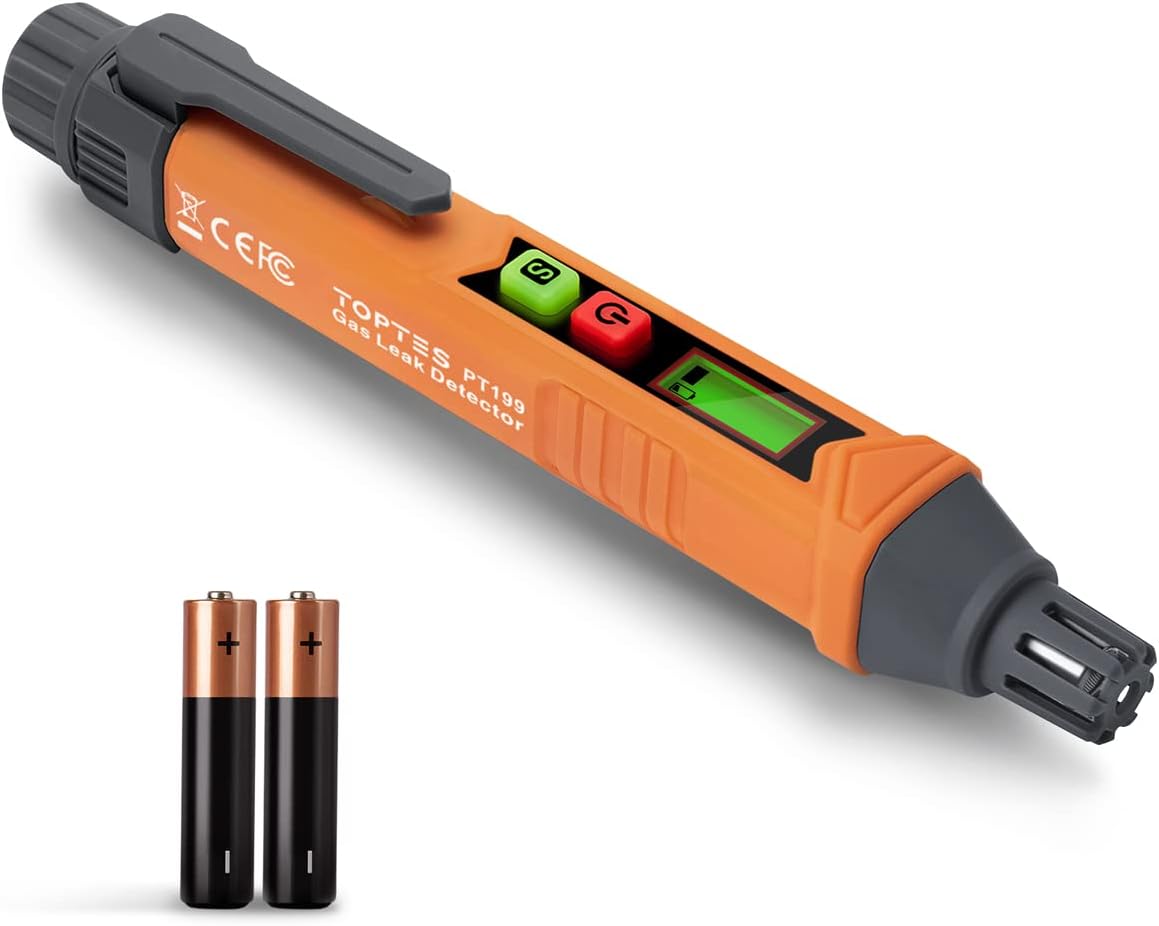
Key specs: Handheld combustible gas sniffer for natural gas, methane, propane, butane and LPG; visual and audible alarm triggering within 0.5 seconds; LCD turns red at high concentration; 2x AAA batteries included; ready after a 30-second warm-up
Buy this when you have a smell and no idea where it is coming from. It responds within half a second of encountering gas, and the alarm intensifies as concentration rises while the LCD turns red at high levels — which is what actually lets you triangulate. You sweep slowly along a pipe run and let the intensity tell you when you are getting closer. It covers natural gas, methane, propane, butane and LPG, so it works regardless of what your house burns, and it ships with batteries and is usable after a 30-second warm-up.
✅ Pros
- Alarm intensity rises with concentration, so it locates rather than just detects
- Half-second response time
- Covers every common household fuel gas
- Batteries included, 30-second warm-up
- Strong review base for a handheld instrument
❌ Cons
- Only works when you are holding it and have switched it on
- No use as an overnight safeguard — this is not a monitor
- A warm-up period means it is not instant when you grab it in a hurry
- Consumer-grade: it finds leaks, it does not quantify them to a technician’s standard
TopTes PT520A Gooseneck Gas Detector — for the joints you cannot reach
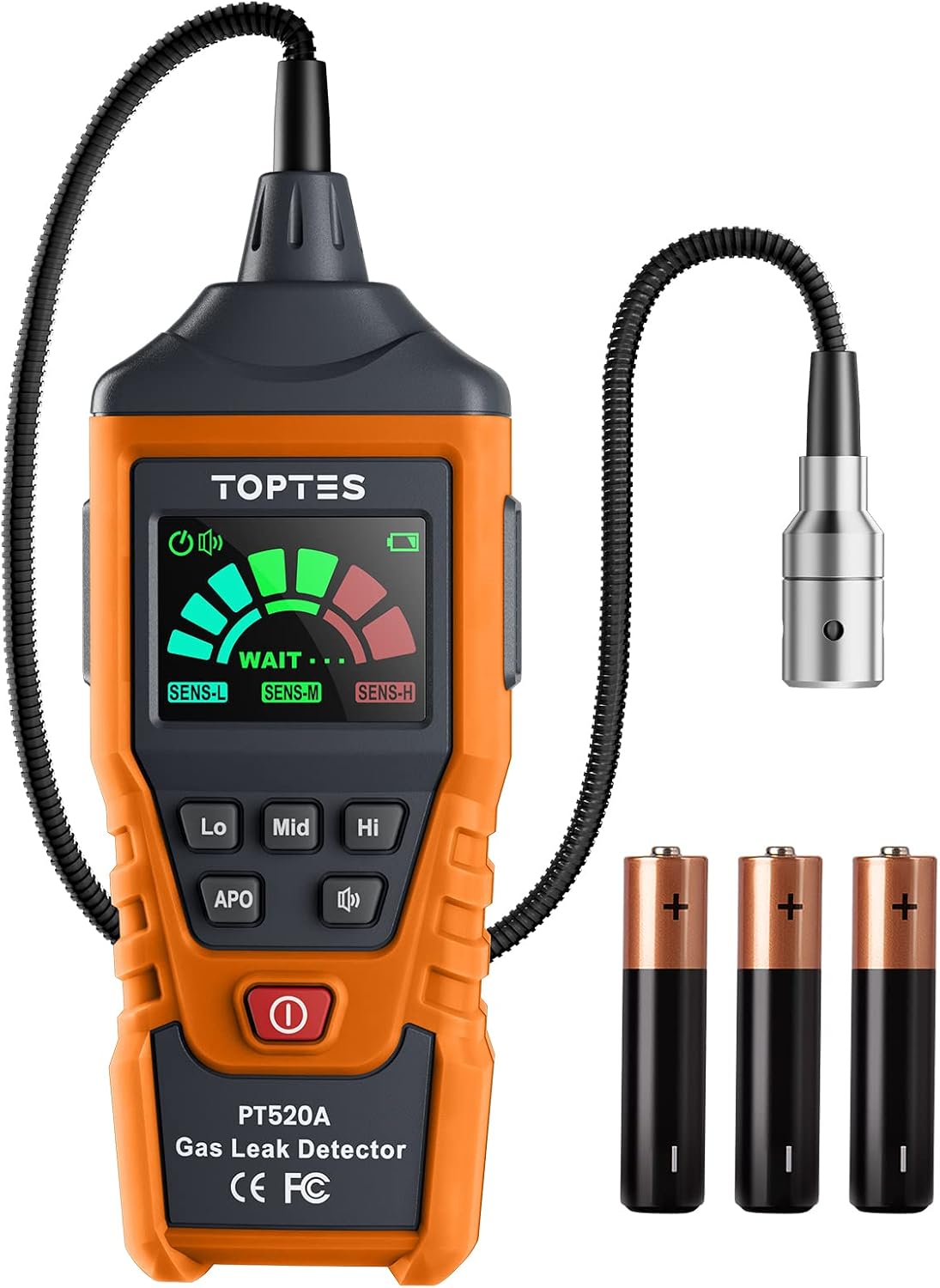
Key specs: Handheld sniffer with a 17-inch flexible gooseneck probe for pipelines, storage tanks, gas fireplaces and basements; detects methane, propane, natural gas, LPG and butane; responds in 0.5 seconds; 7 colored indicator bars and a 75dB alarm
Same idea as the PT199 with one structural difference that decides between them: a 17-inch flexible gooseneck probe. Gas fittings are rarely in convenient places — they are behind the range, under the water heater, at the back of a fireplace, in the crawlspace where the line enters. A rigid handheld unit cannot get its sensor near those joints, and gas dissipates fast enough that a reading taken a foot away can miss what a reading at an inch would find. The manufacturer’s own guidance is to bring the probe within roughly 1–5 cm of the suspected source. Its 7-bar visual indicator serves the same triangulating purpose as the PT199’s rising alarm.
✅ Pros
- 17-inch gooseneck reaches fittings a rigid detector cannot
- 7 colored bars give a finer gradient than an on/off alarm
- Same 0.5-second response as the PT199
- Designed explicitly for pipelines, tanks, fireplaces and basements
❌ Cons
- 75 dB alarm is quieter than the PT199’s
- The probe is one more thing to damage or kink in storage
- Overkill if your gas appliances are all easily accessible
- Still a hunting tool, not a monitoring one
Why This Is Not the Same as a CO Detector
These two hazards get conflated constantly, partly because combination units exist. They are opposites in an important way. Explosive gas is unburned fuel escaping — methane or propane leaking from a line or an unlit burner. The danger is fire and explosion. Carbon monoxide is a product of combustion that did happen, incompletely — a blocked flue, a cracked heat exchanger, a generator running somewhere it should not be. The danger is poisoning.
That difference has consequences for what you buy. A gas leak alarm will not warn you about a furnace producing CO from clean-burning gas, and a CO alarm will not warn you about an unlit burner filling a kitchen with methane. A combination unit covers both, which is why it is the sensible default here — but if you are only going to own one dedicated device, and you have fuel-burning appliances, the CO risk is the one that kills people in their sleep every winter. Our guide on what to do when a CO alarm sounds covers that side, and the beeping-versus-alarming distinction is worth knowing before it happens at 3am.
Worth adding to the same mental shelf: neither of these is a smoke alarm. If you are auditing household detection generally, smoke alarm placement and interconnection is the third leg, and the one most homes already have in some form — often expired.
What to Do If You Smell Gas Right Now
If you can smell gas as you read this, stop reading and act. Do not switch anything electrical on or off, including lights and extractor fans — a switch contact can spark. Do not use a phone inside the building. Leave the property, taking everyone with you, and call your gas utility’s emergency line or the fire service from outside. If you can safely reach an external shut-off valve on your way out, close it.
Note what is not on that list: getting out a gas detector. A sniffer is for confirming and locating a suspected small leak in a ventilated space, not for investigating a smell strong enough to notice from the doorway. The rotten-egg odorant exists precisely so that this decision does not require an instrument.
Final Recommendation
Start with the Kidde Explosive Gas & Carbon Monoxide Alarm, and mount it according to your fuel rather than your outlets. One device covering natural gas, propane and CO with battery backup is the right shape of purchase for a household that currently has nothing, and the placement decision — high for natural gas, low for propane — will do more for your actual safety than choosing a different brand would.
Choose the First Alert GCO1CN instead if the only sensible mounting spot in your house is somewhere awkward to reach. Remote-control muting is a small feature that becomes the deciding one when the alarm is mounted at ankle height behind a water heater.
Add the TopTes PT199 if you maintain your own gas appliances, have just had gas work done, or are chasing a smell you cannot place. Choose the PT520A over it only if your fittings are genuinely hard to reach — behind a range, under a tank, in a crawlspace — where the 17-inch probe is the whole point.
What would change this: if your home has no gas service, no propane, and no fuel-burning appliances at all, none of this applies and your money is better spent on smoke detection instead. And if you rent, check before mounting anything permanently — a plug-in unit needs no landlord conversation, which is part of why it is the recommendation here.
SafeBode does not yet run an in-house product testing program. This guide is built from manufacturer specifications, official support documentation, current retail listings and verified buyer feedback rather than hands-on testing, and we say so plainly rather than implying testing we have not done.
Frequently Asked Questions
Where should a natural gas detector be installed?
High, near the ceiling. Natural gas is lighter than air and rises, so Kidde’s own guidance is to place the alarm near where the gas collects. If you burn propane instead, the rule inverts — propane sinks, so the detector goes low.
Is a gas leak detector the same as a carbon monoxide detector?
No. An explosive gas detector looks for unburned fuel escaping, where the risk is fire. A CO detector looks for a product of incomplete combustion, where the risk is poisoning. Combination units cover both, which is why they are the sensible default.
Why do I need a detector if gas smells?
Because the smell is added on purpose and depends on someone being awake and able to smell it. Natural gas itself is odorless; utilities add mercaptan so leaks can be noticed. A detector covers the hours nobody is there to notice.
Do handheld gas sniffers work on propane?
The two picks here do — both list propane, LPG and butane alongside natural gas and methane. Check the specification rather than assuming, because some combustible-gas instruments are calibrated for methane only.
Can a gas detector tell me how big the leak is?
Not to a technician’s standard. Consumer sniffers indicate relative concentration through alarm intensity or bar graphs, which is enough to locate a source but not to quantify it. Sizing a leak is a job for the utility or a licensed gas fitter.
How long do gas detectors last?
The sensing element in any electrochemical or catalytic detector degrades over time, which is why these devices carry a replacement date rather than running indefinitely. Check the unit’s own stated service life and replace it on schedule rather than waiting for a failure you cannot see.
Should I get a plug-in or a battery detector?
Plug-in, for a monitor. Continuous power is the whole point of a device meant to watch a room indefinitely, and the models here keep a battery backup for outages. Battery-only makes sense for the handheld sniffers, which are used deliberately for short periods.
Will a gas detector alarm when I light the stove?
It should not, if it is correctly placed. Brief unburned gas at ignition is normal and disperses. Persistent alarming near a cooking appliance is worth investigating rather than muting — it can indicate a burner that is not lighting cleanly.
Do I need one in every room?
Not every room, but Kidde’s guidance is a detector on every floor including the basement, and in or near each sleeping area. Prioritize the level your gas appliances are on and the level people sleep on.
Sources
Show sources (6)
- [1] U.S. Energy Information Administration — “Natural gas explained”, www.eia.gov/energyexplained/natural-gas
- [2] Kidde — Explosive Gas and Carbon Monoxide Alarm product information, kidde.com, placement guidance for natural gas and propane
- [3] Kidde — Explosive Gas & Carbon Monoxide Alarm, current retail listing specifications (ASIN B0002EVNJ6)
- [4] First Alert — GCO1CN Combination Alarm, current retail listing specifications (ASIN B000H2651Y)
- [5] TopTes — PT199 Gas Leak Detector, current retail listing specifications (ASIN B0B62LBZPC)
- [6] TopTes — PT520A Gas Leak Detector, current retail listing specifications (ASIN B0BTM3G8DK)


