Best Floodlight Cameras 2026: Wired, Battery, and How Much Light You Need
Affiliate Disclosure: This article contains affiliate links. If you buy through these links, we may earn a commission at no extra cost to you. Our editorial opinions are our own and are not influenced by affiliate relationships. Read our full disclosure policy →
Contents
Quick Answer
Two things decide this, and neither is the camera. Power: almost every real floodlight camera is hardwired to an existing outdoor electrical box, and the few battery models buy install freedom by giving up most of their brightness. Lumens, which buyers routinely over-spec. If you already have a floodlight fixture, the Ring Floodlight Cam Wired Plus is the safest swap-in. If you have no wiring anywhere near the spot, the Blink Outdoor 4 Floodlight Camera is one of only two battery floodlight cameras on the market — and it runs at 700 lumens, not 2,000.
Two Questions Decide This, Not Ten
Listings push you to compare resolution, AI detection, siren volume and field of view. Those specs matter, but they are not what sends a camera back in its box. What sends it back is discovering the wall you picked has no power in it, or that the light you bolted up floods a neighbor’s bedroom window every time a raccoon walks past. So this guide is built around the two constraints that actually decide it: where the power comes from, and how much light the spot needs.
The Power Question, Answered Honestly
🔌 Hardwired — the default
- Needs an existing outdoor electrical box, or an electrician to add one
- Ring, Wyze, Blink Wired and Reolink all mount to a 4-inch round weatherproof box
- Power is constant, so the lights can run at full brightness and the camera can record around the clock
- Installation means shutting off the breaker and connecting line, neutral and ground
🔋 Battery — the exception
- Goes anywhere: a fence post, a shed, a corner with no circuit near it
- SafeWise found only two battery-powered floodlight cameras sold at all
- Brightness drops hard — Blink’s battery floodlight puts out 700 lumens
- Two separate battery systems on the Blink: D-cells for the light, AA lithiums for the camera
That second column is what most roundups gloss over. A battery floodlight camera is not a wired one with a battery bolted on; it is a dimmer class of product, and SafeWise’s testing put it bluntly: Blink’s brightness is not much better than a typical spotlight camera. That is a reason to buy it for the right job — a spot with no power — not a reason to avoid it.
Lumens: The Spec Almost Everyone Over-Buys
Lumens is the number people anchor on, and they get it wrong in the same direction almost every time: up. The reasoning feels sound — brighter light, better video, better deterrence — and it holds only to a point most homes reach well before 3,000 lumens.
What These Cameras Actually Put Out
700
Blink Outdoor 4 Floodlight, on D-cell batteries
2,000
Ring Floodlight Cam Wired Plus, two 3000K heads
2,600
Blink Wired Floodlight, 5000K
2,800
Wyze Cam Floodlight v2
3,000
Reolink Elite Floodlight WiFi, dimmable
Every figure above is the manufacturer’s own published rating for that specific model.
Read that spread against the space you are lighting. A two-car driveway or a small back patio is comfortably covered at the 2,000-lumen end. Deep lots, long side yards and wide frontages are where 2,800 and 3,000 lumens earn the difference. Reolink rates the Elite’s floodlights to throw roughly 12 meters, just under 40 feet — a useful way to turn a lumen number into something you can pace out.
Over-lighting has a real cost beyond electricity. DarkSky International’s model guidance defines light trespass as light originating on one property and landing on another, the most common source of neighbor disputes over outdoor lighting. The same guidance cuts against the brighter-is-better instinct: glare impairs visual acuity and makes it harder to see people, objects and hazards. A floodlight aimed slightly wrong at 3,000 lumens does not record an intruder better. It records a white bloom where the face should be.
DarkSky’s principles apply cleanly to a single security fixture: light only where and when it is needed, in the appropriate amount, warm where you can, and under control — motion sensors, timers, dimmers. Motion triggering handles the "when" on every camera here. Dimming handles the "how much," and only the Reolink offers it. Warmth is a real split: Ring’s heads are 3000K, Blink’s wired model a much cooler 5000K, and Reolink lets you pick anywhere from 3000K to 6500K.
One distinction to get right before you shop, since the two are sold side by side: a floodlight camera has two or three large lights washing a broad area, while a spotlight camera has a single light picking out a narrow one. A spotlight model will disappoint you across a driveway no matter how good the camera is. If you want light and no camera at all, our outdoor motion sensor light guide is the cheaper place to look.
Which of These Need an Existing Junction Box
Run this check before you compare anything else, because it is the one that can make a camera unbuyable for your particular wall. Three of the four picks below, plus Blink’s wired model, mount to an outdoor electrical box that has to already be there. Wyze says it plainly: you must have an existing junction box and a neutral wire, and it recommends a licensed electrician if you do not. Blink specifies a 4-inch round, UL-listed, weatherproof box that is not included, plus a working ground. Ring lists the same 4-inch round weatherproof box with AC wiring, also not included.
| Model | Power | Light output | Needs an existing electrical box | Where footage can live |
|---|
| Ring Floodlight Cam Wired Plus | Hardwired | 2,000 lumens, 3000K | Yes — 4-inch round weatherproof box, wiring not included | Cloud, with a Ring plan |
| Blink Wired Floodlight Camera | Hardwired | 2,600 lumens, 5000K | Yes — 4-inch round UL-listed weatherproof box, not included | USB drive via a Sync Module 2, or cloud |
| Blink Outdoor 4 Floodlight Camera | Batteries (light and camera run separately) | 700 lumens | No — mounts anywhere | Sync Module Core included; local backup needs a Sync Module XR |
| Wyze Cam Floodlight v2 | Hardwired | 2,800 lumens | Yes — junction box and neutral wire required | microSD up to 256 GB, 24/7 local recording |
| Reolink Elite Floodlight WiFi | Hardwired | Up to 3,000 lumens, dimmable | Yes — hardwired installation | microSD up to 512 GB |
If there is no box on the wall you had in mind, you have three options: pay an electrician to add one, move the camera to a wall that already has a fixture, or accept the brightness ceiling and go battery. Do not skip the permit question either — Wyze flags that some areas require a permit and professional installation, and Blink points to local building and electrical codes. Whichever wall you land on, check the Wi-Fi signal at that exact spot first: our guide to testing Wi-Fi before buying a wireless camera covers how, and a floodlight camera at the far corner of a lot is precisely where signal runs out.
Ring Floodlight Cam Wired Plus — best straight fixture swap
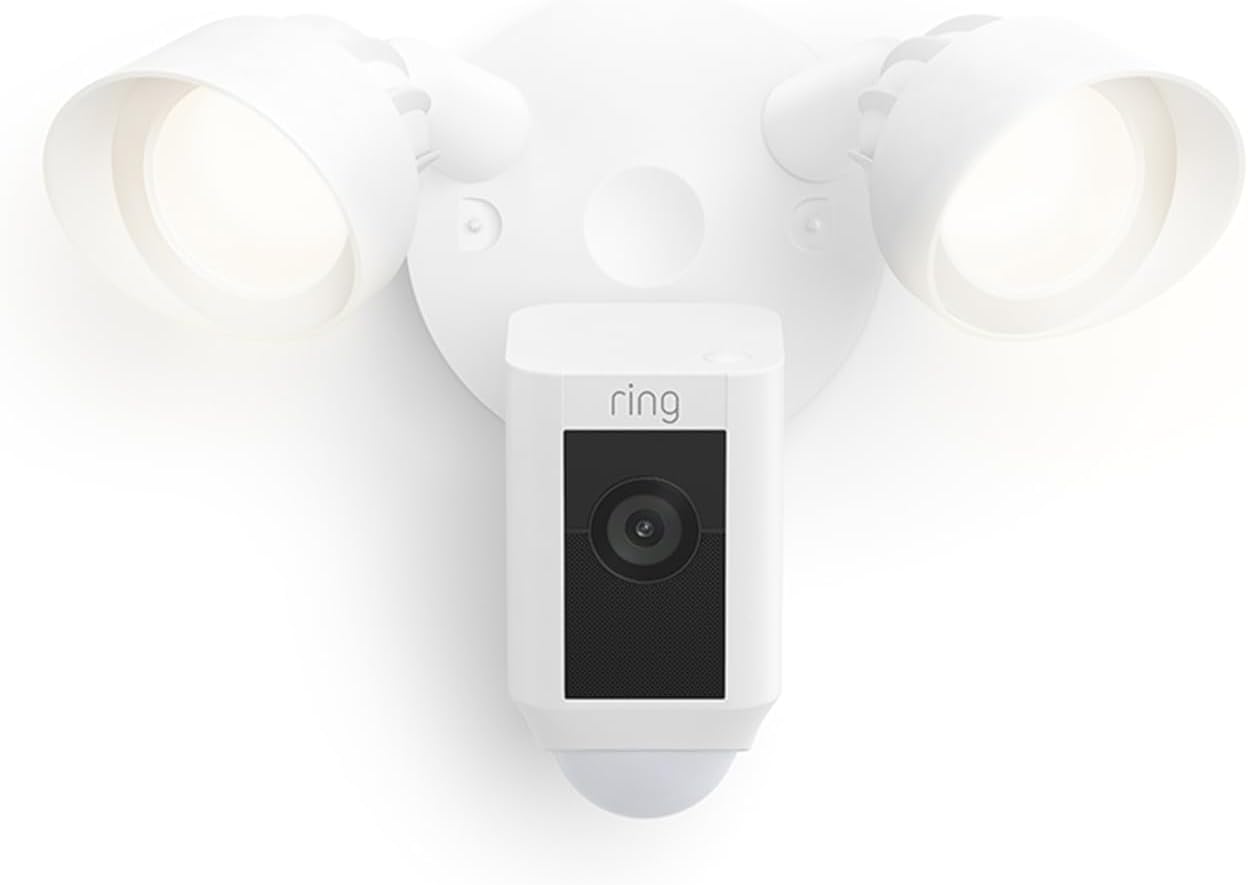
Key specs: Hardwired; two 3000K floodlights at 2,000 lumens combined; 1080p video with night vision; remote-activated 105 dB siren; mounts on a 4-inch round weatherproof electrical box with AC wiring, not included
If a floodlight already sits on the wall and you want to replace it with something that records, this is the least surprising way to do it. Ring publishes two 3000K floodlights rated at 2,000 lumens combined, 1080p video with night vision, a remote-activated 105 dB siren, and a mounting base with adjustable light and camera angles built for a 4-inch round weatherproof electrical box. That 2,000-lumen figure sits at the dim end of this lineup, and Ring is the only pick here with no local storage at all — footage lives in the cloud, on a plan. In exchange you get the most mature app and the widest accessory ecosystem. If you have already settled on the brand, our dedicated Ring floodlight camera guide compares the Wired Plus against the 2nd Gen, the Pro and the plug-in mount rather than repeating that comparison here.
✅ Pros
- Direct swap for an existing fixture on a standard 4-inch round box
- 3000K light, the warmest here and the neighbor-friendly end of the scale
- Remote-activated 105 dB siren you can trigger from the app
- Largest accessory and integration ecosystem of any brand here
❌ Cons
- 2,000 lumens is the dimmest of the four wired options in this guide
- 1080p, where Wyze and Reolink deliver 2K and 4K respectively
- No microSD slot and no USB storage — recorded video requires a subscription
- Fixed brightness, so you cannot dim it if it overshoots a neighbor’s window
Blink’s Own Fork: 2,600 Lumens Wired or 700 on Batteries
Blink illustrates the power-versus-brightness trade better than any other brand, because it sells both ends of it and documents both honestly. The Blink Wired Floodlight Camera is the hardwired half: 2,600 lumens of 5000K light, 1080p video, color night view, a 105 dB siren, and no batteries anywhere in it. It needs a 4-inch round, UL-listed, weatherproof box that is not included, plus a working ground. No Sync Module is required to run it, but clips only save locally with a Sync Module 2 and a USB drive of up to 256 GB.
Same Brand, Opposite Answers
Blink Wired Floodlight — 2,600 lumens
- Hardwired, no batteries at all
- 5000K cool white, the coolest light here
- Needs a 4-inch round UL-listed weatherproof box, not included
- Local clips need a Sync Module 2 plus a USB drive
- No Sync Module required just to run the camera
Blink Outdoor 4 Floodlight — 700 lumens
- Fully wire-free; the light runs on four D-cell alkalines
- Rated up to two years of light on the included D-cells
- The mount cannot power the camera, which needs its own AA lithium cells
- Will not work at all if the camera’s Battery Extension Pack is fitted
- Not compatible with XT, XT2 or Outdoor 3rd Gen cameras
The right-hand column holds the detail that surprises people after purchase: two independent battery systems. Blink’s own support documentation states the Outdoor Floodlight Mount cannot act as a power source or backup for the camera, and that the Outdoor 4 must run its own AA lithium cells to work properly. So "two-year battery life" describes the light’s D-cells, not the whole device. The camera’s cells are a separate replacement cycle, and our Blink camera battery guide covers what actually drains them.
If you already run Blink hardware, our Blink camera roundup covers the full range. The short version: the wired model is a genuinely competitive floodlight camera at 2,600 lumens, and the battery model is a competent camera with a modest light attached to it.
Blink Outdoor 4 Floodlight Camera — best with no wiring at all
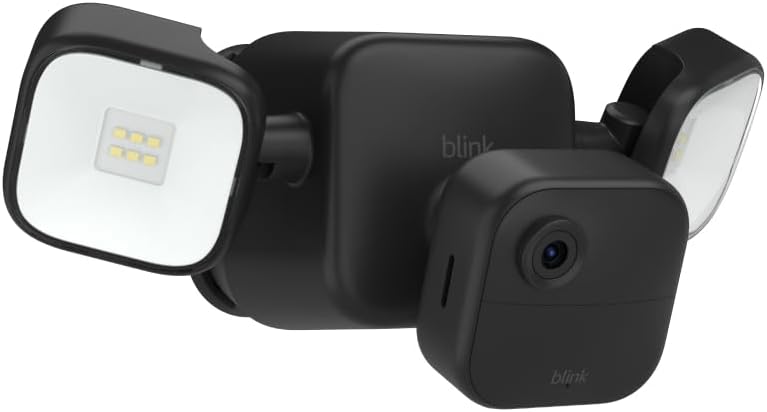
Key specs: Battery Outdoor 4 camera on Blink’s Outdoor Floodlight Mount; 700 lumens from four D-cell alkalines rated up to two years; camera runs on its own separate AA lithium cells; Sync Module Core included
Buy this for the reason it exists: there is no power at the spot you want covered, and running some would cost more than the camera. A shed at the back of a lot, a fence line, a detached garage, a rental where touching the circuit is not an option. SafeWise’s testing across nine floodlight cameras found only two battery-powered models sold at all. Blink’s numbers are modest and stated plainly: 700 lumens from four D-cell alkalines, rated up to two years on the set in the box. SafeWise’s verdict on that brightness is not flattering — not much better than a typical spotlight camera — and you should read it before ordering rather than after. As a light for a dark corner it works. As a replacement for a 2,600-lumen wired floodlight, it is not one.
✅ Pros
- Genuinely wire-free, so it mounts where nothing else here can go
- Up to two years of light on the included D-cells before a change
- Sync Module Core is included in the box rather than sold separately
- Only two battery-powered floodlight cameras exist at all
❌ Cons
- 700 lumens — roughly a quarter of what the brightest wired picks put out
- Two battery systems to track: D-cells for the light, AA lithiums for the camera
- The floodlight mount cannot power or back up the camera
- Incompatible with the Battery Extension Pack, and with XT, XT2 and Outdoor 3rd Gen cameras
Wyze Cam Floodlight v2 — best light-per-fixture with local recording
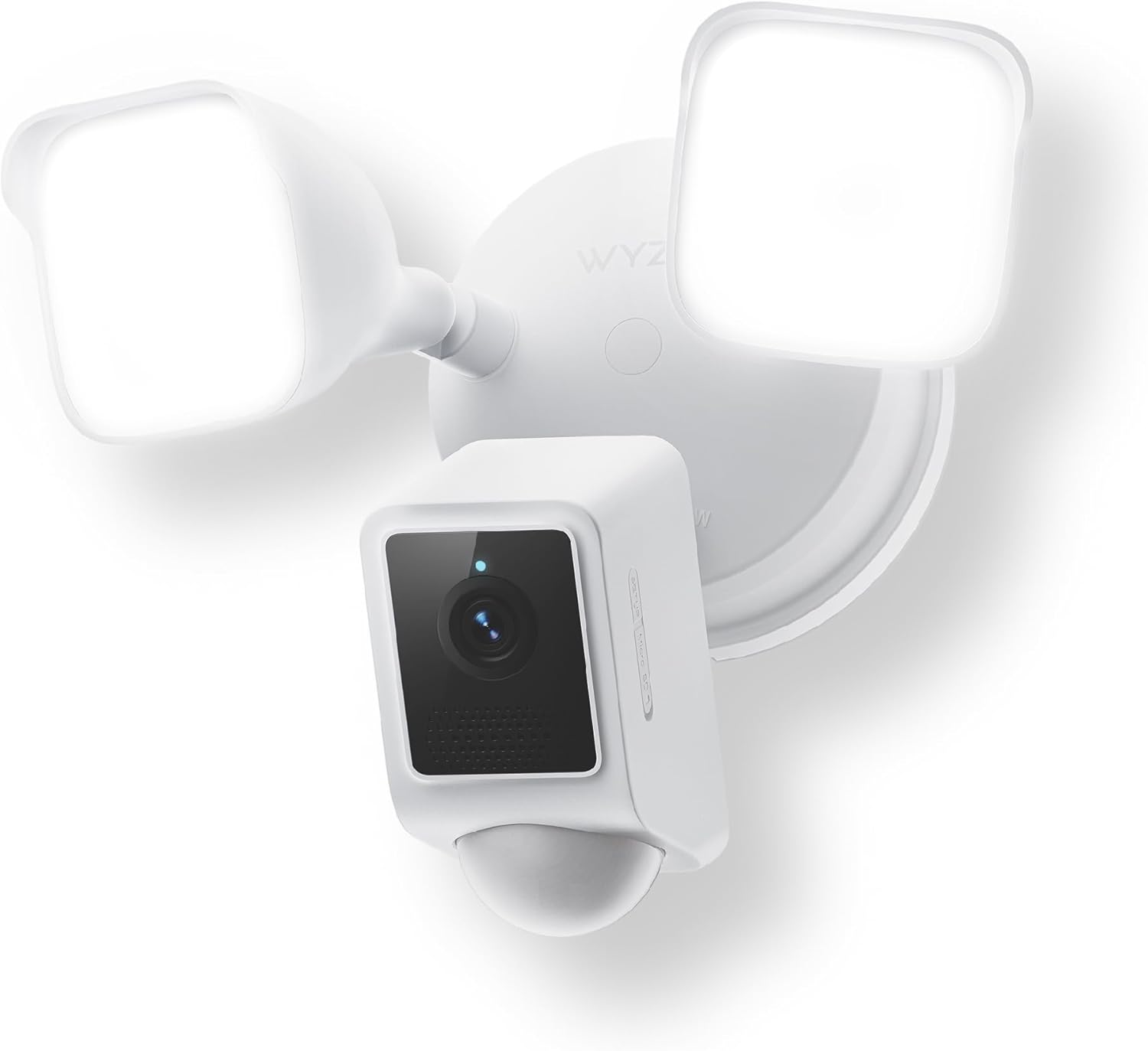
Key specs: Hardwired; 2,800-lumen LEDs; 2K video with color night vision; 160-degree field of view; 24/7 local recording to a microSD card up to 256 GB, sold separately; 105 dB siren; IP65; needs an existing junction box and neutral wire
Take this one if you want strong output from a normal fixture swap and would rather keep footage in your own hands than on a subscription. Wyze publishes 2,800-lumen LEDs, 2K video with color night vision, a 160-degree field of view, a 105 dB siren and an IP65 rating. Storage is what separates it from Ring: a microSD slot taking cards up to 256 GB, recording 24/7 locally, with cloud backup and AI person and package detection as a paid add-on rather than a requirement. The install is standard — Wyze says outright that you must have an existing junction box and a neutral wire, that power goes off at the panel first, and that some areas require a permit and professional installation. Budget for the card too; our microSD card guide for security cameras covers which endurance ratings survive continuous recording.
✅ Pros
- 2,800 lumens, second brightest here and brighter than Ring’s floodlight cam
- 24/7 local recording to a microSD card up to 256 GB, with no plan required
- 2K video and a 160-degree field of view, wider than most single-lens rivals
- 105 dB siren and IP65 weather sealing
❌ Cons
- Requires an existing junction box and a neutral wire
- The microSD card is sold separately, so local recording costs extra on day one
- AI person and package detection sit behind the paid Cam Plus tier
- Smaller accessory ecosystem than Ring if you are building out a whole system
Reolink Elite Floodlight WiFi — best coverage from a single box
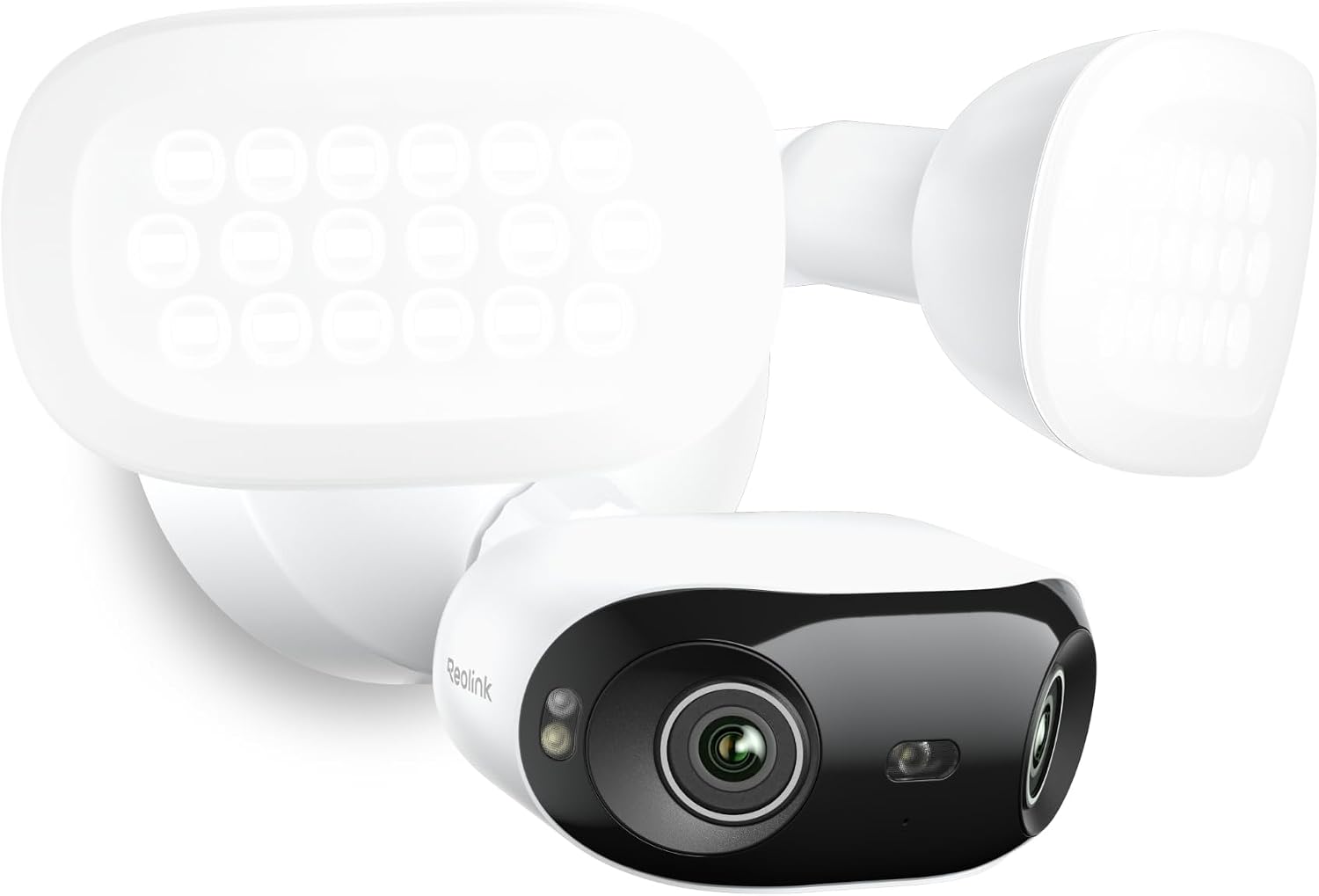
Key specs: Hardwired dual-lens; 4K stitched into a 180-degree panorama; 19W floodlights dimmable to 3,000 lumens, selectable 3000K to 6500K; 105 dB siren; microSD up to 512 GB; dual-band Wi-Fi 6; IP66
The argument here is not brightness, even though it is the brightest pick. It is that two lenses stitched into a 180-degree 4K panorama cover a frontage that would otherwise take two cameras and two electrical boxes. Reolink rates the floodlights at 19W and up to 3,000 lumens, dimmable, selectable from 3000K warm to 6500K cool, with a throw of roughly 12 meters. It carries a 105 dB siren, a microSD slot up to 512 GB, dual-band Wi-Fi 6 and an IP66 rating. Dimming is the quiet advantage: it is the only camera here you can dial back if it overshoots a property line, exactly the control DarkSky’s guidance asks for. The honest caveat: this is a new listing with only a few dozen customer ratings so far, against tens of thousands for the Ring and Blink wired models. The specs are Reolink’s own published figures and the brand has a long track record, covered in our Reolink camera roundup, but there is not yet a deep pool of long-term owner feedback on this exact model.
✅ Pros
- 180-degree stitched 4K coverage from one fixture, replacing what would otherwise be two cameras
- Brightest in this guide at up to 3,000 lumens, and the only dimmable one
- Selectable 3000K to 6500K color temperature, so you can go warm near a property line
- microSD up to 512 GB and Wi-Fi 6, the largest storage ceiling here
❌ Cons
- Thin review base against the established models
- Hardwired only, with no battery or plug-in variant
- 4K over Wi-Fi is demanding; a weak signal shows up as dropped clips
- Dual-lens stitching adds a seam to the panorama that single-lens cameras do not have
What a Floodlight Camera Will Not Do
Four things get expected of these cameras that none of them deliver. Knowing them in advance is the difference between a satisfied owner and a one-star review.
Four Checks Before You Order
1
Find the box, then the camera
Confirm there is a 4-inch round weatherproof electrical box on the wall you want, with a neutral and a ground. Everything else is secondary to this.
2
Pace out the area
A two-car driveway does not need 3,000 lumens. Reolink quotes about 12 meters of throw at 3,000; measure before you pay for output you will dim anyway.
3
Check where the light lands
Aim the heads down, not out. Light crossing onto a neighbor’s property is light trespass, and glare makes faces harder to identify, not easier.
4
Decide where footage lives
Wyze and Reolink take microSD cards; Blink’s wired model needs a Sync Module 2 and a USB drive; Ring is cloud only.
Working through these in order is what separates a clean install from a returned camera.
It will not identify a face at the edge of its range. A bright light behind a subject silhouettes them; one in front blows out the exposure. DarkSky’s point about glare impairing visual acuity applies to a camera sensor as much as to an eye, so aim the heads down and slightly away from the camera’s line of sight. Our explainer on how night vision actually works covers why color night vision and floodlight illumination interact the way they do.
It will not cover a whole property. Even the Reolink’s 180-degree panorama is one wall’s worth of coverage. Our camera placement walkthrough works through it in order of actual entry-point risk. Driveways in particular have their own requirements, which our driveway camera guide gets into.
It will not record for free forever on every brand. Ring’s model in this guide has no local storage at all. Wyze and Reolink record to microSD without a plan, and Blink’s wired model writes to a USB drive through a Sync Module 2. That gap compounds over years rather than months, which our running-cost breakdown lays out, and the choice between the two approaches is covered in where your footage should actually live.
It will not survive a power cut. Every hardwired pick here goes dark and offline when the breaker trips or the grid drops, because there is no battery in any of them. The battery Blink is the only model in this guide that keeps working, and it is the dimmest one. That is the trade in a single sentence.
Final Recommendation
Start with the wall, not the camera. If there is already a floodlight fixture on it, buy the Ring Floodlight Cam Wired Plus. It is the most predictable swap, its 3000K light is the least likely to annoy a neighbor, and its ecosystem and app are the most mature in the category. You are accepting 1080p and cloud-only storage in exchange for that.
Three things should push you off that default. If you want recorded video without a monthly plan, take the Wyze Cam Floodlight v2 instead — 2,800 lumens, 2K, and 24/7 recording to a microSD card. If you are lighting a wide frontage and would otherwise need two cameras, the Reolink Elite Floodlight WiFi covers 180 degrees from one box and is the only dimmable pick here, with the caveat that its review base is still thin. And if there is no power at the spot at all, the Blink Outdoor 4 Floodlight Camera is the realistic option — buy it understanding that 700 lumens is a quarter of what the wired models deliver.
What should not change your mind is a bigger lumen number on its own. Past roughly 2,000 lumens on a typical residential wall you are buying light trespass and glare as much as visibility. Between two cameras, take the one you can dim, aim and store footage from — not the one with the largest number on the box. And if a floodlight camera is the wrong shape of answer entirely, a plain motion-sensor light plus a camera you already own often solves the same problem for less.
SafeBode does not yet run an in-house product testing program. This guide is built from manufacturer specifications, official support documentation, current retail listings and verified buyer feedback rather than hands-on testing, and we say so plainly rather than implying testing we have not done.
Frequently Asked Questions
Do all floodlight cameras need an electrician?
No, but most need an existing outdoor electrical box. If a floodlight fixture is already mounted where you want the camera, swapping it is usually a breaker-off, three-wire job that a confident homeowner can do. Adding a box where none exists is different work, and both Wyze and Blink recommend a licensed electrician for that, along with checking whether your area requires a permit.
How many lumens do I actually need?
For a standard driveway, porch or small yard, the 2,000-lumen class is enough. Wide frontages, deep lots and long side yards are where 2,800 to 3,000 lumens earns its place. Going brighter than the space needs mostly buys glare and light spilling onto a neighbor’s property.
Is a battery floodlight camera bright enough to be useful?
It is useful as light for a dark corner and as a deterrent, but it is not equivalent to a wired floodlight. Blink’s battery model runs at 700 lumens against 2,600 for its own wired one. Buy it because a location has no power, not because it looks like a cheaper way to get the same result.
Can I install a floodlight camera where my old floodlight was?
That is the ideal case and what these cameras are designed for. Confirm the box is a 4-inch round weatherproof type, that a neutral and a ground are present, and that the mounting plate fits. Shut off the circuit at the panel first.
Which of these work without a subscription?
Wyze records around the clock to a microSD card with no plan required, and Reolink takes a microSD card as well. Blink’s wired camera can save clips to a USB drive through a Sync Module 2. Ring’s floodlight camera has no local storage option, so recorded video needs a plan.
Do floodlight cameras keep working during a power cut?
The hardwired ones do not. They have no internal battery, so they go dark and offline until power returns. A battery model keeps running, and that is one of the genuine arguments for choosing one despite the lower brightness.
What color temperature should I pick?
Warmer light is the neighbor-friendly choice and is easier on the eyes at night. Ring’s heads are a warm 3000K, Blink’s wired model is a cool 5000K, and Reolink lets you select anywhere between 3000K and 6500K. If your fixture sits near a property line, take the warmest option available.
Does the light have to come on every time the camera detects motion?
No. Every model here separates light triggering from recording in its app, with schedules and dusk-to-dawn behavior. Leaving detection on while the light stays off during waking hours is a common setup, and it stretches battery life on the wire-free model.
Will a floodlight camera stop my existing lights from working?
It replaces them, because it mounts to the same electrical box the old fixture used. Keeping the original light means adding a second box, which is new electrical work.
Is 4K worth it on a floodlight camera?
It helps most when the camera is covering a wide area, because detail is spread across more ground. On a narrow porch, 1080p at a shorter distance can resolve a face better than 4K across a whole frontage. Higher resolution also demands more of your Wi-Fi and fills a memory card faster.
Sources
Show sources (7)
- [1] Ring Support, “Floodlight Cam Wired Plus Information” — published specifications: two 3000K floodlights at 2,000 lumens, 1080p video, a 105 dB siren, and a 4-inch round weatherproof electrical box with AC wiring (not included).
- [2] Wyze, “Wyze Cam Floodlight v2” product page and installation FAQ — 2,800 lumens, 2K video, 160-degree field of view, microSD to 256 GB, IP65, 105 dB siren, and the stated need for an existing junction box and neutral wire.
- [3] Blink Support, “Blink Outdoor Floodlight Mount FAQ” — 700 lumens from four D-cell alkalines, up to two years of light, and the stated fact that the mount cannot power the camera.
- [4] Blink Support, “Wired Floodlight Camera FAQ” — 2,600 lumens at 5000K, no batteries, a required 4-inch round UL-listed weatherproof box, and local storage via a Sync Module 2 and a USB drive.
- [5] Reolink, “Reolink Elite Floodlight WiFi” product page and specifications — 4K dual-lens 180-degree view, 19W floodlights dimmable to 3,000 lumens at 3000K–6500K, about 12 meters of throw, microSD to 512 GB, Wi-Fi 6, IP66.
- [6] SafeWise, “Best Floodlight Cameras for Home Security” — hands-on testing of nine floodlight cameras, the floodlight-versus-spotlight distinction, and the finding that only two battery-powered models are sold.
- [7] DarkSky International, “Neighborhood-friendly lighting: Model guidance for Homeowners Associations” — light trespass, glare and visual acuity, and lighting only where and when needed.


