Security Screen Doors: What Makes One Secure
Affiliate Disclosure: This article contains affiliate links. If you buy through these links, we may earn a commission at no extra cost to you. Our editorial opinions are our own and are not influenced by affiliate relationships. Read our full disclosure policy →
Contents
Quick Answer
A security screen door is only as strong as its frame and how that frame is anchored to your house — the mesh gets the marketing and does the least work. If you buy one, the Prime-Line Woodguard is the single credible option we found: a welded steel frame with tamper-proof hinges from an established hardware manufacturer, in a category otherwise full of near-identical imports with twenty-odd reviews each. Before you spend, know two things: a reinforced main door usually costs less and resists more, and a keyed security door on an escape route is a genuine fire risk.
Four Parts Decide Whether a Door Is Secure
Listings in this category compete on appearance and on mesh. Neither is where the strength is. Four things determine whether a security screen door does anything at all, and they are worth checking in this order.
| Component | What to look for | Why it matters |
|---|
| Frame | Welded steel, not screwed or riveted aluminum | A forced door fails at the frame first; a welded corner cannot be pried apart |
| Anchoring | Long screws into the structural jamb, not the trim | The strongest door in the world pulls out of soft trim in seconds |
| Hinges | Tamper-proof or with non-removable pins | Exposed hinge pins on an outward-opening door can simply be knocked out |
| Lock and strike | A real deadbolt into a reinforced strike | A latch into thin metal is the weakest link in most of these doors |
| Mesh | Perforated steel sheet or heavy steel mesh | Matters least — almost nobody attacks the middle of the door |
That last row is the one that reverses most people’s assumptions. The mesh is what you look at, so it is what the photographs sell. But an attacker does not cut a neat hole in the center of a door; they pry at the edge, at the lock, or at the hinges, because those are where the leverage is. A door with an impressive mesh in a flimsy frame is a decorative object.
The Frame Is the Product; the Mesh Is the Marketing
Prime-Line’s specification is a useful benchmark for reading any listing in this category: a 1 inch by 1 inch welded steel frame, 24-gauge perforated steel mesh, and three heavy duty tamper-proof hinges. Each of those three details is doing real work.
Welded is the word to search for. A frame assembled with screws or rivets at the corners can be worked apart; a welded frame has to be cut or bent. If a listing describes its frame without using that word, assume it is not welded.
Tamper-proof hinges matter specifically because security screen doors open outward. That puts the hinge barrel on the outside, where anybody can reach it. On an ordinary interior door the hinges face inward and nobody can touch them; on an outward-opening security door, removable hinge pins would let someone lift the whole door off without touching the lock at all.
Reading a Listing Properly
✅ Signals of a real product
- The word “welded” applied to the frame
- Tamper-proof hinges or non-removable pins named explicitly
- A stated steel gauge rather than “heavy duty”
- A named manufacturer with other products in the trade
🚩 Signals to be cautious about
- Mesh described in detail and the frame barely mentioned
- “Security” in the title with no structural specification at all
- A brand name that appears only in this one product category
- A very thin review base on a product that has to last decades
One more item that is entirely outside the box you receive: the anchoring. These doors are supplied with fasteners sized for the door, not for your house. Screws into decorative trim rather than into the structural jamb are the single most common installation failure, and no specification on the listing protects you from it. It is the same principle behind door reinforcement kits for a main door: the strike and the screws are where the strength actually lives.
An Honest Warning About This Category
We normally publish four picks in a buying guide. Here we are publishing one, and the reason is worth stating plainly rather than hiding behind a padded list.
Search security screen doors on the U.S. Amazon catalog and the results are dominated by steel doors from brands you will not have encountered outside that search, in near-identical 36 by 80 and 32 by 80 sizes, frequently carrying somewhere around twenty to twenty-five reviews each. Several list under multiple brand names with the same photographs. That is the signature of white-label importing, and it is a genuine problem for a product that is supposed to be a structural part of your house for twenty years.
Why We Are Only Recommending One
~20–25
reviews on many listings in this category
Multiple
brand names sharing identical product photography
Decades
how long this purchase is supposed to last
One
established hardware manufacturer we could verify
A thin review base is a weak signal on a cheap gadget and a serious one on a door.
This is not a claim that those doors are unsafe — we have not tested them and we are not going to imply we have. It is a claim that you cannot tell, and that a category where you cannot tell is one to approach with a known manufacturer or to skip in favor of something you can assess.
Prime-Line Woodguard Steel Security Door — the one credible pick
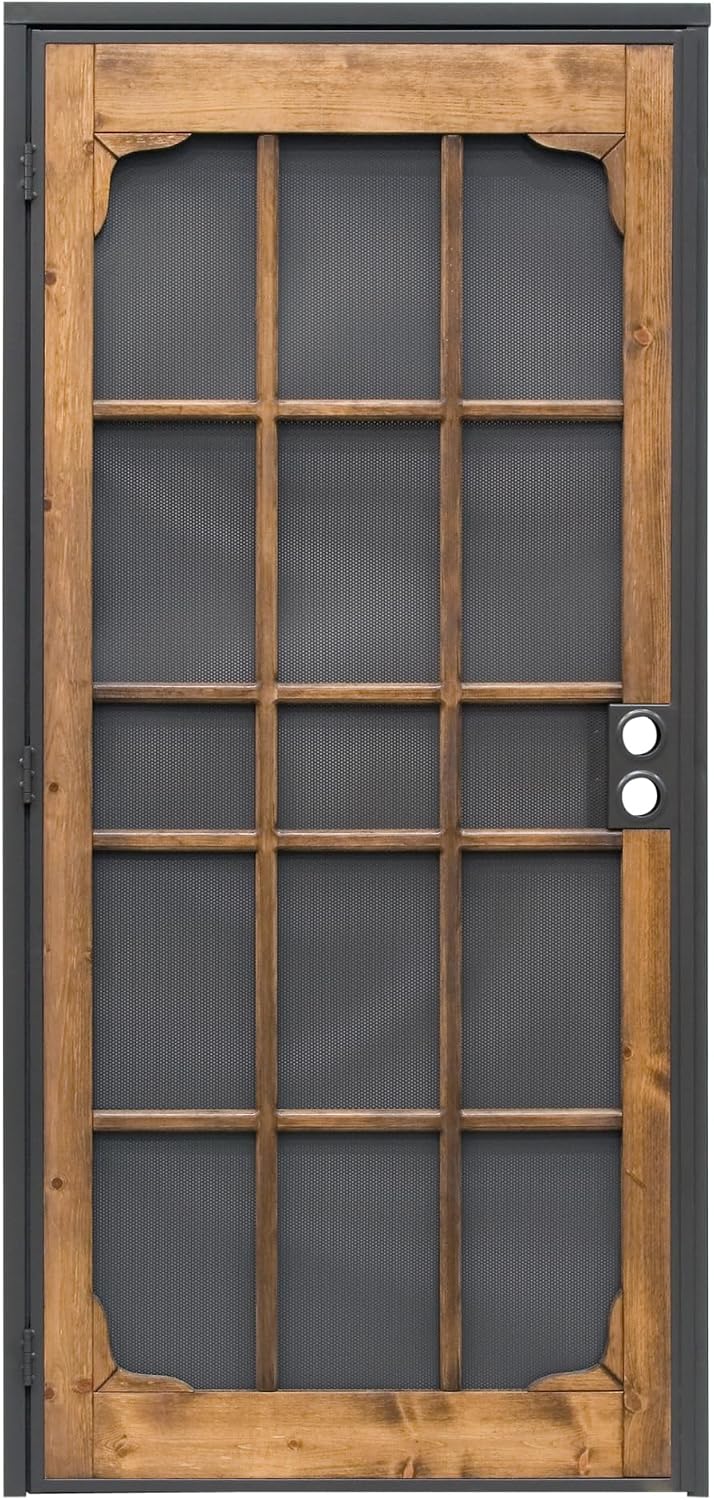
Key specs: 24-gauge perforated steel mesh in a 1 inch by 1 inch welded steel frame; three heavy duty tamper-proof hinges; finished in a light oak stain so it reads as a traditional screen door rather than a security grille
Prime-Line is a genuine hardware manufacturer with a broad catalog rather than a marketplace brand, and this door has a review base an order of magnitude larger than most of the category. The specification is the right shape: 24-gauge perforated steel mesh in a welded 1 by 1 inch steel frame, with three heavy duty tamper-proof hinges — frame, hinges and mesh addressed in that order, which is the order that matters. The light oak stained finish is a deliberate choice to read as a traditional screen door rather than as a security grille, which matters more than it sounds: a house that looks fortified advertises that there is something worth fortifying.
✅ Pros
- Welded 1 x 1 in steel frame, not a screwed assembly
- Three heavy duty tamper-proof hinges
- 24-gauge perforated steel mesh
- Established hardware manufacturer with a real catalog
- Looks like a screen door rather than a grille
❌ Cons
- One size and finish — check your opening before ordering
- Security depends on installation into a structural jamb, which is on you
- An outward-opening door still needs a strong lock and strike to be worth anything
- Adds a keyed barrier on an escape route, which has fire implications
The Fire Safety Problem Nobody Mentions
This is the section that ought to be in every security screen door article and almost never is. A security door adds a second locked barrier to a doorway you may one day need to get through very quickly.
Fire escape guidance is built on two ways out of every room and a rehearsed route to a meeting place outside. A security screen door sits directly on one of those routes. If it is secured with a lock that needs a key from the inside, and that key is not in the lock, the route is closed — in darkness, in smoke, under time pressure.
Making a Security Door Survive an Emergency
1
Prefer a thumbturn inside
A lock that opens from the inside without a key keeps the exit usable. This is the single most important choice you make on the lock.
2
If it is keyed inside, the key lives in the lock
Not on a hook, not in a drawer. A key nobody can find in the dark is the same as no key.
3
Include it in the escape drill
Practice the route with the security door in place. If it slows people down, you have found that out on a calm evening.
4
Check every household member can operate it
Children, older relatives, anyone with limited hand strength. A door only some people can open is a door that traps the others.
A second barrier works both ways — plan for the direction you care about most.
None of this is an argument against security doors. It is an argument for choosing the lock deliberately and for adding the door to your home fire escape plan rather than treating it as a purely security decision. The same consideration applies to window bars, which is why quick-release mechanisms exist on those.
Cheaper Things That Do More
Before buying a security screen door, it is worth knowing what the same money does elsewhere, because for most homes the answer is “more.”
Burglary is classified into unlawful entry where no force is used, attempted forcible entry, and forcible entry. That distinction matters here: a security screen door addresses forcible entry at one doorway. It does nothing about an unlocked window, and it does nothing about the far more common reality that most burglars specifically target homes when nobody is there.
Where the Same Budget Might Go Further
🔩 If forced entry is the worry
- A reinforced strike plate and long screws on the main door
- A high-security deadbolt rather than a second door
- A door security bar for occupied hours
- Attention to the patio slider, which is usually weaker
👀 If deterrence is the worry
- Visible cameras and alarm signage, which research links to deterrence
- Motion lighting on the approach
- An alarm system, since most break-ins target empty homes
- Fixing sight lines so the door is visible from the street
Where a security screen door genuinely earns its place: you want to leave the main door open for airflow while keeping a locked barrier in place, you have a door that gets a lot of unsolicited callers, or the main door itself is weak and cannot easily be replaced. Those are real cases — and they are cases about daily use, not just about resisting an attack. Similar reasoning applies to French doors, where the weakness is structural rather than about the lock.
What to Actually Do
If you want a security screen door, buy the Prime-Line Woodguard and pay attention to the installation. The welded frame and tamper-proof hinges are the specification worth having, and screwing it into the structural jamb rather than the trim is worth more than any upgrade you could buy.
Choose a lock with an interior thumbturn, and add the door to your escape drill. A security door on an exit route is a fire consideration as much as a security one, and this is the decision that determines which.
If your actual concern is forced entry rather than airflow, spend the money on the main door instead. A reinforced strike, long screws and a high-security deadbolt resist more force than a screen door does, cost less, and do not add a barrier to your own way out.
What would change this advice: if you find a security screen door from a manufacturer with a genuine trade catalog and a real installation specification — local suppliers often have these where the marketplace does not — that is a better purchase than anything in the online listings, including our pick. This is a category where buying locally from someone who will install it is a legitimately stronger route than buying online.
SafeBode does not yet run an in-house product testing program. This guide is built from manufacturer specifications, official support documentation, current retail listings and verified buyer feedback rather than hands-on testing, and we say so plainly rather than implying testing we have not done.
Frequently Asked Questions
Are security screen doors actually secure?
A well-built one adds a real barrier, but the strength is in the welded frame, the hinges and how it is anchored to the house — not in the mesh. A strong mesh in a weak frame, or a strong door screwed into decorative trim, is close to decorative.
What should I look for in a security screen door?
In order: a welded steel frame, tamper-proof or non-removable hinge pins, a real deadbolt into a reinforced strike, and only then the mesh. If a listing details the mesh and says little about the frame, that ordering tells you something.
Why do security screen doors need tamper-proof hinges?
Because they open outward, which puts the hinges on the outside where anyone can reach them. Removable hinge pins would let someone lift the door off entirely without touching the lock.
Is a security door a fire hazard?
It can be, if it is locked from the inside with a key and the key is not immediately to hand. Fire guidance depends on two usable ways out of every room, and a keyed second barrier on an exit closes one of them. Prefer an interior thumbturn.
Are cheap security screen doors any good?
We could not verify them, and we are not going to guess. The category is dominated by near-identical imports with very small review bases sharing product photography across brand names, which is a weak basis for a structural purchase meant to last decades.
Will a security screen door lower my insurance?
Possibly, though discounts are more commonly tied to monitored alarm systems than to individual hardware. It is worth asking your own insurer directly rather than assuming, since the answer varies by policy.
Do I need a security door if I already have a deadbolt?
Usually not for strength — a reinforced main door with a good deadbolt resists more force than a screen door. The genuine reasons to add one are airflow with the main door open, and a locked barrier for answering the door to strangers.
Can I install one myself?
Physically yes, and the important part is not the door but the fixings: long screws into the structural jamb rather than into trim. If you are not confident identifying the structural framing behind the casing, that is the argument for professional installation.
Does a security door make my house look like a target?
It can, which is why finish choices matter. A door styled as a traditional screen door reads very differently from a visible steel grille, and a house that looks fortified is also a house advertising that it holds something worth fortifying.
Sources
Show sources (3)


