How to Find Hidden Cameras in a Rental, Hotel or Airbnb
Affiliate Disclosure: This article contains affiliate links. If you buy through these links, we may earn a commission at no extra cost to you. Our editorial opinions are our own and are not influenced by affiliate relationships. Read our full disclosure policy →
Contents
Quick Answer
Start with a physical sweep of the sight lines into the bed and the bathroom — that is where a camera has to be to be worth hiding, and it narrows the search enormously. Turn the lights off and use a bright phone torch held next to your eye to look for the tiny retro-reflective glint of a lens. Check the Wi-Fi network for unfamiliar devices, understanding that a camera recording to a local card will not appear there at all. Recording someone in a bedroom or bathroom is illegal in circumstances where they have a reasonable expectation of privacy — so if you find one, preserve it and call the police rather than removing it.
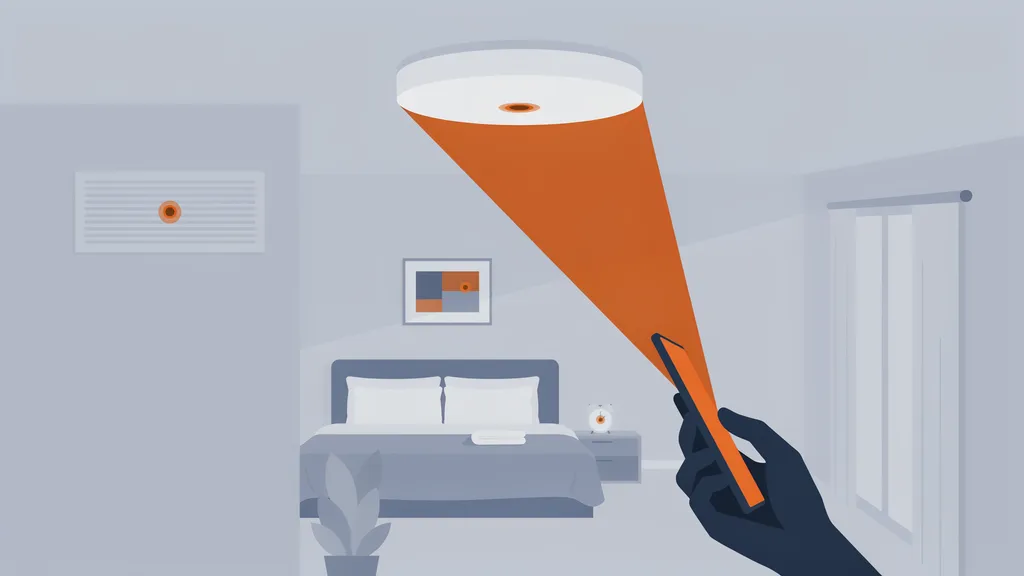
Where They Actually Get Hidden
The useful insight is that a hidden camera is heavily constrained. It needs a sight line to the thing someone wants to see, it needs power or a battery that will not run out, and it needs to sit in an object nobody questions. Those three requirements together eliminate most of a room.
Start by standing where you would undress and looking back at the room. Anything with a clear view of that spot is a candidate; anything without one is not. Then apply the power constraint: mains-powered objects can record indefinitely, so they are far more likely hosts than something running on a small battery.
| Common host object | Why it is chosen | What gives it away |
|---|
| Smoke or CO detector | Ceiling-mounted with a full view; never questioned | A second one in an odd place; a lens dot off-center; no brand markings |
| Alarm clock or radio | Mains powered, faces the bed by design | Pointing at the bed rather than at where you would read it |
| USB charger or power adapter | Plugged in permanently, ignored entirely | Plugged in near a bed with nothing connected to it |
| Air purifier, speaker, or plant pot | Bulky enough to conceal hardware | Positioned facing the room rather than usefully |
| Vent, grille or picture frame | Wall height, no visible electronics | A dark aperture that does not match the others |
| Anything new or mismatched | Added rather than original to the room | It does not match the decor, or has an unexplained cable |
The last row is the most useful heuristic overall. In a hotel or a rental, the fittings are generally consistent. An object that does not belong — a different brand of detector, one newer-looking outlet, a clock in a room where nothing else is that style — is worth more attention than any gadget. It is the same reasoning that makes a peephole camera obvious once you know what one looks like — the giveaway is almost always the object being wrong for the room rather than the lens being visible.
The Physical Sweep, In Order
Ten Minutes, Done Properly
1
Map the sight lines first
Stand at the bed and in the bathroom doorway. Note every object with a clear view. You are now searching a handful of items, not a whole room.
2
Follow the power
Anything permanently plugged in near a sight line is a priority. An adapter plugged in with nothing charging from it deserves a proper look.
3
Handle the candidates
Pick them up. Turn them over. A camera adds weight, needs an aperture, and usually cannot be opened the way the real object would.
4
Check the bathroom separately
Different sight lines, different objects — toiletry holders, vents, the underside of shelves, anything facing a shower or mirror.
A structured sweep beats a gadget, because it does not depend on the camera transmitting anything.
Two details make this materially more effective. First, look up. People search at eye level and cameras are frequently mounted high, because height gives coverage and keeps the device out of the casual search everyone performs. Second, if a smoke detector is the candidate, compare it with the others in the property — a mismatched unit in one bedroom while the hallway has a different model is a genuine anomaly.
The Lens Reflection Trick, and Its Limits
The most useful non-gadget technique exploits physics rather than electronics. Camera lenses are retro-reflective: they bounce light back toward its source more strongly than the surrounding material does. That is why a bright light held close to your own eye can reveal one.
Turn off the room lights and close the curtains so the room is as dark as you can make it. Hold a phone torch immediately beside your eye — the alignment matters, because you need to be looking along the beam rather than across it. Sweep slowly across the candidate objects you identified, watching for a small bright pinpoint that appears and disappears as the angle changes.
What This Technique Can and Cannot Do
✅ Where it works
- Small lenses behind a pinhole in an ordinary object
- Dark rooms, where the glint has contrast to stand out
- Close range, sweeping slowly and deliberately
- Costs nothing and needs no equipment you do not already have
❌ Where it fails
- Lenses behind one-way mirrored or tinted covers
- Bright rooms, or a hurried sweep from across the room
- Cameras positioned inside dark grilles and vents
- It finds lenses, not devices — a covered lens still exists
Treat a negative result as weak evidence rather than an all-clear. The technique genuinely works, and it also misses things. That is exactly why the physical sweep comes first and the torch is a second pass over a shortlist rather than a substitute for it.
Checking the Network, and Why It Often Fails
If you are on the property’s Wi-Fi, a network scanning app will list the devices connected to it. Unfamiliar names, or anything identifying itself as a camera brand, are worth investigating.
But be clear about the two large holes in this method, because it is often presented as definitive and is not. First, a camera recording to a local memory card does not need a network at all — it will never appear in any scan. Second, a camera on a separate network from the guest Wi-Fi is equally invisible to you, and a host who has hidden a camera is unlikely to have put it on the network they gave you the password to.
There is a narrower version of this check that is more useful: if you are staying somewhere long enough, watching for devices that appear and disappear can be informative. But as a one-off, treat a clean network scan the same way as a clean torch sweep — encouraging, not conclusive. The general principle is the same one behind our piece on whether cameras themselves can be compromised: what a device does on a network tells you only part of the story.
Do RF Detector Gadgets Work?
Handheld detectors are sold specifically for this, generally combining a radio-frequency receiver with a ring of red LEDs and a viewing filter for the lens-reflection trick. They are worth understanding rather than dismissing, because the two halves work very differently.
The lens-finding half is real, and it is the same physics as the phone torch, done slightly better — the LED ring around a filtered viewfinder gives a cleaner alignment than holding a light beside your eye. If you buy one of these, that is the part you are actually buying.
The RF-detection half is much weaker than the marketing implies. It can only find something actively transmitting, which excludes any camera recording locally. It cannot easily distinguish a hidden camera from a smart TV, a thermostat, a neighbor’s router or the property’s own devices. And sensitivity high enough to be useful is also sensitivity high enough to alarm on everything. Expect it to generate leads, not answers.
Our honest position: a systematic physical sweep plus a phone torch finds most of what a consumer detector would find, for nothing. If you travel constantly and want the better lens optics, a detector is a reasonable small purchase — but buy it for the viewfinder, not for the RF meter.
What the Law Actually Says
The legal picture matters here because it determines what you should do if you find something, and because it is frequently stated too simply.
Federal law includes a video voyeurism offense: it is a crime to intentionally capture an image of a private area of an individual without consent, under circumstances in which that person has a reasonable expectation of privacy. The statute defines that phrase carefully — circumstances where a reasonable person would believe they could undress in privacy, or that a private area would not be visible to the public. A bedroom and a bathroom are the paradigm cases.
One honest caveat that is almost always omitted: that federal statute is written to apply within the special maritime and territorial jurisdiction of the United States, so in practice most prosecutions of hidden cameras in ordinary rentals happen under state law, which varies. The underlying legal test — a subjective expectation of privacy that society is prepared to recognize as reasonable — comes from Fourth Amendment case law and is the framework courts reason within.
There is a separate dimension people miss: audio. Recording laws treat sound differently from images, and a number of states require the consent of all parties to record a conversation. A hidden camera that also captures audio can therefore breach a second set of rules entirely. We cover that split in more detail in what security cameras can legally record, and it applies to your own cameras as much as to someone else’s. The same distinction is why an indoor camera you install yourself needs deliberate placement rather than maximum coverage — something we work through in choosing between a pet camera and a security camera.
What to Do If You Find One
The instinct is to rip it off the wall. Do not. What you have found is potential evidence in a criminal matter, and handling it badly damages both the evidence and your position.
In This Order
1
Do not touch or dismantle it
Leave it in place. Removing it destroys context and may destroy fingerprints or the storage inside.
2
Photograph it where it sits
Wide shots showing the room and the position, then close shots. Capture the object it is concealed in, undisturbed.
3
Cover the view and leave the room
A towel over it, or move to another room. You can block a lens without disturbing the device itself.
4
Call the police, then the platform
Report it as a crime first. Then notify the booking platform or hotel management, in writing, so there is a record.
Preserve first, complain second — the order matters if this ever becomes a case.
Two practical notes. Get out of the accommodation if you can — you have no way of knowing whether there is a second device, and a property where one was found is not somewhere to spend another night reasoning about probabilities. And keep your report in writing with the platform, because a phone conversation leaves no record of when you told them.
What to Actually Do
On arrival anywhere unfamiliar, spend ten minutes doing the physical sweep. Map the sight lines from the bed and the bathroom, follow the power, handle the small number of candidate objects that survive both filters. This costs nothing, needs no equipment, and finds the devices that a network scan structurally cannot.
Then do one dark-room torch pass over that shortlist. Lights off, phone torch held beside your eye, sweeping slowly. Treat both a clean sweep and a clean network scan as encouraging rather than conclusive — each has a specific blind spot, which is why doing both is worth more than doing either twice.
Do not buy an RF detector expecting it to settle the question. If you travel constantly and want better lens optics than a phone torch, the viewfinder half is a reasonable purchase; the RF half will mostly detect the television. Skipping the gadget entirely and doing the sweep properly is a better use of ten minutes.
What would change this advice: if you have any concrete reason for concern — something a host said, an object that seems to have moved between visits, a device you cannot explain — stop searching and involve the police. At that point you are not doing a precaution, you are handling a possible crime scene, and thoroughness is their job rather than yours. If the accommodation is somewhere you will stay again, a portable door lock addresses a different part of the same unease — control over who can enter while you are inside.
SafeBode does not yet run an in-house product testing program. This guide is built from manufacturer specifications, official support documentation, current retail listings and verified buyer feedback rather than hands-on testing, and we say so plainly rather than implying testing we have not done.
Frequently Asked Questions
Can you find a hidden camera with your phone?
Partly. A phone torch held next to your eye in a dark room can reveal the retro-reflective glint of a lens, and a network scanning app can list devices on the Wi-Fi you are using. Neither is conclusive — a lens behind a tinted cover or a camera recording to a local card evades both.
Do hidden camera detector apps work?
Apps that scan the local network do a real, limited job: they list what is connected to the network you are on. Apps claiming to detect cameras by magnetic field or infrared through the phone camera are much less reliable, and none of them can see a device that is neither transmitting nor on your network.
Where are hidden cameras most often placed?
In mains-powered objects with a clear sight line to a bed or bathroom — smoke detectors, alarm clocks, USB chargers, air purifiers and vents. Start from where you would undress and look back at what can see that spot.
Is it illegal to put a camera in a bedroom or bathroom?
Recording someone in circumstances where they have a reasonable expectation of privacy is criminal, and bedrooms and bathrooms are the clearest examples. The precise offense and penalty depend heavily on state law, since the federal video voyeurism statute is written for a limited jurisdiction.
Are cameras allowed in Airbnb or rental common areas?
Platform rules and local law both apply, and they change — check the current policy of the platform you booked through rather than relying on what was true previously. The general legal line is that private spaces like bedrooms and bathrooms are not permissible regardless of disclosure.
What should I do if I find a hidden camera?
Do not touch or dismantle it. Photograph it in place, block its view without disturbing it, leave the property if you can, and call the police before you contact the host or platform. Then put your report to the platform in writing.
Can a hidden camera record audio too?
Many can, and that matters legally because audio is governed by different rules than video. Several states require all parties to consent to a recorded conversation, so an audio-capable hidden camera can breach a second set of laws.
Will covering a camera with tape be enough?
It stops the recording, but it also disturbs potential evidence and alerts whoever installed it. Draping a towel over the object achieves the same privacy without handling the device, which is the better move if you intend to report it.
How long does a proper sweep take?
About ten minutes if you do it in order — sight lines, then power, then handling the shortlist, then a dark-room torch pass. Searching randomly takes far longer and finds less, because it does not narrow the search space first.
Sources
Show sources (3)


