Best Trail Cameras for Property Security 2026
Affiliate Disclosure: This article contains affiliate links. If you buy through these links, we may earn a commission at no extra cost to you. Our editorial opinions are our own and are not influenced by affiliate relationships. Read our full disclosure policy →
Contents
Quick Answer
If the spot you need to watch has no Wi-Fi and no power, a cellular trail camera is the honest answer — but buy one built for property rather than for deer. The TACTACAM Defend 360 is the pick, because it is sold as a security camera: solar-charged, LTE-connected, and pan-tilt-zoom from a phone rather than fixed at whatever angle you strapped it to a tree. Choose the TACTACAM Reveal X 3.0 instead if runtime matters more than remote aiming. Budget for the data plan before you budget for the camera — every cellular camera here carries one, priced by how many photos it sends, and a busy driveway sends far more than a game trail does.
Why a Hunting Camera Ends Up Guarding a Driveway
Trail cameras were built for one job: sit strapped to a tree for months, photograph animals that walk past, and survive weather with nobody visiting. Every design decision follows from that — battery life measured in months rather than days, cellular rather than Wi-Fi, camouflage housing, and a passive infrared trigger tuned for a warm body crossing a trail.
Those same decisions happen to solve a problem ordinary home security cameras cannot touch. A gate half a mile down a track. A barn with no power run to it. A vacant lot, a hunting lease, a stretch of fence line that keeps getting cut. Standard cameras assume two things — mains power and a Wi-Fi network — and both assumptions fail the moment you step away from the house. Our guide to cameras that work without Wi-Fi covers the near-house version of this problem; a trail camera is what you reach for when the distance is measured in acres.
The gap in the market is that almost all the published advice about these cameras is written for hunters. Reviews rank them on how well they photograph a buck at 80 feet. That is a genuinely different requirement from watching a gate, and it leads people to buy on specs that do not matter to them while ignoring the ones that do.
What a Trail Camera Is Not
Before the picks, the honest part. A cellular trail camera will disappoint anyone expecting it to behave like a doorbell camera. These are the differences that actually bite.
Trail Camera vs Home Security Camera
📷 What a trail camera does well
- Runs for months on batteries, or indefinitely on solar
- Needs no Wi-Fi — it has its own cellular connection
- Survives weather and neglect in places nobody visits
- Triggers on movement and sends you the photo wherever you are
🚫 What it does not do
- Continuous recording — most capture stills or short clips on trigger
- Two-way audio, sirens, or any active deterrence
- Instant live view on demand without eating your data allowance
- Integrate with a home alarm system or smart-home platform
The deterrence point deserves emphasis, because it is the one people are most surprised by. A visible outdoor camera on a house discourages an approach. A camouflaged trail camera strapped to a tree is designed not to be seen, which means it documents an incident rather than preventing one. If your goal is to stop something happening rather than to find out who did it, a driveway alarm or a visible solar security camera is closer to what you want.
The Recurring Cost Nobody Mentions Up Front
Every camera in this guide sends its images over a cellular network, and cellular networks charge for that. The plans are structured by volume: TACTACAM’s Reveal plans step up through tiers defined by how many photos per month they cover, ending at an unlimited option, and SPYPOINT runs its own tiered photo transmission plans including a free entry tier.
Here is why that matters more for security than for hunting, and it is the single most practical thing in this article. A camera on a game trail might trigger a handful of times a day. A camera pointed at a driveway triggers on every delivery van, every visitor, every time the wind moves a branch across the detection zone, and — if you have aimed it badly — every passing car on the road behind. Photo counts that are generous for wildlife are consumed in an afternoon by a busy approach.
What Actually Drives Your Monthly Cost
Triggers
Not image quality — the plan is priced by photo volume
Aim
A badly aimed camera photographs traffic, not your property
Sensitivity
Turning it down cuts both false triggers and real ones
Video
Clips consume allowance far faster than stills
Budget the plan alongside the camera, not after it.
Two practical consequences. First, aim narrowly — at the gate itself rather than the whole field. Second, prefer a camera with on-device filtering. The Moultrie Edge 3 classifies subjects on the camera specifically to reduce false alerts, which is a feature that pays for itself in transmission volume rather than in convenience alone.
The Four Picks Side by Side
| Camera | Connectivity | Power | Aiming | Best for |
|---|
| TACTACAM Defend 360 | LTE cellular | Solar + rechargeable battery | 360° pan, tilt and zoom from a phone | Property security, as the primary purpose |
| TACTACAM Reveal X 3.0 | Multi-carrier SIM, AT&T or Verizon | Batteries, 6+ months claimed; solar optional | Fixed — set it when you mount it | Long unattended runtime in a known spot |
| Moultrie Edge 3 | Auto-connects to strongest of four networks | Batteries; solar optional | Fixed | Marginal signal areas, and cutting false alerts |
| SPYPOINT Flex-M | Cellular, free plan tier available | Batteries; solar sold separately | Fixed | Trying the category cheaply |
TACTACAM Defend 360 — the one actually built for this
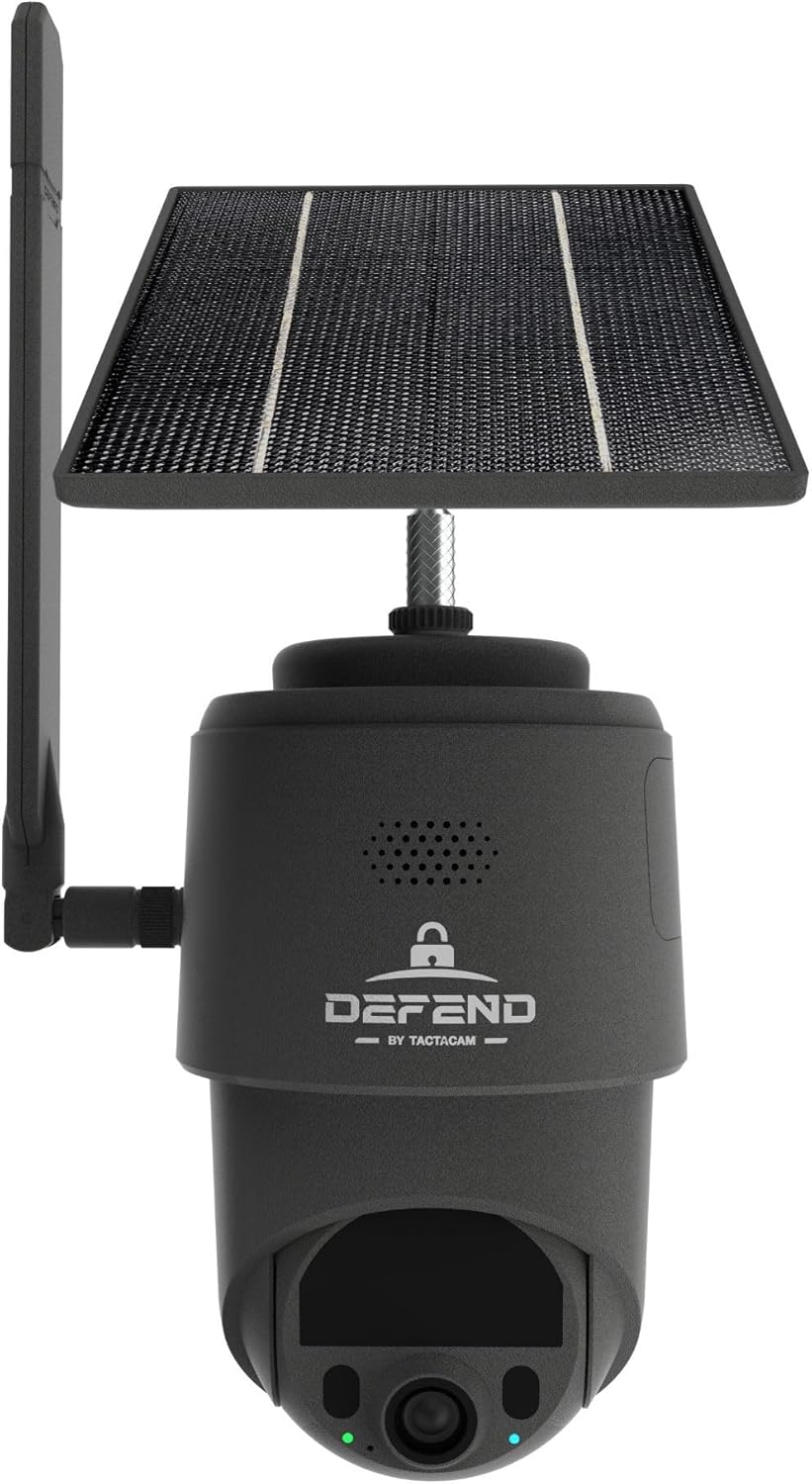
Key specs: Cellular security camera built for property rather than hunting; 360-degree pan, tilt and zoom controlled from a phone; solar charging with a built-in rechargeable battery; runs over LTE with no home network required
This is the pick, and the reason is that it is the only one of the four not designed around photographing wildlife. TACTACAM sells it as a security camera: it connects over LTE rather than a home network so it works at a remote gate, barn or cabin with no Wi-Fi setup, and it pans, tilts and zooms 360 degrees on command from a phone. That last point is the one that changes how you use it. A fixed trail camera commits you to one angle chosen on the day you mounted it; if the problem moves ten feet left, you drive out and re-aim it. Solar charging with a built-in rechargeable battery means it runs off-grid without a battery schedule.
✅ Pros
- Purpose-built for property rather than adapted from a hunting camera
- Remote 360° pan, tilt and zoom replaces several fixed cameras
- Solar plus rechargeable battery, so no battery-swap trips
- No Wi-Fi dependency at all — works anywhere with cell signal
❌ Cons
- Newest and least-reviewed of the four picks — a thinner track record
- PTZ and solar hardware makes it the most conspicuous unit here
- Still carries a cellular data plan like every other camera in this guide
- Remote aiming tempts you into live-view sessions that consume allowance
TACTACAM Reveal X 3.0 — the long-runtime workhorse
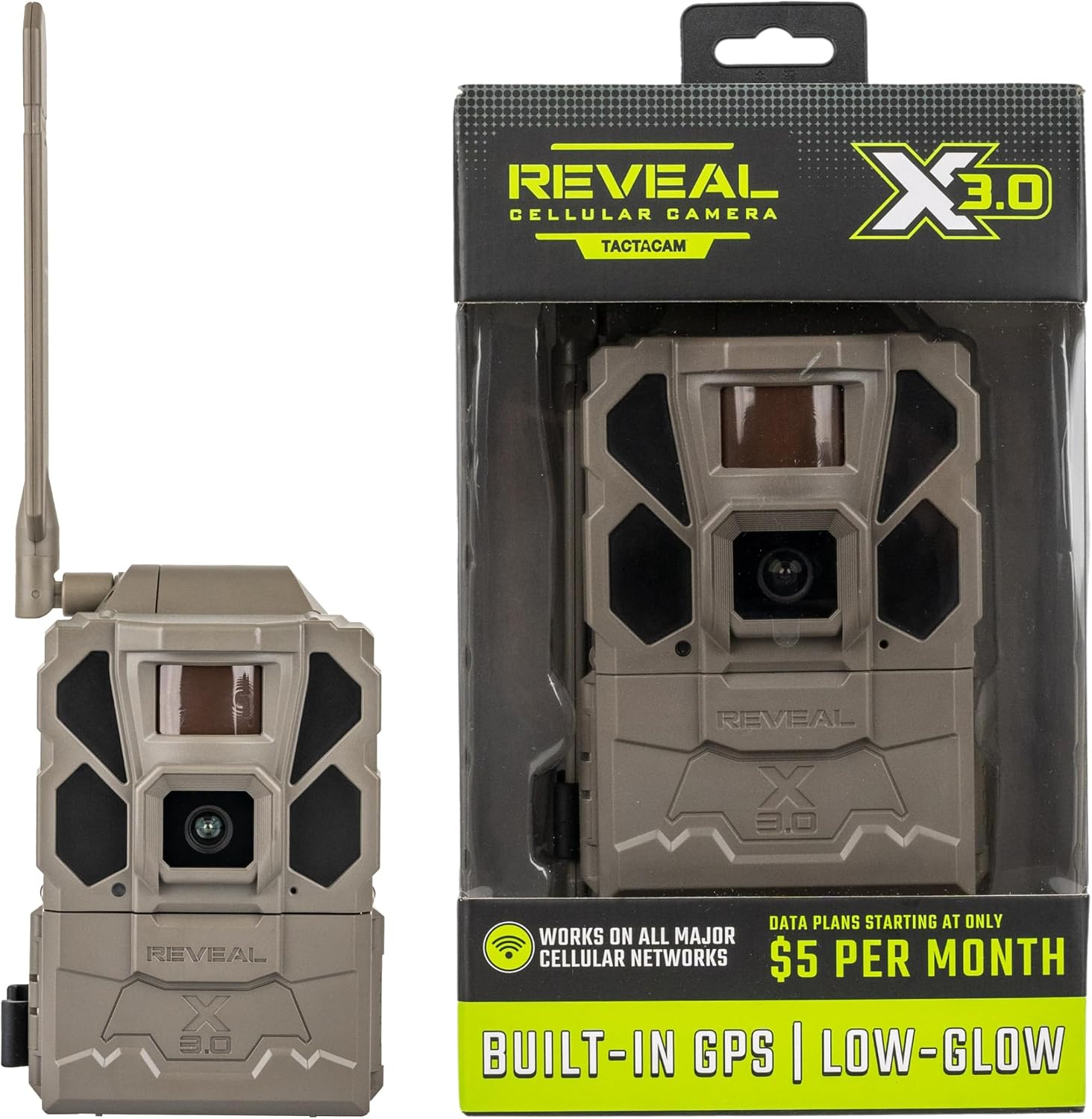
Key specs: Cellular trail camera with an integrated multi-carrier SIM that locks onto whichever of AT&T or Verizon is stronger at the camera’s location; manufacturer states 6+ months of battery life; optional lithium cartridge, solar panel or battery belt; night vision and weather-resistant housing
Choose this if the camera is going somewhere genuinely inconvenient to revisit. Its headline claim is runtime — TACTACAM states 6+ months of battery life, with a lithium cartridge, solar panel or battery belt available to extend it further. The other genuinely useful feature is the integrated multi-carrier SIM, which locks onto whichever of AT&T or Verizon is stronger at the camera’s actual location rather than at the address on the box. Anyone who has bought a single-network device for a rural property and discovered it has no signal at the one spot they needed will recognize why that matters.
✅ Pros
- Manufacturer-stated 6+ months of battery life
- Multi-carrier SIM avoids committing to one network’s rural coverage
- Expandable power via lithium cartridge, solar or battery belt
- Established brand with a solid review base
❌ Cons
- Fixed aim — changing the view means a trip out to the camera
- A hunting camera repurposed, not a security product
- Camouflage housing means zero deterrent value
- Battery claims depend heavily on trigger frequency and temperature
Moultrie Edge 3 — the widest carrier coverage
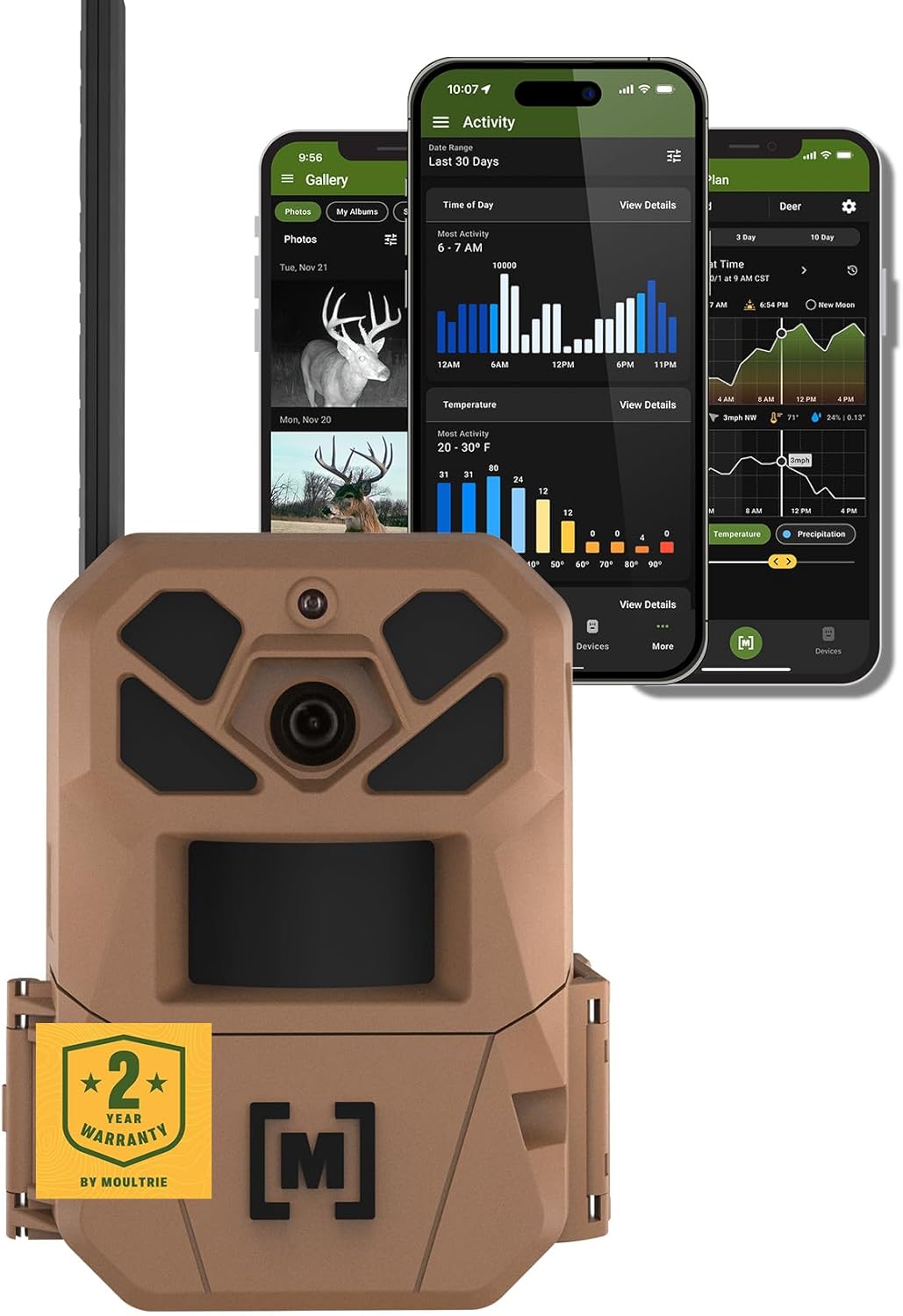
Key specs: 40MP cellular trail camera with a 0.5-second trigger; auto-connects to the strongest of four major U.S. networks with no SIM swapping; on-device AI classification to cut false alerts; delivers photos or HD video to a phone
The Edge 3’s distinguishing feature is that it auto-connects to the strongest of four major U.S. networks rather than two, with no SIM swapping. If your property is somewhere that two-carrier cameras have already failed, that is the reason to look here first. Its second useful trait is on-device AI classification, which Moultrie positions as reducing false alerts — and as covered above, fewer false alerts is not just less phone noise, it is directly less data transmitted and a cheaper plan tier. A 40MP sensor and a 0.5-second trigger are hunting specs, but the fast trigger genuinely helps on a driveway, where subjects move faster than deer.
✅ Pros
- Four-carrier auto-connect, the widest network coverage here
- On-device classification cuts false alerts and transmission volume
- 0.5-second trigger keeps up with vehicles and people
- Delivers stills or HD video
❌ Cons
- Marketing and AI tuning are explicitly aimed at hunting, not intruders
- Fixed aim, like the Reveal
- Smaller review base than the Reveal or Flex lines
- AI classification tuned for game may misjudge vehicles and people
SPYPOINT Flex-M — the budget entry, honestly
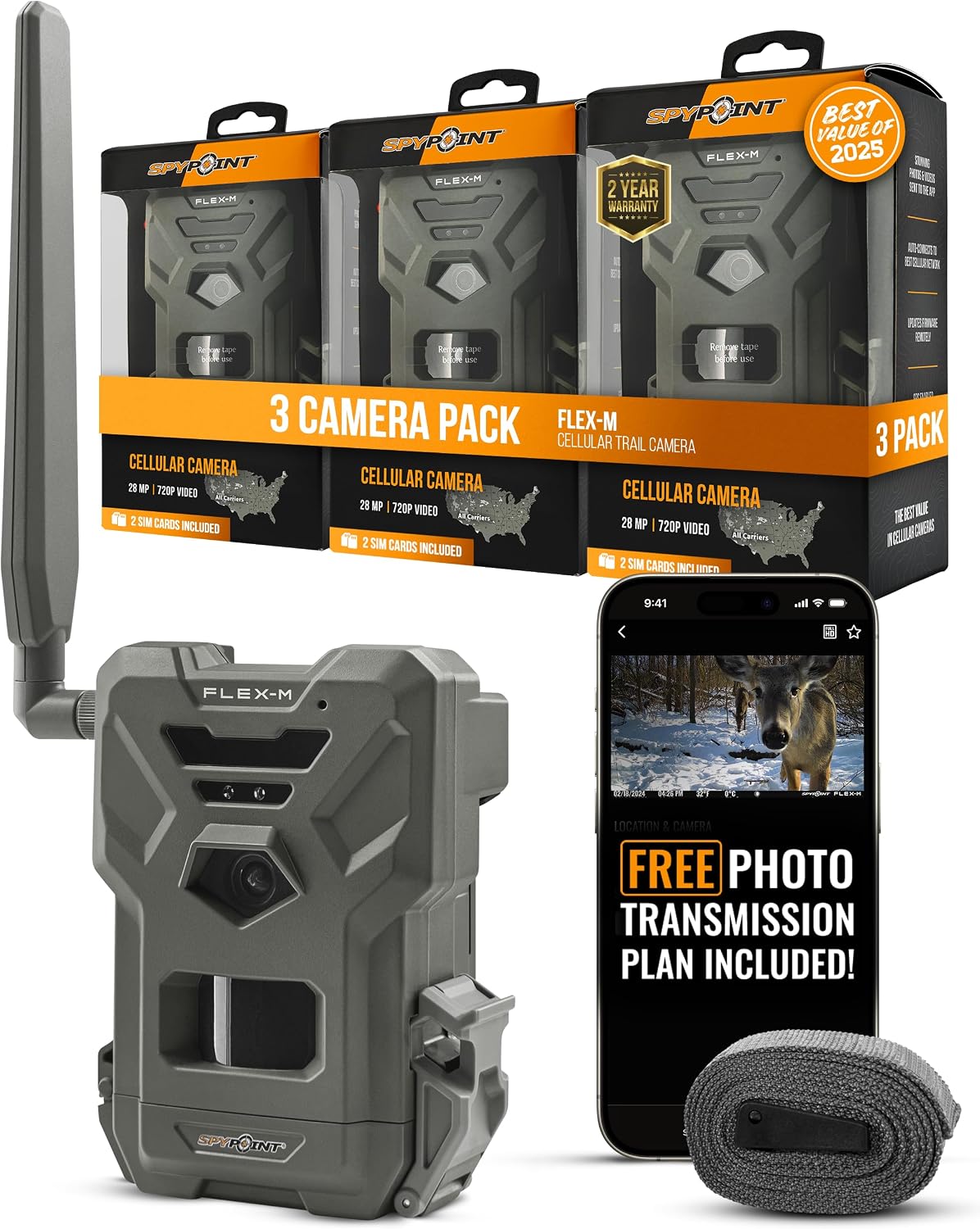
Key specs: Budget cellular trail camera with mobile activation and on-camera setup buttons; microSD card not included; compatible with SPYPOINT solar panels sold separately; includes access to a free tier of SPYPOINT’s photo transmission plan
The Flex-M is here as the cheap way to find out whether a cellular camera solves your problem at all, and it comes with the most honest caveat in this guide: it carries the lowest customer rating of the four picks. That is worth stating plainly rather than burying, because the complaints in this category tend to be about connection reliability, which is the one thing a cellular camera has to get right. Its genuine advantages are a free tier on SPYPOINT’s photo transmission plan and simple mobile activation with on-camera setup buttons. Note the microSD card is not included and solar panels are sold separately, so the real cost is above the sticker.
✅ Pros
- Cheapest route into cellular monitoring here
- Free tier available on SPYPOINT’s transmission plan
- Mobile activation and on-camera setup buttons
- Solar panel compatibility for longer deployments
❌ Cons
- Lowest customer rating of the four picks — reliability complaints are the pattern
- microSD card not included
- Solar panel sold separately, so the entry price is not the real price
- Free plan tiers are limited enough that a busy site will outgrow them fast
Mounting on Land Rather Than on a House
Placement rules for a house camera assume walls, eaves and a known approach. Land does not give you any of that, and the failure modes are different.
Getting a Rural Camera to Actually Work
1
Check signal at the exact spot
Cell coverage varies over yards on broken ground. A multi-carrier camera helps, but nothing rescues a hollow with no service.
2
Aim across the path, not along it
Passive infrared triggers respond best to movement crossing the sensor’s zones rather than walking straight at it — the same principle that governs any motion sensor.
3
Frame tightly on what matters
A gate, a doorway, a track. A wide field view multiplies false triggers and your data bill.
4
Mount high and angle down
Harder to reach, harder to steal, and it keeps low vegetation out of the trigger zone.
The trade-off is always coverage against transmitted volume.
One more consideration that does not apply to house cameras: the camera itself is a theft target sitting unattended in a place nobody watches. Locking mounts and security boxes exist for this reason. If the spot is genuinely contested, a camera that also stores locally means a stolen unit does not automatically mean lost evidence — the same logic covered in where camera footage should live.
The Privacy Problem Rural Cameras Create
A camera on your own front door has a fairly clear scope. A camera on a fence line or a track often does not — it can easily cover a neighbor’s land, a shared access road, or a public right of way, and it will photograph people who have no idea it exists because it is camouflaged by design.
Two things follow. Aim deliberately so the frame covers your own property and the approach to it, rather than pointing generally outward and accepting whatever lands in shot. And if your camera records audio, be aware that audio is treated far more strictly than video in many states. Our guide to what security cameras can legally record covers the distinction; it applies just as much to a camera strapped to a tree as to one screwed to a porch.
Final Recommendation
Buy the TACTACAM Defend 360. Of the four, it is the only one designed for the job this article is about — solar so you are not scheduling battery trips, LTE so no network is required, and remote pan-tilt-zoom so a bad angle is a phone adjustment rather than a drive. Accept that it is the newest and least-proven of the four, which is the honest trade for being the only purpose-built one.
Choose the TACTACAM Reveal X 3.0 instead if the location is fixed, well-understood and genuinely hard to revisit, and you would rather have the longest unattended runtime than remote aiming. Choose the Moultrie Edge 3 specifically if a previous cellular camera failed on signal — four-carrier auto-connect is the concrete reason to prefer it.
Buy the SPYPOINT Flex-M only as an experiment. Its free plan tier makes it the cheapest way to learn whether cellular monitoring solves your problem, and its weaker rating makes it a poor choice to rely on once you know that it does.
What would change all of this: if the spot has mains power or reaches your Wi-Fi, none of these is the right purchase. A conventional driveway camera gives you continuous recording, live view without a data meter running, and visible deterrence — three things no camera in this guide provides.
SafeBode does not yet run an in-house product testing program. This guide is built from manufacturer specifications, official support documentation, current retail listings and verified buyer feedback rather than hands-on testing, and we say so plainly rather than implying testing we have not done.
Frequently Asked Questions
Do trail cameras work without Wi-Fi?
Cellular ones do, which is the whole point of the category. They carry their own LTE connection and send images over a mobile network rather than your home network. Non-cellular trail cameras also work without Wi-Fi, but you have to physically collect the memory card to see anything.
Do cellular trail cameras need a monthly plan?
Yes. Every camera here transmits over a carrier network, and both TACTACAM and SPYPOINT sell tiered photo transmission plans. Some brands offer a limited free tier, but a camera watching a busy driveway will move past it quickly.
Can I use a trail camera as a home security camera?
For outbuildings, gates and land, yes. For a house, generally no — you lose continuous recording, live view on demand, two-way audio and any deterrent effect, because trail cameras are designed to be inconspicuous.
How long do trail camera batteries last?
It depends far more on trigger frequency and temperature than on the brand. TACTACAM states 6+ months for the Reveal X 3.0, but that assumes trail-like activity. A camera triggering on every vehicle in a driveway will drain considerably faster.
Will a trail camera photograph a person clearly enough to identify them?
Sometimes, and not reliably. Identification depends on distance, framing, and whether the subject is lit by infrared at night. Framing tightly on a gate or doorway gives you far better odds than covering a wide field.
Is it legal to put a trail camera on my own land?
Generally yes for video on your own property, but the frame matters — a camera covering a neighbor’s land or a shared access road raises different questions, and audio recording is treated much more strictly than video in many states. Check your own state’s rules before mounting one where it captures beyond your boundary.
What is the difference between a trail camera and a game camera?
Nothing meaningful — the terms are used interchangeably for the same product category. “Game camera” is simply the more hunting-oriented phrasing.
Can someone steal my trail camera?
Easily, unless you plan against it. These sit unattended in places nobody watches, which is exactly why lockable mounts and steel security boxes are sold for them. Mounting high and angled down helps on both theft and framing.
Do trail cameras record video or just photos?
Most do both, but video consumes cellular allowance far faster than stills, so many people run them in photo mode and reserve video for specific situations. That trade-off is a bigger deal on a security deployment than on a hunting one.
Sources
Show sources (6)
- [1] TACTACAM — Reveal app data plans, www.tactacam.com/reveal-app-plan
- [2] SPYPOINT — Photo transmission plans, www.spypoint.com/us/en/phototransmissionsplan.html
- [3] TACTACAM — Defend 360, current retail listing specifications (ASIN B0FQKYL387)
- [4] TACTACAM — Reveal X 3.0, current retail listing specifications (ASIN B0D7FQNM38)
- [5] Moultrie — Edge 3, current retail listing specifications (ASIN B0FJBNWRZT)
- [6] SPYPOINT — Flex-M, current retail listing specifications (ASIN B0DKRCTG6C)


