Best Peephole Cameras 2026: The Renter’s Answer to a Video Doorbell
Affiliate Disclosure: This article contains affiliate links. If you buy through these links, we may earn a commission at no extra cost to you. Our editorial opinions are our own and are not influenced by affiliate relationships. Read our full disclosure policy →
Contents
Quick Answer
A peephole camera exists for one reason: the hole is already in your door, so nothing new has to be cut into it. On an apartment entry door that matters for more than convenience: a door in a rated corridor wall carries a minimum 20-minute fire protection rating under the building code, and the standard the code refers to for those doors limits what may be drilled into one afterwards. Before comparing features, measure two things: your existing peephole’s diameter and your door’s thickness. The Ring Peephole Cam 2K is the pick if those numbers land inside 12–14 mm and 32.5–60 mm and you want alerts on your phone. If they don’t, a battery-powered LCD door viewer fits a far wider range of doors and needs no network at all.
Why This Category Exists At All
Peephole cameras are not a better video doorbell. They are a workaround for a door you are not allowed to modify, and that constraint explains the whole category.
In a multi-family building, the door between your unit and the shared corridor is rarely just a door. Under the International Building Code, a door assembly located in a corridor wall that carries a fire-resistance rating has a minimum 20-minute fire protection rating, at Section 716.2.2.1 and Table 716.1(2). What may then be done to that door in the field is governed by NFPA 80. That standard is not published free to read, so the limits below come from a code specialist writing for a door-hardware manufacturer rather than from the standard itself: field preparation capped at round holes of roughly one inch, viewers among the preparations normally permitted, and anything beyond that needing the door manufacturer’s and its listing laboratory’s approval if the assembly is to keep its label.
Layer a normal lease on top — most treat drilling the entry door as an alteration needing written permission — and mounting a doorbell to the door slab becomes the one installation a renter is least free to make. The frame and corridor wall are often off limits too, being common area rather than your unit. A peephole camera sidesteps all of it by using an opening the builder already put there, the same logic behind our no-drill renter security guide: the best renter hardware leaves no evidence.
The Numbers That Actually Constrain This Decision
20 min
Minimum fire protection rating for a door in a rated corridor wall, IBC Table 716.1(2)
1 in
Round-hole limit for field preparation of a fire door, per a vendor-published summary of NFPA 80
12–14 mm
Peephole diameter the Ring Peephole Cam 2K fits — and nothing outside it
0
New holes a peephole camera puts in the door
Codes are enforced locally and buildings differ. Treat this as the reason to check your lease and your building rather than as a ruling on your specific door.
Before you spend anything: this category has a weak reputation and it earned it. SafeWise’s roundup calls peephole cameras an unimpressive group running dated technology, notes that no major security-camera brand sold a dedicated one, and steers readers to a no-drill doorbell mount instead. That was fair when written. The second half of it stopped being true in July, when Ring announced a modern peephole camera, with general availability set for August 19. The category is now one mainstream product plus a long tail of small-brand hardware, and the two halves deserve to be judged differently.
The Two Measurements That Decide Everything
Ring Peephole Cam 2K: check these before ordering. The dimensions below apply to the 2K model. Ring also requires a removable peephole and clear space for the indoor assembly. Ring’s compatibility checklist.
| Check | What the 2K model needs | If you cannot confirm it |
|---|
| Hole and door | Peephole opening 12–14 mm; door 32.5–60 mm thick. Measure the opening through the door, not the outer decorative rim. | Ask building maintenance to confirm the dimensions before ordering. |
| Viewer type | A removable barrel-style viewer with notches on its inner rim. | Ring lists permanently fixed, glued or cemented viewers as incompatible. |
| Indoor clearance | Room for the inside module, clear of nearby obstructions. | Check the actual mounting area, including existing hardware. |
| Network and setup | 2.4 GHz Wi-Fi; Bluetooth enabled on the setup phone. | Confirm both before replacing the viewer. |
If removal is permitted and necessary to measure the opening, keep the original viewer and follow the model’s installation instructions. Stop if it will not unscrew; do not enlarge the hole to make the camera fit.
Every other spec is downstream of two numbers buyers routinely skip: the diameter of the hole bored through your door, and the door’s thickness, which decides whether the barrel joining the outside lens to the inside screen can reach and clamp. Get either wrong and the product does not work badly — it does not install. One verified buyer review on a pick below reads, in full, that it did not fit the peephole. A buyer of another pick reports keeping a camera he disliked precisely because he had already enlarged his peephole to seat it and had no original lens to put back. That is the failure mode this section exists to prevent: an irreversible change to a door you do not own, made to rescue a purchase.
| Ring Peephole Cam 2K | Bextgoo 2K | H-COME 3.5-inch | NAIERDI KAK-SF520A |
|---|
| Peephole hole diameter | 12–14 mm (0.47–0.55 in) | Not published | 14–28 mm (listing) | 14–28 mm (listing) |
| Door thickness | 32.5–60 mm (1.28–2.36 in) | Not published | 35–100 mm (listing) | 40–100 mm (listing) |
| Field of view | 140° x 140°, 173° diagonal | 170° | 120° | 120° |
| Alerts on your phone away from home | Yes | Yes | No | No |
| Saves video | Cloud recording, needs a Ring plan | microSD card included in the box | No | No |
| Screen inside the unit | No — phone or a paired Echo Show | Yes, 4.3-inch | Yes, 3.5-inch | Yes, 3.5-inch |
| Power | Rechargeable battery pack | 8,000 mAh rechargeable | 4 x AAA | 4 x AAA |
Ring’s fit figures come from its product page and Forbes’ launch coverage; the ranges marked listing are the manufacturers’ own Amazon specifications, and Bextgoo publishes none at all. The smartest product here is the fussiest about your door.
Ring Peephole Cam 2K — best for phone alerts away from home
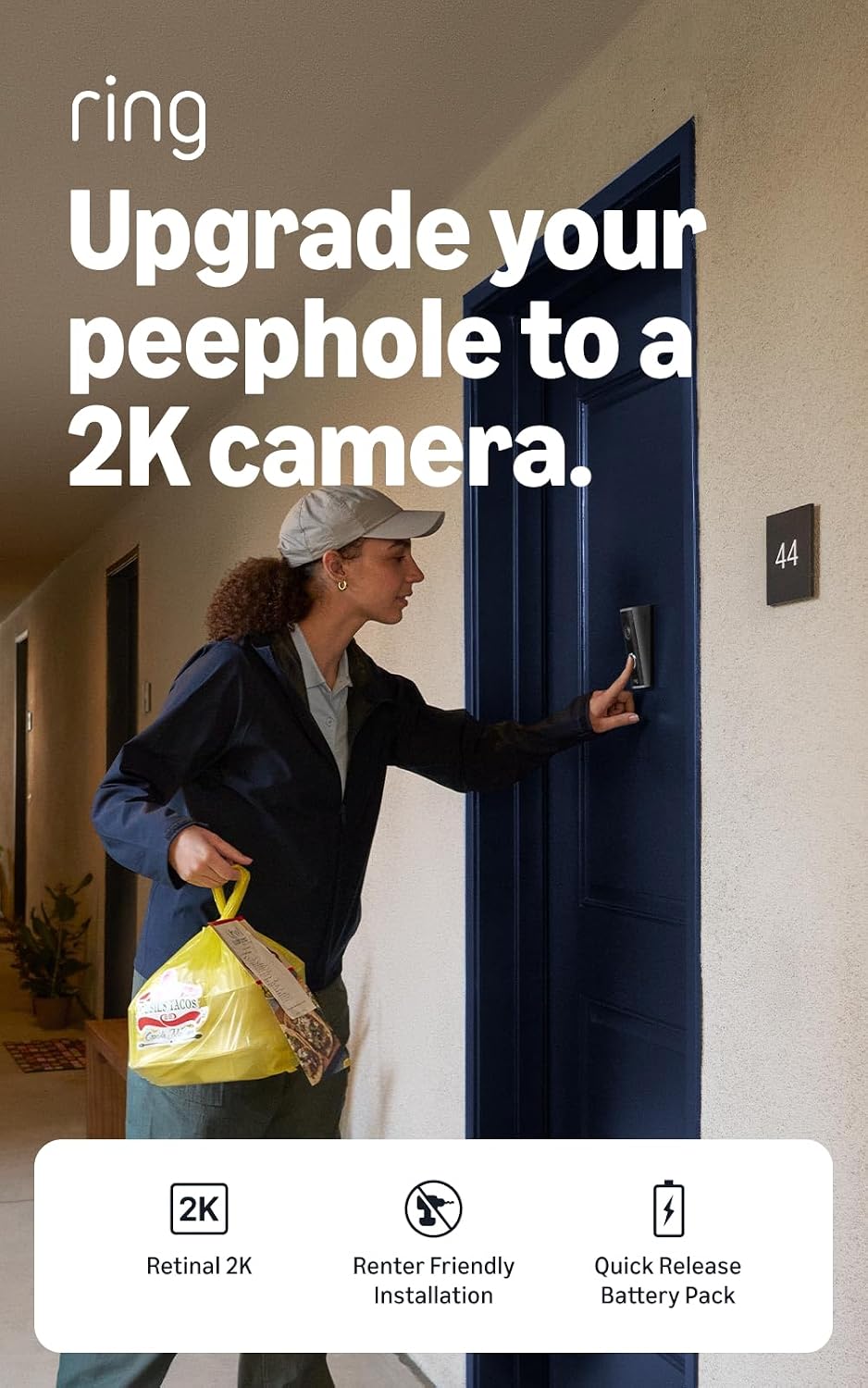
Key specs: 2K video with up to 6x enhanced zoom; 140° x 140° field of view (173° diagonal); rechargeable Quick Release Battery Pack; 2.4 GHz Wi-Fi; fits peepholes 0.47–0.55 in (12–14 mm) across on doors 1.28–2.36 in (32.5–60 mm) thick; Two-Way Talk; Speckled Gray
The first peephole camera from a mainstream security brand, and the only pick here that behaves like a real doorbell camera: motion notifications on your phone wherever you are, Live View and Two-Way Talk through the same Ring app that runs everything else the brand makes. The wedge-shaped body angles the lens downward so the view reaches from a visitor’s face to a package on the mat rather than staring straight down the hallway. Two caveats before you commit. Installing it replaces your existing peephole, and Ring states plainly that you will no longer be able to look through it — a flat battery means no view of the hallway at all. And it does not reach general availability until August 19, 2026, so there is no independent buyer track record behind it yet. Saved video history sits behind a subscription in the usual Ring way, which we break down in our guide to what a Ring plan actually gets you.
✅ Pros
- The only pick with a real app ecosystem, Live View and Two-Way Talk behind it
- Angled lens is designed to see a package on the ground, not just a face
- No drilling, no wiring, and Ring markets the install as under ten minutes
- Rechargeable Quick Release Battery Pack, so no batteries to buy repeatedly
❌ Cons
- Narrowest compatibility of any pick here: 12–14 mm hole, 32.5–60 mm door
- You permanently lose the ability to look through the peephole with your own eye
- No indoor screen in the box — viewing means a phone or a paired Echo Show
- Brand new as of August 2026, with no meaningful independent buyer feedback yet
- Video history is a paid subscription, unlike the local-storage picks below
Bextgoo 2K Video Peephole Doorbell Camera — the local-recording option we cannot recommend

Key specs: 2K capture, H.265 encoding; 170° viewing angle; 4.3-inch indoor color monitor; 8,000 mAh rechargeable battery; 32 GB microSD card in the box, supports up to 128 GB; infrared night vision rated to 20 ft; 2.4 GHz Wi-Fi through the Smart Life / Tuya app; no door thickness or hole diameter published on the listing
The middle ground: Wi-Fi and phone alerts like the Ring, but with a 4.3-inch monitor on the inside of the door and a microSD card in the box, so events record locally with no monthly plan. The 170° lens is the widest of the four. It is also the pick we have the most to be honest about. Bextgoo publishes no door thickness or hole diameter anywhere on the listing — we checked the full specification block and it is absent — and verified buyers describe a tight fit. Buyers criticize the software rather than the hardware: it runs on the generic Smart Life / Tuya platform, and reviews describe clumsy playback, late motion triggers and recordings in a format the card will not play back outside the app. It stays in this guide because it is the only peephole camera here that records to a card you own. It is not a recommendation: an unpublished fit spec, on a fire-rated door you may not re-drill, fails this guide’s own first test, and a local recording you cannot open is not the advantage that justified the compromise. If your door is on marginal Wi-Fi, settle that first — our walkthrough on testing your signal at the spot the camera will live applies exactly as much to a door as to a wall.
✅ Pros
- Records to a microSD card supplied in the box, with no subscription in the path
- Widest field of view of the four picks at 170°
- Large rechargeable battery instead of disposable cells
- You get both a phone app and a screen on the door, which no other pick offers
❌ Cons
- No published door thickness or hole diameter — the one spec that decides fit
- Verified buyers report a tight fit, one having enlarged his peephole to install it
- Generic Tuya-based app draws consistent criticism for playback and motion timing
- Recordings sit in a proprietary format buyers report they cannot read off the card
- Weakest buyer reception of the four, and not a safe default
H-COME 3.5-Inch Digital Door Viewer — best for the widest door compatibility

Key specs: 3.5-inch LCD screen; 120° viewing angle; door hole range 14–28 mm; door thickness range 35–100 mm; outdoor lens body about 30 mm across; powered by 4 AAA batteries (not included); no Wi-Fi, no app, no recording
Strip out the Wi-Fi, the app, the account and the recording, and what is left is a battery-powered magnifying glass with a screen — which for a lot of renters is exactly the product they wanted. Someone knocks, you press a button, a 3.5-inch screen shows you the hallway, and fifteen seconds later it turns itself off. Nothing leaves the door, nothing goes offline. It also has the most generous fit range here: a 14–28 mm hole and a 35–100 mm door, covering thick apartment doors and oversized peepholes the Ring cannot physically accept. It is the longest-established pick in this guide with the deepest buyer history, which counts in a category full of six-month-old brands. Be clear-eyed about what it is not: the manufacturer’s own listing states it is not HD, has no true night vision, and needs some light in the hallway to be usable.
✅ Pros
- Fits by far the widest range of doors and peephole sizes of the picks here
- No network, no app, no account, and nothing recorded or uploaded anywhere
- Keeps working during an internet or router outage, which no Wi-Fi pick does
- Runs on AAA cells, so a dead battery is a two-minute fix rather than a recharge cycle
❌ Cons
- No alerts of any kind — it shows the hallway only when you press the button
- The manufacturer states it is not HD and has no true night vision
- Screen times out after roughly fifteen seconds, which several buyers find short
- 120° view is the narrowest here; someone off to one side is out of frame
- Records nothing, so it cannot help you after the fact
NAIERDI KAK-SF520A Digital Door Viewer — best for staying invisible from the hallway

Key specs: 3.5-inch LCD at 480 x 320; 120° viewing angle; door hole diameter 14–28 mm; door thickness 40–100 mm; zinc alloy body styled to look like an ordinary optical peephole from the hallway side; 4 AAA batteries (not included); no Wi-Fi, no app, no recording
Mechanically this is a close cousin of the pick above: same screen size, same 120° lens, same four AAA cells, same absence of Wi-Fi. Two things separate it. The body is zinc alloy rather than plastic, and buyers repeatedly describe the mounting hardware as unusually solid. More interesting is the outside face, styled to look like an ordinary optical peephole rather than a camera. In a shared corridor that is a real consideration, not a gimmick: a device that visibly announces itself as a camera aimed at common space is the one most likely to draw a complaint from a neighboring tenant or a note from building management. Same reasoning as our camera placement walkthrough — what a camera appears to watch matters as much as what it records. Its fit range is marginally tighter than the H-COME at the thin end, needing a 40 mm door rather than 35 mm, and its buyer base is smaller.
✅ Pros
- Outside face is styled to read as a normal optical peephole, not a camera
- Zinc alloy body and bracket, which buyers repeatedly single out as solid
- Wide fit range: 14–28 mm hole on doors 40–100 mm thick
- No network, no app, no subscription and nothing recorded
❌ Cons
- Functionally very close to the H-COME pick — buy it for build and looks
- Needs a slightly thicker door than the H-COME at the thin end of the range
- No motion activation: buyers note it wakes only when you press the button
- Smaller buyer base than the H-COME, in a category where track record matters
- 480 x 320 screen is modest, and nothing is recorded
What You Give Up Versus a Real Video Doorbell
The limitations here are not incidental. They follow from the hole having been drilled for a human eye rather than a lens, and position is the first of them.
A conventional doorbell gets mounted where you want it, at the height and angle that frames your entry. A peephole camera goes exactly where the builder put the hole — centered, roughly at eye level, aimed straight out. It cannot be angled toward a package drop or a stairwell, and if your peephole was set for someone much taller than you, that is now your camera height. Field of view suffers for the same reason: the lens looks through a bore, and picks here run 120° to 170°, with Ring’s square-ish 140° by 140° frame designed to claw back the vertical coverage a bore-mounted lens loses. Low light is weaker too, because a peephole barrel has no room for the infrared array a doorbell carries on its face.
Which Workaround Fits Your Situation?
🚪 A peephole camera makes sense when
- Your entry door is the only door, and it opens onto a shared corridor
- Your lease or building rules forbid altering the door or the common-area wall
- There is no existing doorbell wiring and no exterior wall you are allowed to touch
- You want the change to be fully reversible at move-out with no trace
🔨 A no-drill doorbell mount makes sense when
- You have a door frame or trim you are permitted to attach an adhesive or clamp mount to
- You want a wider, angled view that reaches the ground for packages
- You want proper infrared night vision rather than available-light imaging
- Your peephole is an odd size, or your door is outside every fit range above
If the right-hand column describes you, a conventional doorbell on a no-drill mount outperforms every product on this page; our wireless video doorbell roundup covers those. Whether a door camera is even the right first purchase for an apartment is worked through in our apartment security decision guide. A door camera watches one point; contact sensors on the windows cover the ones it never sees.
What Happened to the Original Ring Peephole Cam
Search for a Ring peephole camera and you will still find reviews and forum threads about a product that is not the one now sold. The original went by two names, Peephole Cam and Door View Cam. Searching the Amazon US catalog for this article on August 16, 2026 returned the new Peephole Cam 2K in three finishes and no listing for the original, and Ring’s own door-peephole page now serves the 2K as the current model. If you specifically want the original, treat it as a used-market purchase.
One piece of the old documentation still matters. Ring’s in-home chime kit compatibility list names the Ring Video Doorbell Wired and the Peephole Cam (Door View Cam) as the two products not compatible with in-home chime kits, and directs owners to a Ring Chime or Chime Pro instead. The reason has not changed with the new model: a device sitting in a hole in the door has no connection to the transformer and chime box a wired doorbell uses. Ring’s current page lists a Chime Kit Mini as how the Peephole Cam 2K rings indoors. Budget for a separate indoor chime if you want the household to hear the door rather than just your phone. If a unit pairs and then stops responding, our Ring doorbell reset walkthrough covers the recovery steps.
Installing One Without Touching Your Deposit
The whole point is that this stays reversible. A standard peephole is two threaded brass halves screwed into each other through the door; back one out and the hole is empty. Nothing here needs a tool more aggressive than a coin or a wide screwdriver.
Four Steps, In Order
1
Measure first, order second
Confirm the opening through the door, not the outer decorative ring, and the door thickness at its edge. Ask building maintenance if you cannot measure the opening safely.
2
Unscrew, never drill
Back out the existing peephole by hand. If it will not move, that is a reason to stop, not a reason to reach for a drill.
3
Keep the original
Bag the old peephole and tape it inside a kitchen cabinet. It goes back in on the day you move out, and the door is as you found it.
4
Dry-fit before you commit
Seat the outside module and check the barrel reaches through before you tighten the inside bracket. Most fit problems are visible at this stage.
Nothing in this sequence puts a new hole in the door, which is the entire reason to choose this category over a mounted doorbell.
Two practical notes. Corridor doors on self-closing hinges swing harder than interior doors, so tighten the inside bracket properly — a loose module rattling against a fire door turns a tidy install into a maintenance ticket. And if there is a manufacturer’s label near the hinge edge, that is the fire rating; talk to the building office before you touch anything.
Final Recommendation
None of what follows is actionable until you have two numbers: the diameter of the opening through your door, and the thickness of the door at its edge. Measure both, then take the branch they put you in.
If the hole measures 12 to 14 mm and the door 32.5 to 60 mm, buy the Ring Peephole Cam 2K, and it is not close — the only product in this category with a real app, real two-way talk and a mainstream brand behind it. You accept two asterisks with it: it ships from August 19, 2026, so you are buying on specification rather than track record, and you permanently trade away putting your own eye to the peephole.
If either number falls outside that window — an oversized peephole, or a door thicker than 60 mm — the Ring will not assemble, and wanting it does not change that. The H-COME 3.5-Inch Digital Door Viewer has the widest fit range and the longest buyer history here, on the understanding that it shows you the hallway on demand and does nothing else. Take the NAIERDI KAK-SF520A instead if what you want to avoid is your door reading as a camera to your neighbors; it needs 40 mm of door rather than 35.
If what you actually want is recording without a subscription, we have no peephole camera to send you to. The Bextgoo is the only pick here that records to a card you own, and the reasons we will not recommend it are above. Buy a conventional doorbell with local storage on a no-drill mount instead — our wireless video doorbell roundup covers the subscription-free options.
And if your building lets you attach anything to the frame or the trim, that is the better answer whatever you measured. Every product on this page is a compromise forced by a rule, not one that beats the alternative on merit. If the rule does not apply to you, neither does the compromise — and if what you want is to see inside rather than outside, our indoor camera guide for renters is the better starting point.
Frequently Asked Questions
Will a peephole camera fit any door?
No, and this is the single most common reason one gets returned. Each model states a hole diameter range and a door thickness range, and outside those the hardware does not physically assemble. Measure both before ordering, and be especially careful if your peephole looks larger than a standard one — the app-connected models tend to have the tightest tolerances.
Can my landlord make me remove it?
Possibly, depending on your lease and your building’s rules, which is why reversibility matters so much here. Keep the original peephole. Because a peephole camera occupies an existing opening rather than creating one, putting the door back exactly as you found it is a five-minute job, which is a materially better position than arguing about screw holes in a fire-rated door.
Does it still work if the Wi-Fi goes down?
The battery-powered LCD viewers do, because they never touch a network at all — press the button and the screen shows the hallway regardless of your router. The Wi-Fi models do not: no network means no notifications, no live view and, on the Ring, no way to see the hallway at all, since the optical peephole has been replaced.
Can I still look through the peephole after installing one?
It depends on the model. Ring Peephole Cam 2K removes the optical view, so you use its live video instead. The original Ring Peephole Cam retained an optical peephole; do not assume the two generations work the same way. See Ring’s 2K model FAQ and original-model FAQ. The LCD viewers also replace the optical lens, but they put a screen on the inside of the door that shows the same view on a button press, so you retain an offline way to check the hallway as long as the batteries hold.
Do peephole cameras record continuously?
None of the picks here do. The Wi-Fi models record event clips when motion or a doorbell press triggers them, either to a memory card or to the cloud. The battery LCD viewers record nothing at all — they are a live view on demand and nothing more, which some buyers choose deliberately for privacy reasons.
Can a peephole camera see in the dark?
Less well than a doorbell camera, and the reason is physical: a peephole barrel leaves no room for the infrared array a doorbell carries across its face. The Wi-Fi picks do have infrared night vision, rated on the Bextgoo to about 20 feet. The battery LCD viewers are weaker still — one manufacturer states its unit is not HD, has no true night vision, and needs some hallway light to produce a usable picture. If your corridor is genuinely dark, treat night performance as the deciding spec.
Where is the battery, and do I have to take the camera off the door to charge it?
The power source always sits on the inside module, which is the real advantage of a two-piece design: nothing about servicing it happens in the hallway. Ring uses a Quick Release Battery Pack you pop off the indoor half, the Bextgoo has a built-in cell charged over a cable, and the two LCD viewers take four AAA cells swapped from the inside. You never remove the outside lens or disturb the fit you set at install.
What if my door has no peephole at all?
Then this category is not your shortcut, because installing one means drilling the door — the exact thing you were trying to avoid. On a fire-rated corridor door in a rented unit, that is a conversation with the building office, not a weekend project. A no-drill mounted doorbell on the frame or an indoor camera watching the entry is usually the better answer.
Sources
Show sources (6)
- [1] Ring — “Peephole Cam 2K” product page, ring.com/products/peephole-cam-2k (no-drill install, replaces the existing peephole, 2K video, 140° x 140° field of view, Quick Release Battery Pack, 2.4 GHz Wi-Fi, rings indoors with Chime Kit Mini)
- [2] Ring Support — “In-home chime kit compatibility list for battery and Power over Ethernet (PoE) doorbells,” ring.com/support/articles/80uzg
- [3] David Phelan, Forbes — “Amazon Launches Ring Peephole Cam 2K: No-Drill Doorbell For Renters,” July 27, 2026
- [4] Lori Greene, I Dig Hardware — “Decoded: Alterations to Fire Door Assemblies,” a summary of NFPA 80 job-site preparation limits published by lock manufacturer Allegion. NFPA 80 itself is not freely readable, so this is a vendor-published account rather than the standard
- [5] International Code Council — International Building Code, Section 716.2.2.1 (door assemblies in corridors and smoke barriers) and Table 716.1(2), codes.iccsafe.org
- [6] SafeWise — “Best Peephole Cameras,” safewise.com/home-safety/cameras/best-peephole/
SafeBode does not yet run an in-house product testing program. This guide is built from manufacturer specifications, official support documentation, current retail listings and verified buyer feedback rather than hands-on testing, and we say so plainly rather than implying testing we have not done.


