Best Driveway Alarms 2026: Wireless Motion Sensors for Long Driveways and Rural Properties
Affiliate Disclosure: This article contains affiliate links. If you buy through these links, we may earn a commission at no extra cost to you. Our editorial opinions are our own and are not influenced by affiliate relationships. Read our full disclosure policy →
Table of Contents
A Driveway Alarm Isn’t a Camera — and That’s the Point
If you’ve read our guides on wireless camera systems or indoor cameras, this one works differently on purpose. A driveway alarm doesn’t record video, doesn’t stream to an app (in most cases), and doesn’t need a subscription. It does one thing: detects motion at the edge of your property and makes a sound or sends an alert before whoever’s approaching reaches your door. That’s a genuinely different tool for a genuinely different job — early warning, not evidence-gathering.
That distinction matters most for long driveways, rural properties, gated entries, or anywhere a camera’s view doesn’t reach far enough to give you advance notice. All 4 systems in this guide use passive infrared (PIR) motion sensors — the same core technology, with real differences in range, expandability, and whether you get a phone notification or just a chime.
Quick Answer
Who This Guide Is For (and Who Should Skip It)
This guide is for you if:
- ✅ You have a long driveway, rural property, or gated entrance where a camera’s view doesn’t reach far enough to give advance warning
- ✅ You want to know the moment someone or something approaches, without paying a monthly fee to find out
- ✅ You’re fine with a motion alert alone — no video, no recorded footage, no proof of what triggered it
- ✅ You want something you can mount and pair in minutes, no professional installation
We narrowed the driveway-alarm category down to these 4 picks from the dozens of similar-looking listings on Amazon using three criteria: review volume and consistency as a proxy for real-world reliability across many installs, genuine feature differentiation rather than a cosmetic rebrand of the same hardware, and whether the manufacturer discloses expandability and sensitivity specs clearly enough to actually compare. Listings that were thin on reviews, indistinguishable from a competitor already on the list, or vague on specs were excluded.
eMACROS Non-APP Wireless Driveway Alarm
BEST OVERALL
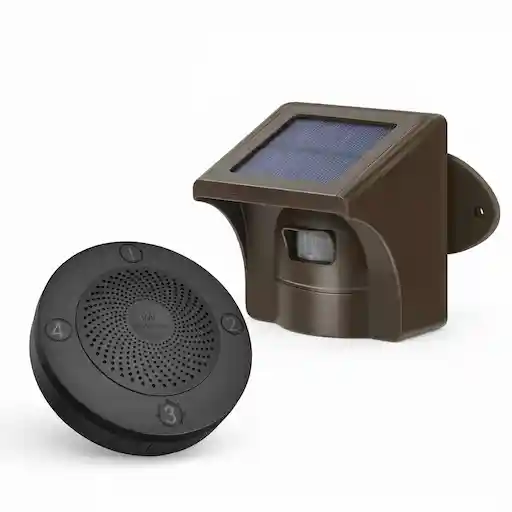
- Range: 1/2 mile (2,640 ft) wireless transmission
- Power: Solar-charged sensor, plug-in receiver, no app or subscription
- Best for: households that want a reliable chime alert without any phone setup
This is the most-reviewed driveway alarm we found — a review base several times larger than any other pick in this guide, which matters for a product category with a lot of near-identical listings. The solar-powered sensor (model HS002) transmits up to 1/2 mile to a plug-in receiver, with no app, no account, and no monthly fee. It’s expandable to 64 sensors and unlimited receivers, with adjustable sensitivity (20 ft low / 30 ft high) to cut down on false alerts from wind or small animals.
Honest limitation: because there’s no app, you only get alerted if you’re within earshot of the plug-in receiver — there’s no way to check your phone if you’re away from home. If that matters more to you than the larger review base, the Pro 3 below is the same brand with Wi-Fi alerts added.
Pros
- Largest review base of any pick here, with a consistently strong customer rating
- No app, no account, no subscription — works straight out of the box
- Expandable to 64 sensors and unlimited receivers for large properties
- Solar-charged sensor means no battery replacement
Cons
- No phone alerts — you have to be near the receiver to hear it
- No video or photo of what triggered the alert
- Plug-in receiver ties placement to an available wall outlet
eMACROS Pro 3 Smart (Wi-Fi)
BEST FOR PHONE ALERTS

- Range: 1/2 mile (2,640 ft) wireless transmission
- Power: Solar-charged sensor, 2.4GHz Wi-Fi receiver, real-time app push alerts
- Best for: households that want to know about driveway activity even when they’re not home
Same brand and same core sensor as our overall pick, with one real difference: the receiver connects to your home’s 2.4GHz Wi-Fi and sends push notifications through the My Hosmart app, so you get an alert on your phone whether you’re in the next room or across town. The listing is explicit that this is a motion-alert system only — no camera, no video, no recording — which is an honest thing for a “smart” driveway alarm to state plainly rather than let buyers assume. It carries a solid customer rating backed by a healthy number of reviews.
Honest limitation: it only supports 2.4GHz Wi-Fi, not 5GHz, so double-check your router’s band settings before buying if your home network is 5GHz-only or a mesh system that hides the band selection. It also costs more than the non-app version for a feature (phone alerts) some households won’t use often.
Pros
- Real-time push notifications on your phone, not just a local chime
- Same solar-powered, expandable sensor platform as our overall pick
- Explicitly no camera and no video — honest about what it is and isn’t
- Quick setup via Bluetooth pairing, no professional installation
Cons
- 2.4GHz Wi-Fi only — won’t work on a 5GHz-only network
- Costs more than the non-app version for households that don’t need phone alerts
- Still no video or photo evidence of what triggered the alert
TECKNET Solar Wireless Driveway Alarm
BEST FOR MULTIPLE ZONES

- Range: 1/2 mile (2,600 ft) wireless transmission
- Power: Solar-charged sensor, plug-in receiver, no app or subscription
- Best for: properties with multiple entry points that need to sound different alerts
The highest-rated pick in this guide, and currently an Amazon’s Choice. The sensor uses PIR technology with two sensitivity levels (16 ft low / 33 ft high) and supports 4 separate zones, each assignable a different one of 36 melodies and 5 volume levels — useful for telling a front-gate alert apart from a back-fence alert without looking at anything. The receiver also flashes a different RGB color per zone for a visual cue in addition to sound. Rated IPX5 for weatherproofing, with a working range of -15°C to 50°C.
Honest limitation: like the eMACROS non-app pick, there’s no phone notification option — alerts are local chime and light only. The 2 sensitivity levels are also less granular than HTZSAFE’s 3-level adjustment below, which matters more if false alerts from pets or traffic are a specific concern for your property.
Pros
- Highest customer rating of the four picks, and Amazon’s Choice
- 4 zones with distinct melodies and RGB visual alerts — easy to tell entry points apart
- 36 melody and 5 volume options for real customization
- IPX5 weatherproofing rated for a wide temperature range
Cons
- No phone app or remote notifications
- Only 2 sensitivity levels versus 3 on the HTZSAFE pick
- No video or photo evidence of what triggered the alert
HTZSAFE Driveway Alarm
BEST BUDGET PICK

- Range: 1/2 mile transmission, 70-ft adjustable sensor detection
- Power: Solar-charged sensor, portable receiver with rechargeable backup battery
- Best for: budget-conscious buyers who want a receiver that keeps working through a power outage
The lowest price of the four systems here, and the only one with a genuinely portable receiver — it runs on its own rechargeable battery and keeps working for 3+ days even without AC power, versus the plug-in-only receivers on the other 3 picks. Detection range adjusts across 3 sensitivity levels (25 / 50 / 70 ft), expandable to 4 sensors on one receiver and unlimited receivers per sensor, with a mute mode for quiet hours. Amazon’s Choice, with a solid customer rating.
Honest limitation: HTZSAFE’s own site doesn’t list this exact sensor-and-receiver pairing as a standalone product page — it’s sold as an Amazon-specific bundle of their standard components, so the manufacturer photo above is from HTZSAFE’s closely related solar sensor and portable-receiver combo, not a pixel-exact match to this specific bundle. The core hardware and specs are the same product family. It also has the smallest maximum detection range (70 ft) of the four picks.
Pros
- Lowest price of the four picks
- Portable, battery-backed receiver keeps working for days without AC power
- 3 adjustable sensitivity levels, the most granular of any pick here
- Mute mode for quiet hours without fully disabling the system
Cons
- Smallest maximum detection range (70 ft) of the four picks
- No phone app or remote notifications
- Manufacturer photo is from a closely related combo, not this exact bundle
Full Comparison Table
| Product | Range | Phone Alerts | Sensitivity Levels | Expandability | Buy |
|---|
| eMACROS Non-APP | 1/2 mile | No | 2 | 64 sensors, unlimited receivers | Check Price |
| eMACROS Pro 3 Smart | 1/2 mile | Yes (Wi-Fi) | 2 | 64 sensors, unlimited receivers | Check Price |
| TECKNET | 1/2 mile | No | 2 | 4 zones, 36 melodies | Check Price |
| HTZSAFE | 1/2 mile (70-ft detection) | No | 3 | 4 sensors per receiver, unlimited receivers | Check Price |
How PIR Motion Detection Actually Works
All 4 systems in this guide use passive infrared (PIR) sensors — “passive” because the sensor doesn’t emit any energy of its own, it only detects changes in infrared heat. Here’s exactly what happens between something approaching and your alert going off:
From Motion to Alert: How PIR Detection Actually Works
STEP 1
A warm object moves
A person, car, or animal crosses the sensor’s field of view, carrying body heat with it.
STEP 2
The sensor detects a change
PIR only reacts to a change in infrared heat across its zones — not to heat or presence alone. That’s why a person standing still often won’t trigger it.
STEP 3
A wireless signal is sent
The sensor transmits to its paired receiver — up to 1/2 mile away on the systems in this guide — with no app or subscription required for the base alert.
STEP 4
You get alerted
A chime, light, and/or phone push notification fires, depending on which system and zone triggered it.
The tradeoffs below apply to PIR-based motion sensors generally, not just the 4 picks in this guide:
Common False-Trigger Sources
- Swaying tree branches
- A passing car’s headlights
- Direct sunlight hitting the sensor
- A large dog or other animal in the yard
The Sensitivity Tradeoff
- Lower sensitivity: fewer false alerts, shorter warning distance
- Higher sensitivity: longer warning distance, more non-threat triggers
- No universally “correct” setting — test at your specific property
Do You Actually Need One?
The honest answer depends on what problem you’re trying to solve. If package theft is the specific worry, the data is more nuanced than it might seem: rural properties actually see package theft at roughly half the rate of urban ones. But burglary is a different story — rural crime rates run lower than urban overall, yet homes on rural and larger properties are frequently the ones with the least visibility from neighbors or passing traffic, which is exactly the gap a driveway alarm is built to close.
More broadly, the deterrence case for any visible security measure is well documented: homes without any security system are roughly 3 times more likely to be burglarized, and a large majority of burglars report actively looking for signs of a security system before choosing a target. A driveway alarm isn’t a full security system on its own, but as an early-warning layer for a property a camera alone can’t fully cover, it fills a real, specific gap.
How to Choose
Who This Isn’t Right For
- You want to see who or what triggered the alert — these are motion-only alarms with no camera; see our wireless camera systems guide for a video-recording option.
- You live in a dense neighborhood with a short driveway — a doorbell camera or single indoor/outdoor camera likely covers your entry point just as well without a separate device; see our indoor camera guide or our Nest outdoor camera guide.
- You need professional monitoring that dispatches police or fire — that’s a monitored alarm service, not a standalone motion sensor; see our Ring Alarm System guide for what that layer looks like.
- You’re securing a business or storefront — see our business camera systems guide instead.
Final Recommendation
If you just want one clear answer: the eMACROS Non-APP Wireless Driveway Alarm is our overall pick. It has by far the largest, most consistent review base of any pick here, needs no app or subscription, and is expandable enough to grow with a large property. If getting alerts on your phone while you’re away matters more to you than that review history, the Pro 3 Smart version above is the same hardware platform with Wi-Fi added.
A driveway alarm tells you the moment something crosses the sensor, but it doesn’t light the area up or do anything visible to whoever (or whatever) tripped it. If you want a visible deterrent alongside the alert, see our guide to the best outdoor motion sensor lights, which compares solar, hardwired, and app-connected options for exactly this kind of coverage.
FAQ
Do driveway alarms record video?
No, not the systems in this guide. All 4 are motion-only PIR alarms — they detect movement and sound a chime or send a phone alert, but none of them capture video or photos. If you want visual confirmation of what triggered an alert, you’d need to pair one with a separate camera, or use a camera-based system instead; see our wireless camera systems guide.
Will a driveway alarm go off every time an animal walks by?
It can, depending on the sensitivity setting and the animal’s size. All 4 picks here offer adjustable sensitivity to reduce (not eliminate) false alerts from pets and small wildlife — lowering the detection range and mounting the sensor at the recommended height for the threats you actually care about (people and vehicles, typically 2–4 feet up) both help.
Do I need a subscription for a driveway alarm?
No. None of the 4 systems in this guide require a subscription or account, including the Wi-Fi-connected eMACROS Pro 3 Smart — its app is free to use for push notifications, with no recurring fee.
How far apart can the sensor and receiver be?
All 4 picks are rated for up to 1/2 mile in open, unobstructed conditions. Real-world range is shorter through walls, trees, hills, or heavy interference — treat the 1/2-mile figure as a best-case number, not a guarantee for every property layout.
Can I use more than one sensor with a single receiver?
Yes, on all 4 picks. The eMACROS systems support up to 64 sensors and unlimited receivers, TECKNET supports 4 zones, and HTZSAFE supports up to 4 sensors per receiver with unlimited receivers per sensor — all can cover multiple entry points from one base setup.
Do these work during a power outage?
The solar sensors themselves keep working since they charge independently of household power. The receivers vary: HTZSAFE’s portable receiver has its own rechargeable battery and keeps working for 3+ days without AC power, while the plug-in receivers on the other 3 picks stop working if the outlet loses power.
Is a driveway alarm a replacement for a security camera?
No — they solve different problems. A driveway alarm gives you advance notice that something is approaching; a camera gives you a visual record of what it was. Many households use both: a driveway alarm for early warning on a long approach, and a camera closer to the house or door for identification.
A note on our research approach: SafeBode has not purchased or installed the systems compared in this guide. Every spec above comes from each manufacturer’s own product documentation and current Amazon listing data, cross-checked against independent coverage from outlets like SafeWise and GW Security (cited throughout). As our testing program develops, we’ll update this guide with genuine hands-on data and disclose that transition transparently.
Sources
Show sources (4)


