Best Standalone Motion-Activated Sirens 2026
Affiliate Disclosure: This article contains affiliate links. If you buy through these links, we may earn a commission at no extra cost to you. Our editorial opinions are our own and are not influenced by affiliate relationships. Read our full disclosure policy →
Contents
Quick Answer
A standalone motion-activated siren is a single battery-powered unit that packs a PIR motion sensor and a loud siren into one box — no hub, no app, no monthly fee, and usually no way to know it went off unless you or a neighbor are close enough to hear it. That makes it the right tool for a shed, a detached garage, a driveway or gate, or a rental where a full alarm kit is not an option, and the wrong tool if what you actually want is a phone alert or a police response. Pick the CPVAN CP2 Pro Motion Sensor Alarm for an enclosed outbuilding, the Qualirey Solar Motion Sensor Alarm (2-Pack) for an outdoor perimeter, and skip straight to the honest-limits section below before you buy anything if remote notification matters to you.
This Is Not a Small Version of a Full Alarm System
It is easy to assume a standalone motion siren is just a cheaper, scaled-down version of a kit like the ones in our DIY home alarm system roundup. It is not a smaller version of that product. It is a different category of device entirely, built around one PIR (passive infrared) sensor that detects a change in infrared heat energy in its field of view and closes a circuit that fires an onboard siren. There is no base station, no keypad, no arm/disarm code synced to a phone app, and in most cases no wifi radio at all. The sensor and the siren live in the same plastic housing you screw or stick to a wall.
That single-box design is also what separates this category from the door and window contact alarms covered in our door alarm guide. A door alarm trips on a magnet separating from a switch when a door opens. A standalone motion siren trips on movement anywhere in an open area, which is why it suits a garage floor, a driveway, or a fence line rather than a single doorframe. Full driveway-alarm kits, the kind in our driveway alarm guide, usually separate the sensor (outside) from a receiver chime (inside the house) over a wireless link. A standalone siren skips that split: the sensor and the siren are the same unit, sitting wherever you mount it, and the siren is what a passerby or a neighbor hears, not you.
What’s Actually Inside the Box
1
sensor + siren in one housing, no separate receiver
0
hubs, apps, or subscriptions required to make it work
120–129dB
typical onboard siren volume across current listings
AA/AAA
typical battery type — no electrician or outlet needed
Specs drawn from the current retail listings for the four picks below.
Where a Standalone Siren Actually Wins
A full alarm system is the better tool for protecting an entire house. A standalone siren earns its place in four narrower situations where a full system is overkill, unavailable, or simply cannot reach.
Four Jobs a Full Alarm Kit Doesn’t Do Well
1
A shed or detached garage with no wiring
No outlet, no existing alarm zone, and often no wifi signal strong enough to reach a hub. A battery unit with its own siren needs none of that.
2
A driveway, gate, or fence line
Outdoor, unpowered, and far from the house. This is the same problem our
driveway alarm guide covers with receiver-chime kits — a solar standalone siren is the version that skips the indoor receiver entirely.
3
A rental where drilling and hubs aren’t an option
Renters covered in our
no-drill renter security guide often cannot mount a hub, run wiring, or get landlord sign-off for a monitored system. A stick-on siren commits to nothing structural, though it is still worth checking a lease for a device-specific restriction before mounting anything.
4
A cheap, redundant deterrent for one weak point
A side door, a basement window, or a garage entry that already has a lock but no alarm coverage. This is the low-cost layer, not a replacement for the front door.
All four of those share one trait: the reader already has, or does not want, a full system, and just needs one loud, local alert at one specific weak point. That is a narrower job than what a monitored system in our cost breakdown guide is built to do, and it is worth being honest that a standalone siren is not trying to replace that broader coverage. The same logic has a quieter sibling indoors: at the spots where you want awareness rather than an alarm — a hallway at night, a stair, a back room — a light that switches itself on does the job, and our roundup of indoor motion sensor lights covers those.
What It Won’t Do: The Honest Limits
This is the section most retail listings skip, and it is the one that actually decides whether this product category fits your situation.
What a Standalone Siren Genuinely Is vs. Is Not
✅ What it genuinely is
- A loud, local, immediate audible alert with no monthly fee
- A real burglar deterrent — surveyed convicted burglars said they check for an alarm before breaking in, and most who found one moved on
- Fast to install: mount it, load batteries, done
- Portable — it moves with a renter or between a shed and a garage
❌ What it is not
- A way to know it went off if you are not close enough to hear it — there is no phone notification on any of the four picks below
- Able to call for help. There is no dispatcher on the other end of a standalone siren, the same limitation SafeHome.org flags for any self-monitored setup: your protection “works only if you are available”
- A replacement for professional monitoring if that is what you actually need
- Immune to false triggers — see the section below before you mount one near a vent or a spot pets can reach
If remote notification is the feature you actually want, a standalone siren is the wrong purchase regardless of how loud it is. That is a real, upfront tradeoff, not fine print, and it is why we are not going to smooth it over just because it costs us four affiliate sales to say it plainly.
How We Picked These Four
We pulled current US listings for standalone motion-sensor sirens and picked four that genuinely differ by use case rather than four interchangeable boxes with different paint jobs: one built for an enclosed indoor space with a remote control, one built and sold as an outdoor solar pair for a driveway or gate, one from an established personal-safety brand stripped down to the simplest possible setup, and one aimed at a larger rural property with a genuinely different feature — a custom recorded sound instead of a plain tone. We are noting review-count depth per pick honestly rather than only listing the picks with the largest sample.
Four Standalone Sirens Side by Side
| CPVAN CP2 Pro Motion Sensor Alarm | Qualirey Solar Motion Sensor Alarm (2-Pack) | SABRE Wireless Motion Sensor Alarm | LAFEINA Solar Motion Sensor Alarm with Recorded Sound |
|---|
| Best for | Shed / detached garage | Driveway / gate | Single side door, simplest setup | Large property, custom sound |
| Power source | Battery (indoor use) | Solar (outdoor rated) | Battery | Solar (outdoor rated) |
| Alert type | Siren + remote arm/disarm | Siren + strobe light | Siren only | Siren + strobe + custom recording |
| Sold as | Single unit | 2-pack | Single unit | Single unit |
| Setup | Mount, load batteries, pair remote | Mount, no wiring | Mount, no wiring | Mount, no wiring, record a sound |
| Phone notification | No | No | No | No |
CPVAN CP2 Pro Motion Sensor Alarm — the shed and detached-garage pick
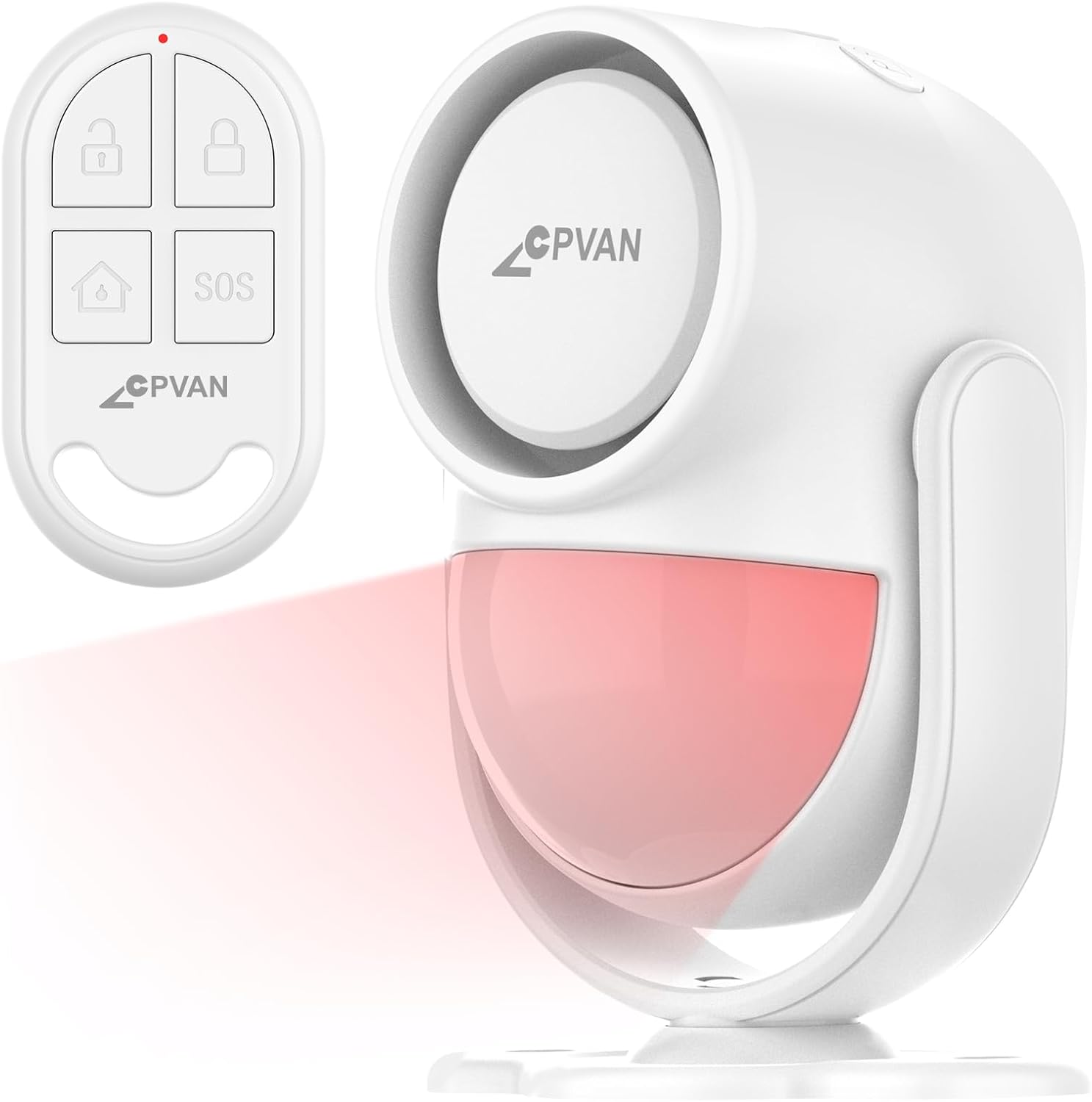
Key specs: 125dB siren built into a wireless indoor PIR motion detector; roughly 40 ft detection range; includes a remote control rated to 328 ft for arming and disarming from inside the house; battery operated; white finish
This is the pick for an enclosed space with no outlet and no existing alarm zone — a shed, a detached garage, or a van. It packs the PIR sensor and the siren into one indoor-rated unit and adds something the other three picks in this roundup do not: a handheld remote so you can arm and disarm it from inside the house rather than walking out to the shed every time. That convenience is also its constraint — it is listed and rated for indoor use, so it is the wrong choice for an outdoor gate or fence line, which is what the next pick is for.
✅ Pros
- Remote arm/disarm means you are not walking out to the shed to reset it
- No wiring, no outlet, no wifi — genuinely standalone
- Battery powered, so it survives a power outage that would take out a wired system
- One of the larger review samples in this category, which is worth something on a budget device
❌ Cons
- Rated and marketed for indoor use, not weatherproofed for an open driveway or gate
- No phone notification — you only know it went off if the siren reaches you
- The remote is a convenience feature, not a security one — anyone in range of the signal could theoretically trigger it, though the practical risk is low for this price tier
- PIR-only detection means it will also fire on a large pet or a sudden shaft of light through a window, covered in more detail below
Qualirey Solar Motion Sensor Alarm (2-Pack) — the driveway and gate pick
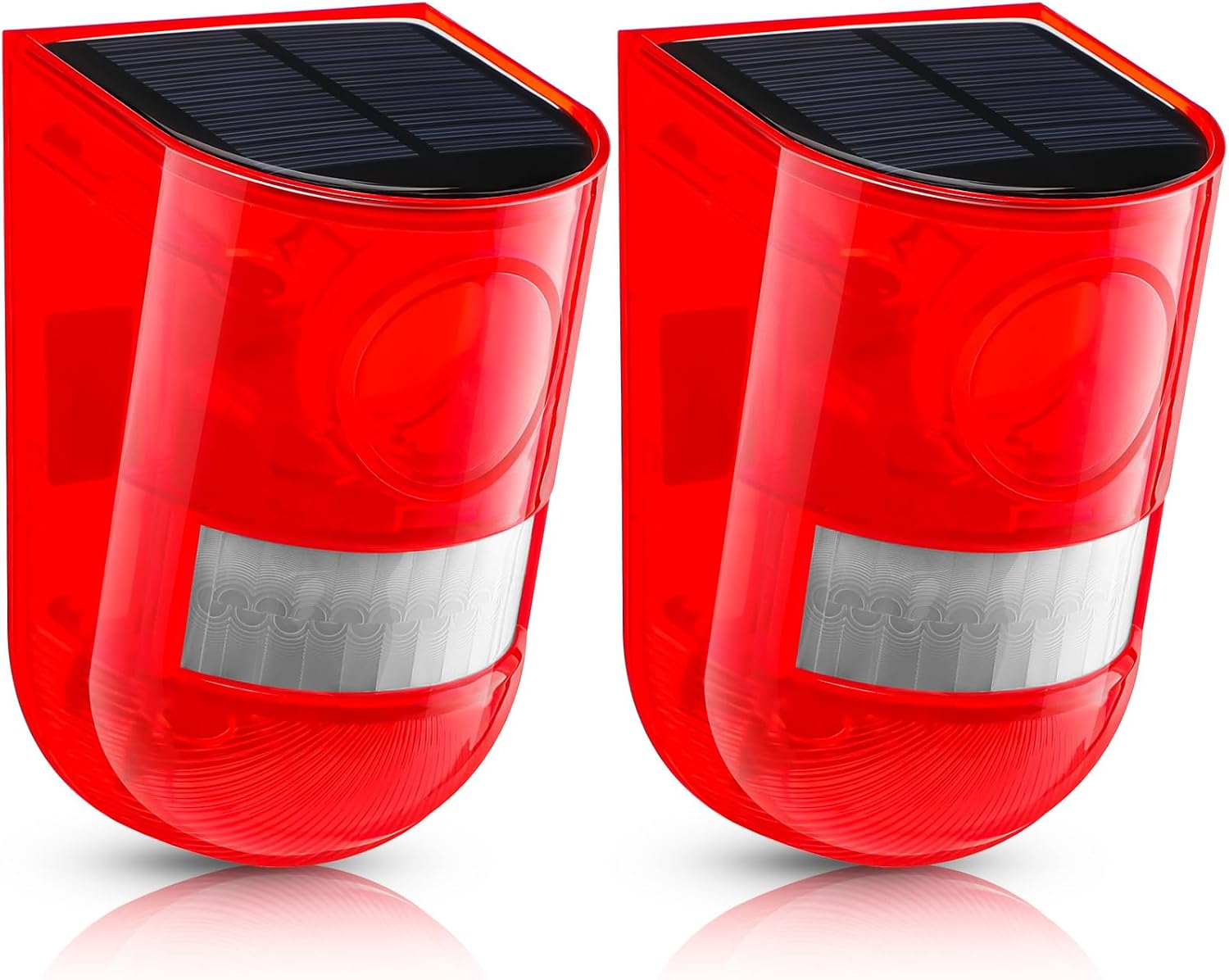
Key specs: 129dB siren paired with a flashing strobe light; solar-powered with a waterproof outdoor rating; sold as a 2-pack, so one covers the driveway and one covers a gate or second entry point; retail listing markets it for driveways and rural perimeters
The driveway alarms in our dedicated driveway alarm guide are mostly two-piece kits: a sensor at the end of the driveway and a separate chime receiver indoors. This is the standalone alternative — a solar-powered unit that is the siren, at the point of entry, rather than routing an alert back to the house. It is sold as a 2-pack, which in practice means one for the driveway and one for a gate or side entrance rather than doubling up on the same spot. Solar power is the real advantage here: no batteries to swap on a unit mounted somewhere inconvenient to reach.
✅ Pros
- Solar powered — no battery swaps at a hard-to-reach mounting spot
- Sold as a 2-pack, so it naturally covers two entry points for one purchase
- Waterproof rating fits genuine outdoor, all-weather placement
- The strobe light adds a visible deterrent alongside the siren, which our driveway alarm guide notes matters for after-dark approaches
❌ Cons
- Solar charging underperforms through extended cloudy or snow-covered stretches, the same honest caveat that applies to any solar security device
- No phone notification — you hear the siren or you don’t
- Outdoor PIR sensors trigger on more than people: passing animals and wind-blown foliage are common causes, covered below
- A thinner independent review history than an established national brand
SABRE Wireless Motion Sensor Alarm — the simplest single-door pick
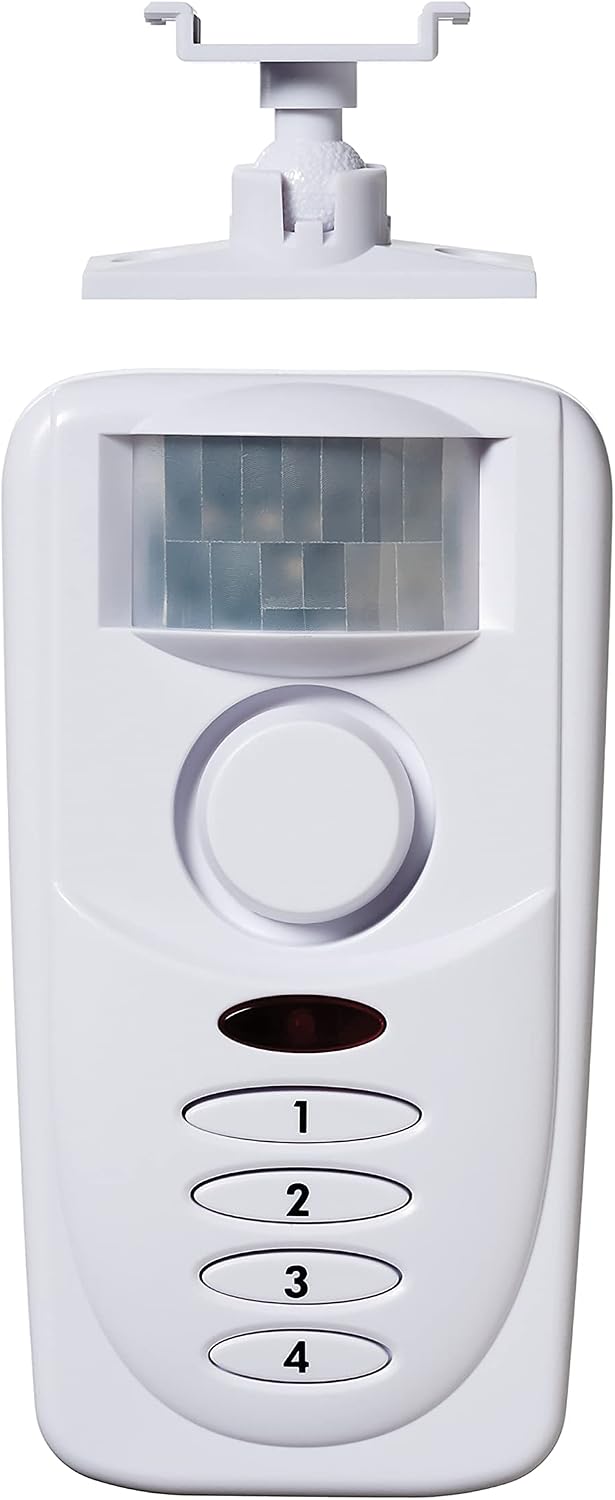
Key specs: 120dB siren with 120-degree wide-angle PIR detection; wireless and battery powered; no app, hub, or wiring to configure; made by SABRE, a personal-safety brand better known for pepper spray and door/window alarms
If the other three picks feel like more configuration than you want, this is the stripped-down version: one wireless PIR sensor, a 120dB siren, and a 120-degree wide-angle detection field, with no remote to pair and no solar panel to position. It comes from SABRE, a brand better known for personal-safety products like pepper spray, which is a different kind of company than most of the budget PIR-siren listings on Amazon — worth knowing if brand recognition matters to you more than the widest feature set. This is the pick for a single side door, a basement window, or a garage entry point that just needs one loud, simple deterrent.
✅ Pros
- Simplest setup of the four — nothing to pair, nothing to charge
- 120-degree detection field covers a wider area than a narrow-beam sensor
- From an established personal-safety brand rather than an unfamiliar import label
- DIY installation with no tools beyond mounting hardware
❌ Cons
- No remote control and no app — you arm and disarm it by hand at the unit itself
- No phone notification, same as every pick in this roundup
- A single 120dB tone with no custom sound option, unlike the large-property pick below
- Detection range and battery life depend on placement quality — see the placement section before mounting
LAFEINA Solar Motion Sensor Alarm with Recorded Sound — the large-property deterrent pick
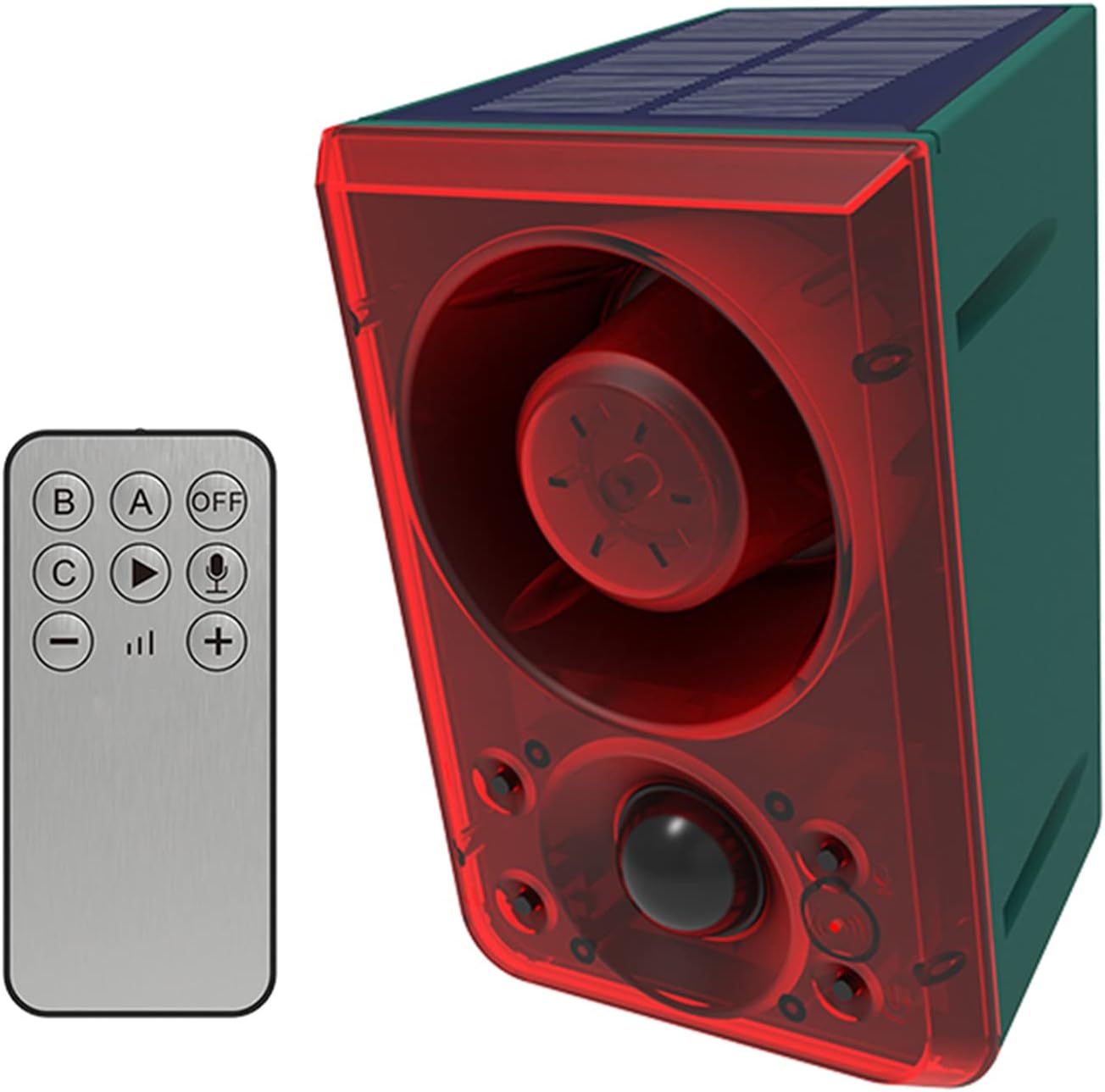
Key specs: 129dB siren plus a strobe light; solar-powered and outdoor-rated; adds a 20-second custom recording slot the retail listing markets for a barking-dog or gunshot sound in addition to the standard siren tone; marketed for farm, barn, and villa perimeters
This is the pick for a bigger rural property — a farm, a barn, or a large yard — where a single siren tone from a far corner of the property may not carry, and where a genuinely different deterrent sound can help. Alongside the standard 129dB siren and a strobe light, the retail listing includes a 20-second custom recording slot the manufacturer markets for a barking-dog or gunshot sound rather than a plain alarm tone. We have not independently tested whether a recorded bark is more effective than a siren at deterring an intruder — that is the manufacturer’s own marketing framing, not a claim we are verifying here, and we are saying so plainly rather than repeating it as fact. What is verifiable is the hardware: solar power, an outdoor rating, and a genuinely different alert option than the other three picks.
✅ Pros
- Custom recorded-sound option is a real differentiator from a plain siren tone
- Solar powered for a property where running power to a fence line isn’t practical
- Strobe light adds a visual cue alongside whichever sound is playing
- Outdoor-rated for genuine perimeter placement
❌ Cons
- Smallest independent review base of the four picks — worth weighing against the unique feature set before buying
- The recorded-sound deterrent claim is the manufacturer’s marketing, not an independently verified result
- No phone notification, same limitation as every pick here
- Solar reliability drops in extended low-light stretches, same caveat as the driveway pick
Placement and Sensitivity: Getting It Right the First Time
A PIR sensor works by watching for a rapid change in infrared heat energy crossing its field of view, not by seeing a shape. That single fact explains almost every false trigger and every missed detection this product category produces, and it is worth understanding before you mount any of the four picks above.
Four Placement Rules Before You Mount It
1
Mount six to eight feet up
SafeWise calls six to eight feet the “sweet spot” for most motion sensors — high enough to avoid pets, low enough to still catch a person walking through.
2
Keep it away from heat sources
SafeWise recommends 10 to 15 feet of separation from radiators, heating vents, and sunny windows — a sensor can trip on a change in heat as small as a cloud passing over direct sunlight.
3
Skip the top of a staircase
A pet climbing stairs looks larger to a motion sensor the higher it climbs, which is a documented, specific cause of pet-triggered false alarms.
4
Expect animals and foliage outdoors
Outdoor PIR units also react to wildlife, insects, and wind-blown vegetation under the right conditions, not just human movement.
Get these four right before assuming a unit is defective — most “broken” budget sirens are actually placement problems.
Why These Trigger More Often Than a Full System Does
Our guide to false alarm causes covers this in more depth for full alarm systems, and most of the same root causes apply here — pets, sensor placement, and sudden temperature swings are the biggest drivers either way. What is different about a standalone siren is that it has no second layer to catch the mistake. A modern hub-based system often pairs a motion sensor with a camera or an app that lets you glance at what actually tripped it before the siren sounds, or that quietly logs a false trigger instead of announcing it outside. A standalone siren has neither. Whatever the PIR sensor decides is motion fires the siren immediately, every time, with no camera, no app, and no way to silence it remotely if you got the placement wrong.
That is a real argument for spending the extra few minutes on the placement rules above rather than mounting a unit wherever is convenient. It is also a reasonable argument for starting with the lower-sensitivity or narrower-angle pick if your property has a lot of wildlife traffic, and for treating a driveway or perimeter unit’s false-trigger rate as normal rather than a defect — our explainer on how motion detectors actually work goes into the sensor technology itself in more detail.
Final Recommendation
Start with the job, not the product. If you have an enclosed shed, detached garage, or van with no outlet, the CPVAN CP2 Pro Motion Sensor Alarm is the right starting pick — the remote control is a genuine convenience nothing else here offers. If the target is outdoors — a driveway, a gate, a fence line — go with the Qualirey Solar Motion Sensor Alarm (2-Pack) instead; solar power matters more than any other spec once a unit is mounted somewhere you don’t want to visit every few months.
Choose the SABRE Wireless Motion Sensor Alarm if you want the least amount of setup for one door or window and would rather buy from a brand you already recognize than chase the widest feature list. Choose the LAFEINA Solar Motion Sensor Alarm with Recorded Sound only if you have genuinely large ground to cover and want to try the recorded-sound option — treat that specific feature as unverified marketing rather than a settled fact, and buy it for the solar-powered hardware underneath it.
And choose none of the four, and look at our full DIY alarm system guide instead, if what you actually want when it goes off is a phone notification or a path to police dispatch — that is a real, common need this entire product category cannot meet, no matter how loud the siren is.
SafeBode does not yet run an in-house product testing program. This guide is built from manufacturer specifications, official support documentation, current retail listings and verified buyer feedback rather than hands-on testing, and we say so plainly rather than implying testing we have not done.
Frequently Asked Questions
Does a standalone motion siren send an alert to my phone?
No, not on any of the four picks in this guide. The siren sounds locally at the unit itself. If you are not close enough to hear it, or a neighbor is not close enough to hear it, you will not know it went off until you check the unit in person. A handful of wifi-connected models exist elsewhere on the market that do send app alerts, but they stop being genuinely standalone once they require an app, an account, and usually a subscription tier for full functionality.
Can these call the police or connect to a monitoring service?
No. There is no dispatcher, no monitoring center, and no professional response tied to any of these units. If a professional response matters to you, look at a monitored system instead of this product category.
Will a standalone siren work during a power outage?
Yes, as long as it is battery or solar powered, which all four picks here are. That is an actual advantage over a hardwired system tied to household power, though it will still stop working if the batteries run out or a solar unit goes through an extended stretch with no sun.
How do I stop it from triggering on my pet?
Mount it six to eight feet up rather than at floor level, and avoid placing it at the top of a staircase, since a pet looks larger to the sensor the higher it climbs. Lowering the unit’s sensitivity dial, where one is available, also helps.
Can I use one of these instead of a full alarm system?
For a single weak point, yes — a side door, a shed, a driveway. For whole-house coverage, no. A standalone siren protects one area with one sensor; a full system covers multiple entry points with sensors that report back to a central panel or app.
Do these need an outlet or wifi?
No. All four picks here run on batteries or solar power and require no wifi connection to function, which is the entire point of the category.
Why does the outdoor pick keep going off at night with nothing there?
Outdoor PIR sensors react to changes in infrared heat, not to a recognizable shape, so wildlife, insects near the lens, and wind-blown branches can all trigger a false alarm under the right conditions. This is a known limitation of the sensor technology itself, not necessarily a defective unit.
Is a loud siren actually an effective deterrent without monitoring?
There is real survey evidence for this: convicted burglars interviewed for a 2018 University of North Carolina study said they check for an alarm before attempting a break-in, and most who found one said they would move on to a different target. That data point is about alarms generally, not this specific product category, but the underlying mechanism — noise and unpredictability discouraging a burglar who wants to work quickly and quietly — applies to a standalone siren too.
Can a renter use one of these without landlord permission?
In most cases, yes, since none of the four picks here require drilling, wiring, or a permanent mount, but check your specific lease first — some leases do restrict security devices outright, and it is worth reading the fine print rather than assuming. Our renter security guide covers this in more detail for a full range of no-drill devices.
Sources
Show sources (5)
- [1] SafeWise — “The Beginner’s Guide to Motion Sensors in 2026,” safewise.com/resources/motion-sensor-guide/
- [2] SafeWise — “Where to Place Motion Sensors for Maximum Coverage,” safewise.com/home-security-systems/sensor-placement/
- [3] SafeHome.org — “Best Self Monitored Home Security Systems,” safehome.org/security-systems/best/without-monitoring/
- [4] Security.org — “Do I Need A Home Security System?,” security.org/home-security-systems/do-i-need-one/
- [5] SafeHome.org — “Are Tenants Allowed to Install Security Cameras?,” safehome.org/home-security-cameras/can-tenants-install/


