Tapo Video Doorbells 2026: The Subscription-Free Doorbell Range Compared
Affiliate Disclosure: This article contains affiliate links. If you buy through these links, we may earn a commission at no extra cost to you. Our editorial opinions are our own and are not influenced by affiliate relationships. Read our full disclosure policy →
Contents
Quick Answer
Tapo’s doorbells make the same argument as its cameras: local recording is included and the cloud is optional. All three save to a microSD card of up to 512GB at no extra cost, with Tapo Care as an add-on rather than a requirement. The Tapo D225 is the one to buy — a 180-degree head-to-toe view, a starlight sensor, and the only model here that can be hardwired for uninterrupted 24/7 recording rather than event clips. Choose the D210 if you want the cheaper battery-only route with a chime in the box, and the D205 if you already own a Tapo hub and want the longest battery life — TP-Link rates its 5,200mAh cell at up to 180 days.
The Argument for Tapo at the Front Door
The video doorbell market splits cleanly into brands that treat recording as a service and brands that treat it as a feature. Tapo is firmly in the second camp: every model here supports a microSD card up to 512GB at no extra cost, with cloud storage through Tapo Care presented as an alternative rather than the default.
That matters more at a doorbell than anywhere else, because a doorbell is the camera people check most often and therefore the one where a subscription is most likely to feel unavoidable. Starting from a card means the recurring cost is a decision you make later, if at all. If you are weighing that decision across brands, our wireless video doorbell roundup compares the subscription policies directly, and the wired doorbell guide covers the permanently powered alternative.
180 Degrees Versus 160: What It Actually Changes
TP-Link quotes a 180-degree head-to-toe view on the D225, capturing visitors, deliveries and the front yard in one frame, against 160 degrees on the D210 and D205. Twenty degrees sounds marginal on paper and is not, for one specific reason: it is the difference between seeing a parcel at the base of the door and seeing only the person who left it.
The Numbers That Separate These Three
180°
field of view on the D225
8 months
wire-free battery life quoted for the D225
512GB
microSD supported across all three, at no extra cost
Manufacturer figures from each doorbell’s own TP-Link product page.
Narrow porches and recessed doorways are where the wider angle earns its keep. On a flat facade with the doorbell at chest height, 160 degrees covers most of what you need. Measure the approach before deciding this is the feature to pay for.
Tapo D225 — the one to buy
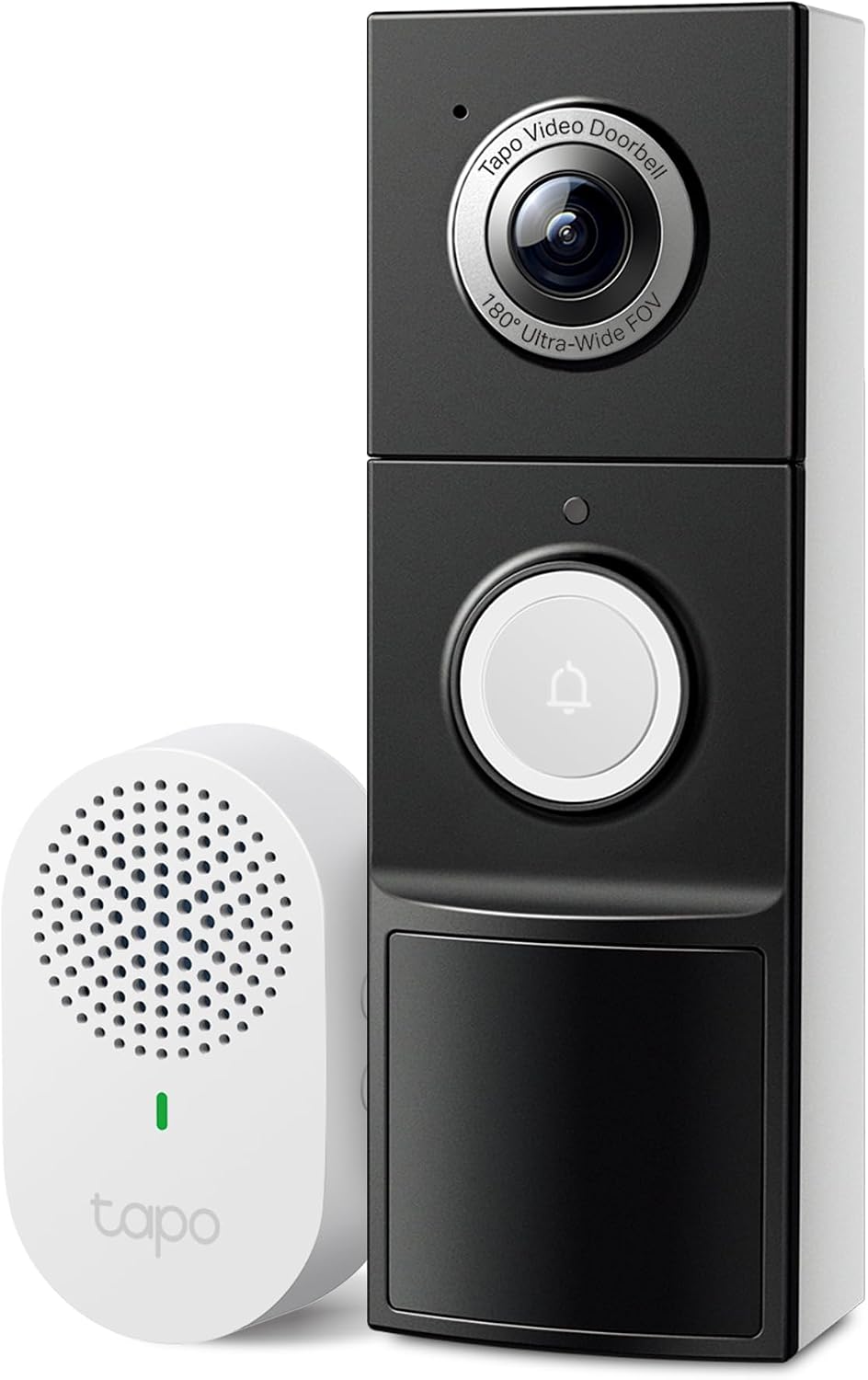
Key specs: 2K doorbell with a 180-degree head-to-toe view and a starlight sensor; runs wire-free for up to 8 months on a charge or hardwired for uninterrupted 24/7 recording; saves up to 512GB to a microSD card at no extra cost; chime included
The D225 is the only model in the range that does both jobs. TP-Link describes it as running wire-free for up to 8 months on a charge, or hardwired for around-the-clock monitoring — and specifically states that hardwired mode gives uninterrupted 24/7 recording for a complete record of activity. That is a genuinely different product from a battery doorbell that records clips. Add the 180-degree head-to-toe view, a starlight sensor for night detail, 2K video, a chime in the box and up to 512GB of free local storage, and the case for spending more here is straightforward.
✅ Pros
- Wire-free for up to 8 months, or hardwired
- Uninterrupted 24/7 recording when hardwired
- 180-degree head-to-toe view, the widest here
- Starlight sensor for night clarity
- Up to 512GB microSD at no extra cost, chime included
❌ Cons
- Costs more than the battery-only models
- 24/7 recording only applies in hardwired mode
- Continuous recording fills a card far faster than clips do
Tapo D210 — battery only, chime included
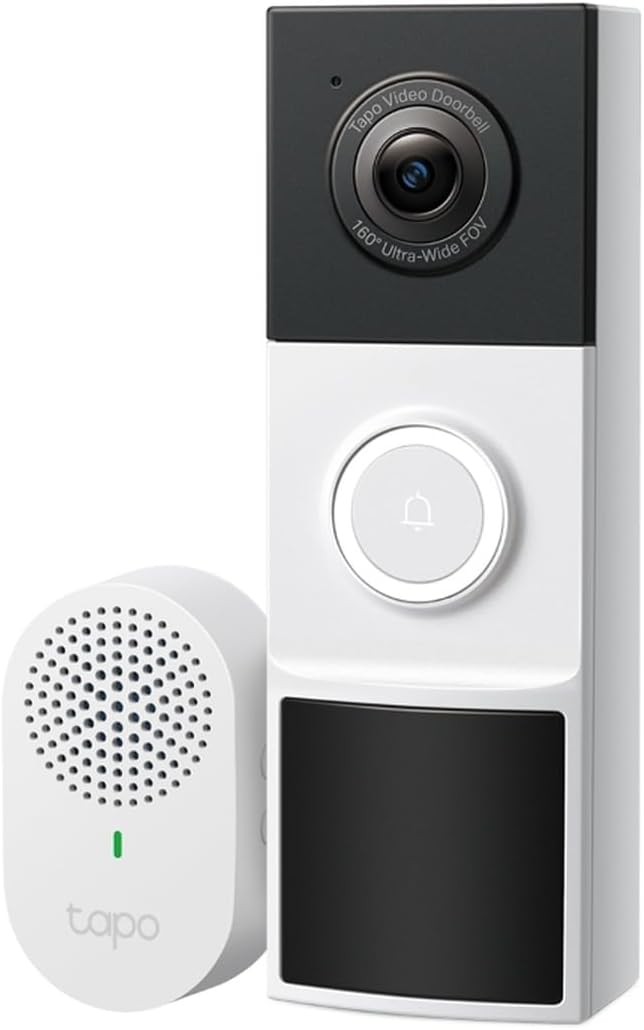
Key specs: 2K battery doorbell with a 160-degree head-to-toe field of view and up to 6 months between charges; microSD card support up to 512GB at no extra cost; chime included
The D210 is the straightforward battery doorbell: 2K video, a 160-degree head-to-toe view that captures visitors and couriers rather than only faces, and up to 6 months between charges. Storage works the same way as the rest of the range, with a microSD card up to 512GB at no extra cost and Tapo Care optional. A chime is included, which matters more than it sounds: several competing doorbells sell the indoor chime separately, and without one the doorbell only rings on a phone.
✅ Pros
- 2K video with a 160-degree head-to-toe view
- Up to 6 months between charges
- Chime included in the box
- microSD up to 512GB at no extra cost
- Simplest install of the three — no wiring at all
❌ Cons
- No hardwired 24/7 recording mode
- Narrower view than the D225
- Battery life drops on a busy street, as with any battery doorbell
Tapo D205 — longest battery, no chime in the box
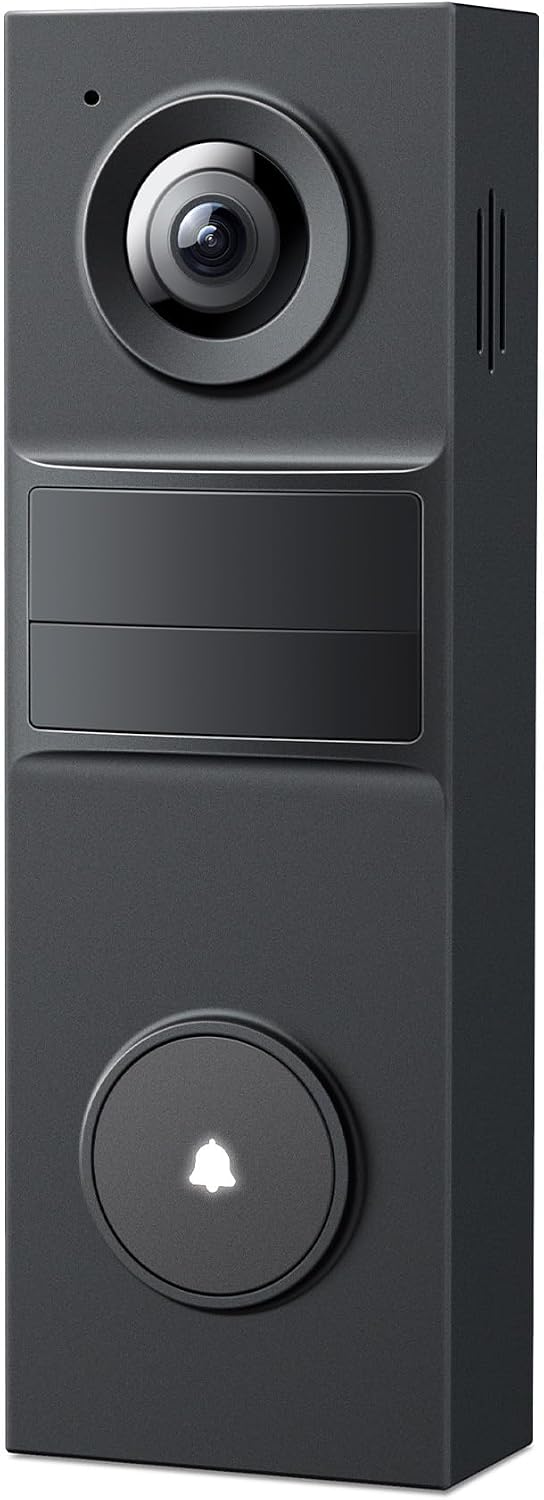
Key specs: 2K battery doorbell with a 160-degree field of view and a 5,200mAh battery rated up to 180 days; chime alerts through an existing Tapo hub or a smart assistant rather than a bundled chime; microSD up to 512GB
The D205 is the pick for a household already inside the Tapo ecosystem. TP-Link specifies a 5,200mAh battery running up to 180 days, and describes chime alerts as arriving through an existing Tapo hub or a smart assistant rather than through a bundled chime unit. Read that carefully before buying: if you do not already own a Tapo hub or a smart speaker you are happy to use as the chime, this doorbell will only ring on your phone. For anyone who does, it removes a device from the hallway and offers the longest quoted battery life in the range.
✅ Pros
- Up to 180 days on a 5,200mAh battery
- 2K with a 160-degree head-to-toe view
- Chime alerts through an existing Tapo hub or smart assistant
- microSD up to 512GB, or Tapo Care
- One less separate device in the hallway
❌ Cons
- No bundled chime — you need a hub or smart speaker
- Battery only, with no 24/7 hardwired mode
- Least useful of the three if you own no other Tapo hardware
The Three Side by Side
| Doorbell | Field of view | Power | Chime | 24/7 recording |
|---|
| Tapo D225 | 180 degrees | Battery up to 8 months, or hardwired | Included | Yes, when hardwired |
| Tapo D210 | 160 degrees | Battery, up to 6 months | Included | No |
| Tapo D205 | 160 degrees | Battery, up to 180 days | Through a Tapo hub or assistant | No |
The Feature Worth Wiring For
Almost every battery doorbell can be trickle-charged from doorbell wiring, and almost none of them change behavior when you do — they still sleep between events, because that is how battery devices protect their cells. The D225 is different in a specific, documented way: TP-Link states that hardwired mode gives uninterrupted 24/7 recording for a complete record of activity.
That is the difference between a folder of clips and a timeline you can scrub. If a delivery went missing between two events, a clip-based doorbell has nothing to show you and a continuously recording one does. It is the single strongest reason to choose the D225 over the cheaper models, and it is only available if you actually run the wiring — which means checking your transformer first, as our doorbell transformer guide sets out.
Three Things to Check Before You Buy
The chime question on the D205. TP-Link is upfront that its chime alerts come through an existing Tapo hub or a smart assistant. If you have neither, budget for one or buy a model with a chime in the box.
Continuous recording eats storage. The 512GB ceiling sounds generous until a hardwired D225 is recording around the clock. Size the card for how you will actually use it — our guide to choosing a card for a security camera covers endurance as well as capacity, and both matter more in continuous mode.
Battery figures assume a quiet door. Eight months, six months and 180 days are all quoted for normal use. A doorbell facing a busy sidewalk wakes far more often than that assumes, and the real interval can be a fraction of the headline. Narrowing the motion zone is the fix, and it is worth doing on day one. If you are comparing Tapo against the broader market rather than within it, our Tapo camera guide covers the rest of the range and our Tapo versus Wyze comparison sets the ecosystem against its closest rival.
Final Recommendation
Buy the Tapo D225. The 180-degree view is the widest in the range and the hardwired 24/7 recording mode is a genuine capability the other two do not have, not a marketing difference. Even used purely on battery it is the better doorbell, and it keeps the wired option open for later.
Two situations point elsewhere. You have no doorbell wiring, no intention of adding any, and want to spend less: buy the D210, which does the same core job on battery with a chime included. You already run a Tapo hub and want the longest possible gap between charges: buy the D205 for its 180-day rating, knowing the chime comes through your existing hardware rather than a bundled unit. What should send you to another brand entirely is wanting professional monitoring or a doorbell tied into an alarm system — Tapo is a camera company, and our DIY alarm system guide covers that requirement.
SafeBode does not yet run an in-house product testing program. This guide is built from manufacturer specifications, official support documentation, current retail listings and verified buyer feedback rather than hands-on testing, and we say so plainly rather than implying testing we have not done.
Frequently Asked Questions
Do Tapo doorbells need a subscription?
No. All three save footage to a microSD card of up to 512GB at no extra cost. Tapo Care adds cloud storage on top, which mainly buys an off-site copy that survives the doorbell being stolen.
Which Tapo doorbell records 24/7?
Only the D225, and only in hardwired mode. TP-Link states that hardwiring it gives uninterrupted round-the-clock recording, where the battery models capture events rather than a continuous timeline.
How long does the battery last?
TP-Link quotes up to 8 months on the D225, up to 6 months on the D210, and up to 180 days on the D205’s 5,200mAh cell. All three assume normal use; a doorbell facing a busy street will fall well short.
Does the doorbell come with a chime?
The D225 and D210 include one. The D205 instead sends chime alerts through an existing Tapo hub or a smart assistant, so if you own neither it will only ring on your phone.
What is the difference between 180 and 160 degrees?
The wider view on the D225 captures more of the ground directly below the doorbell, which in practice is the difference between seeing a parcel on the step and only seeing the person who left it.
Can I hardwire a Tapo doorbell to my existing wiring?
The D225 is designed for it and gains continuous recording as a result. Check your transformer first, because camera doorbells draw considerably more than the mechanical button they replace.
What size memory card should I use?
Up to 512GB is supported across the range. Size it to how you record: event clips stretch a card a long way, while continuous recording on a hardwired D225 will fill one far faster than most people expect.
Do these work with Alexa or Google Assistant?
Tapo devices support both for basic viewing and alerts, and on the D205 a smart assistant can act as the chime. The full feature set stays in the Tapo app, as with the rest of the range.
Sources
Show sources (4)


