Best Indoor Motion Sensor Lights 2026: Closets, Stairs and Rooms With No Switch
Affiliate Disclosure: This article contains affiliate links. If you buy through these links, we may earn a commission at no extra cost to you. Our editorial opinions are our own and are not influenced by affiliate relationships. Read our full disclosure policy →
Contents
Quick Answer
Indoor motion lights are mostly a convenience and night-safety upgrade rather than a security product, and it is worth saying so plainly. Their genuine security role is narrow: light where you are walking at night, and a house that looks lived in — Baltimore Police put that second point simply, advising residents to always leave a light on when they are not home and to use motion lights and timers. For most homes the stick-on 3-pack covers the spots that actually annoy you. Buy the ceiling light for a closet with no fixture, the rechargeable bars for a kitchen, and warm white for stairs — because cool white at 2 a.m. wakes you up properly.
Be Honest About What These Are For
A stick-on light in a closet is not a security device, and any guide that tells you otherwise is selling something. Here is the accurate version, which still leaves three good reasons to own them.
Night movement. The most common real hazard in a house at night is somebody getting up and navigating stairs or a hallway in the dark, often half-awake and without glasses. A light that comes on before you reach the top step solves a problem that a hand-operated switch, several feet away in the dark, actively creates.
Looking occupied. This is the one point where indoor lighting genuinely does security work. Baltimore Police recommend leaving a light on when you are out and using motion lights and timers, and the same guidance covers the rest of the occupied-house picture — collecting mail, keeping the yard tidy, having a neighbor do it while you travel. A light that flicks on in an upstairs hallway is a different signal from a house that is uniformly dark for a week.
Spaces with no switch. Closets, pantries, cupboards under stairs, garages, sheds and basements frequently have either no fixture or a pull cord you cannot find in the dark. That is the job these products were designed for, and they do it well.
What Indoor Motion Lights Do and Do Not Do
✅ Genuinely useful for
- Stairs, hallways and bathrooms at night
- Closets, pantries and cupboards with no fixture
- Making an empty house look lived in
- Anywhere you currently use a phone torch
❌ Not a substitute for
- Outdoor lighting at entry points, which is the deterrent that matters
- Door and window sensors, which detect entry rather than movement inside
- A camera, which records who rather than merely lighting them
- An alarm — nothing here notifies anybody
For the security half of the job, the police guidance is consistently about outside rather than inside: Seattle Police recommend that all entrances be well lit at night, with motion sensor lighting specifically directed at entry points and vulnerable areas, and landscaping trimmed so the perimeter stays visible. If that is what you are actually trying to solve, our outdoor motion sensor light guide is the right page, and this one is the follow-up.
Why Yours Will Trigger on Nothing
Every light here uses a passive infrared sensor, and understanding one thing about how PIR works will save you a lot of irritation: it does not see movement, it sees changes in heat across its field of view.
SafeWise’s explainer covers the practical consequence — a PIR sensor can be triggered by inanimate things that change the infrared energy in front of it, including a moving ceiling fan or a vent blowing hot or cold air. That is why a closet light next to a heating register seems possessed, and why a hallway sensor opposite a sunlit window behaves oddly in the afternoon. The same guide notes that pet immunity settings exist on many sensors specifically to stop small animals producing false triggers.
Four Placement Rules That Prevent Most Complaints
1
Keep vents and fans out of view
A register or ceiling fan in the sensor’s field is the most common cause of a light that switches itself on.
2
Aim across the path, not along it
PIR responds best to movement crossing its zones rather than heading straight at it.
3
Mount at the height you actually pass
Too high and it misses a person on the stairs below; too low and the cat sets it off.
4
Match the color temperature to the room
Cool white for closets and workspaces. Warm white for anywhere you go at night.
Get placement right on day one and these are fit-and-forget devices; get it wrong and you will be taking the batteries out within a week.
It is also worth knowing what these sensors cannot do: passive infrared does not see through glass, so a light aimed at a window will not respond to anything moving outside it. That is a limitation shared with the sensors in most alarm hardware, which is why glass break sensors exist as a separate product rather than being folded into motion detection.
The last rule matters more than people expect. A bright cool-white light on a landing at 3 a.m. does the same thing to your eyes as checking your phone in bed — it wakes you fully, which defeats the point. Warm white gives you enough to see the treads without that.
STAR-SPANGLED 7-Inch Motion Sensor Light 3-Pack — best overall
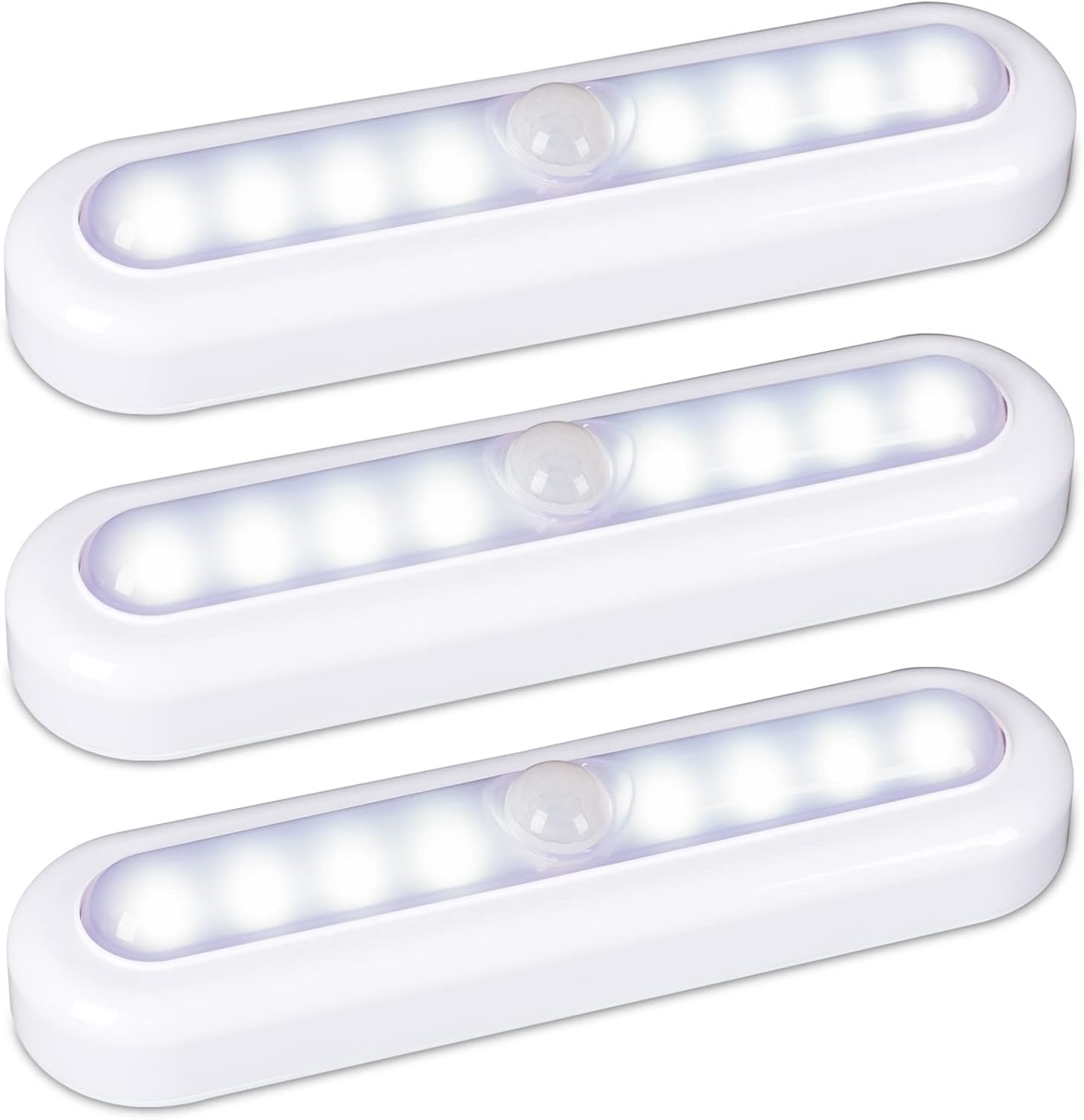
Key specs: Three stick-on LED bars running on AAA cells; 90-degree swivel mount; adhesive backing; cool white; motion activated with automatic shut-off
Three lights, stick-on mounting, AAA cells, and a swivel head so you can aim the beam where it is needed rather than wherever the adhesive happened to land. That combination is why this is the default recommendation: most households do not have one dark spot, they have three or four, and this covers them in one purchase. The swivel is more useful than it sounds — a light mounted above a closet rail can be angled down into the hanging space rather than lighting the ceiling. Cool white is the right choice for closets and cupboards where you are looking for something, less so for a bedroom hallway.
✅ Pros
- Three units covers the several dark spots most homes actually have
- Swivel head lets you aim the beam after mounting
- AAA cells are the easiest battery to have spares of
- Adhesive mounting means no drilling and no damage in a rental
❌ Cons
- Cool white is harsh for anywhere you walk at night
- Adhesive can let go on textured or dusty surfaces — clean the spot first
- Disposable batteries mean an ongoing, if small, cost
- Bar-shaped light is less even than a ceiling fixture in a small room
TOOWELL Motion Sensor Ceiling Light — best for a room with no fixture
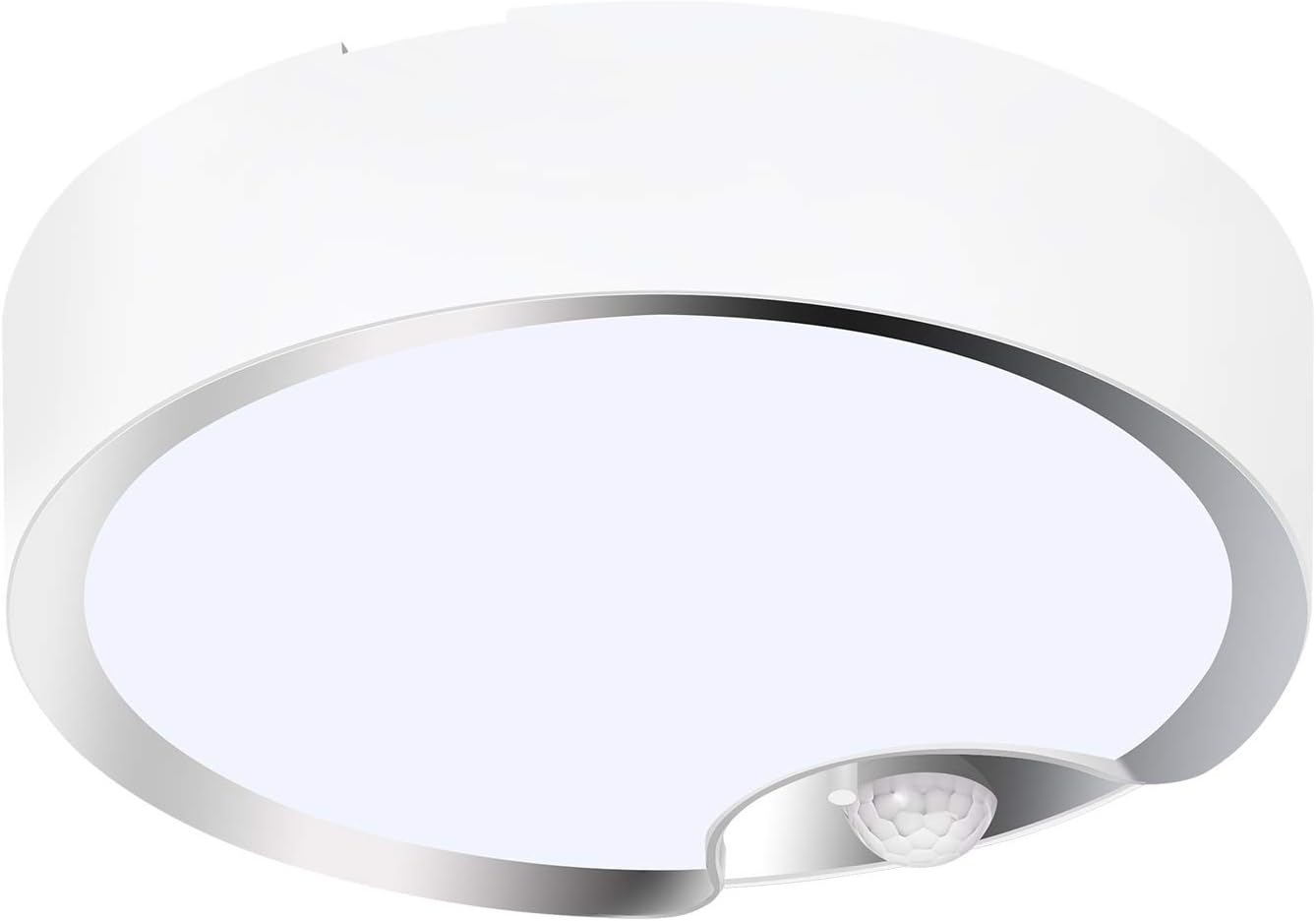
Key specs: Battery-operated 400-lumen ceiling light; wireless mounting with no wiring; cool white LED; motion activated; intended for closets, showers and utility spaces
This is the one to buy when the problem is a whole small room rather than a shelf: a closet with no light, a shed, a laundry cupboard, a basement stairwell. At 400 lumens it puts out genuinely useful light rather than a glow, mounts on the ceiling with no wiring, and switches itself off again. Because it sits overhead, the light is far more even than a bar stuck on one wall, which matters when you are trying to read labels on shelves. The tradeoff is battery consumption — a brighter light on a longer timer eats cells faster than a small puck, so this is a place to use good batteries and expect to change them.
✅ Pros
- Bright enough to genuinely light a small room, not just mark it
- Ceiling mounting gives even coverage rather than one bright wall
- No wiring, so it works in sheds, closets and rentals
- Large owner-feedback history for a product in this category
❌ Cons
- Brighter light plus a longer run time means faster battery drain
- Overhead mounting is the hardest position to reach for battery changes
- Cool white only — not the choice for a bedroom hallway
- Fixed beam, so aim is decided by where you mount it
MCGOR 10-Inch Rechargeable Under-Cabinet Light 2-Pack — best rechargeable
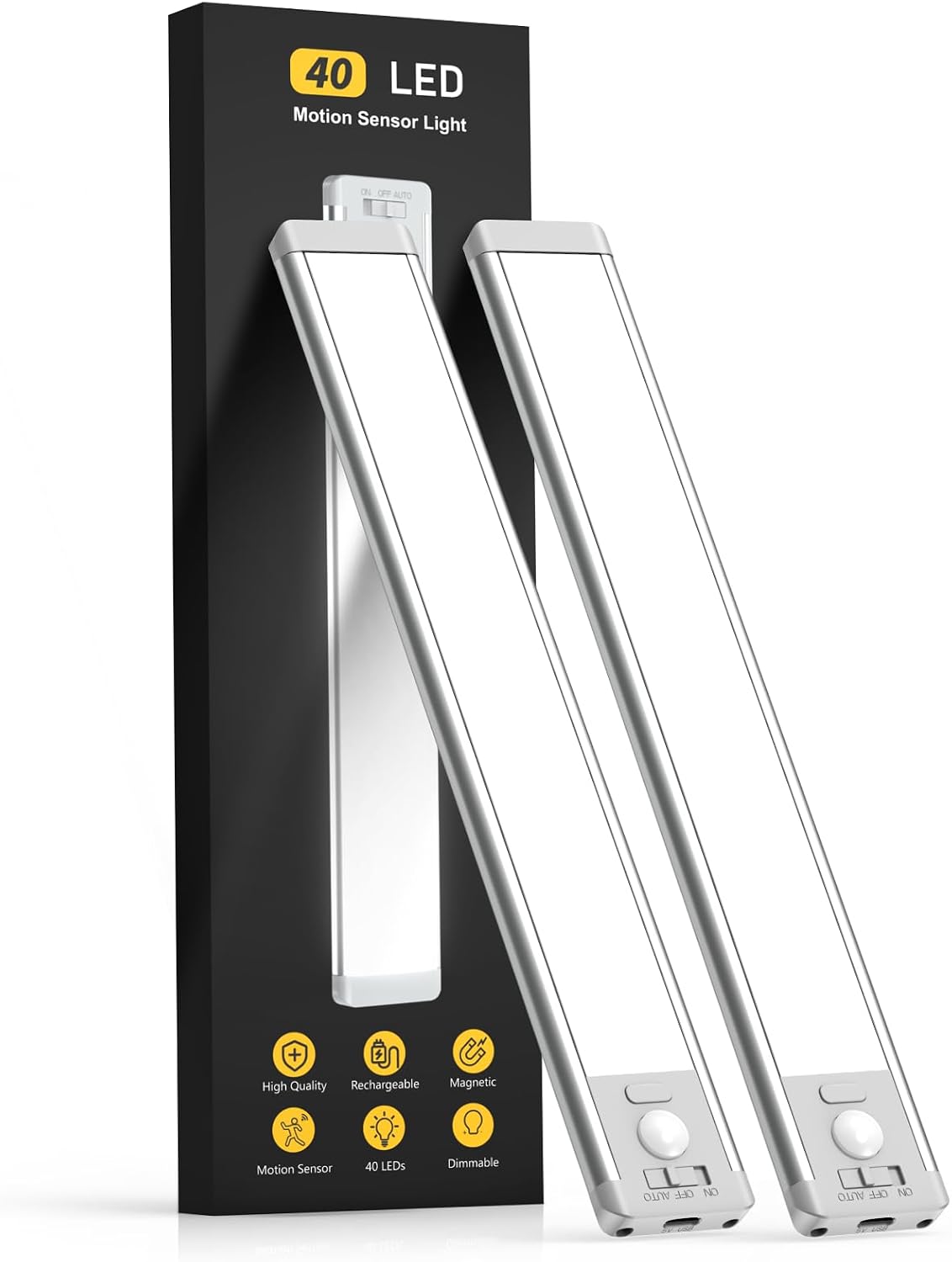
Key specs: Two rechargeable motion sensor light bars; five dimming levels; magnetic mounting for removal and recharging; designed for under cabinets, counters and closets
If the thought of replacing batteries in six lights is what has stopped you buying any, this is the answer. These are rechargeable bars on magnetic mounts: when one runs down you pull it off the metal strip, charge it, and put it back — no unscrewing, no battery drawer. Five dimming levels is unusual at this end of the market and genuinely useful, because the brightness you want under a kitchen cabinet at midnight is not the brightness you want while chopping. It has an enormous owner-feedback history, which for a product this simple is a reasonable proxy for it working as described. Under-cabinet is the obvious position, but the same bars work in a wardrobe or along a shelf.
✅ Pros
- Rechargeable — no disposable cells to buy or forget
- Magnetic mounting makes removal for charging trivial
- Five dimming levels, so it suits both task light and night light duty
- Very large review base for this category
❌ Cons
- Charging is still a chore, just a less frequent one
- Magnetic mount needs the supplied metal strip on non-metal surfaces
- Longer bars are conspicuous if you want the light hidden
- Rechargeable cells degrade over years in a way alkaline replacements do not
WILLED Rechargeable Stair Lights — best for stairs at night
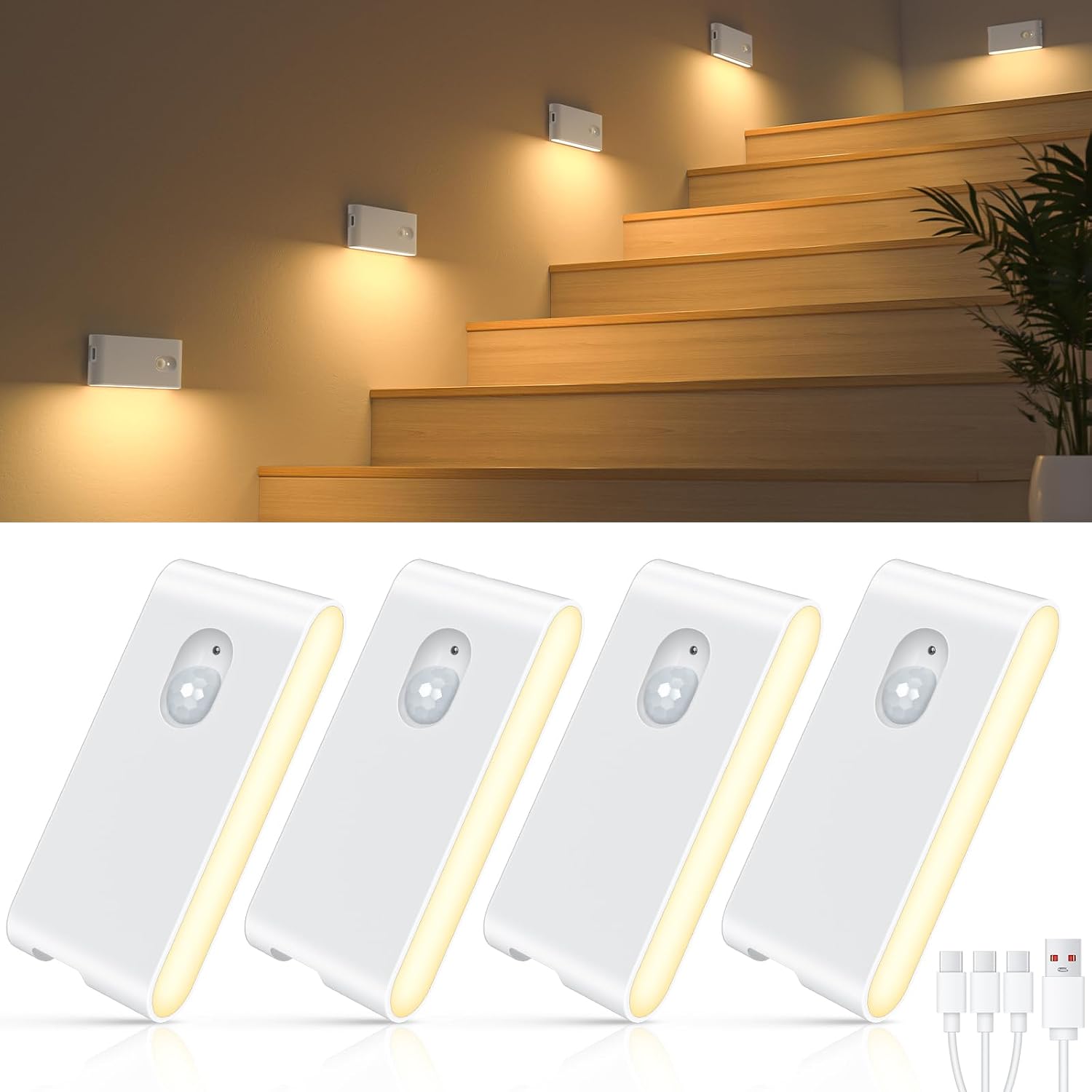
Key specs: Warm white rechargeable stick-on night lights; wireless motion sensing; magnetic mounting; sized for stair treads, hallways and kitchens
Warm white is the entire reason this one is on the list. Stairs are where indoor lighting stops being a convenience and starts being a safety measure, and the light you want there is enough to see the treads without destroying your night vision or waking you fully. These are small rechargeable units on magnetic mounts, sized to sit at tread level or along a hallway skirting. Use several rather than one: the goal is a lit path, not a spotlight at the top. Mount them low and aimed across the steps rather than up the stairwell, which also keeps them out of the sensor’s own way. This is the pick to buy for an older relative’s house.
✅ Pros
- Warm white preserves night vision — the right color for 3 a.m.
- Rechargeable, so no battery hunt at the top of the stairs
- Small enough to sit at tread level without looking like fittings
- Several units make a lit path rather than a single bright point
❌ Cons
- Small lights mean buying several to cover a staircase
- Recharging several units is more faff than swapping one battery
- Not bright enough for task work — this is navigation lighting
- Magnetic mounts need the adhesive plates on wooden stairs
Batteries, Recharging or Wiring
The power question decides how these lights fit into your life more than brightness does. All three approaches are reasonable; they simply fail differently.
| Disposable cells | Rechargeable | Hardwired fixture |
|---|
| Upkeep | Swap cells when they die | Take the unit down and charge it | None |
| Best for | Places you rarely visit — sheds, spare closets | Daily-use spots like kitchens and stairs | A room you use constantly |
| Failure mode | Dies silently, often unnoticed for weeks | Dims, then dies, usually with warning | Fails only if the circuit does |
| Cost over time | Ongoing cost of cells | None after purchase | Installation up front |
| Rental friendly | Yes — adhesive or magnetic mounting | Yes | No, unless you can wire and restore it |
One habit makes any of them work better: check them when the clocks change, along with your smoke and carbon monoxide alarms. A motion light that has been dead for a month is not a problem you notice — you simply stop expecting it to come on. And if false triggering rather than dead batteries is your issue, the causes are the same ones behind nuisance alarms generally, which our guide to repeated false alarms works through in detail.
Final Recommendation
Buy the STAR-SPANGLED 7-Inch Motion Sensor Light 3-Pack first. Three swivel-mounted stick-on lights, no wiring, no drilling, and enough units to fix the closet, the cupboard and the garage step in one go. Clean each mounting surface before you stick them, and keep heating vents and ceiling fans out of the sensor’s view.
Then buy for the specific job rather than repeating the same light. A closet or shed with no fixture wants the ceiling light, because 400 lumens overhead beats a bar on one wall. A kitchen wants the rechargeable dimmable bars, because that is a daily-use position where disposable cells become a chore. Stairs want warm white and several small units, because navigation lighting at night is a different product from task lighting.
Finally, keep the security expectation in the right place. Indoor lights make a house look occupied and make it safe to move around at night — that is real, but modest. The lighting that deters is outside, aimed at entry points, with the approach kept visible. If that part is not done, do it before you buy another indoor light: our camera placement walkthrough and the driveway alarm guide cover the approaches most homes leave completely dark and completely unwatched.
SafeBode does not yet run an in-house product testing program. This guide is built from manufacturer specifications, official support documentation, current retail listings and verified buyer feedback rather than hands-on testing, and we say so plainly rather than implying testing we have not done.
Frequently Asked Questions
Do indoor motion sensor lights improve home security?
Modestly and indirectly. They make a house look occupied and let you move safely at night. They do not detect entry, notify anybody or record anything, and the lighting that actually deters a burglar is outside, aimed at doors and windows.
Why does my motion light come on when nobody is there?
Passive infrared sensors respond to changes in heat across their view, so a heating or cooling vent, a ceiling fan or direct sun can trigger them. Move the light so those are out of its field, or angle it downward.
How long do the batteries last?
Anywhere from a couple of months to a year, depending on brightness, how long the light stays on after triggering, and how often it triggers. A bright ceiling light in a busy hallway is at the short end; a small puck in a spare closet is at the long end.
Should I use warm white or cool white?
Cool white for closets, cupboards and workspaces where you need to see clearly. Warm white for stairs, hallways and bathrooms used at night, because it lets you see without fully waking you.
Will the adhesive mounts damage paint?
Strong adhesive pads can lift paint on removal, particularly on older or poorly prepared surfaces. Magnetic mounts with a screwed or adhesive plate are gentler, and in a rental it is worth testing on an inconspicuous spot first.
Can I use these outdoors?
Not unless the specific model is rated for it. Indoor units are not sealed against moisture, and condensation in an unheated shed or garage will eventually kill one. Outdoor-rated lights exist for that job.
How high should I mount them?
At or slightly above the height you will actually pass, angled across your path rather than along it. Too high and the sensor looks over somebody on the stairs below; too low and pets trigger it constantly.
Are rechargeable ones worth the extra?
In places you use daily, yes — swapping cells in a kitchen light several times a year gets old quickly. For a spare closet you open twice a month, disposable cells are simpler and the recharging routine is not worth it.
Sources
Show sources (3)
- [1] SafeWise — “The Beginner’s Guide to Motion Sensors,” safewise.com/resources/motion-sensor-guide
- [2] Baltimore Police Department — “Burglary Prevention Tips,” baltimorepolice.org/safetytips
- [3] Seattle Police Department — “Burglary Prevention,” seattle.gov/police/crime-prevention


