Best Personal Safety Alarms 2026: What a 130 dB Keychain Does
Affiliate Disclosure: This article contains affiliate links. If you buy through these links, we may earn a commission at no extra cost to you. Our editorial opinions are our own and are not influenced by affiliate relationships. Read our full disclosure policy →
Contents
Quick Answer
Buy the She’s Birdie 3.0 if you want the one people actually keep clipped to a bag, and the Vantamo if you would rather have a low battery notice than a recognizable brand — a personal alarm that has quietly gone flat is the only failure mode that matters here. Understand what you are buying: these attract attention and can deter. They do not stop anyone, and they depend entirely on somebody being within earshot. Their genuine advantage is that they are permitted almost everywhere, including places where other personal safety devices are not.
What a Personal Alarm Actually Does
A personal alarm is a small battery-powered siren, usually with a strobe, activated by pulling a pin or a ring. That is the whole device. It has no other function and it is important to be clear-eyed about the one it has.
SABRE, one of the established makers in this category, describes the purpose plainly: these alarms help attract attention and deter attackers. Both verbs are doing honest work there. Attract attention is the mechanism — the alarm converts a private situation into a public one, which is a genuine change in circumstances. Deter is the hoped-for consequence, and it is contingent: someone who does not want to be noticed may leave, and someone who is not deterred by noise will not be.
What follows from that is the honest limit. A personal alarm is not a weapon and does not create physical distance. Its effectiveness scales with how many people are around to hear it and how likely they are to look. On a busy street it is a strong tool. In an empty parking structure at 2am it is considerably weaker, and it is worth knowing that before you rely on one.
What It Does and Does Not Do
✅ Realistic expectations
- Makes a private situation public, loudly and instantly
- May deter someone who does not want attention
- Draws bystanders’ eyes to a specific location, via the strobe
- Usable by someone with no training and no physical strength
❌ What it cannot do
- Create distance or physically stop anyone
- Summon police — nothing is transmitted anywhere
- Help much where there is nobody to hear it
- Work at all if the battery has quietly gone flat
The Real Advantage: It Is Allowed Where Other Things Are Not
This is the argument for owning one, and it is the one most roundups leave out. SABRE makes the point directly: personal alarms can be taken everywhere, including places where other personal safety devices are prohibited.
That covers a lot of real life. Many campuses restrict what students may carry. Airlines and airports restrict a great deal. Some workplaces and public buildings do too, and rules on chemical sprays and other devices vary considerably by state and by country — which matters enormously if you travel. A device that is simply a loud noise sidesteps almost all of that.
It also has no failure mode that hurts the user. There is nothing to spray back in wind, nothing that can be taken and used against you, and nothing requiring training or nerve to deploy correctly under stress. For a lot of people — students, commuters, runners, older adults, anyone who would not want to carry anything else — that combination is the entire appeal, and it is a legitimate one.
Decibels, Distance, and What the Numbers Mean
Listings compete on decibels, and the number is less informative than it looks. Decibels are logarithmic, so the gap between 120 dB and 140 dB is much larger than the digits suggest — but what you actually care about is audible distance, and that depends on the environment far more than on the last few decibels.
SABRE publishes stated audible ranges alongside its decibel figures, and they are a useful reference point: its alarms are listed at 120 dB and 130 dB with ranges given as 750 feet, 1,200 feet and 1,300 feet depending on model. KOSIN states that its 140 dB unit is audible at distances up to roughly 607 feet and will sound continuously for up to 50 minutes.
The Specs That Actually Differ
130–140
dB across the four picks
50 min
continuous sounding on the KOSIN
Strobe
on three of the four — it locates you
Low-batt
warning, on only one of the four
Duration and a battery warning matter more than the last few decibels.
Two specifications deserve more attention than loudness. Duration: an alarm that sounds for a few seconds is very different from one that runs for 50 minutes, because the point is to keep attention on the situation rather than to make one bang. The strobe: noise tells people something is happening somewhere, and a flashing light tells them where. In a crowded or dark place that is the difference between people looking up and people finding you.
The Four Picks Side by Side
She’s Birdie 3.0 — the one people actually carry
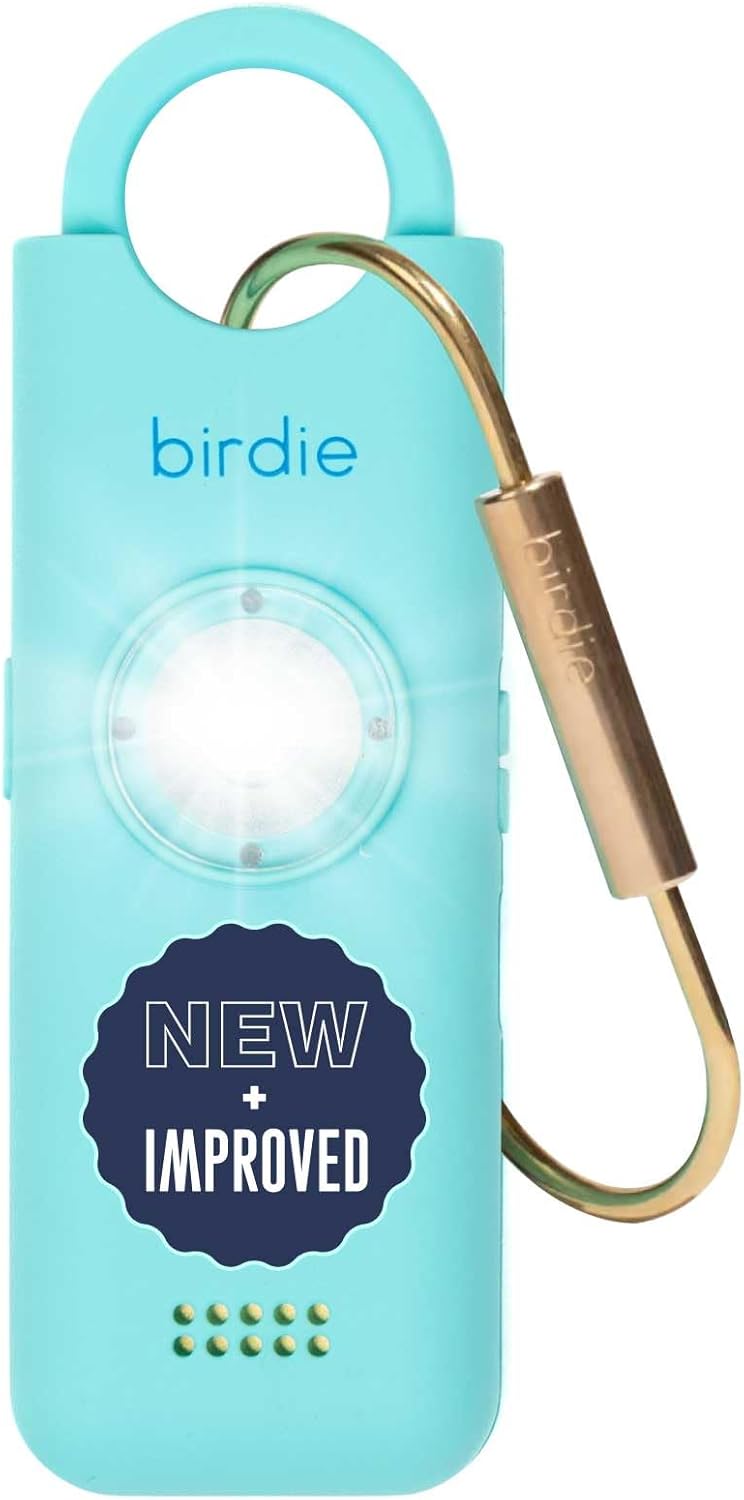
Key specs: 130 dB siren with a high-intensity flashing strobe; activated by pulling the top ring; designed for daily carry on a bag or keys
The category-defining product, and the recommendation for a reason that has nothing to do with specifications: it is the one that stays clipped to a bag rather than ending up in a drawer. That is not a soft point. A personal alarm delivers exactly zero benefit unless it is on you, and the design decisions here — small, unobtrusive, activated by pulling the top ring — are aimed squarely at that. It pairs a 130 dB siren with a high-intensity flashing strobe, so it both draws attention and marks where you are.
✅ Pros
- The design most likely to be carried daily rather than stored
- 130 dB siren plus a high-intensity strobe
- Simple top-ring pull, usable without looking
- The most recognized brand in the category, by a wide margin
❌ Cons
- No low-battery indicator, so a flat unit fails silently
- A pulled ring means finding and reinserting it afterwards
- Premium pricing for what is mechanically a simple device
- Like all of these, it does nothing without people nearby
Vantamo Personal Alarm — the one that tells you it is dying
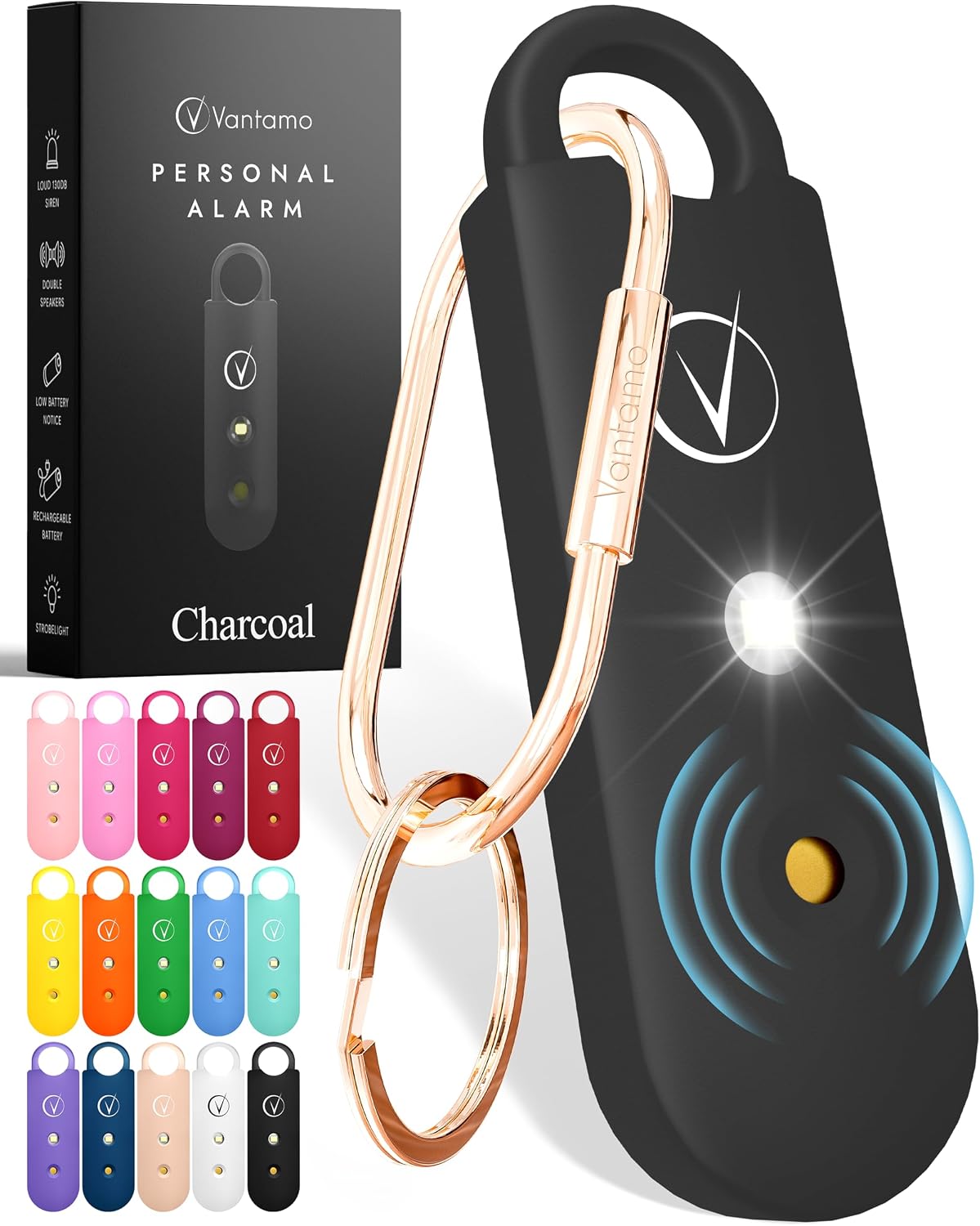
Key specs: Compact keychain alarm with a strobe light and a low battery notice; sized for daily carry clipped to a bag or backpack
Buy this one if you are honest about the fact that you will never test it. Its distinguishing feature is a low battery notice, and that addresses the only failure mode in this whole category that genuinely matters. Every other risk here is a limitation you can reason about in advance; a dead battery is a device that appears to be protecting you and is not. It is otherwise a conventional compact keychain alarm with a strobe, sized to clip to a bag or backpack for daily carry.
✅ Pros
- Low battery notice — unique among these four
- Strobe light alongside the siren
- Compact enough for genuine daily carry
- Strong review base for a non-headline brand
❌ Cons
- Volume is not stated as clearly as the others
- Less recognized than Birdie, if that matters to you
- A battery warning still requires you to act on it
- Same fundamental limits as every alarm here
KOSIN Personal Safety Alarm (6 Pack) — loudest, and for whole households
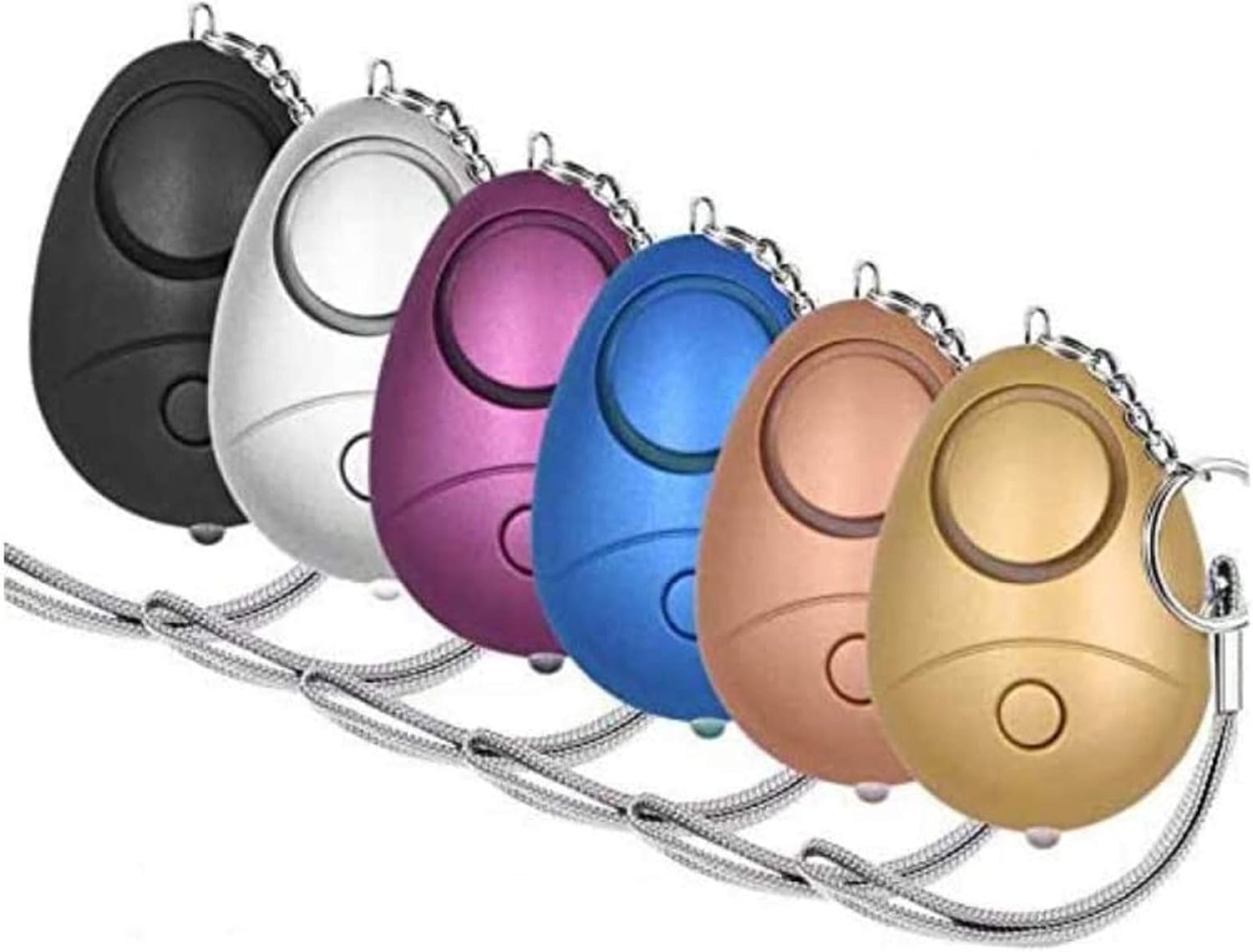
Key specs: 140 dB alarm the manufacturer states is audible at distances up to roughly 607 feet, sounding continuously for up to 50 minutes; powered by three AG13/LR44 batteries; supplied six to a pack
This is the practical choice when you are equipping more than one person — a family, a group of students, a set of staff. Six units in a pack means a spare for a bag, a car, a coat pocket and a dorm room rather than one carefully positioned device. It is the loudest here at 140 dB, with a stated audible range up to roughly 607 feet and up to 50 minutes of continuous sounding. That duration is the underrated figure: an alarm that keeps going long after the initial moment is one that is still attracting help when someone finally comes looking. It runs on three AG13/LR44 cells, which are inexpensive but worth checking you can source.
✅ Pros
- 140 dB, the loudest of the four
- Up to 50 minutes of continuous sounding
- Six per pack, so nobody has to share or remember
- Very large review base
❌ Cons
- Stated audible range is shorter than SABRE’s figures for quieter units
- AG13/LR44 button cells are less convenient to replace than AAA
- No low-battery warning across six units to keep track of
- Button cells are a genuine hazard around small children
HOOTIE Personal Safety Alarm — the pull-pin alternative
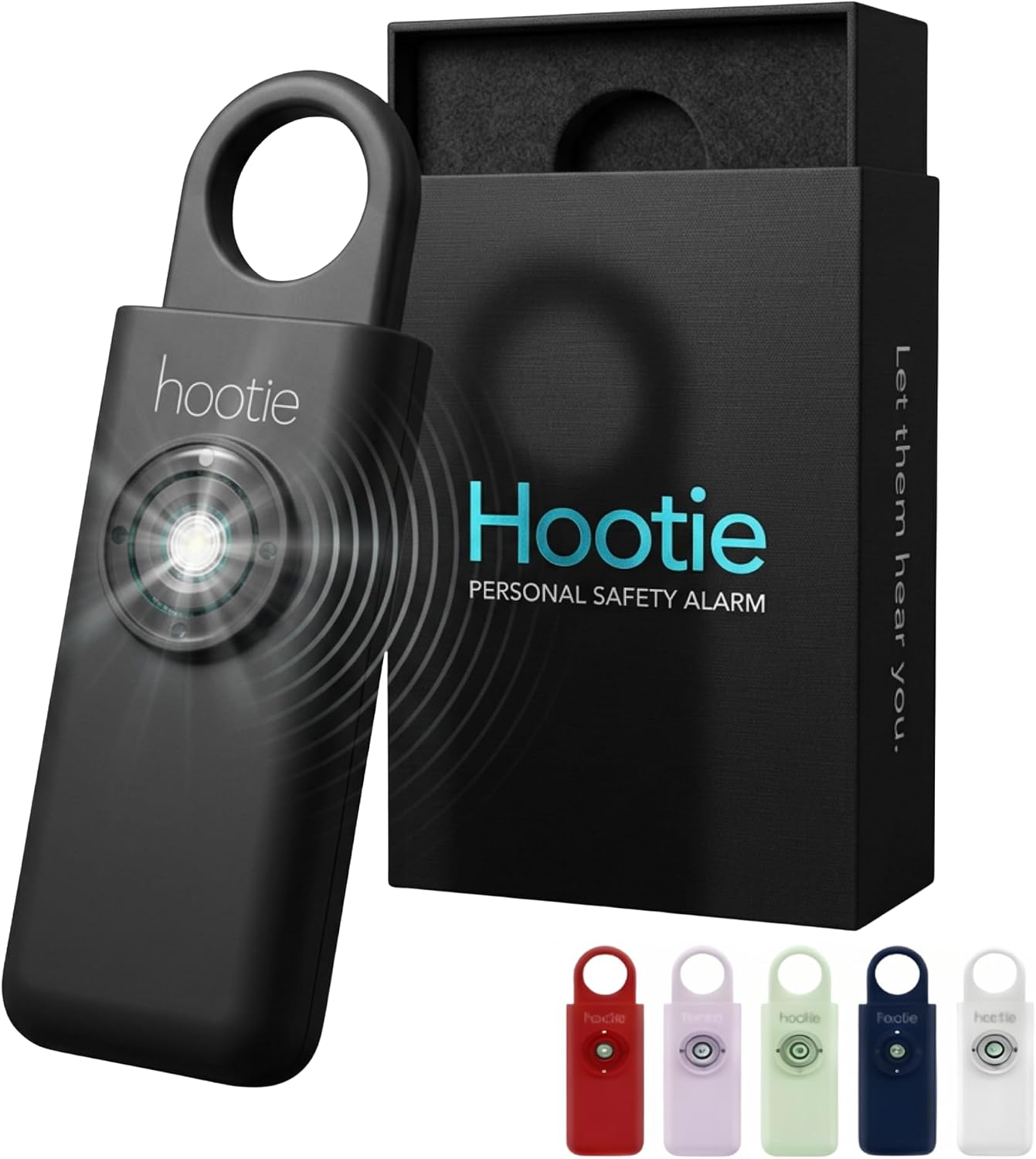
Key specs: 130 dB siren with a bright flashing strobe, activated by pulling a pin; marketed for women, men and kids; compact enough for daily carry
A straightforward 130 dB siren and bright strobe activated by pulling a pin, marketed for women, men and kids alike. The pin mechanism is worth thinking about rather than treating as equivalent to a ring: a pin is unambiguous and hard to trigger by accident in a bag, which matters if you have ever had a device go off against your keys. The trade is that a pulled pin is a small object to keep hold of in a moment when you are not thinking about small objects, and reassembling it afterwards is fiddlier than reseating a ring.
✅ Pros
- 130 dB siren with a bright flashing strobe
- Pull-pin activation resists accidental triggering in a bag
- Positioned for kids as well as adults
- Solid review base and an established listing
❌ Cons
- A pulled pin is easy to lose in the moment
- No low battery indicator
- Not louder than the Birdie despite the same rating
- Same dependence on bystanders as every other alarm here
The Carrying Problem Nobody Solves
Every review of these devices treats them as products. In practice the deciding factor is behavioral: does it end up attached to the bag you actually take out, or does it live in a drawer with the other well-intentioned purchases?
Making It Actually Present
1
Attach it to the thing you always take
Keys or the strap of your everyday bag. Not a bag you swap, and not loose in a pocket where you cannot find it by feel.
2
Practice the motion once, in daylight
Pull it deliberately somewhere it will not alarm anyone. You want the hand movement to be familiar before it needs to be automatic.
3
Set a battery reminder twice a year
Unless you bought the one with a low battery notice, nothing will tell you. Tie it to the clock changes, like smoke alarms.
4
Know what you will do after
The alarm buys attention. Decide in advance whether you are moving toward people, toward light, or into a building.
The device is the easy part; carrying it is the part that fails.
A Second Use Most Buyers Miss
These are marketed for the street, but a personal alarm is also a genuinely useful travel and temporary-accommodation item, in the same category as the portable hardware people take to hotels. It weighs almost nothing and needs no installation, which is exactly the constraint that governs portable travel door locks too.
For a home, though, be clear that this is not a security system. A personal alarm makes noise where you are standing. A door alarm tells you a door opened; a standalone motion siren reacts to someone approaching; a door security bar physically resists entry. Those are different jobs, and a keychain alarm substitutes for none of them.
Where the overlap is real is renting and shared accommodation, where you may not be able to install anything permanent at all. A personal alarm plus portable door hardware covers a surprising amount of ground in exactly the situations covered in our guide to apartment security choices — and unlike a system, it leaves with you.
One smart-home crossover worth knowing about: SwitchBot’s Safety Alarm is the same 130 dB siren-and-strobe idea as the picks above, with an app twist none of them have — double-pressing it triggers a fake incoming call on your phone, and it doubles as a key fob for SwitchBot’s own door lock and keypad. If your home already runs SwitchBot gear, it folds a personal alarm into that ecosystem; we haven’t compared it head-to-head with the four picks here.
Final Recommendation
Buy the She’s Birdie 3.0 if you want the one with the best chance of being on you when it matters. Its 130 dB siren and strobe are competitive rather than exceptional; what it wins on is being a thing people keep clipped to a bag for years, and that is the only spec that survives contact with real life.
Choose the Vantamo instead if you know you will never test it. The low battery notice is the single most useful feature in this roundup, because a silently dead alarm is worse than no alarm — it is a false sense of cover.
Buy the KOSIN six-pack when you are equipping several people at once and want the loudest option with the longest sounding time. Choose HOOTIE if you specifically prefer a pull-pin to a ring and want something positioned for children as well as adults.
What would change our answer: if your concern is your home rather than being out, none of these is the right purchase — a door alarm or a monitored system addresses that, and a keychain siren does not. And if the environments you are worried about are genuinely empty ones, be honest that an alarm’s whole mechanism is other people, and weight your planning toward avoiding those situations rather than toward a device.
SafeBode does not yet run an in-house product testing program. This guide is built from manufacturer specifications, official support documentation, current retail listings and verified buyer feedback rather than hands-on testing, and we say so plainly rather than implying testing we have not done.
Frequently Asked Questions
Do personal safety alarms actually work?
They do the specific thing they are built for: making a private situation loudly public. Manufacturers describe the purpose as attracting attention and deterring attackers, and both depend on people being close enough to hear and respond. They do not physically stop anyone.
How loud should a personal alarm be?
Most sit between 120 and 140 dB. Beyond that range, duration and whether it has a strobe matter more than the last few decibels — an alarm that sounds for many minutes keeps attention on the situation, and a light tells people where to look.
Are personal alarms allowed on planes and campuses?
They are generally permitted in places where other personal safety devices are not, which is one of the main reasons to choose one. Rules still vary by airline, institution and country, so check the specific policy if it matters for a trip.
Do personal alarms call the police?
No. These are self-contained sirens with no connectivity — nothing is transmitted anywhere. If you want an alert that reaches someone remotely, that is a different category of device entirely.
How long do the batteries last?
It depends on the model and how often it is tested, and most give you no warning at all when they run low. Only one of the four picks here has a low battery notice, which is why a twice-yearly check is worth building into a routine.
Can a child carry a personal alarm?
Several are marketed for children as well as adults. Two practical cautions: children may trigger one by accident or for fun, and the button cells some models use are a genuine ingestion hazard for small children.
Pull-pin or ring activation, which is better?
A pin resists accidental triggering in a bag; a ring is easier to reset afterwards. Neither is safer than the other — pick whichever you are more confident operating without looking.
Will an alarm work in an empty area?
Much less well, and this is the honest limit of the category. The mechanism is other people hearing it. In genuinely isolated places the alarm is closer to a deterrent gamble than a reliable intervention.
Should I get one for home security instead of an alarm system?
No. A personal alarm makes noise where you are standing; it does not detect an opening door or an approach, and it does not deter anyone who is not already near you. For a home, a door alarm or a full system is the right product.
Sources
Show sources (5)
- [1] SABRE — Personal Alarms product range and stated audible ranges, www.sabrered.com/personal-alarms
- [2] She’s Birdie — Birdie 3.0, current retail listing specifications (ASIN B0F5K4PCTX)
- [3] Vantamo — Personal Alarm, current retail listing specifications (ASIN B0F743FK2Q)
- [4] KOSIN — Personal Safety Alarm 6 Pack, current retail listing specifications (ASIN B07NLFQS7T)
- [5] HOOTIE — Personal Safety Alarm, current retail listing specifications (ASIN B08MQ3J5DP)


