Best Gun Safes 2026: What Matters Beyond the Price
Affiliate Disclosure: This article contains affiliate links. If you buy through these links, we may earn a commission at no extra cost to you. Our editorial opinions are our own and are not influenced by affiliate relationships. Read our full disclosure policy →
Contents
Quick Answer
“Gun safe” is one of the biggest searches in home security, and almost none of what ranks for it is a certified safe in the sense a locksmith or insurer would use that word. Treat anything you buy on Amazon in this category as a deterrent and organization tool — it keeps a firearm out of casual reach of kids, guests, and an opportunistic thief, and a locked, unloaded firearm stored separately from ammunition is measurably safer than one left out. It is not, by default, a UL-rated burglary vault. Pick based on what you are actually protecting against: quick bedside access to one handgun, a portable case for travel or a vehicle, a cabinet for a growing rifle collection, or genuine fire protection for a larger investment.
Why “Gun Safe” Is Such a Confusing Search
Search “gun safe” and you get a single results page mixing a budget fingerprint lockbox sized for a nightstand drawer, a mid-priced sheet-metal cabinet that holds fifteen rifles, and a premium, 700-lb vault bolted to a concrete slab. All three get called a “gun safe” in casual use and in Amazon category names, but they solve almost entirely different problems. The nightstand box is about seconds — getting a defensive handgun into your hand fast while keeping it away from a child in the meantime. The cabinet is about organization and casual-access control for a collection you are not trying to draw from in an emergency. The vault is about resisting a determined, tooled-up burglar for a meaningful stretch of time, and very few products sold under the “gun safe” name on Amazon are actually built or rated for that third job.
This guide splits the search by the question you are actually asking rather than ranking four products against each other as if they compete. If what you are really after is a general-purpose home safe for documents, cash, or jewelry rather than a firearm specifically, our home safe decision-tree guide routes you by threat type instead of gun capacity, and one of the picks below shows up there too, for a different reason.
A Deterrent Tool, Not a Vault: What a Gun Safe Actually Promises
Two separate rating systems exist for safes, and the industry that certifies them is explicit that a printed claim on a box is not the same thing as passing the actual test. UL Solutions, the organization behind the tests, tells buyers plainly to look for an actual UL certification mark rather than trust an unverified number, because a device that has genuinely earned a UL Mark has been independently tested against a published standard, while a device that merely claims a rating has not. That distinction matters more in the gun safe category than almost anywhere else in home security, because the overwhelming majority of Amazon listings in this category do not carry an independent UL Mark at all.
The burglary side of that testing is called a Residential Security Container, or RSC, under standard UL 1037. Even the baseline tier of a genuine RSC rating is a lower bar than most buyers assume: a Level 1 RSC only has to withstand a five-minute attack by one person using common hand tools such as screwdrivers, hammers, and pry bars, with higher tiers adding time, a second attacker, and heavier tools. A product with no RSC rating at all — which describes most of the sheet-metal cabinets and polymer lockboxes sold as “gun safes” on Amazon — was never tested against forced entry in any standardized way, and its actual resistance time could be well under that five-minute floor. That does not make these products useless. It makes them exactly what a firearms-industry safety program calls them: a locked location, not a vault. Project ChildSafe’s own guidance to gun owners frames secure storage as the number-one way to prevent accidents, theft, and misuse, and lists lockboxes specifically as a good, legitimate storage solution for a home-defense firearm — the framing is about restricting casual access, not about defeating a professional burglar.
So read every claim on this page, and every claim on an Amazon listing in this category, with that distinction in mind. “Heavy-duty steel” and “anti-theft” are marketing language unless a specific UL Mark and standard number are attached to them. None of the four products below carry an independent UL Mark, and we say so plainly for each one rather than letting a manufacturer’s adjective imply more than the product has actually earned.
Match the Safe to Your Actual Use Case
Before comparing products, answer these in order. Getting this sequence backward — starting from star rating instead of use case — is the most common reason a gun safe purchase gets returned or ends up unused in a closet.
Four Questions Before You Buy
1
What are you protecting against?
A slow theft over hours, a curious child, or a house fire are three different problems with three different products.
2
Where will it actually live?
A nightstand drawer needs a small footprint. A vehicle needs something that survives heat and doesn’t rattle. A closet can take a bolted-down cabinet.
3
What are you storing, and how much of it?
One carry pistol needs a fraction of the space a five-rifle collection does, and the access method that works for one is wrong for the other.
4
Do you genuinely need fire protection?
If the contents are irreplaceable or the safe also holds documents, a manufacturer’s specific minute-and-degree fire rating is worth paying for. If it only holds one carry gun, it usually is not.
The four picks below are built around these questions rather than around who is “best” in the abstract — none of them compete for the same answer.
BILLCONCH Biometric Gun Safe — the bedside pick
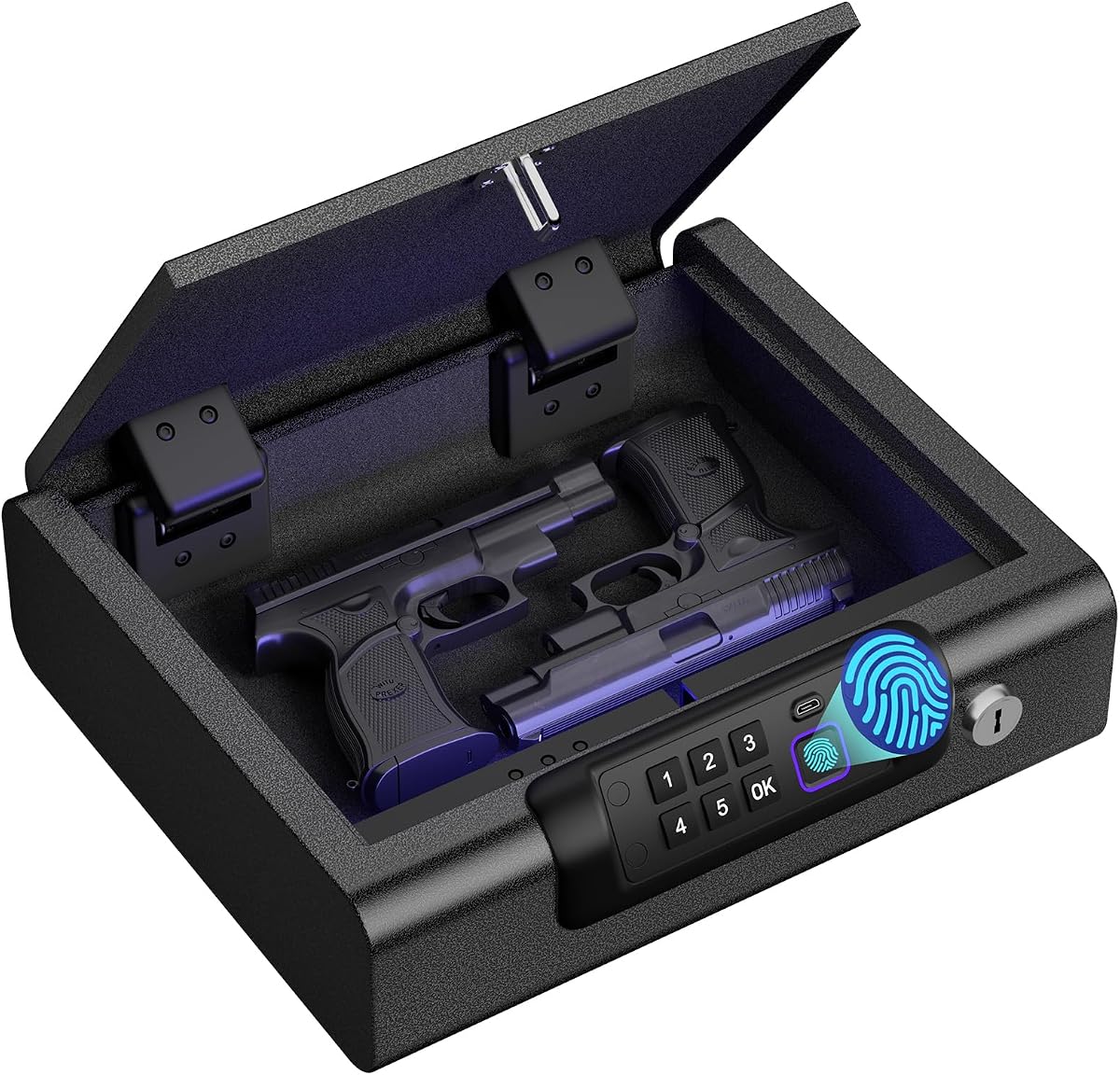
Key specs: Biometric fingerprint, PIN keypad, and backup key access; carbon steel body with foam-padded interior; 8.6″D x 10″W x 2.75″H (241 cubic inches); freestanding or tabletop mount; not water resistant
This is the product most people searching “gun safe” actually mean: something small enough for a nightstand or dresser drawer that opens in under two seconds for a single defensive handgun. It is the single most-purchased item in Amazon’s Gun Safes category, and verified buyers consistently describe the fingerprint scanner as fast and reliable once set up correctly, with the backup PIN and physical key as fallbacks if a finger is wet, gloved, or the battery dies. Multiple reviewers note it comfortably fits a compact handgun with a spare magazine or two, but a full-size pistol with a longer barrel is a snug fit and not a fast draw — check your specific model’s barrel length against the interior dimensions before assuming it fits.
✅ Pros
- Fingerprint access is genuinely fast once your prints are enrolled correctly, per repeated verified buyer reports
- Three redundant unlock methods (fingerprint, PIN, key) mean a dead battery does not lock you out
- Compact enough for a nightstand, desk drawer, or closet shelf without dominating the space
- Interior LED light makes low-light access easier at night, which is the scenario this product exists for
❌ Cons
- Not water resistant, and not rated against forced entry by any independent standard — treat it as a lockbox, not a vault
- A full-size handgun with a longer barrel fits tightly; compact and subcompact pistols fit best
- Freestanding and lightweight enough that a determined thief could simply carry the entire unit away unless it is anchored
- Single-compartment design — it is not meant to store more than one or two firearms
VAULTEK LifePod 20 Biometric — the travel and vehicle pick
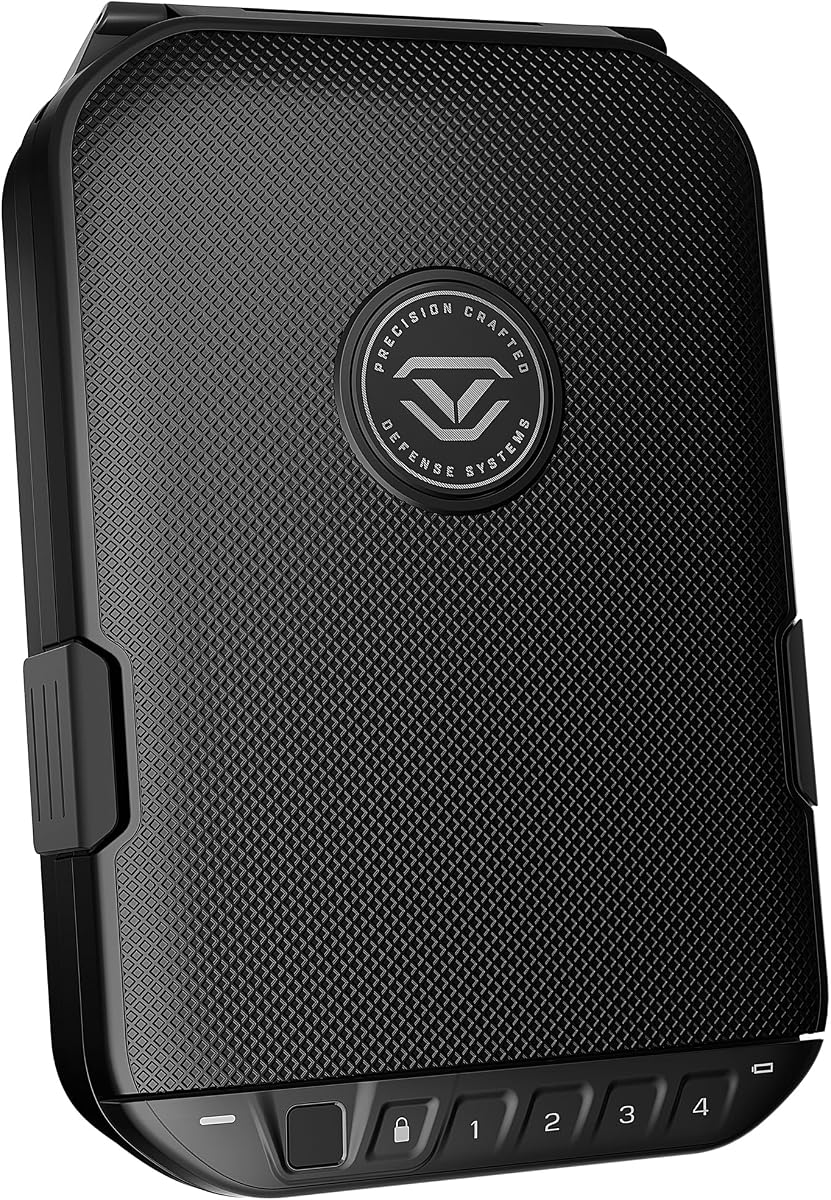
Key specs: Biometric fingerprint, capacitive keypad, and backup key access; waterproof, airtight, and floats; TSA-compliant non-metal polymer shell; holds a full-size handgun up to 9.25 inches; steel security cable included for anchoring to a fixed object
This is a different product family entirely — a hard-shell, weatherproof case rather than a mounted safe — and it solves a problem none of the other three picks do: getting a handgun securely and legally from one place to another. It is airtight, water resistant enough to float, and built to meet TSA guidelines for checked-bag firearm transport, with a steel security cable included so it can be tethered inside a vehicle or to a fixed object at a campsite or hotel room. Verified buyers repeatedly describe using it for exactly that: bedside at home, then straight into a truck or a checked bag for travel, without needing a second product.
✅ Pros
- Genuinely weatherproof and floats, which none of the steel picks in this guide can claim
- Meets TSA guidelines for checked-bag firearm transport, useful for air travel with a firearm
- Steel security cable lets you tether it inside a vehicle instead of leaving it loose on a seat
- Holds a full-size handgun up to 9.25 inches, wider capacity than the compact bedside pick
❌ Cons
- The shell is a non-metal polymer, not steel — at least one verified buyer reported a unit cracking after a hard impact against a solid surface, so treat it as rugged rather than indestructible
- Meaningfully more expensive than a basic steel lockbox for the same core function
- Powered by a replaceable 9V battery for the lock and light — not a dealbreaker, but one more thing to keep stocked
- Portable by design, which cuts both ways: also easy for someone else to simply pick up and leave with if it is not cabled down
KAER 14-15 Gun Biometric Rifle Cabinet — the rifle collection pick
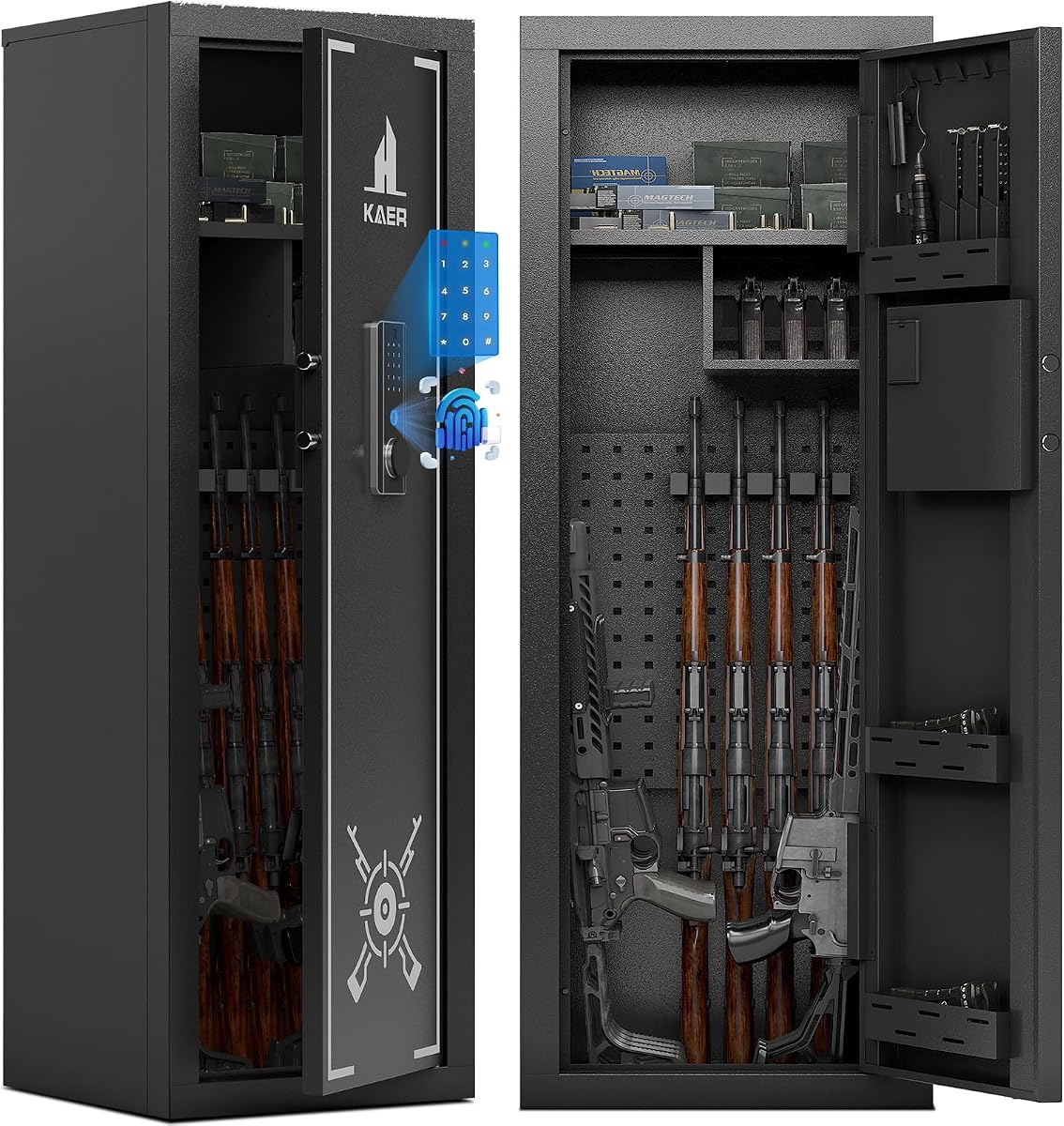
Key specs: Biometric fingerprint, digital keypad, and backup key access; 16-gauge cold-rolled steel; holds 14-15 long guns on adjustable racks plus an overhead handgun and accessory shelf; 57″H x 18.5″W x 15.8″D; 78 lbs, bolts to a floor or wall
Once you own more than one or two long guns, a bedside lockbox stops being the right shape of product entirely, and this is the category people actually mean when they search for a “gun cabinet” rather than a handgun box: a tall, floor-standing unit with adjustable racks for up to 14-15 rifles or shotguns, plus a small overhead shelf for a handgun and accessories. We are not going to smooth over what verified buyer reviews on this exact listing say plainly: this is 16-gauge sheet steel construction with no fire rating and no independent forced-entry certification of any kind. One detailed, critical review on the listing describes it accurately as a cabinet or locker rather than a safe in any legal or functional sense, noting it can be opened by an unauthorized person with basic hand tools in well under a minute — consistent with there being no RSC rating attached to it at all. That is a fair description of the entire budget end of this product category, not a defect unique to this one listing, and it is exactly why the deterrent-not-vault framing above matters before you buy anything in this size and price range.
✅ Pros
- Genuinely large capacity — 14-15 long guns plus a separate handgun/accessory shelf, more than most households need
- Three redundant access methods, and the fingerprint scanner works reliably per repeated verified buyer reports
- Adjustable racks accommodate different firearm lengths, and it bolts to a floor or wall for anti-tip stability
- Priced far below a true rifle vault, which is honest as long as you buy it for what it is
❌ Cons
- No independent fire rating and no RSC/UL burglary rating — verified buyer reviews describe it as openable with basic hand tools in under a minute
- Racks are sized for standard rifle profiles; firearms with scopes or optics may need the racks modified or removed to fit, per verified buyer reports
- Thin sheet-metal construction means it will not survive a determined attack or a house fire — treat it as organization and casual-access control, not theft or fire protection
- Requires assembly, and the door alignment has been reported as occasionally out of square on arrival
Fortress 14-Gun Fireproof Safe — the fire-rated pick
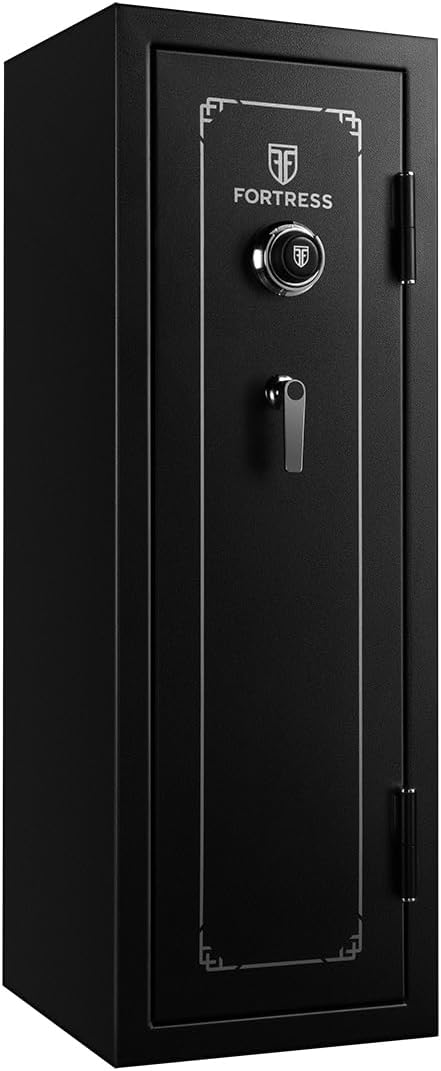
Key specs: Combination lock with 3 active locking bolts, 2 deadbolts, and a patented notch bolt; 2mm steel construction; manufacturer-rated for 30 minutes of fire protection at 1,200 degrees F; built-in anti-theft alarm; 55″H x 20.25″W x 19″D; 270 lbs
This is the pick that actually earns the word “safe” in a meaningful sense, and it is priced accordingly — several times more than the other three combined. The manufacturer states a specific, testable fire claim: 30 minutes of protection at 1,200 degrees Fahrenheit, backed by 2mm steel construction and a combination lock with three active locking bolts, two deadbolts, and a patented notch bolt designed to resist pry attacks at the hinge side. At 270 lbs, it is not something a thief carries out the front door, and a built-in anti-theft alarm adds a second layer beyond the lock itself. The honest caveat: a manufacturer-stated fire rating is not the same claim as an independent UL 72 fire-resistance certification, and this listing does not state that it carries a UL Mark for either fire or burglary resistance — per UL Solutions’ own guidance, that is the specific thing to verify before assuming a printed number means what a certified rating would mean.
✅ Pros
- The only pick here with a specific, testable fire claim (30 minutes at 1,200°F) rather than no fire claim at all
- 270 lbs and 2mm steel with a three-bolt-plus-deadbolt locking system meaningfully raises the forced-entry bar over the sheet-metal cabinet pick
- Built-in anti-theft alarm is a feature none of the other three picks in this guide include
- Backed by a manufacturer warranty covering the lock, the product, and attack damage
❌ Cons
- No stated independent UL Mark for either the fire or burglary claim — verify the manufacturer’s number against UL Solutions’ certification guidance rather than taking it at face value
- Thin review base relative to its price point; treat the rating as a starting signal, not a verdict, and read current reviews before buying
- 270 lbs makes delivery and placement a real logistical step, and it is not something a renter can easily relocate
- Combination lock is slower to operate than the biometric options above — a genuine tradeoff for buying more physical protection
Fire Rating vs. Burglary Rating: Read the Fine Print
These are two unrelated tests, run by the same certifying body but measuring completely different things, and a safe can pass one, both, or neither. A product can legitimately be fire-tested without being burglary-rated at all, which describes most of the budget end of this category — steel thick enough to hold a shape under heat is not the same steel gauge needed to resist a pry bar.
| Fire Rating (UL 72) | Burglary / RSC Rating (UL 1037) |
|---|
| What it actually tests | Internal temperature and humidity during a simulated building fire | Resistance to forced entry with common hand tools, timed |
| Baseline claim to look for | A specific minutes-and-degrees figure, e.g. “30 minutes at 1,200°F” | An actual UL Mark citing Level 1, 2, or 3 — not just the word “anti-theft” |
| What a Level 1 baseline means | Not applicable to this standard | Withstood 5 minutes of attack by one person with hand tools — a floor, not a strong claim |
| Where our 4 picks stand | Only the Fortress pick states a specific fire claim | None of the 4 picks state an independent UL Mark for either standard |
| What this means for you | Don’t assume any “fireproof” label without a specific figure attached | Assume any Amazon “gun safe” without a stated UL Mark is a deterrent, not a rated vault |
None of that makes the cheaper picks a bad purchase — it makes them a different purchase than the name implies. If independent certification genuinely matters for your situation (a large, irreplaceable collection, a legal requirement in your state, or insurance documentation), look specifically for a printed UL Mark and standard number on the product page or spec sheet before you buy, not just the word “fireproof” or “heavy-duty” in the title.
Why Secure Storage Matters, Beyond the Product
Whatever you buy, the practice matters as much as the hardware. Public health guidance on this is consistent and framed as a straightforward safety fact rather than a policy position: keep firearms unloaded and locked, and store ammunition separately and securely from the firearms themselves. Washington State’s Department of Health cites research finding that households that locked both firearms and ammunition were meaningfully less likely to experience a self-inflicted firearm injury, and saw a substantially lower risk of accidental firearm injury among children specifically. A firearms-industry safety program built specifically for gun owners makes the same point from the other direction, listing secure storage as the single most effective step against accidents, theft, and misuse, and calling out ammunition-separate storage as one of its core tips.
Why This Isn’t Optional, By the Numbers
Locked + unloaded
Households storing both this way saw markedly lower rates of self-inflicted and accidental firearm injury
5 minutes
The baseline forced-entry resistance a Level 1 RSC/UL 1037 safe is rated to survive — most Amazon listings carry no such rating at all
83%
of burglars specifically look for signs of security before choosing a target, per a widely-cited burglar-motivation study
Separate storage
Project ChildSafe’s own top tips list storing ammunition in a locked location apart from firearms as a distinct, specific step
Figures are illustrative of the underlying research and guidance cited, not a guarantee for any specific product.
A safe is one layer, not the whole system. Most burglaries are opportunistic rather than carefully planned, and visible signs of security measurably change a burglar’s decision to target a home at all — which is the same logic behind pairing a safe with a proper home alarm system rather than treating the two as substitutes. If you’re weighing whether professional monitoring is worth it on top of a locked safe, or wondering what actually happens after an alarm trips, those are separate decisions from the safe itself, and our DIY alarm system guide and cost breakdown guide cover them without assuming you already own a monitored system.
Final Recommendation
Start from the question, not the star rating. If you want one handgun secured and accessible at arm’s reach overnight, the BILLCONCH Biometric Gun Safe is the right starting point — it is the most-purchased product in this exact category for a reason, and its limitations (no water resistance, a snug fit for a full-size pistol) are ones most bedside buyers never encounter. If that same handgun needs to travel with you, in a vehicle or on a plane, add the VAULTEK LifePod 20 Biometric rather than trying to make the bedside box do double duty.
If you’re storing a growing collection of long guns rather than a single carry pistol, the KAER 14-15 Gun Biometric Rifle Cabinet is honest, inexpensive capacity — buy it understanding it is a locked cabinet for casual-access control, not a burglary-rated vault, per its own verified buyer reviews. And if independent fire protection for a larger investment genuinely matters to you, the Fortress 14-Gun Fireproof Safe is the only one of the four picks here that makes a specific, testable fire claim, though even that claim is the manufacturer’s own rather than an independently confirmed UL Mark. What would change our answer: if you need documented, third-party-certified burglary resistance rather than a deterrent, none of these four is the right purchase — that calls for a specific UL 1037 RSC-rated safe from a dealer who can show you the actual certification, not an Amazon listing that only claims one.
SafeBode does not yet run an in-house product testing program. This guide is built from manufacturer specifications, official support documentation, current retail listings and verified buyer feedback rather than hands-on testing, and we say so plainly rather than implying testing we have not done.
Frequently Asked Questions
Is a biometric gun safe more reliable than a keypad?
Verified buyer reviews across all three biometric picks in this guide describe fingerprint access as fast and consistent once set up correctly, with the most common complaint being an incomplete initial fingerprint enrollment rather than a hardware fault. Every biometric safe worth buying includes a backup PIN or key precisely because no lock type should be your only way in.
What does “RSC” mean on a gun safe listing?
Residential Security Container, the formal name for what most people call a gun safe under UL standard 1037. An RSC rating means the product was independently tested to resist forced entry for a specific amount of time using specific tools; a product with no RSC rating at all was never tested against forced entry in a standardized way.
Do I need a fireproof gun safe?
Only if the contents are genuinely irreplaceable, or the safe also stores documents you cannot easily replace. A single carry handgun rarely justifies the cost premium of a fire-rated unit; a mixed collection with sentimental or historical value more often does.
Should I bolt my gun safe down?
If it’s light enough for one person to carry, yes. A bedside lockbox or a rifle cabinet under roughly 100 lbs can simply be picked up and taken by a thief, which defeats the point of the lock entirely — anchoring it to a stud, subfloor, or concrete slab is what actually makes the lock matter.
What if I lose the backup key to my safe?
Most manufacturers can cut a replacement from your model and serial number, though the process varies by brand. Our guide to replacing a lost SentrySafe key walks through what that process typically looks like even if you own a different brand.
Is a gun cabinet the same thing as a gun safe?
Not legally or functionally, even though both get marketed as “gun safes.” A cabinet is generally thinner steel with no independent fire or forced-entry rating, built to organize firearms and keep them away from casual access. A true safe carries a specific, verifiable rating for one or both of those threats.
Can a determined thief get into any of these safes?
Given enough time and the right tools, yes — that’s true of the fire-rated 270-pound pick in this guide too, just on a longer timeline than the lightweight bedside box. The goal of a home gun safe is to make casual and opportunistic access hard, not to promise an unbreakable vault; that’s the core distinction this guide keeps coming back to.
Where should I store ammunition relative to the safe?
Locked and separate from the firearm itself is the consistent guidance from both public health sources and firearms-industry safety programs — a second, smaller lockbox in a different location works fine for this, it doesn’t need to match the gun safe.
Does a bigger gun safe mean better security?
Not by itself. Size determines capacity, not forced-entry or fire resistance — those come from steel gauge, bolt work, and a genuine independent rating, which a large but thin cabinet may not have any more of than a small one.
Sources
Show sources (6)
- [1] Washington State Department of Health — “Secure Storage of Firearms and Ammunition,” doh.wa.gov/community-and-environment/schools/safety-study-hall/secure-storage-firearms-and-ammunition
- [2] Project ChildSafe (National Shooting Sports Foundation) — “Securing Your Firearm,” projectchildsafe.org/safety/securing-your-firearm
- [3] UL Solutions — “Personal Safe Sales on the Rise — But How Safe Are They?,” ul.com/news/personal-safe-sales-rise-how-safe-are-they
- [4] UL Solutions — “Residential Security Container Standard Revised,” ul.com/news/residential-security-container-standard-revised
- [5] SafeHome.org — “Home Security Statistics,” safehome.org/data/home-security-statistics/
- [6] Amazon — verified buyer reviews on the KAER Biometric Gun Safe Rifle listing (ASIN B0FZBWC594), amazon.com/dp/B0FZBWC594


