Best Diversion Safes 2026: Hiding Valuables in Plain Sight
Affiliate Disclosure: This article contains affiliate links. If you buy through these links, we may earn a commission at no extra cost to you. Our editorial opinions are our own and are not influenced by affiliate relationships. Read our full disclosure policy →
Contents
Quick Answer
A diversion safe — a fake book, a hollowed-out can, a wall plate that looks like an outlet — is built to survive exactly one situation: a burglar who has under 10 minutes to find something obviously valuable and get back out. It is genuinely good at that. It is not a substitute for a real, lockable safe: nothing on this list has a fire rating, a real bolt-down mechanism, or a lock that would slow down someone who actually finds it and has time to work on it. Use one for backup cash, a spare key, or jewelry you would be annoyed rather than devastated to lose, and keep anything that actually matters in a real safe — see our home safe decision guide — or somewhere off-site entirely.
What a Diversion Safe Actually Defends Against
Most articles about diversion safes sell the disguise and skip the threat model. Here is the threat model. A residential burglary is, in the overwhelming majority of cases, an opportunistic sweep, not a thorough search. SafeHome.org’s research into burglar behavior puts it plainly: most burglars aim to complete the entire job in under 10 minutes, because the median police response time to an in-progress call is also about 10 minutes — the burglar is racing that clock, not searching your house at leisure. A separate SafeWise analysis of a University of North Carolina at Charlotte study of incarcerated burglars found the same pattern: most burglaries lasted less than 10 minutes, though a minority ran well over an hour.
Inside that 10-minute window, a person moves fast and grabs what is obviously worth grabbing — electronics on a desk, cash in a wallet, jewelry sitting out on a dresser. What a diversion safe defends against is precisely that pass: it removes an item from the set of things a rushed person will notice, because it does not look like a container at all. A fake book on a shelf full of real books, a shaving cream can standing among real toiletries, or a wall plate that looks exactly like the outlet six inches away from it — none of these register as “something to open” to someone who is moving through a room in seconds, not minutes.
That is a real, useful function. It is also a narrow one, and the rest of this guide is about being honest regarding where that function stops.
What It Won’t Stop: Determined Searches, Fire, and Flood
Two different failure modes matter here, and they are not the same problem.
A determined search is a different situation than an opportunistic sweep. SafeHome.org draws a real distinction between an opportunistic burglar working fast and a professional one who specifically targets high-ticket items like jewelry, gold, and car keys — someone with more time, more motive, or a tip from a contractor, mover, or former houseguest about where things are kept. A diversion safe’s entire security model is that nobody thinks to check it. Once someone does think to check it — because they have time, because they have seen the exact model on a “best diversion safes” list like this one, or because they simply flip through every book on the shelf out of habit — the lock inside is not built to stop them. A key lock on a paper book shell or a 3-digit combination on a light metal box will not meaningfully slow down someone who has already decided to open it.
None of these products are rated for fire or water. That is not a defect in any specific pick, it is definitional: a diversion safe is a disguised container, not a fire-tested vault. A real fire-rated safe carries a UL burn-time and temperature rating that a hollow book or a hidden-compartment can was never built or tested to meet. If what you are protecting is a document you cannot replace — a passport, a deed, an original certificate — a diversion safe does nothing for it in a house fire or a burst pipe. That is exactly the job a real safe is built for, and it is why our home safe decision-tree guide exists as a separate, companion piece rather than a competing recommendation to this one.
Put together, the honest framing is this: a diversion safe is a supplement to a real security layer, never a replacement for one. It sits alongside a locked door, a working alarm, and — for anything that actually matters — an actual safe, not instead of them.
Where Burglars Actually Look First
It helps to know what a diversion safe is competing against, because some “secret” hiding spots are not secret at all. SafeWise’s reporting on burglar tactics is direct about this: burglars already know that people hide valuables in the sock drawer, the freezer, or an empty cereal box, and those clichéd spots remain some of the first places checked precisely because so many people still use them.
How Fast a Burglary Actually Happens
Under 10 min
Typical length of a residential burglary, start to finish
~10 min
Median police response time to an in-progress break-in call
Already checked
Sock drawers, freezers, and cereal boxes are on a burglar’s mental checklist, not a secret
Capped by default
A standard homeowners policy caps jewelry-theft payouts unless you add a floater
None of this makes a diversion safe pointless — it explains exactly which problem it solves, and which ones it can’t.
A diversion safe’s advantage over the sock drawer is that it does not read as a hiding spot at all — a burglar has to recognize the disguise before they even know there is something to search, which is a meaningfully higher bar than “open the obvious drawer.” That gap is the entire value proposition. It is also worth pairing a diversion safe with actual deterrence further up the chain: a monitored system that can shorten how long an intruder is willing to stay is a bigger lever than any single hiding spot, and our guide on whether a monitored alarm actually gets police to show up covers what that response window realistically looks like.
What Actually Belongs Inside One
Given the threat model above, the right contents for a diversion safe are things you would be inconvenienced by losing, not things you would be devastated by losing. That distinction should drive every decision here, more than which product you buy.
What Actually Belongs in a Diversion Safe
✅ A reasonable fit
- A small amount of backup cash, not your full emergency fund
- A spare house key or car key
- Costume jewelry, or a piece you’d be annoyed — not heartbroken — to lose
- A spare backup drive or memory card
- A short-trip supply of everyday medication in its original packaging
❌ A bad fit
- Passports, birth certificates, or any document you’d need to replace under time pressure
- An engagement ring or any single irreplaceable heirloom
- Firearms — none of these picks have a lock rated for that, and hidden plus loaded is its own hazard
- Anything you would need in the middle of the night or in a hurry
- The only copy of anything
If what you actually own tilts toward the right-hand column, stop reading this guide and go read our home safe decision-tree guide instead — a diversion safe is the wrong tool for that job, not a smaller version of the right one. If it tilts toward the left, the four picks below are worth the modest cost.
Amazon Basics Portable Diversion Book Safe — best overall
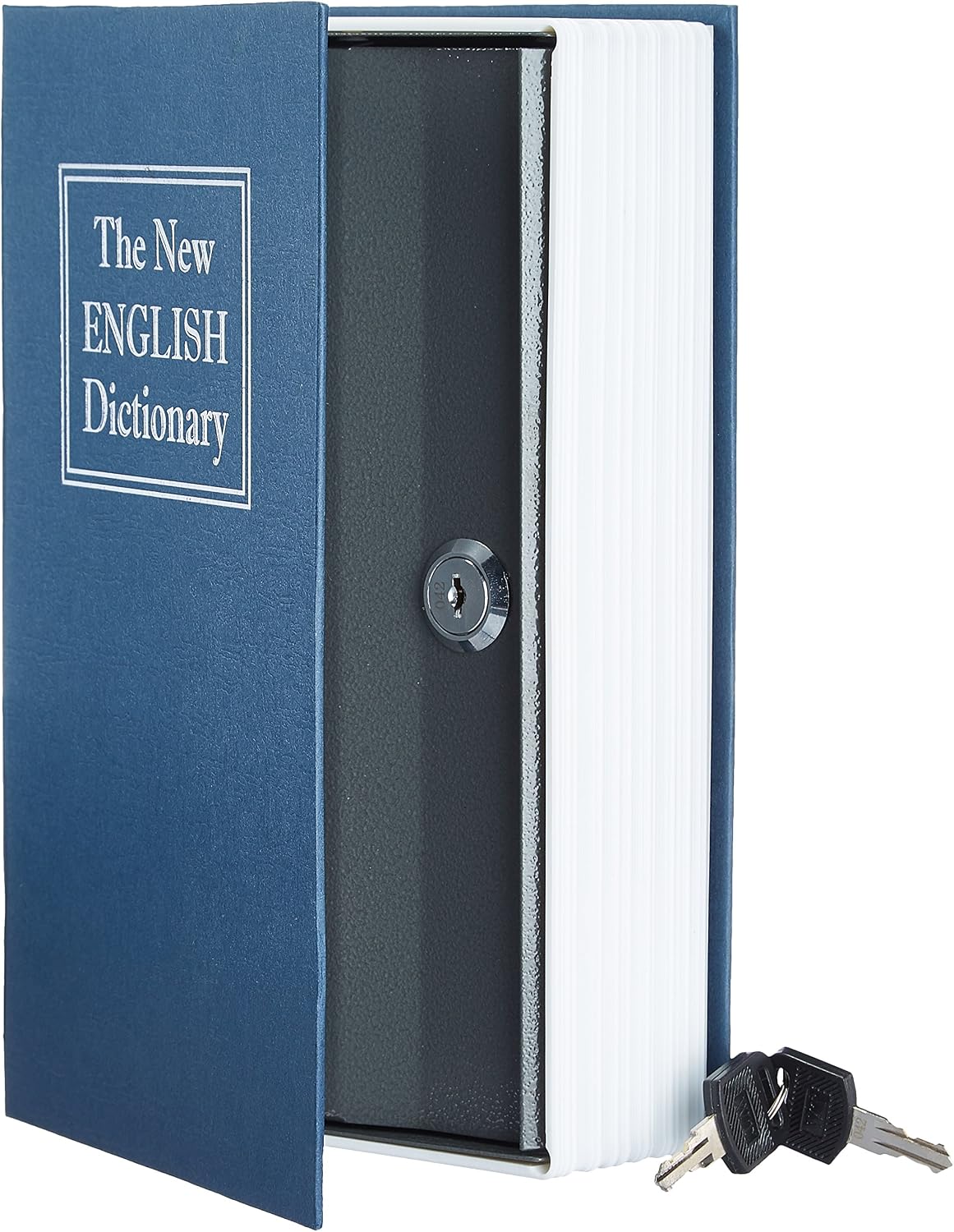
Key specs: Disguised as a hardcover book with a working key lock; portable, no mounting or tools required; roomy interior storage tray; blue cover finish; the most-reviewed diversion safe in this search and a current Amazon’s Choice pick
This is the default starting point for most readers. It disguises as an ordinary hardcover book, opens with a physical key rather than a code you have to remember, and needs no mounting or tools — set it on a shelf among other books and it is done. It is also, by a wide margin, the most-reviewed diversion safe we found in this search, which at minimum means a large number of buyers received a product that matched the listing.
✅ Pros
- Blends in on almost any bookshelf without looking staged
- Physical key lock, no code to remember or forget
- Zero installation — works the moment it’s out of the box
- The largest review base of any pick in this guide, for whatever that reassurance is worth on a decoy product
❌ Cons
- A small brass key is easy to misplace, and losing it means prying the case open
- If it’s the only hardcover on an otherwise all-paperback shelf, it stands out rather than blending in — match it to your actual shelf, not the other way around
- Paper-and-resin shell, not metal — fine against a glance, not against someone who picks it up and squeezes it
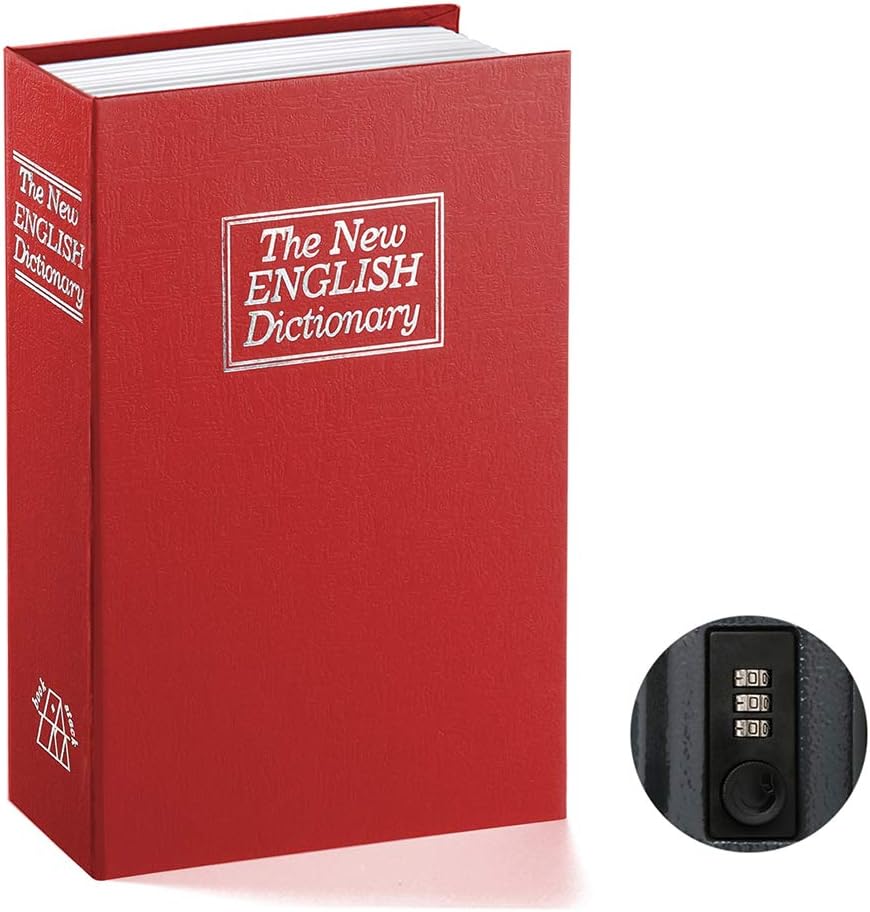
Key specs: Book safe styled as a dictionary, opened with a 3-digit combination instead of a key; metal-shell construction, noticeably heavier than the paper and resin book safes it sits next to on a shelf; portable, no mounting required
Same core idea as the pick above — a book that opens to reveal a storage cavity — with one deliberate difference: a 3-digit combination instead of a physical key. That solves the specific failure mode of losing a tiny brass key, at the cost of a lock that is not meaningfully more secure than the key version; a 3-digit combination has only 1,000 possible settings, and this is still a decoy whose real job is not being noticed, not resisting a patient attempt to open it. The metal shell also gives it more heft than the resin book safe above, which some buyers use as a rough proxy for build quality.
✅ Pros
- No key to lose, misplace, or have a curious kid find
- Metal-shell construction feels noticeably sturdier in hand than a resin book safe
- Same no-installation, shelf-ready setup as any book safe
- Second-largest review base among the four picks here
❌ Cons
- A 3-digit combination is a low bar if someone actually sits down to try it
- Still just a book on a shelf — the same “does it match your other books” caveat applies
- Slightly heavier than a paperback, which a very attentive search could notice
Barbasol Diversion Safe Stash Can — best for a bathroom or garage shelf
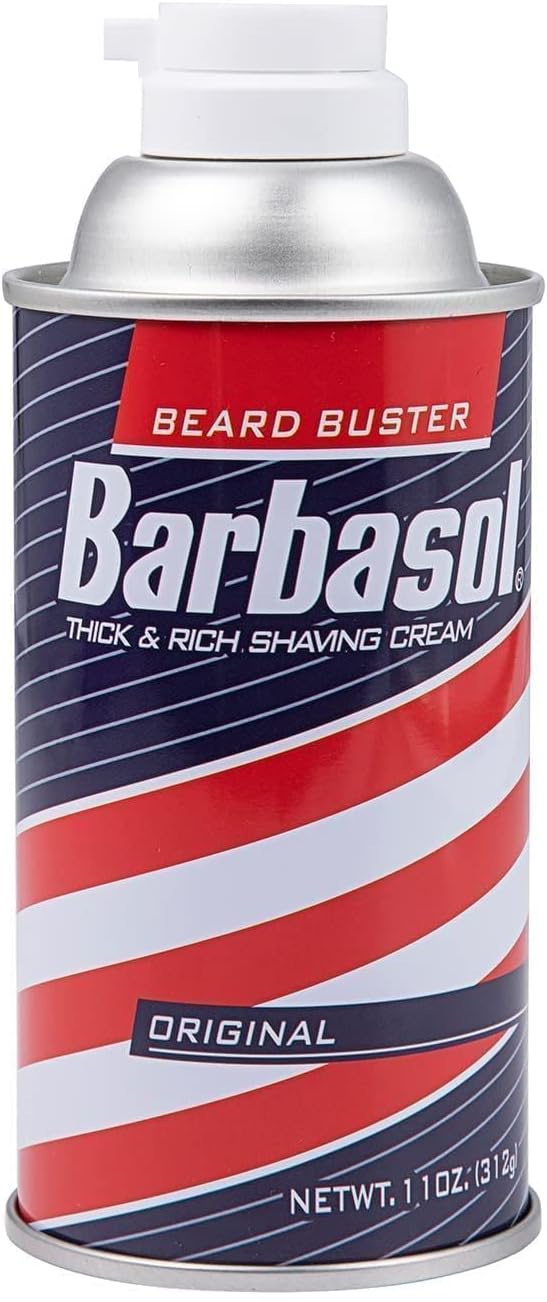
Key specs: Disguised as a genuine Barbasol shaving cream can, correct weight and printing included; the hidden compartment unscrews from the bottom; ships with a food-grade smell-proof storage bag; a current Amazon’s Choice pick
Book safes solve the living-room and bedroom shelf. This solves the bathroom cabinet or garage shelf, where a row of books would look completely out of place but a can of shaving cream does not. It is styled as a real, recognizable product — correct label, correct weighting — and the hidden compartment unscrews from the base rather than the top, so a glance at the cap gives nothing away. It ships with a food-grade smell-proof bag, which is a genuinely useful inclusion if what you are storing benefits from being sealed rather than loose inside a metal shell.
✅ Pros
- Fits a room where a fake book would look obviously out of place
- Correct weight and label design, not an obvious plastic replica
- Includes a smell-proof storage bag most competitors don’t bother with
- Currently an Amazon’s Choice pick for this search
❌ Cons
- The bottom-unscrew can safe is a well-known enough archetype that it shows up on almost every “best diversion safes” list — a burglar who has seen one of those lists once may recognize the format
- Interior capacity is small — cash and small jewelry only, nothing bulky
- Only works if there are other real cans and bottles around it — one lone can on an empty shelf defeats the whole point
Elder Welder Electrical Outlet Hidden Wall Safe — best fixed hiding spot
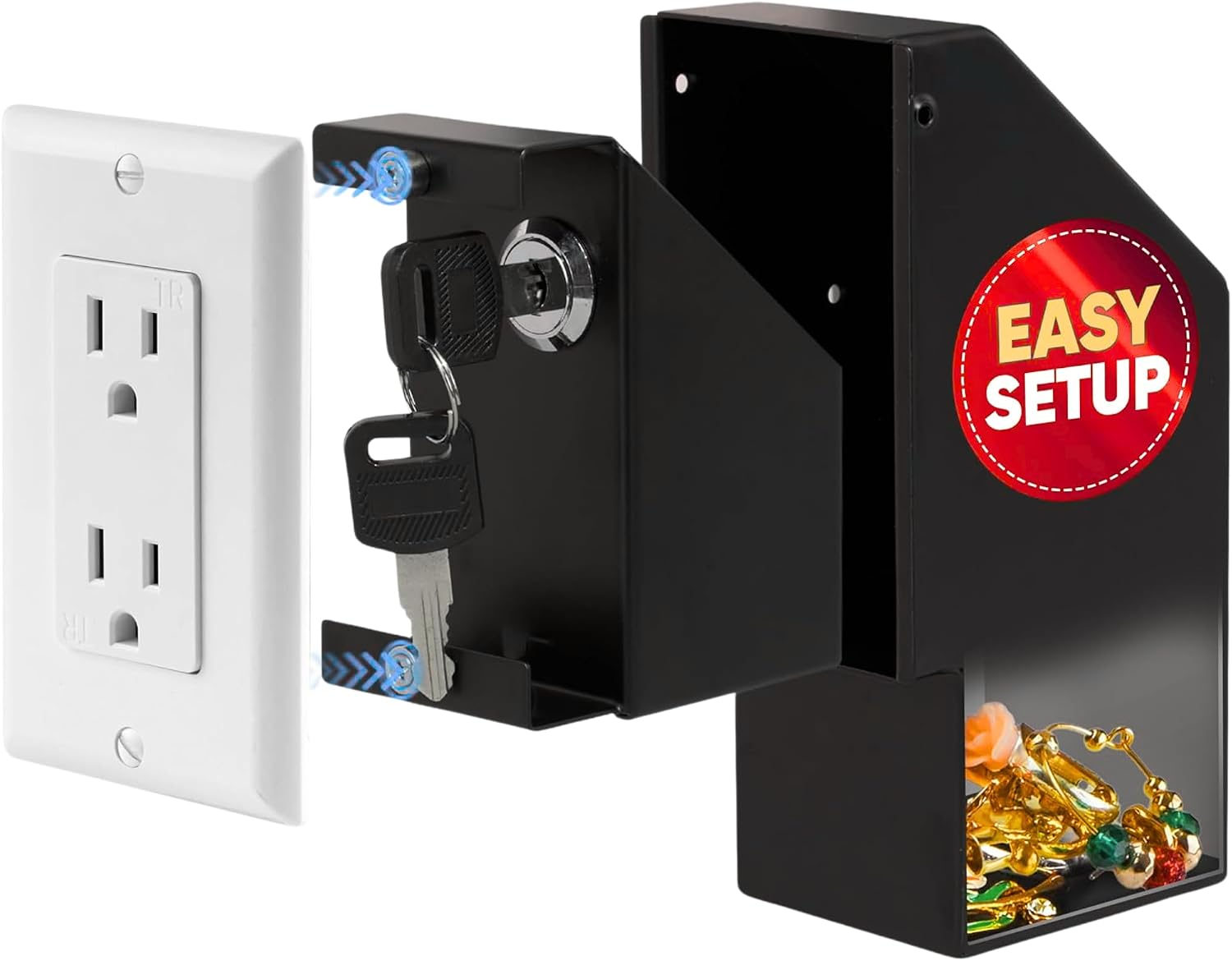
Key specs: Mounts between wall studs behind a genuine electrical outlet cover plate; fixed in place rather than portable; screw-in installation; the smallest review base of the four picks in this guide
Every pick above is portable, which is exactly the point for most people — and exactly the limitation for anyone who wants a hiding spot that is not sitting loose on a shelf where it could be knocked over, packed in a moving box by mistake, or simply picked up along with everything else nearby. This one mounts between wall studs behind a real electrical outlet cover plate, so it reads as part of the wall rather than as an object at all. That is a materially different hiding strategy than a disguised container, and it is the right choice specifically when “looks like an object” is a weaker disguise than “isn’t a separate object in the first place.”
✅ Pros
- Reads as part of the wall, not as a container someone could pick up or carry off
- A genuine electrical outlet cover plate rather than a printed decal
- The only pick here immune to “grabbed along with everything else on the shelf”
- A meaningfully different disguise strategy than every other pick in this guide, worth combining with one of them rather than choosing only one
❌ Cons
- Needs a stud-accessible section of wall and takes real installation time, unlike a book or can you simply set down
- Not portable — a renter who moves loses the hiding spot along with the apartment; see our renter security decision guide if that’s your situation
- The smallest review base of the four picks in this guide, so treat the fit and finish claims with a bit more caution than the better-reviewed book and can picks
The Four Picks, Side by Side
One more way to see the actual differences before you pick: what each one disguises as, how it locks, and whether it moves with you or stays put.
| Amazon Basics Portable Diversion Book Safe | Jssmst Home Dictionary Diversion Metal Safe Lock Box | Barbasol Diversion Safe Stash Can | Elder Welder Electrical Outlet Hidden Wall Safe |
|---|
| Disguised as | A hardcover book | A dictionary | A shaving cream can | An electrical outlet |
| Lock type | Physical key | 3-digit combination | Screw-open base | Fixed cover plate |
| Portable or fixed | Portable | Portable | Portable | Fixed, wall-mounted |
| Best room fit | Living room, office, bedroom shelf | Living room, office, bedroom shelf | Bathroom or garage shelf | Any room with an interior wall |
| Install effort | None | None | None | Real, stud-finding install |
| Review-base note | Largest of the four | Second-largest | Solid, mid-sized | Smallest of the four |
How to Make a Diversion Safe Actually Work
The product matters less than how you use it. Every diversion safe on this list depends entirely on not being noticed — get that part wrong and the lock inside is irrelevant.
Four Rules That Determine Whether It Actually Works
1
Blend it in
Set a book safe among real books, a can safe among real toiletries. One decoy alone on an otherwise empty shelf draws exactly the attention it’s supposed to avoid.
2
Split your stash
Don’t put an entire cash reserve in one container. Splitting a modest amount across two spots beats concentrating all of it behind one disguise.
3
Keep it quiet
Don’t mention it to contractors, movers, or casual guests. The entire security model depends on nobody knowing to look, including people you trust for other reasons.
4
Pair it with something that actually locks
Use this for the small and replaceable. Keep anything at real appraised value in an actual safe or somewhere off-site — see our
home safe guide.
Skipping any one of these turns a working diversion safe into an expensive decoration.
The same logic extends outward from any single hiding spot. A diversion safe reduces what a rushed burglar notices once they’re already inside your home; it does nothing to stop them from getting in, or to shorten how long they’re willing to stay. Layering in real deterrence — visible cameras, a monitored system, or simply a properly installed alarm — changes the 10-minute window this whole guide is built around, and a wireless camera system is one of the more affordable ways to do that for a home that doesn’t already have one. For the entry points themselves, a door security bar is a genuinely different, complementary layer — it slows entry rather than hiding what’s already inside.
What This Means for Your Insurance Policy
A diversion safe changes nothing about how your homeowners or renters policy treats a theft claim, and it is worth knowing that before you decide how much to rely on one instead of insuring what actually matters.
The Insurance Information Institute is direct about this: expensive items like jewelry, furs, art, collectibles, and silverware are covered under a standard policy, but there are usually dollar limits if they’re stolen — a cap that applies whether the item was sitting in a jewelry box or hidden inside a fake book. To insure something like an heirloom ring or a collection to its full value, the I.I.I.’s guidance is to purchase a special personal property endorsement or floater and insure the item for its officially appraised value, which is a completely separate step from where in the house you physically keep it.
That is the practical version of the split this whole guide has been building toward. A diversion safe is about not losing a small, replaceable thing to an opportunistic sweep. An endorsement or floater is about not being financially exposed if you lose something that isn’t replaceable. Neither one substitutes for the other, and relying on a good hiding spot in place of updating a policy is a common, avoidable gap.
Final Recommendation
Start with the Amazon Basics Portable Diversion Book Safe unless one specific thing about it doesn’t fit you. It’s the cheapest way into this category, the most-reviewed pick here, and it needs zero installation — for most readers weighing whether to bother with a diversion safe at all, this is the low-effort way to find out.
Choose differently if a specific constraint applies to you. If you’d rather not track a physical key, the Jssmst Home Dictionary Diversion Metal Safe Lock Box trades it for a combination at no real security cost. If the room you’d use is a bathroom or garage rather than a bookshelf, the Barbasol Diversion Safe Stash Can fits that space in a way a book never will. And if you specifically want a hiding spot that isn’t a loose object at all — one that can’t be knocked over, boxed up in a move, or grabbed along with everything else nearby — the Elder Welder Electrical Outlet Hidden Wall Safe is worth the extra install effort.
Whichever you pick, treat it as one layer among several, not the layer. Anything you’d actually be devastated to lose belongs in a real, appraised, insured safe — our home safe decision-tree guide walks through picking one — and anything you’re trying to keep out of a stranger’s hands in the first place is a job for locked doors, good lighting, and a working alarm, not a disguised can on a shelf.
SafeBode does not yet run an in-house product testing program. This guide is built from manufacturer specifications, official support documentation, current retail listings and verified buyer feedback rather than hands-on testing, and we say so plainly rather than implying testing we have not done.
Frequently Asked Questions
Do diversion safes actually work?
Against the situation they’re built for — a rushed, opportunistic burglar doing a quick visual sweep of a room — yes, reasonably well, because the entire point is that the container doesn’t register as a container. Against someone who has time, motive, or a tip about where you keep things, a diversion safe offers very little resistance once it’s found.
Should I use a diversion safe instead of a real safe?
No. Use one alongside a real safe, not in place of it. A diversion safe protects small, replaceable items from a casual glance; a real safe protects anything you’d actually be devastated to lose, and is the only option with a genuine lock and, in fire-rated models, real fire protection.
What’s the difference between a diversion safe and a decoy safe?
A diversion safe hides a real hidden compartment inside an object that doesn’t look like a safe at all, like a book or a can. A decoy safe is closer to the opposite idea: it looks like an actual safe, sometimes even with a working-looking door, but is set up as a sacrificial target so a thief who finds it opens an empty box instead of searching further.
Can a professional burglar find a diversion safe?
More easily than an opportunistic one. Someone specifically searching for valuables, with time and a reason to be thorough, will eventually open books and check unusual weight on a shelf. Diversion safes are built to defeat a quick pass, not a determined search.
Are diversion safes fireproof or waterproof?
No, and this applies to every pick in this guide. None of these products carry a fire or water rating. If you’re protecting a document or item you can’t afford to lose to a house fire or a burst pipe, that’s a job for a real fire-rated safe, not a diversion safe.
Where’s the worst place to put a diversion safe?
Anywhere it stands alone. A single fake book on an otherwise bare shelf, or one can sitting by itself with no other toiletries nearby, draws exactly the attention the disguise is supposed to avoid. It only works surrounded by real, similar objects.
Can I use more than one diversion safe in the same house?
Yes, and splitting a stash across two different disguise types — say, a book safe and a can safe rather than two of the same product — is a reasonable way to avoid concentrating everything behind one disguise that a searcher might recognize.
Does a diversion safe help with my homeowners or renters insurance?
Not directly. Where an item is physically kept doesn’t change a policy’s coverage limits. If you own jewelry or valuables worth more than your policy’s standard theft cap, that’s solved with a personal property endorsement or floater, not a hiding spot.
Is the wall-outlet diversion safe hard to install?
It takes real effort compared to the other picks here — you need to locate wall studs and do an actual install rather than just setting an object on a shelf. It’s not a difficult DIY project, but it is meaningfully more work than any of the portable options.
Should renters bother with a diversion safe?
The portable picks are a better fit than the wall-mounted one for most renters, since a book or can safe moves with you at the end of a lease while a wall-mounted safe does not. Our renter security guide covers the broader tradeoffs for apartments specifically.
Sources
Show sources (4)
- [1] SafeHome.org — “A Look Into the Mind of a Burglar,” safehome.org/home-safety/mind-of-burglar/
- [2] SafeWise — “How Long Do Most Burglaries Take? The Answer Changes How You Think About Security,” safewise.com/lifestyle/home-security-systems/how-long-do-burglaries-take/
- [3] SafeWise — “Thieves Offer Home Security Tips: How to Make Your Home Less Appealing to a Burglar,” safewise.com/blog/thieves-offer-home-security-tips-make-home-less-appealing-burglar/
- [4] Insurance Information Institute (Triple-I) — “What is covered by standard homeowners insurance?,” iii.org/article/what-is-covered-by-standard-homeowners-insurance


