Swann Security Cameras 2026: Which System Fits, and Where the Brand Falls Short
Affiliate Disclosure: This article contains affiliate links. If you buy through these links, we may earn a commission at no extra cost to you. Our editorial opinions are our own and are not influenced by affiliate relationships. Read our full disclosure policy →
Contents
Quick Answer
Swann is a CCTV company that later moved into smart home, not a smart-home company that added cameras, and everything good and bad about the brand follows from that. You get a recorder with a hard drive, a lot of channels and no obligatory monthly fee. You do not get the app polish, the AI detection or the ecosystem depth of the phone-first brands. Pick Swann when you want many cameras recording locally around the clock. Start with the recorder — it, not the camera, sets every ceiling you will live with.
What Swann Actually Sells, and What It Doesn’t
One fact reframes the whole brand before any model comparison: Swann sells security cameras and video doorbells, and Security.org’s brand breakdown states that it offers no sensors whatsoever. No Swann door contact, no window sensor, no keypad. That single omission decides whether Swann can be your security system or only part of it.
If you want a burglar alarm — something that knows a door opened at 3 a.m. with no camera pointed at it — Swann is not a complete answer alone. You would pair it with a separate alarm kit, meaning two apps and two sets of hardware. Our DIY home alarm system guide covers the brands that sell that layer, and our door and window sensor guide covers buying the sensors alone if you want to keep Swann for video.
What you get in exchange is what subscription-first brands are structurally reluctant to give you: recording that costs nothing to keep. Security.org reports that most Swann systems ship with a one or two terabyte drive holding hundreds of hours locally, with no mandatory monthly fee, and SafeHome.org lists free local storage among the brand’s genuine strengths. If you have ever run the five-year math in our security system cost breakdown, that is not a small thing. Swann is a surveillance brand: cameras, a recorder, a hard drive, footage you own. Nearly every complaint filed against it is a complaint that it is not also something else.
Three Ways Swann Records, and Why That Choice Outlives the Cameras
Swann’s catalog looks sprawling until you notice it is really three product families, separated by how video gets from the camera to storage. The recorder fixes your channel count, your maximum resolution and the type of cable in your walls, and changing it later usually means changing everything. Choose it first; cameras are the replaceable part.
Wired DVR is classic CCTV — one combined video-and-power cable per camera back to a recorder. It is why Swann can put eight cameras in a box at a price the wireless brands cannot approach, and the trade-off is a resolution ceiling that stays put. Security.org flags the behavior every DVR owner meets eventually: when the drive fills, the system records over the oldest footage rather than stopping, so real retention depends on drive size and camera count, not a number anyone advertises.
Wired PoE NVR puts power and data on one Ethernet cable per camera. Fewer cables, longer runs, ceiling up at 4K. This is Swann’s AdvancedX architecture and the one commercial installers reach for — the same reasoning behind the Swann system in our business camera systems guide.
Wire-free means battery or solar cameras with no cable at all. Nothing to drill or trench — and nothing recording continuously either, since these capture events rather than 24 hours a day. SafeHome.org is blunt that Swann’s wireless connections are prone to interference, the standing weakness of the category and the reason to test signal at the mounting spot first.
If This Is Your Situation, This Is Your Recorder
Every approach to an ordinary house covered, on one budget
→ Wired DVR. The most channels per dollar Swann sells, and a 1080p ceiling that does not move afterwards.
You may have to read a face or a plate, not merely notice movement
→ Wired PoE NVR. 4K and on-system analytics, bought with one Ethernet run to every camera position.
The spot you care about has no power and no network within reach
→ Wire-free. Solar and onboard storage, and event clips instead of a continuous timeline.
You already own a working Swann recorder with a spare channel
→ No new system at all. An add-on camera matched to that recorder’s resolution.
Whichever row fits, settle the channel count before you buy anything. Channel count is a hard limit of the recorder rather than a setting, so a ninth camera on an eight-channel system means a second recorder.
One placement note matters more here than on most brands, precisely because you are mounting six or eight cameras rather than one or two: an eight-camera kit hung badly still misses the front door approach. Our room-by-room placement walkthrough sets the priority order before you drill. Our guide to where camera footage should live sets those architectures against the failures you actually care about.
The Four Swann Systems Compared
These are not four grades of the same product. Each is the answer to a question the other three answer badly, which is the useful way to read the table.
| 8-Channel 1080p DVR | AdvancedX 4K PoE NVR | MaxRanger4K Solar | Add-On Bullet |
|---|
| Cabling | One combined cable per camera | One Ethernet cable per camera | None — solar and battery | One combined cable per camera |
| Resolution | 1080p Full HD | 4K | 4K | 1080p Full HD |
| Cameras in the box | Eight | Eight | Two | One, no recorder |
| Recording style | 24/7 continuous to 1TB drive | 24/7 continuous to 1TB drive | Event clips to 64GB onboard | Inherits whatever the recorder does |
| Smart detection | Heat and motion | AI person and vehicle analytics | Person and vehicle alerts | True Detect heat and motion |
| Best for | Covering every angle of an average house | Reading faces, plates and detail | Barns, gates, land with no power | Filling one gap in a system you own |
| Main compromise | 1080p is behind the category in 2026 | Cable run to every camera | No continuous recording | Must match your existing recorder |
Swann 8-Channel 1080p Wired DVR System (8 Cameras) — most cameras for the money
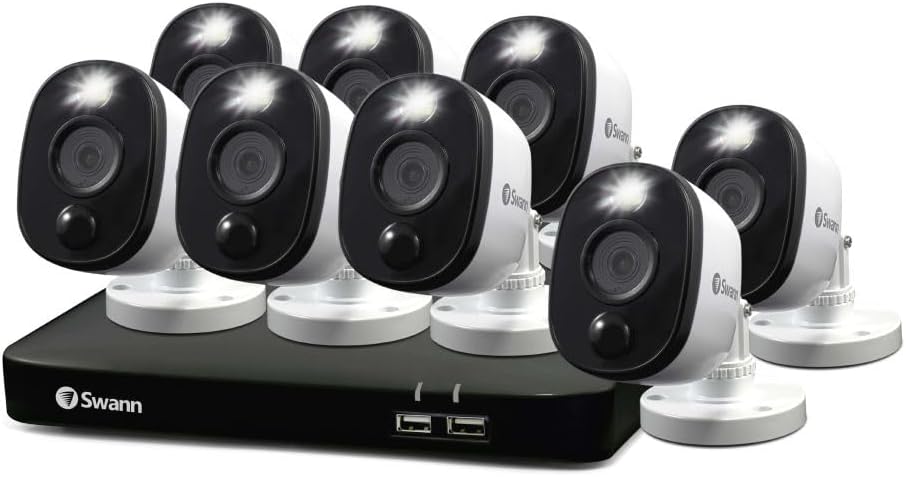
Key specs: Wired DVR for home or business; 1080p Full HD; 8 channels with 8 indoor/outdoor cameras supplied; 1TB hard drive; color night vision; sensor spotlights; 24/7 continuous recording
This is the Swann proposition in its purest form, and the current Amazon’s Choice pick for the brand’s search term. Eight cameras, eight channels, a one-terabyte drive, continuous recording, no plan to buy. Nothing in the wireless world puts eight angles on a house for anything close, and that is the whole argument for it. The sensor spotlights matter more than the spec sheet suggests: color night footage of a face is evidence, monochrome infrared footage of a shape usually is not. The honest problem is the resolution. 1080p was the industry standard when Security.org tested Swann and called the picture genuinely clear, and it still identifies a person you already know — but it will not reliably read a license plate across a driveway. Buy this for eight angles, not for detail in any one of them.
✅ Pros
- Eight cameras and eight channels in one box — coverage no wireless kit matches for the money
- 24/7 continuous recording to an included 1TB drive, no subscription
- Sensor spotlights give color night footage rather than infrared monochrome
- Wired power and video: no batteries to maintain, no wifi dependency to record
❌ Cons
- 1080p is behind the category in 2026 — fine for presence, weak for identification
- Eight cable runs is a real weekend of work, or an electrician invoice
- Retention shrinks as camera count rises; the drive overwrites oldest footage when full
- Thin review base compared with the mainstream camera brands
Swann AdvancedX 4K PoE NVR System (8 Channels, 8 Cameras) — the picture-quality pick

Key specs: Wired NVR; 4K resolution; 8 channels with 8 Power over Ethernet outdoor cameras; 1TB hard drive; color night vision; smart AI video analytics and alerts; motion detection; 24/7 recording
AdvancedX is where Swann stops competing on price and starts competing on output. One Ethernet cable per camera carries power and video together, the recorder is a true NVR, and the ceiling moves to 4K with AI person and vehicle analytics running on the system rather than as a subscription feature. The practical difference from the DVR kit is not prettier footage — it is that you can crop into a 4K frame and still have a usable image, which is the whole game when you hand something to a police officer. The cost is installation discipline, and this is the pick that most often justifies paying someone.
✅ Pros
- 4K, so cropping into a frame still yields a usable image
- PoE carries power and data on one cable — cleaner runs, longer distances
- On-system AI person and vehicle analytics, not a subscription-gated feature
- Same local-first, no-mandatory-fee model as the rest of the wired range
❌ Cons
- Every camera needs an Ethernet run — the hardest install of these four
- Costs substantially more than the 1080p kit for the same camera count
- 4K across eight channels eats drive space far faster than 1080p
- Small review base; a recent line, not a long-proven one
Swann MaxRanger4K Solar Wireless 2-Camera Kit — for property you cannot cable

Key specs: Wire-free outdoor cameras; 4K; manufacturer-rated range up to 2,000 ft; built-in solar charging; 4K color night vision; person and vehicle alerts; 64GB local storage; no subscription required for local recording
This is the most genuinely interesting product Swann makes, and the reason is the radio. Swann’s own MaxRanger4K specifications state the cameras reach the hub over “900MHz Ultra Long Range Wi-Fi HaLow” rather than ordinary 2.4 GHz wifi. HaLow is the Wi-Fi Alliance’s sub-gigahertz standard, which extends Wi-Fi into the 900 MHz band with roughly twice the range of conventional Wi-Fi and materially better penetration through walls and other obstacles — which is how a camera reaches a hub from a distance where a normal wireless camera struggles past the far corner of a yard. Add solar and 64GB of onboard storage and you have a camera for a gate, a barn or a back fence with no power and no network near it. Read the range figure carefully, though, because Swann publishes two of them: up to 2,000 ft in open air, and a typical 650 ft in ordinary use. The headline number assumes clear line of sight, and the second one is what trees, hills and buildings do to it. A wire-free camera also records events rather than continuously, so it is no substitute for a recorder if you want an unbroken timeline. If solar is the deciding factor rather than Swann specifically, our solar security camera roundup compares it against that whole category.
✅ Pros
- Runs on 900 MHz Wi-Fi HaLow, a band that genuinely reaches where ordinary wireless cameras cannot
- Built-in solar means no ladder trips to swap or recharge batteries
- 64GB onboard storage records without a subscription
- The fastest Swann system to install — no cable, no drilling into masonry
❌ Cons
- Event-based recording only; no continuous timeline like the wired kits
- Swann’s own typical-use range figure is roughly a third of the 2,000 ft headline
- Two cameras, not eight — points of interest, not a whole perimeter
- SafeHome.org flags Swann’s wireless links as interference-prone generally
Swann Add-On 1080p Bullet Camera with Sensor Spotlight — for a system you already own

Key specs: Add-on wired bullet camera for an existing Swann DVR; 1080p Full HD; indoor or outdoor housing; sensor spotlight; dusk-to-dawn color night vision; True Detect heat and motion detection; no recorder included
Most Swann guides skip add-on cameras, which is a mistake: the commonest real Swann problem is not choosing a system, it is finding that the system you bought three years ago covers seven angles and you need an eighth. This is a bare 1080p bullet with a sensor spotlight and True Detect heat-and-motion sensing, no recorder included, and the cheapest fix. Read this part carefully, because it is where people waste money. Swann’s own guidance is to read an add-on camera’s title and description closely: the title says it is an add-on and names the systems it connects to. That is not boilerplate — Swann’s 4K add-on cameras carry an explicit listing note that they work only with 4K or higher recorders, so hanging one on the 1080p DVR above gets you nothing. Match the camera to the recorder you own, not the resolution you wish you had.
✅ Pros
- The cheapest way to close a coverage gap without replacing a working system
- Sensor spotlight and color night vision, matching the current wired range
- True Detect heat sensing cuts the wind-and-shadow false alerts of pixel-change detection
- The highest-rated Swann item in this catalog search, on a substantial review base
❌ Cons
- 1080p only — it matches a 1080p recorder, it does not upgrade one
- Compatibility is entirely the buyer’s job; Swann’s advice is to read the listing
- No recorder, no drive, no software — it does nothing on its own
- You still need a free channel and a cable run to the new position
Where Swann Falls Short
A brand guide that only lists strengths is a brochure. Here is the case against Swann, from what independent reviewers found.
The app is the weak link, and it has been for years. Security.org reported serious live-streaming problems and called the app buggy. SafeHome.org, testing a newer generation, described the layout as simple and barebones in a way that reflects the cameras’ limited features. Neither verdict is catastrophic, and neither is anything like the polish of a smart-home-native brand — compare the app consensus in our Nest versus Ring comparison. If you spend most of your camera time in an app rather than at a recorder, this is the single strongest argument against the brand.
Alert triage is genuinely poor. SafeHome.org found Swann’s motion alerts arrive with no visual indicator of what triggered them, so you watch a two-to-three-minute clip in full to learn whether it was a person or a cat. The same review notes the brand lacks the advanced AI detection competitors now ship as standard. On one camera that is an annoyance. On eight it is the difference between a system you check and a system you ignore.
Ecosystem support is thinner. Security.org’s testing found Swann working with Google Assistant but not with Alexa. Integrations shift and models change, so check the listing for the exact system you are buying rather than treating that as permanent — but Swann has never made voice and smart-home tie-ins a headline feature the way the phone-first brands do.
If those three complaints are the ones that would actually bother you, the answer is not a different Swann model — it is a different brand. Our wireless camera system guide and eufy camera guide both cover local-storage systems built by companies whose center of gravity is software.
What a Swann Subscription Actually Changes
“No monthly fees” is Swann’s loudest marketing claim and it is broadly true — recording to a local drive costs nothing, forever. But the free tier is thinner than the slogan implies once wifi cameras are involved. On Swann’s own Secure+ page, the free plan gives most models a single day of rolling cloud storage, and the Evo range gets no cloud backup at all without a membership. Paid tiers extend cloud clip history substantially, and — this is the part that catches people — the “notify me when” alerts for packages, vehicles and pets sit behind a paid plan, as does an extended warranty while the membership is active. The upper tiers add professional monitoring with dispatch, and a video-verification tier above that.
So the accurate version is: local recording is genuinely free and unlimited by time, which is the reason to buy a wired Swann system. Cloud backup, smarter notifications and anything resembling monitoring are subscription products — a distinction that bites hardest on the wire-free cameras, where storage is a small card, not a terabyte drive.
One thing worth saying plainly, if a monitoring tier is what tempts you: professional monitoring on a camera-only system is not the same product as monitoring on an alarm system, and a center watching video has different dispatch consequences than one receiving a sensor trip — as our piece on verified response sets out.
Final Recommendation
Settle the recording architecture, and the model follows from it. For most people arriving at Swann for the reason people do — a lot of cameras, recording all the time, nothing owed monthly — that architecture is a wired DVR, and the Swann 8-Channel 1080p Wired DVR System (8 Cameras) is the version of it to buy. Eight angles and a terabyte of continuous recording is a different category of coverage from the two or three cameras most households settle for.
Move to a PoE NVR the moment identification, rather than awareness, is the job — a long driveway, a business frontage, a plate you may one day have to read. That is the Swann AdvancedX 4K PoE NVR System (8 Channels, 8 Cameras), and it means budgeting for an Ethernet run to every camera, because more 1080p cameras never add up to one 4K one. Go wire-free only where neither wired architecture can physically go: the Swann MaxRanger4K Solar Wireless 2-Camera Kit covers a gate or a barn with no power and no network on a 900 MHz radio built for that distance, and the price of admission is event clips rather than a continuous timeline. And if you already own a working Swann recorder, you are not choosing an architecture at all — buy the Swann Add-On 1080p Bullet Camera with Sensor Spotlight matched to that recorder’s resolution and spend nothing else.
One recommendation against the brand, because it is the honest one: if you will meet these cameras mostly through a phone, and you want tidy person-versus-animal alerts you can triage from a lock screen, Swann is the wrong purchase and no model in the range fixes it. Buy a system whose software was the product. Swann’s product is the hardware and the hard drive, and it is very good at being that.
Frequently Asked Questions
Do Swann cameras require a monthly subscription?
No. Wired Swann systems record continuously to an included hard drive with no plan at all, and that is the main reason to buy the brand. A paid membership adds cloud clip backup, smarter package and vehicle notifications, an extended warranty while active and, on the upper tiers, professional monitoring — but basic recording never depends on it.
Can I mix Swann cameras and recorders from different years?
Sometimes, and it is on you to check. An add-on camera’s title and description state which systems it connects to. The trap is resolution: a 4K add-on will not work on a 1080p recorder, and the listing usually says so in small print rather than the headline.
Is Swann better than Reolink or eufy?
Different, rather than better. Swann’s advantage is cameras per dollar on wired kits and an unusually long-range wire-free line. Its disadvantage is software — app experience, alert quality and AI detection are where reviewers place it behind the phone-first brands.
How long will a Swann DVR keep footage?
It depends on drive size, camera count, resolution and how busy the scene is, which is why no honest fixed number exists. What is predictable is what happens when the drive fills: it overwrites the oldest recordings rather than stopping, so you always have a rolling window.
Does a Swann system still record if my internet goes down?
A wired DVR or NVR system does — cameras, recorder and drive are one closed loop that never touches the internet to record. You lose remote viewing until the connection returns, but footage is still captured. Wire-free cameras writing to onboard storage also keep capturing; anything relying on cloud backup does not.
Can Swann replace a burglar alarm?
Not on its own. Swann sells cameras and video doorbells and no sensors, so it cannot know a door opened unless a camera happens to be watching it. Households wanting both run Swann for video alongside a separate alarm kit for detection, and live with two apps.
What is Wi-Fi HaLow, and why does Swann use it?
It is the Wi-Fi Alliance’s sub-gigahertz standard, operating in the 900 MHz band rather than the usual 2.4 and 5 GHz. Lower frequencies travel further and pass through walls and obstacles better, at roughly twice the range of conventional Wi-Fi. That is what lets Swann’s MaxRanger4K cameras reach a gate or a barn from a hub inside the house, where an ordinary wireless camera would drop out.
Can I add a ninth camera to an eight-channel Swann recorder?
No. Channel count is a hard limit of the recorder, not a setting, so an eight-channel system stops at eight cameras and a ninth means buying a new recorder. This is why the sensible move is to count every position you will ever want covered and then buy more channels than that number, even if you install fewer cameras on day one.
Does Swann work with Alexa and Google Assistant?
Independent testing has found Swann working with Google Assistant but not with Alexa, which is a real gap against the phone-first brands. Integrations shift and vary by model, so check the listing for the exact system you are buying rather than assuming — but voice and smart-home tie-ins have never been where this brand competes.
Is a DVR or an NVR the better choice?
An NVR if you need detail, a DVR if you need coverage. NVR systems use one Ethernet cable per camera for both power and data and reach 4K, which is what you want for reading faces or plates. DVR systems use a combined video-and-power cable, cap out lower, and put far more cameras on a house for the same outlay. Neither is better in the abstract.
Sources
Show sources (7)
- [1] Security.org — “Swann Camera Review,” security.org/security-cameras/swann/review/
- [2] SafeHome.org — “Swann Home Security Camera Review,” safehome.org/home-security-cameras/swann/reviews/
- [3] Swann — “Secure+ Memberships,” us.swann.com/secure-plans/
- [4] Security.org — “Swann Security Camera Pricing and Costs,” security.org/security-cameras/swann/
- [5] Wi-Fi Alliance — “Wi-Fi Alliance introduces low power, long range Wi-Fi HaLow,” wi-fi.org/news-events/newsroom/wi-fi-alliance-introduces-low-power-long-range-wi-fi-halow
- [6] Swann — “Add-On Wired DVR Security Camera Systems,” us.swann.com/products/wired-home-security-systems/add-on-cameras-dvr/
- [7] Swann — “Meet Max: MaxRanger4K,” product and wireless specifications, us.swann.com/meet-max/
SafeBode does not yet run an in-house product testing program. This guide is built from manufacturer specifications, official support documentation, current retail listings and verified buyer feedback rather than hands-on testing, and we say so plainly rather than implying testing we have not done.


