Best Package Delivery Boxes 2026: Parcel Drop Boxes Couriers Will Use
Affiliate Disclosure: This article contains affiliate links. If you buy through these links, we may earn a commission at no extra cost to you. Our editorial opinions are our own and are not influenced by affiliate relationships. Read our full disclosure policy →
Contents
Quick Answer
A parcel drop box is not a safe, and treating it like one is how people buy the wrong thing. It works only if the driver notices it, understands it is for them, and uses it — so the sign, the placement and the bolts matter more than the lock. Portland Police Bureau’s guidance says as much: it recommends a locking parcel box that can be bolted down or secured. For most porches the Step2 Express Parcel Delivery Box is the sane starting point — purpose-built, ships assembled, the deepest buyer history here — provided you accept its lift-off lid and no lock. Want a lock and a ready-made sign? The LHBGO 48-gallon box. Want alerts and outgoing returns? The hyve Smart box. Narrow porch? The YITAHOME 31-gallon box.
The Uncomfortable Thing About Parcel Drop Boxes
Almost every parcel box review is organized around locks — which one has a keypad, which takes a padlock, which lid resists prying. That framing assumes the failure mode is a thief defeating a lock. It usually is not.
The two real failure modes are duller. The first is that the package never goes in the box: a driver walks past an unmarked black container on a dim porch and leaves the parcel on the mat exactly as before. The second is that the box itself leaves — several popular options weigh under ten lb empty and have handles molded into the sides. So the decision is really three stacked: how much capacity you need, how much porch you can surrender, and whether the thing will genuinely get used. Locks matter, but they are the third variable, not the first.
What a Drop Box Fixes — and What It Does Not
✅ Genuinely solved by a good box
- The opportunistic grab: a parcel in plain view from the street
- Weather — a lid keeps rain and snow off cardboard that would otherwise pulp
- The signal a stacked pile of boxes sends that nobody has been home
- Consolidating several deliveries into one collection trip
❌ Still your problem afterwards
- A thief with a car, if the box is not anchored to the porch or the ground
- A driver given no placement instruction, which both police guides call a real step [3, 4]
- Anything larger than the box — that parcel sits beside it
- Proving what happened later, which is a camera’s job
What the Package Theft Numbers Actually Say
Two credible trackers publish annual package theft research, and the honest starting point is that they disagree. Security.org’s 2025 report estimates 37 million packages stolen in a year, worth more than eight billion dollars, averaging around 222 dollars each. SafeWise’s 2025 report puts it at 104.3 million packages, roughly 250,000 a day, with a typical value nearer 143 dollars. That is a threefold gap between two reputable estimates of the same thing, so treat any single figure as an indication of scale rather than a count. What both agree on matters more: this is a high-volume, low-value, opportunistic crime concentrated on doorsteps.
The Numbers Worth Carrying Into a Buying Decision
3x
how much likelier apartment and condo residents are to lose a package than people in single-family homes
31%
of Americans had a package stolen in the past twelve months — down year over year for the first time
65
shipments the average U.S. adult receives in a year, which is what a box has to keep up with
<1 in 4
package theft victims who reported it to local law enforcement
Sources: Security.org’s 2025 package theft report and SafeWise’s 2025 package theft report.
Two of those should change what you buy. Sixty-five shipments a year is more than one a week, and holiday quarters run at roughly double that — a box sized for one parcel is full by Tuesday. And apartment residents are the most exposed group while being least able to bolt a plastic box to a shared walkway. If that is you, our apartment security decision guide and our no-drill renter guide will help more than anything here. One last figure: SafeWise found Amazon parcels are the largest share of stolen packages at 32 percent, ahead of UPS at 20 percent, USPS at 18 percent and FedEx at 17 percent. Whichever carrier brings most of your deliveries is the one whose instructions are worth setting up properly.
Most “Delivery Boxes” Are Resin Deck Boxes
Search Amazon for a package delivery box and much of what comes back is an outdoor resin deck box — the same product sold for pool towels and patio cushions — relisted with parcel photography and parcel keywords. That is not fraud; a lidded weatherproof container genuinely does hold parcels. But it is a different design brief, and Amazon’s own catalog data shows it: two of the four picks below carry a listed item type of “deck box” and rank in Amazon’s Deck Boxes chart, not its Package Drop Boxes and Lockers chart.
The consequences are consistent. No lock in the carton — deck boxes ship with a hasp and leave you to supply a padlock. No anchoring hardware, because a deck box is meant to be moved around a patio, so it has handles instead of floor-mount holes. Light empty weight: one pick below is about 8.8 lb. And no one-way design — purpose-built lockers use a chute or baffle so a hand cannot reach back in, while a hinged deck lid opens the whole box at once.
A deck box is a legitimate choice here provided you buy it knowing what it is, add your own lock and anchor it. Where a pick below is a deck box, we say so in that pick’s own section.
Capacity Versus Footprint
Sizing is where the regret lives, and it runs both ways. Too small and the box is full after two deliveries, so the third goes on the mat. Too large and it swallows the porch or sits somewhere the driver never passes.
The upper bound is published: a USPS package cannot exceed 70 lb, nor 130 inches in total length plus girth, with Priority Mail capped at 108 inches. Almost nothing you order arrives near those limits, but they mark a ceiling no box covers — anything genuinely bulky sits beside it whatever you buy.
So measure the porch first: find the largest footprint you can give up without blocking a door swing or walkway, then take the greatest internal volume that fits it. Height is nearly free on a porch; floor area is not. That is why a tall narrow box beats a wide low one at equal capacity, and it is the biggest difference between the four picks here.
| Step2 Express | LHBGO 48-Gallon | hyve Smart | YITAHOME 31-Gallon |
|---|
| Listed capacity | 37.6 gallons | 48 gallons | Brand states it fits 80 percent of packages | 31 gallons |
| Footprint (L x W) | 23 x 18 in. | 24.37 x 17.8 in. | 20 x 20 in. | 22.05 x 22.87 in. |
| Height | 31 in. | 43.7 in. | 32 in. | 17.13 in. |
| Lid | Lift-off | Hinged flip-top | Hinged, digital lock | Hinged flip-top |
| Lock | None | Hasp, padlock not included | Digital lock included | Padlock point, lock not included |
| Delivery sign included | No | Yes | No, app alerts instead | No |
| Anchoring hardware included | No | No | Tether and door clip | No |
| Assembly | None, ships ready | Tool-free | Assembled | Tool-free |
| Sold as | Package delivery box | Deck box, sold for parcels | Package drop box and locker | Deck box, sold for parcels |
The pattern is clear: the tallest box holds the most in the least floor area, and the only unit arriving with anything to bolt it down is also the only one with a lock included.
Step2 Express Parcel Delivery Box — the default porch answer
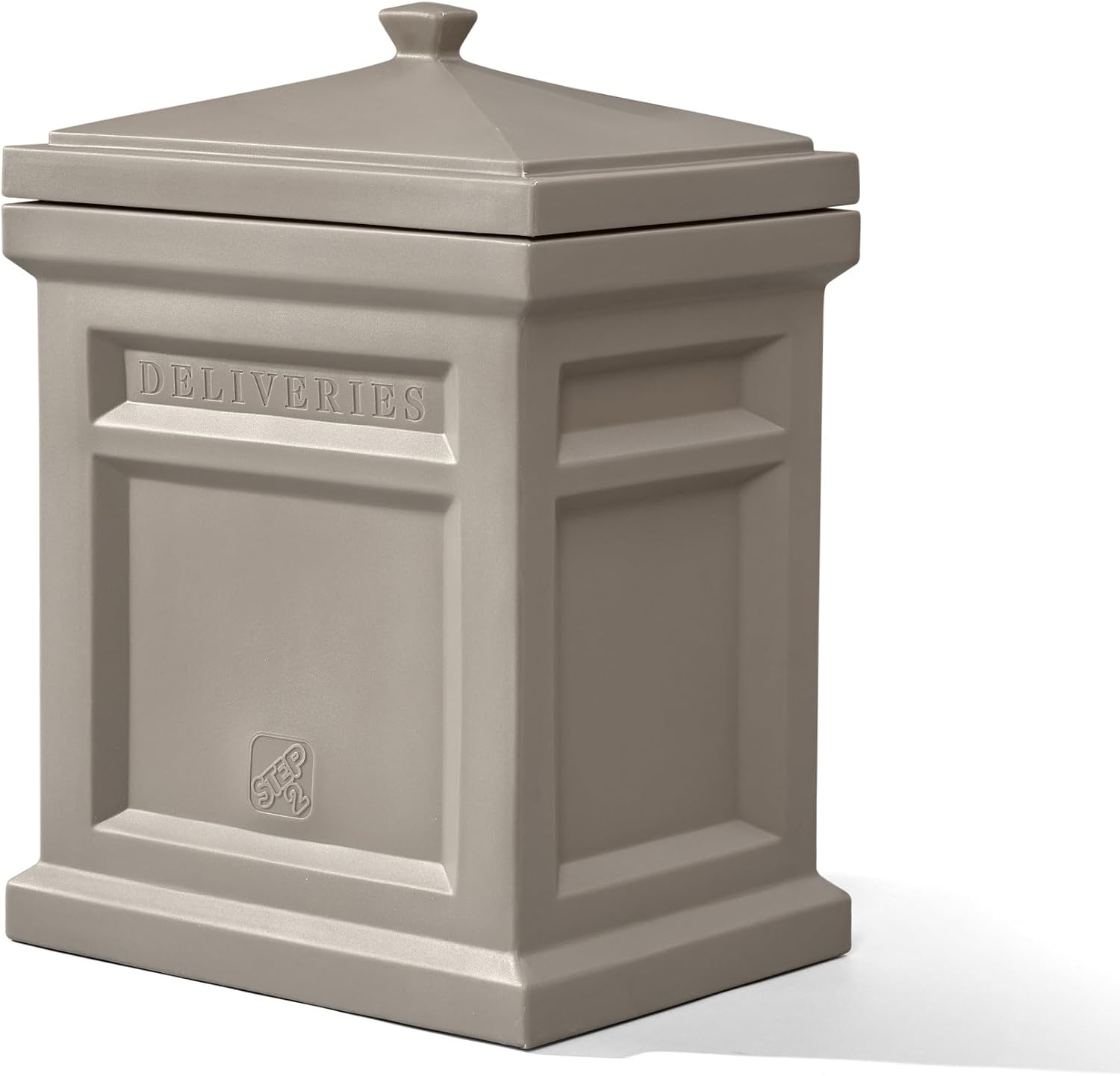
Key specs: 37.6-gallon weather-resistant resin parcel bin; 23 in. long by 18 in. wide by 31 in. high; lift-off lid; ships assembled; no lock and no locking hasp
This is where we would start most readers, for unglamorous reasons. It is a purpose-built parcel bin rather than a repurposed deck box, it arrives assembled, and it has by a wide margin the longest buyer history in a category otherwise full of three-month-old listings from unfamiliar brands. At 23 by 18 inches the footprint is modest, and 37.6 gallons absorbs a normal week at the national average of 65 shipments a year. What we will not smooth over: it has no lock and no hasp. The lid lifts off. This is a designated, weatherproof drop spot, not a security container. If your concern is a thief who stops and opens things rather than one who grabs what is visible, this is the wrong pick.
✅ Pros
- Purpose-built for parcels, not a deck box in parcel photography
- Ships fully assembled — no tools, no panels, no missing hardware
- The most established buyer track record in the category
- Manufacturer lists a 3-year limited warranty, unusual here
❌ Cons
- No lock and no hasp — a lift-off lid opens the whole box
- No anchoring hardware, so bolting or tethering it is on you
- Resin: weather-resistant, not pry-resistant or cut-resistant
- Mocha finish, which will not suit every porch
LHBGO 48-Gallon Package Delivery Box With Sign — the one that ships with signage
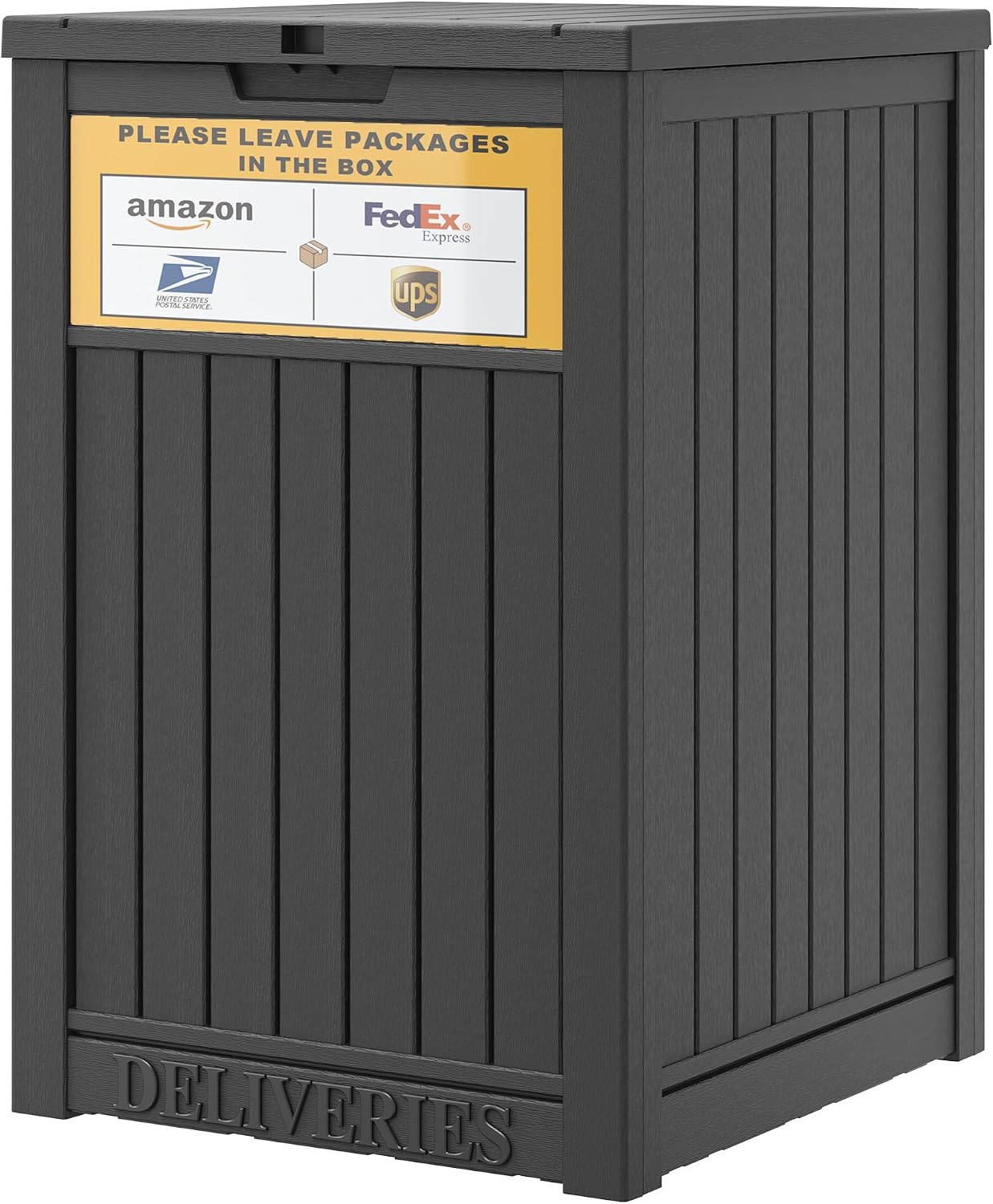
Key specs: 48-gallon double-wall resin box; 24.37 in. long by 17.8 in. wide by 43.7 in. high; hinged flip-top with a lockable hasp (padlock not included); printed delivery sign included; tool-free assembly; listed as waterproof
The reason this one is here rather than any of the near-identical 48-gallon resin boxes on the same search page is the printed delivery sign in the carton. That sounds trivial; it is the most load-bearing accessory in this article, because a box the driver does not identify gets ignored, and both police guides we checked put driver communication at the center of their advice [3, 4]. It is also the tallest pick at 43.7 inches, which is how 48 gallons fits a footprint barely larger than the Step2’s, and the hinged lid takes a padlock. Be clear-eyed, though: Amazon lists this as a deck box, and the padlock is not included.
✅ Pros
- Ships with a printed delivery sign — the part most people forget to buy
- Largest listed capacity here, in a footprint close to the Step2’s
- Real hasp, so a padlock is an option rather than a modification
- Double-wall resin, listed as waterproof, tool-free assembly
❌ Cons
- A deck box by Amazon’s own item type and category ranking
- Padlock not included — pick a shrouded shackle
- 43.7 inches is tall; check window sight lines and storm-door swing
- No anchoring points, so a tether or bolt kit is a separate job
- Manufacturer describes assembly as hard to reverse if a panel goes in wrong
hyve Smart Package Delivery Box — returns and notifications
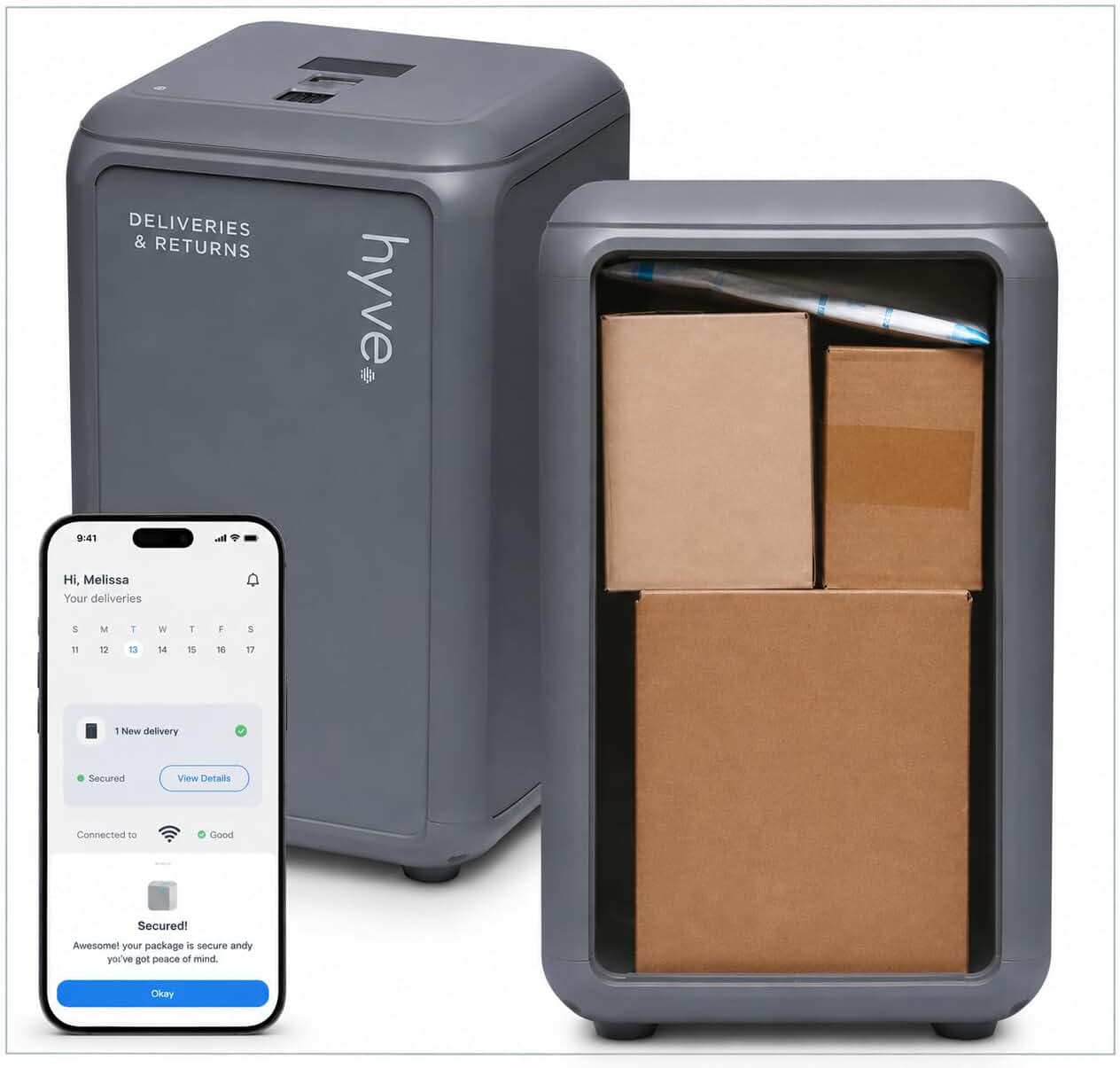
Key specs: 20 in. deep by 20 in. wide by 32 in. high; roughly 40 lb; digital lock; wifi and Bluetooth delivery and pickup alerts; battery power with a solar panel; ships with an anchoring security tether and a door clip
This is the only pick that behaves like connected hardware rather than a lidded container: a digital lock instead of a padlock hasp, wifi and Bluetooth alerts when a delivery lands, battery power with a solar panel so it needs no outlet, and a returns workflow built around leaving an outgoing parcel for a scheduled pickup. Critically for this article’s argument, it is the only unit of the four that ships with anything to stop it being carried away — an anchoring tether and door clip are listed among its components — and at roughly 40 lb it is the heaviest here. The honest caveat is its review base: a recent listing with a review count in the low double digits, against hundreds or thousands of ratings on each of the other three.
✅ Pros
- Digital lock included — no padlock to buy, lose or leave open
- Delivery and return-pickup alerts over wifi and Bluetooth
- Anchoring tether and door clip in the carton, the only pick that includes them
- Battery plus solar, so no outlet is needed on the porch
- Handles outgoing returns, which none of the passive boxes do
❌ Cons
- Very thin review base next to every other pick — a real unknown
- The 80-percent-of-packages figure is a manufacturer claim we cannot verify
- Connected hardware means firmware, batteries and an app to keep working
- Solar charging depends on how much light your porch actually gets
YITAHOME 31-Gallon Resin Deck Box — the low-profile option
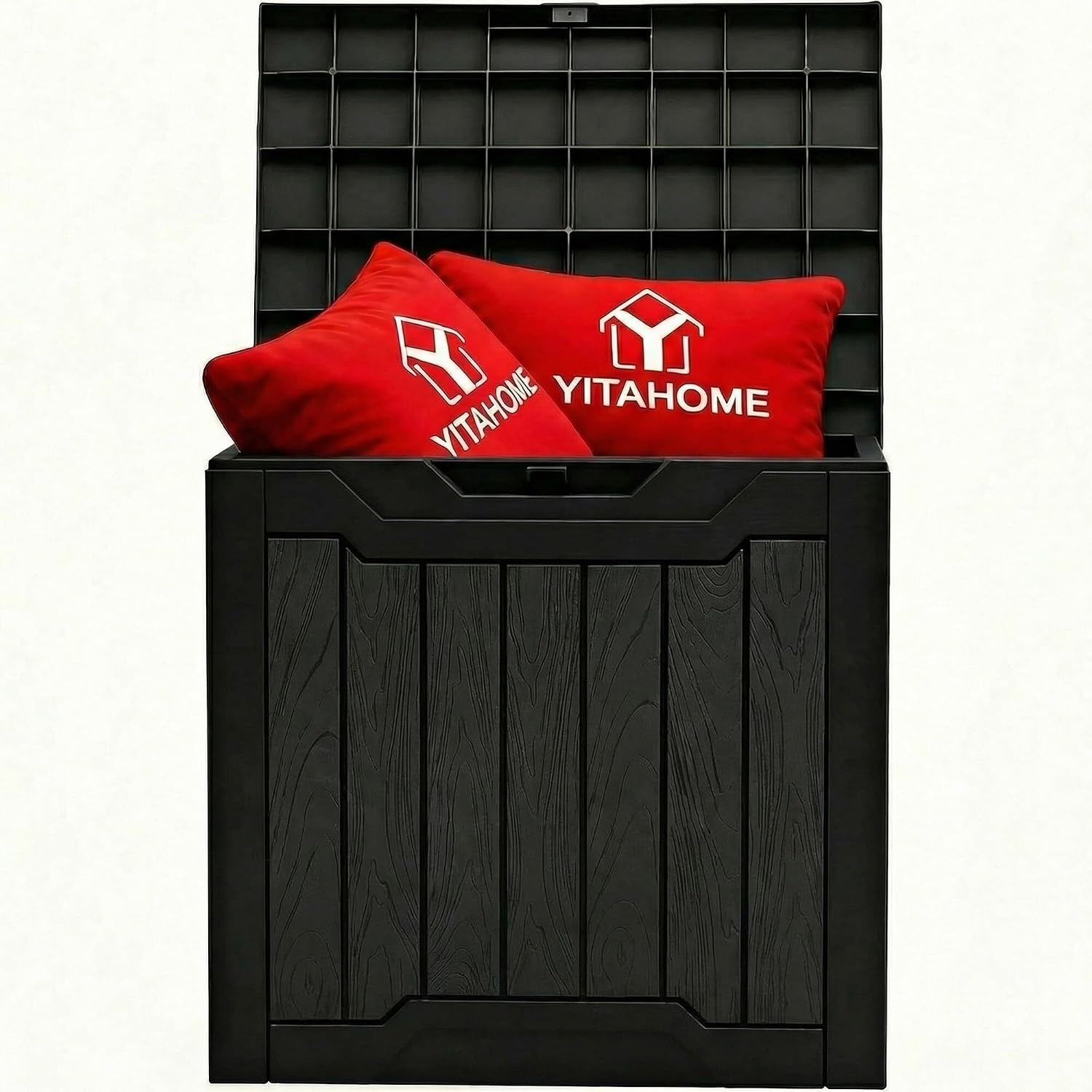
Key specs: 31-gallon polypropylene resin box; 22.05 in. long by 22.87 in. wide by 17.13 in. high; roughly 8.8 lb empty; hinged flip-top with a padlock point; molded side handles; listed as waterproof and UV-resistant
Every other pick here is a tower. This one is 17 inches high, which makes it the answer for a porch where a tall box would block a window or foul a storm door. Twenty-two inches square and 31 gallons still holds several ordinary parcels, it takes a padlock at the lid, and it doubles convincingly as a bench between deliveries. Two honest flags. It is explicitly a deck box: Amazon lists the item type as deck box, and the manufacturer’s own copy leads with pool accessories and beach towels. And at roughly 8.8 lb with molded side handles it is the easiest unit here to pick up and walk off with, which makes anchoring non-optional here rather than a nice-to-have.
✅ Pros
- Only 17.13 inches high — fits under a window ledge or beside a step
- Genuinely dual-purpose as a bench between deliveries
- Takes a combination lock or padlock at the lid
- Waterproof and UV-resistant, with a large existing buyer history
❌ Cons
- A deck box by Amazon’s own item type and category ranking
- Roughly 8.8 lb with carry handles — trivially portable unless anchored
- Smallest capacity here; a busy holiday week will overflow it
- Wide, low footprint costs more porch floor per gallon
Getting the Courier to Actually Use It
You can buy the best box here and still get parcels left on the mat, because nothing about a closed container tells a driver on a tight route what it is for. This is the hour of work that turns the purchase into a result.
The Setup Order That Actually Matters
1
Set carrier instructions first
USPS lets you provide Delivery Instructions online and authorize your carrier to leave a package in a specified location when it will not fit your mailbox. Asheville Police Department points to the private-carrier equivalents, UPS My Choice and FedEx Delivery Manager, which let you tell drivers to leave a parcel at a back door or in a coded lockbox.
2
Put a sign on the box itself
App instructions do not reach a substitute driver on an unfamiliar route. A printed sign facing the way drivers approach covers that case, and both police guides treat placement instructions as a distinct prevention step [3, 4].
3
Place it on the natural path
The box must sit where someone walking to your door passes it, not tucked round a corner for tidiness. Portland also advises a spot that conceals the parcel from passers-by.
4
Then keep it empty
A full box is functionally a missing box. Emptying it the day deliveries land is what decides whether any of this works.
Carrier instructions and a physical sign are not alternatives. Use both.
On signage: a weatherproof decal reading Please leave packages in box costs less than anything else in this guide and does more work than the lock. The self-adhesive vinyl delivery signs sold as an 11-by-7-inch two-pack are the simple version if your box did not come with one. Mount it at chest height on the face a driver sees first, not on the lid.
One tension is worth naming. Portland’s guidance is to conceal the parcel from people walking or driving past — but a box invisible from the street is often one the driver does not notice either. The resolution most porches allow: screened from the sidewalk by a railing, a planter or the porch angle, while sitting in the approach path with a sign.
Anchoring: The Step Almost Everyone Skips
Portland Police Bureau does not recommend a locking parcel delivery box. It recommends one that can be bolted down or secured. That qualifier is the whole ballgame, and it is what listings are quietest about. The picks above run from about 8.8 lb empty with handles on both sides to around 40 lb. Neither number describes an object that resists being lifted into a trunk, and a thief who takes the box gets everything in it plus whatever lands before you notice.
Four approaches work, in rough order of strength. Lag bolts through the floor into a wood deck, or masonry anchors into a concrete stoop, hold best; most resin boxes take a drilled base hole without cracking if you pilot it and spread the load with fender washers. A ground anchor driven into soil beside the box and cabled to it works where you cannot drill. A cable to a fixed object — a porch post, a railing upright — is the renter-friendly version; a hardened cable and shrouded padlock make it a two-tool job rather than a one-hand grab. Ballast, a couple of concrete pavers in the base, is weakest and needs no hardware, but it turns a one-handed lift into a conspicuous struggle in view of the street.
If you rent, check the lease before drilling. The cable and ballast routes leave no marks — the same logic behind the picks in our renter-friendly security guide. Anchoring also pairs badly with a box you plan to move seasonally, so decide before you drill.
Pairing a Box With a Camera
A box prevents; a camera documents. They are not substitutes, and the honest case for the camera is narrower than the marketing suggests. Security.org found fewer than one in four package theft victims reported the crime to law enforcement, and recovery is rare. Footage earns its keep proving to a retailer that a parcel marked delivered was taken, and on the deterrent value of a visible lens over the drop point.
Aim it at the box and its approach rather than the whole yard — the logic we work through in our room-by-room camera placement walkthrough. A video doorbell already covers the doormat on most houses and is the cheapest way to watch a box in its field of view; a battery-powered camera makes more sense when the box sits away from the door, and a solar camera suits a box at the end of a driveway with no power nearby. A motion-triggered fixture over the drop point does double duty, making footage usable and the approach less appealing; our outdoor motion sensor light guide covers the options.
Two things people discover late. Retention: a Thursday discovery of a Monday theft is provable only if the clip still exists, a question of how long your camera keeps footage rather than sensor quality. And the law: a camera on your own porch is uncontroversial, but framing that captures a box near the property line can pull in a sidewalk or a neighbor’s door, worth reading up on before you mount — see our guide to what a home camera can legally record.
Who Should Skip a Delivery Box Entirely
Apartment and condo residents without private outdoor space. This group is more than three times likelier to lose a package and has the least room for a box that needs a footprint and an anchor point. Asheville Police Department points to locker delivery as an alternative to an unsecured doorstep, and both guides list shipping to a work address or a neighbor who is home as the simplest fix of all [3, 4].
Anyone with a garage they can have deliveries put in. An in-garage arrangement beats any box for capacity, weather protection and security, at the cost of granting access — at which point the garage becomes a security boundary rather than a storage room. Our piece on the garage as a home’s weakest entry point is the relevant reading.
Households already running in-home delivery. If you have a smart lock and are comfortable issuing a one-time code, the parcel goes inside and no outdoor container is involved — a bigger trust decision than a plastic box, but it removes the problem rather than relocating it. And anyone receiving a couple of parcels a month: below roughly a delivery a week, a box spends most of its life as porch furniture, and signature-required delivery, which both police guides recommend [3, 4], covers the occasional valuable item better.
Final Recommendation
Start with the Step2 Express Parcel Delivery Box. It is the only pick built for parcels from the ground up rather than adapted from patio storage, it arrives assembled, and it has a far longer buyer history than anything else here. Buy it understanding what it is: a large, weatherproof, clearly-designated drop spot with no lock, which solves the opportunistic snatch and the rain and does not pretend to solve anything else.
Three things should push you off it. If you want a lock and a sign in one purchase, buy the LHBGO 48-Gallon Package Delivery Box With Sign, add a shrouded padlock, and accept that you are buying a well-specified deck box. If alerts and outgoing returns matter more than a proven track record, the hyve Smart Package Delivery Box is the only pick that does either and the only one with anchoring hardware in the carton — but weigh that thin review base honestly. And if a tall box would block a window or a storm door, the YITAHOME 31-Gallon Resin Deck Box is the low-profile answer, provided you anchor it, because it is light enough to carry.
Whichever you choose, spend the first hour on the three things that decide whether it works at all: set your carrier delivery instructions [4, 5], put a sign on the face the driver approaches, and fasten the box to something. A locked box nobody was told to use, sitting loose on a porch, is an expensive storage bin.
SafeBode does not yet run an in-house product testing program. This guide is built from manufacturer specifications, official support documentation, current retail listings and verified buyer feedback rather than hands-on testing, and we say so plainly rather than implying testing we have not done.
Frequently Asked Questions
Will a delivery driver actually put my package in the box?
Often, but only if the driver can tell it is meant for deliveries and nothing in their handheld says otherwise. Set the carrier-side instruction and add a sign. Regular drivers learn a route fast; the sign is for the substitute who has never seen your porch.
Do I really need a lock on a package delivery box?
Less than the category implies. A lock stops someone who stops and opens things. It does nothing about the commoner failure — a parcel that never went in the box — and nothing at all if the box itself can be carried away.
Can a thief just carry the whole box away?
Yes, and it is the failure mode people underestimate. Several popular options weigh under ten lb empty and have handles molded into the sides. Bolting the base down, cabling it to a porch post, or dropping concrete pavers inside all raise the effort substantially.
What size delivery box should I buy?
Measure the porch first: the largest footprint you can give up without blocking a door swing or walkway, then the greatest internal volume that fits it. Height is nearly free and floor area is not. Size for two or three parcels at once, not one.
Are resin delivery boxes waterproof enough for rain and snow?
For keeping cardboard dry, generally yes — these are the materials used for outdoor patio storage, with overlapping lids. They are not airtight or insulated, so condensation can form on humid days, and none is a good place to leave groceries or medication.
Can I use a parcel drop box for outgoing returns?
Only if the box and the carrier both support it. A passive lidded box cannot tell you a pickup happened, and most carriers will not collect from an unattended container without an arrangement. If returns are routine, that is a real reason to pay for a connected box.
Does a package delivery box work in an apartment?
Usually not well. Apartment residents are the most exposed group in the theft research, but they have the least private outdoor space and rarely have permission to anchor anything to a shared walkway. Lockers, a package room or a pickup point fit better.
Is a delivery box or a camera the better first purchase?
The box, if you can only do one. A box changes the outcome; a camera changes what you know about it. Footage helps prove to a retailer that a parcel marked delivered was taken, but very few package thefts end in a recovery. Prevent first, document second.
Sources
Show sources (6)
