Commercial Fire Alarm Systems for Small Business: What the Code Requires
Affiliate Disclosure: This article contains affiliate links. If you buy through these links, we may earn a commission at no extra cost to you. Our editorial opinions are our own and are not influenced by affiliate relationships. Read our full disclosure policy →
Contents
Quick Answer
A commercial fire alarm system — interconnected detection, notification appliances, and monitoring wired to dispatch — is not something you install yourself, no matter how good a panel looks on a retail listing. Whether your business needs a full system at all is decided by your local building and fire code based on your building’s size, occupancy and floor count, and only your local fire marshal or building department can tell you exactly where that line sits for your address. If you do need one, it has to be designed and installed by a licensed fire alarm contractor and signed off by your Authority Having Jurisdiction (AHJ). What you can legitimately buy and manage yourself, underneath that threshold, is standalone commercial-grade smoke and CO detection, correctly placed and maintained fire extinguishers, and compliant exit signage.
The Two Questions Every Small Business Owner Actually Has
Searches for “commercial fire alarm” mostly come from one of two very different starting points, and they need different answers. The first is “do I need one at all?” — a question only your local code and your local AHJ can settle, because it depends on your building’s square footage, occupant load and number of stories, not on what kind of business you run. The second is “can I buy and install this myself, the way I’d install a residential smoke alarm?” — and for anything that qualifies as a fire alarm system under your local code, the honest answer is no.
This article is built around that second answer, because it is the one most buying guides avoid saying plainly. We are not going to point you at a panel on Amazon and call it a commercial fire alarm system, because doing so would set you up to fail an inspection, void your insurance, or both. What we can do is explain what the code generally requires so you walk into that first call with a contractor sounding like you did your homework, and show you exactly what is left over that you genuinely can buy and manage yourself.
What a Commercial Fire Alarm System Actually Requires
Strip away the brand names and a commercial fire alarm system is three linked layers, not one box: detection (smoke, heat or duct detectors wired into a central panel), notification (horns, strobes and speakers that alert everyone in the building at once, not just whoever is near the device that triggered), and monitoring (a connection that gets the fire department dispatched even if the building is empty overnight). A permitting bulletin from the City of San Diego’s own development services department describes exactly this shape of project: plan submittals have to include monitoring station information, notification-circuit voltage-drop calculations, battery backup calculations, and point-to-point wiring for every piece of alarm equipment and fire safety function in the building.
That same bulletin is a useful reality check on scale. Even a small tenant improvement — as few as four initiating devices (detectors, pull stations) and ten notification appliances (horns, strobes) — still requires a fire alarm contractor to file a formal affidavit with the city. There is no threshold at which this becomes something you wire up over a weekend.
Why AHJs Enforce This Strictly
108,500
estimated US nonresidential building fires per year, 2017–2019 average
90
estimated annual deaths in those fires
1,125
estimated annual injuries in those fires
58%
of nonconfined nonresidential fires that spread beyond the room where they started
U.S. Fire Administration, three-year annual average, nonresidential structures.
How This Differs From a Residential Smoke Alarm Setup
If you have installed hardwired, interconnected smoke alarms in a house — the kind covered in our smoke alarm placement and interconnection guide — a commercial system will look familiar in one respect and unfamiliar in every other one. The familiar part is interconnection: one triggered device sounds every device on the circuit, which is the same underlying idea in both settings. Almost everything else is different in scale and in who is legally allowed to touch it.
| Residential smoke alarm setup | Commercial fire alarm system |
|---|
| Who can install it | The homeowner, in most jurisdictions | A licensed fire alarm contractor, with a project designer of record |
| What triggers the requirement | Building/dwelling code at construction or renovation | Building size, occupant load and stories, set by local fire/building code |
| Notification | Audible alarm inside the dwelling unit | Horns, strobes and often voice evacuation across the whole building |
| Monitoring | Optional, consumer-grade (a Wi-Fi hub or a security company) | Typically required, tied to a supervising or central station that dispatches the fire department |
| Who signs off on it | No formal inspection in most cases | The local Authority Having Jurisdiction (AHJ), after plan review and a final test |
| Who is licensed to service it | Nobody — you can swap the unit yourself | A registered fire alarm company with a state-licensed technician on staff |
That last row is worth sitting with. Texas, for example, requires a company to hold a Fire Alarm Certificate of Registration from the State Fire Marshal’s Office, with at least one full-time employee holding a Fire Alarm Planning Superintendent, Fire Alarm Technician or Residential Fire Alarm Superintendent license before that company can legally install, service or monitor a commercial system. Every state runs its own version of this licensing structure, and it exists for the same reason building permits exist generally: the person signing off on your fire alarm is accountable if it fails.
When You’re Legally Required to Have a Full System
There is no single square-footage number that applies everywhere, and any article that hands you one specific figure is guessing on your behalf. What determines the requirement is a combination set by your state or local fire code — typically adopted from a national model code — and it generally weighs building size, number of stories, and how many people can occupy the space at once. A single-story retail space with a handful of employees can land in a completely different bucket than the same square footage stacked three stories high with public access on every floor.
The only way to get a real answer for your specific address is to ask the people who enforce it. Two calls settle this faster than any amount of searching: your local fire marshal’s office (or the fire prevention bureau, depending on how your jurisdiction is organized), and your local building or planning department, since a fire alarm requirement is frequently triggered or re-triggered by a change of occupancy, a renovation, or a change of tenant even in a building that never needed one before. If you are opening in a leased space, ask this before you sign, not after — retrofitting a system into a space you did not know needed one is a materially more expensive project than designing it in from the start.
Why This Isn’t a DIY Purchase, Even If You Wanted It to Be
Three separate things stand between a small business owner and a self-installed commercial fire alarm system, and any one of them alone would already rule it out.
What Stops a DIY Commercial Fire Alarm Install
🚫 The legal barrier
- Most states require a licensed, registered fire alarm company to design, install and service a commercial system — not just a certified individual working alone
- Plans typically need a designer of record: an architect, fire protection engineer, or a licensed fire alarm contractor
- The system has to be inspected and formally accepted by your local AHJ before it can legally operate
🔧 The technical barrier
- Notification circuits need voltage-drop and battery-backup calculations sized to the specific building, not a generic panel setting
- Monitoring has to be wired to an actual supervising or central station, not a consumer app
- A single miswired zone can mean the whole system fails its acceptance test — there is no partial credit on a fire inspection
The third barrier is simpler than the first two: insurance. A commercial property or business owner’s policy typically expects code-compliant, professionally installed and monitored fire protection where the code requires it. A self-installed system that was never inspected or accepted by your AHJ is not something most insurers will treat as meeting that expectation, which is a real financial exposure layered on top of the life-safety one. None of this is a reason to avoid the topic — it is the reason this guide focuses on getting you to the right call, not the wrong purchase.
Finding and Vetting a Licensed Fire Alarm Contractor
Once you know a full system is required, the practical next step is finding a contractor who is actually licensed to do this work in your state, not just a general electrician or a security-camera installer who says they can add it on. A few concrete questions do most of the vetting work:
What to Ask Before You Hire a Fire Alarm Contractor
1
Ask for the license number
A registered fire alarm company should hand you a state registration or certificate number without hesitation — this is public information in most states.
2
Ask who the designer of record is
Depending on your project’s scope, this may need to be an architect or engineer, not just the installer.
3
Ask how monitoring is handled
Confirm the system reports to a real supervising or central station, and ask what happens if that connection drops.
4
Ask about the permit and inspection process
A contractor who has done this before will already know your local AHJ’s submittal requirements and can walk you through the timeline.
Getting these four answers in writing before work starts is the single best protection against a system that fails its final inspection.
If you already have a business security camera system, it is worth mentioning it to any fire alarm contractor you’re evaluating — some jurisdictions allow certain integrations between building systems, and a contractor who also understands your existing setup, like the systems covered in our business security camera guide, can flag conflicts (shared conduit, panel space, network drops) before they become a change order.
What You Can Legitimately Buy and Self-Manage
None of the above means a small business owner is powerless until a contractor shows up. Underneath the threshold that triggers a full interconnected system, there is a real, legitimate category of fire safety equipment you can buy today, install yourself, and maintain on an ongoing basis: standalone commercial-grade smoke and CO detection for a single small space, correctly placed and maintained fire extinguishers, and compliant exit signage. We cover all three below, honestly, including the one detector line that turned out to be discontinued mid-research.
First Alert SMICO100-AC Hardwired Smoke and CO Alarm — for spaces below the panel threshold
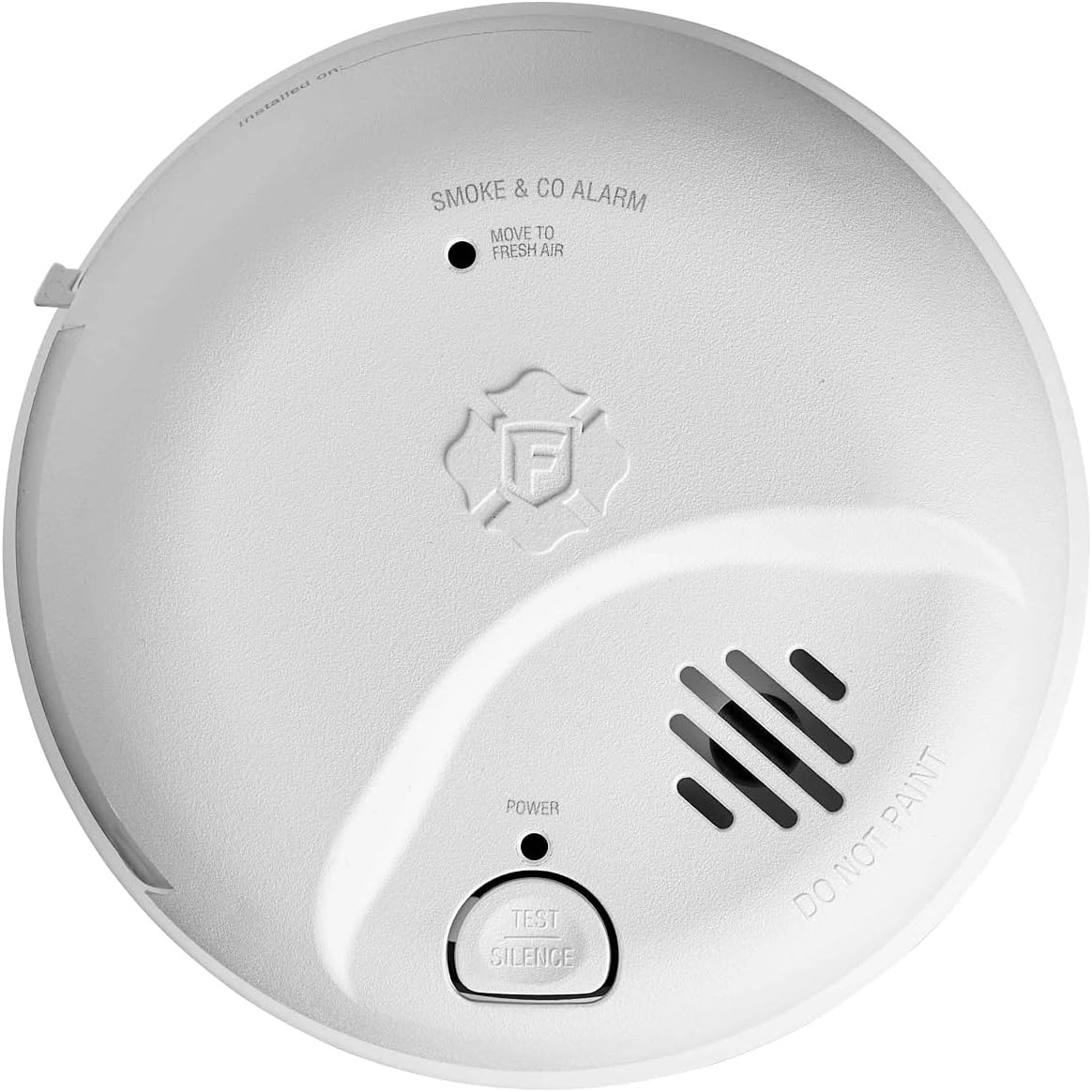
Key specs: Hardwired 120V combination smoke and carbon monoxide alarm with 9V battery backup; ionization sensor; interconnects with other compatible First Alert / BRK hardwired alarms so one triggered unit sounds every connected unit; tamper-resistant locking mounting bracket; test/silence button; white finish; this is First Alert’s current replacement for the discontinued SC9120B line
This is a standalone, hardwired 120V smoke and carbon monoxide alarm — the kind that suits a single small office, a break room, or a small retail floor that does not trigger a full interconnected fire alarm system requirement under your local code. It is First Alert’s current model in this product line; the previous version, the SC9120B, is now listed as discontinued directly on First Alert’s own site, with this unit named as the replacement. Worth being upfront about: this specific listing carries a considerably thinner review count than most picks on this site, so treat it as a solid current option rather than a long-track-record one. It interconnects with other compatible First Alert and BRK hardwired units, which matters if you have more than one small room to cover. It is not a substitute for a required commercial system — see the threshold section above if you are not sure which category your space falls into. (For a home instead of a business, our smart smoke detector guide and carbon monoxide detector guide cover the residential side of this same decision.)
✅ Pros
- Hardwired with battery backup, so it keeps working through a short power outage
- Interconnects with other compatible First Alert/BRK units for multi-room coverage
- Tamper-resistant locking bracket discourages an employee from pulling the battery
- A straightforward, legitimate purchase for a space that doesn’t require a full panel
❌ Cons
- Thin review base relative to most picks on this site — a newer listing, not an established one
- Replaces a now-discontinued First Alert model, so specify this exact model when ordering
- Not a substitute for a required interconnected system with notification and monitoring
- Interconnection here means other alarms in the same small space, not a building-wide notification network
Kidde Pro 460 Commercial Fire Extinguisher — the higher-capacity pick
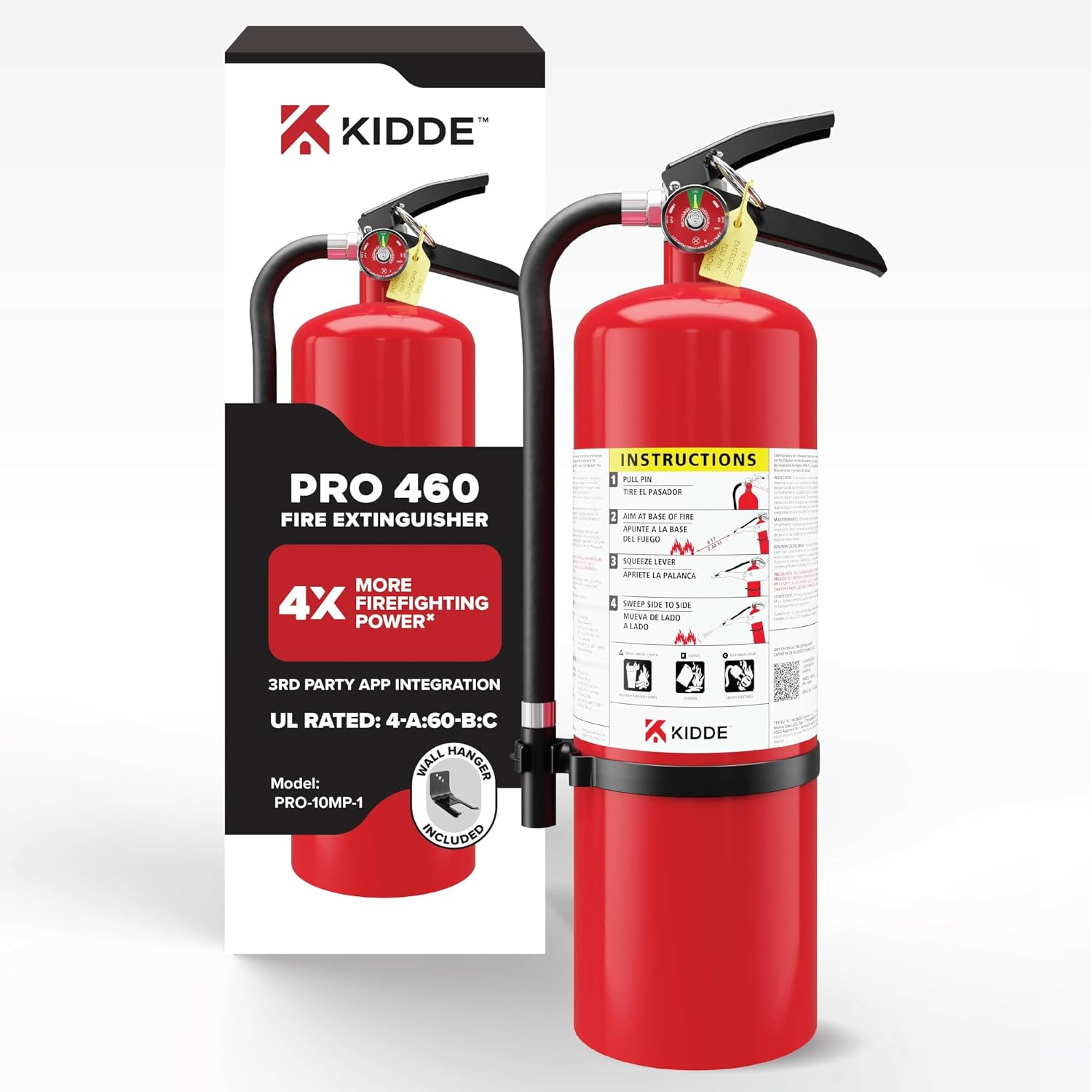
Key specs: Rechargeable stored-pressure dry chemical fire extinguisher; 10 lb.; UL rated 4-A:60-B:C; monoammonium phosphate dry chemical agent effective on wood/paper/textile, flammable-liquid and electrical fires; metal valve and pressure gauge; wall-mount bracket and location sign included; Kidde markets this specific line as commercial-grade, separate from its residential extinguisher range
Kidde markets the Pro 460 specifically as a commercial-grade extinguisher, separate from its residential range, and rates it 4-A:60-B:C — roughly four times the firefighting rating of a typical small home extinguisher, per Kidde’s own product description. That higher rating matters for a retail floor, a workshop, or any space larger than a single small office, where OSHA’s travel-distance rule means one unit has to cover more ground. It ships rechargeable with a wall bracket and a location sign, which doubles as a head start on the visibility requirement covered below.
✅ Pros
- Rated 4-A:60-B:C — genuinely built for larger commercial floor plans, not a home kitchen
- Rechargeable rather than disposable, which is standard for a code-compliant commercial unit
- Includes a wall bracket and location sign in the box
- Marketed by Kidde specifically as a commercial-line product, not a relabeled home unit
❌ Cons
- Larger and heavier than a typical home extinguisher — mount it where it can genuinely be reached fast, not just where it fits
- Still needs the monthly visual check and annual professional maintenance every commercial extinguisher requires
- One extinguisher covers one zone; a larger footprint needs more than one, positioned by the travel-distance rule below
Amerex B500 5 lb ABC Fire Extinguisher — the standard pick most inspectors already know
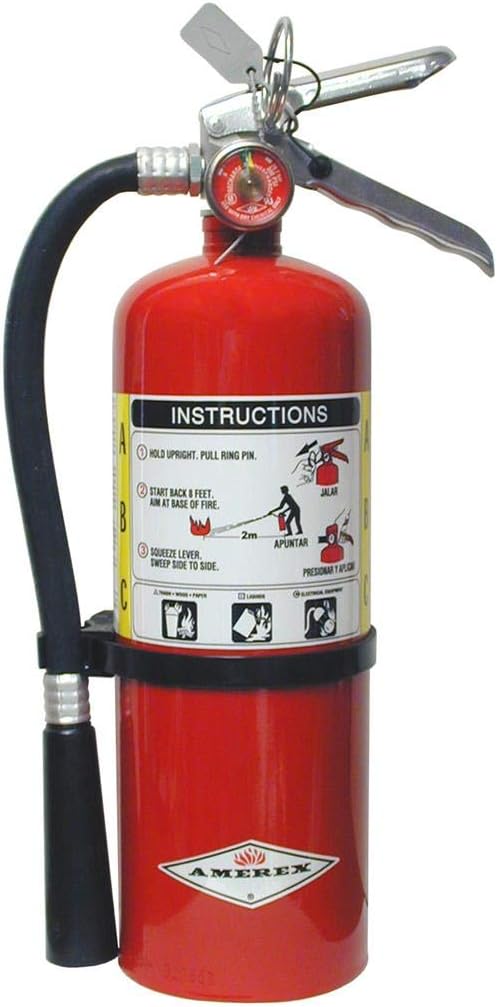
Key specs: Rechargeable all-metal stored-pressure dry chemical fire extinguisher; 5 lb.; UL rated 2A:10B:C; dry chemical agent; steel cylinder with brass valve; wall-mount bracket; Amerex is one of the largest manufacturers of the code-mandated extinguishers actually installed in US commercial buildings
The Amerex B500 is a smaller, lighter alternative to the Pro 460 above, rated 2A:10B:C rather than 4A:60-B:C — enough for a single small office or a compact retail counter area rather than an open floor. Amerex is one of the largest manufacturers of the actual code-mandated extinguishers installed in US commercial buildings, which is a genuine practical advantage: a fire inspector or your local fire marshal’s office has almost certainly seen this exact unit before, so there is no explaining what it is during an inspection.
✅ Pros
- All-metal, rechargeable construction built for repeated professional servicing
- A widely recognized commercial brand, not a generic import — familiar to inspectors
- Lighter and easier to mount than the higher-capacity Pro 460 pick above
- A sensible single-unit choice for a small office or a compact retail counter
❌ Cons
- Lower rating (2A:10B:C) than the Pro 460 — undersized for a larger open floor plan
- Still requires the same monthly visual check and annual maintenance cadence
- One unit, one zone — measure your actual travel distances before assuming one is enough
Fire Extinguisher Placement and Maintenance, By the Numbers
OSHA’s portable fire extinguisher standard is one of the few pieces of this topic with actual numeric thresholds you can act on directly, rather than a range that depends on your local AHJ. The core placement rule is a travel distance, not a room count: an employee should never have to walk more than a set distance to reach one.
| Requirement | What OSHA specifies | Source |
|---|
| Maximum travel distance, Class A hazards (ordinary combustibles) | 75 feet | |
| Maximum travel distance, Class B hazards (flammable liquids) | 50 feet | |
| Accessibility | Mounted, located and identified so it is reachable without injury risk | |
| Visual inspection | Monthly, by someone on staff | |
| Full maintenance check | Annually, with dated records kept on file | |
| Employee training | At initial employment and at least annually after that | |
Put in plain terms: measure the actual walking distance from any point on your floor to the nearest extinguisher, not the straight-line distance on a floor plan. If any spot on a Class A floor is more than 75 feet from an extinguisher, or a Class B area (a kitchen with a fryer, a space with flammable solvents) is more than 50 feet from one, you need another unit, not a bigger single one. Log the monthly visual checks somewhere you can actually produce during an inspection — a clipboard or a shared spreadsheet both work, but “we probably checked it” does not.
Egress Signage and Exit Routes
Exit signage is the other piece of this a business owner can act on directly without a contractor. OSHA requires every exit to be marked with a sign that is clearly visible, and any doorway or passage that could be mistaken for an exit but is not one has to be marked “Not an Exit” or otherwise labeled for its real use. Where the direction to the nearest exit is not obvious, directional signage along the route is required, not optional.
The specific numbers matter here too. OSHA requires exit signs to be illuminated to at least five foot-candles by a reliable light source, with the word “EXIT” in letters at least six inches high and stroke width of at least three-quarters of an inch. Self-luminous or electroluminescent signs have their own minimum brightness standard rather than needing an external light source. None of this requires a licensed contractor to install — compliant signage is a straightforward retail purchase, and getting it right is entirely within a small business owner’s own control.
The Realistic Path From First Call to Passed Inspection
If your building does need a full commercial fire alarm system, the process follows a recognizable shape almost everywhere, even though the specific paperwork differs by jurisdiction.
From First Call to Final Inspection
1
Confirm the requirement
Call your local fire marshal or building department and get the requirement for your specific address in writing, not from a generic online threshold.
2
Hire a licensed contractor
Confirm state registration and ask who the designer of record is for your project’s scope.
3
Plan submittal and permit
Your contractor files plans, including monitoring, notification-circuit and battery-backup details, with your local building department.
4
Installation and wiring
Detection, notification and monitoring are wired and tested as one integrated system, not as separate purchases.
5
Final inspection and acceptance
Your local AHJ tests the completed system and formally accepts it before it can legally operate.
Expect this to take real calendar time, especially the permit review step — starting the first call as early as possible in a build-out or lease negotiation is the single biggest lever you have over the timeline.
Final Recommendation
Make one phone call before you buy anything: contact your local fire marshal’s office or building department and ask, in writing if possible, whether your specific space requires a full commercial fire alarm system. That single call determines everything else, and it costs nothing.
If the answer is yes, do not shop for equipment at all yet — shop for a licensed, registered fire alarm contractor, verify their license number, and ask who the designer of record will be for your project. If the answer is no, or you are simply below the threshold, start with the extinguisher placement math in this guide: measure your actual travel distances, and buy the Amerex B500 5 lb ABC Fire Extinguisher for a single small office or counter area, or the more heavily rated Kidde Pro 460 Commercial Fire Extinguisher if your floor plan is larger. Pair either one with the First Alert SMICO100-AC Hardwired Smoke and CO Alarm if your space is small enough that a standalone detector, rather than a full interconnected system, is genuinely what your code requires — and confirm that with your AHJ rather than assuming it.
What would change this recommendation: if your local fire marshal tells you a full system is required, none of the products above substitute for that system, and buying them instead of making the contractor call would leave you out of compliance regardless of how good the extinguisher is. Our guide to third-party alarm monitoring is a useful next read once you’re comparing how a contractor proposes to handle the monitoring layer specifically.
SafeBode does not yet run an in-house product testing program. This guide is built from manufacturer specifications, official support documentation, current retail listings and verified buyer feedback rather than hands-on testing, and we say so plainly rather than implying testing we have not done.
Frequently Asked Questions
Do I need a licensed contractor for a single standalone smoke detector in a small office?
No. A standalone, hardwired smoke and CO alarm covering a single small space is a normal retail purchase you can install yourself, the same as in a home. A licensed contractor becomes necessary once your local code classifies your space as needing a full interconnected fire alarm system with notification and monitoring.
How do I find out if my business needs a full fire alarm system?
Call your local fire marshal’s office or building department directly and ask about your specific address. The requirement depends on your building’s size, occupant load and number of stories as set by your local fire and building code, and there is no single national square-footage number that applies everywhere.
Can an electrician install a commercial fire alarm system instead of a fire alarm company?
In most states, no. Commercial fire alarm installation, service and monitoring typically requires a company registered specifically for fire alarm work, with a state-licensed fire alarm technician on staff, separate from a general electrical contractor’s license.
What is the difference between a monitored and an unmonitored commercial fire alarm?
A monitored system is wired to a supervising or central station that automatically notifies the fire department when it triggers, even if the building is empty. An unmonitored system only sounds locally, so a fire that starts overnight or when nobody is present may go undetected by emergency services until someone happens to see it.
Do I need a fire alarm permit even for a small tenant improvement?
Often yes. Some jurisdictions still require a formal filing for changes as small as a handful of new detectors or notification devices, even when the project doesn’t need a full engineered plan set. Check with your local building department before assuming a small change is exempt.
How often does a commercial fire extinguisher need to be serviced?
OSHA requires a monthly visual inspection you can do yourself, plus an annual maintenance check, with dated records kept on file. Stored-pressure dry chemical units also need periodic hydrostatic testing on a longer cycle, typically handled by a licensed extinguisher servicing company.
Can I mount exit signs myself, or does that need a contractor too?
You can install compliant exit signage yourself. It has to meet specific size, lettering and illumination requirements, but it is a straightforward retail purchase and installation, not licensed fire alarm work.
Does a commercial fire alarm system replace the need for fire extinguishers?
No. A fire alarm system detects and reports a fire; it does not put one out. Extinguishers, correctly placed and maintained, remain a separate, required layer of protection regardless of whether a building also has a full alarm system.
What happens if I skip the permit and just install equipment myself?
An uninspected, unpermitted system is not legally recognized as meeting your fire code requirement even if the equipment itself works, and it can create real exposure with your insurer and with your local AHJ if discovered during an inspection or after an incident.
Sources
Show sources (6)
- [1] Occupational Safety and Health Administration — “1910.157 – Portable fire extinguishers,” osha.gov/laws-regs/regulations/standardnumber/1910/1910.157
- [2] Occupational Safety and Health Administration — “1910.37 – Maintenance, safeguards, and operational features for exit routes,” osha.gov/laws-regs/regulations/standardnumber/1910/1910.37
- [3] City of San Diego Development Services — “How to Obtain a Permit for Fire Alarm Systems,” Information Bulletin 137, sandiego.gov/development-services/forms-publications/information-bulletins/137
- [4] Texas Department of Insurance — “Fire alarm registration, license, and test information,” tdi.texas.gov/fire/information-fire-alarm-registration-license-test.html
- [5] U.S. Fire Administration (FEMA) — “Nonresidential Building Fires,” usfa.fema.gov/statistics/reports/where-fires-occur/nonresidential-building-fires-v21i9.html
- [6] Kidde — “Pro 460 Fire Extinguisher, PRO-10MP-1,” kidde.com/products/commercial-fire-extinguishers/pro-460-fire-extinguisher


