Best Portable Safes 2026: For the Car, Travel, and a Go-Bag
Affiliate Disclosure: This article contains affiliate links. If you buy through these links, we may earn a commission at no extra cost to you. Our editorial opinions are our own and are not influenced by affiliate relationships. Read our full disclosure policy →
Contents
Quick Answer
A portable safe is a lockbox you can carry, not a burglar-rated safe you bolt to the floor — and it is honest to say those are different products solving different problems. What it actually does is slow down an opportunistic thief and keep casual snooping out, in places a real safe cannot go: a glovebox, a hotel room, a backpack. For most travelers, the Master Lock 5900D is the right starting pick — small, cabled, and cheap enough to keep in every bag. Driving somewhere and need it to survive a hot trunk unattended for hours, get the weatherproof VAULTEK LifePod X Micro. Packing for a trip with no guaranteed room safe, the Pacsafe Travelsafe Gii straps to almost anything. Building an emergency document kit at home, the Vaultz Locking Storage Chest is sized for it — with one honest caveat below.
Why “Portable” and “Secure” Pull in Different Directions
Search results for “portable safe” mostly skip the tension in that phrase. A safe is supposed to be heavy, bolted down, and hard to move. A portable safe is, by definition, none of those things — it has to be light enough to pack, small enough to fit a glovebox, and easy enough to open with one hand. Every design choice that makes it portable is a design choice a real burglary-resistant safe deliberately avoids.
Underwriters Laboratories publishes the actual standard for burglar-resistant safes, UL 687, which rates safes by how many minutes of forced entry with hand tools, power tools, or torches they can withstand — the lowest tier, TL-15, means 15 minutes of resistance to common tools. None of the four picks in this guide carry that rating, and neither does almost anything sold under the words “portable safe” on Amazon. That is not a defect in the product category. It is what portability costs. SafeWise’s own buying guide for full-size home safes makes the companion point directly: weight, not the lock mechanism, is what actually keeps a safe from being carried out the door, which is exactly why the guide recommends bolting a real safe to the floor or wall rather than trusting the lock alone. A portable safe cannot be bolted down without stopping being portable.
What “Time-Resistance” Actually Means
0 min
burglary-resistance rating any portable lockbox in this guide carries
15 min
UL TL-15 — the starting tier for a real bolted safe’s forced-entry resistance
30 min
UL TL-30 — the tier for stronger sophisticated-tool resistance
Weight
not the combination lock, is what actually keeps a safe from being carried off
A portable safe is built to be carried — which is exactly what makes it possible for someone else to carry it too.
So treat every pick below as a deterrent and an organizer, not a vault. It stops a hotel housekeeper from casually opening your bag, a kid from finding cash in the glovebox, or a smash-and-grab thief from seeing a phone sitting on the passenger seat. It will not stop someone with bolt cutters and ten unsupervised minutes. If what you actually need is protection against a determined burglary at home — a UL-rated, floor-bolted safe for firearms, cash, or irreplaceable documents — our home safe decision-tree guide covers that different product category. And if your worry is someone getting through a door rather than into a box, that is a separate problem again; our portable door lock guide covers travel-specific hardware that blocks the door itself, which nothing in this article does.
Three Real Jobs a Portable Safe Can Do
“Portable safe” covers three genuinely different use cases, and the right pick changes depending on which one you actually have.
Match the Job to the Safe
1
The car problem
A glovebox or console is the first place a smash-and-grab thief checks. Comprehensive auto insurance typically does not cover personal belongings like phones, laptops, or jewelry left inside the vehicle — the safe is protecting things your insurance will not.
2
The hotel-room problem
Not every room has a safe, and the ones that do are sized for a passport and a phone, not a laptop and a jewelry case. A safe you bring yourself and tether to something heavy works anywhere, including rentals and hostels with no safe at all.
3
The go-bag problem
Passports, deeds, insurance policies, and a backup drive need to be grabbable in one motion during an emergency, and organized well enough that you are not hunting for them under stress. That is a storage-and-grab-speed problem, not a lock-strength problem.
None of these three jobs need a UL-rated safe. All three need something more deliberate than a sock drawer.
Four Portable Safes Side by Side
The table below is built from each product’s own listed specifications, not marketing copy. “Tether” means the safe ships with a cable to lock it to something fixed rather than just to itself.
| Master Lock 5900D Portable Safe | VAULTEK LifePod X Micro | Pacsafe Travelsafe Gii 5L | Vaultz Locking Storage Chest |
|---|
| Best for | Everyday travel & hotel rooms | The car | Go-bags & anywhere you can tether it | Home document/emergency kit |
| Lock type | 4-digit mechanical combination | Electronic keypad, 4-8 digit code | 3-dial TSA-accepted combination | Dual push-button combination |
| Shell material | ABS plastic with foam lining | Impact-resistant polymer | Steel wire mesh in polyester fabric | Aluminum-and-steel frame, polymer shell |
| Water resistance | Water-resistant | Water-resistant, airtight when latched | Water-resistant fabric | Not water-resistant |
| Ships with a tether cable | Yes | Yes, plus a carabiner | Yes | Yes, plus a cable grommet |
| TSA-accepted lock | Not stated by the manufacturer | Not stated by the manufacturer | Yes | Not applicable — too large to carry on |
| Roughly holds | A phone, cash, cards, a passport | A phone, cards, a passport, small jewelry | Two tablets or one laptop, plus documents | A laptop and file folders |
Master Lock 5900D Portable Safe — best overall, best for hotel rooms
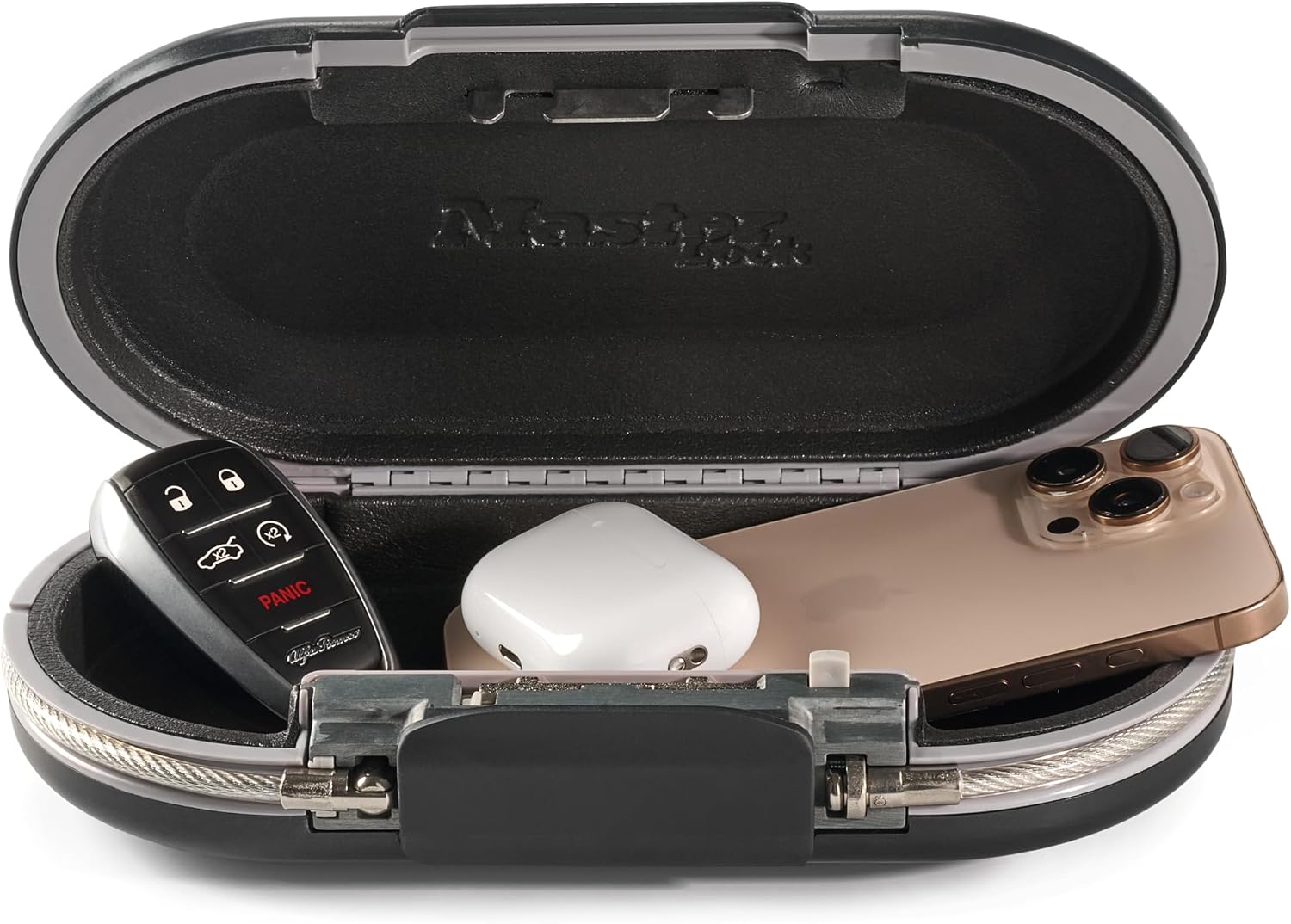
Key specs: Set-your-own 4-digit combination lock; exterior roughly 2.25″H x 9.31″W x 3.5″D, interior roughly 1.25″H x 8.13″W x 3.5″D; ABS plastic shell with shock-absorbing foam lining; water-resistant, not waterproof; includes a vinyl-coated steel tether cable; one-year limited warranty
This is the default answer for the largest group of readers: you want a small, cheap, genuinely portable box for a phone, cash, and a passport, and you do not need it to survive being run over or dropped in a pool. It is small enough to disappear into a suitcase and cheap enough that losing it to a determined thief is not a financial event. The included cable is meant to loop around a fixed object — a radiator, a bed frame, a bathroom pipe — rather than to guarantee it cannot be cut. Verified buyers describe that cable as closer to a thin bike-lock wire than hardened steel, and one reviewer who tested it against bolt cutters said it lost in seconds; Master Lock does not market the cable as cut-resistant, and neither will we. Its job is to stop someone from simply picking the box up and walking away, not to defeat tools.
✅ Pros
- Small enough to carry in a daypack or stash in a suitcase without adding real weight
- Set-your-own combination, no key to lose
- Water-resistant shell and a foam-lined interior that keeps small items from rattling
- The lowest-commitment pick here if you are not sure you will use it often
❌ Cons
- The tether cable is thin and not marketed as cut-resistant — a determined thief with bolt cutters can defeat it quickly
- The lid does not open past roughly a 45-90 degree angle, which some buyers find awkward
- Interior is sized for a phone and documents, not a laptop or larger valuables
- Not fireproof or waterproof, only water-resistant
VAULTEK LifePod X Micro — best for the car
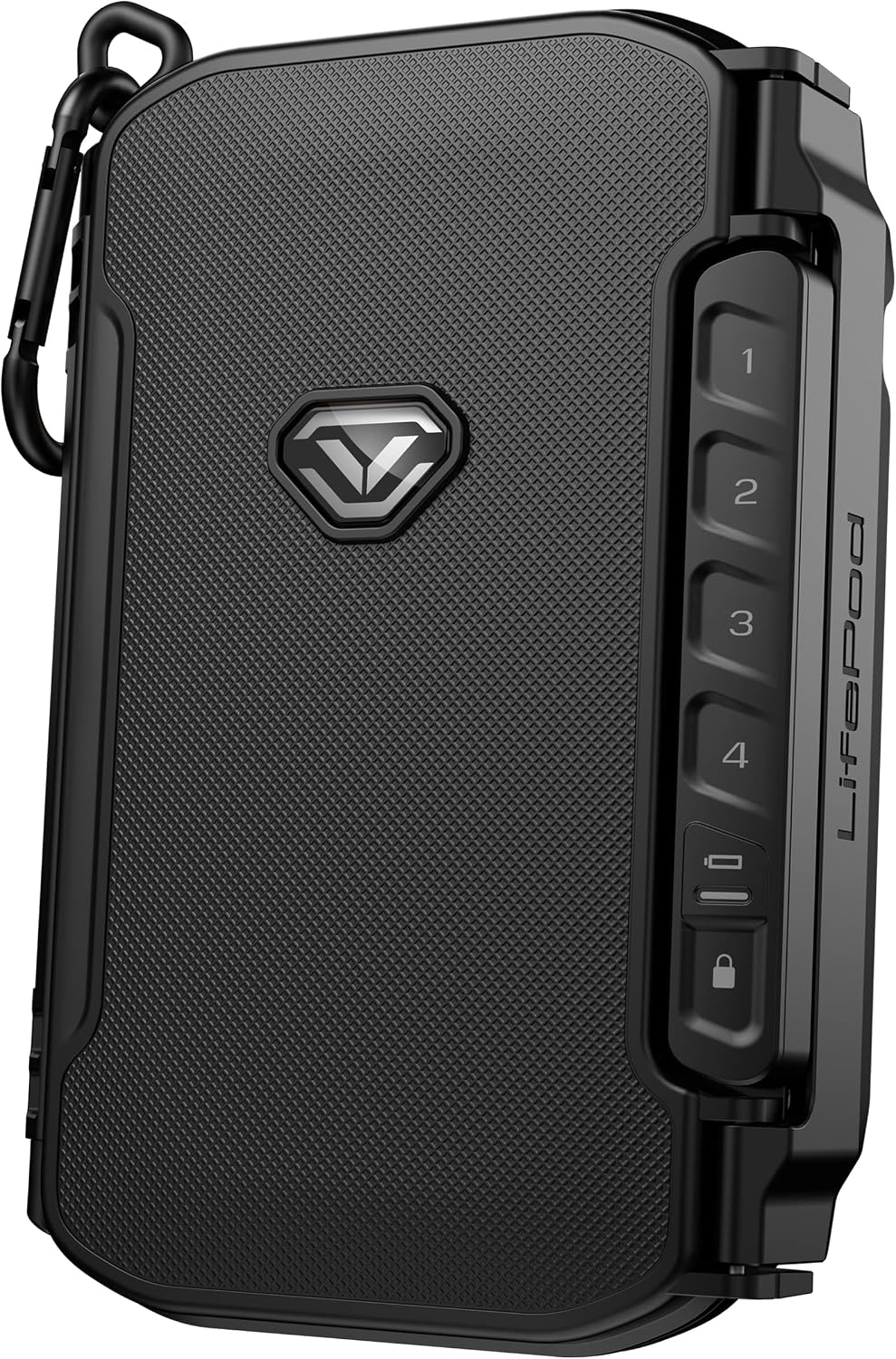
Key specs: Touch-activated electronic keypad, 4-8 digit code with 87,000+ possible combinations; exterior roughly 8.13″D x 1.9″W x 5.5″H, interior roughly 7.6″L x 3.5″W x 1.4″H; impact-resistant polymer shell; water-resistant and airtight when the compression latch is engaged; runs on one AA battery with a micro-USB backup power port; includes a steel security cable and carabiner
The LifePod X Micro is built for exactly the scenario a glovebox creates: heat, occasional damp, and needing to lock and unlock it quickly without fumbling a mechanical dial. The touch keypad backlights in the dark, the shell seals close enough to be water-resistant and airtight when latched, and the whole unit is light enough to move between a backpack, a center console, and a trunk without a second thought. It is the pick if your actual problem is items that need to stay sealed and reachable inside a vehicle, not the largest capacity available. For the network side of protecting a parked vehicle rather than what is inside it, our home security cost breakdown covers what a monitored system runs versus a one-time purchase like this.
✅ Pros
- Electronic keypad with 87,000+ possible codes and a backlit display for use in the dark
- Water-resistant and airtight when the compression latch is engaged
- Includes a steel tether cable and a carabiner for attaching to a bag or fixed point
- Micro-USB backup power port means a dead AA battery does not permanently lock you out
❌ Cons
- Runs on a single AA battery; one verified buyer reported needing a replacement every couple of weeks rather than the advertised year of life, so carry a spare
- A meaningfully smaller review base than Master Lock’s pick — a newer product with less track record
- Interior fits a phone, passport, cash, and small jewelry, not a laptop or tablet
- Plastic construction; several buyers call it good-enough deterrence rather than serious security
Pacsafe Travelsafe Gii 5L — best for a go-bag
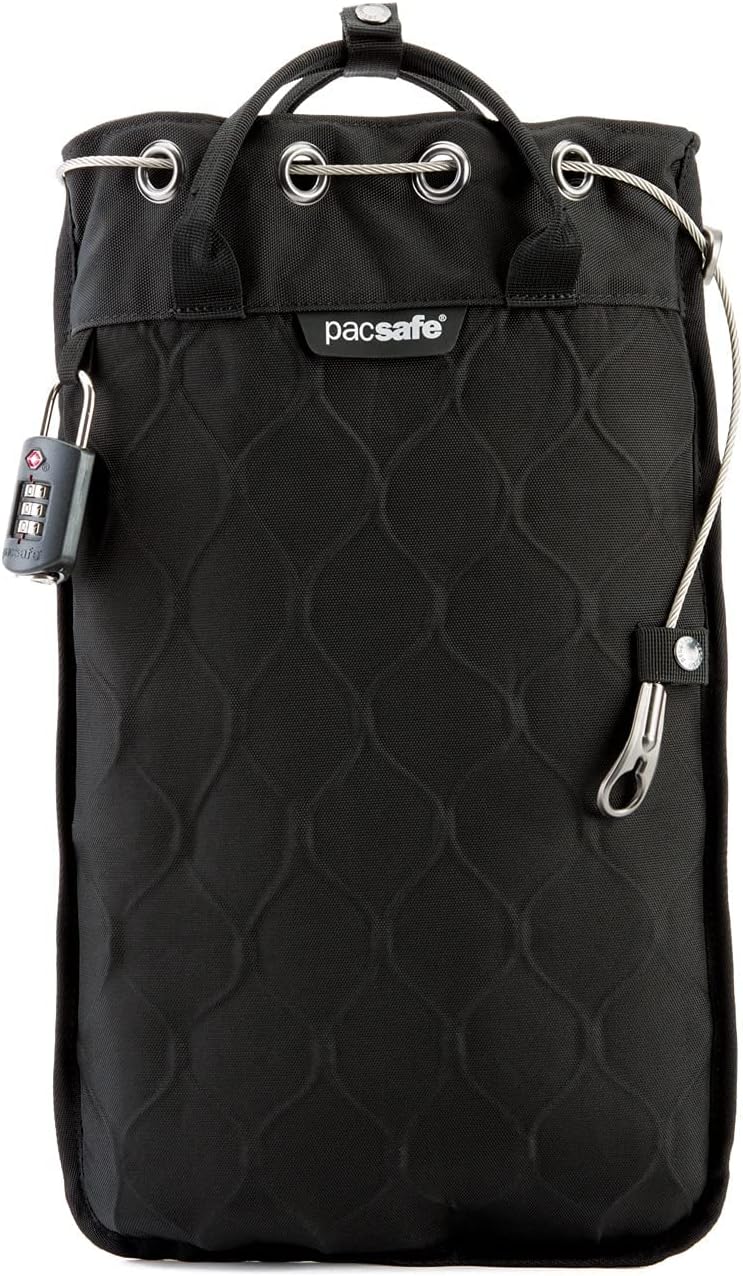
Key specs: 360-degree stainless-steel wire exomesh embedded in water-resistant polyester fabric; 5-liter capacity, roughly 16.3″H x 10.4″W x 1.2″D; folds flat for packing; includes a TSA-accepted 3-dial combination lock and a stainless-steel tethering cable; weighs under 1 pound
The Travelsafe Gii solves a problem none of the hard-sided boxes here can: it packs flat. Folded into the bottom of a suitcase or the corner of a backpack, it takes up almost no room until you need it, then unfolds into a soft bag reinforced with a stainless-steel wire mesh, closed with a TSA-accepted combination lock and cinched shut with a steel cable that loops around whatever is fixed in the room — a bed frame, a radiator, a railing. That combination is why it is the right answer for hostels, Airbnbs, and any stay where you cannot count on a room safe existing at all. It is explicitly a deterrent product, not a vault: the fabric can be cut with scissors given enough time and privacy, and several verified buyers report the included lock itself failing within weeks, forcing them to cut it off and swap in their own. Budget for that possibility rather than assuming the bundled lock is the final word.
✅ Pros
- Folds flat for packing — the only pick here that does not take up rigid box space
- TSA-accepted lock, so it is a legitimate travel companion through airport security
- Steel wire mesh resists a casual slash-and-grab better than fabric alone
- 5-liter capacity comfortably fits two tablets, a phone, a passport, and cash together
❌ Cons
- Multiple verified buyers report the bundled combination lock failing or breaking within weeks
- The most expensive pick in this guide by a wide margin
- Fabric construction means a patient thief with scissors or a blade can eventually get through it
- Bulkier than it looks in photos — several reviewers note it eats real suitcase space
Vaultz Locking Storage Chest — best for a document go-bag
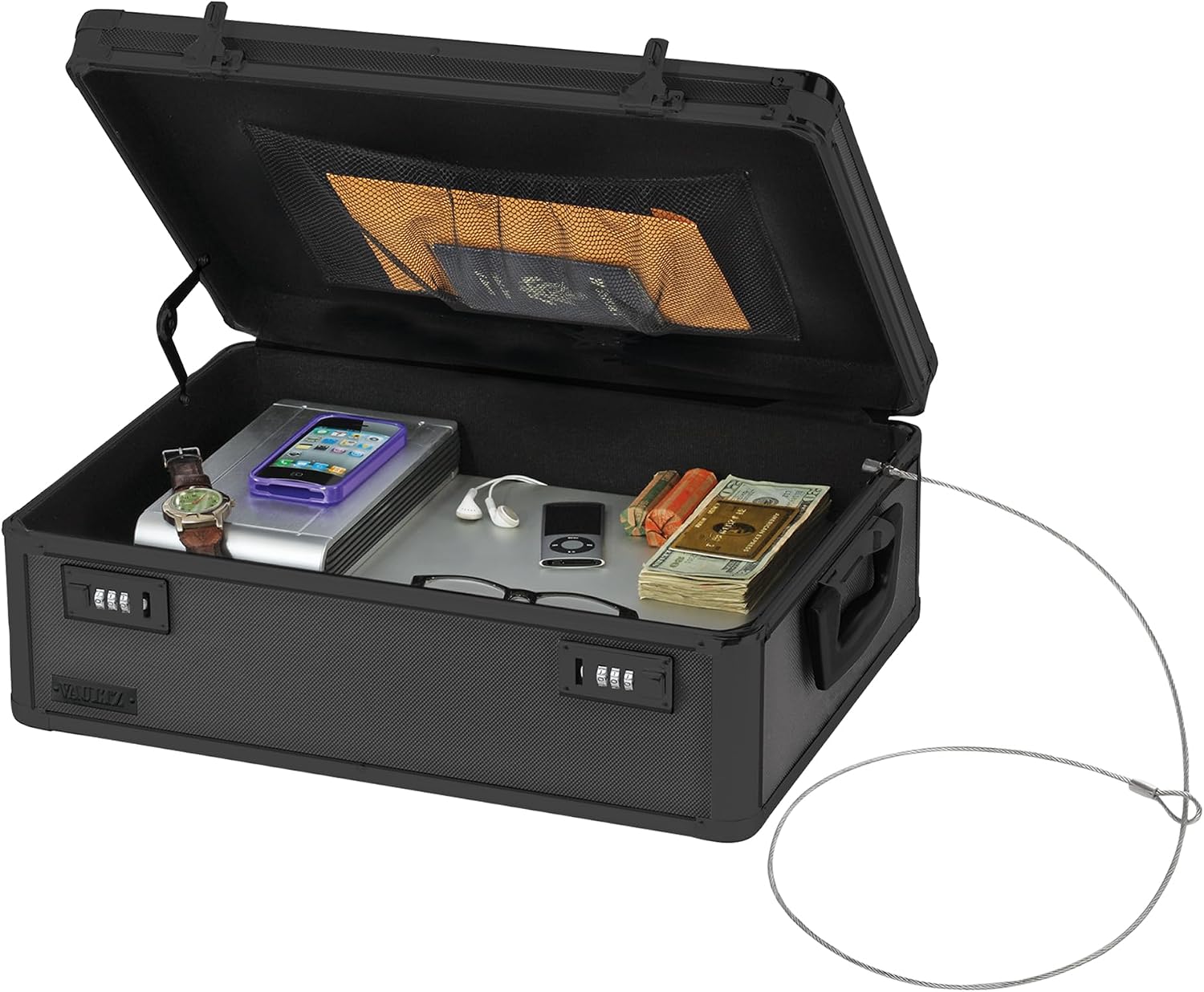
Key specs: Dual push-button combination locks; exterior roughly 18.11″W x 12.99″D x 6.18″H, interior roughly 17.5″L x 12.4″W x 4.25″H, sized for a laptop and file folders; aluminum-and-steel frame over a polymer shell; includes a security-cable grommet and tether loop plus an interior mesh pocket; not water-resistant
This is the odd one out in this lineup, and deliberately so: it is sized for what the other three cannot hold. A laptop, a stack of file folders, and a home-inventory binder all fit with room to spare, which is exactly what an emergency document kit needs — see the checklist further down this guide for what actually belongs in one. It ships with a security-cable grommet so it can be tethered like the others, and dual combination locks mean you can set different codes for different levels of access in a shared household. The honest caveat: unlike every other pick here, the manufacturer does not list it as water-resistant. For a box meant to protect documents specifically against fire, flood, or an evacuation, that is a real gap — pair it with individually sealed plastic sleeves for anything paper, the same fix SafeHome.org’s document storage guide recommends for any non-waterproof container.
✅ Pros
- The only pick here genuinely sized for a laptop plus files, not just a phone and a passport
- Dual combination locks allow separate codes for separate people or access levels
- Cable grommet and tether loop for securing it to a fixed object like the other three
- Interior mesh pocket keeps small items from sliding around the main compartment
❌ Cons
- Not water-resistant — a real weakness for a document safe, unlike every other pick here
- Several verified buyers describe the shell as easy to pry open by hand once the locks fail
- Bulkiest pick here; it is a home storage chest, not something you carry on your body
- One verified buyer reported the combination mechanism failing outright after about a year
Do You Still Need One If the Hotel Already Has a Safe?
Often, yes. A built-in hotel safe is usually sized for a passport, a phone, and maybe a small jewelry pouch — not a laptop, a second phone, and cash for a family of four. Budget properties, hostels, vacation rentals, and older hotels frequently have no in-room safe at all, which is the exact gap the Pacsafe and Master Lock picks above are built to close: they travel with you regardless of what the room provides.
There is also a separation-of-risk argument for owning your own. The Insurance Information Institute’s guidance on protecting valuables recommends insuring genuinely expensive items like jewelry and collectibles separately from a standard policy, since a typical homeowners or renters policy caps payouts on those categories. A hotel safe you did not choose and cannot verify the condition of is not a substitute for that kind of planning — it is a convenience layer, and a portable safe you control the combination on is a second, independent layer under it.
Where to Actually Put It
In a car: the trunk beats the glovebox or console every time. Security.org’s guidance on car break-ins is blunt about this — nothing should be visible inside the passenger compartment, and items should go in the trunk where they cannot be seen at all rather than tucked under a seat, since a thief watching from a distance can see you stash something and come back for it later. The same guidance notes that comprehensive insurance typically will not reimburse stolen personal items left in the car, which is the whole reason a dedicated lockbox earns its keep. Locking the car itself matters as much as the box inside it — nearly a quarter of vehicle theft happens through doors that were simply left unlocked.
In a hotel room: tether the cable to something bolted to the structure, not to furniture that can be lifted. A radiator pipe, a fixed closet rod, or a bed frame’s metal leg all work; a dresser drawer handle does not, because the whole dresser can be tipped. Loop it and lock it before you leave the room, not after you notice something is missing.
For a go-bag: keep it with the rest of your emergency kit, not in a closet you would only reach after grabbing everything else. If you are building a broader emergency setup around your home rather than just the documents box, our no-drill security systems guide covers the kind of low-commitment hardware that pairs well with a grab-and-go safe, since neither approach requires permanent changes to a rented space.
What Belongs in a Document Go-Bag
SafeHome.org’s guidance on storing important documents recommends a “3-2-1” approach: one physical copy in a fire-resistant container, plus two digital backups in different places, such as encrypted cloud storage and a separate external drive. The table below is a starting checklist for what the physical copy should actually contain, based on that guidance plus the Insurance Information Institute’s home-inventory recommendations.
| Category | What to include | Why it matters |
|---|
| Identity | Passports, birth certificates, Social Security cards | Hardest and slowest documents to replace if lost in a disaster |
| Insurance | Homeowners/renters policy, auto policy, health insurance cards | You need policy numbers to file a claim, which is exactly when originals may be gone |
| Financial | Bank and investment account numbers, a recent statement | Speeds up proving ownership and reopening access after a loss |
| Property | Deed or lease, vehicle title, a written or photographed home inventory | The III recommends a room-by-room inventory with photos for any insurance claim |
| Backup copies | A USB drive or SD card with scanned versions of everything above | A physical copy can still be destroyed; SafeHome.org’s 3-2-1 rule assumes redundancy |
| Cash | A small amount of small-denomination bills | Card networks and ATMs are not guaranteed to work during a widespread outage or evacuation |
None of this needs to live in an expensive container. It needs to live somewhere you can grab in one motion, that keeps paper dry, and that you have actually opened recently enough to remember the combination.
Final Recommendation
Start with the Master Lock 5900D Portable Safe if you are not sure yet which of the three jobs above you actually have — it is the cheapest, most flexible pick, and it will handle a hotel room or a daypack equally well. Swap in the VAULTEK LifePod X Micro specifically if the safe is going to live in a car and needs to survive heat and the occasional spill without a second thought. Choose the Pacsafe Travelsafe Gii if you travel to places that may not have a room safe at all, and budget for replacing its lock eventually. And if what you are actually building is a home document kit rather than something you carry, skip straight to the Vaultz chest and add plastic sleeves for anything on paper.
One thing that should change your answer regardless of pick: if what you are protecting is something you genuinely cannot afford to lose — firearms, significant cash, heirloom jewelry — none of these four products are the right tool. That calls for a real UL-rated safe bolted to the structure of your home, which is a different purchase covered in our home safe guide. A portable safe’s entire value proposition is that it moves; a real security safe’s entire value proposition is that it does not.
SafeBode does not yet run an in-house product testing program. This guide is built from manufacturer specifications, official support documentation, current retail listings and verified buyer feedback rather than hands-on testing, and we say so plainly rather than implying testing we have not done.
Frequently Asked Questions
Will a portable safe stop a determined thief?
No, and none of the manufacturers here claim otherwise. A portable safe deters casual theft and snooping. Stopping someone with tools and unsupervised time requires a heavy, burglary-rated safe that is bolted down, which by definition cannot be portable.
Is it safe to leave a lockbox visible inside a parked car?
No. Put it somewhere it cannot be seen from outside the vehicle, ideally the trunk, before you arrive at your destination rather than after you park, since someone watching can see you stash it and come back later.
What if I forget the combination?
Mechanical combination locks like the Master Lock and Pacsafe picks are set by the owner and can usually be reset with the tool or instructions included in the box, provided you still have that documentation. Electronic keypads like the VAULTEK have a backup power port for exactly this situation, but if the code itself is truly lost, expect to force the unit open and replace it — these are not designed to be pickable or recoverable by a locksmith the way a fixed home safe is (our guide to lost keys and codes on a home safe covers that recovery process for a real bolted safe, which does have one).
Are portable safes fireproof?
No, and none of the four picks in this guide claim fire resistance. “Water-resistant” on these products means resistance to splashes and light rain, not fire or submersion. If fire protection for documents matters to you, that is a different, UL fire-rated product category.
Can I bring a portable safe through airport security?
The lock matters more than the box. A TSA-accepted lock, like the one included with the Pacsafe pick, carries a Travel Sentry logo that lets airport security open and reclose it without cutting it off if your bag is searched. A lock without that logo may simply get cut if TSA needs to inspect it.
Do I need to bolt a portable safe down at home?
You can tether it to something heavy with the included cable, but bolting defeats the point of a portable design. If you want something that stays anchored permanently at home, a fixed home safe is the right category, not a portable one.
What is the difference between a portable safe and a portable door lock?
A portable safe locks valuables inside a box. A portable door lock blocks a door from being opened from outside, protecting an entire room rather than a handful of items. They solve different problems and are often used together while traveling.
How much can these actually hold?
The three smaller picks here fit a phone, cash, cards, and a passport comfortably, with the VAULTEK adding room for small jewelry. Only the Vaultz chest is sized for a laptop and files — check the side-by-side table above before assuming any of these will fit a device larger than a phone.
Is a more expensive portable safe actually more secure?
Not necessarily. Price here mostly buys convenience — an electronic keypad instead of a dial, a fold-flat design, more interior room — not meaningfully more resistance to forced entry. None of the four picks in this guide carry a burglary-resistance rating regardless of price.
Sources
Show sources (6)
- [1] UL Standards & Engagement — “UL 687: Standard for Burglary-Resistant Safes,” shopulstandards.com/ProductDetail.aspx?UniqueKey=23121
- [2] SafeWise — “Best Home Safes: A Buyer’s Guide,” safewise.com/resources/home-safe-buyers-guide/
- [3] Security.org — “What to Do if Your Car Is Broken Into,” security.org/home-security-systems/car-break-in/
- [4] SafeHome.org — “How to Safely Store Your Important Documents,” safehome.org/identity-theft-protection/storing-important-docs/
- [5] Insurance Information Institute — “Making a Home Inventory,” iii.org/article/brochure-home-inventory
- [6] Master Lock — “What Are TSA-Accepted Locks?,” masterlock.com/cms/support/what-are-tsa-accepted-locks


