Best Battery Operated Doorbells 2026: Wireless Chimes With No Wiring and No Camera
Affiliate Disclosure: This article contains affiliate links. If you buy through these links, we may earn a commission at no extra cost to you. Our editorial opinions are our own and are not influenced by affiliate relationships. Read our full disclosure policy →
Contents
Quick Answer
A battery doorbell with no camera is a two-piece radio: a weatherproof button outside and a chime receiver inside. No wiring, no app, no subscription, nothing to fail but batteries. Start with the SECRUI Wireless Doorbell – it is the most-reviewed kit in the category and does the job without asking anything of you. Choose the AVANTEK instead if there is no convenient outlet for a plug-in receiver, because that constraint decides more purchases here than any feature.
Why Buy a Doorbell With No Camera in 2026
The obvious question first. Video doorbells dominate the category and there are good reasons for that, so it is worth being clear about who this product is genuinely better for rather than pretending it competes on features.
A wireless chime is the better buy when
This describes you
- There is no doorbell wiring, and you are not adding any
- You rent and cannot modify the door frame or the electrics
- You do not want a subscription, an account or an app
- The existing wired doorbell failed and you want it working today
- You need a second chime in a workshop, basement or garden room
Buy a video doorbell instead when
- You want to see who is there before opening the door
- Package theft is the actual problem you are solving
- You want a recorded history of callers
- You want to answer the door while you are out
- You already own cameras and want one app for everything
There is also a compatibility argument that catches people mid-upgrade. Ring’s own documentation states that the Wired Doorbell 4K Pro, except when powered over Ethernet, and the Wired Doorbell 2K Plus are not compatible with existing chimes, and that a Chime Kit Mini is needed to hear a chime inside the house. So “just fit a video doorbell” is sometimes two purchases rather than one. If that is the road you are on, our wired video doorbell comparison covers what fits a wired circuit.
The Receiver Decides Everything
Every kit here has a battery-powered button. The meaningful difference is the receiver – the part that makes the noise – and it comes in two forms that suit completely different houses.
Two receiver types
1
Plug-in receiver
Plugs straight into a wall outlet. Louder, never needs a battery change, and stays where you put it. Requires an outlet in a spot where you will hear it.
2
Battery receiver
Runs on its own batteries, so it can sit on a shelf, move between rooms, or go out to a workshop. Quieter, and it is a second set of batteries to track.
3
Multiple receivers
Most kits support extra receivers paired to the same button, which is the real answer for a large or multi-storey house.
Choose the receiver type first. It constrains where the doorbell can be heard, which is the whole point of the product.
The mistake worth avoiding is buying a plug-in receiver and discovering the only outlet in range is in a hallway nobody occupies. Walk the house before ordering and pick the room where you actually are – then check there is an outlet in it.
What Those Range Numbers Actually Mean
Listings in this category advertise ranges like 1,000 or 1,312 feet, and those numbers are measured in open space with nothing in between. That is not a lie, but it is not your house either. Every wall, floor and appliance between button and receiver takes a bite out of it, and metal takes the biggest bite.
How to read a range claim
1,312 ft
TECKNET’s stated open-space range – line of sight, no obstructions
1,000 ft
AVANTEK’s stated range, on the same basis
Walls
The variable the number does not account for
Metal
Steel doors, foil-backed insulation and appliances cut range hardest
Treat published range as a way to rank products against each other, not as a distance you will achieve through a brick wall.
In practice, almost any of these covers a normal house comfortably. Range only becomes a real constraint on long properties, detached workshops, or where the receiver has to sit at the far end of a basement. If that is you, buy the longest-rated kit and expect to test placement – the same principle we apply to camera placement in our guide to testing signal at the mounting point.
The Four Picks Side by Side
SECRUI Wireless Doorbell — best overall
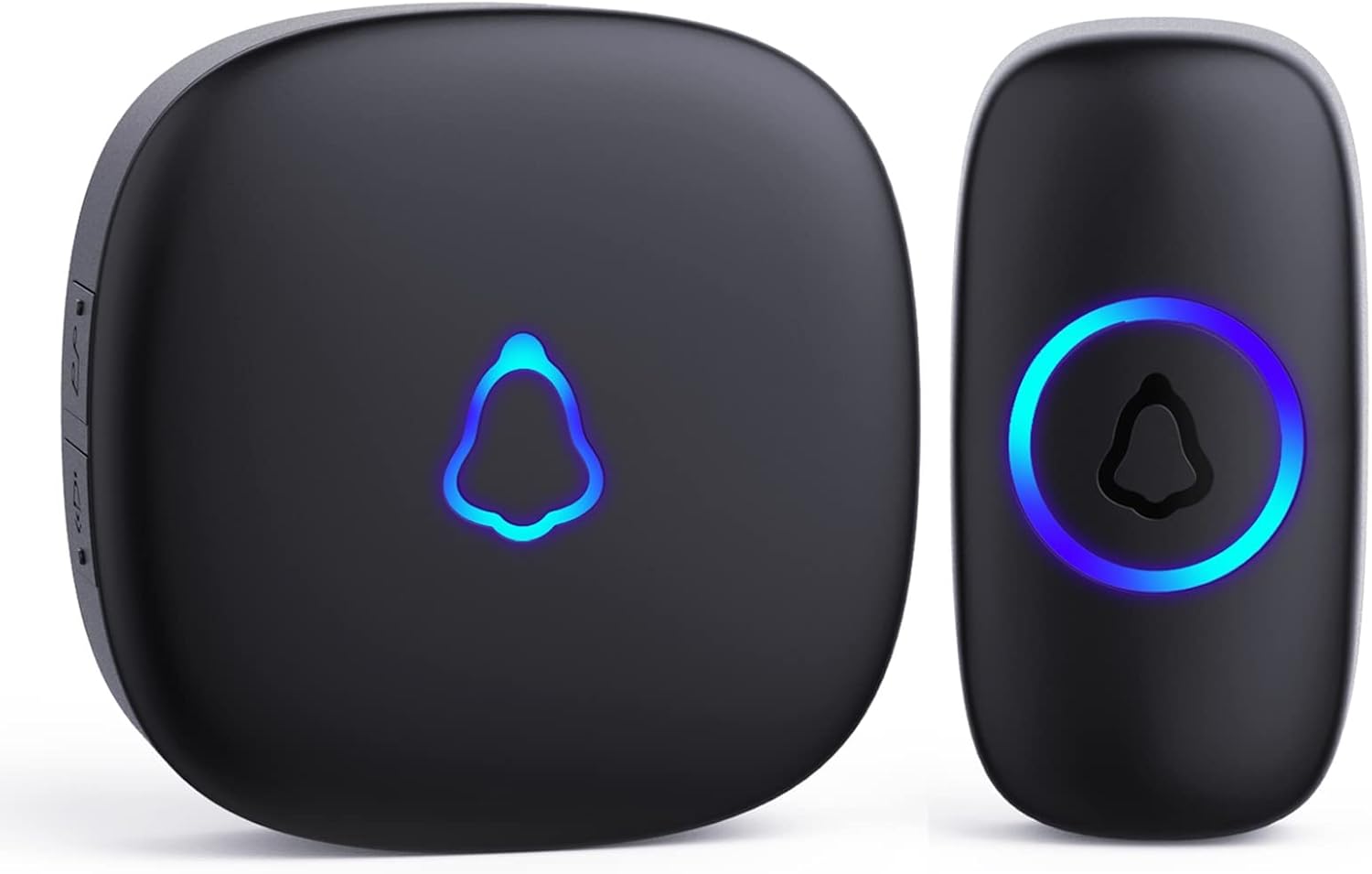
Key specs: Battery push button with a plug-in receiver; 58 chime tones and adjustable volume; weatherproof button for exterior mounting; adhesive or screw fitting; the most-reviewed wireless doorbell kit in the category on Amazon US
This is the one to buy if you want to stop thinking about it. A weatherproof battery button outside, a plug-in receiver inside, 58 tones and adjustable volume, and it arrives paired. The plug-in receiver is the right default for most houses because it is louder than a battery unit and never needs its own batteries changed – two fewer things to go wrong on a device whose entire value is that it just works. Its review base is far larger than anything else in the category, which for a simple radio product is a reasonable proxy for it pairing reliably and surviving weather. Fifty-eight tones is more than anyone needs, but the volume range is the setting that matters and it has one.
✅ Pros
- Largest review base of any wireless doorbell kit here
- Plug-in receiver is louder and needs no batteries
- Weatherproof button suits an exposed door
- Arrives paired – setup is genuinely plug and stick
- Adhesive or screw mounting for the button
❌ Cons
- Receiver needs an outlet where you want to hear it
- 58 tones is a menu you will scroll once and never revisit
- No published IP rating like the TECKNET
- Button batteries are still a consumable
TECKNET Wireless Doorbell — best for exposed doors
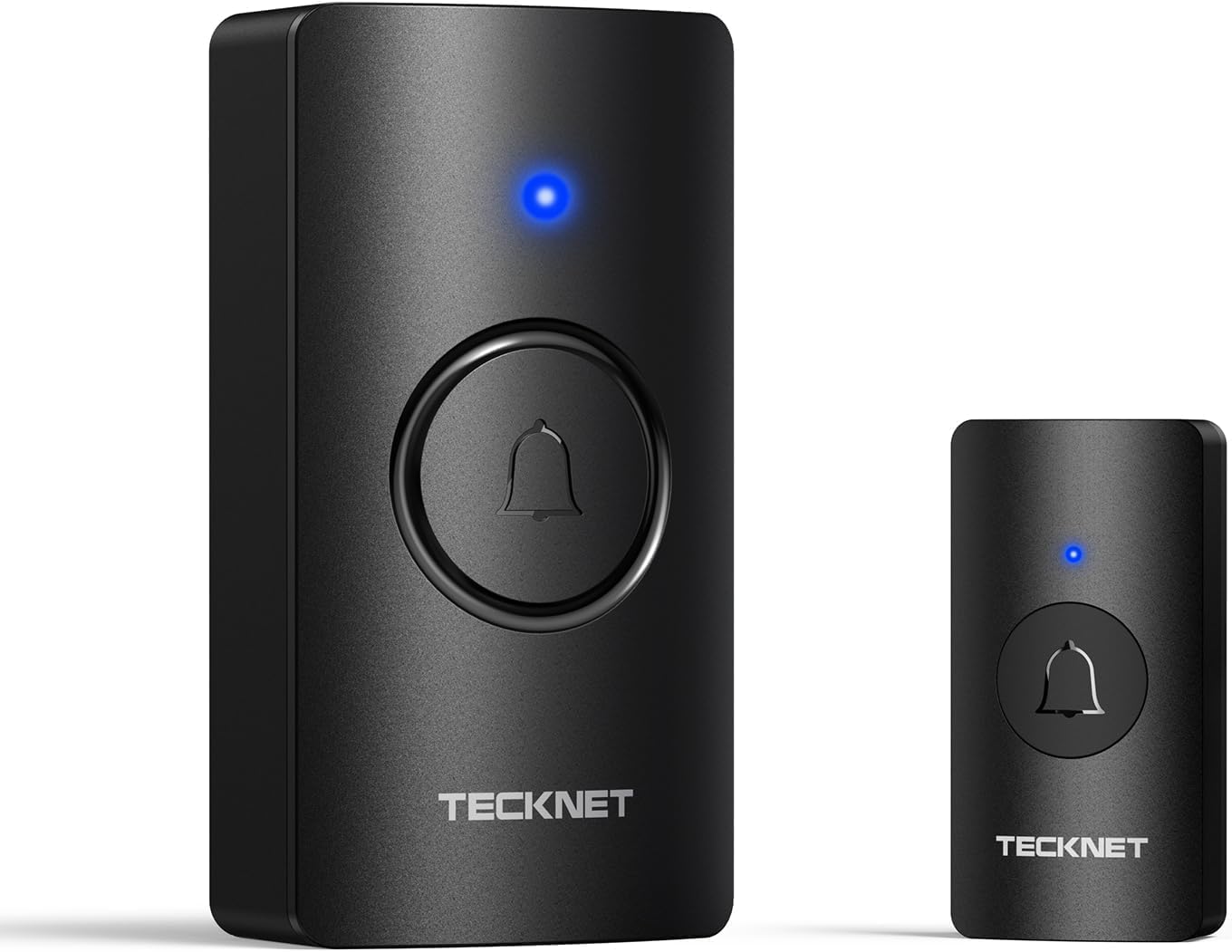
Key specs: Battery push button rated IP67 against dust and water immersion, with a stated operating range of 1,312 ft in open space; plug-in receiver with adjustable volume and multiple tones
The reason to pick this one is a specific rating rather than a general claim: IP67 covers dust ingress and temporary immersion in water, which is a genuinely high bar for a doorbell button. If your front door has no porch, faces prevailing weather, or sits where snow packs against the frame, that rating is the difference between a button that works in year three and one that does not. The stated 1,312 ft open-space range is the longest here, which matters on a long property. Everything else is comparable to the SECRUI – plug-in receiver, multiple tones, adjustable volume – so this is a weather-and-range pick rather than a feature one.
✅ Pros
- IP67 rating – the clearest weather claim in this group
- Longest stated open-space range at 1,312 ft
- Plug-in receiver, so no receiver batteries
- Adjustable volume and multiple tones
❌ Cons
- IP67 applies to the button, not the indoor receiver
- Range figure is open-space and will not survive walls intact
- Smaller review base than the SECRUI
- Still needs an outlet for the receiver
AVANTEK Wireless Doorbell, Battery Receiver — best where there is no outlet
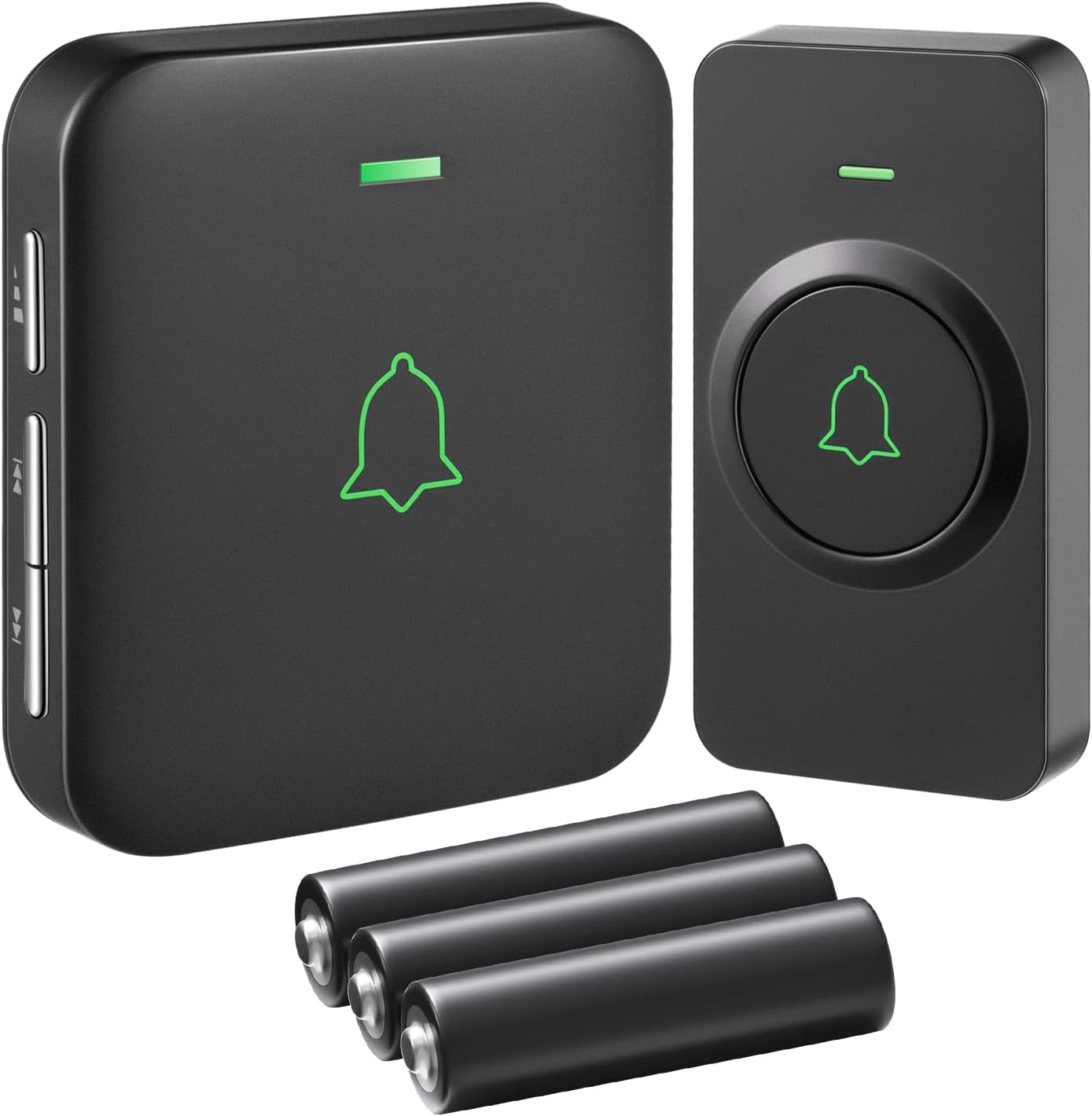
Key specs: Battery-powered receiver as well as a battery button, so nothing needs an outlet; portable and can be carried between rooms; stated 1,000 ft range
This is the pick that solves a problem the others cannot. Both halves run on batteries, so the chime does not need an outlet at all – it can live on a kitchen shelf, move upstairs at night, or go out to a garden office. For older houses with awkward outlet placement, or for anyone who wants the chime in a room where every socket is already occupied, that flexibility is worth more than any tone count. The stated range is 1,000 ft in open space. The honest tradeoffs are that a battery receiver is quieter than a plug-in one, and you now have two sets of batteries rather than one – which is fine as long as you notice when the chime stops rather than assuming nobody has called.
✅ Pros
- Battery receiver needs no outlet at all
- Portable – carry it to whichever room you are in
- Stated 1,000 ft open-space range
- Large review base for a battery-receiver kit
❌ Cons
- Battery receivers are quieter than plug-in ones
- Two sets of batteries to keep track of
- A dead receiver battery is silent, which is easy to miss
- Portability means it gets left in the wrong room
GE Wireless Doorbell Kit — best simple kit
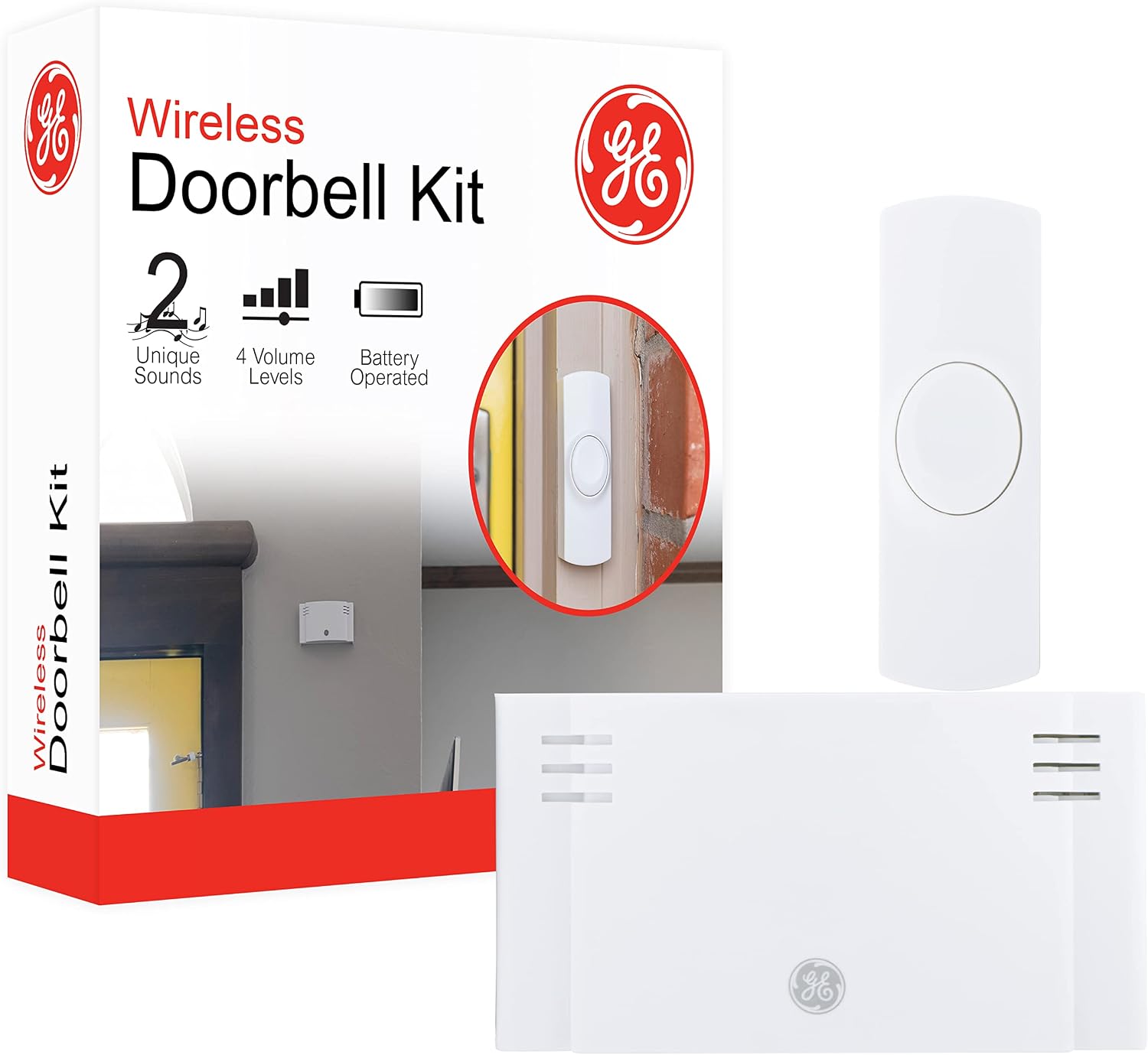
Key specs: Simple two-melody kit with a battery-operated receiver and one push button; four volume levels; the pared-back option for anyone who wants a doorbell rather than a menu of tones
Two melodies, four volume levels, one button, a battery receiver. There is a real argument for this: every extra tone and mode in this category is a setting somebody has to get right, and a doorbell is a device where the correct number of decisions is close to zero. If you are fitting this for someone who will not be adjusting settings – a rental, an elderly relative, a workshop – the pared-back option is the considerate one. It is a long-standing product from a name people recognize, and its limitation is exactly its appeal: if you later want a second receiver or a specific tone, this is not the kit that flexes.
✅ Pros
- Almost nothing to configure
- Battery receiver, so no outlet needed
- Four volume levels covers the useful range
- Recognizable brand with a long track record
❌ Cons
- Only two melodies
- Least expandable option here
- Battery receiver is quieter than a plug-in one
- No published range or weather rating to compare
Volume, and the Limits of Turning It Up
Volume is the setting people actually use, and it is worth a note of context. The NIDCD notes that sounds at or below 70 A-weighted decibels are unlikely to cause hearing loss even after long exposure, while long or repeated exposure at or above 85 dBA can cause it, with distance and duration both mattering.
A doorbell chime is brief and intermittent, so this is not a safety warning – it is a placement one. A receiver at maximum volume on a shelf beside where someone sits is a different experience from the same receiver down a hallway, and the usual complaint about these kits is not that they are too quiet but that the one loud enough for the basement is unpleasant in the kitchen. Two receivers at moderate volume beats one at maximum, which is why the ability to add a second receiver is a more useful spec than the tone count.
Wireless Chime vs Fixing the Wired One
If you already have a wired doorbell that has stopped working, a wireless kit is the fast fix rather than the correct one – and the correct one is often cheaper. A wired doorbell is a transformer, two conductors and a button, and the button is a two-dollar part that fails far more often than the rest. Our guide to replacing a doorbell button walks through the ninety-second test that tells you which part died before you spend anything.
Where a wireless kit genuinely wins is when the wiring itself is the problem – a broken conductor inside a wall, a dead transformer in an inaccessible spot, or no doorbell circuit at all. Ring publishes transformer requirements in the 8 to 24 VAC range depending on model, and separate wiring diagrams per doorbell type, which gives a sense of how much there is to get right on the wired side. A radio button and a plug-in chime sidestep all of it.
One more scenario worth naming: adding a second chime to a house that already has a working wired doorbell. A wireless kit does that without touching the existing circuit, which is usually simpler than extending it. If you are weighing the whole doorbell question rather than just the chime, our wireless video doorbell roundup and our doorbell-versus-smart-lock comparison cover the two directions you could go.
Final Recommendation
Buy the SECRUI Wireless Doorbell. For a product whose whole job is to make a noise when somebody presses a button, the largest review base in the category and a plug-in receiver that never needs batteries is the right combination. It arrives paired, it mounts with adhesive or screws, and there is nothing about it that will need attention again.
Choose the TECKNET if your door is genuinely exposed – the IP67 rating is the most specific weather claim here, and an unsheltered button is the part of these kits that actually fails. Choose the AVANTEK when there is no outlet where you need to hear the chime, which is a more common constraint than people expect and the one thing a plug-in kit cannot solve. Take the GE kit when fewer settings is the feature.
What would change this: if you have existing doorbell wiring and the doorbell simply stopped working, do the two-wire touch test before buying any of these – a failed button is the most common cause and the cheapest fix. And if what you actually want is to see who is at the door rather than hear that someone is, no wireless chime solves that, and the honest answer is a video doorbell with the transformer checked first.
SafeBode does not yet run an in-house product testing program. This guide is built from manufacturer specifications, official support documentation, current retail listings and verified buyer feedback rather than hands-on testing, and we say so plainly rather than implying testing we have not done.
Frequently Asked Questions
Do wireless doorbells need wifi?
No. These use a direct radio link between the button and the receiver, with no network, account or app involved. That is why they keep working during an internet outage and why there is nothing to subscribe to.
How long do the batteries last?
Typically a year or more in the button under normal use, less if the doorbell is pressed constantly or the button is somewhere very cold. A battery-powered receiver is the one worth watching, because a flat receiver battery is silent rather than obvious.
Will the advertised range work in my house?
Not literally. Published ranges are measured in open space with nothing in between, so walls, floors and especially metal will reduce it substantially. Use the figure to rank products rather than as a distance you will achieve indoors.
Can I add a second chime in another room?
Most kits support pairing extra receivers to the same button, and that is usually a better answer than turning one receiver up. Two receivers at moderate volume covers a house more comfortably than one at maximum.
Can I use one alongside my existing wired doorbell?
Yes, and it is one of the better uses for these kits. A wireless button and receiver are entirely independent of the wired circuit, so you can add a chime in a basement or workshop without touching the existing wiring.
Are these weatherproof?
The buttons generally are, to varying degrees. One pick here carries an IP67 rating, which covers dust and temporary immersion; the others describe weather resistance without a published figure. The indoor receiver is not weather-rated in any case.
Why not just buy a video doorbell?
If you want to see who is there, do. But check compatibility first – some current video doorbells are not compatible with an existing in-home chime and need a separate chime accessory, so the upgrade is occasionally two purchases rather than one.
Do neighbors’ doorbells set these off?
It is possible with older fixed-code kits if a neighbor happens to run the same code on the same frequency, and it is rare with current products that pair a specific button to a specific receiver. If it happens, re-pairing the kit usually resolves it.
Sources
Show sources (4)


