Ring Solar Panel Guide: What It Does for a Battery Camera (and the 80% Charge Ceiling)
Affiliate Disclosure: This article contains affiliate links. If you buy through these links, we may earn a commission at no extra cost to you. Our editorial opinions are our own and are not influenced by affiliate relationships. Read our full disclosure policy →
Contents
Quick Answer
A Ring solar panel does not power your camera – it keeps the camera’s battery topped up, and Ring is explicit that it will not run the device with no battery inserted. Two things decide whether it works for you. It needs direct sunlight for a minimum of four to six hours a day, and Ring says filtered light through cloud will not provide a charge at all. And the battery level will not exceed a threshold of around 80%, deliberately, to extend battery lifespan. Site it in real sun and it ends battery swaps. Put it on a shaded wall and it does close to nothing.
What a Solar Panel Actually Does
The mental model most people arrive with is wrong in a way that matters. A solar panel is not an alternative power source that replaces the battery – it is a trickle charger that keeps the existing battery pack from running down. Ring states this directly: the solar panel is designed to help keep your camera charged longer, and it will not power your device without a battery inserted.
That distinction explains most disappointment with these panels. If your camera is draining faster than the panel replaces, the panel slows the decline rather than stopping it, and you will still be pulling the pack – just less often. A busy camera on a north-facing wall in January is exactly that situation.
The Outdoor Cam is designed around this flexibility, with Ring listing battery, plug-in and solar as power options for the same camera body. That is genuinely useful: if solar does not keep up where you mounted it, switching to a plug-in adapter is a purchase rather than a different camera. We compare the current outdoor lineup in our Outdoor Cam versus Outdoor Cam Plus guide.
The 80% Ceiling Nobody Mentions
Here is the detail that catches people who are otherwise doing everything right. Ring states that even with exposure to maximum sunlight, the battery level will not exceed a threshold of around 80% – deliberately, to extend battery life.
So a correctly-installed panel in perfect sun does not produce a camera sitting at 100%. It produces one hovering below 80%, and that is the system working as designed. If you have been checking the app and worrying that the panel is underperforming because the number never climbs, this is very likely the explanation rather than a fault.
Ring’s published solar numbers
4-6 hrs
Minimum daily direct sunlight Ring specifies
~80%%
Ceiling the battery level will not exceed, by design
45°
Angle Ring recommends the panel face the sun at
5W vs 2W
Super Solar Panel against the original, a stated 2.5x
The 80%% ceiling is deliberate battery-life protection, not underperformance.
It also has a practical implication worth planning around. Because the panel holds the battery below full rather than at full, you have less reserve than a freshly-charged pack would give you going into a long cloudy stretch. That is the tradeoff Ring has chosen on your behalf: longer battery lifespan, slightly less headroom.
Direct Sunlight Means Direct
Ring’s requirement is specific and stricter than most people assume: the panel should be installed where it will receive direct sunlight for a minimum of four to six hours a day. Not daylight. Direct sun on the panel.
The company is equally direct about what happens otherwise. Asked about mostly cloudy, rainy areas, Ring’s answer is that a frequently very cloudy installation area limits the sunlight reaching the panel, that the panel requires direct sunlight, and that filtered or indirect sunlight through cloud will not provide a charge. That is a stronger statement than “charges more slowly” – it is a statement that overcast light does not charge it.
Sites where solar works, and where it does not
Works
- A south-facing wall or roof in the Northern Hemisphere
- A spot with four to six hours of unobstructed direct sun
- Somewhere you can aim the panel at roughly 45 degrees
- A camera with moderate event volume
Does not work
- Under an eave, a porch roof or a balcony above
- A wall in shade for most of the day
- Below overhanging branches, or in their moving shadows
- A high-traffic camera in a cloudy winter climate
Ring adds two site details worth checking before you drill: watch for overhanging branches and the shadows of nearby branches, and remember that seasonality and how far north or south you live affect the strength of the sun. A spot that gets six hours of sun in July may get two in December, and December is when the camera’s battery is already struggling with the cold.
The Options Side by Side
| Accessory | Output | What it is for | Key limitation |
|---|
| Ring Solar Panel (2nd Gen) | 4W | The standard panel for Outdoor Cam, Outdoor Cam Plus, Stick Up Cam Pro and Spotlight Cam | Needs 4-6 hours of genuinely direct sun |
| Ring Small Solar Panel | 1.9W | A discreet panel for the same camera families | Gathers considerably less power than the 4W |
| Super Solar Panel | 5W, 5V DC | Cloudier locations and cameras with heavy battery drain | Larger and more visible; -5°F to 120°F rated |
| Quick Release Battery Pack | n/a | The pack the panel charges – required for any panel to do anything | Still the consumable in the system |
Ring Solar Panel (2nd Generation), 4W — the default choice
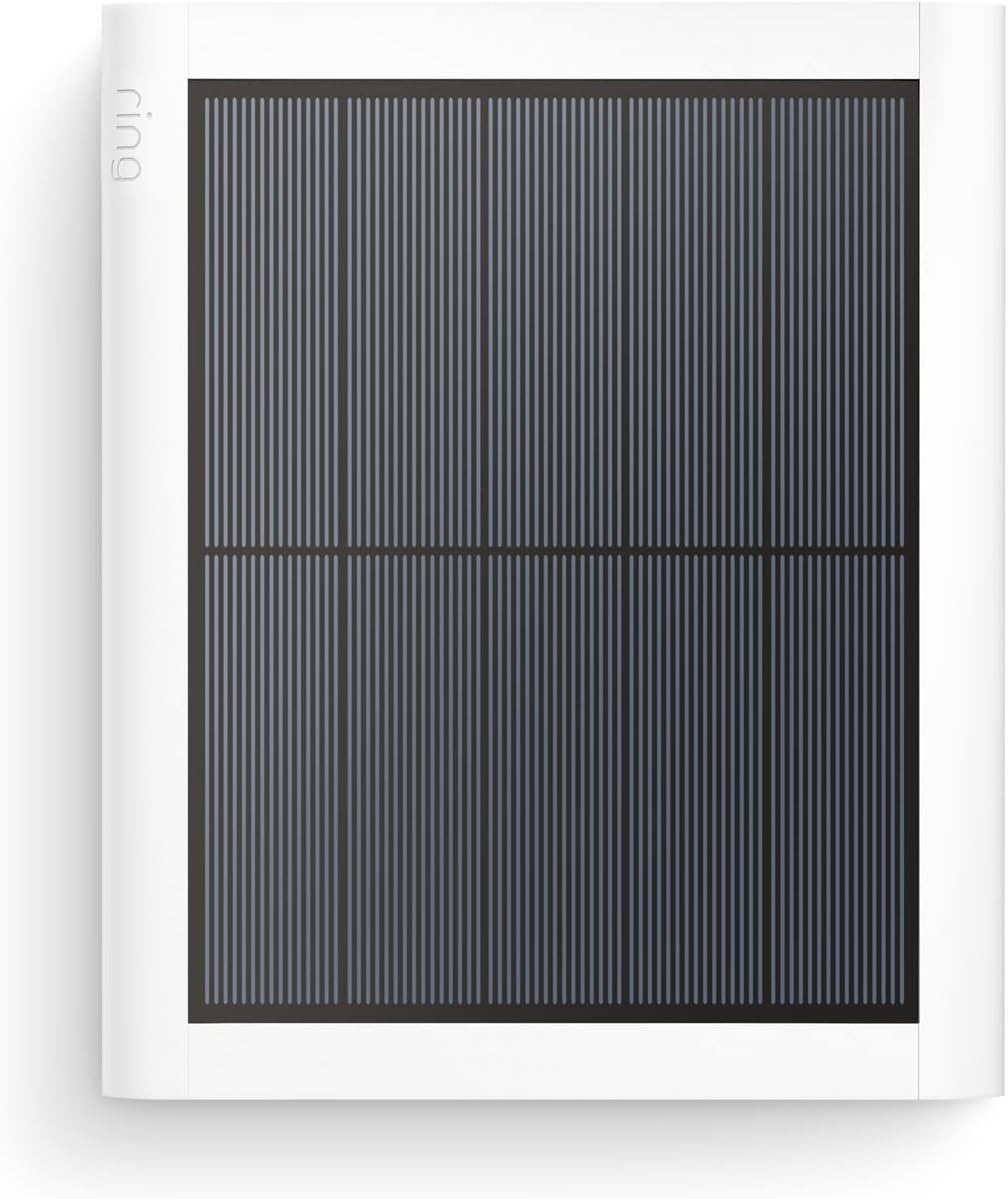
Key specs: 4W panel listed for Outdoor Cam Plus, Outdoor Cam (formerly Stick Up Cam), Stick Up Cam Pro and Spotlight Cam models; weatherproof barrel connector; adjustable mounting arm so the panel can be aimed at the sun
This is the panel to buy for a normally-sited camera. At 4W it is listed for the Outdoor Cam Plus, the Outdoor Cam (formerly Stick Up Cam), Stick Up Cam Pro and Spotlight Cam models, which covers most of Ring’s battery lineup, and it connects to the camera with a weatherproof barrel connector. The adjustable mounting arm is the part that earns its keep: Ring recommends aiming the panel at roughly a 45-degree angle toward the sun, facing south in the Northern Hemisphere, and a fixed panel bolted flat to a wall cannot do that. Fit it somewhere with four to six hours of real direct sun and battery maintenance stops being something you think about.
✅ Pros
- Covers most of Ring’s battery camera families
- Adjustable arm lets you actually aim it
- Weatherproof barrel connector
- Ends routine battery pulls on a well-sited camera
- Mounts to wood, brick, concrete or stucco
❌ Cons
- Useless without four to six hours of direct sun
- Holds the battery near 80%%, not 100%%
- Another item to mount and aim
- Does not enable 24/7 Recording
Ring Small Solar Panel, 1.9W — discreet, and weaker
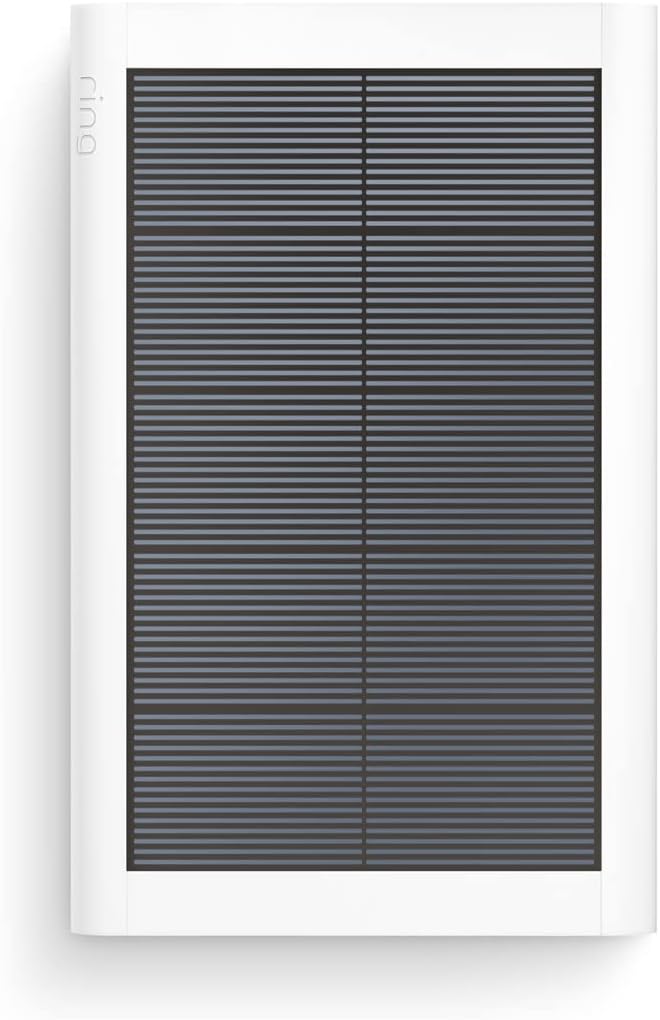
Key specs: 1.9W panel for the same camera families in a smaller housing; the discreet option for a location where a full-size panel is too visible, at the cost of gathering considerably less power
The small panel exists for a real problem: a full-size panel on the front of a house is conspicuous, and some people would rather have a smaller one they will actually install than a bigger one they keep putting off. At 1.9W it gathers considerably less than the 4W version, which is roughly half the collecting capability for the same sunlight. The honest way to think about it: this is the right choice only where sun exposure is genuinely excellent and the camera’s event volume is modest. In a marginal location, a small panel turns a half-working solution into a non-working one, and the money is better spent on a plug-in adapter.
✅ Pros
- Much less visible than the full-size panel
- Same camera compatibility families
- Easier to site on a small or awkward surface
- Same weatherproof connection design
❌ Cons
- 1.9W against 4W – roughly half the gathering capability
- Poor choice anywhere sun exposure is marginal
- Same 80%% battery ceiling applies
- Same four-to-six hour direct sun requirement
Ring Quick Release Battery Pack — what the panel is charging
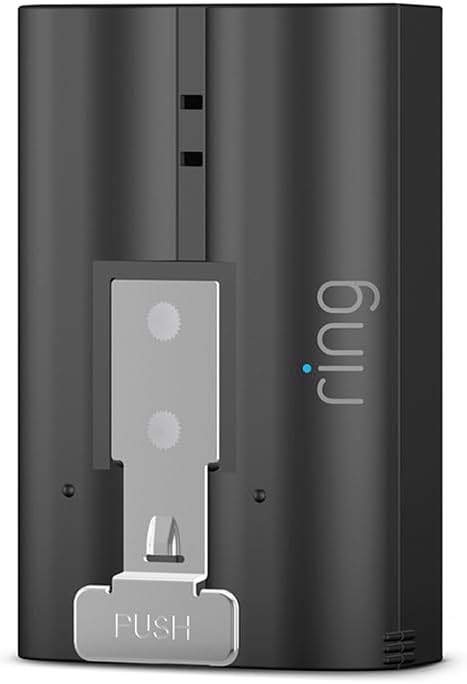
Key specs: The rechargeable pack every battery-powered Ring camera and doorbell runs on; a solar panel keeps this charged rather than replacing it, and Ring is explicit that a panel will not power a camera with no battery inserted
Worth including because a surprising number of people expect a solar panel to remove the battery from the equation, and Ring is explicit that it does not – the panel will not power your device without a battery inserted. The Quick Release pack is the component doing the actual work; solar just keeps it topped up. Having a second pack alongside a panel is the combination that genuinely ends downtime: when a long overcast stretch finally drains the installed pack, you swap in the charged spare and the panel refills the first one. On a camera you rely on, that is a better spend than upgrading the panel.
✅ Pros
- The component every battery Ring camera actually runs on
- A charged spare removes downtime during cloudy stretches
- Compatible across battery-powered Ring cameras and doorbells
- Swaps in seconds without dismounting the camera
❌ Cons
- Still a consumable that degrades over years
- Cold weather reduces usable capacity regardless of solar
- Does not solve a badly-sited panel
- Two packs is a real cost on top of the panel
Aiming It Properly Matters More Than Wattage
Given a choice between a bigger panel mounted badly and a smaller one aimed well, take the second. Ring’s installation guidance is specific: mount to a wall or flat surface, direct the panel toward the south in the Northern Hemisphere and toward the north in the Southern, and set it at roughly a 45-degree angle facing the sun using the adjustable arm.
Getting the install right
1
Find four to six hours of direct sun
Watch the spot across a day before drilling. Ring’s minimum is four to six hours of direct sunlight daily.
2
Check for branches and shadows
Ring specifically warns about overhanging branches and the shadows of nearby branches.
3
Face it toward the equator
South in the Northern Hemisphere, north in the Southern.
4
Set 45 degrees
Loosen the adjustment nut, angle the panel, tighten it again.
5
Insert a charged battery first
The panel maintains a battery; it does not replace one.
Ring rates the Super Solar Panel for -5°F to 120°F, so cold itself is not the constraint – available direct sun is.
If you are choosing between panels because your location is marginal, that is the case Ring makes for the Super Solar Panel specifically: it provides 5W against the original’s 2W – a stated 2.5 times the power – and Ring describes it as useful in areas with more cloud cover or for devices subject to faster battery drain through frequent use. It also carries a one-year parts warranty and lifetime theft protection.
Solar Does Not Make a Camera Eligible for 24/7 Recording
This one costs people money, so it is worth stating plainly. Ring’s 24/7 Recording feature requires an eligible camera that is hardwired, plugged in or powered over Ethernet, plus a Ring Protect subscription, plus a separate 24/7 Recording add-on for each camera. Solar is not on that list.
That makes sense once you think about the power budget – continuous recording draws far more than a trickle charger replaces – but it is not obvious from the marketing, and a solar camera looks like a permanently powered one in the app. If continuous recording is your goal, you need a plug-in or PoE camera, and the panel is the wrong purchase. Our guide to Ring’s subscription plans covers how the plan tiers and add-ons fit together.
Worth knowing alongside that: continuous footage is held for up to 14 days, shorter than the event-clip storage window on the same camera. So the feature you would be buying a plug-in camera for also produces the shortest-lived recordings in the system.
When It Is Not Worth Buying
When the mounting spot is shaded. Ring’s own position is that filtered or indirect sunlight through cloud will not provide a charge. A panel under an eave is decoration. Move the camera, use a plug-in adapter, or accept the battery swaps.
When the camera is a no-subscription setup that stores locally. Solar keeps a Ring camera fed, but Ring records nothing without a plan at any power level. If the reason you liked the idea of solar was avoiding recurring costs entirely, our roundup of solar cameras across brands is the honest place to look instead.
When an outlet is within reach. A plug-in adapter is cheaper than a panel, never has a bad month, and unlike solar it makes the camera eligible for 24/7 Recording. Solar exists for places you cannot run a cable, not as a general upgrade.
When the camera is extremely busy. A camera on a street-facing driveway recording dozens of events a day can outpace what a panel replaces, which is the scenario Ring points at the higher-output Super Solar Panel for. If your battery is dying weekly now, a panel will make that fortnightly rather than never. Reducing false triggers is often the better first move – our guide to cutting false motion alerts covers how, and our placement walkthrough is worth reading if the camera is also watching the wrong area.
Final Recommendation
Buy the 4W Ring Solar Panel (2nd Generation), and only if you have a mounting spot with four to six hours of genuinely direct sun. That condition is the whole decision. Met, the panel ends battery maintenance on a normally-used camera and the adjustable arm lets you aim it properly at 45 degrees facing south. Unmet, no panel in the range fixes it.
Choose the Super Solar Panel instead if your climate is genuinely cloudy or the camera is busy enough to drain quickly – Ring positions its 5W output, 2.5 times the original panel, at exactly those two cases. Take the 1.9W small panel only where sun exposure is excellent and visibility of the hardware genuinely matters, because in a marginal spot the smaller panel is the difference between working and not.
What would change this: if there is an outlet within reach, buy a plug-in adapter instead. It is cheaper, it is unaffected by weather, and it is the only route to 24/7 Recording, which no solar panel enables. And set expectations before you install: a working panel holds the battery near 80% rather than full, which is deliberate battery protection rather than a fault.
SafeBode does not yet run an in-house product testing program. This guide is built from manufacturer specifications, official support documentation, current retail listings and verified buyer feedback rather than hands-on testing, and we say so plainly rather than implying testing we have not done.
Frequently Asked Questions
Does a Ring solar panel replace the battery?
No. Ring states the panel will not power the device without a battery inserted – it keeps the existing battery pack charged rather than acting as a power supply. The battery is still doing the work.
Why does my camera never reach 100% with solar?
By design. Ring says that even with maximum sunlight, the battery level will not exceed a threshold of around 80%, deliberately, to extend battery lifespan. A camera sitting just below 80% is the system working correctly.
How much sun does it actually need?
Ring specifies a minimum of four to six hours of direct sunlight a day. Direct is the operative word – the company states that filtered or indirect sunlight through cloud will not provide a charge.
Will it work in a cloudy climate?
Poorly, on Ring’s own account. Its guidance for frequently cloudy areas is that the panel requires direct sunlight and that indirect light will not charge the device. The higher-output Super Solar Panel is what Ring points at for cloudier locations.
Which way should the panel face?
Toward the equator – south in the Northern Hemisphere, north in the Southern – at roughly a 45-degree angle, using the adjustable mounting arm. Check for overhanging branches and their moving shadows before mounting.
Does solar let me use 24/7 Recording?
No. That feature requires a camera that is hardwired, plugged in or powered over Ethernet, plus a subscription and a per-camera add-on. Solar is not an accepted power source for it, and this is a common and expensive misunderstanding.
Is the Super Solar Panel worth the upgrade?
In two specific cases: a cloudy climate, or a camera whose battery drains fast because of frequent events. Ring rates it at 5W against the original’s 2W and positions it at exactly those situations. In a sunny spot on a quiet camera, the standard panel is enough.
Can I mount the panel on brick?
Yes. Ring’s instructions cover mounting directly into wood with the supplied screws, and provide a separate procedure for brick, concrete or stucco. The adjustable arm then lets you aim the panel regardless of the surface angle.
Sources
Show sources (4)


