Ring Outdoor Cam vs Outdoor Cam Plus (2026): What Happened to the Stick Up Cam
Affiliate Disclosure: This article contains affiliate links. If you buy through these links, we may earn a commission at no extra cost to you. Our editorial opinions are our own and are not influenced by affiliate relationships. Read our full disclosure policy →
Contents
Quick Answer
The Stick Up Cam was renamed, not discontinued – Ring states plainly that Stick Up Cam (3rd Gen) is now called Outdoor Cam, with the same features and the same accessories. The genuine decision is between that camera and the Outdoor Cam Plus, and it comes down to three specs: 1080p versus 2K, a 110 degree versus 140 degree field of view, and 2.4 GHz-only versus dual-band wifi. If your camera sits far from the router or watches a wide driveway, the Plus is worth it. If it is covering a back door ten feet away, it is not.
First: The Stick Up Cam Did Not Disappear
A lot of the confusion around this comparison is a naming problem rather than a product one. Ring’s own support page for the camera says it directly: Stick Up Cam (3rd Gen) is now Outdoor Cam, all the features are the same under the new name, and every instruction, guide and accessory for the Stick Up Cam (3rd Gen) still works with the Outdoor Cam.
That matters practically. Mounts, solar panels and battery packs sold for the Stick Up Cam are not orphaned stock – they are current accessories with an old name on the box. Ring’s own solar panel listing still names both products, which is a reasonable sanity check when you are trying to work out whether something fits.
It also means older reviews are not automatically stale. A 2024 review of the Stick Up Cam (3rd Gen) describes the camera Ring currently sells as the Outdoor Cam. What it will not describe is the Outdoor Cam Plus, which is a genuinely different camera and the actual subject of this comparison.
The Real Gap Between These Two Cameras
Strip the marketing and there are exactly three differences that change what you see and whether the camera works reliably where you want to put it. Everything else – the siren, Two-Way Talk with noise cancellation, the flexible battery, plug-in or solar power – both cameras have.
The three specs that actually differ
1080p to 2K
Resolution: 1080p HD on Outdoor Cam, 2560×1440 on the Plus
110 to 140
Horizontal field of view, in degrees
57 to 80
Vertical field of view, in degrees
1 to 2 bands
2.4 GHz only, versus dual-band 2.4 and 5 GHz
Ring publishes both spec sheets. These four rows are where they diverge; the rest of the feature list is shared.
The field-of-view numbers deserve more attention than the resolution ones. Going from 110 to 140 degrees horizontally is a large change in how much of a driveway or yard fits in frame, and the vertical jump from 57 to 80 degrees is proportionally even bigger – that is the axis that determines whether you see a face at the door and the ground where a package was left. Resolution helps you identify what is in frame. Field of view determines whether it is in frame at all.
Specifications Side by Side
| Specification | Outdoor Cam (ex Stick Up Cam) | Outdoor Cam Plus |
|---|
| Video | 1080p HD, Color Night Vision | 2K, 2560×1440, night vision |
| Field of view | 110° horizontal, 57° vertical | 140° horizontal, 80° vertical, 160° diagonal |
| Wifi | 2.4 GHz only | Dual-band 2.4 GHz and 5 GHz |
| Power options | Battery, plug-in or solar | Battery, plug-in, solar or Power over Ethernet |
| Siren | Remote-activated | Remote-activated |
| Audio | Two-Way Talk with noise cancellation | Two-Way Talk with noise cancellation |
| Stated operating range | Not published on the product page | -4°F to 122°F, weather resistant |
| 24/7 Recording eligible | Yes, on continuous power | Yes, on continuous power |
| Size | 2.36 x 2.36 x 3.82 in without stand | 2.6 x 2.6 x 5.0 in with stand |
The Dual-Band Difference Nobody Mentions
Reviews lead with resolution because it is easy to photograph. In practice the wifi radio causes more real-world grief. The Outdoor Cam is 2.4 GHz only; the Plus supports both 2.4 and 5 GHz. Neither is strictly better – they fail in opposite directions.
Which band actually helps where you are mounting
2.4 GHz alone is fine when
- The camera is close to the router or a mesh node
- You live somewhere with few competing networks
- The camera is behind one interior wall at most
- Range matters more than throughput – 2.4 GHz travels further
Dual-band earns its keep when
- You are in an apartment building where 2.4 GHz is congested
- The camera is close enough to reach 5 GHz cleanly
- You are pushing 2K video and want the headroom
- Your router hands out one SSID and picks the band itself
The scenario that catches people is a 2K camera on a congested 2.4 GHz band: the sensor is capable, the network is not, and the result is a camera that buffers or drops. If you are mounting anything far from the router, test the signal at the actual mounting spot before you buy – we walk through how in our guide to testing wifi before buying a wireless camera. Bandwidth is also the reason where you place the camera matters more than camera choice for some households.
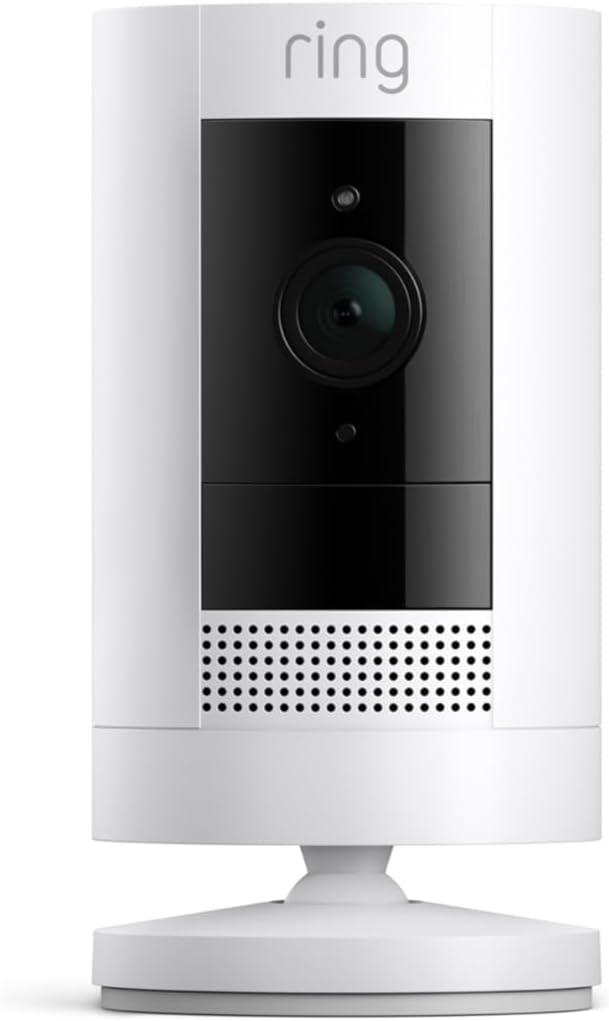
Key specs: 1080p HD with Color Night Vision; 110 degrees horizontal by 57 degrees vertical field of view; 2.4 GHz wifi only; remote-activated siren; Two-Way Talk with noise cancellation; battery, plug-in or solar power; 2.36 x 2.36 x 3.82 in without the stand
This is the camera most people already own without realizing its name changed. At 1080p with a 110 by 57 degree field of view it is a competent close-range camera: a back door, a side gate, a garage interior, anywhere the subject will be within a few yards and roughly centered. It keeps everything that made the Stick Up Cam popular – the remote siren, Two-Way Talk, and the ability to run on battery, plug-in or solar power from the same body. Its real limitation is not image quality, it is coverage: the narrow vertical field means you are choosing between seeing a face and seeing the doorstep, and 2.4 GHz-only wifi puts a ceiling on where you can mount it reliably.
✅ Pros
- Same camera as the Stick Up Cam (3rd Gen), just renamed
- Remote-activated siren and Two-Way Talk
- Battery, plug-in or solar from one body
- Physically smaller than the Plus
- Every existing Stick Up Cam accessory still fits
❌ Cons
- 1080p, against 2K on the Plus
- 110° by 57° field of view is genuinely tight
- 2.4 GHz wifi only – no 5 GHz fallback
- Ring does not publish an operating temperature range for it
Ring Outdoor Cam Plus, Battery — the default upgrade
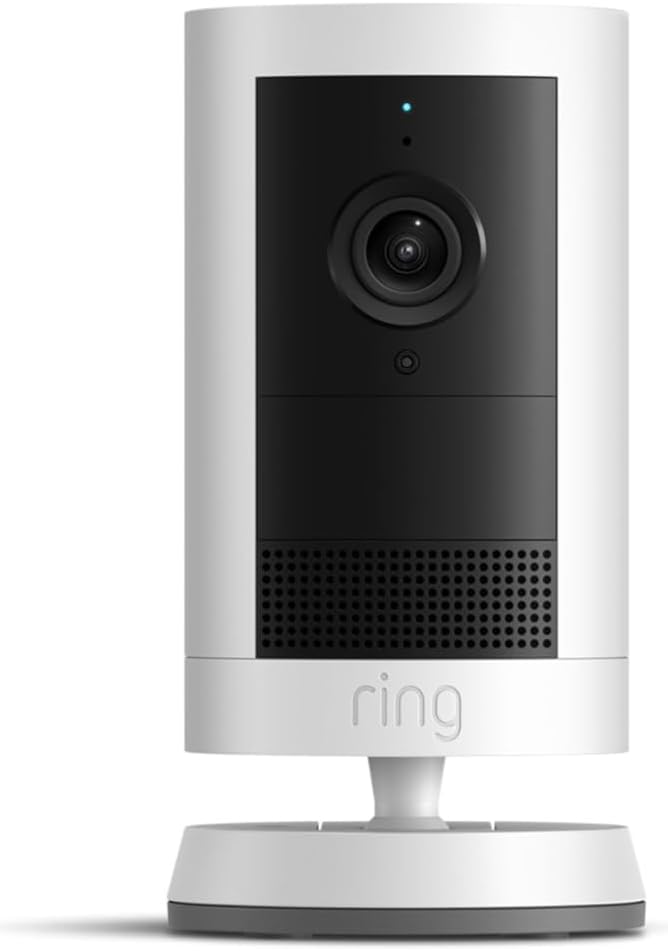
Key specs: 2K video at 2560×1440 with night vision; 140 degrees horizontal by 80 degrees vertical, 160 degrees diagonal; dual-band 2.4 GHz and 5 GHz wifi; rechargeable battery pack included; rated -4F to 122F; remote-activated siren; eligible for 24/7 Recording when on continuous power
The battery Outdoor Cam Plus is the version most buyers should be comparing against. You get 2K at 2560×1440, a 140 by 80 degree field of view, and dual-band wifi, in a body that still installs anywhere because the battery pack means no wiring. Ring publishes an operating range of -4°F to 122°F for it, which is a specification the older camera’s page does not state at all. The honest catch is the one every battery camera shares: recording drains it, and a busy driveway will have you pulling the pack more often than the product page implies. That is what the solar panel below exists to solve.
✅ Pros
- 2K resolution and a much wider field of view
- Dual-band wifi solves the congested-2.4 GHz problem
- Published -4°F to 122°F operating range
- Installs anywhere, no wiring needed
- Can be moved to plug-in or PoE later
❌ Cons
- Battery life falls with event volume, as on any battery camera
- Physically larger than the Outdoor Cam
- Not eligible for 24/7 Recording while on battery
- 2K on a weak network is worse than 1080p on a strong one
Ring Outdoor Cam Plus, Plug-In — the one that unlocks 24/7
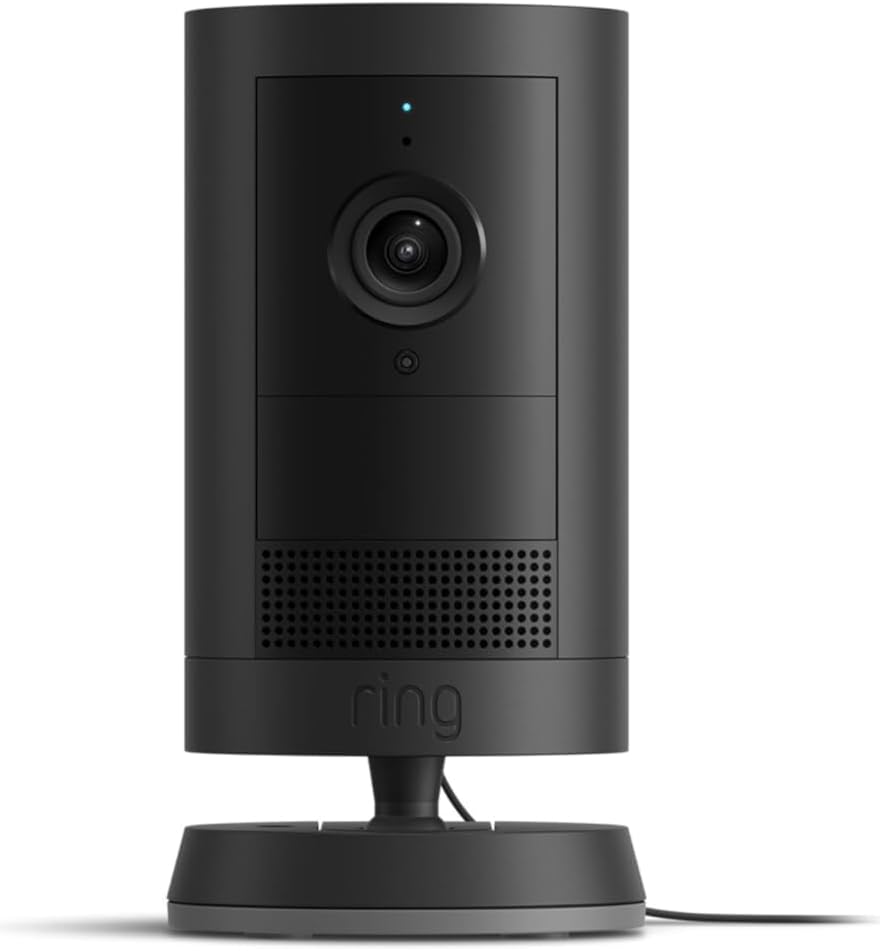
Key specs: The same 2K sensor and 140 by 80 degree field of view as the battery model, permanently powered from a wall outlet; dual-band wifi; Power over Ethernet available as an option; the configuration that makes 24/7 Recording possible
Same sensor, same optics, different power. The plug-in Outdoor Cam Plus matters because of a constraint that is easy to miss when shopping: 24/7 Recording only works on cameras that are hardwired, plugged in or powered over Ethernet, and it needs its own add-on subscription for each camera on top of a Ring Protect plan. A battery camera cannot do it at any price. If continuous recording is the reason you are buying, this is the configuration – or the PoE option, which the Plus also supports. Worth knowing before you commit: continuous footage is only held for up to 14 days, shorter than the event-clip window on the same camera.
✅ Pros
- Only configuration that makes 24/7 Recording possible
- No batteries to pull, recharge or replace
- Same 2K sensor and 140° field of view as the battery model
- Power over Ethernet supported as an alternative
❌ Cons
- Needs an outlet within reach of the mounting point
- 24/7 Recording is a separate per-camera add-on
- Continuous footage is capped at 14 days
- A power cut takes the camera offline entirely
Ring Solar Panel (2nd Generation) — the accessory that changes the maintenance story
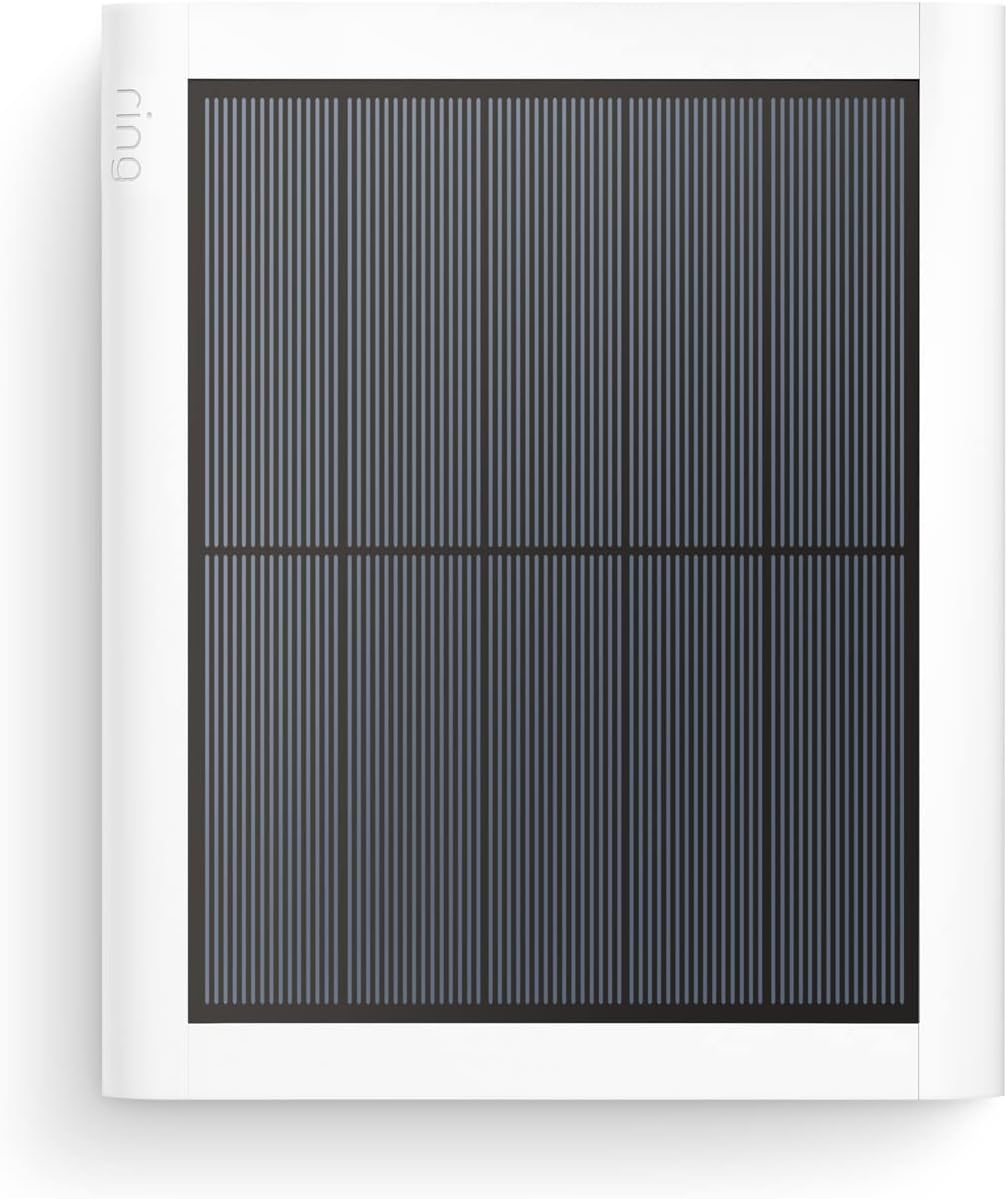
Key specs: 4W solar panel listed for Outdoor Cam Plus, Outdoor Cam (Stick Up Cam), Stick Up Cam Pro and Spotlight Cam models; keeps a battery camera topped up so the battery pack does not need pulling and recharging
This is the purchase that quietly decides whether you still like your battery camera in a year. The 4W second-generation panel is listed for the Outdoor Cam Plus, the Outdoor Cam (Stick Up Cam), the Stick Up Cam Pro and Spotlight Cam models, which is a useful confirmation that Ring treats the renamed camera as fully current. Attached to a camera with real sun exposure, it turns a quarterly battery swap into something you stop thinking about. The honest limitation is the one every solar accessory shares and few listings state: it trickles, it does not fast-charge, so a north-facing wall, a heavily shaded yard or a long overcast winter will not keep up with a busy camera.
✅ Pros
- Ends routine battery pulls on a well-sited camera
- Listed for both the Outdoor Cam and Outdoor Cam Plus
- Works with the existing Quick Release battery pack
- No wiring or outlet needed
❌ Cons
- Needs genuine direct sun, not just daylight
- Trickle charge only – it will not recover a heavily used camera in winter
- Another thing on the wall to mount and aim
- Does not make the camera eligible for 24/7 Recording
Both Need a Subscription to Record Anything
This applies equally to every camera on this page and it is the single most common misunderstanding about Ring hardware. Without a subscription you can view live video and respond to alerts as they happen, but a subscription is required to review recorded video, and events are only recorded after you subscribe. Buying the more expensive camera does not change that.
Storage length is set per device rather than per account, and in the US defaults to 60 days for 1080p and 2K cameras – which is both of these – adjustable from 1 day up to 180. The plan tiers themselves changed names in January 2026, and we break down what each one now covers in our guide to Ring’s 2026 subscription plans. If the recurring cost is what is holding you back, our roundup of systems that do not need one is the more useful comparison.
How to Choose in Ninety Seconds
Four questions, in order
1
How far from the router?
Far, or through several walls, in a building full of competing networks? Take the Plus for dual-band. Close by? The band does not matter.
2
How wide is the area?
A driveway, a yard, a shopfront – the Plus’s 140 by 80 degree view is the reason to buy it. A single door at close range does not need it.
3
Do you want continuous recording?
Then you need a plug-in or PoE camera plus a per-camera add-on. No battery model qualifies, whichever one you buy.
4
Will you actually recharge a battery?
If not, budget for the solar panel now or buy the plug-in version. This is where people regret the cheaper choice.
Only one of these four questions is about image quality, and it is not the first one.
Final Recommendation
Buy the Ring Outdoor Cam Plus in its battery form, and add the solar panel at the same time. The 140 by 80 degree field of view is the upgrade that changes what the camera actually captures, dual-band wifi removes the most common cause of an unreliable outdoor camera, and pairing it with solar removes the maintenance chore that makes people stop trusting battery cameras. That combination covers the widest range of real mounting spots without wiring anything.
Choose the plain Outdoor Cam instead when the camera is watching a small, close, well-lit area within easy reach of your router – a back door, a side passage, the inside of a garage. At that range 1080p resolves faces perfectly well, the narrower field of view is not a handicap, and you are not paying for coverage you cannot use. Buy the plug-in Plus only if 24/7 Recording is genuinely the goal, and go in knowing the continuous footage expires after 14 days regardless of your storage setting.
What would change this recommendation entirely: if you do not want a subscription, none of these are right. Every one of them records nothing without a plan, so a camera with local storage is the honest answer, not the cheaper Ring. And if you already own a Stick Up Cam (3rd Gen), you own the Outdoor Cam – there is nothing to upgrade unless the field of view is the thing failing you. Our full Ring camera comparison covers where each current model lands.
SafeBode does not yet run an in-house product testing program. This guide is built from manufacturer specifications, official support documentation, current retail listings and verified buyer feedback rather than hands-on testing, and we say so plainly rather than implying testing we have not done.
Frequently Asked Questions
Was the Stick Up Cam discontinued?
No. Ring’s support page states that Stick Up Cam (3rd Gen) is now called Outdoor Cam, that all the features are the same, and that existing instructions and accessories still work. It is a rename, not a replacement.
Will my old Stick Up Cam mounts and solar panel fit the Outdoor Cam?
Yes. Ring says explicitly that accessories for the Stick Up Cam (3rd Gen) work with the Outdoor Cam, and its current solar panel listing names both products.
Is 2K noticeably better than 1080p on these cameras?
At close range, less than you would expect. The bigger practical gain on the Plus is the wider field of view, which changes what ends up in frame at all. Resolution mainly helps when you need to identify something at distance or crop into the image.
Can either camera record 24/7?
Both are listed as eligible, but only when hardwired, plugged in or powered over Ethernet, and only with a separate per-camera add-on on top of a Ring Protect subscription. A battery-powered camera cannot do it regardless of model.
Do I need 5 GHz wifi for the Outdoor Cam Plus?
No. It supports both bands and will happily run on 2.4 GHz. Dual-band is an option that helps in congested environments, not a requirement.
How cold can these cameras get?
Ring publishes -4F to 122F for the Outdoor Cam Plus. It does not publish an operating range on the Outdoor Cam product page, so we are not going to state one for it. Battery capacity drops in cold weather on either camera.
Does the solar panel mean I never touch the battery again?
Only if the panel gets real direct sun. It trickle-charges rather than fast-charges, so a shaded mounting spot or a long overcast stretch on a busy camera will still drain the pack faster than the panel refills it.
Can I use these without paying Ring anything?
You can view live video and get real-time alerts with no subscription, but nothing is recorded and there is no history to review. Ring is explicit that events are only recorded after you subscribe, so a plan is not optional if saved footage is the point.
Sources
Show sources (5)


