How Much Does a Home Security System Actually Cost? A Full Cost Breakdown (2026)
Affiliate Disclosure: This article contains affiliate links. If you buy through these links, we may earn a commission at no extra cost to you. Our editorial opinions are our own and are not influenced by affiliate relationships. Read our full disclosure policy →
Table of Contents
The Sticker Price Isn’t the Real Cost
Most “home security system cost” searches land on a single number — an average price meant to represent every system, every household, every city. That number is close to useless on its own, because the actual cost of a security system is spread across several categories that don’t move together: equipment you buy once, an optional monthly subscription, and a set of local fees almost nobody budgets for until they get a bill for one. Two households can buy the exact same hardware and end up with very different total costs, depending on whether they self-monitor or pay for professional monitoring, and whether their city charges for alarm permits or false alarms.
This guide breaks the real cost into its actual components instead of quoting one blended average, so you can see exactly where your money goes and where it doesn’t have to. For product picks by category, see our DIY home alarm systems guide or our renter-focused systems guide.
Quick Answer
A security system’s real cost has 3 parts: equipment (a one-time purchase), monitoring (an optional recurring fee that ranges from free self-monitoring to a paid professional tier), and local fees most people never see coming — alarm permits and false-alarm fines, which are set by your city, not the manufacturer. The single biggest lever on your long-term cost isn’t which brand you buy; it’s whether you self-monitor or pay for a multi-year professional contract, since “free” professional installation is usually financed inside that contract rather than actually free.
Who This Guide Is For
This guide is for you if:
- ✅ You’re budgeting for a security system and want to know what actually drives the total cost
- ✅ You’re comparing DIY self-monitoring against a professional monitoring contract
- ✅ You want to know about permit requirements and false-alarm fines before you get surprised by one
- ✅ You want to understand how your monitoring choice affects your insurance discount eligibility
Skip this guide if:
- ❌ You already know which system you want and just need the picks — see our DIY home alarm systems guide instead
- ❌ You’re specifically choosing between a full system and standalone cameras as a renter — see our system vs. camera decision guide
- ❌ You want a review of a specific brand’s pricing (see our ADT review, or SimpliSafe, Vivint) rather than the category as a whole
The 3 Real Cost Categories
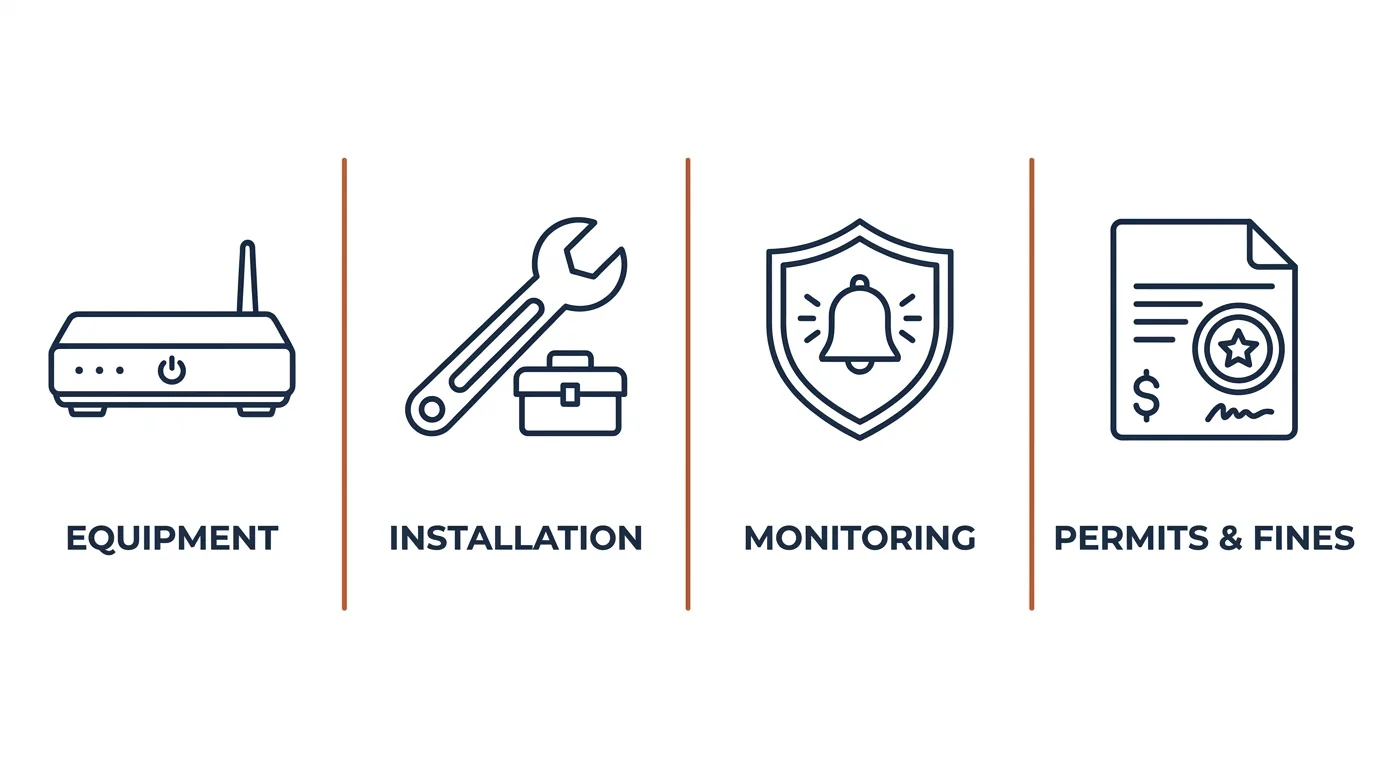
1. Equipment
This is the one-time purchase: a hub or base station, entry sensors for your doors and windows, and usually a motion sensor. It’s the most straightforward cost, since it’s a single transaction with a clear price tag at checkout, and it varies mainly by how many entry points you’re covering and whether you add extras like a camera or a smoke detector.
2. Installation
Most modern DIY-friendly systems use adhesive-mount sensors you install yourself in minutes, so this cost is effectively zero for most renters and homeowners. Professional, wired installation still exists for larger or more complex systems, and companies frequently advertise it as “free” — but that’s rarely the full picture, which is exactly why the next section exists.
3. Monitoring
This is the recurring cost, and it’s the one with the widest range: free if you self-monitor through an app, or a paid monthly tier if you want 24/7 professional monitoring that can actually dispatch police. It’s also the category most worth comparing carefully before you buy, since it’s the part of the bill you’ll keep paying for as long as you own the system.
DIY vs. Professional: Where the Cost Actually Goes
The security system market really splits into two different cost models, not two versions of the same one. A DIY system asks you to pay more upfront for the hardware, then gives you the freedom to self-monitor for free or add a paid tier later with no long-term commitment. A professionally installed system flips that: the installation and often even the equipment show up as “free” or heavily discounted, but professional monitoring typically requires a multi-year contract to unlock — which means the hardware cost hasn’t disappeared, it’s been folded into monthly payments you’re locked into for years.
The “Free Installation” Catch
When a provider waives installation or equipment cost, that cost hasn’t vanished — it’s typically recovered through the required multi-year monitoring contract. Before comparing a “$0 upfront” professional offer against a DIY kit’s sticker price, multiply the monthly monitoring fee by the full contract length to see the real total, not just the number on the box.
The Cost Most People Forget: Permits and False Alarm Fines
In most areas, a monitored alarm system requires a local permit, and the consequences for skipping it are set by your city, not your alarm provider. Some cities have “no permit, no response” policies where emergency services won’t respond to an unregistered alarm at all; in most cities, homeowners face a fine of up to $1,000 if emergency services do respond to an unregistered system. In Los Angeles specifically, operating a home security system without a permit is against the law and can carry real legal consequences, not just a fine.
False alarms are the other cost nobody budgets for. False alarms account for up to 94% to 98% of all alarm calls, costing emergency services roughly $1.8 billion a year nationally — which is exactly why most cities charge escalating fines after your first couple of free passes. The fee itself varies enormously by location, as the comparison below shows.
$6,350
San Jose’s fine for 10 false alarms in a year
$500
Denver’s fine for the exact same 10 false alarms
Check your specific city’s alarm ordinance before you buy, not after your first false trigger.
How Your Monitoring Choice Affects Your Insurance Discount
Many renters and homeowners insurance policies offer a discount for having a security system in place — and that discount is a real, if often overlooked, way to offset the monitoring cost. But insurers generally reserve the larger discounts for professionally monitored systems, not self-monitored ones, since a monitored system that can actually dispatch help is a lower risk to insure than one that just sends you a phone notification. If a lower premium is part of your cost calculation, confirm your specific insurer’s requirements before assuming a free self-monitored setup will qualify.
Full Cost Breakdown Table
Actual dollar figures shift constantly with promotions and inventory, so instead of a snapshot that goes stale, this table shows the relative cost tier and payment structure for each category — see Forbes Home’s current cost guide for today’s specific price ranges.
| Cost Category | Relative Tier | Payment Structure | Who Sets the Price |
|---|
| Equipment (DIY) | Moderate | One-time purchase | Manufacturer / retailer |
| Installation (DIY, adhesive-mount) | None | Your own time | N/A — self-installed |
| Installation (professional, wired) | Often waived upfront | Recovered via monitoring contract | Monitoring provider |
| Self-monitoring | None | Free, app-based | N/A |
| Professional monitoring | Moderate to high | Recurring monthly, often contract-locked | Monitoring provider |
| Alarm permit | Low | One-time or annual, varies by city | Local government |
| False alarm fine | None if no false alarms; escalates fast if repeated | Per-incident, after a free-pass threshold | Local government |
How to Lower Your Total Cost
- Register for your permit immediately. It’s typically the cheapest line item in this whole breakdown, and skipping it risks a fine that dwarfs it.
- Test your system after every change. A high false-alarm count is the single most avoidable cost here, and most fine schedules escalate sharply after the first couple of incidents. See our guide to stopping false alarms for the specific steps that actually reduce this.
- Compare the full contract cost, not the headline offer. Multiply “free installation” offers by their required contract length before comparing them to a DIY kit’s upfront price.
- Ask your insurer what actually qualifies for a discount before assuming self-monitoring will save you money on your premium.
Who This Guide Isn’t Right For
- You want specific product picks, not a cost framework — see our DIY home alarm systems guide instead.
- You’re renting and choosing between a full system and standalone cameras — see our system vs. camera decision guide.
- You want a single brand’s exact current pricing — check that provider’s own site directly, since promotional pricing changes frequently.
Final Recommendation
Before you compare a single product’s price tag, total up all 4 categories in this guide for your specific situation: equipment, monitoring, your city’s permit requirement, and your realistic false-alarm risk. For most renters and budget-conscious homeowners, a DIY system with adhesive-mount sensors and either free self-monitoring or a no-contract paid tier keeps every one of those categories under your own control, rather than locked into a multi-year contract you agreed to based on a headline “free installation” offer. See our DIY home alarm systems guide for specific picks once you’ve settled on your monitoring approach.
Weighing this against other options? See our DIY Systems hub for a full breakdown by situation.
FAQ
Is “free” professional installation actually free?
Not usually. Professional installation and equipment discounts are typically recovered through a required multi-year monitoring contract, so the cost hasn’t disappeared — it’s just been spread into monthly payments you’re locked into.
Do I actually need a permit for a home alarm system?
In most areas, yes, if the system is professionally monitored. Requirements and consequences vary by city, from a required registration fee to, in places like Los Angeles, real legal consequences for operating without one. Check with your local police or fire department directly.
How much can a false alarm actually cost me?
It depends heavily on your city and how many you’ve had. Fine schedules escalate fast after a small number of free passes, and the exact cost varies enormously by jurisdiction — from a few hundred dollars to several thousand for repeated offenses in some cities. Check your specific city’s alarm ordinance.
Does self-monitoring ever qualify for an insurance discount?
Rarely to the same degree as professional monitoring. Insurers generally reserve their larger discounts for systems with active, professional monitoring rather than self-monitored setups. Confirm the exact requirement with your own insurer.
Is DIY or professional monitoring cheaper in the long run?
It depends on how long you keep the system and whether you value the insurance discount and dispatch response enough to pay for it. DIY self-monitoring has the lowest total cost since there’s no recurring fee, but a professionally monitored system’s multi-year contract can still work out reasonably if you were going to want monitoring anyway and stay past the contract term.
A note on our research approach: this guide describes cost structure and relative tiers rather than point-in-time dollar figures, since security system and monitoring pricing changes frequently with promotions and market competition. Permit and false-alarm figures are drawn directly from the primary and secondary sources cited throughout, which are more stable since they’re set by local government ordinance rather than market pricing.
Sources
Show sources (4)


