Retail Store Security Cameras 2026: Coverage That Deters Theft
Affiliate Disclosure: This article contains affiliate links. If you buy through these links, we may earn a commission at no extra cost to you. Our editorial opinions are our own and are not influenced by affiliate relationships. Read our full disclosure policy →
Contents
Quick Answer
For a customer-facing store, buy the 4COVR 16-channel system — IK10 vandal-resistant housings are the specification a shop floor needs and a warehouse does not, because your cameras are within arm’s reach of the public. Choose the ONWOTE instead if your priority is finding a specific person in weeks of recorded footage; its AcuSearch video search is aimed squarely at that. And settle the compliance question before you order: federal contracting rules bar video surveillance equipment from several named manufacturers, which matters if you sell to government at all.
Retail Is Not a Bigger House
Most camera advice, including most of ours, is written for a home. A shop changes the problem in ways that alter which specifications matter, and buying a scaled-up residential system is the usual mistake.
What Changes in a Customer-Facing Space
🏠 A home system assumes
- Cameras are mounted where the public cannot reach them
- You review footage rarely, usually after an alert
- The people on camera are strangers passing by outside
- One or two zones matter: the door and the driveway
🏪 A store system needs
- Housings that survive being hit — IK10 or similar
- Fast search through weeks of continuous recording
- Customers, staff and stock all in frame legitimately
- Five or more distinct zones with different requirements
The vandal-resistance point is the one people underestimate. A residential camera lives under an eave at ten feet with nobody near it. A retail camera is often at head height in a space full of strangers, some of whom have a specific reason to want it not working. IK10 housings exist for that, and a dome shape matters for the same reason — there is nothing to grab and no obvious direction to knock it out of alignment.
The other structural difference is that retail footage gets reviewed, routinely, for incidents that were not flagged in real time. That makes the recording and search side of the system more important than the live-view side, which is the opposite of how home systems are usually sold. If you are weighing this against a general-purpose commercial setup, our business camera systems guide covers the wider category; this page narrows it to a shop floor.
The Five Zones a Store Actually Needs
Camera count is the wrong starting question. Zones are the right one, because each zone has a different requirement and a camera that suits one is wrong for another.
| Zone | What it must capture | What that implies |
|---|
| Entrance | A clear, usable face of everyone entering | Mounted at face height, aimed inward, not a wide overview shot |
| Point of sale | Hands, the drawer, the transaction | Close range and high detail — this is where resolution earns its money |
| Aisles and displays | Movement and concealment behavior | Wide coverage matters more than fine detail |
| Stock room and back door | Who goes in, what comes out | Often the highest-value zone and the most commonly skipped |
| Exterior and parking | Approach, departure, vehicles | Needs genuine low-light performance rather than infrared only |
Two of those rows deserve emphasis because they are where budgets go wrong. The entrance camera is the single most valuable one in the store and it needs to be aimed for identification, not for coverage — a wide shot of the doorway from the ceiling produces footage where nobody is identifiable. Mount it to catch faces at the height faces actually are.
The stock room and back door is the zone most retailers skip because customers are not there, which inverts the actual risk. Internal loss and back-door shrinkage happen where there is no audience. If budget forces a choice between another aisle camera and a stock-room camera, the stock room wins. The same reasoning that drives camera placement in a home applies here, with the priority order rewritten for a business.
Searchability Beats Live Viewing
Here is the specification that changes daily life with a retail system, and it barely features in consumer reviews: how quickly you can find a specific moment in recorded footage.
The realistic retail workflow is not watching a live feed. It is being told on Thursday that something went missing on Tuesday, with a vague description and no timestamp, and needing to produce usable footage. On a 16-camera system recording continuously, that is potentially hundreds of hours to scrub through. ONWOTE positions its AcuSearch technology at exactly this — locating a subject and searching video rapidly rather than sequentially.
Where the Time Actually Goes
16
channels recording simultaneously
4TB
typical supplied storage on these systems
Weeks
of retention that has to be searchable
Minutes
how long finding an incident should take
AI detection filters recording; search tools filter review. They are different features solving different halves of the problem.
AI human and vehicle detection is the complementary feature, and it works on the other end of the pipeline: ONWOTE positions it as reducing false alarms and saving storage. Filtering out an afternoon of moving shadows means less to store and less to search. For a store, both halves matter — detection to keep the archive manageable, search to get through it when something happens.
Storage architecture matters here too. The 4COVR ships with a 4TB drive and two SATA bays, so capacity can be expanded rather than replaced. At 16 channels of continuous recording, retention is a function of drive space, and running out means the footage of an incident you have not discovered yet is already gone.
The Compliance Question Before You Buy
This applies to a specific but sizable slice of businesses, and it is much cheaper to check before installing sixteen cameras than after.
Federal acquisition rules include a prohibition on contracting for certain telecommunications and video surveillance equipment. The clause names video surveillance and telecommunications equipment produced by Hytera Communications Corporation, Hangzhou Hikvision Digital Technology Company and Dahua Technology Company as covered equipment for public safety, security of government facilities, physical security surveillance of critical infrastructure and other national security purposes.
The reach is broader than “do not sell cameras to the government.” Section 889(a)(1)(B) prohibits an executive agency from entering into, extending or renewing a contract with an entity that uses covered equipment. So a retailer that supplies a federal agency, or hopes to, has a reason to care about which cameras are on its own walls — not just which ones it sells.
Practically: if federal contracting is anywhere in your plans, verify the manufacturer and the original equipment maker before ordering. Rebranding is common in this market, and “reasonable inquiry” under the clause means asking rather than assuming. If it is not in your plans at all, this section does not apply to you and you can choose on the merits.
The Four Systems Side by Side
4COVR 16-Channel Vandal-Proof PoE System — the one built for a shop floor
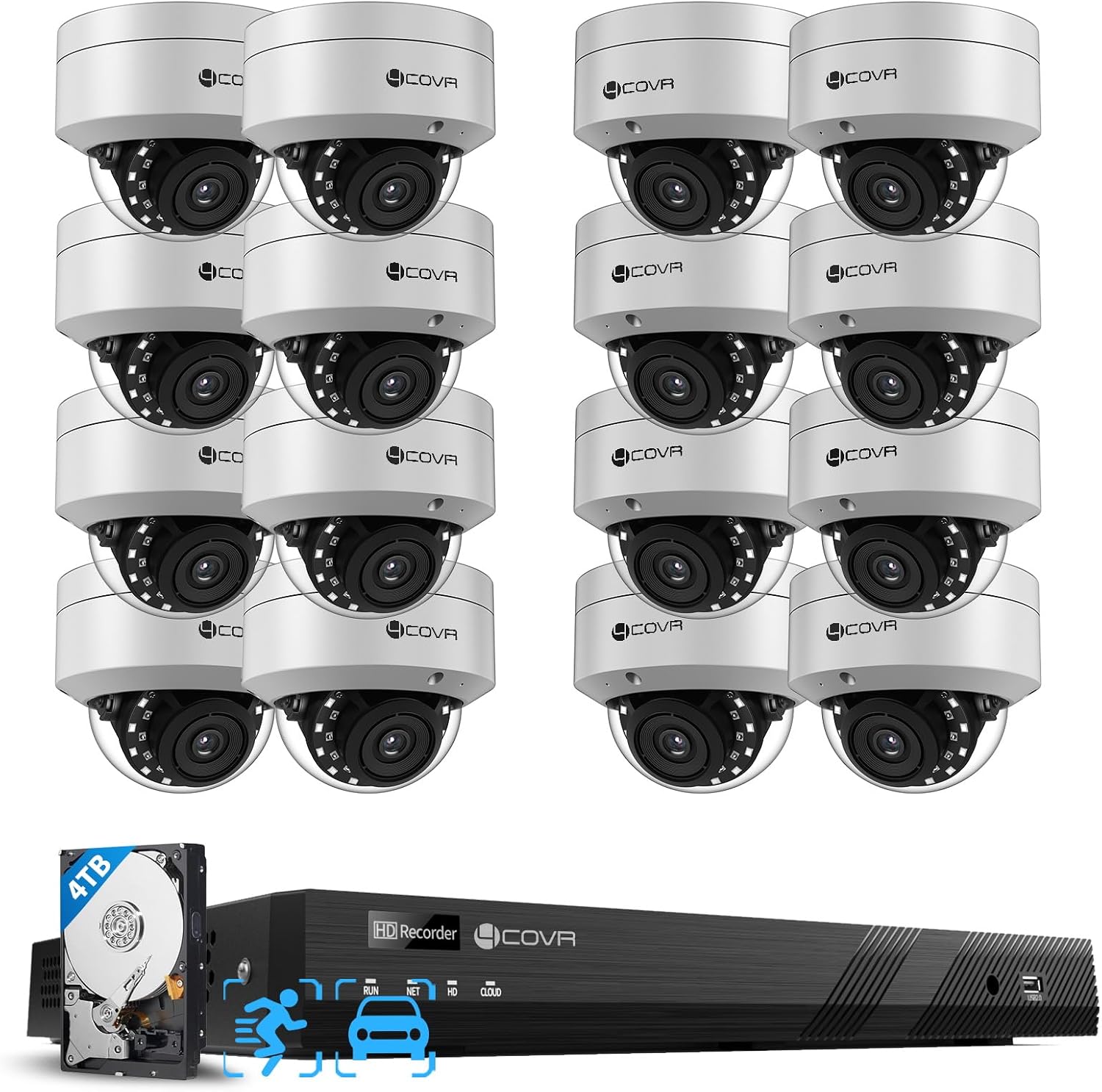
Key specs: 16 x 5MP fixed 2.8mm lens cameras with IK10 vandal-resistant housings and built-in microphones; 4K 16-channel NVR with a 4TB drive and two SATA bays for expansion
The pick for a store with customers in it, and the reason is a specification the others do not lead with: IK10 vandal-resistant housings on all sixteen cameras. In a retail environment your cameras are reachable, and a camera that can be knocked out of alignment with an elbow is a camera that will be. Fixed 2.8mm lenses rather than PTZ is the right choice here too — a store wants consistent, predictable coverage of known zones, not a camera that might be pointed elsewhere when something happens. The 4TB drive with two SATA bays means retention can grow without replacing the recorder, and built-in microphones are included, which is a feature to check against your state’s audio recording rules before enabling.
✅ Pros
- IK10 vandal-resistant housings across all 16 cameras
- Fixed lenses give predictable, unchanging zone coverage
- 4TB supplied with two SATA bays for expansion
- Built-in microphones on the cameras
- 16 channels covers a real store’s zone list
❌ Cons
- 5MP rather than the 12MP the Reolink offers
- Fixed 2.8mm lenses cannot zoom in on a POS counter after the fact
- Audio capability needs a legal check before you switch it on
- Smaller review base than Reolink
ONWOTE 16-Channel 5MP PoE System — for finding the footage afterwards
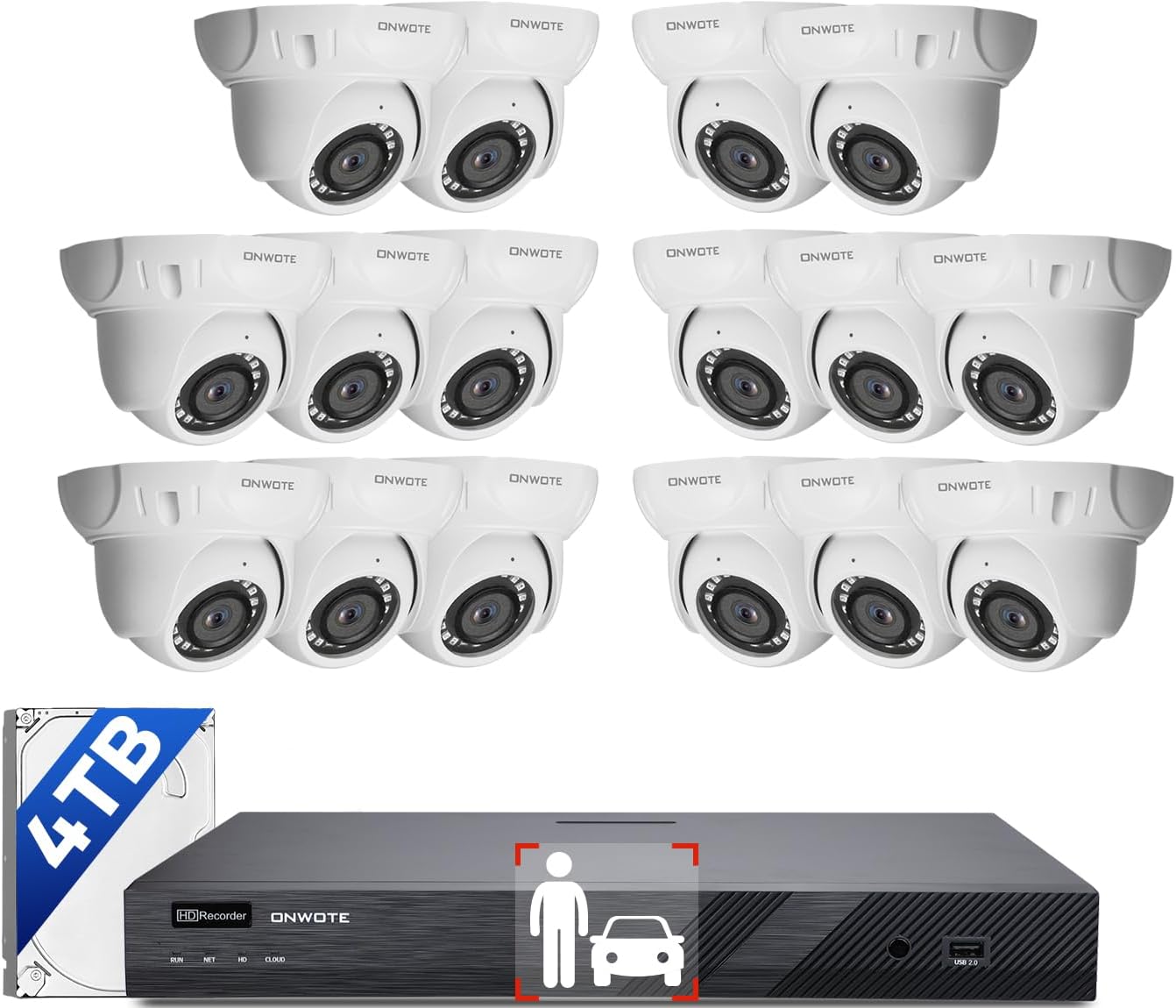
Key specs: 16 x 5MP PoE cameras with a 122-degree diagonal view and a 12MP NVR; AI human and vehicle detection to cut false alarms and storage use; AcuSearch video search for locating a subject across recorded footage
Choose this if your realistic use case is reviewing rather than watching. Its AcuSearch feature is positioned specifically around locating a subject and searching video rapidly, which is the task that consumes actual staff hours in a store — finding the four minutes that matter in a week of footage from sixteen cameras. AI human and vehicle detection works the other end of the same problem, cutting false alarms and storage consumption. The cameras are 5MP with a 122-degree diagonal field of view, which is a sensible middle ground for aisle coverage.
✅ Pros
- AcuSearch video search aimed at incident review
- AI human and vehicle detection cuts false alarms and storage
- 16 channels at 5MP with a 122° diagonal view
- 12MP-capable NVR leaves headroom for future cameras
❌ Cons
- No stated vandal-resistance rating like the 4COVR’s IK10
- 5MP limits how far you can crop into a POS shot
- Search tools vary in quality — verify against your own footage in the return window
- Smaller brand presence than Reolink
REOLINK RLK16-1200D8-A 12MP PoE System — when detail matters more than count
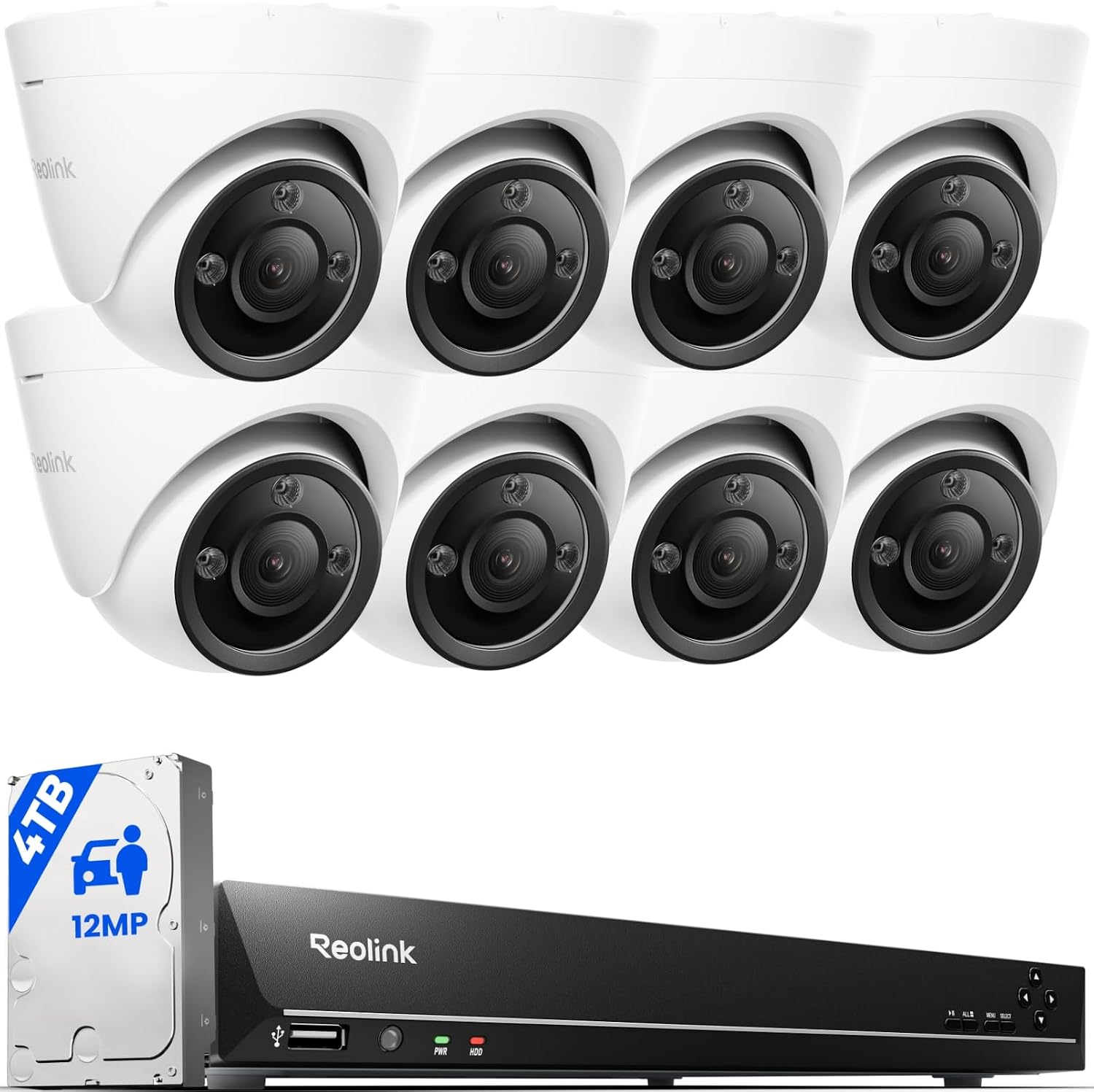
Key specs: 16-channel NVR with 4TB storage and eight 12MP PoE cameras; spotlight-assisted full color night vision; H.265 encoding to reduce storage consumption at high resolution
The right choice for a smaller footprint where a few cameras need to capture genuinely identifiable detail. Eight cameras at 12MP is a different bet from sixteen at 5MP: fewer zones, far more pixels on each. For a store where the point of sale and the entrance are the zones that actually matter, that is arguably the better allocation. Spotlight-assisted full color night vision is a real advantage over infrared for after-hours exterior coverage, because color footage is dramatically more useful for identification than monochrome. H.265 encoding keeps 12MP storage consumption manageable, which matters at that resolution. Reolink is also the most established brand of the four.
✅ Pros
- 12MP, the highest resolution here by a wide margin
- Spotlight full-color night vision rather than infrared only
- H.265 encoding to control storage at high resolution
- The most established manufacturer of the four
- 16-channel NVR, so cameras can be added later
❌ Cons
- Eight cameras, half the count of the others
- No stated vandal-resistance rating
- 12MP consumes storage faster despite H.265
- Fewer zones covered out of the box on a larger floor
GW Security 16-Channel 4K Dome System — widest coverage per camera
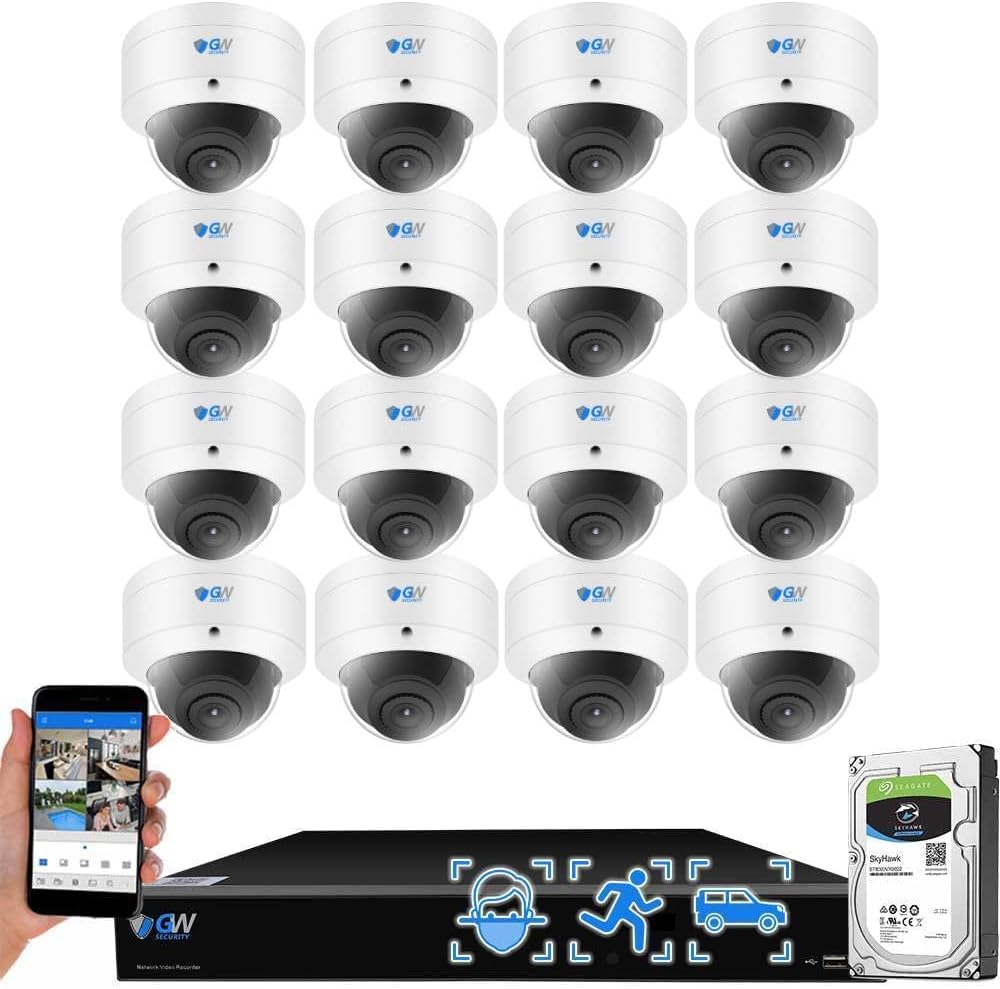
Key specs: 16 x 4K (8MP) weatherproof PoE dome cameras with 2.8mm 135-degree wide-angle lenses and built-in microphones; 12MP 6K NVR; H.265+ encoding; face recognition and human detection features
Worth considering when floor area rather than fine detail is the constraint. Sixteen 4K dome cameras with 2.8mm 135-degree wide-angle lenses cover more square footage per camera than the 122-degree ONWOTE units, and the dome form factor is the traditional retail choice for a reason — it is harder to grab and harder to tell where it is aimed. Built-in microphones are included, with the same legal caveat as the 4COVR. The face recognition and human detection features are genuinely useful in a retail setting and also the ones to think hardest about, since biometric data is regulated separately from video in some states — a point we cover in our wireless camera systems guide.
✅ Pros
- 4K resolution across all 16 cameras
- 135° wide-angle lenses cover more floor per camera
- Dome form factor, the retail standard for good reasons
- H.265+ encoding to manage 4K storage
❌ Cons
- Face recognition raises state-level biometric compliance questions
- No stated IK vandal rating despite the dome housing
- Smallest review base of the four systems
- Audio capability needs a legal check before enabling
Three Expensive Mistakes
What Goes Wrong on Retail Installs
1
Buying for camera count, not zones
Sixteen cameras covering aisles and none in the stock room is a system that watches the customers and ignores the loss.
2
Mounting the entrance camera as an overview
A ceiling shot of the doorway gives you a person-shaped blur. Aim for faces at face height — this is the one camera whose footage gets shown to police.
3
Enabling audio without checking
Several of these systems ship with microphones. Audio recording is treated far more strictly than video in many states.
4
Sizing storage for the cameras, not the retention
Running out of drive space silently overwrites the footage of an incident nobody has reported yet.
Every one of these costs more to fix after the install than to plan around before it.
There is a fifth worth adding for smaller retailers: assuming cameras alone are the security system. Research consistently links visible cameras and alarm systems to deterrence, but a camera records an after-hours break-in while an alarm interrupts it. For a store that is empty overnight, the two belong together, which is the argument made in our small business alarm systems guide.
Final Recommendation
Buy the 4COVR 16-channel system for a customer-facing store. IK10 vandal-resistant housings address the specific risk a shop floor has and a warehouse does not, sixteen channels covers a real zone list, and expandable storage means retention can grow with the business.
Choose the ONWOTE instead if you will spend more time reviewing footage than watching it. AcuSearch and AI detection together attack the part of the job that actually consumes staff hours.
Choose the Reolink for a small footprint where identification matters most — 12MP with full-color night vision on eight well-placed cameras beats sixteen mediocre angles. Choose GW Security if floor area is the constraint and you want the widest coverage per camera.
What would change our answer: if you supply, or intend to supply, any federal agency, settle the covered-equipment question first — that constraint outranks every specification on this page. And if your premises is a warehouse or office rather than a shop floor, vandal resistance stops being the deciding factor and our warehouse camera guide is the better starting point.
SafeBode does not yet run an in-house product testing program. This guide is built from manufacturer specifications, official support documentation, current retail listings and verified buyer feedback rather than hands-on testing, and we say so plainly rather than implying testing we have not done.
Frequently Asked Questions
How many cameras does a retail store need?
Count zones, not cameras. Most stores need the entrance, the point of sale, the aisles, the stock room and back door, and the exterior — and the stock room is the one most commonly skipped despite being where internal loss happens.
What resolution do retail cameras need?
It depends on the zone. The point of sale and the entrance benefit from high resolution because identification matters there. Aisle coverage benefits more from a wide field of view than from extra pixels.
Why do retail cameras need vandal-resistant housings?
Because in a store they are within reach of the public, unlike a home camera under an eave. An IK10-rated housing and a dome shape resist being knocked out of alignment or damaged, which a standard bullet camera at head height does not.
Can retail security cameras record audio?
Several of these systems include microphones, but audio is regulated far more strictly than video in many states. Check your own state’s rules before enabling it — this is one of the easiest ways to turn a security system into a legal problem.
What is NDAA compliance and does it apply to my store?
Federal acquisition rules prohibit contracting involving video surveillance equipment from several named manufacturers, and the restriction extends to entities that use such equipment. If you supply a federal agency or hope to, it applies to the cameras on your own walls, not just the ones you sell.
Is face recognition worth having in a store?
It can be operationally useful, and it also moves you into biometric data, which some states regulate separately from ordinary video. Treat enabling it as a compliance decision rather than a feature toggle.
How much storage do I need?
Enough for the retention period you actually want, not just enough for the cameras. Sixteen channels recording continuously consume drive space quickly, and running out silently overwrites footage of incidents nobody has reported yet. Prefer a recorder with spare drive bays.
Do cameras actually reduce shoplifting?
Visible cameras and alarm systems are consistently linked to deterrence, but a camera records rather than intervenes. For overnight protection specifically, an alarm system interrupts a break-in in a way a camera cannot.
PoE or wireless for a store?
PoE, in almost every case. A commercial installation benefits from one cable carrying power and data, no batteries to maintain across sixteen devices, and no dependence on Wi-Fi in a space full of customer phones competing for the same spectrum.
Sources
Show sources (6)
- [1] Acquisition.gov — FAR 52.204-25, Prohibition on Contracting for Certain Telecommunications and Video Surveillance Services or Equipment, www.acquisition.gov/far/52.204-25
- [2] Security.org — Home Security Systems, www.security.org/home-security-systems
- [3] 4COVR — 16 Channel PoE Security Camera System, current retail listing specifications (ASIN B0D99PPV2Z)
- [4] ONWOTE — 16 Channel Security System, current retail listing specifications (ASIN B08XTMPD9S)
- [5] REOLINK — RLK16-1200D8-A, current retail listing specifications (ASIN B0B8HLXC8Y)
- [6] GW Security — 16 Channel 4K Dome System, current retail listing specifications (ASIN B09V79GQB7)


