Best Doorbell Cameras for Apartments 2026: No Drilling, No Landlord Fight
Affiliate Disclosure: This article contains affiliate links. If you buy through these links, we may earn a commission at no extra cost to you. Our editorial opinions are our own and are not influenced by affiliate relationships. Read our full disclosure policy →
Contents
Quick Answer
If your door has a peephole, the Ring Peephole Cam is the answer — it replaces the peephole rather than mounting to the frame, so nothing is drilled and the install reverses when you move. If you already own a Ring doorbell, an adhesive anti-theft mount lets you fit it without screws, but you must match the mount to your exact doorbell generation — the two mounts here cover different, non-overlapping model lists. And check your lease and your building’s rules before you point anything at a shared hallway.
Three Constraints an Apartment Adds
A doorbell camera in a house is a straightforward purchase. In an apartment, three things change the decision before features enter into it, and every recommendation below follows from them.
What Is Different About a Rented Door
🏢 The physical constraints
- No drilling into the door, frame or hallway wall
- Often no doorbell wiring to the unit at all
- The mounting surface may be a fire door you must not modify
- It has to come off cleanly at the end of the tenancy
📋 The permission constraints
- The lease may prohibit alterations to the door
- The hallway is usually common property, not yours
- The camera’s view may cover neighbors’ doors
- Building rules can differ from what the lease says
The third physical constraint deserves emphasis because it is easy to miss. Many apartment entry doors are rated fire doors. Drilling one can compromise that rating, which is a genuine safety issue rather than merely a lease violation — and it is a reason to prefer a peephole replacement or an adhesive mount even where a landlord would not personally object.
None of this makes a doorbell camera a bad idea in a rental. It changes which product is appropriate, and it is why the general roundups — including our own wireless doorbell guide — are the wrong starting point for an apartment even though the hardware overlaps.
Which Route Applies to You
| Your situation | The right route | Why |
|---|
| Door has a peephole | Peephole camera | Nothing is drilled; the original peephole goes back when you leave |
| You already own a Ring doorbell | A no-drill adhesive mount | Keeps the device you have, provided the mount matches its generation |
| Starting fresh, want no subscription | A standalone battery doorbell | Removes the recurring cost, which matters more on a short tenancy |
| Landlord permits drilling | A conventional battery doorbell | The widest choice and the best mounting stability |
| No door-mounted option at all | An indoor camera facing the door | Covers the entry without touching the door or the hallway |
The peephole route is genuinely underrated and it is the one we would try first. Its one real limitation is framing: a peephole sits at adult eye height and points straight out, so it shows a visitor well and the floor in front of the door poorly. If parcels on the mat are your specific concern, that is worth knowing before you commit — and it is the same framing trade-off we work through in our front door camera comparison.
The Mount Compatibility Trap
If you are going the adhesive-mount route, this is the section that saves you a return. No-drill doorbell mounts are model-specific to a degree that surprises people, and the two in this guide cover almost entirely different device lists.
The Homalor mount lists compatibility with Ring Video Doorbell 1, 2, 3 and 4, the 2020 second-generation Video Doorbell, and the 2023 and 2024 Battery Doorbell, Battery Doorbell Plus and Battery Doorbell Pro. The Mamerry mount lists the 2026-release Battery Doorbell 2nd Gen, Plus 2nd Gen and Pro 2nd Gen, plus the first-generation Blink video doorbell — and states explicitly that it is not compatible with the Video Doorbell 2, 3, 3 Plus or 4.
Read This Before Ordering a Mount
2 lists
the two mounts here cover different generations
Explicit
one states which models it will not fit
Year
the release year is part of the model name
Check
your doorbell’s exact generation in the Ring app
Ring’s naming reuses words across generations, which is what makes this easy to get wrong.
The practical instruction: open your doorbell’s app and find the exact device name and generation before you order, rather than matching the picture. Ring’s naming reuses “Battery Doorbell Plus” and “Pro” across release years, so two products with the same words on the box can need different mounts.
Ring Peephole Cam 2K — the true no-drill answer
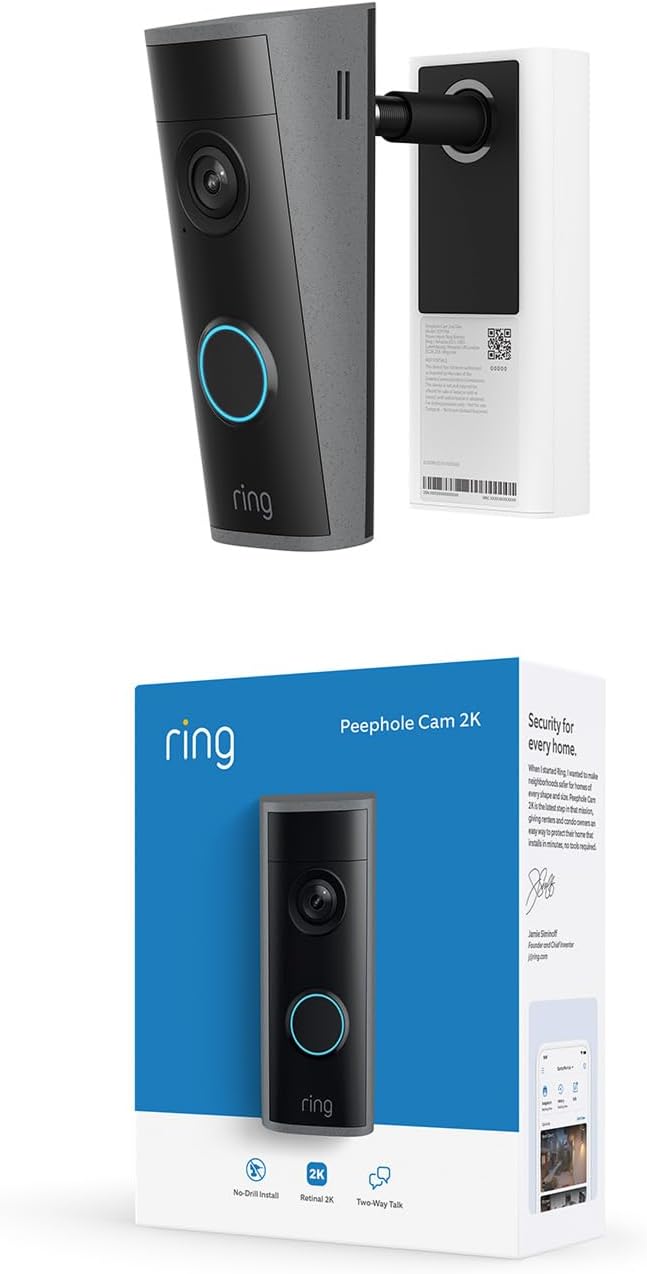
Key specs: Replaces the existing peephole in the door rather than mounting to the frame; renter-friendly installation with no drilling into the wall or door frame; 2K video
This is the pick, and it is the only option here that requires no adhesive and no modification of any kind — it replaces the peephole that is already in the door. That matters in three separate ways for a renter: nothing is drilled, nothing can fail in summer heat the way tape can, and the install is fully reversible when you hand the keys back. It gives 2K video, the same generation of sensor as Ring’s current frame-mounted doorbells. There is nothing protruding into a shared hallway to be knocked, stolen, or objected to, which quietly solves the building-politics problem too.
✅ Pros
- No drilling and no adhesive — uses the existing peephole
- Fully reversible at the end of a tenancy
- 2K video, current sensor generation
- Nothing protruding into a shared hallway to be stolen
- Sidesteps the fire-door modification problem entirely
❌ Cons
- Requires a door with a compatible peephole
- Framing is fixed at eye height, so it shows parcels poorly
- Ring’s useful recording features involve a subscription
- Only covers what is directly outside the door, not an approach
BOIFUN Wireless Video Doorbell — no subscription, wide view
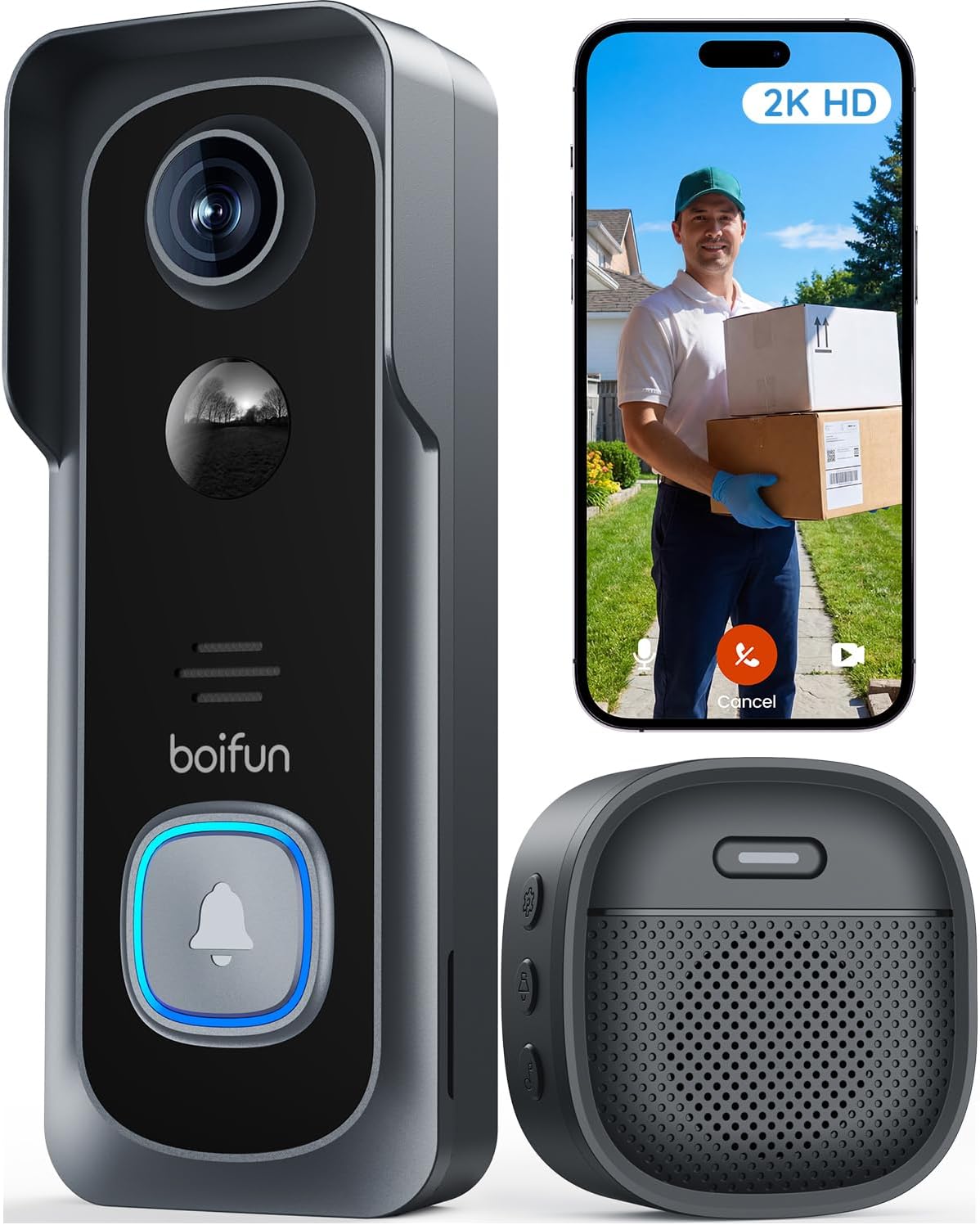
Key specs: 166-degree field of view with an f/2.5 aperture for full porch coverage with no blind spots; 2.4 GHz Wi-Fi; on-device AI processing; no subscription required for basic operation
The pick if you are starting from nothing and would rather not add a monthly cost to a tenancy that might last a year. It runs without a subscription for basic operation, which changes the arithmetic considerably on a short lease. Its other genuine advantage is coverage: a 166-degree field of view with an f/2.5 aperture, which the manufacturer positions as covering a porch with no blind spots. In an apartment that width often means seeing the whole landing rather than just the person directly in front of the door — useful, and also the thing to think carefully about before pointing it at a shared corridor.
✅ Pros
- No subscription required for basic operation
- 166-degree field of view, wider than most
- f/2.5 aperture for better low-light facial detail
- On-device AI processing rather than cloud-only
❌ Cons
- Still needs mounting, so drilling or adhesive applies
- A very wide view covers more of a shared hallway than you may want
- 2.4 GHz Wi-Fi only
- Less established brand than Ring, on a device you rely on daily
Homalor Anti-Theft No-Drill Ring Mount — for older Ring doorbells
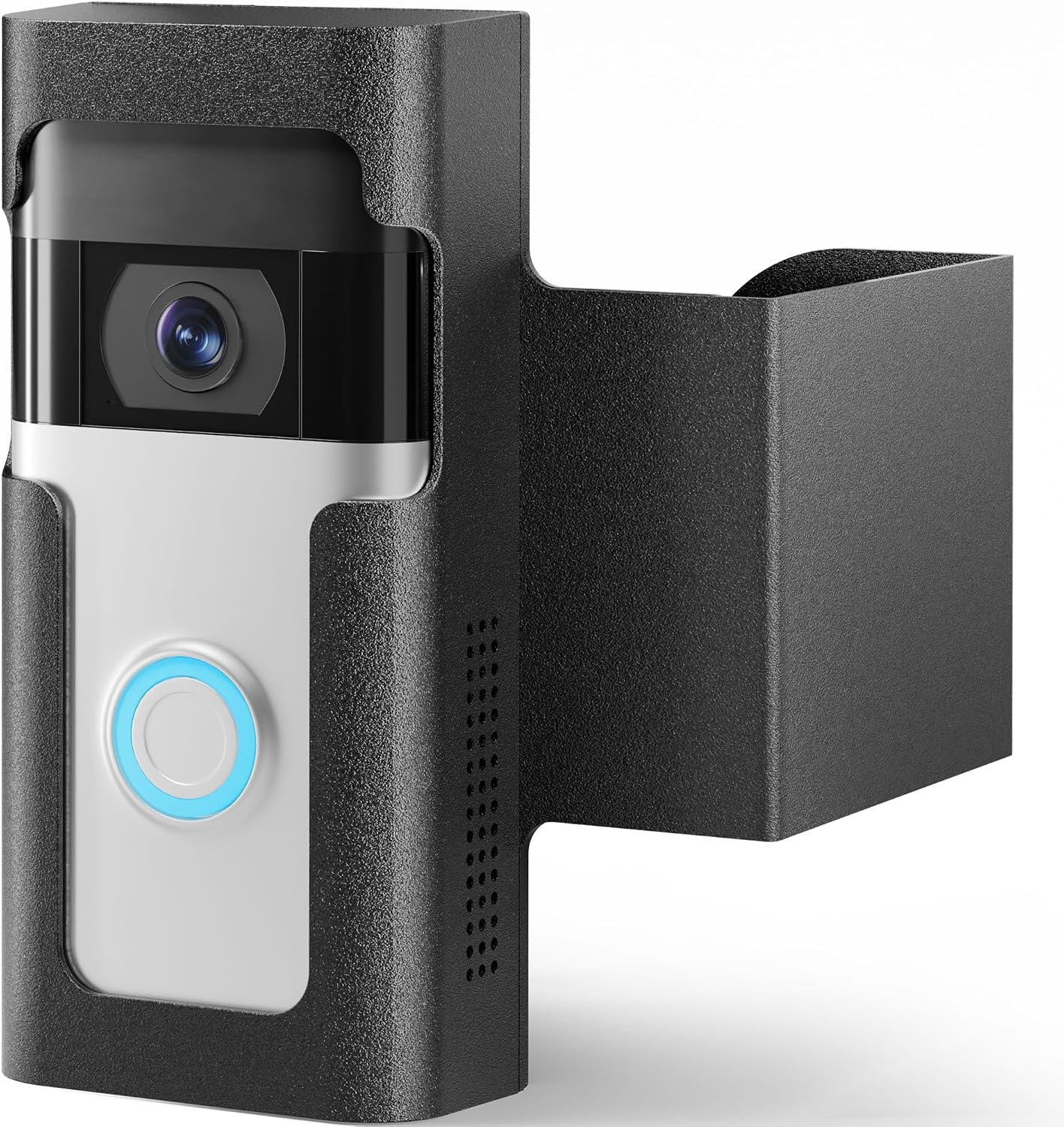
Key specs: Stainless steel anti-theft mount requiring no drilling; manufacturer lists compatibility with Ring Video Doorbell 1/2/3/4, Video Doorbell 2nd Gen (2020), Battery Doorbell (2024), Battery Doorbell Plus (2023) and Battery Doorbell Pro (2024)
A mount rather than a camera, and the right accessory if you already own a Ring from the earlier generations. Its stated compatibility covers Ring Video Doorbell 1, 2, 3 and 4, the 2020 second-generation Video Doorbell, and the 2023–2024 Battery Doorbell, Plus and Pro. It is stainless steel and anti-theft, which addresses the specific apartment worry that an unattached doorbell in a shared corridor is easier to walk off with than one screwed to a private porch. Fitting is adhesive, so no drilling — check your door surface takes adhesive cleanly before committing.
✅ Pros
- Covers the older and mid-generation Ring line
- Stainless steel with an anti-theft design
- No drilling into the door or frame
- Keeps a doorbell you already own rather than replacing it
❌ Cons
- Not compatible with the 2026-release models
- Adhesive can fail in heat or on textured or painted surfaces
- Adds thickness, which can matter on a narrow frame
- It is a mount only — you still need the doorbell
Mamerry No-Drill Doorbell Mount (2026 Models) — for the current generation
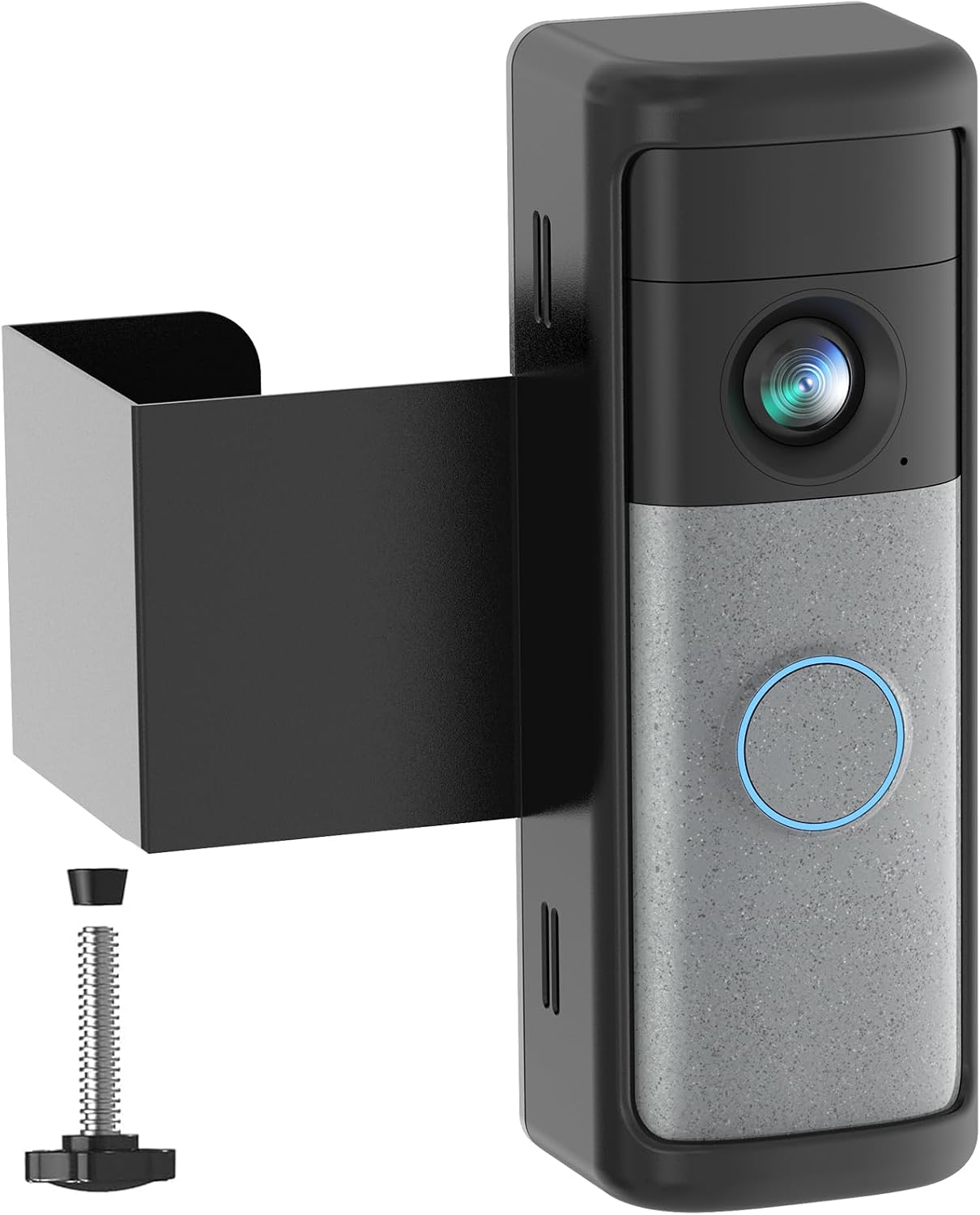
Key specs: No-drill anti-theft mount listed as compatible with the 2026-release Ring Battery Doorbell 2nd Gen, Plus 2nd Gen and Pro 2nd Gen, plus the first-generation Blink video doorbell; explicitly not compatible with the earlier Ring 2/3/3 Plus/4 line
The counterpart to the Homalor, for the newer hardware. It lists the 2026-release Ring Battery Doorbell 2nd Gen, Plus 2nd Gen and Pro 2nd Gen, and the first-generation Blink video doorbell. What earns it a place here is its honesty: the listing states outright that it is not compatible with the Ring Video Doorbell 2, 3, 3 Plus or 4, which is exactly the disclosure this accessory category usually omits. Blink compatibility is worth noting separately, since Blink owners have fewer no-drill options than Ring owners do.
✅ Pros
- Covers the 2026-release Ring generation
- Also fits the first-generation Blink video doorbell
- States its incompatibilities explicitly rather than hiding them
- No-drill anti-theft design
❌ Cons
- Does not fit the older Ring line the Homalor covers
- Smaller review base than the Homalor
- Adhesive mounting, with the usual surface caveats
- A mount only, not a camera
The Hallway Problem
In a house, a doorbell looks at your own path. In an apartment it very often looks at a shared corridor, at your neighbor’s door, and at everyone who walks past. That is a different situation legally, practically and socially, and it is worth thinking about before the first complaint rather than after.
Practical steps that resolve most of it: aim as narrowly as the device allows, favor a peephole camera whose view is inherently limited to what is directly outside your door, and turn off audio recording if the device allows it — audio is treated far more strictly than video in many places, and a shared hallway is where conversations happen.
Check the building rules as well as the lease. They are frequently different documents and the building’s rules on common areas may say things the lease does not. A short message to the manager describing what you intend to install costs nothing and converts a possible dispute into a recorded permission.
If the answer comes back no, the fallback is an indoor camera positioned to see the door from inside, which touches neither the door nor the corridor. That approach and its trade-offs are covered in our apartment security guide, alongside the broader question of how much security a rental actually justifies.
Final Recommendation
If your door has a peephole, buy the Ring Peephole Cam. Nothing drilled, nothing adhered, nothing protruding into a shared hallway, and a fully reversible install. It solves the lease problem, the fire-door problem and the hallway-politics problem in one purchase, and no other option here does all three.
If you already own a Ring, buy the mount that matches your exact generation — the Homalor for the older and mid-generation line, the Mamerry for the 2026 models and Blink. Check the device name in the app first, not the photograph.
Choose the BOIFUN if you are starting fresh and want no monthly cost. On a one-year tenancy the subscription question is a larger share of total cost than it is for a homeowner, and its 166-degree view is genuinely wide — aim it thoughtfully in a shared corridor.
What would change our answer: if your landlord permits drilling and there is doorbell wiring to the unit, none of these constraints apply and you should shop the general market instead. Renting is what makes this a narrow category; permission removes it. And if the building says no outright, an indoor camera facing the door is the fallback that breaks no rules — the same reasoning behind the no-drill approaches in our renter security guide. A portable door lock covers the other half of a rented door — who can get in while you are behind it — and needs no permission at all.
SafeBode does not yet run an in-house product testing program. This guide is built from manufacturer specifications, official support documentation, current retail listings and verified buyer feedback rather than hands-on testing, and we say so plainly rather than implying testing we have not done.
Frequently Asked Questions
Can I install a video doorbell in an apartment?
Usually yes, but not by drilling. A peephole camera replaces the existing peephole with no modification, and adhesive anti-theft mounts let a conventional doorbell attach without screws. Check the lease and the building rules, which are often separate documents.
Will drilling my apartment door break the lease?
Very likely, and there is a safety dimension too: many apartment entry doors are rated fire doors, and drilling one can compromise that rating. That is a reason to avoid it even if a landlord would not object.
Are no-drill doorbell mounts secure?
The better ones are stainless steel with anti-theft designs, which addresses the real apartment worry of a device in a shared corridor being walked off with. The weak point is the adhesive, which can fail in heat or on textured surfaces.
Do no-drill mounts fit every Ring doorbell?
No, and this is the most common ordering mistake. The two mounts here cover almost entirely different generation lists, and one states explicitly that it does not fit the Ring Video Doorbell 2, 3, 3 Plus or 4. Check the device name in the app before ordering.
Is a peephole camera as good as a doorbell camera?
For an apartment, often better, because it needs no modification at all and reverses when you move. Its limitation is framing — a peephole sits at eye height and points straight out, so it shows visitors well and parcels on the floor poorly.
Can my neighbors object to my doorbell camera?
They can, and in a shared corridor they may have a point, since your device is recording common property and possibly their door. Aim narrowly, consider turning audio off, and check the building rules rather than only the lease.
Do I need a subscription for an apartment doorbell?
Not necessarily. Some doorbells operate without one for basic function, and on a short tenancy that recurring cost is a bigger share of the total than it would be for a homeowner.
What if my building bans door-mounted cameras entirely?
An indoor camera positioned to see the entry covers most of the same ground without touching the door or the corridor. It loses two-way talk at the door, but it breaks no rules.
Will a doorbell camera work without existing doorbell wiring?
Yes — battery doorbells and peephole cameras need no wiring at all, which is fortunate because many apartments have no doorbell circuit to the individual unit.
Sources
Show sources (4)
- [1] Ring — Peephole Cam 2K, current retail listing specifications (ASIN B0GLJ8NM1W)
- [2] BOIFUN — Wireless Video Doorbell, current retail listing specifications (ASIN B0CZLFJKYB)
- [3] Homalor — Anti-Theft No-Drill Ring Doorbell Mount, current retail listing specifications (ASIN B0DCG8MC4V)
- [4] Mamerry — No-Drill Anti-Theft Doorbell Mount, current retail listing specifications (ASIN B0GYMV8NP1)


