Best Portable Door Locks for Travel (2026): What Works on a Hotel Door and What Does Not
Affiliate Disclosure: This article contains affiliate links. If you buy through these links, we may earn a commission at no extra cost to you. Our editorial opinions are our own and are not influenced by affiliate relationships. Read our full disclosure policy →
Contents
Quick Answer
A portable door lock is a metal claw that seats in the strike slot of an inward-swinging door and stops the latch from retracting – so the door cannot be opened from outside, even with a key. Start with the AceMining Portable Door Lock: it is the most-reviewed device in the category, installs in seconds with no tools, and does the job without adding anything to fail. Add the Securityman version instead if you want a 130 dB alarm to wake you rather than a silent block. None of these are a substitute for a real deadbolt, and all of them create an exit problem you need to think about before you go to sleep.
How a Portable Door Lock Actually Works
The mechanism is simpler than the marketing suggests, and understanding it tells you immediately whether one will work on your door. You open the door, slide a flat metal plate into the strike slot in the door frame – the recess the latch normally drops into – and close the door so the plate is trapped. Then you fit a claw or handle onto the stud sticking out of that plate on your side. The claw sits in front of the latch, so the latch physically cannot retract far enough to clear the frame.
That is why the listings claim the door cannot be opened from outside even with a key: a key retracts the latch, and the claw is blocking the space the latch needs to move into. It is not defeating the lock, it is occupying the space the lock needs. The whole assembly goes on and comes off in seconds with no tools, which is the actual selling point for anyone who is somewhere for one night.
What happens at the door, in order
1
Find the strike slot
The rectangular recess in the frame where the latch seats. No slot, no device – this is the single most common reason one does not fit.
2
Insert the plate
Slide the flat metal plate into that slot with the door open, stud facing into the room.
3
Close the door
The plate is now clamped between door and frame. Nothing is screwed or stuck to anything.
4
Fit the claw
Drop the claw over the stud so it sits in front of the latch. The latch can no longer retract, so the handle turns uselessly from outside.
Every device in this guide uses this same mechanism. The differences are materials, the shape of the claw, and whether an alarm is bolted on.
The Doors These Will Not Work On
This is where most one-star reviews come from, and it is entirely predictable if you know what to look for before you pack one. The device needs an inward-swinging hinged door with an accessible strike slot. Take away either condition and it does nothing.
Check the door before you rely on it
Works
- Inward-swinging hinged doors – most hotel rooms and bedrooms
- Doors with a standard rectangular strike plate and recess
- Wooden and hollow-core interior doors
- Dorm rooms, short-term rentals, shared houses
Does not work
- Outward-swinging doors – the plate has nowhere to be trapped
- Sliding doors and patio doors of any kind
- Doors with a magnetic or recessed strike with no open slot
- Doors where the gap between door and frame is unusually tight or wide
Outward-swinging doors are the trap worth naming twice, because they are common on hotel rooms in some regions and on many apartment entrances. If the door opens toward you when you stand in the corridor, none of these devices apply and a door-wedge alarm is the closer substitute. Sliding doors are a different problem entirely, and we cover the real fixes in our guide to securing a sliding glass door.
The Safety Tradeoff Nobody Puts on the Box
A portable door lock is deliberately designed so nobody outside can get in – including hotel staff, a building manager, and emergency responders. That is the feature. It is also, unavoidably, the risk, and no listing on this page mentions it.
The principle is worth borrowing from workplace regulation, where it is written down explicitly. OSHA requires that exit routes be unobstructed at all times, and that employers ensure doors are not locked from the inside and that doorways, hallways and stairways remain unblocked. Those rules govern workplaces, not your hotel room – but they exist because a door that cannot be opened in an emergency is a known way for people to die, and that physics does not change because you are on holiday.
The time pressure is the part people underestimate. The U.S. Fire Administration warns that residents may have less than two minutes to escape a home fire once the smoke alarm sounds, and its escape-planning guidance is explicit that doors and windows must not be blocked. Two minutes is not long to wake up, orient yourself in an unfamiliar room, and remember that you fitted a metal claw to the door in the dark.
Why the exit side matters
Under 2 min
Time residents may have to escape once a smoke alarm sounds
Unobstructed
The standard OSHA sets for exit routes at all times
Seconds
How long removal takes – if you remember it is there
One door
Most hotel rooms have exactly one way out
Use one while you are in the room and awake or asleep, and remove it whenever you leave. Practice taking it off once, in daylight, before you need to do it at 3am.
The Four Picks Side by Side
| Device | Material | Alarm | Power | Standout |
|---|
| AceMining Portable Door Lock | Stainless steel with ABS cover | None | None needed | The most-reviewed option in the category |
| Addalock | One-piece metal | None | None needed | The original design, with anti-counterfeit marking |
| Securityman with Alarm | Dual-claw strike plate | 130 dB, 3 sensitivity levels | USB-C rechargeable, up to a year standby | Wakes you rather than just blocking |
| Guard Dog Blocklock | Electroplated stainless steel | None | None needed | Polished edges, tool-free in the dark |
AceMining Portable Door Lock — best overall
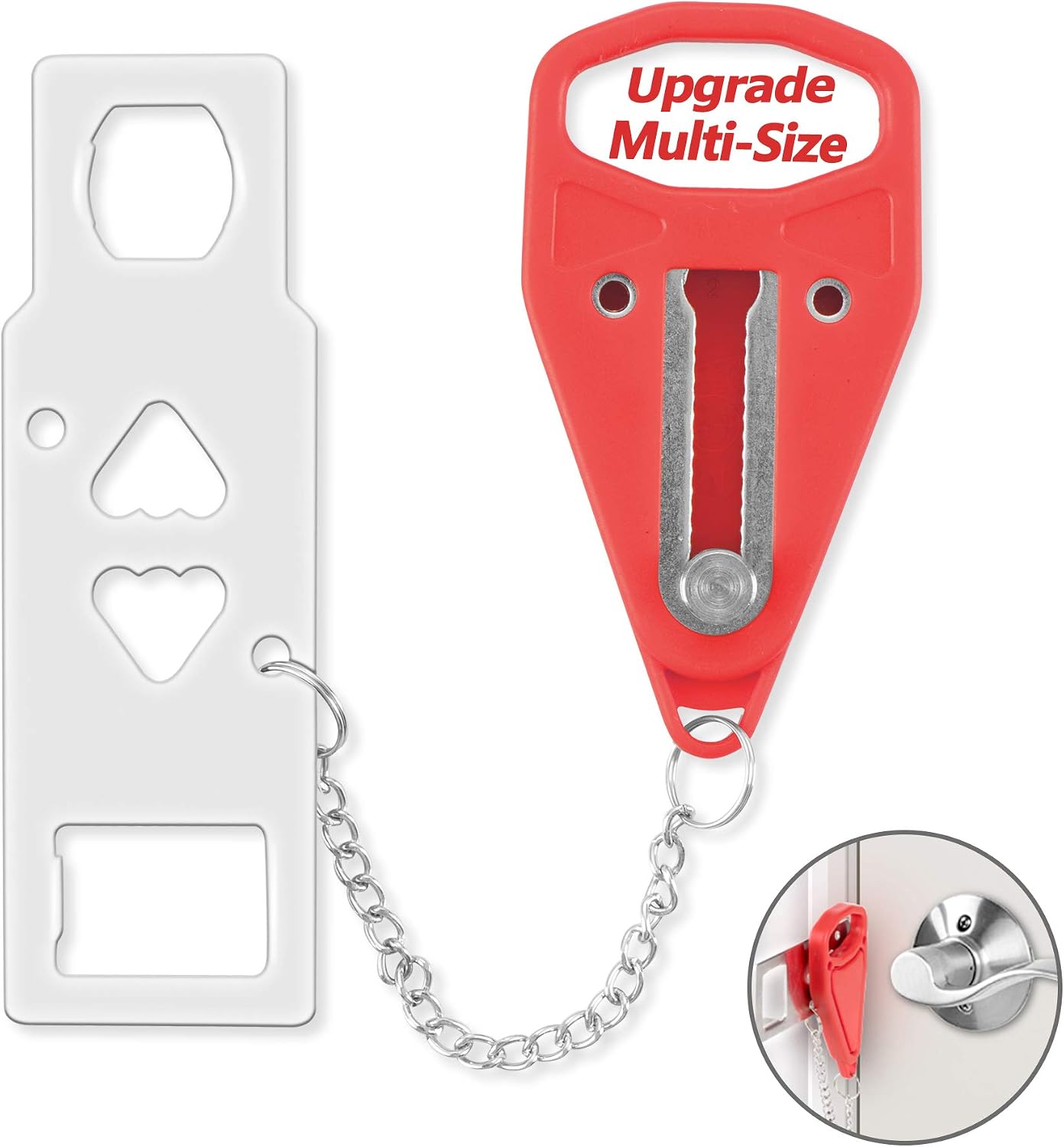
Key specs: Stainless steel claw with an ABS cover that seats in the door’s strike slot; installs and removes in seconds without tools; blocks the door from being opened from outside even with a key; the most-reviewed device in this category on Amazon US
If you want one device and no decisions, this is it. The AceMining is a stainless steel claw with an ABS cover intended to stop the metal marking the door, and it carries by far the largest review base of anything in this category on Amazon US – which for a product this simple is a reasonable proxy for it fitting the doors people actually encounter. It installs in seconds without tools, works in the dark once you have done it once, and has nothing to charge or replace. The listing’s claim that the door cannot be opened from outside even with a key is a description of the mechanism rather than marketing: the claw occupies the space the latch needs to retract into.
✅ Pros
- Largest review base in the category
- No batteries, no charging, nothing to fail
- ABS cover reduces marking on rental doors
- Tool-free, installs in seconds
- Packs flat in a bag
❌ Cons
- Inward-swinging doors with a strike slot only
- Silent – it blocks entry but will not wake you
- No third-party security certification of any kind
- Easy to forget on the door when you check out
Addalock The Original Portable Door Lock — the original design
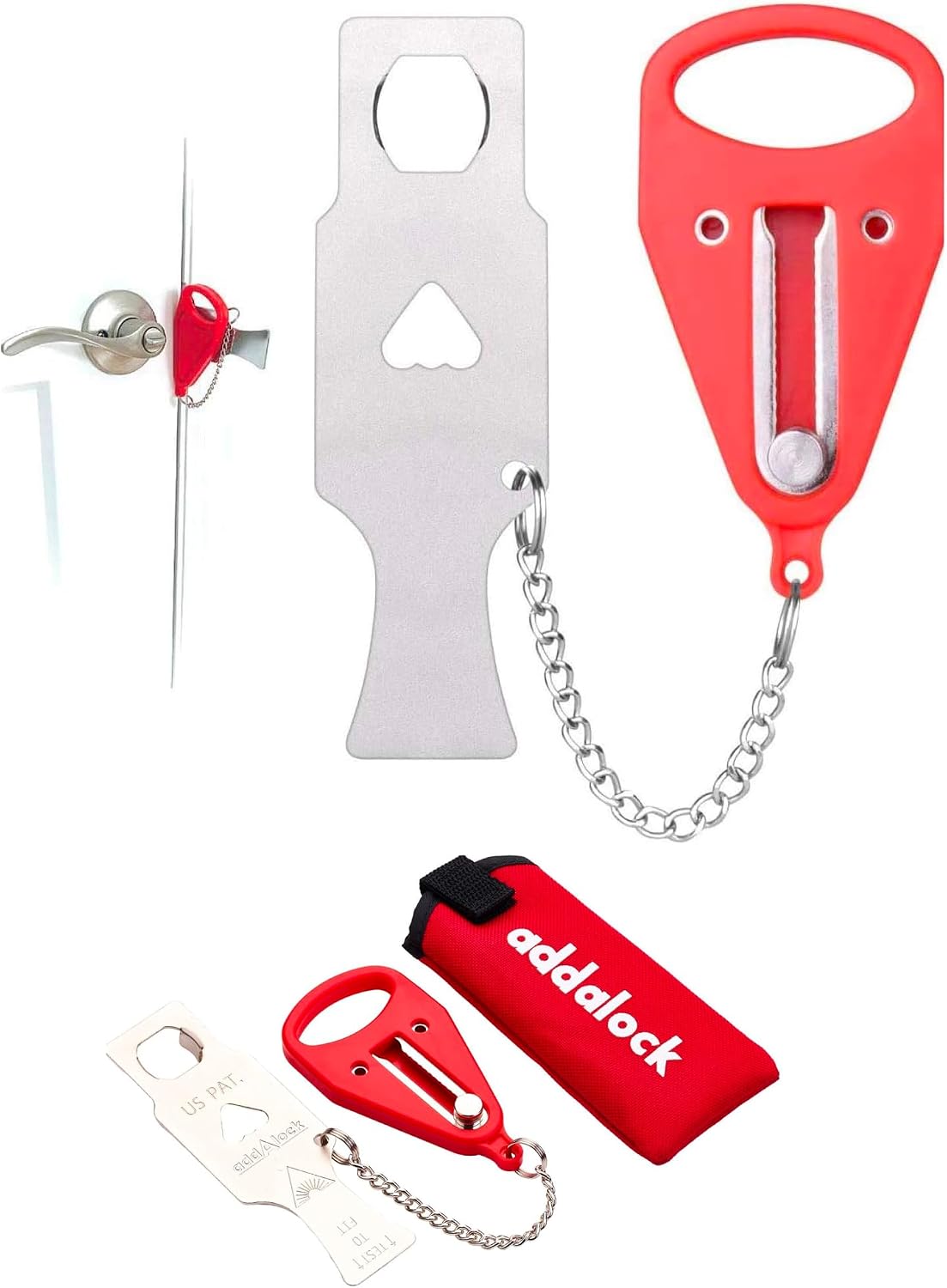
Key specs: One-piece metal latch designed for inward-swinging hinged doors; tool-free, fits in a bag; the original design in this category, sold with a branded pouch and an engraved body because counterfeits are common
The Addalock is the device the rest of this category copied, and it is still a reasonable buy. It is a simpler one-piece metal design intended for inward-swinging hinged doors, and the maker is explicit that it works on most such doors regardless of whether the bolt fits neatly in the designated opening. The reason to care about buying the genuine one: the listing itself flags that counterfeits exist, and identifies the real product by an engraved logo and a branded red pouch. Since the entire function is a piece of shaped metal resisting force, a soft counterfeit is not a cosmetic issue.
✅ Pros
- The original design in this category
- One-piece metal, nothing to break off
- Explicit anti-counterfeit markings
- Doubles as a bedroom or dorm privacy lock
- No power source at all
❌ Cons
- Bare metal can mark a painted door frame
- Silent, like the other non-alarm picks
- Counterfeits are common enough that the maker warns about them
- Same inward-swinging-door limitation as every claw device
Securityman Portable Door Lock with Alarm — best if you want to be woken
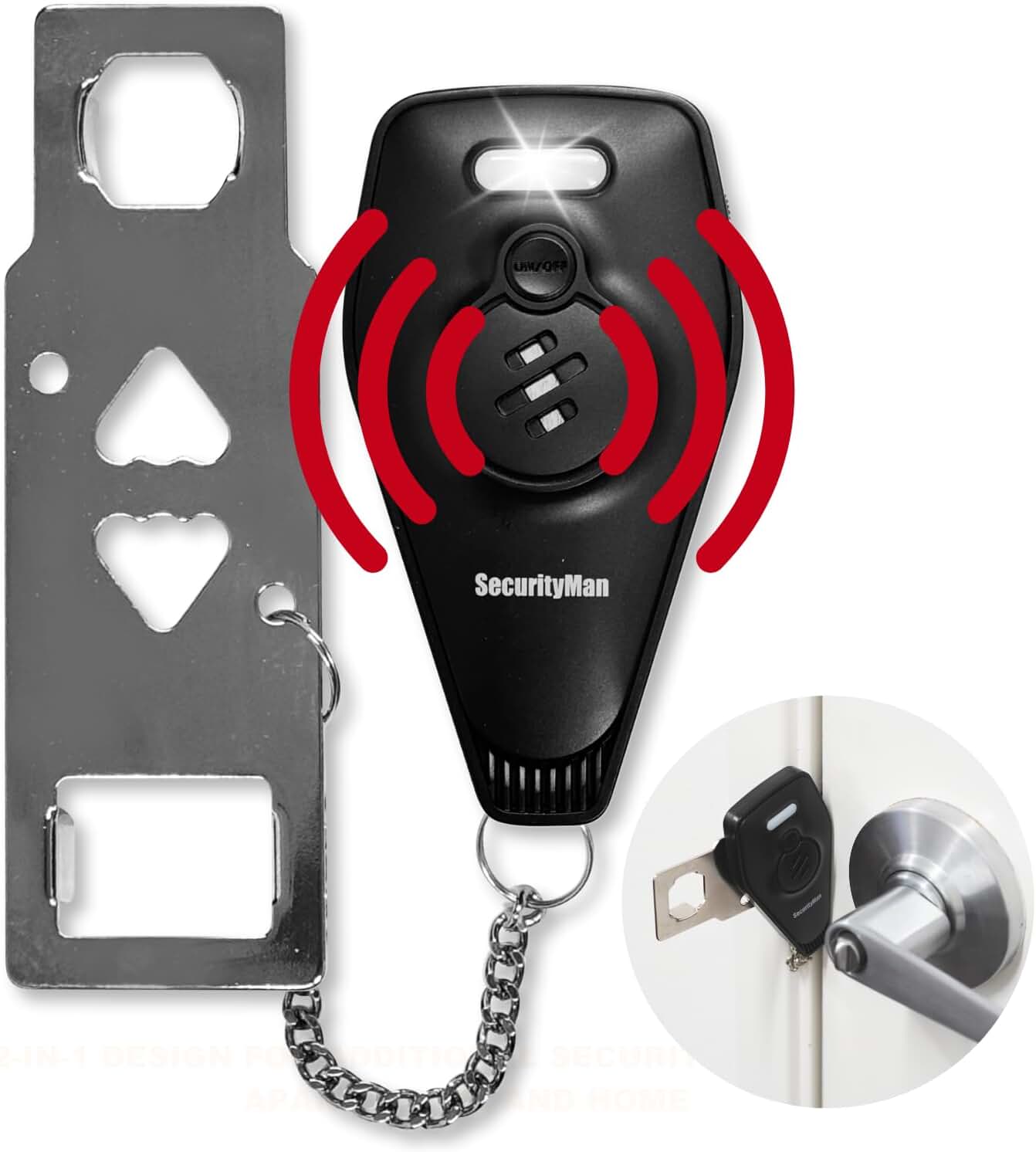
Key specs: Portable lock combined with a 130 dB vibration alarm that triggers on tampering; three sensitivity levels; USB-C rechargeable with a stated standby time of up to a year; dual-claw strike plate for most swinging doors
The honest problem with a silent door block is that it works perfectly and you sleep through the attempt. The Securityman pairs the same dual-claw mechanism with a 130 dB vibration alarm that fires when something tampers with the door, with three sensitivity levels so a corridor full of slamming doors does not set it off. It charges over USB-C with a stated standby time of up to a year, which is the right power design for something you use a few nights a month. The tradeoff is that it is now a device with a battery: one more thing to have charged before a trip, and one more thing that can false-trigger at 2am in a noisy hotel.
✅ Pros
- 130 dB alarm actually wakes you
- Three sensitivity levels to cut false triggers
- USB-C, stated up to a year of standby
- Same physical blocking as the plain claws
- Comes with a carrying pouch
❌ Cons
- Needs charging before a trip
- False triggers are a real risk in busy corridors
- Bulkier than a plain metal claw
- A 130 dB alarm in a hotel corridor will involve other people
Guard Dog Security Blocklock — best budget claw
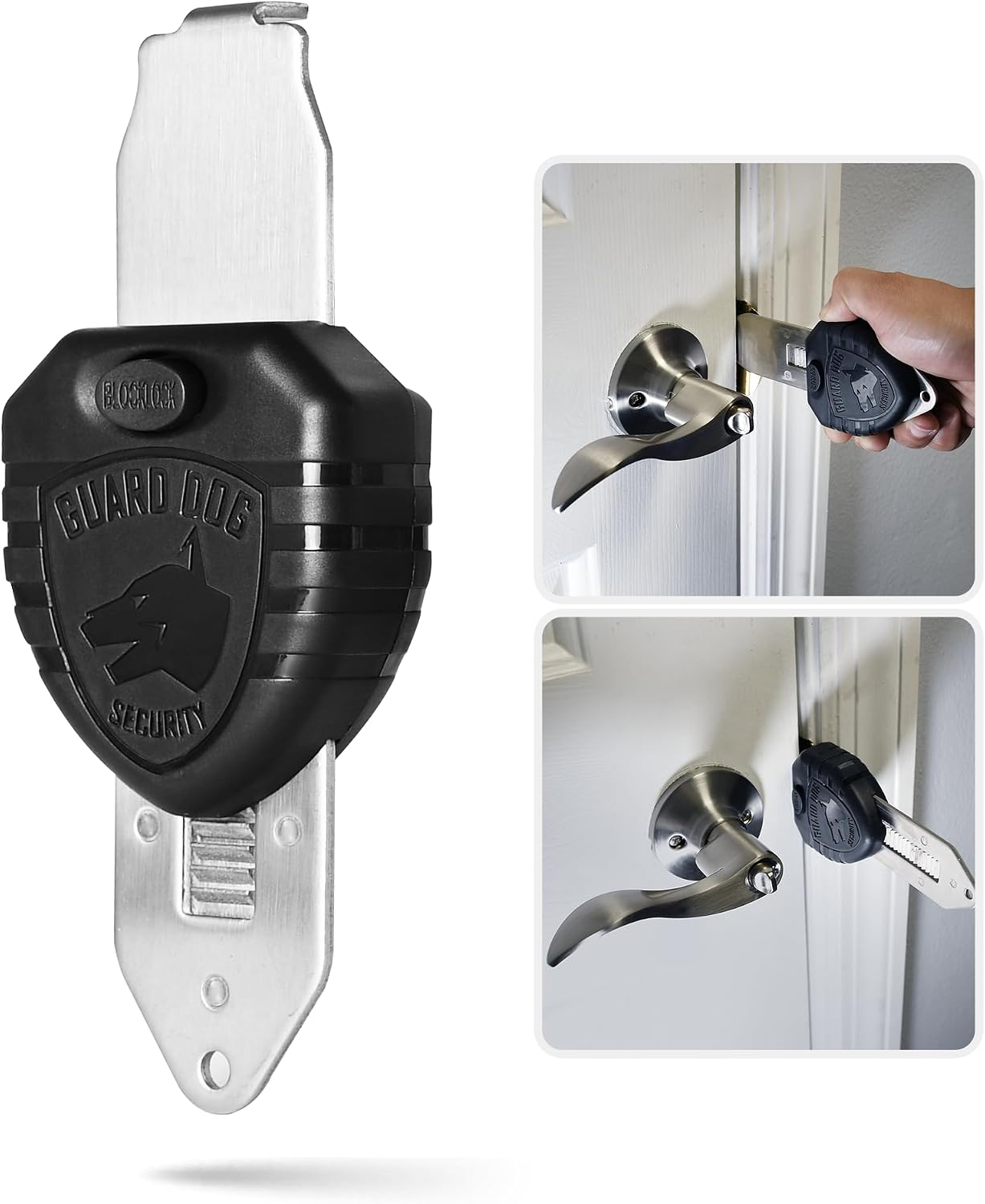
Key specs: Stainless steel claw device with an electroplated, polished surface; tool-free insert-and-close installation that works in the dark; marketed for travelers, renters and shared housing
The Blocklock is the same idea executed cleanly: stainless steel, electroplated and polished so the edges do not catch skin or door paint, tool-free insert-and-close installation that the maker specifically says works in the dark and in emergencies. There is no meaningful functional difference between this and the AceMining, and the honest reason it is here is choice – if the top pick is out of stock or the finish suits your door better, nothing is lost. It carries a smaller review base than the first two, which on a product this mechanical matters less than it would on electronics, but is worth knowing.
✅ Pros
- Polished edges reduce injury and door marking
- Works in the dark, no tools needed
- Stainless steel construction
- Nothing to charge or maintain
❌ Cons
- Smaller review base than the AceMining or Addalock
- Silent, no alarm
- Inward-swinging doors only
- No certification behind the durability claims
What These Devices Realistically Stop
Set expectations honestly, because the category is sold with imagery that overstates it. A portable door lock defeats the most common real threats to someone in a hotel or rental: a master key or keycard used without your consent, a door left unlatched, a wrong-room entry at 1am, and an opportunist trying the handle. It gives you an audible, physical warning that someone is at the door rather than already inside.
What it is not is a substitute for a certified lock. BHMA runs a certification program specifically for residential hardware, rating locks and deadbolts on security, durability and finish, and notes that products without the Secure Home label are not assured to have been tested and certified by a third-party lab. No portable travel device on this page carries anything comparable. Against a determined, forceful attack on the door itself, the frame gives before the claw does.
For context on how often that scenario arises at all: the Bureau of Justice Statistics recorded household burglary rates falling 56% between 1994 and 2011, from 63.4 to 27.6 victimizations per 1,000 households. That is residential rather than hotel data and it is now over a decade old, so treat it as background rather than a current figure – but the direction is worth knowing before you buy security hardware out of fear. If you are thinking about your own home rather than a hotel, our comparison of door security bars and our guide to door and window sensors are the more useful reads.
Using One Without Locking Yourself Into a Problem
Fit it once in daylight before you need it. These are simple, but figuring out the mechanism for the first time while half asleep in an unfamiliar room is not the moment. One practice run is enough.
Remove it whenever you leave the room, not just at checkout. A device left on a door you are not behind is doing nothing except waiting to be forgotten – and with the plate trapped in the frame, housekeeping may not be able to tell you left it.
Know your exit before you fit it. The USFA’s escape-plan guidance is to know your route and keep doors and windows unblocked. In a hotel, that means noticing which direction the nearest stairwell is when you walk to your room – which takes about four seconds and is the single most useful safety habit on this page.
Do not use one on a door someone else may need to open. A room with a child or an elderly relative sleeping alone behind a blocked door is the scenario where this device causes harm rather than preventing it.
If you are reaching for one of these because you rent and cannot drill into the door, that is a different problem with better answers. Our guide to renter-friendly security that does not cost your deposit covers no-drill options that stay put rather than needing to be fitted and removed every night.
Final Recommendation
Buy the AceMining Portable Door Lock. For a device whose entire job is to be a correctly-shaped piece of steel in the right place, the largest review base in the category is a genuinely useful signal that it fits the doors travelers actually meet. It has no battery, nothing to charge, and nothing that can be flat when you arrive at midnight. Pack it, practice with it once, and remove it every time you leave the room.
Choose the Securityman with the 130 dB alarm instead if your real worry is sleeping through an attempt rather than the door being opened – solo travelers and anyone in unfamiliar short-term rentals get more from being woken than from a silent block, and the three sensitivity levels make it usable in a busy corridor. Take the Addalock if you would rather have the original design and are willing to check the engraving and pouch to be sure you got a real one, and the Guard Dog Blocklock when the top pick is unavailable.
What would change this recommendation completely: if your door swings outward, none of these work at all and you need a wedge-style door alarm instead. And if you are securing your own home rather than a hotel room, do not buy any of them – fit a real deadbolt, which is certified, permanent and cannot be forgotten on the door. Our keypad door lock guide covers where to start.
SafeBode does not yet run an in-house product testing program. This guide is built from manufacturer specifications, official support documentation, current retail listings and verified buyer feedback rather than hands-on testing, and we say so plainly rather than implying testing we have not done.
Frequently Asked Questions
Will a portable door lock work on any hotel door?
No. It needs an inward-swinging hinged door with an accessible strike slot in the frame. Outward-swinging doors, sliding doors and frames with recessed or magnetic strikes all rule it out. Check the door when you first walk in rather than at bedtime.
Can hotel staff still get in if I use one?
No, and that is the point. A master key retracts the latch, and the claw is occupying the space the latch needs to move into. It also means staff cannot enter in an emergency, which is the reason to remove it whenever you leave the room.
Is a portable door lock as strong as a deadbolt?
Not close. A deadbolt is certified residential hardware tested for security, durability and finish. None of these devices carry that kind of third-party certification, and against sustained force the door frame fails before the device does.
Does using one break hotel rules or damage the door?
It does not attach to anything, so there is nothing to damage beyond possible scuffing from bare metal on paint – the picks with a plastic cover or polished finish reduce that. Policies vary by property, and staff being unable to enter is the practical objection.
Are the ones with alarms worth the extra hassle?
If your concern is being asleep when someone tries the door, yes – a silent block works perfectly and tells you nothing. If you would rather not manage a charge cycle and risk false triggers in a noisy corridor, the plain metal versions do the blocking equally well.
Can I use one on my bedroom door at home?
Yes, and it is a common use for shared houses and dorms. Do not use one on a door behind which a child or someone who may need help is sleeping alone, because nobody outside can open it.
What is the difference between these and a door security bar?
A bar braces the door against the floor and resists force along the door’s length; a portable lock blocks the latch and resists a key or handle. Bars are better against a kick-in, portable locks are better against someone with legitimate access. They solve different problems.
How do I avoid buying a counterfeit?
It is a real issue in this category – the Addalock listing specifically warns about it and identifies genuine units by an engraved logo and a branded pouch. Since the whole function depends on the metal resisting force, a soft copy is a safety issue rather than a cosmetic one.
Sources
Show sources (4)


