eufy vs Ring 2026: Own Your Footage, or Own the Ecosystem
Affiliate Disclosure: This article contains affiliate links. If you buy through these links, we may earn a commission at no extra cost to you. Our editorial opinions are our own and are not influenced by affiliate relationships. Read our full disclosure policy →
Contents
Quick Answer
These two brands are not competing on picture quality — they are competing on where your footage lives and who else can reach it. eufy builds around local storage: the SoloCam E42 records to a microSD card of up to 128GB with no monthly fee, or to a HomeBase. Ring builds around its app and its plans, with an accessory ecosystem nothing else in this price bracket matches. Choose eufy if the recurring bill and the question of who can see your recordings are what bother you. Choose Ring if you want the widest range of devices that all work together, and you accept a subscription and a cloud provider as part of the deal — a provider whose past practices the FTC set out in detail in 2023.
The Real Split Is Storage, Not Cameras
Put a eufy camera and a Ring camera on the same wall and most people would not reliably tell you which produced which clip. Both brands make competent outdoor cameras with spotlights, sirens, two-way talk and app control. Comparing them on that basis produces a coin toss.
The decision that actually matters is architectural. eufy’s default is that footage stays in your house: the SoloCam E42 records locally to a card or to a HomeBase with no monthly fee attached. Ring’s default is that footage goes to Ring, and the useful history lives behind a plan. Neither is wrong, and both have real costs. But it is the difference that persists for the whole life of the system, long after the specification sheet has stopped mattering. At the front door the split is the same, and our eufy video doorbell guide explains which of the three local-storage arrangements each model actually uses.
What Each Default Costs You
eufy’s local-first approach
- No recurring fee for recording
- Nobody at a company can review your footage
- Keeps working when the internet is down
- But: a stolen camera can take its own card with it
- And: no off-site copy if the house burns
Ring’s cloud-first approach
- Footage survives the camera being stolen or destroyed
- Accessible from anywhere without any local hardware
- Sharing clips is straightforward
- But: recording history is tied to an ongoing plan
- And: your footage sits on a provider’s infrastructure
Two Different Answers to the Battery Problem
Both brands sell battery cameras and both have had to solve the recharging problem. Their answers are genuinely different and worth understanding, because the one that suits you depends on how much sun your walls get.
eufy leans on solar. The SoloCam E42’s SolarPlus 2.0 charging is rated on two hours of direct sunlight a day for continuous operation — which is a requirement stated as a benefit, and worth measuring honestly against a north-facing wall under a tree. Ring leans on swappable batteries: the Quick Release Battery Pack slides out with a press of a tab so a charged spare goes in immediately, and Ring states a battery can take up to 10 hours to fully charge from a USB or USB-C cable. Ring also sells solar as an option, but the swap-a-spare model is the one that defines the experience.
The Two Approaches, in Numbers
2 hrs/day
direct sun the eufy solar rating assumes
Up to 10 hrs
to fully charge a Ring battery from a cable
128GB
local card ceiling on the eufy camera
1 minute
to swap a charged Ring battery pack
Manufacturer figures from each brand’s own product and support pages.
Read that as a lifestyle question rather than a technical one. If your camera position gets real sun, eufy’s approach means you may genuinely never touch it. If it does not, Ring’s spare-battery rotation is the more reliable arrangement — our guide to swapping and charging Ring batteries covers how that works in practice.
The Privacy Question, With the Record Attached
This section exists because the comparison is incomplete without it, not to score points. In May 2023 the FTC announced a proposed order against Ring. Its complaint described a failure to restrict employee and contractor access to customer videos, and a failure to implement standard protections against credential stuffing and brute force attacks until 2019 — despite attacks in 2017 and 2018 — with roughly 55,000 US customers’ accounts reached as a result.
Two things follow, and both matter. First, Ring today is a company operating under an order that requires a privacy and security program including multifactor authentication for customer and employee accounts, and it supports two-step verification by text, authenticator app, WhatsApp or push approval. Second, none of that changes the structural point: choosing a cloud-first brand means accepting a provider’s practices as part of your own security. A local-storage system removes that question rather than managing it. Our piece on what the FTC case actually found goes through the detail, and our storage decision guide covers the trade in full.
eufy SoloCam E42 — the eufy argument
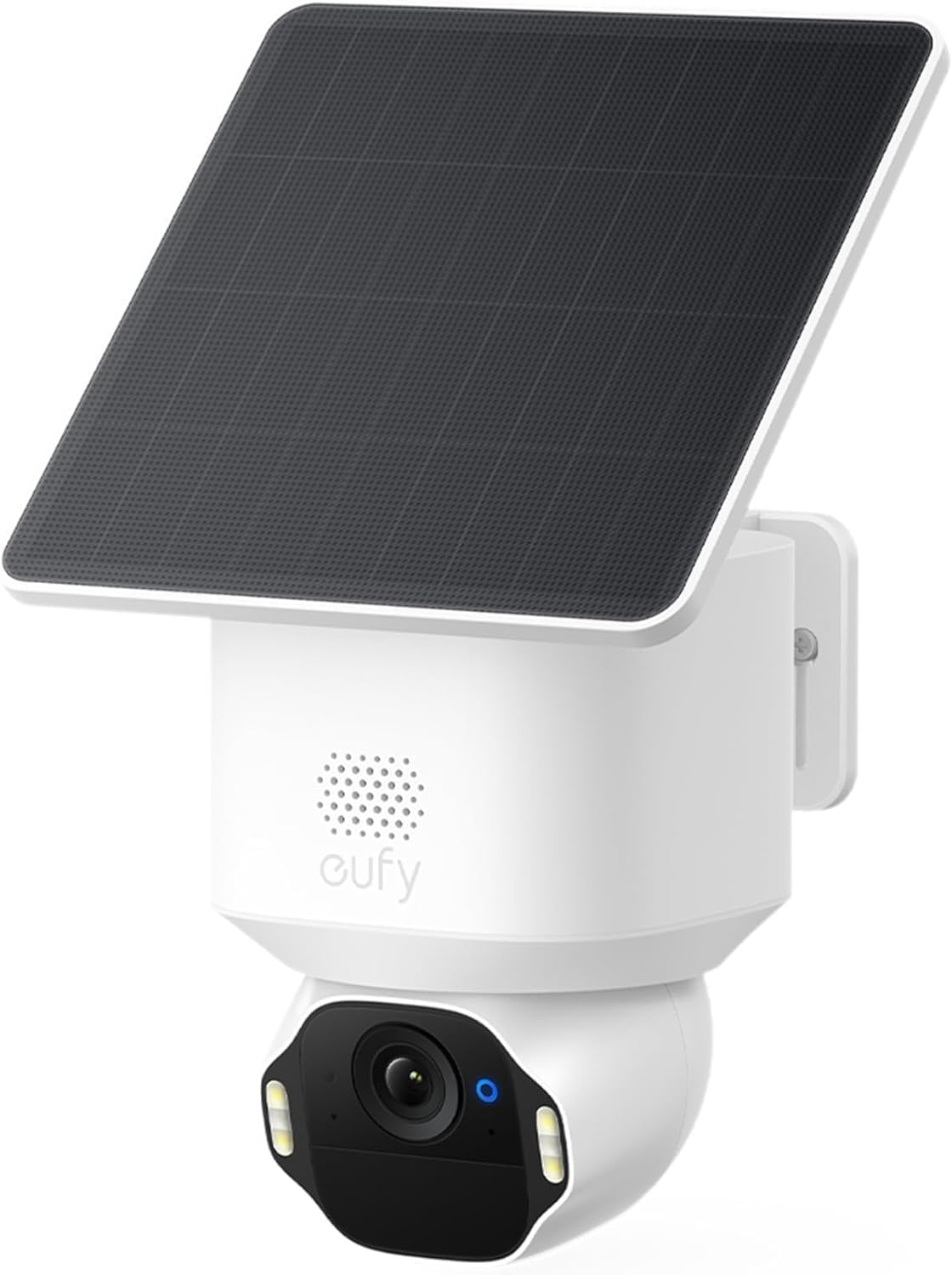
Key specs: 4K solar pan and tilt camera with AI tracking and 360-degree coverage; SolarPlus 2.0 charging rated on two hours of direct sun a day; up to 128GB of microSD storage with no monthly fee, or recording to a HomeBase
This camera is the eufy pitch in one device. It is 4K with AI tracking across a full circle of coverage, it charges from the sun on eufy’s stated two hours of direct sunlight a day, and it records to a microSD card of up to 128GB with no monthly fee — or to a HomeBase if you own one. There is a spotlight with a red and blue strobe for deterrence. What you are buying is the absence of an ongoing relationship: no plan, no cloud dependency, no third party with access. The trade is real and worth stating — if somebody takes the camera off the wall, the card goes with it, and 128GB is a modest ceiling if you ever want a long history.
✅ Pros
- Local recording with no monthly fee
- 4K with AI tracking and 360-degree coverage
- Solar charging rated on two hours of sun a day
- Spotlight with red and blue strobe
- Works with a HomeBase if you already own one
❌ Cons
- Card ceiling of 128GB is modest
- A stolen camera takes its card with it
- Solar rating assumes a position that genuinely gets sun
Ring Spotlight Cam Plus — the Ring argument
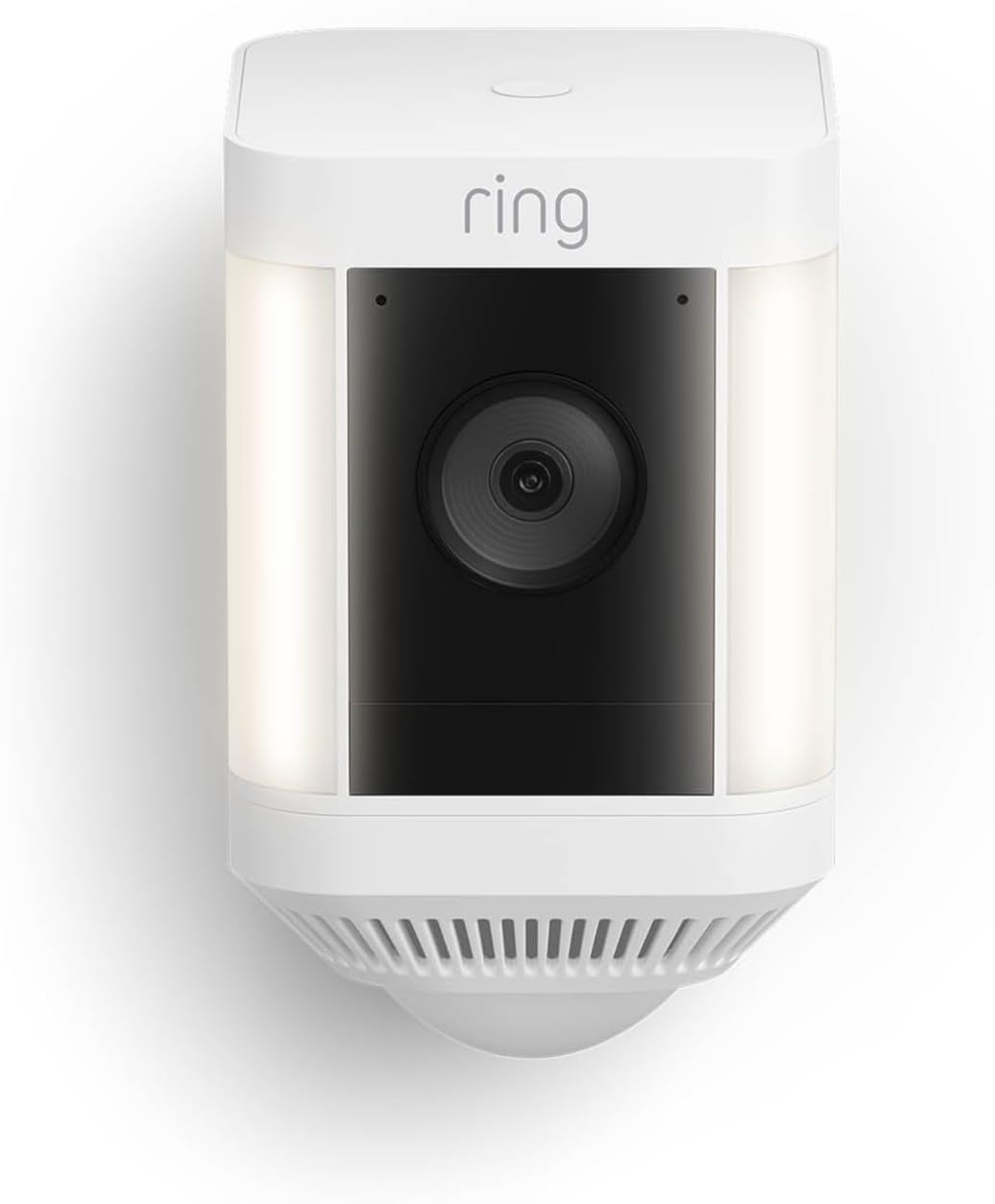
Key specs: Outdoor camera with two LED spotlights and a built-in siren, live view and two-way talk; sold in battery, solar and plug-in power options; uses Ring’s Quick Release Battery Pack and the wider Ring app ecosystem
The Spotlight Cam Plus is Ring’s mainstream outdoor camera and it shows what the ecosystem buys you. Two LED spotlights and a built-in siren handle deterrence, live view and two-way talk handle interaction, and the same camera is sold in battery, solar and plug-in versions so the power decision is not locked to the model. It uses the Quick Release Battery Pack, so a charged spare swaps in immediately rather than leaving the wall empty for hours. What it does not do is give you a useful recording history without a plan, and that is the recurring cost eufy exists to avoid.
✅ Pros
- Two LED spotlights and a built-in siren
- Live view and two-way talk
- Battery, solar and plug-in versions of the same camera
- Quick Release Battery Pack for one-minute swaps
- The widest accessory and integration ecosystem in the category
❌ Cons
- Recorded history depends on a subscription
- Footage sits on the provider’s infrastructure
- Charging from a cable takes up to 10 hours without a spare
eufy and Ring Side by Side
| eufy | Ring |
|---|
| Default storage | Local — microSD or HomeBase, no fee | Cloud, tied to a plan |
| Recurring cost | None required for recording | Expected for useful history |
| Battery strategy | Solar, rated on two hours of sun a day | Swappable Quick Release packs, up to 10 hours to charge |
| Works with no internet | Yes, recording continues locally | Local recording is limited |
| Ecosystem breadth | Cameras, doorbells, locks | The widest range of compatible devices |
| Account security | Standard app account | Two-step verification by text, app, WhatsApp or push approval |
Where Ring Is Genuinely Ahead
It would be easy to write this comparison as a one-sided argument for local storage, and it would be wrong. Ring’s advantage is breadth, and breadth compounds: doorbells, cameras, alarm sensors, chimes, lighting and third-party integrations that all appear in one app with one set of modes. If you want a system where arming the alarm also changes what the cameras do, that coherence is worth real money and eufy does not match it.
The second advantage is the accessory economy. Batteries, mounts, solar panels, chimes and replacement parts are all easy to find, which matters more over five years than any specification on the box. If you already own Ring hardware, adding another Ring camera is almost always the right answer — our Ring lineup guide covers which model fits which position, and the Ring Protect breakdown sets out exactly what the plan adds. On the eufy side, the eufy camera guide and eufy smart lock guide cover that range.
Final Recommendation
Buy into eufy if you are starting fresh and the recurring bill is what puts you off connected cameras. Local recording with no monthly fee is the whole proposition, it is stated plainly on the product itself, and over five years it is the difference between owning a camera and renting a service. The SoloCam E42 is the natural first camera, provided the wall you have in mind genuinely gets a couple of hours of direct sun.
Buy into Ring if you already own Ring hardware, or if you want one app covering cameras, a doorbell, sensors and lighting with modes that tie them together. Go in accepting two things: the useful recording history is a subscription, and your footage lives on a provider’s infrastructure — so turn on two-step verification on day one, which Ring supports by text, authenticator app, WhatsApp or push approval. What would change the recommendation entirely is a camera position with no sun and no easy access for battery swaps: in that case neither brand’s battery strategy works well and a wired camera is the honest answer.
SafeBode does not yet run an in-house product testing program. This guide is built from manufacturer specifications, official support documentation, current retail listings and verified buyer feedback rather than hands-on testing, and we say so plainly rather than implying testing we have not done.
Frequently Asked Questions
Is eufy or Ring better?
They optimize for different things. eufy is built around local storage with no monthly fee, and Ring around a broad ecosystem with cloud recording behind a plan. The right answer depends on whether you mind the recurring cost more than you value the breadth.
Does eufy really have no subscription?
For recording, yes on the models built around local storage. The SoloCam E42 records to a microSD card of up to 128GB or to a HomeBase without a monthly fee. Optional cloud plans exist but the camera does its job without one.
Do I need a Ring Protect plan?
Not to view a live feed, but a useful recorded history depends on one. That is the practical difference between the two brands, and it is worth pricing across the number of cameras you expect to own rather than just one.
Which is better for a spot with no power?
eufy if the position gets real sunlight, because its solar charging is rated on about two hours of direct sun a day. Ring if it does not, because swapping a charged Quick Release battery takes a minute rather than the up-to-ten-hours a cable charge needs.
Is Ring safe to use after the FTC case?
Ring now operates under an order requiring a privacy and security program including multifactor authentication, and supports two-step verification through several methods. The structural point remains that cloud storage means trusting a provider, which local storage avoids entirely.
Can I mix eufy and Ring cameras?
You can own both, but they live in separate apps with separate settings and notifications. For two or three cameras that is a mild annoyance; across a whole house it is the main practical reason to commit to one.
Which brand is better if the internet goes down?
eufy, because local recording continues on the camera or the HomeBase regardless of the connection. A cloud-first setup loses both the alert and the footage for the duration of the outage.
What happens to my footage if a camera is stolen?
On a card-only eufy camera, it goes with the camera, which is the main argument for pairing it with a HomeBase. On Ring with a plan, the footage is already off-site and unaffected, which is the clearest benefit the cloud model provides.
Sources
Show sources (5)


